1942: Ewald Schlitt, performative cruelty

From Hitler’s Prisons: Legal Terror in Nazi Germany:

Despite the unprecedented legal terror [inside Germany], he [Hitler] continued to attack the legal apparatus as slow and formalistic, comparing it unfavourably with the unrestrained actions of the police. … In the autumn of 1941, he complained repeatedly in his private circle that the German judges passed too lenient sentences … In May 1941, he complained to Goebbels that inmates could emerge from prison ‘fresh and unused’, ready to act once more against the state — a statement which showed Hitler’s disregard for the brutal realities inside penal institutions. He had made a similar point a few months earlier to Himmler, telling him that criminals knew that inside penitentiaries ‘everything is nice, hygienic, nobody will do one any harm, the Minister of Justice vouches for that’.

Hitler’s simmering hostility towards the legal system blew up in spectacular fashion in the spring of 1941. The spark was yet another supposedly lenient court sentence. On 14 March 1942, the district court in Oldenburg found the engineer Ewald Schlitt guilty of having abused his wife so badly that she eventually died. However, the judges decided that Schlitt had not acted in cold blood but was liable to sudden violent fits of temper. Rather than condemning him to death as a ‘violent criminal’, the court sentenced Schlitt to five years in a penitentiary. When Hitler heard about this case, he exploded with rage. Ignorant of the details, he demanded that Schlitt be executed and took the court’s sentence as confirmation of the impotence of the judiciary. If there were any more such sentences, Hitler fumed in his private circle on Sunday 22 March 1942, he would ‘send the Justice Ministry to hell through a Reichstag law’. Hitler made no secret of his fury. On the very same day, he berated the acting Minister of Justice Schlegelberger on the telephone. Highly agitated, Hitler exclaimed that he could not understand why criminals were treated so leniently at a time when the ‘best’ German soldiers were dying at the front. Hitler threatened Schlegelberger with very serious consequences should the legal system fail to change.

The Reich Ministry of Justice immediately engaged in damage limitation, following Hitler’s outburst. Two days after his phone call, Schlegelberger wrote to Hitler to reassure him about the ruthlessness of the legal system: ‘My Fuhrer, I share your desire for the harshest punishment of criminal elements with the greatest conviction.’ To prove his point, Schlegelberger informed Hitler that the Schlitt case would be taken up by the Reich Court. The court duly delivered the desired result. On 31 March 1942, it quashed the original sentence against Schlitt and instead sentenced him to death, a decision which was immediately relayed to Hitler. Ewald Schlitt was guillotined two days later. Schlegelberger did not let the case rest here. He was concerned enough to inform the general state prosecutors, in a meeting on the day of Schlitt’s retrial, about Hitler’s threats. …

In previous protests by Hitler against court sentence he considered too ‘mild’, the file had been closed after the execution of the offender. But not this time. One of the reasons why Hitler did not let matters rest was his growing concern about the home front. In March 1942, the Nazi leadership knew that rations would have to be cut and evidently feared a backlash among the population … The Nazi leaders were convinced that the legal system would be unable to deal with any unrest. Thus, after Hitler had discussed the forthcoming cuts in rations with Goebbels on 19 March 1942, the two men went on to complain about the failures of the judiciary and to talk about the need for tougher measures on the home front. It was at this point that Hitler floated the idea of convening the Reichstag to give himself special powers against ‘evil-doers’, an idea he returned to after the Schlitt case. The cut in rations, the most serious during the entire war, was finally introduced on 6 April 1942, and caused great disquiet. Hitler’s apparent concern about this was betrayed in an extraordinary outburst at dinner on the very next day. Inevitably, his thoughts circled around the 1918 revolution and, with unprecedented ferocity, he vented his homicidal determination to prevent another ‘stab in the back’:

If a mutiny broke out somewhere in the Reich today, then he would answer it with immediate measures. To start with, he would:

a) have all leading men of an oppositional tendency … arrested at home and executed, on the day of the first report;

b) he would have all inmates in concentration camps shot dead within three days;

c) he would also have all criminal elements rounded up for execution within three days on the basis of the available lists, irrespective of whether they were in prison or at liberty at the time.

The shooting of this scum, which comprised a few hundred thousand people, would make other measures appear unnecessary, as the mutiny would break down by itself due to a lack of mutinous elements and fellow-travellers.

Only two weeks later, Hitler rang Goebbels and instructed him to take the very unusual step of summoning the Reichstag.

I also expect that the German jurisprudence understands that the nation is not there for them but they for the nation. That not the entire world is allowed to perish, in which also Germany is included, so that there is a formal right, but that Germany has to live, notwithstanding the formal interpretation of justice.

I have no understanding for it, just to mention an example, that for instance a criminal who married in 1937 and then mistreated his wife that she became mentally deranged and who then died of the results of his last mistreatment, is sentenced to 5 years of hard labor in a moment when 10,000 brave German men have to die in order to save the homeland from Bolshevism, that means to protect their wives and children.

I will take a hand in these cases from now on and direct the order to the judges that they recognize that as right what I order.

What German soldiers, German workers, peasants, our women in city and country and millions of our middle-class etc. do and sacrifice all only with the one thought of victory in their minds, then one can ask a congenial attitude for them who have been called by the people themselves to take care of their interests.

At present there are no self-styled saints with well-earned rights, but we all are only obedient servants in the interests of our people.

-From Hitler’s April 26, 1942 address to the Reichstag

On 26 April 1942, the Reichstag deputies assembled in Berlin, curious as to the purpose of the meeting. … The legal system, Hitler warned [in his address], must have only one thought: German victory. It was high time, he continued, that the legal system realised that it did not exist for its own sake, but for the nation. As an illustration of the inane approach of the judiciary, Hitler pointed to the Schlitt case. … The deputies cheered loudly, broke into chants of ‘Heil’ and then passed a resolution that explicitly exempted Hitler from ‘existing statutes of law’, giving him the right to remove from office and punish anyone ‘failing their duties’. Hitler was officially above the law.

Hitler’s attack in the Reichstag on 26 April 1942 received a mixed reception from the German public. Many Germans, it seems, supported Hitler’s views. But conservatives and members of the bourgeoisie started to voice some concerns about the threat to the rule of law. The German legal officials themselves were stunned … One senior judge exclaimed in private: ‘Out of shame, each judge has to hide his face from the public’. The officials feared that the attack would destroy public confidence int he independence of the judiciary and provide further incentives for the police to interfere in the legal process. To discuss measures which would increase Hitler’s confidence in the judiciary, the Reich Ministry of Justice held two meetings with senior regional officials in early May 1942 in Berlin. The meeting on 6 May was chaired by State Secretary Freisler. Hitler’s speech, he acknowledged, had hit the legal system like a ‘thunderstorm’. Freisler reminded the officials of the lessons which needed to be drawn: the legal officials had to become harder, focusing even more on retribution …

Hitler continued to complain in private about the weakness of the legal system. On 22 July, for example, he once more ranted at length about the judiciary, concluding that nobody resembled the jurist more closely than the criminal.

The Nazi leaders made sure that legal officials knew that Hitler was still unhappy. On the same day as Hitler’s latest private outburst, on 22 July 1942, Goebbels made an explicit speech to the officials at the People’s Courtk outlining the Nazi leaders’ criticism of the judiciary. Goebbels’s comments had special significance because, as he informed his listeners, Hitler had personally approved them. Goebbels began by complaining that many judges still had the wrong attitude, derived in large measure from their legalistic training. After referring in detail to several ‘unbearable’ sentences, Goebbels made crystal clear what was required from the judiciary. During the war, it was not important whether a judgment was fair or unfair; rather, it had to protect the state by eradicating the ‘inner enemies’: ‘The starting point is not the law, but the decision [that] this man has to disappear’.

On this day..

2007: Six Bangladesh bombers

Bangladesh on this date in 2007 hanged six Islamic militants* for a terrorist bombing wave two years prior.

Several were agents of the terrorist organization Jamaat-ul-Mujahideen Bangladesh, notable for a headline-grabbing coordinated bombing on August 17, 2005 that saw hundreds of explosions throughout Bangladesh. That organization’s chief Shaykh Abdur Rahman was among those executed on March 30, 2007, as was “Bangla Bhai” (Siddique ul-Islam), the leader of the Al Qaeda-aligned Jagrata Muslim Janata Bangladesh (JMJB).

* Four different prisons were used for the executions.

On this day..

1623: Reinier van Oldenbarnevelt, family tradition

Reinier van Oldenbarnevelt was a chip off the old headsman’s block on this date in 1623, beheaded in The Hague for plotting to avenge the beheading of his father.

The old man, Johan van Oldenbarnevelt by name, had lost a power struggle to Maurice of Orange and gone to the scaffold in 1619.

Full of murderous filial piety, our man Reinier (English Wikipedia entry | Dutch) conspired with his brother Willem and others of their faction to return the favor on Maurice by having a gang of toughs ambush him in early February.

Word leaked early; the plot fizzled and Reinier was captured to face the vengeance Maurice had once once designed for his father. (Willem escaped to Belgium, but two of their accomplices were dismembered with Reinier.)


Dutch illustrator Claes Janszoon Visscher depicted the son’s execution, as he had once depicted the father’s. For an analysis of the scene, see John Decker’s Death, Torture and the Broken Body in European Art, 1300-1650.

On this day..

1907: Joseph Jones, no workhouse

Another great hang-day post today from the Facebook page of our friends at Capital Punishment UK, in which we discover one Joseph Jones, teetering on the edge of destitution,

hanged at Stafford on the morning of Tuesday the 26th of March 1907. Henry Pierrepoint and William Willis carried out the execution. Jones is reported to have told Pierrepoint “This is a damned sight better than the workhouse.”

On this day..

1752: James Lowry, despotical nautical

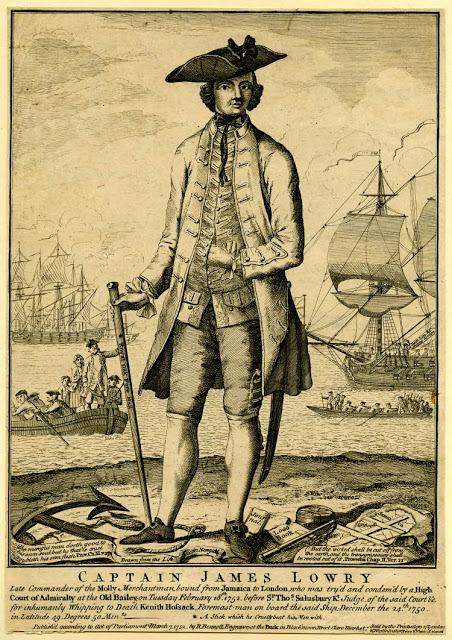
On this date in 1752 the tyrannous Scottish sea captain James Lowrey or Lowry was hanged at London’s execution dock for beating a crew member to death.

Lowr(e)y came to public notice in 1751 after the return to English shores of his merchantman, the Molly, from a run to Jamaica: ten of his ex-crew subscribed a public advertisement accusing him of murdering their mate on board, to which Lowry replied with advertisements accusing those accusers of mutiny.

Right away the British public knew it had a page-turner on its hands.

The captain had become unreasonably enraged with Kennith Hossack for lagging in his duties as he recovered from an illness, and upon a purported accusation of theft he had the mariner tied up and personally battered him about the head using a doubled-over rope as his cudgel, on Christmas Eve no less. Hossack at last dropped dead, at which point the heartless captain slapped his man and denounced him for “shamming Abraham” (i.e., feigning injury to skip work). Lowry evidently really had it in for Hossack, for the first mate explained that “I don’t know that he ever came upon deck twice in a week without beating him: my heart has bled for him many and many a time.” In the mate’s opinion, these beatings were always for no adequate reason.*

That’s a remark from the Admiralty Trial of Captain Lowry, where his former seamen developed the picture of an intolerably Queeg-like commander liable to take bitter umbrage if his men managed an illicit extra ration of sugar or rum, a guy who carried around a beating-cane with its own name (“the Royal Oak Foremast”) just in case he felt like doling out a disciplinary bludgeon. Three days after Hossack’s death, he came to blows with the second mate; two days after that, a fed-up crew “took the command from him” and ran the ship themselves, although they did not forcibly confine him.

Once the ship put in at Lisbon for repairs on the return journey, Lowry lodged a piracy complaint against his crew, but despite the incredibly serious charges and countercharges, everybody sailed on together for home thereafter, each party perhaps silently calculating the odds that the other would dare to press the case further as against getting on about their lives. Lowry does not appear to have made himself scarce until his former comrades went public with their claims, although once they did so he incriminatingly avoided the thief-takers and the small private reward set upon his capture for a few weeks.

On March 25, 1752, the brute was carried from Newgate Prison to the Execution Dock on the Thames, in a cart surmounted by a silver oar emblematic of the Admiralty. There he was hanged, and his body afterwards put in irons and displayed in infamy down the river at Blackwall.


Lowry pictured as part of a “Scotch Triumvirate” of Caledonian evildoers, along with the Scottish officer William Cranstoun, blamed for seducing Mary Blandy to the gallows, and the more mysterious “Major James MacDonald” whose papers suggest involvement in the South Sea Bubble 32 years prior (?). I’m in good company with my confusion on this MacDonald fellow, as the British Museum can’t identify him either. Check out britishtars.com for a fascinating exposition on the iconographic detail of the Lowry images in this post; we have also featured in this narrative several additional links to that same site’s various posts about the events on the Molly.

We have revisited a few times in these pages the intense commercial bustle among publishers of crime ephemera — in England as well as Ireland. Naturally this headline-grabbing execution excited plenty of competitive hawking.

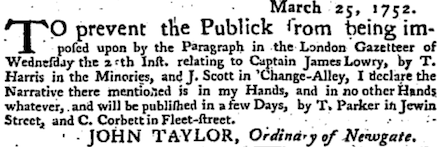
Two examples appear below; the first of them is by a pair of publishers named Harris and Scott; the second, by Parker and Corbett, who at this time had the deal to publish the Ordinary of Newgate’s accounts. Harris and Scott were first to the market here, in an environment where rapidity counted for a lot; the Ordinary wanted to be sure the public knew that his “official” (according to him) version would be soon forthcoming, so he burdened the pages of London newspapers and even his own Ordinary’s Account of ‘regular’ Tyburn criminals with adverts to that effect.


This image from the London General Advertiser of March 26, 1752, one of several papers to carry the notice. For more on the relationship between publishers and crime in this era, see Print Culture, Crime and Justice in 18th-Century London by Richard Ward

Read on below to enjoy both.

* In fact, one nugget from this case is that an adequate reason for corporal punishment at sea might sit at a much higher threshold than we commonly assume today. Although the Royal Navy was (in)famous for the discipline of the lash, multiple experienced sailors testified at this trial that they never knew floggings or beatings to occur on merchant vessels.

On this day..

1819: John Van Alstine

John Van Alstine was (incompetently) hanged two hundred years ago today for murdering Schoharie County, N.Y., deputy sheriff William Huddleston — whom he bludgeoned to death in a rage when Huddleston turned up to execute a civil judgment forcing the sale of Van Alstine’s property to service a debt. The man acknowledged having a ferocious temper.

“It is not a year since I stated in Judge Beekman’s presence, (and, I stated it as the firm conviction of my mind), that there were two things I should never come to — the state’s prison and the gallows,” the confessed murderer mused in his public reflections, below. “How often have these words occurred to me since the regretted 9th, and taught me the vanity of human boasting, and the weakness of human resolution, when opposed to long indulged passions.”


This document has also been transcribed here.

On this day..

1696: Charnock, King, and Keyes, frustrated of regicide

On this date in 1696, a trio of Jacobite conspirators were hanged for their failed assassination plot against King William.

An exiled loyalist to the deposed King James II, the onetime Oxford don Robert Charnock conceived what the propagandists would call “the late Hellish and Barbarous Plott” along with fellow Stuart loyalist George Barclay. Their mission in murdering William III was to catalyze a general Jacobite rising that would reverse the Glorious Revolution and restore James to the throne: it was a recurring campaign against the Dutch usurper throughout the 1690s.

Ambush was the gambit proposed by the worthies in this case, for William.

was in the habit of going every Saturday from Kensington to hunt in Richmond Park. There was then no bridge over the Thames between London and Kingston. The King therefore went, in a coach escorted by some of his body guards, through Turnham Green to the river. There he took boat, crossed the water, and found another coach and another set of guards ready to receive him on the Surrey side. The first coach and the first set of guards awaited his return on the northern bank. The conspirators ascertained with great precision the whole order of these journeys, and carefully examined the ground on both sides of the Thames. They thought that they should attack the King with more advantage on the Middlesex than on the Surrey bank, and when he was returning than when he was going … The place was to be a narrow and winding lane leading from the landing place on the north of the river to Turnham Green … a quagmire, through which the royal coach was with difficulty tugged at a foot’s pace. The time was to be the afternoon of Saturday the fifteenth of February. (Macaulay)

Some 40 assassins had been marshaled for the purpose of surprising the royal party on that occasion but as they nursed their cups in the vicinity’s public houses they received the disquieting intelligence that the king had skipped the hunt that day.

Although the inclement weather was the reason given out, the truth of the matter was that they were betrayed. In a week’s time, most of the conspirators would be in custody* and the country on a virtual war footing against prospective invasion by France. On March 11, the first three prospective assassins stood at the bar: Charnock, Edward King, and Thomas Keyes. They were plainly guilty and condemned accordingly.

King died firmly; Keyes, in “an agony of terror … [that] moved the pity of some of the spectators”; and Charnock, being repelled in his bid to turn songbird in exchange for his life, went out with a missive bitterly defending his project, for “if an army of twenty thousand men had suddenly landed in England and surprised the usurper, this would have been called legitimate war. Did the difference between war and assassination depend merely on the number of persons engaged?” (both quotes from Macaulay) Several additional conspirators would follow them to the scaffold in the weeks to come.


“The Triumphs of Providence over Hell, France & Rome”: Broadside celebrating and satirizing the deliverance of the realm from the Jacobite plot, via the British Museum.

* George Barclay, however, successfully escaped to the continent.

On this day..

1780: Elizabeth Butchill, Trinity College Cambridge bedding-girl

A Cambridge University servant was hanged on this date in 1780 for infanticide.

Elizabeth Butchill made her way turning down the beds for the boys attending Trinity College, work she had secured via her aunt who held the same position. She somehow got pregnant, an event which does not appear to have inordinately exercised her eventual judges perhaps by virtue of its very obviousness; as Frank McLynn wryly observes, “It does not need the imagination of a novelist to reconstruct the events that led her to the gallows.”

She was surely desperate to avoid social opprobrium and unemployment, so we find from the Newgate Calendar that “she confessed that she was delivered of a female child on Thursday morning [January 6, 1780], about half past six o’clock, by herself; that the child cried some little time after its birth; and that, in about twenty minutes after, she herself threw the said infant down one of the holes of the necessary into the river, and buried the placenta, &c. in the dunghill near the house.”

“Modest, patient, and penitent” during her confinement awaiting the noose, Butchill died

firm, resigned, and exemplary. She joined with the minister in prayer, and sung the lamentation of a sinner with marks of a sincere penitent, declaring she had made her peace with God, and was reconciled to her fate. Desiring her example might be a warning to all thoughtless young women, and calling on Jesus Christ for mercy, she was launched into eternity amidst thousands of commiserating spectators, who, though they abhorred the crime, shed tears of pity for the unhappy criminal.

Whether the nameless infant’s nameless father shared those tears is a matter for the novelist’s imagination.

On this day..

1984: James Hutchins

James W. Hutchins was gassedexecuted by lethal injection in North Carolina on this date in 1984.

Hutchins was “credited” with the largest one-day slaughter of North Carolina law enforcement officers in 1979. An altercation with his teenage daughter* led to a domestic disturbance call, which led eventually to three dead cops all killed in separate shootings.

Hutchins shot Captain Roy Huskey by ambush when he responded alone to the 911 call. Several minutes later, a deputy named Owen Messersmith rolled up to check on the situation since Huskey hadn’t checked in. Messersmith quickly realized the reason, but was shot through the window of his patrol car as he slammed into reverse and “the vehicle drifted backwards across the street and came to rest in a ditch with Messersmith’s body slumped over the steering wheel, causing the horn to blow without stop.” (Wikipedia) The third victim, state highway patrolman Robert L. Peterson, pulled Hutchins over for speeding as the latter fled in his car.

Only by this point did the garbled and chaotic communications flying through dispatch radios that day finally coalesce sufficiently to give cops on the scene a full picture of what was going on: Peterson, for instance, is thought to have been entirely innocent of the knowledge that a suspect in a double shooting was at large in the area.

At any rate, the ensuing manhunt brought Hutchins into custody and a postscript as a part of political lore: in a sort of Ricky Ray Rector play, Democratic Governor Jim Hunt theatrically staged Hutchins’s execution date and denial of clemency in the run-up to his 1984 Senate campaign. But Rector’s sacrifice at least had the excuse of success: not so Hutchins’s. No matter Hunt’s tough-on-crime credentials, he was still trounced at the polls by goggle-eyed racist Jesse Helms.

There’s an independent film about the events in this notorious murder spree, titled Damon’s Law.

* Hutchins was pissed that she spiked the punch for her high school graduation party with vodka.

On this day..

1889: Samuel Rylands, the first hanged at Shepton Mallet

On this date in 1889, the already-venerable prison at Shepton Mallet — which dates to 1610 and was England’s oldest working jail until its closure in 2013 — began its illustrious era as an execution site.

Samuel Reyland/Ryland/Rylands (press accounts used all three variants) bludgeoned, slashed, and strangled to death 10-year-old Emma Jane Davies in Yeobridge, Somerset, on January 2nd of that same year. Some newsmen eagerly attributed to the Yeobridge Murderer a wish “to emulate the London tragedies,” i.e., the Ripper slayings of late 1888. If Rylands’s confession is to be believed, it might have traced instead to a brain injury.


From the Western Mail, Feb. 26, 1889.

Shepton Mallet would remain a site for civilian executions until 1926; it was also favored as the American military prison during World War II, and 18 U.S. military executions took place there.

On this day..