1883: Milton Yarberry, Marshal of Albuquerque

On this date in 1883,* Albuquerque hanged its Town Marshal.

Milton Yarberry was one of those belt-notching Wild West gunmen badass enough to be worth deputizing for a frontier town with a spiraling crime problem — which Albuquerque was experiencing as the just-completed railroad boomed its population. A number of crimes had been attributed to him in a career that took him from stage-robbing in his native Arkansas, to the Texas Rangers, to a Colorado saloon, to a New Mexico cathouse, a veritable bucket list of spaghetti western tropes packed into 34 roughhewn years with bodies planted at nigh every stop. Yarberry was even reputed to have fought alongside Billy the Kid.

The last of these tropes, of course, was as the bad hombre upon whom the townspeople foist a badge.

It will not surprise that even when minted as a peace officer, Marshal Yarberry continued his manslaying ways. Still, nobody in our present age of impunity could well imagine a lawman standing trial for murder twice in the space of a year.

Yarberry in early 1882 defeated a charge for wasting his lover’s paramour during a row in the street, as witnesses said Harry Brown shot first, just like Greedo.

There was no administrative leave or counseling after that, just straight back on the beat — and barely a month later, the copper gunned down a guy whom he was trying to stop for questioning. It was a confusing encounter in which the Marshal insisted that he fired when the victim, Charles Campbell, wheeled on him with a gun. A single state’s witness was able to establish in the court’s mind that there was no gun in Campbell’s possession.

Our hard-living triggerman would never waver from his self-defense story as his appeals were made;** he had many supporters who believed that he was being railroaded on account of the public relations hit the city was taking for employing a dude who had so liberally populated the Republic’s Boot Hills — and those advocates included the sheriff who recruited Yarberry as a Marshal, Perfecto Armijo, who was also the sheriff detailed to hang Yarberry in the end.

The local Albuquerque podcast City on the Edge has an episode dedicated to Yarberry here.

* In the anarchic game of telephone that was 19th century reporting, some editor somewhere mistakenly understood a story of Yarberry’s condemnation in 1882 as an actual report of his execution; as a result, there were news stories (themselves repeated by multiple papers) announcing Yarberry’s hanging in June 1882. In this business, once one wrong date is out there it’s bound to be echoed into eternity, so it’s still possible to find sources that misdate the execution to June 16, 1882. Past the question of the calendar, the fact that these stories actually expanded with details about the fictitious hanging scene strongly underscores the degree to which the hang-day bulletin had become colorfully but generically abstracted from any save accidental relationship to the actual scene at the gallows.


Cincinnati Daily Gazette, June 17, 1882, vividly peopling an imaginary scene.

** Because New Mexico was still just a territory — it was only admitted to the Union as a state in 1912 — Yarberry’s clemency decision went to the U.S. President, Chester A. Arthur.

On this day..

1940: Peter Barnes and James McCormack, the last IRA men hanged

“The two that swung in Birmingham, with ordered step
From off the gallows floor.”

Brendan Behan

On February 7, 1940 — Ash Wednesday, as it happened to be — Peter Barnes and James McCormack became the last Irish Republican Army men executed by the British

They were condemned by the outraged British after a then-shocking terrorist bombing that has largely vanished from the historical memory, subsumed by the simultaneous outbreak of World War II.

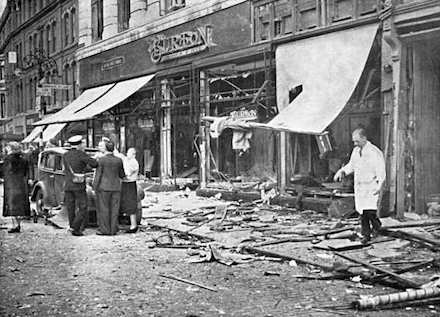
Although it was neither the first nor the last strike in the 1939-1940 campaign of Irish Republican attacks on English soil aimed at forcing London to relinquish control of Northern Ireland, the five-pound bicycle-mounted bomb that ripped apart Broadgate on August 25, 1939, might have been the one that most hardened British hearts against the authors.* Five people were killed in the explosion and some 70 injured; the scene resembled a war zone.**

The resulting investigation — explored in great detail here — never laid hands on the man who actually planted this bomb, eventually revealed to be Joby O’Sullivan.

Many years later and near his death, O’Sullivan claimed that the bomb was supposed to be parked at the Coventry police station; other reports have it destined for an electrical station, and the decision to abandon the ticking bicycle in a crowded street a freelance cock-up by O’Sullivan. Maybe. What is known is that on August 24, London police had busted an IRA plot to place explosives at Westminster Abbey, Scotland Yard, and the Bank of England — all timed to explode at the very same moment as the Coventry package, 2:30 the next afternoon. Had that coordinated fourfold bombing occurred, it would have rated one of the bloodiest and most spectacular terrorist events in history.

But the single blast that did take place was more than enough to bring down the crown’s fury.

Five faced trial for their lives, even though no hand among them had actually set the Coventry bomb. In Ireland and many other places, this latter stipulation made the entire affair an outrageous injustice, especially if one takes as a given that the bomb was not meant to hit civilians. We leave that interesting question of justice to the reader’s consideration, but it must be understood that our hanged men were certainly party to the IRA’s bombing project. The accused, for a trial that December, were:

  • Barnes, an IRA operative in London who had delivered bomb components to Coventry
  • McCormack, part of an IRA cell in Coventry who had rented the house where the bomb was constructed
  • Joseph and Mary Hewitt, and Mary’s mother Brigid O’Hara, Irish immigrants who had taken on McCormack as a lodger

Little evidence could be produced against Hewitt family, who appeared to be quite innocent of their tenant’s intentions. The latter three were cleared of all charges, and then vengefully deported.

McCormack kept stoically silent during the trial, rising only at his sentencing to announce “that the part I took in these explosions since I came to England I have done for a just cause. As a soldier of the Irish Republican Army I am not afraid to die, as I am doing it for a just cause. I say in conclusion, God bless Ireland and God bless the men who have fought and died for her.”

Barnes, whose role on the far end of the supply was even more remote from the final detonation, said as he would maintain to the end, “I am innocent and later I am sure it will all come out that I had neither hand, act or part in it.”

The pair hanged together in Birmingham’s Winson Green Prison. The return of Barnes and McCormack’s remains from that gaol’s unmourned yards to Irish soil soon became a running national demand; the remains were finally repatriated (to great fanfare) in 1969.

Amid the patriotic encomia, civil war veteran Jimmy Steele gave an address on the occasion of the republicans’ reburial critical of the Sinn Fein leadership — an address that is often considered a milepost en route to the imminent (December 1969) splitting-away of the Provisional IRA.

* And in a less justifiable expression, against the Irish generally; Coventry’s Irish immigrant populace faced an immediate racist backlash.

** A chilling preview, for the next year Coventry was devastated by German planes — one of the cities hardest hit by the Reich’s bombing campaign.

On this day..

1967: Sunny Ang, a murderer without a body

On this date in 1967, Sunny Ang hanged in Singapore for murder.

“This is an unusual case insofar as Singapore, or for that matter Malaysia,* is concerned,” said the prosecutor. “This is the first case of its kind to be tried in our courts that there is no body.”

The missing corpse did not present anything like the difficulty the barristers might have anticipated for this landmark conviction.

For one thing, everyone knew where and how 22-year-old waitress Jenny Cheok Cheng had died: on a diving trip near the Sisters’ Islands, Cheng had slipped under the waves while her betrothed waited in the boat … and she had never resurfaced. Frogmen combing the area could find only a single swimming flipper: it had been sliced with a knife to make it slip off during the swim, the inference being that the bladehandler had been interested in the inexperienced diver “accidentally” losing her maneuver while the forceful straits currents went to work on her.

Loverboy Sunny Ang, a vain wastrel facing bankruptcy,** just so happened to be in line to benefit, having insured his bride-to-be to the tune of nearly $1 million over several policies — including one which he had extended mere hours before the murder, and extended by only five more days. One imagines here that the tampered flipper might have been just one of several innocuous-looking accidents, each one a little lure for the Angel of Death, slated to cross Jenny Cheng’s path during the couple’s seaside canoodle courtesy of her own personal Final Destination.

In his young life, Ang had washed out of teacher school, pilot school, and law school. Ang’s laziness went on full display in the murder caper because the hired boatman who took the couple out diving — a witness whom Ang was probably expecting to provide his alibi — took the stand to describe the amazing extent of his guest’s unconcern about his lover going missing.

In a situation where the reasonable homicidal villain would anticipate means, motive, and opportunity all implicating him like blazing klaxons, Ang couldn’t be arsed to allay suspicion with the duest of panic-stricken diligence, like putting on his own suit and jumping in the water to look for her, or even raising his voice a few decibels to feign alarm. He did not, however, neglect to file his insurance claims very promptly.

Small wonder with bloodless banter like this that his jury only needed two hours to convict him, body or no body.

Justice Buttrose: Did you realise that this girl, whom you love and whom you were going to marry, had gone down and disappeared, and you calmly turn round to the boatman and said, ‘All right. Go to St John’s’?

Ang: If she was anywhere around the boat we would have seen her air bubbles.

Justice Buttrose: It didn’t occur to you to go down and search for her?

Ang: No.

Justice Buttrose: Why?

Ang: Because I thought there was obviously a leak and also if she was anywhere around the boat, we would have seen her air bubbles.

Mr Seow: You had skin-diving equipment with you in the boat?

Ang: Yes.

Mr Seow: The girl you were going to marry was obviously in difficulty, if not actually dead already. Why didn’t you use your skin-diving equipment to go down?

Ang: I was not quite sure what sort of difficulties she was in. It occurred to me — it was a vague thought — that she might have been attacked by sharks. In fact, I remarked upon that to Yusuf [the boatman]. Not then, but long after the incident.

Justice Buttrose: You could have gone down to find out?

Ang: She might have been attacked by sharks.

Mr Seow: When did you change back into your street clothes?

Ang: I think I remember I put them on, on my way to St John’s Island.

Mr Seow: So that when the Malay divers were going in, you were then in your street clothes, and you saw no point in joining them?

Ang: I do not say I saw no point. I was in my street clothes and there were more experienced skin-divers, and there were five of them. Besides I knew the chances of finding her were very slim.

Justice Buttrose: You never got into the water at all that day? You never got your feet wet?

Ang: That is so.

* Ang went on trial in April 1965, when Singapore was still part of Malaysia — hence the reference to the scope of the country as a whole. By the time Ang hanged, Singapore had been expelled from Malaysia and become an independent polity.

** He had also previously stolen from his father and police already knew that, so he didn’t enter his capital trial with much existing credence for rectitude.

On this day..

1939: Maurice Pilorge, Le Condamné à mort

On this date in 1939, the murderer Maurice Pilorge dropped his beautiful head under the blade.

This strange execution by retrospect almost marks the pivot between eras of crime and culture. Public executions were about to disappear entirely; the Third Republic that ordered them would not long outlive them.

And Pilorge’s death specifically would prove to be the last performance of the guillotine in Rennes. It was also to have been the 396th in the legendary career of 75-year-old headsman Anatole Deibler … except that Deibler dropped dead on a Paris metro platform two days before, as he set out for the lethal rendezvous.

So too did Pilorge’s crime belong to that interwar moment of cosmopolitan decadence. He fatally slashed the throat of a Mexican visitor named Escudero after what Pilorge claimed, in an unsuccessful attempt to leverage the “gay panic” defense, was an indecent proposition. The facts of the case appear better to fit the hypothesis that indecent propositions were Pilorge’s stock in trade: a black book full of dates and initials whose owners he would not identify, a short late-night visit to Escudero’s hotel room, and a total refusal to explain his activities.

Pilorge, who maintained a wry and mirthful attitude throughout his trial, could not but laugh at the judge’s speculation — inspired by the swarthiness of his victim in the case at hand? — that his prisoner was involved in traite des blanches, the white slave trade: “I was never cut out for that. I assure you that I have never fallen so low.”

If Pilorge’s character entered the public gaze awash in same-sex eros, he was fixed in the firmament as such by the pen of Villonesque criminal/writer Jean Genet after the war years.

Claiming (falsely) to have had a prison intimacy with this doomed “Apollo”, Genet dedicated to Pilorge, “assasin de vingt ans,” one of his breakthrough works. Written in prison in 1942, Le Condamné à mort is a homoerotic hallucination of lovemaking ahead of a gathering doom and it helped to launch the theretofore Genet into literary superstardom. I’ve found the lengthy poem available online only in the original French, but here’s a translated excerpt via The Columbia Anthology of Gay Literature:

O come my beautiful sun, o come my night of Spain,
Arrive in my eyes which will be dead tomorrow.
Arrive, open my door, bring me your hand,
Lead me far from here to scour the battleground.

Heaven may awaken, the stars may blossom,
Nor flowers sigh, and from the meadows the black grass
Gather the dew where morning is about to drink,
The bell may ring: I alone am about to die.

O come my heaven of rose, o my blond basket!
Visit in his night your condemned-to-death.
Tear away your own flesh, kill, climb, bite,
But come! Place your cheek against my round head.

We had not finished speaking to each other of love.
We had not finished smoking our gitanes.
Well we might ask why the Courts condemn
A murderer so beautiful he makes the day to pale.

Love come to my mouth! Love open your doors!
Run through the hallways, come down, step lightly,
Fly down the stairs more supple than a shepherd,
More borne up by the air than a flight of dead leaves.

O cross the walls; so it must be walk on the brink
Of roofs, of oceans; cover yourself with light,
Use menace, use prayer,
But come, o my frigate, an hour before my death.

The poem was one of several that Genet wrote later set to music by herhis friend, Helene Martin. (It’s also been covered and reinterpreted by several others.)

On this day..

1903: Amelia Sach and Annie Walters, the Finchley baby farmers

On this date in 1903, the Finchley baby farmers hanged together at Holloway Prison.

Though “both repulsive in type” according to the cold notes of their hangman, Amelia Sach and Annie Walters were plenty appealing to young ladies in a certain condition.

Sach’s lying-in house in the north London suburb was a destination of choice for inconveniently pregnant women for a couple of years at the dawn of the 1900s, and there they could deliver discreetly and pay a surcharge for adoption services to place the child with a family.

Except, as the mothers must have understood, few if any of those children were destined to find a doting parent.

The baby farming business stood as cover for post-partum abortion in a society exacting penalties legal, medical, and social against single motherhood and terminated pregnancies alike. The solutions an unexpectedly pregnant maid might turn to were all desperate and unappealing, and in the absence of better provisions for orphans and mothers a significant pattern of infanticide was baked into Victorian* England.


Risky home-brew abortifacients like pennyroyal were another option.

The £25-30 donative solicited of mothers by the Goodwife Sach was not enough to maintain the little darlings surrendered to her care: only enough to ease the conscience to forgetfulness. After delivery under Sach’s eye, the infants would be spirited away by Annie Walters for “adoption.” In her hands, they’d be chloroformed or strangled.

Nobody knows how many souls who might have grown up to serve as cannon meat at the Somme were destroyed untimely by our subtle duo; in the end, they were only tripped up by Walters’s surprisingly careless decision to take one of her charges home — where a neighboring, and nosy, police officer noticed it before it mysteriously disappeared.

Their joint death was the most recent occasion Great Britain carried out a double hanging in which both of the executed were women. For a novelization of the case, pick up Nicola Upson’s Two For Sorrow (review).

* For gratification of the pedants: Queen Victoria died in 1901.

On this day..

2015: Robert Ladd, “let’s ride”

(Thanks to Rev. Dr. Jeff Hood — “pastor, theologian, activist, writer” — for the guest post, which originally appeared on his own site as part of his 2015 “Lenten Reflections from the Executed” series. -ed.)

“Let’s ride.”

We stop. We are afraid. We don’t want to move an inch. Danger is a paralyzing force. In the face of certain death, Robert Ladd looked danger in the eye and shrugged. If we place our trust in God, we too can have such confidence.

Staring down whatever danger you face, I invite you to pray the last words of Robert Ladd:

“Let’s ride.”

Amen.

(Ladd also wrote two letters to Gawker concerning his case and the mental disability that was at issue in his final appeals: 1 | 2)

On this day..

1820: The slaves Ephraim and Sam, “awful dispensation of justice”

From the Savannah Daily Gazette, Feb. 5, 1820:


From the August Chronicle 2d inst.

EXECUTION:

On Friday last two negro men, named Ephraim and Sam, were executed in conformity to their sentence, for the murder of their master Mr. Thomas Hancock, of Edgefield District S.C.

Sam was burnt and Ephraim hung, and his head severed from his body and publicly exposed. The circumstances attending the crime for which these miserable beings have suffered, were of a nature so aggravated, as imperiously demanded the terrible punishment which has been inflicted upon them.

The burning of malefactors is a punishment only resorted to, when absolute necessity demands a signal example. It must be a horrid and appealing sight to see a human being consigned to the flames.

Let even fancy picture the scene — the pile — the stake — the victim — and the mind sickens, and sinks under the oppression of its own feelings — what then must be the dread reality!

From some of the spectators we learn, that it was a scene which transfixed in breathless horror almost every one who witnessed it. As the flames approached, the piercing shrieks of the unfortunate victim struck upon the heart with a fearful, painful vibration — but when the devouring element seized upon his body, all was hushed — yet the cry of agony still thrilled in the ear, and an involuntary and sympathetic shudder ran thro’ the crowd.

We hope that this awful dispensation of justice may be attended with such salutary effects as to forever preclude the necessity of its repetition.

On this day..

2017: Seven in Kuwait, including a sheikh

A sheikh, and six others much less exalted hanged this morning in Kuwait.

Garnering most of the headlines, Sheikh Faisal Abdullah al-Jaber al-Sabah — the first Kuwaiti royal ever put to death — shot an equally royal nephew dead in 2010.

He was one of only two actual Kuwaitis among the seven hanged; the population of the oil-rich Gulf emirate is more than half comprised of foreign nationals at any given time. The other Kuwaiti was a woman, Nasra al-Enezi, who vengefully set fire to a wedding tent when her husband took a second wife. More than 50 people reportedly died in the blaze.

The Philippines was exercised over the fate of its national, Jakatia Pawa — a domestic worker condemned for stabbing her employer’s adult daughter to death. Kuwait is the sixth-largest destination for the vast expatriate labor sector known as Overseas Filipino/a Workers (OFWs).

An Ethiopian maid, unnamed in the press reports that I have been able to find, was also convicted of murder, as were two Egyptians. The seventh to go to the scaffold today was a Bangladeshi man condemned for a non-fatal kidnapping and rape.

Human rights organizations were naturally aghast, with Human Rights Watch denouncing the mass hanging — on the heels of capital punishment resumptions in Jordan and Bahrain — as part of an “alarming trend in the region for countries to return to or increasingly use the death penalty.”

On this day..

1641: Not Manuel de Gerrit de Reus, chosen by lot, saved by hemp

Dutch New Amsterdam’s council minutes give us today’s remarkable story, of the chance condemnation and chance deliverance of an Angolan

Our Manuel — his “de Reus” surname came from his Dutch owner — appears to have been among the very earliest slaves imported into New Amsterdam when the Dutch West India Company first introduced this institution in 1626.

By every indication apart from this brush with the scaffold he was a respected man who prospered about as well as his situation permitted. Manuel received (partial) freedom in 1644 along with nine other slaves, prominently including several others charged in this same fracas. These freedmen and their families would thereafter form the nucleus of Manhattan’s first black community by settling (post-manumission) neighboring farming plots north of Fresh Water Pond.*

We can continue to track Manuel, fleetingly, through colonial records as late as 1674 — by which time his place was no longer New Amsterdam at all, but New York.


Anno 1641. In the Name of God

On Thursday, being the 17th of January, Cornelio vander Hoykens, fiscal, plaintiff, vs. little Antonio Paulo d’Angola, Gracia d’Angola, Jan of Fort Orange, Manuel of Gerrit de Reus, Anthony the Portuguese, Manuel Minuit, Simon Conge and big Manuel, all Negroes, defendants, charged with homicide of Jan Premero, also a Negro. The plaintiff charges the defendants with manslaughter committed in killing Jan Premero and demands that Justice be administered in the case, as this is directly contrary to the laws of God and man, since they have committed a crime of lese majesty against God, their prince and their masters by robbing the same of their subject and servant.

The defendants appeared in court and without torture or shackles voluntarily declared and confessed that they jointly committed the murder, whereupon we examined the defendants, asking them who was the leader in perpetrating this deed and who gave Jan Premero the death blow. The defendants said that they did not know, except that they committed the deed together.

The aforesaid case having been duly considered, it is after mature deliberation resolved, inasmuch as the actual murderer can not be discovered, the defendants acknowledging only that they jointly committed the murder and that one is as guilty as another, to have them draw lots as to who shall be punished by hanging until death do ensue, praying Almighty God, creator of heaven and earth, to designate the culprit by lot.

The defendants having drawn lots in court, the lot, by the providence of God, fell upon Manuel of Gerrit de Reus, who shall be kept in prison until the next court day, when sentence shall be pronounced and he be executed.

On the 24th of January, being Thursday The governor and council, residing in New Netherland in the name of the High and Mighty Lords the States General of the United Netherlands, his highness of Orange and the honorable directors of the Chartered West India Company, having seen the criminal proceedings of Cornelio vander Hoykens, fiscal, against little Antonio, Paulo d’Angola, Gracia d’Angola, Jan of Fort Orange, Manuel of Gerrit de Reus, Antony the Portuguese, Manuel Minuit, Simon Conge and big Manuel, all Negroes and slaves of the aforesaid Company, in which criminal proceedings by the fiscal the said Negroes are charged with the murder of Jan Premero, also a slave, committed on the 6th of January 1641, which said defendants on Monday last, being the 21st of this month, without torture or irons, jointly acknowledged in court at Fort Amsterdam that they had committed the ugly deed against the slain Premero in the woods near their houses; therefore, wishing to provide herein and to do justice, as we do hereby, in accordance with the Holy Scriptures and secular ordinances, we have, after due deliberation and consideration of the matter, condemned the delinquents to draw lots which of them shall be hanged until death ensue. And after we had called upon God to designate the culprit by lot, finally, through the providence of God, the lot fell upon Manuel of Gerrit de Reus, who therefore is thereby debarred from any exceptions, pleas and defenses which in the aforesaid matter he might in any wise set up, inasmuch as the ugly murderous deed is committed against the highest majesty of God and His supreme rulers, whom he has deliberately robbed of their servant, whose blood calls for vengence before God; all of which can in no wise be tolerated or suffered in countries where it is customary to maintain justice and should be punished as an example to others; therefore, we have condemned, as we do hereby condemn, the afore­said Manuel of Gerrlt de Reus (inasmuch as he drew the lot) to be punished by hanging until death follows, as an example to all such malefactors.

Thus done and sentenced in our council and put into execution on the 24th of January of this year of our Lord and Savior Jesus Christ anno 1641.

On the 24th of January 1641 Manuel of Gerrit de Reus having been condemned to be executed with the rope so that death would follow, standing on the ladder, was pushed off by the executioner, being a Negro, having around his neck two good ropes, both of which broke, whereupon the inhabitants and bystanders called for mercy and very earnestly solicited the same.

We, therefore, having taken into consideration the request of the community, as also that the said Manuel had partly under­gone his sentence, have graciously granted him his life and pardoned him and all the other Negroes, on promise of good behavior and willing service. Thus done the day and year above written, in Fort Amsterdam in New Netherland.

* Also (and better) known as Collect Pond. Although the body of water itself has long since gone the way of urban infill, we touched on its interesting proximity to Gotham’s criminal history in a footnote to this post.

On this day..

1876: Marshall Crain, Bloody Williamson killer

(Thanks to Robert Elder of Last Words of the Executed — the blog, and the book — for the guest post. This post originally appeared on the Last Words blog here. Fans of this here site are highly likely to enjoy following Elder’s own pithy, almanac-style collection of last words on the scaffold. -ed.)

“I must make a statement in regard to this matter. I feel it my duty to God and to man to do so. I am guilty of killing the two men. My soul is stained with blood and my punishment is just. I hope all will forgive me. I pray God to guide and prosper this country. I am the murderer of William Spence. And George W. Sisney. That is all I have to say.”

Marshall Crain, convicted of murder, hanging, Illinois.
Executed January 21, 1876

Crain, a twenty-year-old hired assassin, murdered Sisney and Spence in 1876. The double murder, labeled by the press the “Williamson County Vendetta,” was part of a long- standing feud between the Bulliner and Henderson families of Carbondale, Illinois. Before Crain’s execution, he was remanded to a jail in Marion County in order to avoid a lynching at the hands of an angry mob.

The Chicago Tribune noted: “He was born, raised, educated, married, committed his crimes and was executed within a radius of 10 miles.”

(Williamson County, Illinois has an impressively vast catalogue of highlight-reel violence to its history; there’s more about the Great Vendetta and other skeletons in Williamson’s closet in Bloody Williamson: A Chapter in American Lawlessness.

On this day..