1994: Glenn Ashby, abruptly

On this date in 1994, Glenn (or Glen) Ashby was hastily hanged at Port of Spain, Trinidad and Tobago.

Ashby’s strange and internationally condemned (pdf) case was a milestone en route to the creation of the Caribbean Court of Justice.

Constrained by a 1993 legal decision from the British Privy Council — still the court of final appeal for Commonwealth Caribbean countries — to the effect that death-sentenced prisoners who awaited execution for more than five years were inherently being subjected to “cruel and inhuman treatment,” Trinidad raced to hang Ashby before his five years ran out. Since Ashby had been sentenced on July 20, 1989 (he stabbed a guy to death during a burglary) that newly-discovered deadline was practically on top of them.

Ashby’s date with the hemp was scheduled for July 14, but his lawyers appealed to the Privy Council. However, in spite of an undertaking by Trinidad and Tobago Attorney General Keith Sobion that the execution would wait on the Council’s ruling, Ashby was hurried to the gallows around 6:30 a.m. Minutes later, word arrived that the Privy Council had actually granted the stay.

Needless to say, hanging a fellow while his appeal was still pending got some legal briefs in a twist.

“I’m disgusted that a country can sign international human rights law and then execute one of their citizens while an appeal is still pending,” death row barrister Saul Lehrfreund total The Guardian.* “From the information I have, this is a summary execution, it’s judicial murder.”

Most Trinidadians felt otherwise when it came to Ashby’s hanging.

And indeed, the jurisdiction of the Privy Council, and especially its reluctance to sanction capital punishment, became particularly controversial in the region during the high-crime 1990s; a similar execution hurried to circumvent the body took place in St. Kitts and Nevis, with similar post-hanging recriminations.

This perceived overseas meddling in local criminal justice helped bring about the creation of the Caribbean Court of Justice as a potential alternate court of last resort. But in the decade since its putative establishment, actual full-on adoption of the CCJ continues to lag: even though the court is actually based in Port of Spain and has judges from Trinidad and Tobago, that country has still not replaced the Privy Council with the CCJ as a court of final appeals.

(The CCJ also handles regional treaty disputes, but overall has “a paltry case load”.)

* July 15, 1994.

On this day..

2010: William Garner, arsonist

(Thanks to Meaghan Good of the Charley Project for the guest post. -ed.)

On this day in 2010, at 10:38 a.m., at the Southern Ohio Correctional Facility in Lucasville, convicted arsonist and quintuple murderer William L. Garner got the needle for the crimes he had committed eighteen years earlier.

Garner had burglarized the Cincinnati, Ohio apartment of Addie F. Mack on January 26, 1992, after he stole her purse and keys while she was being treated in a hospital emergency room.

After taking some electronics, Garner set three fires within the residence, although he knew there were children asleep inside it. Markeca Mason and Richard Gaines, both 11, Denitra Satterwhite, 12, Deondra Freeman, 10, and Mykkila Mason, 8, all died of smoke inhalation. Addie Mack’s oldest child, 13-year-old Rodriczus Mack, escaped through a window; he was the only survivor.

Rodriczus, Denitra, Deondra and Mykkila were siblings, and Markeca was their cousin. Richard was a friend of Rodriczus who happened to be spending the night.

Thanks to a tip from an observant taxi driver, Garner was arrested the next day and quickly confessed. He considered the children’s deaths to be “accidental” because he only set the fires to obliterate his fingerprints and he believed the children would smell the smoke and be able to get out in time.

Unfortunately, the apartment’s smoke detector was inoperable.

Garner was nineteen years old at the time of the murders. He had a criminal record dating back to age eleven, and following his January 1992 arrest he racked up thirteen behavior infractions in prison … including a fire-setting incident.

A psychologist who interviewed him said he functioned at the level of a 14-year-old, and his IQ tested at 76, barely above the juridical cutoff mark for mental retardation. When asking for clemency, Garner’s attorneys cited these factors as well as his “extremely violent and dysfunctional” upbringing, and also argued that he was brain-damaged due to lead poisoning.

In June 2010, the parole board voted unanimously to reject Garner’s clemency request, stating in its report, (pdf)

Considerable weight was afforded the considerable mitigation presented. It is clear that Mr. Garner suffered developmentally and was raised in an exceptionally and horrendously abusive environment. However, we cannot conclude that the mitigating factors are significant enough to outweigh the aggravating circumstances of an offense resulting in the death of five innocent children.

Garner was executed a month later, using Ohio’s recently-adopted “one-drug” lethal injection protocol (most states use, as Ohio had previously, a cocktail of three). It didn’t go smoothly.

A Toledo Blade article provides a detailed account of his last moments. The prison had to open a second viewing room to fit all the people who came to watch him die.

On this day..

2006: Rocky Barton, suicidal

On this date in 2006, Ohio murderer Rocky Barton died by lethal injection for murdering his wife.

Say this for Barton: the experience of failed marriages had not jaded him on the institution. When his fourth wife, Kimbirli Jo, proposed to leave him, he was distraught enough to shoot her dead in a fit of passion, and then turn the gun on himself, too. “I couldn’t stand the thought of living without her,” he explained.

And say this, too: he wasn’t one for any special pleading.

“”It was an act of anger. Evidently it was not too thought out or I wouldn’t be where I am today,” he told a reporter just days before his execution. “I strongly believe in the death penalty. And for the ruthless, cold-blooded act that I committed, if I was sitting over there [in the jury box], I’d hold out for the death penalty.”

Voluntarily dropping his appeals, he spent less than three years on the “greased lightning” track to the Ohio gurney, only some 42 months overall from murder to execution. Kimbirli’s daughter, and Rocky’s stepdaughter, got a special release from a county jail where she was serving a drug sentence to witness the execution.

His suicide attempt, though unsuccessful, required “four surgeries to insert pins, wires and screws to hold his eyes in their sockets and the cadaver’s jaw to replace his shattered one,” and hundreds of thousands in public expenses to post special guard details for said reconstructive surgeries.

On this day..

1938: Anthony Chebatoris, in death penalty-free Michigan

This post was contributed by Andrew Gustafson, a writer and cartographer based in Brooklyn, NY. Andrew’s work can be found on his website, and he regularly blogs about New York City history and culture for Urban Oyster Tours.

On this date in 1938, Anthony Chebatoris was hanged at the federal prison in Milan, Michigan, becoming the only person executed in Michigan since it gained statehood in 1837.

Chebatoris and an accomplice, Jack Gracy, rolled into Midland, Michigan on September 29, 1937, with the intention to rob the Chemical State Bank. They never did get their hands on the cash, and only one of them would leave the town alive, though with a proverbial noose dangling from his neck. The two men, armed with a pistol and a sawed-off shotgun, entered the bank and approached the bank manager, Clarence Macomber, with guns drawn. In the ensuing scuffle, Chebatoris shot Macomber and another bank employee, Paul Bywater. Upon hearing the shots, Frank Hardy, a dentist whose office was next to the bank, grabbed the loaded deer rifle he kept handy and went to the window to see what the commotion was about. As Chebatoris and Gacy abandoned the botched robbery empty-handed, Hardy began firing at the fleeing robbers, hitting Chebatoris in the arm and causing him to crash the getaway car he was driving. As the wounded men looked for another escape route, Chebatoris spotted a uniformed truck driver named Henry Porter, whom he mistook for a police officer, and shot him. The men then tried to hijack a truck to make their escape, but as Gacy attempted to climb into the cab, the sharpshooter Hardy shot him in the head from 150 yards away, killing him instantly.* Chebatoris took off on foot and was apprehended a short distance away, exhausted and bleeding.

Chebatoris would survive his injuries, as would the bank employees Macomber and Bywater. But the innocent bystander Henry Porter put our convict on the road to the gallows: after two weeks in the hospital, Porter would succumb to his injuries, and murder would be added to the charges against the surviving bank robber. Michigan had outlawed the death penalty for murder in 1846, becoming the first U.S. state to do so. But Chebatoris found himself subject to a legal system that had been changed by New Deal politics and the public’s panic over escalating violence and criminality. Federal prosecutors took on the case, under the authority of the National Bank Robbery Act of 1934, which was passed in response to the rash of bank holdups across the country. The law gave the federal government the authority to prosecute anyone involved in the robbery of a bank that was a member of the Federal Reserve System or the newly created Federal Deposit Insurance Corporation. Unluckily for Chebatoris, Chemical State Bank was a member of both.

With a mountain of evidence against him, Chebatoris was easily convicted, and on November 30, 1937, he was sentenced to death by federal judge Arthur Tuttle. The case set off a political controversy in Michigan, one that would pit an anti-death-penalty governor against federal judges and prosecutors who wanted the sentence passed down and carried out in the state. Under the federal statute, federal death sentences could only be carried out in states that had their own death penalty. While Michigan had long abolished capital punishment for murder and other crimes, it still kept an obscure law on the books allowing execution for treason (which has never been exercised, as it is unclear how one would commit treason against the state of Michigan). This loophole allowed the federal capital prosecution and execution to proceed within the confines of the staunchly abolitionist state.

In response to the decision, Michigan Governor Frank Murphy said, “There hasn’t been a hanging in Michigan for 108 years. If this one is carried out in Michigan, it will be like turning back the clock on civilization.” Illinois, which had its own electric chair, offered to finish off Chebatoris, but Judge Tuttle ordered that the execution should proceed in Michigan, noting, “The just verdict having been returned, the law was mandatory in the three respects, namely that the penalty should be death, that it should be hanging, and that it should be within the state of Michigan. These last two requirements resulted from the fact that Michigan has one statute providing for the death penalty by hanging. If the sentence had been different in any one of these respects, it would have been unlawful. I have neither the power nor the inclination to change the sentence.”

Chebatoris was transferred from the Saginaw County Jail, where he had been held throughout his trial, to the federal prison in Milan. At 5 a.m. on July 8, 1938, he was brought to the gallows, and before 23 witnesses, including an inebriated hangman named Phil Hanna, he was hanged. In the middle of the night before the execution, Hanna had arrived at the prison demanding that his three drunken friends be admitted to the hanging. After an argument with the warden and a call to the director of the Federal Bureau of Prisons, Hanna was allowed to proceed with execution, and the warden acceded to his demands (though at the time of the execution, the warden barred the three friends from the proceedings, knowing that the room was too dark, and Hanna too drunk, for him to notice their absence).**

Chebatoris’ execution was both a unique event and a bellwether for things to come in the federal death penalty system. Since 1927, he is the only person to be executed for a murder committed in a state that does not have its own death penalty statute. After World War II, executions, both federal and state, went into a steep decline across the United States, culminating in the 1972 Supreme Court decision Furman v. Georgia, which struck down every capital punishment statute in the land. Four years later, the death penalty was revived in Gregg v. Georgia, and it took barely six months for states to resume executions. The federal government was slower, however, and the first post-Furman federal death penalty statute did not appear until 1988. Since that date, however, we have seen the steady expansion of the federal death penalty, building on the precedents set by the National Bank Robbery Act. Rather than targeting bank robberies, the federal government has used the death penalty to take aim at other perceived scourges, employing it is a weapon in the various domestic “wars” on crime, drugs, and terrorism.

In the past twenty years, the federal death penalty has been transformed from a seldom-used punishment for pirates and crimes committed in the territories to an expansive weapon that can be imposed in a wide range of jurisdictions, leading the Criminal Defense Network to conclude that “virtually every homicide occurring within federal jurisdiction is now death-eligible.”† The greatest expansion of the federal death penalty came with the 1994 Violent Crime Control and Law Enforcement Act, which greatly expanded federal jurisdiction and authorized the death penalty for nearly 60 different crimes. And the reach of the federal death penalty has continued to expand, even into states like Michigan that have rejected capital punishment.

There are currently 58 people sitting on the federal death row, nine of whom committed their crimes in states that either do not have a constitutionally valid state death penalty statute or have active moratoriums on the death penalty.‡ Interestingly, all of those nine were sentenced to death during the tenures of Attorneys General John Ashcroft and Alberto Gonzalez, and their decisions to pursue capital prosecutions marked a departure from the actions of their predecessors. Early in his term, John Ashcroft revised the U.S. Attorneys Manual and removed language about the Department of Justice’s policy towards seeking the death penalty in states that did not have their own capital punishment statutes. Previously the manual stated that in these states, “penalty-driven decisions to file federal charges are inappropriate.” That language was removed, and presumably this opened the door for the increase in prosecutions, convictions, and death sentences handed out in federal districts located within abolitionist states. Since Chebatoris’ execution, no one who falls into this category has been executed, and current Attorney General Eric Holder has signaled a return to the earlier practices, meaning the federal government will be less inclined to pursue these kinds of cases. Nevertheless, it is likely that at least one of these nine will eventually be executed.

When that happens, Anthony Chebatoris will no longer be a solitary historical footnote.

* Hardy was a hero, but he is not nearly as celebrated as another bank robbery foiler, Northfield, Minnesota’s Joseph Lee Hayward, who is remembered annually at the town’s “Defeat of Jesse James Days.” Perhaps Midland could build its own tourist attraction around Hardy?

** For a detailed account of the case of Anthony Chebatoris, read Aaron Veselenak’s article in the May/June 1998 issue of Michigan History Magazine, “The Execution of Anthony Chebatoris.”

† From Burr, Dick, David Bruck and Kevin McNally (2009). “An Overview of the Federal Death Penalty Process.” Capital Defense Network.

‡ These death row inmates are: Carlos Caro (WV), Donald Fell (VT), Marvin Gabrion (MI), Dustin Honken and Angela Johnson (IA), Ronald Mikos (IL), Alfonso Rodriguez (ND), Gary Sampson (MA), and Kenneth Lighty (MD). For a description of their cases, visit the Death Penalty Information Center. All are held in the Federal Correctional Complex in Terre Haute, IN, with the exception of Gary Sampson, who is being held in New Hampshire. For more information on these cases, visit the Death Penalty Information Center.

On this day..

1891: Four to save the electric chair

After its famously inauspicious debut the previous summer, this date in 1891 marked the second, third, fourth and fifth uses of New York’s pioneering electric chair.

Having grotesquely botched its maiden execution of William Kemmler, there was a considerable sentiment to retire the electric chair immediately.

The second round of “electrocutions” — 19th century papers still put this then-neologism in quotes — were closely watched as an acidelectric test of the chair’s staying-power. If these men burned to death, slowly and horribly, as Kemmler had, that might have been it. And had New York reverted to hanging or moved on to lethal injection,* the chair’s subsequent adoption by other states and its journey into the iconic popular culture would likely have been aborted.

But, they fixed up the chair, tested it on some more large animals, and moved the electrode combination from head+spine to head+leg … and voila!

There was nothing about the executions of the horrible nature that shocked the country when Kemmler was made the first victim of the law. If the testimony of a score of witnesses is to be believed, the executions demonstrated the use of electricity for public executions to be practical whether or not it is humane. While the Kemmler butchery, with all its terrible details cannot be forgotten, against that one awful failure the advocates of the law now point with unconcealed pride to four “successes.”

–New York Times, July 8, 1891

“Unconcealed” pride would be an interesting choice for these advocates, since these prophets of brave new death technology had themselves feared a calamitous failure of their apparatus as much as anybody — well, as much as anybody except the condemned.

Consequently,

every witness of the execution was made to pledge himself in writing never to reveal any detail of it unless requested to do so by the authorities. No newspaper representative was admitted. As THE TIMES has repeatedly stated, it was the intention of the advocates of the law to keep the public from knowing anything about these executions … Therefore, Gov. Hill** and his henchman, Warden Brown, made up their minds that these experiments with the law should not go before the public as anything else than successes, and they packed the jury accordingly with picked men.

The Times dilates considerably in this vein; ever the helpful courtier, it is concerned principally that the state’s orchestrated public relations campaign would have had more credibility had the successful executions been witnessed by third parties who have newspapers to sell. You know?

But … if only the state’s handpicked friendly witnesses were allowed to see what went down, do we actually know that it wasn’t another dog’s breakfast? The July 8, 1891 London Times — for the executions had a global audience — cobbled together a less reassuring wire report.

There are, however, many conflicting statements current as to what actually occurred, and it is extremely difficult to discriminate as to which are true and which are false … Dr. Daniels, one of the witnesses of the executions this morning, said, in an interview this afternoon, that he might tell a great deal about the affair if he were not bound to silence. He added that the Kemmler scene was practically repeated in each case, there having been two shocks given to each of the condemned men. The truth, Dr. Daniels said, would make a thrilling story.

Wait, what!?

If Dr. Daniels actually said anything like that, someone got this electric chair proponent rewrite (pdf) pretty quickly.

I was misquoted. I simply said that if I were at liberty to give a detailed account of the scenes in the death chamber the public would no doubt be interested in knowing that the executions had been a pronounced success.

You could totally see how the guy would say “pronounced success”, and this British rag would hear, “the Kemmler scene was practically repeated in each case.” Separated by a common language and all that.

For the record, the chair salvaged itself upon these unfortunates:

  • James Slocum (a former minor league baseball player†), for murdering his wife
  • Levy Smiler, for murdering his mistress
  • Joseph Wood, for murdering a fellow-laborer
  • Shibuya Jugiro, a Japanese seaman, for murdering one of his comrades

History has all but forgotten them … save that their deaths were officially ruled a great technological triumph, sufficient to rescue “the chair” from abortive 19th century penal cul-de-sac and set it on its way to becoming a pop culture icon.

* The modern-seeming method of lethal injection was actually one of the options vetted to replace the rope in the 1880s.

** Hill at this time was flirting with a presidential run, which ultimately didn’t happen: he won a Senate seat instead.

† Thanks to @LisaWinston for the tip to Slocum’s sports career.

On this day..

1983: Aleksandr Kravchenko, in Chikatilo’s place

On this date in 1983, Aleksandr Kravchenko was executed in the Soviet Union.

Kravchenko attempted to rape and then brutally strangled to death nine-year-old Lena Zakotnova in December 1978, dumping her body in a nearby river.

Oh … wait, no. That turned out to have been done by later-infamous serial killer Andrei Chikatilo: actually, Zakotnova was Chikatilo’s very first victim.

Sorry about beating that confession out of you, Sasha.

As for Russia’s present-day criminal justice system, there’s no more death penalty. But, “if a person ends up in a police cell as a suspect, he will find himself in court no matter what, and the court will find him guilty, guaranteed. And everyone knows it … you’ll end up in court, then straight to jail. The machine works automatically. It happens all the time.”

On this day..

1899: Ologbosere, of the Benin Empire

On this date in 1899, British forces occupying Benin City hanged a local tribal leader for the massacre whose perpetration had justified London’s, er, “humanitarian” intervention.

The locale of today’s post is “Benin”, but it’s important to note that this is not the modern country of Benin but rather the land just to the east currently situated in southern Nigeria — which was then the Benin Empire, at the tail end of a very long run.

Ruled from Benin City (also presently in Nigeria), this great African state had been in direct contact with European countries since the 15th century.

By the 19th, of course, it had waned with colonial incursions — but Benin itself had sagely declined to extend “free trade” to the powers that meant to dominate it, nor to cede sovereignty by signing a “protectorate” arrangement.

It was only a matter of time before Britain (or someone else) made an offer Benin couldn’t refuse.

In January 1897, a British expedition attempting to enter Benin during a religious festival against the orders of its oba (king) was slaughtered by a Benin force led by the oba‘s son-in-law, Ologbosere (alternatively, Ologbosheri). Britain claimed it was a diplomatic mission; Benin apparently believed the deputation meant to attack.

Regardless, the tactical victory would prove a strategic debacle.


New York Times, Jan. 21, 1897. The last paragraph of this article innocently observes that “the country is said to be very rich, and it would not be surprising to find that one result of the punitive expedition would be the annexation of the whole territory to the British possessions in West Africa.”

The circumstances of this encounter remain murky and hotly disputed to this day. (Here’s a Benin-sympathetic take.) We at Executed Today are confident that a global superpower would never misrepresent its intentions nor engineer a provocation in order to unseat a resource-rich dictator.

As we learn from the London Times (June 12, 1897),

The object of the mission is described as peaceful, and one version even asserts that the party were unarmed … it was intended to send a party to Benin city to ask the King to remove the obstacles which he places in the way of trade …

The King and his capital have a bad reputation. He is a “Ju Ju” follower and addicted to human sacrifices, the gruesome remains of which are to be found in abundance in his capital. He is said recently to have threatened death to the next white man who attempted to visit him, and there is but too good reason to fear that he has kept his word. A military expedition against him probably would have been necessary in any event sooner or later.


Why, less than a teaspoon of Ju-Ju is enough to …

Dispatched within days, the retaliatory Benin punitive expedition sacked Benin City by the end of February, sending its reigning oba into exile. The Benin Empire had fallen; as the journalist had predicted, it was folded into Britain’s colonial administration.

Punitive force personnel reported a veritable bloodbath perpetrated within Benin City by its outgoing administration, including that trump taboo, human sacrifice.

Naval intelligence officer R.H. Bacon wrote,

The one lasting remembrance of Benin in my mind is its smells. Crucifixions, human sacrifices, and every horror the eye could get accustomed to, to a large extent, but the smells no white man’s internal economy could stand. …

Blood was everywhere; smeared over bronzes, ivory, and even the walls, and spoke the history of that awful city in a clearer way than writing ever could. And this had been going on for centuries! Not the lust of one king, not the climax of a bloody reign, but the religion (save the word!) of the race …

the atrocities of Benin, originating in blood lust and desire to terrorise the neighbouring states, the brutal love of mutilation and torture, and the wholesale manner in which the caprices of the King and Juju were satisfied, could only have been the result of stagnant brutality …

[I saw] a crucifixion tree with a double crucifixion on it, the two poor wretches stretched out facing the west, with their arms bound together in the middle. The construction of this tree was peculiar, being absolutely built for the purpose of crucifixion. At the base were skulls and bones, literally strewn about; the debris of former sacrifices … and down every main road were two or more human sacrifices.

The synoptic reports of two other officers are excerpted in this tome; e.g.,

Seven large sacrifice compounds were found inclosed by walls … [containing earthen] altars [that] were covered with streams of dried human blood … [and] open pits filled with human bodies giving forth the most trying odours.

Whilst Britain set about making Benin safe for the olfactory nerves of long-barred merchandisers, Ologbosere persisted in the bush for more than two years. He was finally snared with the connivance of some local tribal chiefs keen to do business with the new boss.


Ologbosere, captured.

Tried on June 27 — just one day before his actual execution; the verdict, of course, foreordained — Ologbosere was damned by those chiefs’ testimony that the strike force he had led back in 1897 to precipitate the intervention “was not sent to kill white men — and we therefore decide that according to native law his life is forfeited.”

Ologbosere said otherwise, to no avail.

The king told me that he had heard that the white men were coming to fight with him, and that I must get ready to go and fight the white men … when all the people called the mass meeting at Benin City and selected me to go and fight the white men, I went. I had no palaver with the white men before.

The day I was selected to go from Benin City to meet the white men all the chiefs here present were in the meeting, and now they want to put the whole thing on my shoulders.


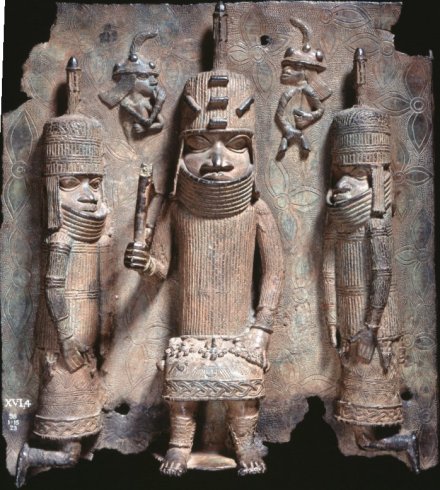
Great Britain’s punitive expedition also resulted in the capture of many hundreds of metal objects scattered to European museums and collections — collectively known as the Benin Bronzes. (It’s a misnomer: they’re actually brass.)

Hocked to defray the expense of their plundering, their diffusion around the empires’ continent helped broaden European appreciation for African art, and influenced modernist art movements. (Notably (pdf) German expressionism: tons of the bronzes ended up in Germany, and many can still be seen at Berlin’s Ethnological Museum.)

Nigeria, and the successor obas of Benin, have for decades besought their return in vain.


Cultural encounter: this Benin “bronze” shows the oba with two attendants, and the smaller floating heads of two European (Portuguese) traders.

More on this object, and its place in the story of Benin and Europe, in this episode of the BBC’s History of the World in 100 Objects; or, at the “bronze’s” page at the British Museum website.

On this day..

1845: Not William Weaver, defended by Abraham Lincoln

This date in 1845 was the appointed hanging of William Weaver, the first convicted murderer in Champaign County, Illinois.

While drunk, Weaver shot to death one David Hiltibrau and despite the able representation of one Abraham Lincoln was speedily convicted. (pdf)

Where the rail splitter failed, fortune prevailed.

“A few days — or nights rather — before that set for his execution,” we read,

a friendly auger passed to him afforded the means of escape. Just then delays were dangerous to poor drunken Bill Weaver, for Sheriff Lewis had the rope and scaffold ready, so he did not await a farewell word from friends, but sped away to the North, as the winds go. At that time the tangled forests and the untramped prairies afforded unexcelled means for seclusion and escape, and the condemned man, once a mile from town, might well bid farewell to every fear of being caught and hanged, as he doubtless did. Years afterward Weaver was heard from in far Northern Wisconsin, a useful, law-abiding citizen. No effort was ever made to bring him back from his delicious exile.

On this day..

1790: Thomas Bird, the first federal execution under the U.S. constitution

This date in 1790 saw the first federal execution under the auspices of the recently ratified U.S. Constitution, when English mariner Thomas Bird hanged in Portland, Maine. (At the time, still part of Massachusetts.)

This book is also available here, and via the author’s Portland, Me., History Blog, or on order from any bookstore.

Today, we’re pleased to interview author Jerry Genesio, whose Portland Neck: The Hanging of Thomas Bird compellingly reconstructs this once-forgotten story — a small British slave ship making landfall in a North American city only recently torched by the British, where it is found that its violent captain has been murdered at sea in unclear circumstances.

In the aftermath of the American Revolution, the one man to pay life for John Connor’s life was the one British sailor aboard the ship.

Besides a captivating account of an 18th century American capital trial, Portland Neck features biographies of all the principal characters. Portlanders will also especially enjoy a 25-page appendix on the topography of the town at the dawn of the American Republic.

This was a British subject who killed a British victim on a British ship in international waters. Was there any question of whether a U.S. court had jurisdiction?

The people who were on the vessel when it was captured — one was British, one was Norwegian, one was American, and there was a 12- or 14-year-old African boy named Cuffey.

They came under U.S. jurisdiction because in the constitutional convention (article 3, section 2), the federal courts were given jurisdiction of admiralty and maritime cases.

The Supreme judicial court in Massachusetts — Maine was part of Massachusetts then — apparently considered bringing the case before its judges, but then the constitution overruled that when it was ratified.

And then they had to wait for the federal courts to be organized, because they didn’t exist yet. They languished in jail for almost a year while the courts were being organized.

In Chapter II, you describe Thomas Bird’s ship, the Mary, operating on the Guinea coast. It’s a small ship basically working the coast and rivers, making small sales of one or two slaves to the large slavers waiting to cross the Atlantic. There must have been whole niches of the slavery industry occupied by these sorts of small-timers.

Oh, yes. The large slave ships that carried several hundred, three, four hundred in their hold — they were too large to get too close to the coast of Africa. So they would anchor perhaps a mile offshore, and they would wait for these smaller ships, like the sloop Mary — Captain Connor was in business with people in London who sent him down there just to go up the rivers to various villages where they knew there were wars going on, and when there were wars, the captives would be sold to slavers. (They also traded ivory and gold.)

When they got slaves, crews like the Mary‘s would go to the ships who had been there the longest, because they knew they would get the best price. They were known to have been there as long as a year trying to fill their cargo, and the slaves they held were liable to die while they waited. Slave ships couldn’t even allow the slaves topside because they would jump overboard if they could and try to swim for shore.

Incidentally, the Google book project has many slave captain logs online. I was able to read about the ports that Captain Connor and Thomas Bird actually visited, and it gave me such a wealth of information, and I could practically see where they were.

Ed. note: here are a few from Genesio’s bibliography, all free at Google books:

You’ve compiled this book despite a paucity of primary trial data, and there are some spots where you’re clearly reading between the lines. How difficult was the historiography on Portland Neck?

There’s not a complete trial record. Even the examination before the court — the scribe tried, apparently, to write down all of their answers, but he did not write down the questions.

My concern is more around the scribe. Was the scribe hearing these answers properly? Was the scribe hard of hearing? One of them was replaced in the process. Was the scribe able to keep up? He was writing with a quill pen, after all.

And then, on top of all of that, they did not indicate on the court record who was the scribe, who did the questioning, and who wrote the answers down. And the prisoner never signed it!

And you felt that at some level, they targeted the Englishman out of this multinational crew.

I believe that people are so influenced by the events of their times — look at World War II and how we viewed the Japanese and the Germans, or the people involved in the war in Vietnam.

These people on the jury, the foreman on the grand jury, many of them were Portland residents whose homes had been burned by the British just 14 years earlier. The war had just ended seven years earlier.

Every one of the court officials on the prosecutors’ side were all officers in the Revolutionary War. [Notably, the U.S. marshal who actually carried out Bird’s hanging, Henry Dearborn. He took part in the decisive Battle of Yorktown and would go on to become Thomas Jefferson’s Secretary of War, as well as the namesake of the city of Dearborn, Michigan. -ed.]

All of these things influence what was going on. And the fact that they acquitted the Norwegian kid and executed the Englishman makes me feel, certainly, that there was a strong influence there that was hostile to Thomas Bird. But what actually happened and how people felt, we’re just too far away — but I suspect that played a role.

Thomas Bird claimed in his dying statement, knowing that he was to be hung in a couple of hours, that he did not kill John Connor. The lawyers desperately tried to get then-President Washington to give him a commutation, and Washington refused to do it.


Information wants to be free, y’all. The newspaper editor tried to sell a broadside with the condemned man’s final narrative, but public pressure eventually forced him to put it in the July 26, 1790 Cumberland Gazette.

How did you come by this story?

When I was working at Portland Public Library and I ran into a couple of lines referring to a Thomas Bird in books by William Willis and William Goold.

In Goold’s book, Portland in the Past, he actually interviewed a fellow named Charles Motley who was in his 90s, and this interview took place in the 1880s. Motley was the youngest child of the jailer who held Thomas Bird, and Charles Motley, and he describes being five years old and being allowed into the cell where Thomas Bird would carve them little toy boats. With a knife! Then when Thomas Bird was executed, there was a note about the jailer’s wife, Emma Motley, taking all seven children away, to the other side of the land from Portland, so that they wouldn’t know what was going on. They were probably playing with Thomas’s boats as he was being hanged. So it was obvious that the Motley family held this Thomas Bird in high regard, and I got to thinking, I want to know more about this guy.

He (Motley) was five years old at the time, and, with his older brother Edward, at the request of Bird, was often admitted by his father to the cell and spent much time there. The prisoner made them toy ships and boats … At the time of the execution, Mrs. Motley, the mother of the boys, took them over back of the Neck to be out of sight of the gallows, as the whole family had become interested in the fate of Bird.

–Goold

For a couple of years, I couldn’t find much of anything. Finally, I took the time to go down to the federal archives in Waltham, Mass., I found a little manila folder that was like a bar of gold. It had 12 little sheets written in quill, and it’s as much of a record of the trial as exists.

The other question in my mind is, why has nobody written about this before? I think maybe it’s because it’s something of an embarrassment, which reinforces my belief that maybe this hanging should not have taken place.

Thomas Bird, if they really suspected he was a participant, should have been punished, but probably shouldn’t have been hung. Unfortunately in those days, captains were like gods on their little wooden worlds. Even though, based on the testimony, [the victim] John Connor was a brutal drunk who beat his men mercilessly. Connor murdered his first mate on that voyage.

It’s sad because Bird probably saw America as some sort of refuge — he probably didn’t expect that he might be hanged for this crime. He’d been at sea since age eight, and all through the [American] Revolution he had been on both American and British ships. The British navy kept impressing him and making him serve on British warships, and he kept deserting and signing up for American ships instead.

One other interesting aspect of this story is that when Thomas Bird was looking for a ship to sign on with and signed on with the Mary, he might just have signed up on the HMS Bounty, because the Bounty was tied up at Wapping before its voyage to Tahiti. Had he signed on with the Bounty, he wouldn’t have fallen into American hands, but he might not have fared any better.

How thick on the ground were slaves and slavers in New England at this time?

There were a lot of slave captains, a lot of owners. Their home ports were in Boston or in Portland. Normally, when they came back to their home port, the product they were carrying was rum and molasses. Slaves would be delivered in the South or in the West Indies, separate legs in the triangle trade.

What’s your next project?

I’m working on a family genealogy.

After that, maybe something about Captain John Lovewell. He was a bounty hunter who went hunting for Indian scalps. In 1725 he was living in Massachusetts, and he got the court to authorize 10 pounds per scalp, and he recruited a small army and took off looking for Indians and found the Pequawket here in Fryeburg, Maine. They were not warriors, they were farmers.

Lovewell and a Scaticook named Paugus ended up killing each other at a battle at a pond now called Lovewell’s Pond.

Lovewell is the namesake of the town of Lovell. A couple of people have written Lovewell’s story, but I wanted to write it from the perspective of the Indians. And not only the Indians, but the true perspective — because John Lovewell was a bounty hunter, not a hero. He was willing to kill farmers who hadn’t killed anyone for their scalps.

On this day..

1986: Jerome Bowden

A quarter-century ago this date, a “scared” mentally disabled prisoner named Jerome Bowden was electrocuted in Georgia for a crime many think he did not commit.

Bowden drew a death sentence for a robbery-murder on the strength of two very suspect pieces of evidence:

  • the accusation of a juvenile co-defendant who might well have been the real murderer; and
  • a signed confession Bowden could barely understand

While present-day DNA exonerations are fortunately forcing reconsideration of the ubiquitous problem of false confessions, Bowden’s was understandably doubted even before his execution.

Asked to explain his signature on a document obviously beyond his capacity to compose himself, he gave a confused answer that seemed to indicate he’d been led to sign it by a suggestion that it would keep him out of the electric chair.

“Detective Myles had told me this here … Had told me about could help me, that he could, you know, which I knew that confessing to something you didn’t take part in was-if you confess to something that you didn’t do, as if you did it, because you are saying that you did.”

(This remark inspires us to re-issue our occasional reminder: do not talk to the police.)

Bowden’s assent to this fatal “admission” sadly evokes the characteristic eagerness to please one often encounters in the developmentally disabled — sometimes, as with Joe Arridy, to their own destruction.

It’s noticeable, too, in Bowden’s incongruously ingratiating last statements, recordings of which were taken and subsequently leaked publicly. This and others are available at SoundPortraits.org.*

[audio:Jerome_Bowden_last_statement.mp3] [audio:Jerome_Bowden_last_statement_addendum.mp3]

Bowden had been evaluated with an I.Q. of 59 at the age of 14, the examiner reporting him “functioning at the lower limits of mild retardation. He has little or no insight into his situation … He is easily distracted and has a tendency to act on impulse regardless of the consequences.”

And even though the authorities hustled through a test the day before his execution that reckoned Bowden with an I.Q. of 65 — still solidly below the conventional threshold for mental disability, but good enough for the Georgia Board of Pardons and Paroles — the whole affair shook the state. It “unsettled more than a few persons in government and law enforcement,” the Atlanta Constitution later editorialized.

Its [the state’s] reasoning was grievously faulty. Whether Bowden understood his fate or not, whether he knew right from wrong — he was indisputably handicapped …

Most states have progressed beyond the dated right-wrong standard in weighing such cases … and ask: Could the defendant help himself? There is compelling evidence that Bowden could not …

brute whimsy was given full sway. For the state of Georgia, it was a willful lapse of decency.

–Atlanta Constitution, July 1, 1986 editorial**

This lapse of decency rippled over the months ahead until Georgia in 1988 became the first state to enact a law barring the execution of the mentally disabled.

Maryland followed suit the next year, but the U.S. Supreme Court held in the 1989 decision Penry v. Lynaugh that executing such prisoners did not constitute “cruel and unusual punishment”.

While that decision was reversed in 2002, the putative ban on executing the mentally disabled in the United States remains very far from a bright line. It’s up to the states themselves to decide who falls under that definition,† and at least some have given ample indication that they’re prepared to exploit any expediency necessary to get a fellow onto death row, or keep him there. Earlier this very week, Texas (of course) put to death a man of dubious competence, Milton Mathis, essentially by cherry-picking its data and having federal appellate review barred on a technicality.

A quarter-century on, those ripples started by Jerome Bowden still have a way to go.

* We’ve previously featured another recording in this set of a particularly frightful botched electrocution.

** Both Constitution quotes, and the childhood IQ examiner quote, as cited in Robert Perske’s Unequal Justice?.

† As an irony of its early adoption, Georgia later found itself with an unusually stingy legal standard for protecting disabled defendants from the death penalty.

On this day..