1810: Tommaso Tintori, the first guillotined in Rome

It’s easy enough to accuse the Catholic Church of being behind the times.

But this date two hundred years ago found it in the criminological progressive vanguard (just ask Lord Byron!), conducting Rome’s first beheading by guillotine, that brave new instrument of egalitarian execution.

Okay, granted: it wasn’t the ecclesiastical authorities but the French occupiers who introduced the guillotine, as was their wont.

But when the Papal States were restored a few years later, after the Napoleonic Wars, the vicars of Christ were enlightened enough to keep this efficient device (and its sunk capital cost) around … at least as one option among the restored traditional sentences of hanging, quartering, and the local specialty, mazzolatura.

Biographical details of our milestone criminal are scarce on the ground, but we have his name, date of execution, and crime — omicidio — courtesy of the Italian list kept by the famed executioner Mastro Titta.

Seguono Le Giustizie Eseguite Nel Nuovo Edifizio Per Il Taglio Della Testa Nel Governo Francese.

106. Tommaso Tintori, reo di omicidio, li 28 febbraio 1810.

As one might guess, that “106” means that the prolific Titta had already notched 105 official kills in his 14 years as executioner prior to the guillotine. He would run his career total north of 500.

On this day..

1623: Amboyna Massacre

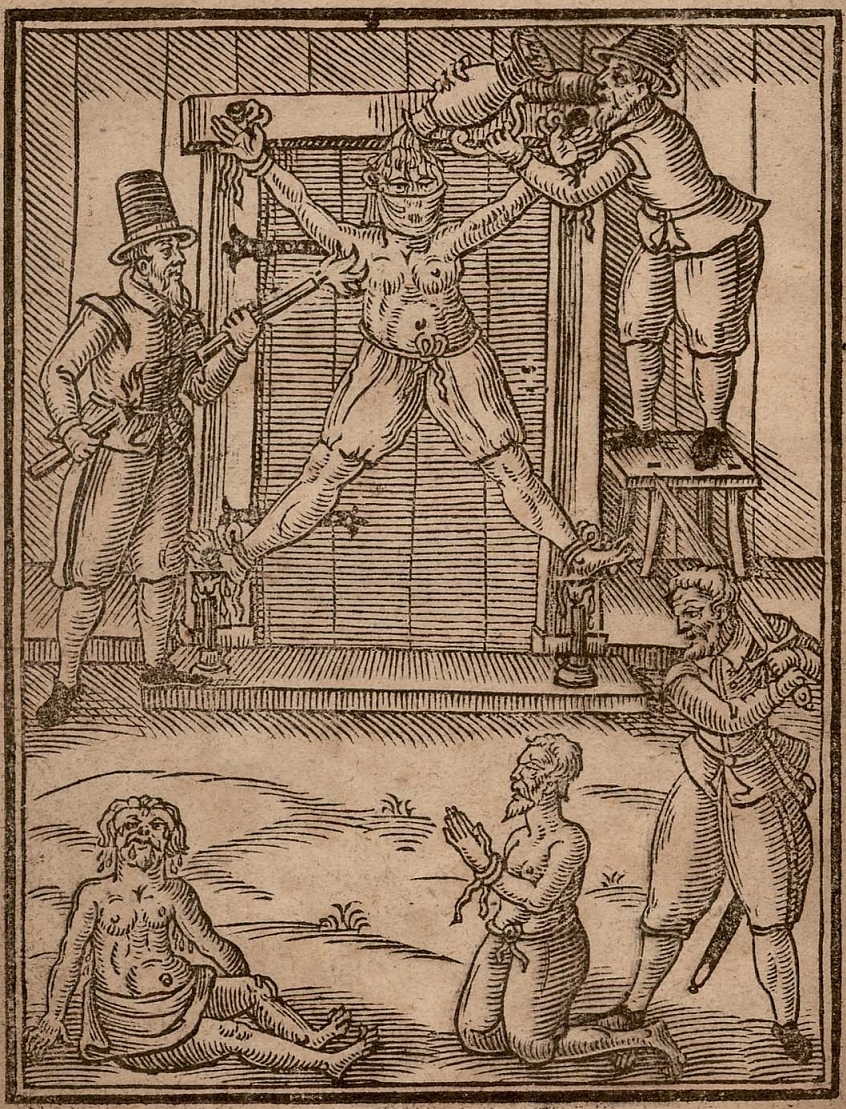
On February 27,* 1623, the Dutch East India Company beheaded twenty who had been waterboarded into confessing to a terrorist plot.

English prisoner suffering “waterboarding” faux-drowning torture, published under the name “A true relation of the unjust, cruell, and barbarous proceedings against the English at Amboyna in the East-Indies 1624”.

The torturers “poured the water softly upon his head until the cloth [wrapping his head] was full, up to the mouth and nostrils, and somewhat higher, so that he could not draw breath but he must suck in all the water.” More nasty description.

(cc) Image from Flickr | BiblioOdyssey

Posh Spice

As in modern times, this scenario originated with resource competition in the Muslim world … in this case, competition for spice, in Indonesia.

European colonialism had pitted the Dutch East India Company against its British counterpart on the archipelago, both scrabbling after the lucrative trade in cloves and pepper, with garnishes of nutmeg, cinnamon, mace, and ginger.

The two rival powers had, as we lay our story, recently come to a tense truce, dividing the commerce between them — and swapping mutual accusations of violating that pact. The arrangement basically gave the Dutch a bigger slice of the pie, so we’ll find them when the cloves hit the fan having the balance of power on their side.

Terrorists

We’re going to oversimplify to set the scene.

On Ambon Island, one of the very “Spice Islands” (i.e., the Moluccas) — at the Dutch-controlled fortification of a trading post also shared by the English — the Dutch merchant-governor Herman van Speult heard that a Japanese mercenary had asked about the Dutch fortifications.

The security-conscious van Speult ordered that unfortunate soldier interrogated under torture.

As tends to happen when the interrogators in such a case are convinced of a ticking time bomb situation, the torture uncovered a ticking time bomb situation.

The mercenary got the Dutch to stop burning and drowning him by “revealing” a highly implausible** English plot to seize the Dutch fort, with 20 guys or so and no prospect of imminent outside aid. Wouldn’t you know it: when the supposed confederates named by the mercenary were similarly tortured, they too admitted the plot. Van Speult’s English opposite number, Gabriel Towerson, was one of them.

The Amboyna Massacre followed anon, with Towerson and nine other British East India Company employees beheaded, along with nine Japanese mercenaries and one Portuguese. (The latter ten worked for the Dutch East India Company, not the British. A fifth column!)

They went to their deaths protesting their innocence, and many smuggled out written recantations to that same effect: “tortured … with that extream Torment of Fire and water, that Flesh and Blood could not endure it, and we take it upon our Salvation, that they have put us to Death Guiltless.”

Anger in the English Street

That last quote comes from Karen Chance, “The Amboyna Massacre in English Politics, 1624-1632,” in Albion: A Quarterly Journal Concerned with British Studies (Winter 1998).

As the title of that piece suggests, the Amboyna Massacre outraged Towerson’s countrymen and -women once word finally made it back to the mothership. (In addition to the torture/wrongful execution dimension, the legal authority of the Dutch trading concern to impose judicial punishment on their English counterparts was questionable at best.)

English demands for satisfaction against the perpetrators continued to complicate Dutch-English relations into the reign of Charles I and beyond. Even Oliver Cromwell required, as the price of peace for the First Anglo-Dutch War in the 1650s, punishment of any surviving offenders. (Which was apparently nobody at all.)

And still later, the burgeoning British Empire’s propaganda arm reached for the Amboyna narrative to justify seizing New Amsterdam on the grounds that the Dutch had attempted to spring a massacre on English settlers — “their Amboyna treacherous Cruelty extended itself from the East to the West Indies, and pursued thus the straight channel of Dutch blood”.

As for the trade-jockeying: the Netherlands’ commanding position in Indonesia ultimately squeezed the English out.** But don’t fret for Old Blighty: she turned attention to gobbling up India, and made a lot more bank than did the Dutch spice racket.

* February 27 was the date according to the Julian calendar in use at this time by the British. By the Gregorian calendar the Dutch were using, the massacre took place on March 9.

** For more on both the fanciful nature of the supposed plot, and the economics of the East Indies trade as it unfolded in the 17th century, see D.K. Bassett, “The ‘Amboyna Massacre’ of 1623”, Journal of Southeast Asian History, September 1960.

On this day..

1922: Henri Landru, French Bluebeard

“Widower with two children, aged 43, with comfortable income, serious and moving in good society, desires to meet widow with a view to matrimony.”

The personal ads sections of the Parisian papers were the stalking-grounds of French Bluebeard Henri Désiré Landru, guillotined in Versailles this date in 1922.

A former soldier himself, Landru trawled the Craigslists of World War I for their ample population of ample war widows.

His M.O.: enchant one into letting him get his hands on her huge … fortune.

(No, really. Her fortune.)

Then, kill her and incinerate the body in his kitchen stove.

Repeat x10 (plus one teenage son of one the widows), and you’ve got yourself your basic Bluebeard.

Landru’s story inspired the 1947 Charlie Chaplain flick Monsieur Verdoux.

And that’s not the only thing of Landru’s that made it to Hollywood. His severed dome is on exhibit at the Museum of Death.

On this day..

1880: Ippolit Mlodetsky, Loris-Melikov’s would-be assassin

If you were a person of any privilege or official authority in late 19th century Russia, chances are that Narodnaya Volya was planning to take a shot at you.

If you were General Loris-Melikov, a Ukrainian Jew did that to you two days before this date in 1880.*

And if you were that errant assassin, Ippolit Mlodetsky, this was your execution date.

Even though Melikov rated as something of a liberal on the Russian autocracy spectrum, he had no qualms about ordering legal proceedings barely this side of summary.

Gen. Melikoff, on Wednesday evening, ordered a court-martial to assemble on Thursday morning. The trial of the prisoner was opened at 11 o’clock in the morning. The prisoner was insolent in his language and demeanor, and refused to stand up or take any part in the proceedings. He said he had nothing to add … that he did not want to be troubled any more, and wanted the matter finished. … at 1 o’clock … judgment was pronounced against him. The judgment on the prisoner sentenced him to be hanged, and his execution was appointed for 10 o’clock this (Friday) morning on the Simeonofsky Plain, near the Tsarskoe-selo Railway terminus.

And so he was.

Mlodetsky’s public hanging was witnessed by novelist Fyodor Dostoyevsky in the very square where Dostoyevsky himself had faced mock-execution for revolutionary activity 30 years before.

Dostoyevsky was, even then, pulling together his magnum opus, The Brothers Karamazov.

The very day Mlodetsky tried to kill Melikov found Fyodor Mikhailovich chatting with fellow reactionary journalist Aleksey Suvorin about the plague of terrorism and its accompanying social malaise.

On the day of the attempt by Mlodetsky on Loris Melikov I was with F. M. Dostoyevsky.

… Neither he nor I knew anything about the assassination. But our conversation presently turned to political crimes in general, and a [recent] explosion in the Winter Palace in particular. In the course of talking about this, Dostoyevsky commented on the odd attitude of the public to these crimes. Society seemed to sympathize with them, or, it might be truer to say, was not too clear about how to look upon them … (Quoted here.)

Dostoyevsky in this conversation revealed that for the planned sequel to The Brothers Karamazov — never to be realized in the event —

he was going to write a novel with Alyosha Karamazov as the hero. He planned to bring him out of the monastery and make a revolutionary of him. He would commit a political crime. He would be executed.

(Much more about this sequel in this paper.)

Melikov’s brush with death did not dissuade him from continuing to push for constitutional reforms as the antidote to terrorism, including introduction of a parliament. Tsar Alexander II was on the point of implementing that proposal … when he himself was assassinated by Narodnaya Volya, precipitating a political backlash.

That murder of Alexander II helped put the kibosh on the Karamazov sequel, which would thereafter have become politically problematic.

Nor was that the only artistic casualty of the Russian terrorists.

A discomfiting thematic similarity in Mlodetsky’s execution with that of the protagonist resulted in the cancellation of a just-opened opera: The Merchant Kalashnikov. (It would be a few more decades before that connection could appear ironic.)

* The assassination attempt occurred on February 20, with the execution on February 22, according to the Julian calendar still in use in Russia at that time. By the then-12-days-later Gregorian calendar, the dates were March 3 and March 5, respectively.

On this day..

1951: Charlie Gifford, politician-killer

On this date in 1951, Charlie Gifford was electrocuted in Florida’s Raiford Prison for murder.

The murder victim was popular young Florida legislator/war hero Charles Schuh, whose promising political career ended abruptly on April 24, 1950, when the 71-year-old Gifford strode into his St. Petersburg offices and shot him dead over some head-scratching private grievance relating to Schuh’s legal practice. (Schuh represented Gifford’s ex-wife in a divorce proceeding.)

An insanity defense didn’t fly, though Gifford’s purchase on reality seems to have been … hit and miss. The septuagenarian perp didn’t seem to mind the death sentence.

The murdered legislator’s son, Charles E. Schuh, grew up into a political career of his own, eventually becoming mayor of St. Petersburg. Charles E. Schuh’s recent passing brought out this fascinating story by a former reporter who witnessed Gifford’s execution.

The electric chair was in the center, but the controls were behind a glass-enclosed area. I was repelled by the sight of “Old Sparky,” the electric chair. I was even more horrified to see that the executioner, a local electrician, wore a black hood reminiscent of the Inquisition. …

Today I am a decade older than Gifford was then, but to a 22-year-old reporter he seemed to be just a frail old man with a shaved head.

On this day..

1994: Andrei Chikatilo, the Butcher of Rostov

On this date in 1994, Ukrainian serial killer Andrei Romanovich Chikatilo was shot dead in a soundproof room in Novocherkassk, Russia, for a stupendous serial murder spree in the 1980s USSR.

The quintessential case study in anonymous middle-aged melancholy turned larger-than-life horror, the sexually dysfunctional Chikatilo raped, murdered and mutilated dozens in a homicidal career beginning at the unusually late age of 42.

After that initial foray into rape-murder in 1978, three years passed before the factory clerk (molestation allegations had drummed him out of teaching in the interval) began his harvest of 50-plus victims: children and teenagers of both sexes, and young adult women.

In addition to the staggering body count, the murders of the “Rostov Ripper” were marked by orgiastic savagery: breasts severed, eyes gouged out, genitalia mutilated and even eaten, and bodies lacerated with scores of stab wounds.

Like many monsters, he was also, as much as his more well-adjusted fellows, a creature of his own time and place.

Chikatilo was a socially maladjusted child in part due to his father’s capture by the Germans during World War II, subjecting the family to the postwar ostracism that awaited returning POWs. (Some sources also say Chikatilo saw his mother raped by German soldiers.)

The part of his life for which he’s most famous, meanwhile, drew out into a years-long bloodbath even though he was a suspect from the very first murder — a crime for which another man was wrongfully executed. Sclerotic bureaucracy and investigative cock-ups hobbled the police effort throughout, a sort of criminological emblem of the Soviet Union’s twilight. Authorities were loathe to involve the public by admitting the presence of a serial killer, a type officially associated with bourgeois society.

Chikatilo was arrested once in 1984 carrying a Bundy-esque murder kit, but authorities couldn’t make anything stick (Chikatilo’s Communist Party membership helped); another officer stopped him leaving the forest where bodies turned up, but didn’t search the satchel which contained his most recent victim’s severed breasts. Chikatilo was investigated early on, but ruled out as a suspect because of a blood type mismatch between his blood and crime-scene semen — apparently the result of a rare biological anomaly that (combined with authorities’ outsized confidence in forensic detection) bought him years of killing and involved thousands more suspects before investigators finally circled back to Andrei Romanovich.

Even at his last arrest, investigators who knew they had their man nearly let him slip away because they couldn’t charge him within 10 days — finally cajoling a confession and the killer’s cooperation at nearly the last possible hour.

According to Cannibal Killers, the Chikatilo task force solved 1,062 unrelated crimes, including 95 murders, while puzzling out the Rostov Ripper.

There’s much more about Chikatilo’s career at trutv.com; the 1995 film about the Chikatilo murders, Citizen X, indulges some dramatic license, but it’s pretty watchable for a TV movie.

On this day..

1906: William Williams, the last hanged in Minnesota

On this date in 1906, Minnesota hanged a Cornish immigrant for the murder of his homosexual lover … and hanged him so clumsily that it never hanged again.

William Williams shot Johnny Keller dead after Keller’s mother intervened in the teenagers’ relationship. A series of mooning-slash-menacing letters failed to win back affections. “I want you to believe that I love you now as much as I ever did,” Williams wrote. “Keep your promise to me this time, old boy, as it is your last chance,” he wrote, later.

When the man with the redundant name went to die in the dead of night at a St. Paul prison, it seems that there’d been a slight miscalculation. When dropped through the trap, Williams’s “feet touched the ground by reason of the fact that his neck stretched four and one-half inches and the rope nearly eight inches.”

Consequently, three deputies on the scaffold hoisted the rope up to get him airborne, where he strangled to death over the span of a ghastly quarter-hour.

Slowly the minutes dragged.

The surgeon, watch in hand, held his fingers on Williams’ pulse as he scanned the dial of his watch.

Five minutes passed.

There was a slight rustle, low murmurs among the spectators and then silence.

Another five minutes dragged by.

Would this man never die?

Fainter and fainter grew the pulsations of the doomed heart as it labored to maintain its function.

The dead man’s suspended body moved with a gentle swaying.

The deputies wiped their perspiring brows with their handkerchiefs.

Members of the crowd shifted from one foot to another.

There were few murmurs, which died at once.

Eleven, twelve, thirteen minutes.

The heart was beating now with spasmodic movement, fainter and fainter.

Fourteen minutes—only a surgeon’s fingers could detect the flow of blood now.

Fourteen and a half minutes.

‘He is dead,’ said Surgeon Moore.

The end has come.

And the end had come.

Two things happened in consequence of this sensational press narrative.

First: the news entities who promulgated these descriptions were themselves prosecuted under a law sponsored by anti-death penalty Republican legislator John Day Smith to make executions as secretive as possible. The St. Paul Pioneer Press, St. Paul Dispatch and St. Paul Daily News each caught fines of 25 bones or clams or whatever you call them.

Second: those illicit descriptions out in the public eye triggered efforts (eventually successful in 1911) to abolish the death penalty full stop in the Land of 10,000 Lakes.

There’s a great roundup of the Williams case here, and a pdf from the Minnesota Historical Society about the background and consequences of the John Day Smith law, themselves quite topical for this blog.

Smith’s law was adopted as a half-measure when death penalty abolition couldn’t pass in 1889, as a bit of moral hygiene against the unseemly spectacle of public execution. The measure pioneered the familiar 20th century routine of conducting executions after midnight behind prison walls. Newspapermen derisively called it the “midnight assassination” law — but it was taken up by many other states over the succeeding years as public executions went extinct.

As for Smith himself … there’s a rumor of a ghost story, and (given a tragic love story, a sensational crime, a capital punishment milestone, and a queer identity) the palpable fact of a play.

On this day..

1585: Frederick Werner, the executioner’s brother-in-law

Being ‘broken on the wheel’ was an agonising and prolonged way in which to die …

The felon was secured, spread-eagled, face upwards, on a large cartwheel mounted horizontally on an upright which passed through the hub, the wheel sometimes being slightly canted in order to give the spectators a better view of the brutal proceedings …

Death was meted out by the executioner wielding a heavy iron bar, three feet long by two inches square, or using a long-handled hammer. Slowly and methodically he would shatter the victim’s limbs; the upper and forearms, the thighs and the lower legs … On being removed from the wheel the corpse would resemble a rag doll, the various short sections of the shattered limbs being completely disconnected from each other …

In some states in Germany the regulation number of blows was forty. Franz Schmidt, executioner of Nuremberg in the sixteenth century, wrote in his diary that on 11 February 1585 he ‘dispatched Frederick Werner of Nuremberg, alias Heffner Friedla, a murderer who committed three murders and twelve robberies. He was drawn to execution in a tumbrel [a cart], twice nipped with red-hot tongs and afterwards broken on the wheel.’

This multiple murderer was in fact Schmidt’s brother-in-law and, probably in view of their relationship, the judges decreed that only thirty-one blows need be struck. One wonders whether, after that number, there was anything worthwhile left to aim at.

On this day..

1852: Martin Merino, Jesuit assassin

On this date in 1852, a 63-year-old Jesuit priest was garroted outside Madrid’s Toledo Gate for attempting to assassinate Queen Isabella II.

Only five days before, Martin Merino y Gomez (Spanish Wikipedia link) had slipped into the palace wearing his clerical robes, and planted a dagger in the Queen’s side. (Non-fatally; her corset partly shielded the blow.)

Despite some speculation that he might have been connected to some more elaborate plot, investigation found him to be a lone nut, “crazed with Liberal doctrines, disordered vanity, and bilious disease.”

Neither a clear motive nor a real link to any other actor was ever established. Merino died as a lone nut, and then his parricidal remains were burned to ashes and scattered to the winds.

On this day..

1885: George Gibson and Wayne Powers

As of today, Scott County, Va., has gone 125 years since its last hanging — the execution in Estillville* of George Gibson and Wayne Powers for the drunken murder of a comrade.

Wayne Powers and Jonas Powers (brothers), and George Gibson and William Gibson (no relation), were on the road to West Virginia looking for opportunity and all that jazz, when the last-named William Gibson was slain by his traveling companions.

The crime was either one of minute pecuniary interest (the three survivors divided up the few dollars William had on him, and the clothes off his back), or just some inane drunken midnight quarrel between men who all happened to be well-armed.

At any rate, the inebriated killers “spent nearly the entire night trying to burn the body with a fire made of fence rails, and were thus discovered.”

Though all three were condemned, Jonas Powers was reprieved as not actually involved in the killing; both his brother and George Gibson used their scaffold time to insist upon his innocence. He was not ultimately executed.

His less fortunate companions did not neglect to blame Demon Rum for their woes, and took their leave of this earth doing their little bit to speed the day of a ruinous social policy.

O! may the cup of intoxicating drink never touch their lips, for it was this that has brought a fate so terrible upon their father. Society would do well to banish liquor forever from its midst. I, who have been decoyed to my ruin by it, might with some show of just reproach turn upon that people whose laws license this most deadly and dangerous of all agents, and say, ‘shake not thy glory locks at me.’”

The hanging itself was technically private, but the doomed men were trotted out on a stand outside the jail yard to address three thousand onlookers, and many of the public climbed trees to watch the gallows proceedings over the walls.

* Estillville is today known as Gate City. If the name rings a bell, it might be for its recent foray into the electoral fraud headlines.

On this day..