1781: The slaves of the Zong, for the insurance

Beginning this day in 1781, the captain of the slave ship Zong began throwing his cargo overboard in a still-notorious case combining the horrors of the Middle Passage with the cruel rapacity of capital.

The Liverpool-based ship was en route from Africa to Jamaica, there to exchange its human chattel for New World produce bound for the European market.

Characteristically for slave ships, it was inhumanly packed: more economical for a slaver to overcrowd its captives and write off the ones who died than to maximize slaves’ chances of survival. And on this particular ship, malnutrition and disease claimed more than 60 slaves (as well as seven crew members).


Underwater sculpture off Grenada commemorating slaves thrown overboard during the Middle Passage.

With many more in danger of expiring, Captain Luke Collingwood reasoned that the cargo would be a loss if it succumbed, but that shippers’ insurance would reimburse the firm “when slaves are killed, or thrown into thrown into the sea in order to quell an insurrection.” Over a three-day span beginning Nov. 29, 1781, Collingwood had 133 still-living but sick slaves cast overboard;* “the last ten victims sprang disdainfully from the grasp of their executioners, and leaped into the sea triumphantly embracing death.” (Source)

This gave the ship’s owners — the good captain himself was not among them — the chance to attempt an insurance scam.

This historical-philosophical book (review, a pdf) analyzes the Zong affair as the emblematic “inauguration of a long twentieth century underwritten by the development of an Atlantic cycle of capital accumulation.”

When the Zong landed having lost in total more than half of its original 440 slaves (and Collingwood himself, that fastidious servant of his shareholders), its owners did indeed attempt to recoup the many who had been intentionally killed. Smelling fraud, the insurer refused to pay.

There followed the signal case of Gregson v. Gilbert, a dry insurance trial that also became a beacon of the slave system’s blood-chilling jurisprudential logic.

After a jury sided with the claimant shippers against the insurers, the matter hit a wide public on appeal before Lord Chief Justice Mansfield when abolitionist activists Granville Sharp and Olaudah Equiano seized upon its conscience-shocking quality.

While Sharp and Equiano agitated unavailingly for a homicide investigation, the insurer — which was itself in the very same business of human bondage as the shipper — self-righteously posed “as counsel for millions of mankind, and the cause of humanity in general.” (Source) Its interests, after all, would be served by the least possible indemnity for slaves murdered in passage.

Solicitor-General John Lee — “the learned advocate for Liverpool iniquity,” in Sharp’s estimation — successfully insisted upon limiting the case to its commercial considerations.

What is this claim that human people have been thrown overboard? This is a case of chattels or goods. Blacks are goods and property; it is madness to accuse these well serving honourable men of murder. They acted out of necessity and in the most appropriate manner for the cause. The late Captain Collingwood acted in the interest of his ship to protect the safety of his crew. To question the judgment of an experienced, well-travelled captain held in the highest regard is one of folly, especially when talking of slaves. The case is the same as if horses had been thrown overboard. (Quoted here; Wikipedia has it “as if wood had been thrown overboard.”)

Lord Mansfield agreed, “(though it shocks one very much) that the case of slaves was the same as … horses,” and simply found with the insurers that no liability attached them since the killings were voluntary rather than necessary.

Nobody was ever prosecuted.
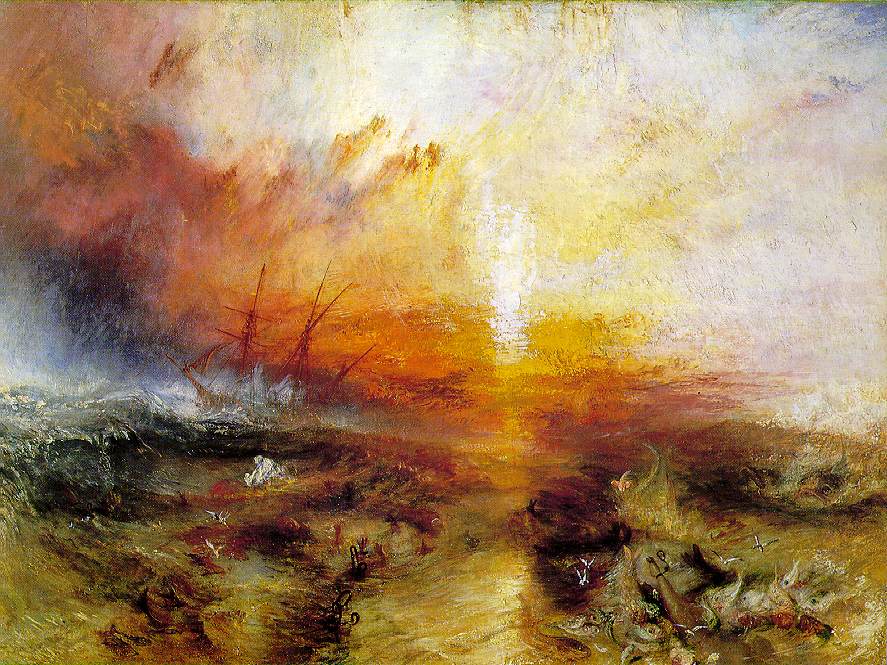

The disturbing 1840 Turner seascape “Slavers throwing overboard the Dead and Dying – Typon [sic] coming on”, also known simply as “The Slave Ship”, is widely thought to have been inspired by the Zong episode. The allusion would have been well-known to his contemporaries.

* One of the 133 survived by climbing back aboard the ship.

On this day..

1803: Johannes Bückler, “Schinderhannes”

On this date in 1803, the famous German bandit “Schinderhannes” and 19 others of his gang were efficiently guillotined in French-occupied Rhineland.

Schinderhannes with mistress Juliana Blasius and their child.

As low-born as they come, Johannes Bückler (English Wikipedia link | German) hailed from a family of executioners and knackers (his appellation means “John the Knacker”).

But this outcast was born to command, and in the wild Rhineland at the close of the 18th century, his audacity, charisma, and deft cruelty made him a legendary bandit king.

He stole, he blackmailed, he slipped his fetters … “he seemed to contest French authority” recently projected by the revolutionary citizen-army, and he preyed heavily on unpopular Jewish merchants, all of which gave Bückler purchase on folk hero status with the boldness to hold a public “robber’s ball” at the ruined castle his band occupied.

His legend grew in his own lifetime, and as such things do, it inflated quite past any capacity of its originator’s character to support.

When things got too hot on the French side of the Rhine, he ducked over the frontier to the Holy Roman Empire in the east, but was nabbed attempting to lay low in the imperial army under an assumed name, and handed back to the French.

The authorities turned his outlaw gallantry to good effect (or at least, that’s the cover story his apologists have made for his stool pigeoning) by threatening to come down on the mistress who bore him a child, leading Schinderhannes to get her off with a slap on the wrist by giving up his bandit brethren.

And with French law came French execution technology, whose proliferation in the train of Napoleon’s Grande Armee would bequeath the German condemned death by the “falling axe” down to Hitler’s time and even after.

A spectacle here as it was in France, tens of thousands turned up in Mainz this date in 1803 for what sounds like an anticlimactic six-minute show of a score of Schinderhannes’ gang losing their heads to the mechanical contraption.

Scottish scribbler Leitch Ritchie helped convey to posterity the legend with Schinderhannes, the robber of the Rhine, which romantically celebrates a knave who must have been less lovable to those who knew him from the business end of his blade. These, nevertheless, are all long gone, and Ritchie has the authority of historical mythologizing to vindicate his text’s last eulogy with its hero’s foot upon the scaffold:

The bandit-chief preserved his intrepidity to the last, and left to other times, unsullied by many of the basenesses of his tribe, the name of SCHINDERHANNES, THE ROBBER OF THE RHINE.

He sure did. From the practically mandatory ballad …

… to the stage …

… to the screen

… to vicious-looking Cambrian anomalocarid Schinderhannes bartelsi

… the outlaw has long outlived his guillotining, to the profit of the tourist trade in his former stomping-grounds.

On this day..

1539: Richard Whiting, the last Abbot of Glastonbury

Letter to Thomas Cromwell from his man in Somerset,* Richard Pollard, a local gentry type making out well under the Dissolution of the Monasteries:

Pleaseth it your lordship to be advertised, that … the same 15th day [of November] the late abbot of Glastonbury went from Wells to Glastonbury, and there was drawn through the town upon a hurdle to the hill called the Torre, where he was put to execution; at which time he asked God mercy and the king for his great offences towards his highness, and also desired my servants then being there present to see the execution done, that they would be meane [communicate] to my lord president and to me that we should desire the king’s highness of his merciful goodness and in the way of charity to forgive him his great offences by him committed and done against his grace, and thereupon took his death very patiently, and his head and body bestowed in like manner as I certified your lordship in my last letter. And likewise the other two monks [John Thorne and Roger James, executed with Richard Whiting] desired like forgiveness, and took their death very patiently, whose souls God pardon.

And whereas I at my last being with your lordship at London moved your lordship for my brother Paulett, desiring your lordship to be a mean that he might have the surveyorship of Glastonbury, which I doubt not but he will use and exercise the said office to the king’s most profit and advantage, and your lordship’s goodness herein to him to be shown he shall recompense to his little power, I assure your lordship he hath been very diligent, and divers others by his means, to serve the king at this time, according to his duty and right…

the late abbot of Glastonbury, afore his execution, was examined upon divers articles and interrogatories to him ministered by me, but he could accuse no man but himself of any offence against the king’s highness, nor he would confess no more gold nor silver nor any other thing more than he did before your lordship in the Tower …

From Wells, the 16th day of November.

Your assured to command,

Rychard Pollard

Once one of the greatest religious houses in England (and the legendary burial place of King Arthur), Glastonbury Abbey today is a picturesque ruin. Cornell University has published some 19th century photos of the abbey’s remains in a less manicured, more gorgeously overgrown situation.

Pollard had just a few weeks before exonerated the monastery of any profligacy, and the abbot seems perhaps not to have even been properly charged or attainted … but as one can discern in Pollard’s cloying appeal to keep the surveying position in the family, the practical henchman had no qualms as events unfolded about taking a commercial position on the end of the Abbot of Glastonbury.

For your public domain perusing pleasure: The last abbot of Glastonbury: and other essays, by Cardinal Francis Aidan Gasquet.

* Pollard had been in the thick of the destruction of Henry Courtenay, Marquess of Exeter just the year before.

On this day..

1845: Lavinia Burnett and Crawford Burnett

On this date in 1845, husband-and-wife murderers Crawford and Lavinia Burnett (nee Sharp) danced a gallows jig built for two in Fayetteville, Arkansas.

The duo contrived with their son, John, to rob and murder a nearby recluse, Jonathan Selby, for the money he was thought to be hoarding.

The family the slays together, pays together.

Alas for mom, dad, and big brother, 15-year-old daughter Minerva shopped them.

John-boy was still on the lam at this time — he’d be caught soon, and hanged December 26 — but Lavinia and Crawford hanged together before a large crowd in the vicinity of the present-day Fayetteville National Cemetery.

It was the first recorded execution of a woman in Arkansas history, and would be the only such until the year 2000.

Among the ranks of the Burnetts’ illustrious if unsuccessful defense team was Isaac Murphy, who would go on to become a notable pro-Union pol during the Civil War (with a murky part in an infamous massacre of Confederate sympathizers), and subsequently became governor of the state during Reconstruction.

On this day..

2003: Four for the oil of Chad

On this date in 2003, seven Chadians were shot in the capital of N’Djamena, with an eighth in the eastern city of Abeche. (A ninth would be executed three days later.)

Chad’s first known judicial executions since 1991 came as a shock to observers; the country had publicly mooted death penalty abolition earlier that very year.

It also seems to have come as a shock for its subjects.

Four of those executed this date — the four that concern us here — were ranking power-brokers in President Idriss Deby’s regime convicted of bumping off the head of the Chad Petroleum Company, one Sheik Ibn Oumar Idriss Youssouf.

Mahamat Adam Issa, Adouma Ali Ahmat, Abderamane Hamid Haroun and Moubarack Bakhit Abderamane had been condemned on Oct. 25, just a month after the Sheikh was assassinated outside the Foreign Ministry. Less than two weeks later, the perps were shot when Deby denied them clemency even with their Supreme Court appeal still pending (pdf). (The Chadian judiciary seems a rickety thing (pdf).)

The murder, for its part, came just a month after Chad christened a $3.7 billion pipeline project.

It’s often called the “Adouma affair” after its principal defendant, which helpfully suggests the murky oil politics surrounding the speedy execution.

Ali Adouma was a former Deby advisor; both Adouma and the victim were from Darfur, in neighboring Sudan, whose conflict has spilled into Chad (pdf).

The Sudanese government had at times sought Adouma’s extradition for financing anti-govenrment Zaghawa forces across the border; while the Zaghawa ethnic minority (whose ranks include President Deby) dominates Chad, its Darfurian brethren have had the worst of their conflict with the Sudanese government.

So even if the convicts’ torture-adduced confessions resembled the truth of the murder, it can be safely inferred that the fact and the haste of their executions were matters of state. (Adouma’s confidence that there would not actually be an execution was reportedly shaken only in the last hours of his life.)

What matter of state is a different, uncertain matter: to calm potential foreign investors who’d be understandably nervous about seeing a petroleum kingpin pinched on the streets without consequence? A sop to Khartoum in Deby’s ongoing diplomatic efforts to limit the knock-on from Darfur to Chad? Or a warning to Deby’s own base? (pdf)

The vague attempts at conciliation by the Chadian President do not please his entourage which almost sees it as treason. Last May, 80 soldiers tried to overthrow Deby and would have assassinated him …

President Idriss Deby, according to observers with knowledge of Chadian politics, would be in a “precarious” situation. The Chad regime, undermined by corruption and ever on the brink of a chronic socio-economic crisis … may become even “tougher”. In N’Djamena, the hasty conviction and execution of Ali Adouma are seen as a sign from the President to his inner circle, even the ones in charge of the national economy, that he is ready to use coercion, even against his own clan.

These pictures of the execution were published in a Chadian paper. In image three, the circled figure is one of the firing squad members, who was himself bizarrely reported fatally shot during the execution. (Whispers continue to circulate that the unlucky executioner had in fact been intentionally eliminated after receiving some sensitive parting confidence from the well-placed condemned.)

“Chad,” said Interior Minister Routouang Yoma Golom, “has given a wonderful example to wrong-doers.”

On this day..

1409: Jean de Montagu

Six hundred years ago today, onetime royal favorite Jean de Montagu* was, at the instigation of his powerful noble rival, beheaded in Paris and his body hung up at Montfaucon.

Montagu (French link) was the 50-something scion of an ennobled notary — or else the illegitimate produce of King Charles V, whose ennobled notary had been induced to claim him. Regardless his blood, the lad made himself quite wealthy with a virtuous cycle of administrative acumen and political connection, winning a variety of honorary posts and riches aplenty he did not shy from displaying. Typical “New Money” type.

Sadly for Montagu, this cycle crested during the reign of Charles VI, also known as Charles the Mad for his bouts of illucidity.

“History,” wrote Barbara Tuchman, “never more cruelly demonstrated the vulnerability of a nation to the person of its chief of state than in the affliction of France beginning [with Charles’ first spell of insanity] in 1392.”

Charles the Mad’s erratic tenure would help bring French fortunes to the low ebb from which Joan of Arc would retrieve them.

Montagu’s period sob story was that his wealth earned him the enmity of nasty Duke of Burgundy John the Fearless,** who induced King Charles during one of the latter’s episodes to affix on Montagu responsibility for the crown’s financial shortfalls. Our day’s victim was arrested on October 7, 1409, tortured into a confession, and beheaded in Paris October 17.

Montagu’s surviving family had the verdict reversed within three years, which would have been a better deal for them had the family’s main branch not been wiped out three years after that at the Battle of Agincourt.

For the wider benefit of posterity, the beheaded lord also left a fair collection of endowed building projects in his lands in Marcoussis, including (French links all): the usual village church; a Celestine monastery; and a picturesque castle unfortunately devastated during the French Revolution but once resembling this:


Atmospheric old sketch from here; others here.

* Not to be confused with his (likewise beheaded) contemporary across the channel, John Montagu, Earl of Salisbury.

** John the Fearless had most recently been seen engineering the infamous murder of the king’s brother, and surviving by dint of his ransom potential the hecatomb of the last crusade.

On this day..

1788: William “Deacon” Brodie, Dr. Jekyll and Mr. Hyde inspiration

On this date in 1788, the real-life Dr. Jekyll and Mr. Hyde was hanged at Edinburgh.


The Execution of Deacon Brodie, by Alexander Hay Ritchie.

William Brodie, respectable burgher by day, Deacon of the Guild of Wrights, wasn’t the type for the gallows. Actually, the upright citizen is said to have proposed an improvement in the old Tolbooth gallows, replacing the old-school ladders with a forward-thinking drop mechanism.

“Brodie,” says Traditions of Edinburgh, “was the first who proved the excellence of [the] improvement … He inspected the thing with a professional air, and seemed to view the result of his ingenuity with a smile of satisfaction.”*

Insouciance in the face of mortality … but Brodie had plenty of practice in compartmentalization.

With a gambling habit, a couple of mistresses, and five kids, Brodie the oleaginous society man had a double life, or treble, or more. By and by, the well-known tendency of such profligate pastimes to lead a man to venture his neck in order to keep up appearances worked its will upon Brodie, who began using his contracts with Edinburgh’s upper crust to case their houses and copy their keys … returning at night to burgle his employers.

It was taking on partners that did in the budding master thief; inevitably, someone flipped to dodge the gallows himself. Brodie’s cover was blown, and he hanged with his confederate George Smith, keeping up appearances to the very end.

A century later, native Edinburgher Robert Louis Stevenson would tap this extraordinary local history (and maybe some similar predecessors) as inspiration for that classic novelistic exploration of the soul’s duality, The Strange Case of Dr. Jekyll and Mr. Hyde.

In fact, prior to that work’s 1886 publication, Stevenson (who grew up with Brodie furniture in the house) co-wrote a play called Deacon Brodie, or The Double Life.

That earlier composition hasn’t been entrusted to celluloid, to my knowledge (though there is a Deacon Brodie film of recent vintage). But Jekyll and Hyde has been.

Brodie’s striking case does not live on only through his literary doppleganger(s); you can enjoy the company of the hanged criminal to this day on Edinburgh’s Royal Mile at Deacon Brodie’s Tavern.

Brodie himself is supposed to have made his own bid to live on by surviving the hanging. William Roughead in Classic Crimes describes these machinations whose generally attested failure is now and again disputed anew.

Of the plans, various and futile, formed for the resuscitation of the Deacon there are two contemporary and competing versions. One is that the hangman was bribed to tamper with the rope, so as to give a short fall and avoid dislocation of the vertebrae. But by an excess of caution that officer first made it too short and then too long. The body, when cut down, was placed in a cart and driven furiously round the back of the Castle to the Deacon’s woodyard at the foot of Brodie’s Close, so that animation might be restored as in the historic case of “half-hangit Maggie Dickson,” a lady whose departed spirit was recalled by similar Jehu methods. In his own workshop his veins were opened by a French surgeon, whose services had been retained to that end; but all the resources of science could not bring the Deacon back to life. According to another account, he had, before leaving his cell for the last time, been supplied with a small silver tube for insertion in his throat at the final ceremony in order to prevent suffocation, and wires were carried down both his sides from head to foot to counteract the jerk of the fall. In spite of these precautions and of subsequent bleeding by a surgeon, his friends had reluctantly to admit that “Brodie was fairly gone.”

* This “tradition” of Edinburgh is kin to a folkloric subgenre and should not at all be presumed dependable. Roughead:

Of the many picturesque legends of old Edinburgh which, in defiance of truth, cling like ivy about her vanished past, one of the most persistent is that Deacon Brodie was the first to suffer upon the new drop which he himself designed. This myth, upon research, I found myself reluctantly compelled to disprove. He may have planned the “moveable platform for the execution of criminals,” which the Town Council caused to be erected in 1786 at the west end of the Tolbooth; but it was certainly not of his construction, nor was he the first to benefit by its ingenuity. The place of execution was the roof of a low building which projected from the west gable of the prison — roughly where the Buccleuch statue now stands. A beam was drawn out from an aperture in the wall above the platform and from this depended the fatal rope.

On this day..

1944: Bronislav Kaminski, Waffen SS collaborator

On this date in 1944, the Gestapo eliminated more-trouble-than-he-was-worth Russian SS man Bronislav Kaminski.

The St. Petersburg-born Kaminski was Soviet by citizenship, but not Russian by nationality. Half-German and half-Polish, he’d done time twice for his questionable loyalties during the paranoid 1920’s and 30’s.

Turns out the commissars were on to something … or maybe, to paraphrase the old saying, that a Nazi is a Communist who’s been to the gulag.

Either way, when the front swept past Belarus where Kaminski was serving his post-release internal exile, the engineer jumped on an opportunity to join a classmate with the Russian National Liberation Army (RONA, or ROA). Kaminski soon rose to command the anti-partisan “army,” and earned an Iron Cross and the rank of Major General when it was incorporated into the Waffen-SS.

Unfortunately for Kaminski — and more so for anyone who happened to be in his unit’s vicinity — the 29th Waffen Grenadier Division was much better at roughing up partisans and their presumed civilian sympathizers than conducting disciplined military operations.

Little more than a roving band of armed thugs,* it was completely ineffective in the Siege of Warsaw earlier in August 1944, spending its time raping and looting instead.

That, evidently, was enough for Himmler, who had Kaminski eliminated** in punishment for his own looting (the booty was supposed to belong to the Reich), and the alleged rape-murder of German women along with all the expendables in Warsaw.

The exact trigger for this execution (for the juridical machinery always veils acts of discretion and intentionality; certainly, this is evident in a state like Nazi Germany) has never been completely clear; it may have been that between Kaminski and turncoat Red Army general Andrei Vlasov, the shrinking Reich had room enough for only one Russian commander.

Devil knows what he was commanding, anyway.

When, post-Kaminski, Vlasov assigned the remains of the RONA to Ukrainian collaborator Sergei Bunyachenko, the latter fumed, “So that’s what you’re giving me, bandits, robbers and thieves! You’ll let me have what you can no longer use!” … and soon bailed on his “patrons” by switching sides in the war yet again.

* It had some operations with the notorious Dirlewanger Battallion.

** The official announcement was that Kaminski had been killed in a partisan ambush; crazy conspiracy theorists refused to buy it.

On this day..

1889: “Cattle Kate” Ella Watson lynched

On this date in 1889, Ella Watson, a homesteader with a small ranch, was demonstratively lynched by vigilantes of Wyoming’s powerful cattlemen.


“Cattle Kate”

In the Western frontier amidst the rapine of the Gilded Age, ranching oligopolists had Wyoming by the throat.

Ellen Watson was a late-30’s escapee of an abusive marriage in Kansas who had homesteaded her own land and set up shop as an independent proprietor.

This put her in a class of people soon to be pitted in a resource war against the big ranchers — the Johnson County War, to erupt in 1892.

Watson was a casualty of the increasingly violent run-up to open “war”, a period when the catchall “cattle rustling” charge did the dirty work of licensing arrests and property seizures (and worse) deemed convenient for Big Cattle. When the latter decided that Watson’s stock was stolen, they seized her and partner James Averell and strung them up.

Hanging from the limb of a stunted pine growing on the summit of a cliff fronting the Sweetwater River, were the bodies of James Averell and Ella Watson. Side by side they swing, their arms touching each other, their tongues protruding and their faces swollen and discolored almost beyond recognition. Common cowboy lariats had been used, and both had died by strangulation, neither fallen over two feet. Judging from signs too plain to be mistaken a desperate struggle had taken place on the cliff, and both man and woman had fought for their lives until the last.

The subsequent trial of the paramilitaries ended in acquittal when potential witnesses were bought off or intimidated into silence, leaving “Cattle Kate” a legendary figure most defined by cattlemen-controlled Cheyenne newspapers. These made her out to be not only a thief but a (literal) whore, an image sharply contested by George Hufsmith’s The Wyoming Lynching of Cattle Kate.

Michael Cimino’s legendary cinematic Hindenburg Heaven’s Gate is about the Johnson County War, and features Isabelle Huppert as Watson, opposite Kris Kristofferson as Jim Averell. The film treats her sympathetically … but she’s also a madam who accepts payment for her cathouse’s services in the form of rustled cattle.

On this day..

1777: William Dodd, mind wonderfully concentrated

On this date in 1777, they hanged the macaroni parson at Tyburn.

High-living, Cambridge-educated vicar William Dodd achieved this emasculating nickname for his frippery — macaroni (or maccaroni) being 18th century slang for a sort of outrageous continental metrosexual.*

He came particularly in for public ridicule when he was caught trying to bribe his way to a lucrative ecclesiastical position, financial hardship from his lifestyle having driven him to the desperate need for a pay hike. (In sorer straits later, he would sum up his life: “my greatest evil was expense. To supply it, I fell into the dreadful and ruinous mode of raising money by simonies. The annuities devoured me.”

Playwright Samuel Foote skewered the recently-humiliated Dodd on the stage in The Cozeners as “Dr. Simony,” described in the scrambled boast of “Mrs. Simony”:

not a more populous preacher within the sound of Bow-bells: I don’t mean for the mobility only … with a cambric handkerchief in one hand, and a diamond ring on the other: and then he waves this way and that way; and he curtsies, and he bows, and he bounces, that all the people are ready to — but then his wig, madam! I am sure you must admire his dear wig … short, rounded off at the ear, to show his plump cherry cheeks, white as a curd, feather-topped, and the curls as close as a cauliflower…

Then, my doctor is none of your schismatics, madam; believes in the whole thirty-nine! and so he would if there were nine times as many.

Three years after Foote’s cruel pen gave Dodd’s name immortality, the divine himself was (so he should think) ushered into eternity, after he got caught passing a forged bond against the revenues of his onetime student Lord Chesterfield.

Condemned to die for the offense,** a longer-than-usual lag from sentence to execution gave Dr. Simony leave to follow that classic Calvary of errant clerics with a mien of pious self-flagellation that helped his case raised a public outcry for clemency.

Samuel Johnson was among thousands of Britons who petitioned for mercy, and in Johnson’s case, went a bit further to ghost-write a piece in Dodd’s name, “The convict’s address to his unhappy brethren”. It was when the litterateur’s hand was suspected behind this prose† that Johnson made his quotable, tweetable remark,

“Depend upon it Sir, when a man knows he is to be hanged in a fortnight, it concentrates his mind wonderfully.”

Dr. Johnson, nevertheless, was the true author, and the old scribbler used it to express some of his particular opinions on the proper staging of gallows-theater.

It is the duty of a penitent to repair, so far as he has the power, the injury which he has done. What we can do, is commonly nothing more than to leave the world an example of contrition. On the dreadful day, when the sentence of the law has its full force, some will be found to have affected a shameless bravery, or negligent intrepidity. Such is not the proper behaviour of a convicted criminal. To rejoice in tortures is the privilege of a martyr; to meet death with intrepidity is the right only of innocence, if in any human being innocence could be found. Of him, whose life is shortened by his crimes, the last duties are humility and self-abasement. We owe to God sincere repentance; we owe to man the appearance of repentance.—-We ought not to propagate an opinion, that he who lived in wickedness can die with courage.‡

William Dodd (together with another criminal, Joseph Harris: there’s a wonderful profile of this forgotten youth here) had occasion to do just that this day in 1777. Dodd became the last person hanged for forgery at Tyburn.

Updated: According to Wendy Moore, there was an posthumous attempt at resuscitation, which was known to work sometimes.

Dodd, himself a big death penalty opponent from his former public perch, gave a sermon the very year of his eventual death titled The Frequency of Capital Punishments Inconsistent with Justice, Sound Policy and Religion, critiquing “voluntary destruction” of human life and its inconsistency with “the humane and benevolent spirit which characterizes the present times.”

He was also — which helps explain the revival attempt — a big supporter of the Humane Society, which sought to apply the developing science of the Enlightenment to the problem of resuscitating the (near-)drowned. (The Royal Humane Society’s motto today is lateat scintillula forsan, “a small spark may perhaps lie hid.”)

Dodd preached an enthusiastic sermon to this body in 1776, expansively anticipating its work for analogous “various other kinds of sudden and accidental death” such as “malefactors executed at the gallows, [which] would afford opportunities of discovering how far this method might be successful in relieving such as may have unhappily become their own executioners by hanging themselves.” Dodd’s own engagement with both the medical and the theological questions at stake in resuscitation surely conditioned his own anticipation under the noose that, if revived, he might live on as a “renovated being.”

(Dodd’s involvement with the Humane Society is detailed in Kelly McGuire’s “Raising the Dead: Sermons, Suicide, and Transnational Exchange in the Eighteenth Century,” Literature and Medicine, Spring 2009.)

It was, surely, an astounding time to live; no less so, to die. And the mysterious border between the two might be re-engineered by human ingenuity.

As Lord Byron (a man with his own fascination for the scaffold) wrote in Don Juan,

What opposite discoveries we have seen!
(Signs of true genius, and of empty pockets.)
One makes new noses, one a guillotine,
One breaks your bones, one sets them in their sockets;

Bread has been made (indifferent) from potatoes;
And galvanism has set some corpses grinning,
But has not answer’d like the apparatus
Of the Humane Society’s beginning
By which men are unsuffocated gratis:
What wondrous new machines have late been spinning!

* The lyrics of “Yankee Doodle Dandy” (“stuck a feather in his hat and called it macaroni”) may be the most recognizable modern-day relic of this lexicon.

** Dodd made a groveling plea to the jury in the face of overwhelming evidence against him, at one point bold enough to appeal to injury his death would inflict upon those who lent him money: “I have creditors, honest men, who will lose much by my death. I hope, for the sake of justice towards them, some mercy will be shown to me. ”

† Dodd could write a little himself; he had a theological tract and a commentary on Shakespeare already to his name, and at Newgate cranked out Thoughts in Prison, a collection of sub-Villon poetry.

‡ In an addendum that would have warmed the cockles of the Roberts court, Johnson-as-Dodd also opined,

Every man reposes upon the tribunals of his country the stability of possession, and the serenity of life. He therefore who unjustly exposes the courts of judicature to suspicion, either of partiality or error, not only does an injury to those who dispense the laws, but diminishes the public confidence in the laws themselves, and shakes the foundation of public tranquility.

On this day..