1705: Captain Thomas Green and two of his crew on the Worcester

On this date in 1705, another century’s supposed terrorist was hanged on Leith Sands with two of his “pirate” crew by a Scottish court “drunk with patriotic prejudice.”*

This execution took place in the feverish run-up to England and Scotland’s Acts of Union welding the neighboring realms into Great Britain in 1707.

Arising as it did from the same causes that animated that national marriage of convenience, Green’s execution also endangered it: Daniel Defoe, who was at this time a pro-Unionist mole (and prolific pamphleteer) for English pol Robert Harley, described this hanging as one of the six crises that had to be overcome en route to the Union.

A Man, A Plan, A Calamity

Panama.

That’s where it all started, for Green and Union alike.

Mired in economic backwardness as neighboring European states carved up the world, Scotland made a bold, doomed bid for a chit in the empire game: the Darien scheme. One part visionary and (at least) two parts daft, this venture attempted to establish a Scottish colony on the Isthmus of Panama (aka the Isthmus of Darien) with a view to porting freight across the narrow strip of land separating Atlantic and Pacific, and dominating the dramatically more efficient east-west trade route that would result.
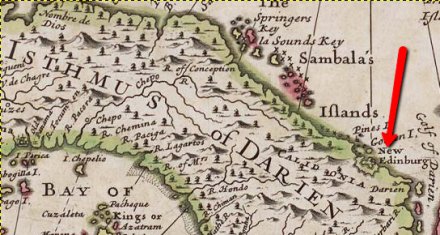

The intended Scottish colony in Panama; map from this University of Glasgow exhibit.

Students of the Panama Canal project will be aware that this malarial tropic would not be described as especially hospitable; to the natural disadvantages of the climate were added the political interpositions of England herself, whose hostility to the advent of her Caledonian neighbor as a New World rival was expressed in legislation choking the Darien adventure of foreign aid.

(Also a problem: Spain. The colony was abandoned at last under Spanish siege.)

So Scotland went it intrepidly, injudiciously alone in this last bid for real independent muscle in Europe. The hyperbole of the Isthmus’s publicists eventually sucked in 20 percent or more of the capital circulating in Scotland. And when Darien-dot-com went bust by 1700 at the cost of a couple thousand lives, it cratered the Scottish economy too. That set the stage for Edinburgh’s partnership in a different scheme: Great Britain.

Green with Envy

In the years following the Darien catastrophe, the Scottish corporation chartered to undertake it was still throwing stuff against the wall in the world trade game, trying to get something to stick to at least take the edge off the losses.

This company (theoretically a potential rival of England’s own East India Company) had suffered the further national indignity of having one of its ships, the Annandale, seized in the Thames for infringing the East India Company’s royal monopoly. Its appeals for redress falling on deaf ears, the Darien company apparently induced Scottish authorities to undertake the retaliatory seizure of an English merchant ship, the Worcester, that had the ill luck to weather a storm at the Firth of Forth.

Rumor soon connected this ship to another vanished Darien company vessel overdue from its return trip from the East Indies … and, as it quickly became understood by all right-thinking Scots, overtaken in the Indian Ocean by this same Worcester and its crew butchered.

Captain Thomas Green and his English crew were hailed before an Admiralty court** on piracy charges on this extremely fantastical connection in a virtual mob atmosphere.

It never was clearly established that an act of piracy had been committed as a distinct fact, but by putting certain circumstances together it was inferred that Green was guilty of piracy. The very shape in which the accusation is set forth, shows that the accusers could not point to the specific act of piracy which had been committed …

[There] was no specification as to the vessel taken, which might enable the accused to prove that it had not been taken; no names of parties murdered, who might be shown still to be alive; no ownership of cargo, which might admit of proof that the owner’s goods had arrived safe. As Green himself is made justly to say in the document published as his dying speech, “We are condemned as pirates and murderers on a coast far distant from this place — is there any of you who wants either a friend whom we have murdered, or whose goods we have taken?”

Worcester Sauce

The Worcester‘s Malabari cook provided a highly dubious charge — dubious, for he was not yet among the crew when it last called at the location he claimed the crime took place — of Green and crew hatchet-murdering approximately ten English-speaking mariners on an unnamed vessel off the Indian coast.

Upon this evidence, 14 or more members (the ready sources are a little loose on the total number) of the Worcester crew were condemned for piracy, and initially slated for three batches of hangings. Queen Anne‘s personal intervention managed a stay,

The Scottish Privy Council unto the very last hours debated what to do with the diplomatic appeals, with evidence forwarded from London to the effect that the crew these Worcester men had supposedly slaughtered were alive, their vessel having been hijacked in another place, by another man.

But a surging Scottish mob aggrieved by the preceding years’ misadventures and the impending shotgun marriage to Westminster rather than anything Green himself had really done was already engorged on the blood of the supposed English corsairs. Most of the Council thought better than to deny them their sacrifice.†

The Streets fill’d with Incredible Numbers of Men, Women and Children, calling for Justice upon those ENGLISH Murtherers. The Lord Chancellor Seafield‘s Coach happening to pass by, they stop’d it, broket he Sashes, haul’d him out, and oblig’d him to promise Execution should speedily be done before he could get from ’em … According to the Chancellors promise, soon after, on the same Day, being Wednesday, Captain Green, Madder [the mate], and Sympson [the gunner] were brought out, and convey’d to Execution, which was at Leith Road upon the Sands, and all the way was Huzza’d in Triumph as it were, and insulted with the sharpest and most bitter Invectives. Being come to the place of Execution, Good God! what a moving sight was it to see those Men stand upon the very Varge of Life, just launching in to Eternity, and at the same time see the whole Multitudet ransported with Joy!”

-From an anonymous Letter From Scotland To a Friend in London, quoted by James Kelly, “The Worcester Affair,” The Review of English Studies, Feb. 2000

In the event, these three were the only ones actually hanged; passions cooled enough for the other “pirates” to be quietly released.

But the wider, national passions unleashed by this date’s executions would long provide fodder for intemperate patriotic recrimination, and specifically anti-Unionist propaganda — on both sides of the border.

Competing propagandistic broadsides framed and re-framed the events, as the affair of unscrupulous English buccaneers or perfidious highland barbarians. (Defoe, maneuvering for Union, wrote to chill such bad-for-business hostility: “Nothing could be more horrid, than that the Scots should Execute these Men on a meer Pique at the English Nation. Nothing can be more like it, than to conclude rashly, that it is so, and improve it on purpose to Exasperate our People against the Scots.” (Kelly))

And that, of course, is precisely the viewpoint that prevailed.

While the hemp neckties issued to Green et al this date threatened to (ahem) scotch the Union project, that very danger might have ultimately hastened its completion — as elites recognized, in Defoe’s words, that Union represented “the only way to preserve the publick Tranquillity, and prevent the certain Mischiefs that threatened the whole Body,” (Kelly, again) and rammed it through with dispatch.‡

* English historian G.M. Trevelyan.

** A lengthy account of the trial can be found in this Google books freebie

† In their very scanty defense, the Scottish magistrates had reason to fear Scottish citizens.

‡ The ebb and flow of national resentment continued long after the Acts of Union, of course; continuing Scottish support for the restoration of the Stuart monarchy was one expression of Scottish nationalism and anti-Union sentiment.

On this day..

1977: Girma Kebede in the Ethiopian Red Terror

There’s a reason why “may you live in interesting times” is a curse.

The eras we call a “Terror” — Stalin’s Russia, Robespierre‘s France, Pol Pot’s Cambodia — are pretty interesting.

Ethiopia in the mid-1970’s was one of the most interesting places in the world.

After the Derg, a shadowy committee of leftist officers, toppled the monarchy in 1974, factional violence between Ethiopia’s two main Marxist parties soon came to the fore.

Long story short, All-Ethiopian Socialist Movement (MEISON) backed the Derg — while its rival the Ethiopian People’s Revolutionary Party (EPRP) denounced it as fascistic.

And when Mengistu assumed dictatorial power in February 1977, it was Red Terror on.

It was as dirty as it sounds, “one of the most systematic uses of mass murder by the state ever witnessed in Africa” according to Human Rights Watch. This was the context of Mengistu’s most notorious public appearance, at an Addis Ababa rally later this same month of April 1977 when he theatrically smashed bottles of (apparently) blood while inciting his supporters against “enemies.”

Now that is red terror.

The Derg-MEISON alliance* built up Kebeles, small neighborhood militias — “essentially a matter of arming the lumpenproletariat against members of the urban intelligentsia,” writes Christopher Clapham.

But even these MEISON-allied goon squads were liable to run afoul of revolutionary justice if their indiscriminate mayhem failed to discriminate at the most essential moment.

On two occasions, March and again in May 1977, house-to-house searches were carried out in Addis Ababa, and suspected EPRP members rounded up for execution. Attempts by the EPRP to launch a school strike were likewise countered by the execution of students who failed to attend classes. The press regularly reported the execution of ‘anarchists’ and ‘paid assassins’. Along with the conflict between the rival political factions went the settling of personal scores, and gratuitous killings by psychotics on either side. The most notorious of these, Girma Kebede, was a Meison kebelle chairman in the Arat Kilo area of Addis Ababa, and the well-educated son of a former high official; he overreached himself by taking away for execution a group of ‘reactionaries’ from the Ministry of Education who included Mengistu’s uncle, and was then shot on the charge of seeking ‘to alienate the people from the Government and incite the broad masses against the revolution’.

On this date in 1977, Girma Kebede paid the forfeit. His, er, strategy of killing scores of humans to alienate the people from the government would take many more years and bodies to succeed.

* Later that year, the Derg-MEISON alliance also fell apart, Mengistu cemented his power, and MEISON got the same treatment it had once meted out to its EPRP enemies.

On this day..

1968: Three blacks in Rhodesia, notwithstanding Queen Elizabeth II

On this date in 1968, Rhodesia earned global opprobrium with a triple hanging in Salisbury (today known as Harare).

Labour M.P. Anne Kerr lays a wreath at the Rhodesian embassy to protest this date’s hangings. A few months later, Kerr would be the one in the world’s headlines … when she was roughed up by Chicago police at the 1968 Democratic Convention.

This was the first “Rhodesian” execution, three years on into the white-supremacist (pdf) breakaway state — which had bucked orderly majority-rule decolonization by declaring independence under its settler government.

So it was hardly a matter of whether James Dhlamini, Victor Mlambo and Duly Shadrack were or were not “guilty”: springing the trap on the gallows was an act fraught with racial hostility within Rhodesia (today, Zimbabwe) and throughout a decolonizing world.

Queen Elizabeth II issued a royal reprieve and the British government warned of the “gravest personal responsibility” attaching to anyone who involved himself in the proposed hanging. Rhodesia royally ignored it.

I have been hanging people for years, but I have never had all this fuss before.

(white) executioner Ted “Lofty” Milton (n.b. seemingly pictured here)

“This fuss” would encompass cross-partisan fury in the British House of Commons as well as a moment of silence in the Indian parliament, denunciations by both America and the Soviet Union … basically everybody. Tanzanian-born British M.P. Andrew Faulds called for criminal sanctions “not excluding the death penalty”. (London Times, , Mar. 7 1968)

There were even demands for humanitarian intervention — amounting to a British military occupation — to protect the other hundred-plus blacks then awaiting the gallows. Needless to say, that wasn’t about to happen, so in the face of Salisbury’s intransigence, was it all just sound and fury?

Does the Secretary of State recall that it was Winston Churchill who said: “Grass grows quickly over the battlefield; over the scaffold, never.”?

-Still-sitting Conservative M.P. Peter Tapsell — then a pup of 38, now the Father of the House — during Parliament’s emotional March 6 debate

Rhodesia insisted on the point by hanging two more Africans five days afterwards … but it also announced 35 reprieves.

In its fifteen years, Rhodesia never did get itself clear of the fuss over white rule; it remained a global pariah and eventually succumbed to its long-running Bush War.

On this day..

1984: Maqbool Bhat, for Kashmir

On this date in 1984, India hanged Kashmiri nationalist Maqbool Bhat.

A terrorist to his enemies and a freedom fighter to his friends, Bhat was born in the Kashmir region back when it “was ruled by the Dogra Family and the entire Kashmiri nation was living a life of slavery.”

When Bhat was a nine-year-old child, the prince of Jammu and Kashmir inked a bitterly controversial accession of his domain to the foundling independent nation of India. Kashmir has been hitched to the adjective “troubled” ever since.

The broader Kashmir region remains a warren of competing claims among Pakistan, India, and China. Bhat operated not for any of these governments, but for Kashmiri independence … and since he came of age in the revolutionary twilight of colonialism, he did not shy from putting the fight in freedom fighter. Bhat was an early exponent of an armed independence struggle.

Both India and Pakistan proscribed as terrorist Bhat’s Jammu and Kashmir National Liberation Front (forerunner of the still-extant JKLF, which is the same acronym less the middle letter); both those longtime subcontinent antagonists arrested Bhat at different times for subversive activities. The most notable: Bhat engineered an airplane hijacking in 1971 to push his cause onto the world’s front pages.

But the hostage-taking game came a-cropper for the Kashmiri rebel.

Languishing under a dormant death sentence for the 1968 murder of an Indian policeman,* Bhat unexpectedly became the focus of his fellow-travelers’ revolutionary ardor: in Birmingham, England, Kashmiri activists kidnapped Indian diplomat Ravindra Mhatre in an attempt to force a hostage exchange.

When Delhi refused to deal, the captors executed Mhatre. Within days, India traded tit for tat by stringing up Bhat — a man who in life had been known for his boast that “nobody has the rope which can hang men.”

They may not have got their man, but they sure got a martyr.

Five years after Bhat’s execution, Kashmir finally broke into armed revolt — Bhat’s very own project, and one that has claimed tens of thousands of lives in the succeeding years.

That movement repeatedly demands the return of Bhat’s remains for burial. It annually marks this anniversary of his martyrdom with tributes and strikes.

* Bhat’s partisans insist that he was wrongly accused.

Update: Reprint of a 1984 article, “The last days of Maqbool Butt”

On this day..

1640: Bishop John Atherton, buggerer

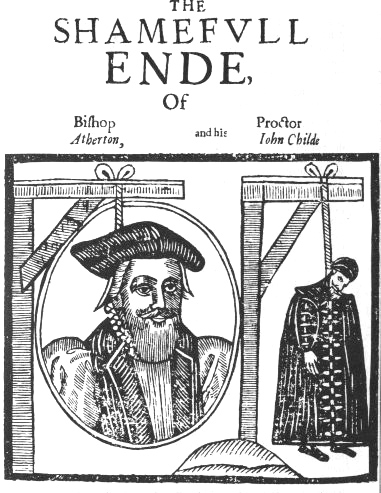
On this date in 1640, John Atherton achieved the unenviable distinction of being the only Anglican bishop hanged for buggery.* (His proctor, and alleged lover, John Childe, got the same treatment a few months later.)


Suppose a Devill from th’infernall Pit,
More Monsterlike, then ere was Devill yet,
Contrary to course, taking a male fiend
To Sodomize with him, such was the mind
Of this Lord Bishop, he did take a Childe
By name, not years, acting a sinne so vilde
-From the text of the pamphlet this image decorates

The Oxford-educated Englishman was appointed Lord Bishop of Waterford and Lismore by King Charles‘s hated governor Thomas Wentworth.

It may well have been the internecine politics of the day that claimed Atherton’s life, just as the civil wars they engendered in the ensuing decades claimed the original trial records.

While posterity is left to speculation, Atherton was defended in print in those years as well. (Defended as no homo, that is — not defended on principle against ubiquitous anti-gay laws.) If it wasn’t really a voracious sexual appetite (not exclusively same-sex**), goes this argument, it was intra-Protestant infighting, with Atherton’s successful clawback of land for the weak Irish Anglican church stepping on the toes of the local land barons who had recently expropriated it.

This politics outside the boudoir argument gets compelling treatment in Mother Leakey and the Bishop, a historical investigative thriller that links Atherton to a weird ghost story† in his native Somerset — that of “Old Mother Leakey,” the Minehead ghost.

Mother Leakey was Atherton’s mother-in-law, and Somerset family members claimed she haunted them — including with a message for the bishop that one of his sisters-in-law actually went to deliver in Ireland. The message isn’t known; in legend, this was a warning from beyond against the prelate’s ungodly behavior; in reality, it was more probably a family shakedown.‡

Despite the skepticism of the Leakey family’s own contemporaries, the facts, allegations, suppositions, and pure flights of fancy somehow managed to blend and recombine into a lasting tale of the paranormal that Minehead still retails to this day.

And it goes right back to the public opprobrium Bishop Atherton endured — as described in that 1641 hanging pamphlet:

“demonstrates the link between the stories of Mother Leakey and Bishop John Atherton … in a highly readable and often entertaining fashion”

… through pride, high fare, and lustfull life,
Incest committed with the Sister of his wife,
For which he sued his pardon, and then fled
To Ireland, where a worser life he led

He surely warned was to mend his life,
By his own Sister Master Leakies wife,
Which Master Leakies Mother being dead,
And in her life-time conscious how he led
His lustfull life, her Ghoast in gastful wise
Did oft appeare before her Sisters Eyes,
But she feare-strucken durst not speak unto it,
Till oft appearing forced her to doe it:
Then thus she spake, Mother in Law what cause
You from your rest, to my unrest thus drawes?
Who answered, daughter tis the wicked life
Your Brother leads, warne him to mend his life;
If not, then plainely tell him tis decreed,
He shall be hangd, bid him repent with speede:
Then shall my restless spirit be at rest,
And not till then; Thus vanisht. She addrest
Herselfe for travaile, Into Ireland went
With this sad message unto him was sent:
Which how he tooke to heart may plaine appeare
By the slight answer he returned her,
What must be, shalbe: If I must, I must dye,
Mariage, and hanging, come by destiny.
Thus scoft her counsell, sent her back, and when
Shee was returnd, he grew farre viler then
He was before, if Viler man may be,
For one bad Act before, committed three.

* According to Who’s Who in Gay and Lesbian History, Atherton and Childe were the second pair of alleged homosexual lovers executed in the British Isles. The first was the Earl of Castlehaven in 1631, along with his manservants.

** “[O]ne should note the compound sexual nature of the ‘sodomy’ charge in this context, a portmanteau omnibus of non-procreative sex, which is what ’sodomy’ was widely held to be.”

† Walter Scott footnotes this legend in Rokeby: “Mrs Leakey … dispatched her [daughter-in-law] to an Irish prelate, famous for his crimes and misfortunes, to exhort him to repentance, and to apprize him that otherwise he would be hanged; and how the bishop was satisfied with replying, that if he was born to be hanged, he should not be drowned.”

‡ Archbishop William Laud dispatched a team of ghost-whisperers to investigate the Leakey story well before the ectoplasm hit the fan for Atherton, and they weren’t buying: “certainly it is a fiction and a practice … it may be some money business.” Bishop Atherton had left home under a cloud with the suspicion that he’d had an affair with his wife’s sister, and this was part of the eventual Irish complaint against the horny goat.

On this day..

1808: Sultan Mustafa IV, by his brother

On this date in 1808, the former, and now deposed, Ottoman Sultan Mustafa IV was strangled at the command of his successor and brother.

The Ottoman Empire, once the very terror of western Christendom, entered the 19th century in a stagnation that had it well on its way to its way to “sick man of Europe” status.

Its fate would be defined by the political — and sometimes literal — battle between its entrenched interests and forward-looking reformers who struggled to restructure the empire for the challenges that lay ahead.

And at this point, it wasn’t only the Ottoman polity that had to fret for its survival. Its very namesake dynasty was in danger of extinguishing itself. There hadn’t been a male born to the House of Osman in twenty years, and in the events herein narrated, internecine conflict would winnow the Osmans down to their very last man.

Aggressive Progressive

Reform was the project of our principal’s predecessor, Selim. In the years around the turn of the century, Selim endeavored to get Turkey out of its wasteful foreign conflicts to gain maneuvering room for more urgent domestic projects.*

Chief among the many oxes Selim proposed to gore were the Janissaries, the Ottomans’ powerful and increasingly archaic military elite, much given to destructive use of their martial prowess in various factional conflicts within the Empire.

Possessive Regressive

The Janissaries deposed Selim in 1807, elevating his cousin — our man, Mustafa, a mere handmaiden of the hidebound. (His contemporaries in Europe more commonly transliterated the name “Mustapha”)

They didn’t kill Selim … just left him alive within the palace where armed men could find him in a pinch.

That pinch arrived in June in the form of Mustafa Bayrakdar, a reformist official who marched on Istanbul to overthrow the reactionary elements. As Bayrakdar took the city in hand, Mustafa desperately ordered the executions of Selim and of Mustafa’s own brother, Mahmud.

Selim was disposed of. Mahmud got tipped off, and the servants — most famously, a Georgian harem girl named Cevri Kalfa — helped him escape to the roof. Mustafa Bayrakdar ousted the ousters before anyone who meant Mahmud ill could find him.

Impressive Successive

That left Mahmud the only choice for Sultan, and he followed his brother’s own questionable policy of consanguinary clemency. Mustafa’s demotion back to crown prince after having once ordered the now-sultan’s death must have made for some awkward chit-chat around the family table.

It didn’t last long. The London Times of January 16, 1809 reported** that

[o]n the 14th of November, at day-break, the Janissaries were seen assembling from all quarters, and being reinforced by those who were in the vicinity of Constantinople, they … massacred all the partisans of the Grand Vizier that came in their way. The contest spread to eveyr street in Constantinople … On the 15th, the Janissaries assaulted the high walls of the Seraglio; and it was at this moment that the Grand Vizier, after causing the unfortunate Mustapha IV, who was a prisoner there, to be strangled, blew himself up in his own Palace with gunpowder, of which he purposely provided a large quantity before-hand, to prevent his falling alive into the hands of his enemies.

Sauce for the goose was sauce for Mustafa, and on this same desperate day when he lost Bayrakdar to a vault of gunpowder, Mahmud had his brother put to death. This maneuver left Mahmud the last surviving male Osman.

Passive Aggressive?

The legacies of this date were varied and ambiguous.

Mahmud II remained on the Ottoman throne for the next three decades, ample time to secure the Osman line.

The Janissaries returned to their barracks, chastened; Mahmud would destroy them after an attempted revolt in 1826.

But Mahmud too was chastened by the experience — or else, too encumbered by the apparatus of the state, or too cautious of his legacy before that heir appeared (it took years), or simply too unskillful — and his reformist vision proceeded haltingly until the very end of his life, even as breakaway nations continued to erode the Porte’s influence.

In his The Decline and Fall of the Ottoman Empire, Alan Palmer says of Mahmud,

Over a century and a half after his death, Mahmud II remains the most puzzling of the thirty-six Ottoman Sultans … Was he a despot or a reformer, a capricious betrayer of trust or a dedicated ruler of a vision, a muddler who plunged into disastrous wars or a shrewd statesman who preserved his Empire from rapacious neighbors? Should we think of him as the ‘Infidel Sultan’ who imposed European ways on the Islamic faithful, or as Mahmud Adli (‘Mahmud the Just’), like Turks today? The contrasts seem endless. Mahmud is one of history’s most enigmatic figures …

* Selim was sucked back into armed conflict by the Napoleonic wars.

** Though two months after the fact, the report is in media res, since it was transcribing German papers from mail dispatched out of the Ottoman capital on Nov. 16 when “the utmost confusion still prevailed there.”

On this day..

1553: Prince Mustafa, heir to Suleiman the Magnificent

On this date in 1553, the capable heir apparent to Ottoman Emperor Suleiman the Magnificent was strangled at dad’s order — casualty of the the realm’s lethal harem politics.

If ’tis state thou seekest like the world-adorning sun’s array,
Lowly e’en as water rub thy face in earth’s dust every day.
Fair to see, but short enduring is this picture bright, the world;
‘Tis a proverb: Fleeting like the realm of dreams is earth’s display.
Through the needle of its eyelash never hath the heart’s thread past;
Like unto the Lord Messiah bide I half-road on the way.
Athlete of the Universe through self-reliance grows the Heart,
With the ball, the Sphere—Time, Fortune—like an apple doth it play.
Mukhlisi, thy frame was formed from but one drop, yet, wonder great!
When thou verses sing’st, thy spirit like the ocean swells, they say.

-Prince Mustafa, about himself

Suleiman’s first-born son by his first concubine, Mustafa seemed well-positioned to emerge in the Ottomans’ fratricidal succession.

The racket: when the current sultan dies, all his sons by his various concubines make a rush from their provincial outposts for the capital and fight it out, the winner killing off his half-brothers to consolidate his rule.

This disorderly ascension made, while dad still lived, for fraught internal politicking among the sons for the inside track: the most prestigious positions, and the assignments closest to Istanbul. The various mothers of the contenders jockeyed just as aggressively on behalf of their various entrants in the imperial sweepstakes.

Mustafa was the capable eldest son in a kingdom at its very acme,* but to his misfortune, and the empire’s too, he found himself pitted against one of the ablest women ever to call the Ottoman harem home: Hürrem Sultan, also known as Roxelana (or Roxolana).

A Ukrainian woman kidnapped to the harem by Tartar slavers, Roxelana enchanted Suleiman and soon became his favorite. Therefore, Roxelana also became the rival, with her son and her own potential heir, to Mustafa and his mother.

As the story is told, Roxelana at length contrived to convince Suleiman that Mustafa was in cahoots with the rival Safavid Empire to supplant Suleiman on the throne; Suleiman had his firstborn summoned to his tent on campaign in Anatolia, and straightaway put to death. He’s supposed to have sat by the body in grief for days afterwards, and barely averted a revolt by his elite Janissaries, who much favored the talented Mustafa.

“This terrible tragedy exercised an effect on Ottoman affairs resembling that which the Massacre of St. Bartholomew had on the history of France,” according to The Cambridge Modern History (vol. 3). Roxelana’s unimpressive son “Prince Selim, in whose favour the crime was committed, was the first of a series of degenerate Sultans, sunk in pleasure-seeking or stricken with Imperial mania, under whose sway the Empire went to ruin.”

Consequently, Mustafa is still mourned in Turkey as a tragic turning-point; visitors pay homage to his tomb at Bursa.

Westerners had word of this fascinating palace intrigue through diplomatic correspondents who were not privy to the actual harem, and adopted the story themselves while imaginatively filling in the orientalizing details. Inevitably these imaginings have helped shape the story as it comes to us.

The scenario blending the familiar and the exotic — a European in the court of the Turk; a slave woman dominating the conqueror; fratricidal princes and the alluring seraglio — all set in the heart of the feared Muslim state proved irresistible to literary interlocutors. These made of Suleiman, Mustafa (Mustapha), and Roxelana moral fables, theater (endorsed by Samuel Pepys!), symphony

… and opera (many librettos, this by Hasse):

Not to mention, of course, more titillating fare.

* The PBS documentary Islam, The Empire of Faith does engrossing coverage of Suleiman (including his relationship with Roxelana and the execution of Mustafa) in these video segments: 3, 4, 5.

On this day..

1914: Rudolf Duala Manga Bell, in German Kamerun

On this date in 1914, the Germans hanged D(o)uala king Rudolf Duala Manga Bell for treason in German Kamerun.

European-educated and on retainer by the colonial German government, Bell was hardly the subversive type: rather, as the head of the largest clan of the important Duala tribe, he was the guy that Berlin looked to to uphold its authority.

This mutually satisfactory relationship began unraveling in 1910, with the Reich’s plan to abnegate the 1884 treaty under whose auspices it intruded into Kamerun (Cameroon) in the first place.

Seeking to confine the Duala to a few coastal villages — and subsequently, to push those Duala to less desirable inland territory — Berlin managed the rare feat of uniting the tribe’s various families, and pushing Rudolf Manga Bell himself into (surprising, to Germany) resistance.

When petitions to the Reichstag were ignored, the Duala began (Bell’s own degree of involvement in this seems to be a disputed point) making noises about holding Berlin in breach of the colonial treaty and finding itself a new European patron, like France or England.

Azanwi Nchami’s Footprints of Destiny (“the historical Cameroonian novel par excellence”) tells the story of Rudolf Manga Bell, Martin Paul Samba, and emergent Kamerunian nationalism.

And one notes the year in this post’s title, which would become momentous to Germany for other reasons. “The coming war,” notes Victor T. LeVine, “made it appear that Manga Bell had been plotting with Germany’s enemies.”

Bell was arrested for treason in the first half of 1914, as the Germans seized prime Bell land along the Wouri River.

In the conflict that became remembered as World War I, the first declarations of war were made in the very first days of August; Axis and Ententethe Central Powers and Triple Entente lined up against one another in the colonial territories, too, and German administrators in Kamerun realized that they were about to face an invasion from neighboring British and French colonies.

So it was in an atmosphere of panic and a view towards desperate internal repression that Bell was tried for treason on August 7, 1914, along with his friend and fellow-traveler Martin Paul Samba — and put to death the very next day.

Postscript

The Allied invasion had taken Duala and the other principal cities of Kamerun from the Germans by the end of September; over an 18-month campaign, the Germans were totally defeated in the territory, which France and England claimed as victors’ spoils after the war. (Also inheriting the tense relationship with the Duala; France was still trying to sort out the 1914 German expropriations that started the whole mess decades later.)

As a result, Rudolf Duala Manga Bell’s son, Alexander Ndoumbe Duala Manga Bell, not only inherited his father’s royal position among the Duala — he became Cameroon’s first elected representative to the French National Assembly.* There’s more about that guy here.

It is here that the Germans part ways with Cameroon’s national story, but there was almost a “peace in our time” diplomatic reconquista.

Although Hitler originally held the colonial movement in great disdain, in the late 1930s his regime ‘adopted’ and coordinated this movement. After 1936 the renewed campaign for the recuperation of German colonies had its desired results among the Allied powers. In discussions between the French Foreign Minister, Yvon Delbos, and the American Ambassador, William Bullitt, proposals were considered for the appeasement of Germany including tariff reductions, the involvement of the Third Reich in the development of Africa, and finally the granting of a colony to Germany, probably the Cameroons. In November 1937, during talks between Premier Chautemps, Prime Minister Chamberlain, Eden and Delbos, the suggestion was allegedly made by Chamberlain that France should ‘hand the Cameroons to Germany at once without any quid pro quo’.**

* Ralph A. Austen, “The Metamorphoses of Middlemen: The Duala, Europeans, and the Cameroon Hinterland, ca. 1800 – ca. 1960”, The International Journal of African Historical Studies, Vol. 16, No. 1 (1983).

** Richard A. Joseph, “The German Question in French Cameroun,” Comparative Studies in Society and History, Vol. 17, No. 1 (1975)

On this day..

1775: Maharajah Nandakumar, judicially murdered?

On this date in 1775, inconvenient Indian official Nandakumar (or Nand Kumar, or Nuncomar) was hanged on a forgery charge — all too conveniently inflicted at the very time he was accusing British Governor-General Warren Hastings of corruption.

Nandakumar and Hastings decidedly did not get along; the Indian believed he had been unfairly denied a plum career assignment.

He leveled in response an accusation that Hastings was taking payola in exchange for his appointments.

English pols involved in the administration of India, such as Philip Francis, John Clavering and George Monson, had their own rivalries with Hastings and wanted to pursue these charges. Instead, within weeks, Nandakumar was facing years-old forgery charges,* and two months after his trial, he was at the end of a rope.

Hastings’ actual involvement in this circumstance is impossible to prove, but

Warren Hastings: not a man to be trifled with. (Portrait by Tilly Kettle.)

The certain facts are that Nand Kumar was Hastings’s enemy, that [India’s Chief Justice Elijah] Impey was Hastings’s friend; that at a moment of grave crisis in Hastings’s life, when Nand Kumar was the most eminent witness against his name and fame, that witness was arraigned on a charge that was very old, that had been suddenly converted from a civil to a criminal charge; that he was tried, found guilty, and executed. On the basis of that bare narrative of facts it would seem that if Hastings had nothing to do with the matter, he might almost as well have had as far as the judgment of posterity went. The thing was too apt, the conditions too peculiar not to leave their stigma upon the memory of the man who gained most by them.

This sort of questionable administration of the crown’s possessions on the subcontinent would lead in 1781 to the Amending Act, an attempt to place India on an organizational footing more conducive to the confidence of an increasingly dubious public.

Parliamentarian heavyweight Edmund Burke would eventually weigh in on the hanged man’s side, charging that Hastings had “murdered this man, by the hands of Sir Elijah Impey.” In a report to the select committee established by the Amending Act (cited in this tome), Burke noted

that this Trial and Execution was looked upon by many of the Natives as political; nor does the Committee conceive it possible, that, combining all the Circumstances together, they should look upon it in the Light of a common judicial Proceeding; but must regard it as a political Measure, the Tendency of which is, to make the Natives feel the extreme Hazard of accusing, or even giving Evidence of corrupt Practices against any British Subject in Station, even though supported by other British Subjects of equal Rank and Authority. It will be rather a Mockery, than a Relief to the Natives, to see Channels of Justice opened to them, at their great Charge, both in the Institution and in the Use, and then Appeals, still more expensive, carefully provided for them, when, at the same Time, Practices are countenanced, which render the Resort to those Remedies far more dangerous than a patient Endurance of Oppression, under which they may labour.

Hastings was impeached for corruption in 1787 — it took Burke, who served as one of the prosecutors, two full days to read the 20-count indictment against him, though Burke’s own attempt to add judicial murder to the bill of particulars was jettisoned — along with the now ex-Chief Justice Impey.

Both were acquitted, even though investigations had laid bare a sort of endemic, routine bakhsheesh: “the native offers because he thinks he is bound to do so, and the Englishman accepts because he fears to hurt the giver’s feelings.” Hastings acknowledged availing himself of donatives, generally arguing that it was the done thing, benefited the East India Company for which he worked, and everything stayed well this side of egregious.

The (lurid) conduct of this impeachment proceeding, and its effect for consolidating British imperial control away from the irregular hands of the British East India Company while generating a national mythology of missionary civilization, is the subject of a fascinating book, The Scandal of Empire: India and the Creation of Imperial Britain.

Another record of the trial is available free from Google books; J. Duncan M. Derrett considers the facts of the forgery case (it “was not a judicial murder”) in the collision of Hindu and English law in “Nandakumar’s Forgery” in The English Historical Review of April 1960.

* He forged part of a will to recover a bad loan. All concerned appear to agree that this charge is factually accurate, which is, of course, a long way from explaining why the matter required immediate adjudication at this juncture.

Incidentally, while forgery could get you hanged in England, it was a much less serious offense under Hindu law.

Part of the Themed Set: The Empire Strikes Back.

On this day..

1917: Gasim, by Lawrence of Arabia

“With Major Lawrence, mercy is a passion. With me, it is merely good manners. You may judge which motive is the more reliable.”

-Alec Guinness as Prince Faisal in Lawrence of Arabia

This date in 1917 was the eve of the Battle of Aqaba, wherein a force of Arabs with famous British officer T.E. Lawrence emerged from the desert to surprise and capture the Ottoman Red Sea port today located in Jordan.*

And that makes this, in the cinematic masterpiece Lawrence of Arabia, the date on which the titular character kept the peace within his fragile coalition by personally executing a malefactor to prevent a tribal blood feud.

The victim, Gasim, is a real figure described in the real T.E. Lawrence’s memoirs

a gap-toothed, grumbling fellow, skrimshank in all our marches, bad-tempered, suspicious, brutal, a man whose engagement I regretted, and of whom I had promised to rid myself as soon as we reached a discharging-place.

Gasim is most famous as the beneficiary of the movie scene in which Lawrence boldly turns back into the desert to rescue this worthless retainer when Gasim’s camel is found riderless in the caravan. This, too, is based on an actual incident in Lawrence’s memoir, albeit heavily dramatized on celluloid.

In the film, Lawrence’s godlike power to give Gasim life is soon mirrored by the godlike power to deprive it.

Effectively exploiting dramatic license, Lawrence of Arabia portrays the Englishman surveying the scene of the coming triumph when a disturbance breaks out in his camp. Hastening thither, he discovers clan lining up against clan over the destructive right of blood vengeance because of a murder in the camp — a murder committed by the man he has saved.

To forestall a “tribal bloodbath” on the very eve of victory, Lawrence himself volunteers to execute the culprit. Having once risked everything to save Gasim, Lawrence sacrifices him ruthlessly when the occasion demands.** This act underscores the chameleon-like other-ness of the character, one of the film’s principal leitmotifs: “I have no tribe, and no one is offended!”

Though the real Lawrence did no such thing to the real Gasim, this astonishing scene is also related in the memoirs — just at an earlier point, and with a different, less dramatically integral character.

My followers had been quarrelling all day; and while I was lying near the rocks a shot was fired. I paid no attention; for there were hares and birds in the valley; but a little later Suleiman roused me and made me follow him across the valley to an opposite bay in the rocks, where one of the Ageyl, a Boreida man, was lying stone dead with a bullet through his temples. The shot must have been fired from close by; because the skin was burnt about one wound. The remaining Ageyl were running frantically about; and when I asked what it was Ali, their head man, said that Hamed the Moor had done the murder. I suspected Suleiman, because of the feud between the Atban and Ageyl which had burned up in Yenbo and Wejh; but Ali assured me that Suleiman had been with him three hundred yards further up the valley gathering sticks when the shot was fired. I sent all out to search for Hamed, and crawled back to the baggage, feeling that it need not have happened this day of all days when I was in pain.

As I lay there I heard a rustle, and opened my eyes slowly upon Hamed’s back as he stooped over his saddle-bags, which lay just beyond my rock. I covered him with a pistol and then spoke. He had put down his rifle to lift the gear; and was at my mercy till the others came. We held a court at once; and after a while Hamed confessed that, he and Salem having had words, he had seen red and shot him suddenly. Our inquiry ended. The Ageyl, as relatives of the dead man, demanded blood for blood. The others supported them; and I tried vainly to talk the gentle Ali round. My head was aching with fever and I could not think; but hardly even in health, with all eloquence, could I have begged Hamed off; for Salem had been a friendly fellow and his sudden murder a wanton crime.

Then rose up the horror which would make civilized man shun justice like a plague if he had not the needy to serve him as hangmen for wages. There were other Moroccans in our army; and to let the Ageyl kill one in feud meant reprisals by which our unity would have been endangered. It must be a formal execution, and at last, desperately, I told Hamed that he must die for punishment, and laid the burden of his killing on myself. Perhaps they would count me not qualified for feud. At least no revenge could lie against my followers; for I was a stranger and kinless.

I made him enter a narrow gully of the spur, a dank twilight place overgrown with weeds. Its sandy bed had been pitted by trickles of water down the cliffs in the late rain. At the end it shrank to a crack a few inches wide. The walls were vertical. I stood in the entrance and gave him a few moments’ delay which he spent crying on the ground. Then I made him rise and shot him through the chest. He fell down on the weeds shrieking, with the blood coming out in spurts over his clothes, and jerked about till he rolled nearly to where I was. I fired again, but was shaking so that I only broke his wrist. He went on calling out, less loudly, now lying on his back with his feet towards me, and I leant forward and shot him for the last time in the thick of his neck under the jaw. His body shivered a little, and I called the Ageyl, who buried him in the gully where he was. Afterwards the wakeful night dragged over me, till, hours before dawn, I had the men up and made them load, in my longing to be set free of Wadi Kitan. They had to lift me into the saddle.

Peter O’Toole’s Lawrence almost palpably manifests the conflicting aspects of his character as he shoots Gasim to death — and he confirms the transformative effect of his first homicide in subsequent dialogue with Gen. Edmund Allenby.

Lawrence: I killed two people. One was … yesterday? He was just a boy and I led him into quicksand. The other was … well, before Aqaba. I had to execute him with my pistol, and there was something about it that I didn’t like.
Allenby: That’s to be expected.
Lawrence: No, something else.
Allenby: Well, then let it be a lesson.
Lawrence: No … something else.
Allenby: What then?
Lawrence: I enjoyed it.

* Actually, Aqaba is Jordan’s only port. This battle was not so epic as the film depicts.

** In a bit of complex foreshadowing, the cinematic Gasim has told Lawrence at the outset of the expedition that “Allah favors the compassionate.”

On this day..