1911: Ah Q

On this date in 1911, the fictional title character of Lu Xun’s The True Story of Ah Q was shot in “Weichuang village,” China.

Ah Q wins another victory. Image from the Marxist Internet Archive.

A modern masterpiece that remains standard reading in China, The True Story of Ah Q was also one of the first literary pieces in the vernacular. Published in 1921 and set in the events of the Xinhai Revolution ten years prior, the novella/short story acidly satirizes China through the biography of the absurdly hapless Ah Q.

Lu Xun (or Lu Hsun) presents the reader a peasant whose real name is literally unknown — an everyman, and no man at all — and proceeds to characterize this discomfiting allegory: a weakling, a bully, a chauvinist, a fool, whose pluck is all folly born of a bottomless capacity for convincing himself that each new failure and humiliation of his abject life is a victory. (In 1933, the American journalist Edgar Snow asked Lu Xun if there were still manh Ah Qs in China. “It’s worse now,” Lu Xun replied. “Now it’s Ah Qs who are running the country.”)

The second and third chapters detail many such “victories.” Through them, the Chinese tongue gained the phrase “the spirit of Ah Q” to indicate determined self-deception.

This story is well worth reading, which can be done for free here.

Though specific calendar dates are scarcely at all alluded to in the narrative itself, the timing of the “climactic” execution — it is an empty death tragic only in its dearth of tragedy, for a revolution that from the author’s standpoint of hindsight was still struggling with the country’s colonial legacy of weakness and backwardness — can be deduced from the text.

Its action takes place in the confused days immediately following the town’s going over to the revolution, which swept through the Chinese provinces in late October and early November of 1911.*

The robbery that precipitates Ah Q’s execution takes place on a night with “no moon”; according to the year’s lunar chart, there was a new moon on the night of Nov. 20. (The December new moon is much too late to make sense.) In the story, it is “four days later” that Ah Q is arrested at night, then drug out for interrogation the next morning (the 25th); returned to his cell and recalled the morning after (the 26th) to sign a confession;** and after one more night in custody,&dagger hauled to an execution he does not even realize is taking place until the last moment.

Suddenly it occurred to him — “Can I be going to have my head cut off?” Panic seized him and everything turned dark before his eyes, while there was a humming in his ears as if he had fainted. But he did not really faint. Although he felt frightened some of the time, the rest of the time he was quite calm. It seemed to him that in this world probably it was the fate of everybody at some time to have his head cut off.

He still recognized the road and felt rather surprised: why were they not going to the execution ground? He did not know that he was being paraded round the streets as a public example. But if he had known, it would have been the same; he would only have thought that in this world probably it was the fate of everybody at some time to be made a public example of.

Ah Q suddenly became ashamed of his lack of spirit, because he had not sung any lines from an opera. His thoughts revolved like a whirlwind: The Young Widow at Her Husband’s Grave was not heroic enough. The words of “I regret to have killed” in The Battle of Dragon and Tiger were too poor. I’ll thrash you with a steel mace was still the best. But when he wanted to raise his hands, he remembered that they were bound together; so he did not sing I’ll thrash you either.

“In twenty years I shall be another …”‡ In his agitation Ah Q uttered half a saying which he had picked up himself but never used before. The crowd’s roar “Good!!!” sounded like the growl of a wolf.

At that instant his thoughts revolved again like a whirlwind. Four years before, at the foot of the mountain, he had met a hungry wolf which had followed him at a set distance, wanting to eat him. He had nearly died of fright, but luckily he happened to have an axe in his hand, which gave him the courage to get back to Weichuang. He had never forgotten that wolf’s eyes, fierce yet cowardly, gleaming like two will-o’-the-wisps, as if boring into him from a distance. Now he saw eyes more terrible even than the wolf’s: dull yet penetrating eyes that, having devoured his words, still seemed eager to devour something beyond his flesh and blood. And these eyes kept following him at a set distance.

These eyes seemed to have merged into one, biting into his soul.

“Help, help!”

But Ah Q never uttered these words. All had turned black before his eyes, there was a buzzing in his ears, and he felt as if his whole body were being scattered like so much light dust.

As for any discussion of the event, no question was raised in Weichuang. Naturally all agreed that Ah Q had been a bad man, the proof being that he had been shot; for if he had not been bad, how could he have been shot? But the consensus of opinion in town was unfavourable. Most people were dissatisfied, because a shooting was not such a fine spectacle as a decapitation; and what a ridiculous culprit he had been too, to pass through so many streets without singing a single line from an opera. They had followed him for nothing.

* According to this footnote, it can be more specifically dated to the fall of Shaoxing, which would have been early November.

** Ah Q has no idea he is signing a confession; an illiterate, he makes his mark with a circle — fixated only on making it a perfect circle, at which endeavor he naturally fails “victoriously.”

† During Ah Q’s last night on earth, the scene cuts to two local officials arguing about the prisoner’s fate, where the man’s life is forfeit in some other mean contest of the municipal pecking order — “Punish one to awe one hundred! See now, I have been a member of the revolutionary party for less than twenty days, but there have been a dozen cases of robbery, none of them solved yet; and think how badly that reflects on me. Now this one has been solved, you come and argue like a pedant. It won’t do!”

‡ According to this footnote, “‘In twenty years I shall be another stout young fellow’ was a phrase often used by criminals before execution, to show their scorn of death.”

On this day..

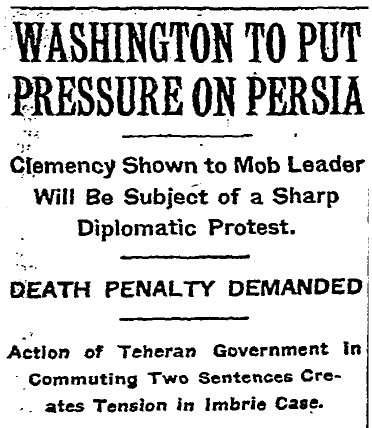
1924: Ali Reshti and Sayyid Husain, to placate America

On this date in 1924, diplomatic maneuvering, oil patch politics, and a dead American consul put two Iranian teenagers in front of a firing squad.

Largely forgotten today, the affair which prompted their execution helped Cossack commander Reza Khan‘s ongoing consolidation of power, culminating in another year’s time with his conquest of the Persian throne itself.

By the summer of 1924, he was by title Prime Minister and his domestic opponents could read the writing on the wall: he had made a premature bid for formal executive authority in 1923 only to be rebuffed.* At the same time, he was engaged in the perilous oil game with an attempt to use American companies to break a British oil monopoly.

On July 18, 1924, American Vice Consul Maj. Robert Imbrie and his civilian countryman Melvin Seymour were attacked by a Tehran mob while photographing a well which had become a Moslem devotional site for purported miraculous healings. Imbrie was beaten to death; Seymour was lucky to survive … and it soon emerged that soldiers from the nearby barracks had not only failed to protect the Americans but actually taken part in the assault.

Iran’s emerging strongman lost no time in making the most of it.

The event gave [Reza Khan] … the excuse for declaring martial law and a censorship of the Press … Numerous arrests have been made, chiefly of political opponents of the Prime Minister. (British military attache Col. W.A.K. Fraser)

It’s like Lenin said, you look for the person who will benefit and, uh, you know, uh, you know, you’ll, uh, you know what I’m trying to say …

Assuming one discerns some measure of design in the Imbrie murder, and the convenient outburst of anti-Baha’i paranoia that sparked the fatal incident, one can go a couple of different directions at this point.

  1. That the Prime Minister’s foes, allied with British oil interests (the British angle was so widely believed in Iran at the time that press censorship forbade the incendiary charge), were firing up the rowdies in an attempt to shake his power. This 1924 American cable makes that case:

    “It had the earmarks from the beginning of an artificially inspired movement, of which the organized powers of evil were quick to take advantage in order to create disorder for the Government … Reza Khan found himself faced with a situation before which he was powerless. The fanaticism of the crowd was so incited by the continuous preaching of the Mullahs that any act on his part would have been interpreted as treason to Islam and prima facie evidence that he was a Bahai; hence his unfortunate orders to the military and the police not to intervene under any circumstances in religious demonstrations and under no circumstances to fire.”

  2. That Pahlavi’s own agents fomented the disorder. According to Michael Zirinsky‘s review of the case, another American official speculated that Reza Khan himself hoped a foreigner would die “so that he could declare martial law and check the power of the Mullahs.”

Which, in the event, is exactly what happened.

The U.S. made a great show of demanding exemplary justice, and it had the leverage to do so: Iran (how times change!) wanted American support and American oil exploitation.

Three were condemned to death for their parts in the riot, and after the first, a young soldier named Morteza said to have incited the mob, was shot on Oct. 2, the government announced leniency for the other two.

Not good enough.


“When you are dealing with a government like Persia … if you ask them to execute a Moslem for the death of a Christian … if they do it, you accomplish more for the prestige of your country than if they paid a million.” -a young Allen Dulles, in 1926 testimony to the U.S. House of Representatives.

At American insistence, those other two were recalled to death after all: 17-year-old mullah Sayyid Husain (various alternate transliterations – e.g., Seyid Hussein), who was supposed to have raised the riot-triggering “Baha’i well-poisoner” accusation in the first place, and 14-year-old camel driver Ali Reshti.

Zirinsky once again:

With the ending of the Iran-U.S. dispute by the execution of Ali and Husain on November 2, 1924, Reza was free to leave the capital city. He had support from the foreign legations, he had secured financing for the army, he had reestablished discipline in the Cossack Brigade, and by executing Sayyid Husain — a mullah — he had demonstrated his domination over the clergy … in the course of the next months’ campaign, he completed the unification of Iran and ensured that his government would get all the [Anglo-Persian Oil Company] royalties…

While the Imbrie affair was not the only critical event of Reza’s seizure of total power in Iran, it came at a critical moment in his rise … he used the murder to his best advantage.

And they all lived happily ever after.

* The future Shah’s future rival Mohammed Mossadegh was among the Iranian Majlis members who blocked Reza Khan’s attempt to rule Iran as a republic in 1923.

** “Blood, Power, and Hypocrisy: The Murder of Robert Imbrie and American Relations with Pahlavi Iran, 1924,” International Journal of Middle East Studies, vol. 18, no. 3 (Aug. 1986). Zirinsky quotes an American diplomat who believed Reza Khan was actually intentionally trying to create a situation where a foreigner would be killed, to give him a pretext for bringing his nation to heel with foreign support.

On this day..

1415: Bardolph, Hal’s friend

On this date in 1415, on the eve of the Battle of Agincourt, the young English King Henry V approved the execution of his onetime boon companion Bardolph in William Shakespeare’s Henry V.

The fictional Bardolph had been the ruddy-nosed friend of Henry’s in the Henry IV plays (Part 1, Part 2), where the hard-drinking, rabble-rousing young prince is a disappointment to the father who fears his heir will never merit the throne.

By Henry V, the boy has become the ruler, and launched an audacious incursion into France during the Hundred Years’ War.

Hal’s willingness to own the rough decisions of statecraft — in this case having his friend put to death further to his win-French-hearts-and-minds policy — is part of his coming of age as Henry V.

Whether that means Hal’s maturation into regal dignity or the corruption of his humanity by power is up to the reader.

KING

How now Fluellen, cam’st thou from the Bridge?

FLUELLEN

I, so please your Maiestie: The Duke of Exeter
ha’s very gallantly maintain’d the Pridge; the French is
gone off, looke you, and there is gallant and most praue
passages: marry, th’ athuersarie was haue possession of
the Pridge, but he is enforced to retyre, and the Duke of
Exeter is Master of the Pridge: I can tell your Maiestie,
the Duke is a praue man

KING

What men haue you lost, Fluellen?

FLUELLEN

The perdition of th’ athuersarie hath beene very
great, reasonnable great: marry for my part, I thinke the
Duke hath lost neuer a man, but one that is like to be executed
for robbing a Church, one Bardolph, if your Maiestie
know the man: his face is all bubukles and whelkes,
and knobs, and flames a fire, and his lippes blowes at his
nose, and it is like a coale of fire, sometimes plew, and
sometimes red, but his nose is executed, and his fire’s
out

KING

Wee would haue all such offendors so cut off:
and we giue expresse charge, that in our Marches through
the Countrey, there be nothing compell’d from the Villages;
nothing taken, but pay’d for: none of the French
vpbrayded or abused in disdainefull Language; for when
Leuitie and Crueltie play for a Kingdome, the gentler
Gamester is the soonest winner.

This is Laurence Olivier’s 1944 version of the scene, with the commoner Bardolph well off-camera:

… and Kenneth Branagh’s more pathos-laden 1989 interpretation, with the king wavering a moment as he locks eyes with his doomed subject, and flashing back to bygone scenes of conviviality before delivering his troop the stern lesson of his friend’s strangling:

Although Bardolph himself and his prior relationship with his sovereign are fiction, the action of the scene actually proceeds from reality. Shakespeare has (as is his wont) cribbed Holinshed, who relates that Henry’s army was under strict orders not to pillage the countryside, and observed that discipline to a man —

except one, which was, that a souldiour tooke a pix out of a church, for which he was apprehended, and the king not once remooved [i.e., he halted] till the box was restored, and the offendor strangled. The people of the countries thereabout, hearing of such zeale in him, to the maintenance of justice, ministered to his armie victuals, and other necessaries, although by open proclamation so to doo they were prohibited.*

* As quoted in the very apt 1992 “Shakespeare’s Henry the Fifth and the Law of War” by Theodor Meron, American Journal of International Law, vol. 86, no. 1.

Part of the Daily Double: Agincourt.

On this day..

30 B.C.E: Caesarion, “Little Caesar”

(Thanks to Jonathan Shipley of A Writer’s Desk for the guest post. -ed.)

Like father like son … unfortunately, in this case.

It was around this date that Ptolemy XV Philopator Philometor Caesar, “Caesarion” to his pals, the son of Julius Caesar and Cleopatra, was put to death by orders of the autocratic Octavian.

Cleopatra and Caesarion walk like Egyptians at the temple of Dendera, Egypt.

Caesarion (“Little Caesar”) was the only known son of Julius Caesar. Octavian, whose claim to power proceeded from his status as Caesar’s adoptive son, became the Emperor Augustus after eliminating the dangerous rivalry of his “brother”.

While most of us at the age of three were putting Matchbox cars in our mouths and eating macaroni and cheese, little Ptolemy XV was co-ruler of Egypt with his famous mom. King in name only, he must have seen his mother still grieving because of Caesar’s assassination March 15, 44 B.C.

The little tyke, though born in Egypt, spent the first couple of years in Rome with Caesar and his mother. Then his dad was stabbed, repeatedly, and Cleopatra took the boy home to Egypt. Proclaimed “King of Kings,” little Caesarion couldn’t realize at his young age the power struggles roiling around him and his mother.

Indeed, things were a little tense outside the family home. (And inside.)

There was some wrestling going on, and not Greco-Roman. No, there were men who wanted power. Lots of power.

There was Mark Antony, Cleopatra’s lover and a Roman General. He was Julius Caesar’s second cousin.

There was the patrician Marcus Lepidus, Caesar’s, for lack of a better word, deputy dictator.

Then, the aforementioned Octavian (Julius Caesar was his great uncle).

Together, the three were the Second Triumvirate, a dream team of Roman political heavyweights. Supreme rule they had. Ambition, sometimes, makes a mess of things. Only one of the three would stand victorious at the end, and there’d be casualties, like Caesarion.

Lepidus was driven into exile to Circeii. At least he died peacefully years later, securely ensconced as the Triumvir You’re Most Likely To Forget.

Conflict between Octavian and Antony climaxed at the Battle of Actium, one of history’s signal events.* (Its anniversary is next week, September 2.)

Octavian won the battle.

Antony escaped to Egypt, but as Octavian’s legions closed in the following year, Antony committed suicide by stabbing himself with a sword. He died in Cleopatra’s arms. Cleopatra’s arms would be cold with death soon after when she committed her famous (supposed) suicide-by-asp on August 12, 30 B.C.


“Death of Cleopatra”, by Edmonia Lewis. (Commentary.)

Before the Queen died, she sent her son Caesarion away from the political tumult.

Now 17, Caesarion bolted to the Red Sea port city of Berenice. Things were looking bleak for the young man. Octavian controlled Alexandria in early August, annexing Egypt to the Roman Empire. Antony died. His mother died. His father had been dead most of his young life. And now Octavian — making an offer he couldn’t refuse — was asking for the lad, the closest living blood relation to Caesar, to come to Alexandria. He was to be spared. There was nothing to fear. Mercy would be heaped upon Caesarion.

It was not to be. “Two Caesars are too many,” Octavian declared … so Caesarion was subtracted. No documentation has been discovered about his death; because of his young age, it is thought he died of strangulation.

Octavian assumed absolute power, became known as Augustus, and died of illness August 19, AD 14. While Augustus, during his reign, was proclaimed a god by the Senate, Caesar’s only known son became a footnote in history, long dead and buried.

* More on the Battle of Actium here and here, and at this episode from the highly recommended The History of Rome podcast. -ed.

On this day..

1997: Norio Nagayama, spree killer and author

On this date in 1997, the wait was over for a writer who had spent his entire adult life awaiting the noose.

Norio Nagayama witnessed another (eventually executed) murderer‘s Tokyo shooting spree in 1965, and three years later popped four people (two security guards and two cabbies) himself. The killing spree shocked Japan.

Only 19 at the time, which made him a juvenile by Japanese law, Nagayama was sentenced, unsentenced, re-sentenced. Twenty-eight years he spent from his arrest until his execution, not necessarily an atypical span for Japan.

It’s what Nagayama did with those years that makes him so remarkable: entering the criminal justice system from an impoverished background, Nagayama became a literary figure and a prominent public spokesman for social justice. He’s still commemorated years after his death.

Nagayama is credited with nine works, the first (Tears of Ignorance) about the poverty he blamed for his murders; the last (Hana) published posthumously from his manuscripts; he donated proceeds to victims’ families and poor children, especially in Peru. In fact, all these years dead, he’s still raising money for children.

Some books by Norio Nagayama
(all in untranslated Japanese)

Nagayama’s death was triggered, at last, by apprehension of a 14-year-old for a sensational crime barely a month prior to this date; in hanging Nagayama, the government aimed “to foster support for legislation that would ‘get tougher’ on juvenile offenders. Indeed, in 2000 Japan’s Juvenile Law was revised to make it easier to transfer minors to adult court.”

Nagayama was hanged in Tokyo with another murderer, Hideki Kanda; a husband-wife convict couple were executed the same day in Sapporo.

On this day..

1546: Anne Askew, the only woman tortured in the Tower

On this date in 1546, Protestant martyr Anne Askew was martyred for her Protestantism.

One of the more intriguing religious martyrs of Tudor England, Askew was a gentlewoman forced to take her older sister’s place in an arranged betrothal when said sister (as was the style in the 16th century) dropped dead young.

Askew’s adherence to Protestantism put her at loggerheads with her Catholic husband, a domestic prefiguring of the factional political dispute that would see her to a Smithfield stake: the Reformation that rent England was itself contested within, with more aggressively reformist Protestant types resisted by the more conservative Catholic-without-Rome faction. Taking the wrong line at the wrong time was taking your life in your hands, and in the treacherous Tudor court, religion became the stalking-horse of deadly politics.

A like conflict played out in townships and households throughout the realm.

Askew and her husband separated (but were not granted divorce) over her conversion to Protestantism; she moved to London and started preaching doctrines anathema to the doctrinaire. As a noblewoman herself, she was absorbed into social circles reaching Henry VIII’s last wife, Katherine Parr.

Askew’s outspoken heterodoxy soon brought her into conflict with anti-Protestants, and when the “send her back to hubbie” strategy didn’t take, they had her clapped in the Tower.

Here she evidently became a pawn in courtly politics; with the obese and aging king liable to drop dead any moment, religious and political authority during the succession was at stake.

Askew was therefore racked in the Tower in an effort to extract evidence against powerful women of known Protestant inclinations, possibly up to and including the queen herself.

Then came Rich and one of the council, charging me upon my obedience, to show unto them, if I knew any man or woman of my sect. My answer was, that I knew none. Then they asked me of my Lady of Suffolk, my Lady of Sussex, my Lady of Hertford, my Lady Denny, and my Lady Fitzwilliam. To whom I answered, if I should pronounce any thing against them, that I were not able to prove it. Then said they unto me, that the king was informed that I could name, if I would, a great number of my sect. I answered, that the king was as well deceived in that behalf, as dissembled with in other matters.

Then they did put me on the rack, because I confessed no ladies or gentlewomen to be of my opinion, and thereon they kept me a long time; and because I lay still, and did not cry, my lord chancellor and Master Rich took pains to rack me with their own hands, till I was nigh dead.

Then the lieutenant caused me to be loosed from the rack. Incontinently I swooned, and then they recovered me again. After that I sat two long hours reasoning with my lord chancellor upon the bare floor; where he, with many flattering words, persuaded me to leave my opinion.

Askew didn’t talk, and the act of torturing a woman shocked contemporaries so much that it has never been officially repeated. She was burned to death with three fellow-heretics in Smithfield, so crippled by torture that she had to be carried in a chair to the pyre.


Anne Askew’s executed, together with John Lascelles, John Adams and Nicholas Belenian. Preaching in the pulpit is Nicholas Shaxton, who avoided the fagots with a timely recantation.

Askew survives to us as a particularly consequential Protestant martyr not only for her what-might-have-been proximity to a court plot that might have altered the course of English history, but because she left her own testimony to the ordeal.

Her Examinations — firsthand accounts of her interrogations — were reportedly smuggled out of England where they were published by John Bale. Still, we come by Anne’s own voice in the mediated form of other (male) publishers with their own agendas.

One reading of Bale’s editions that has now become conventional envisions Askew’s narrative as an embattled text: an authentic narrative, the autobiography of a learned and valiant woman, onto which Bale has imposed an insensitive, misogynistic misreading.

Specifically, Bale has been dinged for shoehorning source material that reveals a contentious and tough-minded critic into the vanilla pattern of the meek woman suffering for the faith — a cardboard cutout martyr shorn of less consumer-friendly unfeminine behavior.

While both Bale and Protestant martyrologist John Foxe, who also published versions of the Examinations, stand in that sense between us and the “real” Anne Askew, their polemical needs are precisely the reason we are able to descry the woman standing behind the martyr-archetype.

while her body was consumed by the flames, her identity remains at least partially preserved. The Henrician Anglo-Catholics made Askew famous through the process of her trial and public execution. The Protestant reformers rhetorically retrieved Askew’s broken, tortured, criminalized body from the stake and restyled it as a saint and symbol of their cause. Her identity thus paradoxically emerges in a variety of ways from the tensions … that we find in all the scraps of surviving archival material relating to her. (Theresa D. Kemp, “Translating (Anne) Askew: The Textual Remains of a Sixteenth-Century Heretic and Saint,” Renaissance Quarterly, Vol. 52, No. 4 (Winter, 1999))

Part of the Themed Set: The Feminine Mystique.

On this day..

1706: Dona Beatriz Kimpa Vita, the Kongolese Saint Anthony

On July 2, 1706, Kimpa Vita, a Congolese noblewoman also known by her baptismal name Dona Beatriz, was burned as a witch in Evululu.

This remarkable woman claimed to be a medium for the spirit of Saint Anthony of Padua, a popular saint in the Catholicized Kingdom of Kongo, and attracted a mass movement in the midst of civil war and social breakdown in the proud Kongo state.

Executed Today is pleased to mark this occasion with an interview with Boston University Prof. John K. Thornton, author of The Kongolese Saint Anthony: Dona Beatriz Kimpa Vita and the Antonian Movement, 1684-1706.


This is a very unfamiliar story to most, as you point out in The Kongolese Saint Anthony. So let’s begin with some orientation — the Kingdom of Kongo is in the midst of a ruinous civil war. Why?

The civil war in Kongo was basically a dynastic affair, that is, a battle between branches of the royal family for control over the throne. Kongo had a very highly centralized political structure, the king and his council had a lot of power not only over who held high office, but also who got what income, because a lot of income derived from holding office. So controlling the kingship and its related patronage was very important.

This story is very complicated, I try to lay it out as simply as possible in Chapter II of my book. To make matters short, by D Beatiz’ day it had two branches duking it out — the Kimpanzu and the Kinlaza, with Pedro IV, conveniently descended from both these families, as a sort of conciliatory figure.

And it’s a highly Catholic country. How did that come to be?

Pretty remarkable story.

Actually I think it’s the only real missionary victory that the Catholic church had in the early modern period. By that I mean that they spread the faith to a completely independent country and not just by conquest.

Officially, it was a series of miracles that both Catholic priests and Kongo elites witnessed in 1491 that led Nzinga a Nkuwu, the king of Kongo to become a Christian and be baptized on May 3, 1491 (my birthday is May 3, 1949 which I have taken to be a sort of sign that I should be studying Kongo).

However, it was Nzinga a Nkuwu’s son Afonso (ruled 1509-1542) that really established the church. Afonso provided for the funding of the church, created schools for teaching literacy and Christian religion for the nobility, had children educated in Portugal and returned to the country, and working with his own educated people and Portuguese priests also figured out how to blend the two traditions into a religion that was acceptable in the country. It’s no wonder the Church called him the “Apostle of Congo”.

The kings who followed elaborated and extended what Afonso started, especially by creating a network of schools all over the country. By and large Rome and Portugal collaborated and blessed the project, so the Pope allowed Afonso’s son Henrique to be the first Sub-Saharan African bishop in 1518, and assigned him to extend the church in Kongo (Henrique died in 1531). In 1596 the Pope made Kongo’s capital city the seat of the Bishop of Congo and Angola.

The Church grew again in the late sixteenth century when a series of kings named Alvaro (I and II, father and son, in particular) went a lot farther than Afonso had in Europeanizing Kongo. They gave the nobles titles of nobility in European fashion (Counts, Dukes and Marquis), the brought in relics from Europe (bones of martyrs, for example), established an embassy in Rome, renamed the capital city as Sao Salvador, and so on. The Kongolese ambassador to Rome, Antonio Manuel, who died in 1608 and is honored in a wing in the church of Santa Maria Maggiore in Rome, left personal papers when he died now found in the Vatican archives. They show the sort of culture a person educated entirely in Kongo could show, in addition to a fascinating array of Kongolese administrative documents — the only ones we have. He also studied Carmelite mysticism, and had correspondence from many different people all over Europe. He was clearly at home among elite Europeans and was regarded by those who met him as a cultured individual in a period when extra-Europeans were not always seen that way.

The Jesuits established a college in Kongo in 1624 and it provided advanced education along European lines until it was close just about the time that Beatriz was active. Kongo had a library, in fact, though no trace of it exists any more, found on the second floor of the Jesuit college.

So in short, the answer is that the political elite of the country decided in the sixteenth century to make their country a Catholic one, and they took vigorous steps to make it happen.

They put teachers out all through the country, visiting priests from Europe constantly met these teachers in the rural areas, they were usually literate and possessed a good deal of knowledge of European culture, some had even lived in Europe. These schoolmasters were the soul of the church; they instructed the people (using a catechism in their own language after 1624), prepared them for the sacraments and led weekly prayers at places of worship, usually large wooden crosses erected at key points all around the country.

So there’s a religious penetration that on the face of it might seem to be a religion of colonization, of foreign domination. But that’s clearly not the way most Kongolese thought about it.

It was never a religion of conquest, and for that reason, the Kongos managed to make it their own without feeling they were abandoning or being forced to give up something. In the sixteenth and seventeenth centuries foreign visitors often commented on how proud the Kongos were, of their country, their language, their food and the like, thinking that they were the best people in the world. “Congo arrogance” was a common epithet that the Portuguese who built the colony of Angola on Kongo’s southern border used to describe them.

And it’s still very true today. I go to Angola quite a bit and have been to Mbanza Kongo twice. You can feel and hear that pride even now. During the colonial period (roughly 1885 to 1975 in that area) the Portuguese tried very hard to replace indigenous languages with Portuguese and to erase African culture in a systematic way, especially after 1926. But the Kongos simply refused to be erased: they continued their language secretly, kept their special foods and taught their children that they were still the best. It worked.

Today in Angola, you see in so many places that Portuguese is the language of daily life — even street kids shout at each other in Portuguese in Luanda and the land east all the way to Malange. But in Mbanza Kongo and elsewhere in the north, the language of daily life is Kikongo, the ancient language of the country. Their pride has been a problem for Kongo, too. In 1992 a lot of them were massacred in Luanda, partially for political reasons that are very complicated, but also I think because other Angolans resent this pride. But enough on that.

Anyway, the Kongolese were proud to be not just Christians but Catholics. The Portuguese tried to invade Kongo from Angola several times, first in 1622, then again in 1657, and finally in 1670. Each time they were decisively defeated. On the other hand, the Kongos were also unable to invade Angola, as they were repelled there also, first in 1580 and again in 1665 (when the famous Battle of Mbwila was fought on the border between the two domains of Angola and Kongo).

This led to great hostility between Kongo and Portugal and especially its governors of Angola. Portuguese were massacred in the wake of the 1622 invasion and after the Battle of Mbwila in 1665, and by the 1670s they had been effectively forced to leave the country, trading their only with Africa servants called pombeiros who represented their interests. (Priests were an exception).

Yet this history didn’t impact on the way Kongos saw themselves as Catholics. King Garcia II (1641-1661) famously wrote a letter in which he proudly stated that they obeyed the Pope, vicar of Christ on earth, even though the Portuguese, whom they hated, had introduced them to the religion. Indeed, the only thing that we see in the correspondence of Kongolese kings that they do say good about Portugal was that it introduced them to the religion.

The idea of a Catholic Kongo was reinforced when Kongo made an alliance with the Dutch. This took place in 1622 in the aftermath of the failed Portuguese invasion. Pedro II, the king, sent a letter to the Dutch States General proposing an alliance in which the Dutch would send a fleet to attack Angola by sea, and Kongo would send an army by land. The first attempt to do this in 1624 failed, in part because the Portuguese went out of their way to conciliate Kongo, but the second attempt, in 1641, succeeded and for a time the Kongo-Dutch alliance (joined by the formidable Queen Njinga of Ndongo-Matamba who was also at war with Portugal) nearly drove the Portuguese out of Angola.

The Dutch hoped to use this opportunity to also convert Kongo to the Calvinism of the Dutch Reformed Church and they even had special literature designed to convert Catholics who spoke Portuguese to Calvinism. But Garcia II would have none of it, and had the books burned (it was the seventeenth century after all), and forced the ministers to leave. He wrote a letter to the Dutch Estates General protesting the attempt and in it he made the statement I summarized in the paragraph above.

Kongo tried to make contact with Dutch speaking Catholic countries in the aftermath of the third failed Portuguese invasion in 1670. It seemed like a good compromise though the Dutch never did come back to Angola to fight, and the Catholic parts weren’t part of the Dutch program.

So, that’s background — now, who is Dona Beatriz Kimpa Vita?

She was the daughter of a noble Kongo family from the region right around Kibangu, a flat-topped mountain that lays some distance east of the capital of Mbanza Kongo (on a clear day you can see that mountain from Mbanza Kongo).

She seems to have had spiritual gifts even as a youth, and had dreams of playing with angels and visions and the like. Not surprisingly, she turned to religious pursuits, becoming a nganga Marinda, a spiritual person whose role the Catholic missionaries did not like, but was widely accepted in the Kongo as legitimate. She was probably too spiritual and independent to be married, since she had two failed marriages by the time she began her prophecy.

Her movement combines both a religious renewal and a national restoration. Should one think of her as a religious person whose cause happened to have political implications, or someone who’s very intentionally trying to alter the balance of power? Is it even right to separate the secular and the religious dimensions?

I think Beatriz was trying to end war as much as anything else. This was at the height of the slave trade: thousands of people were being exported annually to Brazil, to the Spanish Indies, to Suriname, and some even to South Carolina.

The slave trade was one of the byproducts of war (along with death and destruction), and because slavery was lucrative, it helped to continue the wars in a vicious cycle. As Beatriz understood it, the solution was to end the civil war and restore the kingdom. None of the pretenders to the throne seemed able to do that.

She thought that he had sent Saint Anthony do to that, and he had come to earth and chose to be incarnate in her. It harmonized with Kongos’ belief that they were God’s chosen people (he had created Kongo himself, sending his angels to create the rest of the world), and he would intervene to set things right.

And who exactly are her followers?

Beatriz had followers from all ranks and walks of life. Pedro IV had her burned, but his own wife Hipolyta became a devotee. Pedro was intrigued by her message himself. A number of the top contenders also were either tempted or became her followers. The most notable of her followers was Pedro Constantinho da Silva, one of Pedro’s generals who saw allying with her as a chance to become king. Along with the political guys was a great mass of peasants, who really hoped for a better time and thought that Beatriz’ movement could restore the kingdom.

It was the politics of her movement that got her in trouble. Once Beatriz threw herself in with Pedro Constantinho she was doomed because the other contenders became her enemies. It was Pedro IV who managed to capture her, and he had her burned as a heretic and witch. Before she went over to Pedro Constantinho, Pedro IV had been very interested in her mission and protected her.

Dona Beatriz? Kimpa Vita?
What’s In A Name?

Kongos in those days usually had at least two names.

The first one was a zina dia santu (Saint’s name), given as a Portuguese name though often pronounced as in Kikongo and always incorporating “Dom” or “Dona” as part of the name. So someone named Joao would be called Ndozau, and someone named Miguel would be Ndomigel.

Their second name was a Kikongo name, like Mpanzu, Nkuwu, Vita, Nzinga and so on. As far as I can tell people got both names from their parents when they were born, and they probably started using the zina dia santu even before baptism. If people had two Kikongo second names, the second one was the father’s first name, sort of like the Scandanavian system where a Johan’s child is named Johansson.

Beatiz’ second names mean “scheme” or “plan” (Kimpa), and “war” (Vita). It might be because she was born in a war and this was added, or it might just be her father’s first Kikongo name. King Antonio I had Vita as an element in his name; some people use this as evidence she was descended from this king who was killed in the Battle of Mbwila in 1665. I think such a fact would have been noted at the time and I doubt it.

Nowadays, people in Angola and DRC tend to look down on the zina dia santu, which they view (wrongly, I believe) as a remnant of the colonial past. Many Angolans believe that somehow the Portuguese organized all that Christian stuff in Kongo and the local people resisted or rejected it.

I think the reason for this is twofold: first, because that’s what the Portuguese claimed during the colonial period, that they really more or less created the Kingdom of Kongo, which is totally untrue. A second reason is because most Angolans with any nationalist feeling don’t like to be identified with Portugal and so look to a non-Portuguese past. Hence, D Beatriz is rather militantly known as “Kimpa Vita” in Angola and one does not often hear her Christian name, though of course people know it.

-J.K.T.

Dona Beatriz rejects or alters a number of religious practices we might think of as essentially Catholic, like the iconography of the cross, but she’s not doing it in the name of rejecting Catholicism — she’s doing it in the name of Saint Anthony of Padua. Was there simply a pent-up need for renegotiating the way the faith worked for Kongolese? If so, did it happen in some other way after she was executed?

I think she was concerned that Christianity was too European, and one of the things she chided the missionaries about was that they did not represent any black saints.

She had direct revelation from God on her side, she died every Friday and spent each weekend in Heaven conferring with the Heavenly Father about the affairs of Kongo and so what she got there was pretty much undeniable. From these sessions in Heaven she learned the stories about Jesus being born in Nsundi, baptized in Sao Salvador and Mary being a slave of a Kongo marquis. There was probably a lot more richness to these stories that our accounts tell us.

Kongos were pretty sure, I think, that God was an African and their pride also gradually placed stories in Africa, so in this way Beatriz was confirming what people believed or wanted to believe. After her death, we find a lot of art objects, particularly crucifixes, in which Jesus is shown as an African (his features are African) and is wearing a cloth with a specifically Kongo design. Cecile Froment has recently competed a wonderful Ph.D. thesis at Harvard on this art which I think will really demonstrate how much the Church in Kongo incorporated Kongo concepts. I don’t know if Beatriz’ movement inspired this art directly, but her movement and the art together represent what many people were thinking.

An aside here. From Afonso’s time onward, there was a desire to make an independent Kongo church under its own bishop and with its own clergy. They had the educational resources to support this, so they felt they should. Alvaro II entertained ideas that he could control such a church, that the king was “vicar of his kingdom” and could appoint clergy at will. This wasn’t canonical and the church didn’t support it, even going to far as to try some of those who advised him on this through the Inquisition. But even when Kongo got its own bishop in 1596, the kings of Portugal managed to get control of appointment and put Portuguese in there.

This was the cause of endless conflicts between the kings and the bishops, particularly because of the hostility between Portugal and Kongo over Angola. Finally, a compromise was worked out. While the bishop ended up residing in Angola, and he refused to ordain many Kongolese, the priestly needs of Kongo were to be met by missionaries, who weren’t really there to spread the faith (it had already spread) but to perform the sacraments that an ordained priest could. Because Portugal didn’t want Kongolese clergy, and Kongo didn’t want Portuguese clergy, the compromise was to chose Italian clergy who were from neutral states (mostly Florence, but others as well). These priests came from the Capuchin order, a strongly Counter-Reformationist order that wanted to purge Kongo’s Catholicism of its local elements in the name of purifying the faith. That didn’t go so well, and the struggle over just how Kongo the church could be was waged along these lines.

Beatriz came into this struggle on the Kongo side. While not denying the Capuchins their place as priests, she contended with them over the theological questions. She lost this round, mostly for political reasons and not theological ones. Maybe the African Jesus of Froment’s thesis was the theological victory of Beatriz or at least her followers.

She occupies the ruined former capital. What’s the significance here? Had she remained unmolested, what trajectory might her movement have been on?

I think that messianic religious leaders like her in a politically charged environment don’t have much chance unless they are very astute or their supporters are strong. Of course occupying the capital was vital. It had been abandoned in 1678 and was in ruins, yet it was the very symbol of Kongo. The kings were all buried there, the cathedral was there. Holding the city was in effect restoring the kingdom and presumably ending the civil war.

She could only have remained in power if she had stayed with Pedro Constantinho and if his forces had been enough to protect her and to fend off the inevitable attacks that the other two primary contenders, Joao II of Bula and Pedro IV of Kibangu, would mount. Pedro ended up beating both of these two, first Pedro Constantinho in 1709 and then Joao. So with Pedro Constantinho as patron she could not have survived.

She also made the political mistake, which we can only put down to overconfidence or naivete, of going back home to her parents who lived in Pedro IV’s domain to have her baby. Having the baby also upset her, and made her feel guilty since as a saint she should not have done this.

But let’s be a bit speculative and say that Pedro IV didn’t capture her, or he decided to follow her and put distance between himself and the Catholic clergy who were obviously opposed to her. What might have happened? Perhaps he would have re-founded the church in Kongo with a new relationship to Rome, and decided to have Kimpa Vita and some sort of apostolic succession from her ordain priests and bishops. These would clearly have been drawn from the schoolmasters who ran the church in Kongo anyway. A good number of them did become Antonioans and they would have created a new church. It would have had some of its own new traditions, like the stories that Beatriz told about Jesus’ birth in Nsundi and baptism in Mbanza Kongo, or the descent of kings and the like. These might have been written since the chruch was literate and perhaps formed a new scripture. And perhaps they might have found, in time a way to reconcile this with Rome, but maybe not. It would have been an independent church as we see all over Africa now.

What exactly leads to her execution? Cui bono?

Her execution was done following her capture as described above. She was tried in a civil not an ecclesiastic court under Kongo and not church law. Kongo law prescribed punishment for witchcraft and heresy and those were the charges against her.

We don’t know what happened in her trial since the record has not survived (my dream is to find it, since there probably was one once, and who knows, it might have been sent to the Inquisition in Portugal or Angola). But all we know is what the Italian priests, Bernardo da Gallo and Lorenzo da Lucca told us, and they were not invited to the trial (fine by them; they didn’t want to be too closely associated with the results). They questioned her about her beliefs, and da Gallo’s account of that inquiry is our basis for knowing what she believed. But they could do no more on that end than hear the result. They were happy for it since that’s what they wanted too.

Her movement isn’t destroyed by her execution. What happens over the next 2 1/2 years before the Battle of Sao Salvador? And what happens after that battle: What was Dona Beatriz’ immediate legacy? Was she remembered, was her name invoked? What became of her followers?

We know the movement remained very strong in Mbanza Kongo after her death, and that Antonian prayers were shouted out by the defenders of the city in 1709. But there is not documentary mention of them further after that. But don’t read too much into this, since the documentary record becomes very, very quiet after 1710 or so — we just don’t have any details about it from any source. In fact, until I discovered a kinglist written in 1758 (I think by a Kongo) we weren’t sure how long the reigns of the kings were for the next fifty years or even what order they ruled in. It is possible that the movement survived even there.

We also know that the movement had very strong bases in the southwest part of Kongo, in lands belonging the the Kimpanzu faction that had been headed by Suzanna de Nobrega. This faction was not involved in the war in 1709 and thus would not have suffered the inevitable persecution that took place in Mbanza Kongo.

But Manuel II, the king who followed Pedro IV after his death in 1718, came from that faction and region. He had abandoned the Antonians to join Pedro, and perhaps he also suppressed the movement back home. We have a couple of letter from him, written early in his reign and dealing with ecclesiastical matters, but the question of Antonians doesn’t come up in them.

After my book was published, Simon Bockie, a librarian at Berkeley and an excellent ethnographer of Kongo (he’s a Kongo himself) wrote a critical review. He claimed that I had not made use of abundant oral traditions that he had heard in his youth about Kimpa Vita in writing my book and thus I had written an account based on only the testimony of her enemies.*

I had searched published sources in French, Portuguese and Kikongo for traditions that I could relate to Beatriz when I did my research, and I did make as much use of these as I could when I wrote. But at the time I had not been able to do research in Mbanza Kongo and so had to let that aspect go. When my wife, Linda Heywood and I went to Mbanza Kongo in 2002, we specifically asked about traditions concerning Kimpa Vita (as she is usually called today) and were taken to a man who claimed to be the local expert on her. He asked us if we wanted to hear the tradition in French, Portuguese or Kikongo (Mbanza Kongo is very near the border of the Democratic Republic of the Congo and probably half the population is trilingual). We said Kikongo, which he proclaimed to be the right answer. He then went into a half-hour or maybe forty-five-minute discourse on the question. He had some interesting things to say. First, I noticed that he gave dates in his account, but he stated them in French. Likewise, he mentioned the names of the missionaries and the Christian names of Kongo kings in French also. I thought this was strange and concluded that he had received a “fed back” tradition, meaning that he had combined what he might have known from oral sources, such as his parents or elders, with written sources that drew on the movement which was described in French at least as early as 1953.

I might have easily concluded that both his traditions and those Bockie heard as a youth were simply feed back stories made to surround an event known only from modern historical reconstruction. You can hear such a tradition and have no idea that it is of modern creation, since you might not know its sources and even the one telling you might have heard rather than read it. Personal elaboration around a few set facts is a common point of oral tradition, and thus explaining things one receives from tradition or even from books can be expanded this way.

But having said that I was very intrigued by other elements in the story which were purely Kikongo. The most important was the very significant role played in the story I heard in Mbanza Kongo by Beatriz’s mother (ngudi andi Kimpa Vita), to the point where much of the inspiration of the movement was in fact from the mother, and moreoever, the mother continued the movement after her daugher’s death.

The traditionalist went on to link modern religious movements through the descent of this mother. Was it possible that the movement did live on? I can’t say. I do know that several independent churches claim Kimpa Vita as their founder, or claim to be heirs to her message, most notably some branches of the Kimbanguist church (founded in the 1920s by a prophet named Simon Kibangu) and the Bundu dia Kongo, a rapidly growing church founded by Mwanda Nsemi in the 1960s. It could be true, or it could be simply propaganda of these movements, also fed back into tradition.

Was it unusual that this movement was led/instigated by a woman? Or would that not have been consequential to her followers and opponents?

The movement was led by Saint Anthony; D Beatriz was only his earthly form. Why he chose a woman is harder to say.

Did it make a difference that he did? Probably. Beatriz realized that the woman/man thing was a problem. When Pedro’s soldiers arrested her they challenged her, asking how Saint Anthony, who was a man, could have a baby. Her only answer was that she didn’t know, only that it had come from Heaven. She certainly was attentive to women; for example, she could make the barren bear children, and women were among her close followers.

I don’t think, though, that we should read too much into the sex issue. There were also a number of very powerful women in Kongo at her time: Queen Ana Afonso de Leao all but ruled the southeast, and Queen Suzanna de Nobrega ruled the southwest. Although Joao II ruled Lemba, everyone knew that his sister, Elena was the real ruler of that territory. There were provisions in Kongo law allowing women who reached a certain political level to have male concubines and treat them more or less as men treated female concubines.

Finally I confess that I didn’t do as much as I wanted to or could about the question of women and females in Kongo life when I wrote the book, and sacrificed some analytical asides in the interests of narrative. I tried to remedy this ever so slightly in an dense and technical article I published in the Journal of African History, called “Elite women in the Kingdom of Kongo”, not for the faint-hearted, that addressed the question of female power. I had also addressed female power in the life of Queen Njinga, who ruled in the Kimbundu speaking area south of Kongo, in another article some twenty years ago, and I hope to write more about women in the future.

Has there been a reclamation or rediscovery of her in the postcolonial period? How does Dona Beatriz/Kimpa Vita read in Angola now?

As long ago as 1996 there was an official decision to erect a statue to her somewhere in the country. There is an image of her, drawn by Bernardo da Gallo from life, on the cover of my book, so it wouldn’t be hard to do. This would be the “book” D Beatriz Kimpa Vita, with the full apparatus of scholarship, as opposed to the “tradition” Kimpa Vita, supported by the oral traditions and independent churches. It will be interesting to see how these two versions, my book, and Kongo pride run into each other.

* Canadian Journal of African Studies, Vol. 32, No. 3 (1998), pp. 645-647, in which Bockie writes,

As a child growing up in the Lower Congo listening to tales from our oral history, I heard many times about the exploits of Kimpa Vita, who was still remembered after 250 years as a major cultural heroine … It was something of a shock to find that Thornton has chosen to present his account almost exclusively through the eyes of her enemies and killers … there remains no convincing Kongo voice or presence in this book.

On this day..

2003: Three ferry hijackers

On this date in 2003, three men who commandeered a Havana harbor ferry and made a bid for American waters were shot as Cuba cracked down hard on a wave of hijackings.

Things moved extremely quickly for Lorenzo Enrique Copello Castillo, Barbaro Leodan Sevilla Garcia and Jorge Luis Martinez Isaac, described as “the three principal, most active and brutal leaders” of a gang of about 10.* It had been less than two weeks before that they seized the Baragua and ordered it to head for Florida.

The ship ran out of fuel, and the Cuban Coast Guard towed it back to Mariel. There were no injuries reported among the 50 passengers.

In the context of a then three-year-old moratorium on executions on the island, this probably would not have been enough to cost the ringleaders their lives, save that Fidel Castro perceived the need for a salutary example.

Despite the Yankee’s post-9/11 reprobation of “terrorism,” its definition of the phenomenon retained the familiar geopolitical biases — who is and is not a terrorist when it comes to Cuba is driven by anti-Castro Cuban exiles’ outsized political weight in Florida.

So Havana had some alarm to observe a spate of hijackings: two passenger planes had been redirected to Key West in the previous two weeks, and the passengers therefore offered American residency.

Accusing the U.S. of abetting terrorism — Washington blamed Cuba’s airport security — the government sent its own message when the Baragua desperadoes made it three hijackings in a fortnight.**

The Cuban Council of State, including Castro himself, reviewed the charges directly and gave the go-ahead to the shootings.

Hijackings did indeed stop.

Still, such a severe reprisal so swiftly enacted drew sharp rebukes from human rights advocates and even Cuban allies abroad.

Whether chastened by the reaction or just because it was indeed an exceptional circumstance, Cuba subsequently reverted to its de facto moratorium, and has not executed anybody else since this date six years ago. In 2008, Raul Castro commuted most of the extant death sentences in Cuba, leaving only three people — condemned on terrorism charges — still potentially in danger of execution.

* Others drew prison sentences ranging from a few years to life.

** The Cuban government claimed to have prevented yet another attempted skyjacking the night before the execution.

On this day..

1956: Wilbert Coffin

Just after midnight this day in 1956, Wilbert Coffin hanged for murdering three American tourists — a case that has since entered Canadian annals as a paradigmatic wrongful execution.

The aptly-named Coffin affair saw the prospector sent up on an entirely circumstantial case.

Under the pressure of losing tourist dollars to breathless coverage in the U.S., and with the aid of a desultory defense attorney, the Coffin case was rushed along to completion. Though sympathy in Gaspe seems to have been considerable, its elevation to cause celebre was likewise bound up in Quebec politics, pushed by foes of powerful, unscrupulous premier Maurice Duplessis.

Gadfly journalist Jacques Hebert (not the guillotined French Revolution demagogue of the same name, of course) published three books on the case (the 1963 volume immoderately titled J’accuse les assassins de Coffin landed him in jail)

While the death penalty vanished from Canada, the Coffin case has never fully faded as a public controversy. And it’s had something of a revival around the hanging’s recent 50th anniversary, with the government flirting with a posthumous pardon.

There’s even a prime alternate suspect, now dead, whose family has allegedly implicated him.

The Gaspe guitarist who appears in the above piece, Dale Boyle, makes his Wilbert Coffin song (and details about the case) available on his web site.

Lew Stoddard’s blog covers the Coffin case in exacting detail from the standpoint of a strong advocate of the hanged man’s innocence. The Coffin family itself also maintains wilbertcoffin.com, naturally dedicated to clearing Wilbert’s name.

Still, even should officialdom ultimately side with the apparent judgment in the court of public opinion, a wrongful execution is a wound that can never be salved.

I’ve often wondered what went through my brother’s mind when they came and took him out of his cell to take that last walk to be hanged. You can’t imagine what it’s been like to live with this all these years. It’s like a black, black hole that never ends.

On this day..

2003: Liu Yong, for corruption

On this date in 2003, Liu Yong’s situation took a very abrupt turn for the worse.

The wealthy Communist Party member and Shenyang city legislator had been sentenced to death 20 months before in a corruption case for ordering the murder of a tobacco vendor as part of a mafioso racket of graft, extortion, black marketeering, and kindred mayhem.

When that sentence was reduced on retrial on a showing that Liu’s confession was extracted by torture, public outcry at the appearance of a well-connected insider getting off scot-free led the Supreme Court to take the unprecedented step of yet again re-trying a criminal case itself.

“According to China’s legal system, a criminal case can usually be tried only twice,” as China Daily lightly put it.

Amnesty International is less measured, and alleges that the irregular Supreme Court hearing was ordered by political insiders to buttress the credibility of the country’s anti-corruption drive — and to avoid setting any precedent that evidence of torture should mitigate criminal sentencing. (China certainly found defenders for the trial (the link is to an ugly layout of raw HTML).)

The high court handed down its sentence this very day, after which Liu was immediately hailed to one of China’s mobile execution vans, given a lethal injection, and cremated.

On this day..