Unspecified Year: Tess of the d’Urbervilles

On an unspecified July date in an unspecified late-19th century year, the title character of Thomas Hardy‘s Tess of the d’Urbervilles was hanged for murder.

Recent film adaptations of Tess of the D’Urbervilles. The book is available free from Gutenberg.org.

The heroine, “goodness made interesting” — or “A Pure Woman Faithfully Presented,” in the words of the subtitle — has been torn between the man she loves, Angel Clare, and one she loathes, Alec d’Urberville. Alec’s early, unwelcome attentions lead him to forcibly deflower young Tess, and the revelation that she is not a virgin ultimately shatters her prospectively happy marriage to Angel.

Years later, Angel returns from seeking his fortune in Brazil to find Tess miserably wed to her onetime rapist. But no sooner has Tess sent Angel away than she chases him down in the streets of Sandbourne.

“Angel,” she said, as if waiting for this, “do you know what I have been running after you for? To tell you that I have killed him!” A pitiful white smile lit her face as she spoke.

“What!” said he, thinking from the strangeness of her manner that she was in some delirium.

“I have done it — I don’t know how,” she continued. “Still, I owed it to you, and to myself, Angel. I feared long ago, when I struck him on the mouth with my glove, that I might do it some day for the trap he set for me in my simple youth, and his wrong to you through me. He has come between us and ruined us, and now he can never do it any more.”

The two flee together overland, intending to wait out the search that must pursue them and slip away to a ship. They have a few days’ idyllic refuge in an abandoned house, and at once blissful and tragic, Tess foreshadows her fate:

“I fear that what you think of me now may not last. I do not wish to outlive your present feeling for me. I would rather not. I would rather be dead and buried when the time comes for you to despise me, so that it may never be known to me that you despised me.”

Finally forced to move on, they cinematically take their rest at Stonehenge — Tess literally sleeping on an altar.


One of the illustrations of the original serialized version of Tess.

There they are captured — on a pagan shrine, their love long frustrated in its licit form, at last fulfilled on the lam. (“Fulfillment” is the title of the novel’s last section.)

Hardy wastes no words on his heroine’s travail with the judiciary, which is merely inexorable.

The city of Wintoncester, that fine old city, aforetime capital of Wessex, lay amidst its convex and concave downlands in all the brightness and warmth of a July morning. The gabled brick, tile, and freestone houses had almost dried off for the season their integument of lichen, the streams in the meadows were low, and in the sloping High Street, from the West Gateway to the mediƦval cross, and from the mediƦval cross to the bridge, that leisurely dusting and sweeping was in progress which usually ushers in an old-fashioned market-day.

From the western gate aforesaid the highway, as every Wintoncestrian knows, ascends a long and regular incline of the exact length of a measured mile, leaving the houses gradually behind. Up this road from the precincts of the city two persons were walking rapidly, as if unconscious of the trying ascent — unconscious through preoccupation and not through buoyancy. They had emerged upon this road through a narrow, barred wicket in a high wall a little lower down. They seemed anxious to get out of the sight of the houses and of their kind, and this road appeared to offer the quickest means of doing so. Though they were young, they walked with bowed heads, which gait of grief the sun’s rays smiled on pitilessly.

One of the pair was Angel Clare, the other a tall budding creature — half girl, half woman — a spiritualized image of Tess, slighter than she, but with the same beautiful eyes — Clare’s sister-in-law, ‘Liza-Lu. Their pale faces seemed to have shrunk to half their natural size. They moved on hand in hand, and never spoke a word, the drooping of their heads being that of Giotto’s “Two Apostles”.

When they had nearly reached the top of the great West Hill the clocks in the town struck eight. Each gave a start at the notes, and, walking onward yet a few steps, they reached the first milestone, standing whitely on the green margin of the grass, and backed by the down, which here was open to the road. They entered upon the turf, and, impelled by a force that seemed to overrule their will, suddenly stood still, turned, and waited in paralyzed suspense beside the stone.

The prospect from this summit was almost unlimited. In the valley beneath lay the city they had just left, its more prominent buildings showing as in an isometric drawing — among them the broad cathedral tower, with its Norman windows and immense length of aisle and nave, the spires of St Thomas’s, the pinnacled tower of the College, and, more to the right, the tower and gables of the ancient hospice, where to this day the pilgrim may receive his dole of bread and ale. Behind the city swept the rotund upland of St Catherine’s Hill; further off, landscape beyond landscape, till the horizon was lost in the radiance of the sun hanging above it.

Against these far stretches of country rose, in front of the other city edifices, a large red-brick building, with level gray roofs, and rows of short barred windows bespeaking captivity, the whole contrasting greatly by its formalism with the quaint irregularities of the Gothic erections. It was somewhat disguised from the road in passing it by yews and evergreen oaks, but it was visible enough up here. The wicket from which the pair had lately emerged was in the wall of this structure. From the middle of the building an ugly flat-topped octagonal tower ascended against the east horizon, and viewed from this spot, on its shady side and against the light, it seemed the one blot on the city’s beauty. Yet it was with this blot, and not with the beauty, that the two gazers were concerned.

Upon the cornice of the tower a tall staff was fixed. Their eyes were riveted on it. A few minutes after the hour had struck something moved slowly up the staff, and extended itself upon the breeze. It was a black flag.

“Justice” was done, and the President of the Immortals, in Aeschylean phrase, had ended his sport with Tess. And the d’Urberville knights and dames slept on in their tombs unknowing. The two speechless gazers bent themselves down to the earth, as if in prayer, and remained thus a long time, absolutely motionless: the flag continued to wave silently. As soon as they had strength, they arose, joined hands again, and went on.

Among the numerous potential inspirations for the character of Tess was a woman we have already met in these pages: Elizabeth Martha Brown, an battered wife who slew her husband. The teenaged Hardy saw her publicly executed one rainy morning in Dorset in 1856.

On this day..

1535: Cardinal John Fisher

On this date in 1535, Catholic prelate John Fisher was beheaded on Tower Hill for refusing to endorse Henry VIII as the head of the Church of England.

The longtime Bishop of Rochester had only been elevated to the cardinalate weeks before by the new Pope Paul III, in the vain hope that the sublimity of the position would induce King Henry to ease the prelate’s imprisonment.

Henry eased it, all right. Permanently.*

Forbidding the official hat to be delivered to Albion, Henry declared he would dispatch its owner’s head to Rome instead.

A jury including the father of the usurping queen who had occasioned all this trouble — Anne Boleyn, of course, bound for the block herself in less than a year — condemned the aged ecclesiastic to death for treason.

He was hustled to the scaffold on this date to beat the June 24 feast day of his patron and namesake Saint John the Baptist, Christ‘s Biblical precursor who was … beheaded by a ruthless king whose marriage the Baptist had denounced. Struck a little too close to home, that.

Fisher’s friend and fellow-traveler both spiritual and temporal, Sir Thomas More, followed the cardinal’s footsteps to Calvary a fortnight later.

Both men are considered saints not only by Catholics (for obvious reasons) but also by Anglicans. June 22 is their feast day on the Catholic calendar of saints.

* It’s possible Henry had been out for Fisher’s blood for some time. As a foe of the king in his so-called Great Matter of many years’ standing, Fisher was the presumed target of a 1531 assassination-by-poison attempt that resulted in a horrific execution by boiling alive.

On this day..

1606: Caravaggio murders Ranuccio Tomassoni

This site is occasionally prepared to stray outside its execution-anniversary beat to cover especially fascinating manifestations of the death penalty in history.

So for this date, we observe the anniversary not of a punishment, but of the crime itself: a capital homicide in the capital of the world that changed art forever.

NNDB summarizes Caravaggio as a “temperamental painter,” but a less generous interlocutor might prefer a descriptor like “lowlife.”

Painter, he certainly was.

Caravaggio’s pioneering realism and flair for the dramatic …


Caravaggio’s Judith Beheading Holofernes, 1598-1599. Though the young painter on the make would hardly want for models of public decapitation in 16th century Rome, the gendered intimacy with the act invites consideration of Caravaggio’s likely attendance at the execution of Beatrice Cenci.

… made him a rock star on the canvas.

Though the papacy in its dogmatic counter-reformation aspect may have viewed Caravaggio’s eye-catching chiaroscuro with suspicion, there were scudi enough to burst the coinpurse of a talent who could grace a chapel with awe-inspiring stuff like this:


Caravaggio’s Crucifixion of St. Peter, painted in 1601 for Rome’s Santa Maria del Popolo.

However many souls his stark brushwork won for the Church, Caravaggio’s reverential fare belied the creator’s own distinctly profane pastimes: gambling, boozing, brawling, and whoring around. He needed the intervention of well-placed patrons to duck prosecution on several occasions.

May 29, 1606 finds our “temperamental” antihero encountering a wealthy scoundrel by the handle of Ranuccio Tomassoni and a problem that would outstrip any political pull the artist could muster.

Allegedly, the two met to settle a paltry tennis wager, although this may have been a cover story for a rivalry over a courtesan.*

On whatever pretext, the young hotheads fell into a melee. Caravaggio won … and Tomassoni bled to death from the gash his foe dealt to his femoral artery.**

Caravaggio now had mortal blood on his hands. Homicides were treated very harshly by the authorities. Caravaggio was about to have a price put on his head, and if he were caught, that head would be summarily removed from his body and hung on a public street. Allies of Ranuccio bent on revenge were likely to be after him as well. … Caravaggio, the celebrated Italian painter, was now a notorious wanted killer. (Source)

Condemned an outlaw by Pope Paul V — himself fruit of Rome’s Borghese family, great patrons of art in their own right — Caravaggio fled the Eternal City. His brilliance went with him, perhaps even amplified by the exile.

“The fall from grace was huge,” a curator of late Caravaggio works argued. “It had a profound impact. He started expressing the psychological essence of the stories he is telling.”

The painter and killer had four years left to him — an exile spent sleeping clothed and armed, forever looking over his shoulder. But what his jangled nerves could still spare for the canvas would help launch the baroque artistic epoch and still influences us today.

Flight, fancy, and fortune took Caravaggio to Malta and to Sicily, but the year or so he spent as Naples’ visiting genius would make his artistic legacy: that city’s succeeding generations of painters took enthusiastic inspiration from Caravaggio’s Neapolitan offerings — like a Seven Works of Mercy that must have carried a very personal meaning for the hunted man.

He was reportedly as arrogant and hot-tempered on the run as he had been in Rome, but Caravaggio’s art in exile also traces his desperate attempts to undo the consequences of his bad behavior.

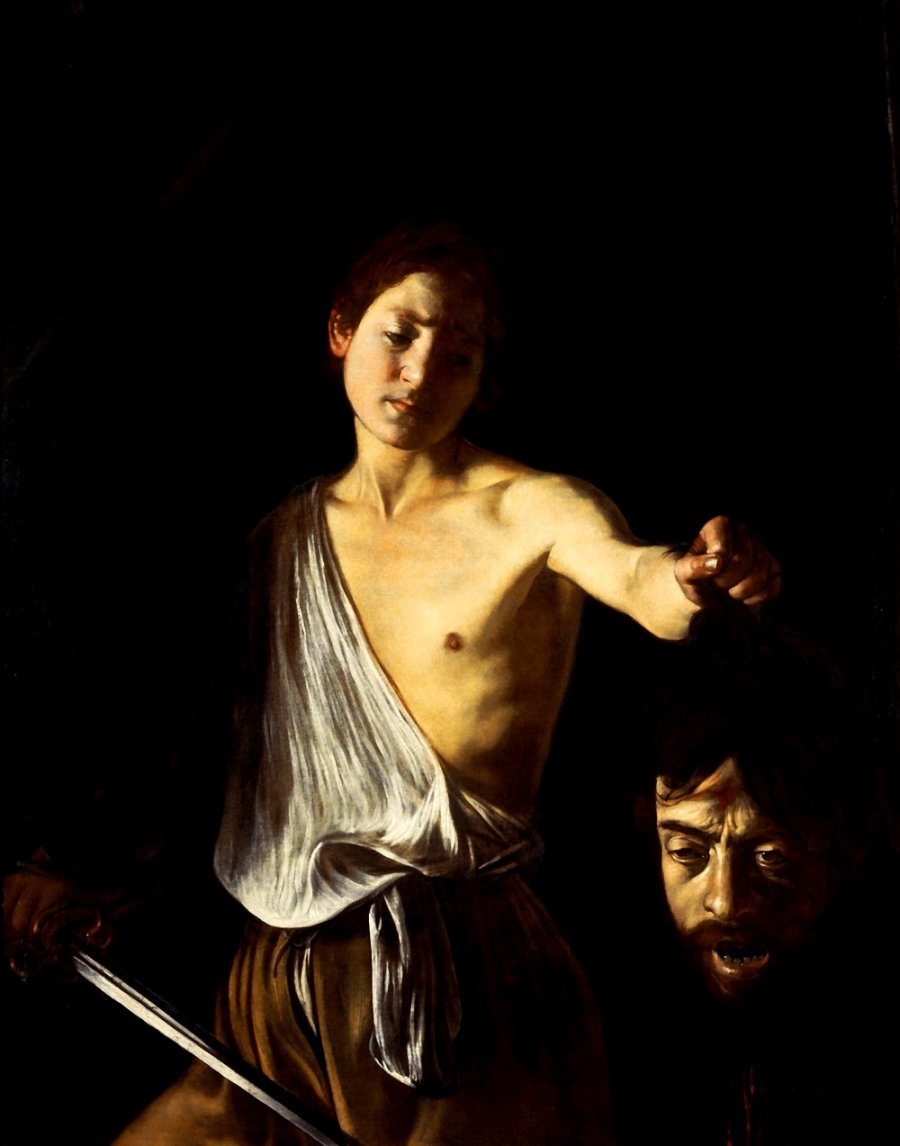
Exploiting his apparent affinity for the sawing off of heads, Caravaggio rendered his own head in a severed state in at least two apparently penitential paintings during this vulnerable period.

This Salome with the Head of John the Baptist was made for the Grand Master of the Knights of Malta after the latter had in 1608 booted Caravaggio from that island refuge:

While David with the Head of Goliath seems to have been created shortly before Caravaggio’s own death for the pope’s art-hounding “Cardinal Nephew” Scipione Borghese, in a bid to earn a pardon. Caravaggio’s self-portrait as the dead man, and Latin inscription “humility kills pride” on the Israelite hero’s sword, suggest an attempt to effect through his creative virtuosity his own execution in effigy.

That would be, at any rate, the only execution Caravaggio ultimately had to endure. He died in the summer of 1610 under unclear — and inevitably suspicious — circumstances while attempting to return to Rome.

A few biographical books about Caravaggio …

… and some Caravaggio art books

* Ranuccio Tomassoni was the pimp and lover of a prostitute named Fillide whom Caravaggio had painted years before, and become enamored of. This Fillide was also Caravaggio’s model for Judith in the arresting painting of the Biblical heroine in mid-decapitation above.

** Possibly, if you like the love triangle angle, in a botched attempt to castrate his rival.

On this day..

1951: Willie McGee

As of today, it is sixty years since the Laurel, Mississippi execution of Willie McGee for rape — a lightning rod for controversy over race, crime, and justice in one of the Cold War’s principal antagonists.

McGee died silent in the state’s portable electric chair, rigged up in the very courtroom of his trial, right in front of the box from whence his all-white jury had retired two and a half minutes before convicting him. Fifty or so observers were there with him — plus those of the hundreds of local residents milling around outside intrepid enough to scale a tree for an illicit view through the courthouse windows.*

(Given the setting, some sources call this a “public execution,” which is not technically correct. This courtroom tableau was actually a standard deployment for the mobile electric chair.)

But McGee’s own silence hardly muted global outrage: for years, appeals for McGee’s life had deluged Mississippi and the White House from Europe, the Soviet Union, and what was quaintly known as “Red China.”

Oh, yes. The Reds.

Willie McGee’s case popped out of backwoods obscurity when he got from the pinko Civil Rights Congress a leftist young attorney — future U.S. Congresswoman Bella Abzug.

Once it got out there, it became the Free Mumia case of the nascent civil rights movement and the nascent Cold War. Its appeal to communist countries and cadres only raised the hackles of American establishment types. This was a Negro raping a white housewife literally and metaphorically.


Author Jessica Mitford (The American Way of Death) campaigning to save Willie McGee’s life. William Faulkner, Albert Einstein, and Josephine Baker also publicly supported McGee.

Whether there actually was a literal rape is the enduring mystery — the enduring Rorschach blot — of the McGee case. The accused himself remained silent on the matter for years; eventually, he claimed that the two were having a consensual but forbidden interracial affair and that he had been brutalized into a confession.

McGee’s defenders believed that the “victim” herself initiated the affair, and

threatened to cry rape if he refused her flirtatious advances … McGee reluctantly went [along] with Hawkins, fearing the tragic consequences of turning her away. “People who don’t know the South don’t know what would have happened to Willie if he told her no,” [Willie’s wife] Rosalee told a friend. “Down South you tell a woman like that no, and she’ll cry rape anyway. So what else could Willie do?”

–At the Dark End of the Street: Black Women, Rape, and Resistance

(In this version, the manipulative Hawkins executed the threat when her husband — who later witnessed McGee’s electrocution — found out. McGee’s cited reason for changing his story was the very plausible fear of lynching.)

A Laurel African-American who was then a child remembers being taken by his family to view the body, and impress upon him the lesson of its electrical burns: “Don’t mess with white girls.”

McGee’s persecutors considered all that miscegenation stuff so much subversive rubbish, a “revolting insinuation,” in the words of the Mississippi Supreme Court.**

And if at its apex the controversy generated more heat than light, its historical fade to embers has not sufficed to resolve the factual questions.

McGee has benefited from a recent rediscovery — one that indicates such memories of the McGee case as persevere in Laurel still divide starkly along racial lines.

Explore this case and its many resonances (without the Perry Mason big reveal) in Alex Heard’s 2010 The Eyes of Willie McGee (review); and, in a spellbinding NPR series on “My Grandfather’s Execution” by Bridgette McGee-Robinson, which is exactly what it sounds like. (Direct links to several Radio Diaries mp3 episodes can be found from the RSS feed here.)

Both were facilitated by a recording of execution-night radio news coverage fortuitously preserved by a young Hattiesburg reporter.

Book Cover

* New York Times, May 8, 1951.

** McGee did at least win two retrials in Mississippi; federal courts gave him short shrift, with anti-civil rights judge Sidney Mize — later memorable for fighting the legal rearguard against integrating Ole Miss — lecturing Abzug in a last-ditch appeal that McGee’s “guilt is plain” and that “courts ought to rise up and defend themselves.” (Source)

Taken as an obvious given: “actually guilty” or not, a defendant executed for rape in the American South is certainly a black man with a white accuser.

On this day..

2000: An adulteress, by stoning

On this date in 2000, according to the New York Times,

Afghanistan’s hard-line Taliban religious rulers stoned a mother of seven to death in northern Afghanistan today after she was found guilty of committing adultery, the Taliban radio said.

The last execution of a woman in Taliban territory was in November, when a woman was shot three times by a Taliban soldier after she was found guilty of killing her abusive husband with an ax.

The stoning today was carried out at a sports stadium in Mazar-e-Sharif in northern Afghanistan before several thousand spectators.

On this day..

1872: Yoarashi Okinu, geisha

On this date in 1872, geisha Yoarashi (“Night Storm”) Okinu was beheaded at Tokyo’s Kozukappara execution grounds after killing her lover to run away with a kabuki actor.

A notorious dokufu, so-called “poison-women” that captivated that country in the late 19th century, Night Storm (English Wikipedia entry | Japanese) was of humble origins but became a sought-after geisha in Edo.

Her celebrity affairs are treated here (reliability: unknown), but the reason she’s in this here blog is poisoning off the second-last of them with arsenic in order to get free to run off with kabuki actor Arashi Rikaku.

Rikaku himself was up to his eyeballs in this same plot, and was arrested — our source says, during a kabuki performance! — and initially condemned to death. Since Okinu was pregnant, however, her execution was put off pending childbirth; eventually, Rikaku’s sentence was moderated from capital punishment altogether.

Okinu’s head was cut off, and displayed in public for several days. Her lover served three years in prison, then rebuilt his kabuki career as Ichikawa Gonjuro.

* The date was the “20th day of the 2nd month of the fifth year of Meiji”, using Japan’s system of dating years from the start of the current emperor’s reign. Helpful in nailing down the date: Tokyo’s first daily newspaper published its first issue on the very next day.

On this day..

1918: Emile Ferfaille, the last in Belgium

On this date in 1918, Belgium carried out its last execution for ordinary crimes — in fact, its only one since 1863.

Now, that figure excludes a reported 242 people executed from 1944 to 1947, in revenge for the Nazi occupation. (To say nothing of those conducted by the Nazis themselves.) But that’s quite a stunning run, considering that death penalty statutes were on the books until 1996: it’s just that the sentences were routinely commuted.

According to the information in this thread on the lively Francophone guillotine.cultureforum.net (it does what it says in the url), Ferfaille murdered his pregnant girlfriend to further his career tomcatting with his other not-yet-pregnant girls. (This being the fourth year of the Great War, a lot of his competition was fertilizing no-man’s lands.)

And as disreputable as hammering one’s lover to death and stuffing her in the vegetable garden is, we’re comfortable averring that it was probably not the single most villainous act to transpire in Belgium the whole of this past century and a half.

Farfaille’s exceptional fate was a consequence of his committing his particular atrocity during that same Great War that gave him such great odds with Flemish females.

Ferfaille was executed in Veurne, just up the road from Dunkirk in the tiny corner of Belgium not occupied by Germany … and he was executed during Germany’s Spring Offensive on the Western Front, its last desperate (and ultimately unsuccessful) gamble* to secure battlefield victory before the recently-committed Americans threw their corn-fed thumbs on the scale.

Despite the conventionality of the crime, Ferfaille’s capital punishment was decreed by military court, since the perp was a soldier. With shells kerploding in the distance, the rakish junior officer was set up to face a tribunal with a particular shortage of patience for his shenanigans. (Belgium also carried out military executions in World War I — it’s just that the others were for military crimes, like desertion.)

Although what remained of Belgium was not jumpy in the execution of its sentence. Quite the opposite.

Actually conducting this beheading** required requisitioning from France prolific belle epoque headsman Anatole Deibler (French Wikipedia entry), and his assistants, and their portable guillotine. (Belgium had a guillotine of its own, but it would have had to cross the front to get to Emile Ferfaille. War is hell that way.)

This party of death made a hazardous journey skirting the charnel house of the Western front, protected by all the might of two nations’ armies for their mission to kill one man in a season where thousands died namelessly day by day … sort of a Bizarro World Saving Private Ryan.

The train took these rather small-time ministers of doom to Dunkirk, where they transferred to a truck for Veurne, then under direct German bombardment. The execution crew stood in only a little less danger than its client, but it carried out the sentence, “publicly” in the town’s all-but-empty square. Due to German shelling, barely anyone in the public witnessed this milestone event.

* The manpower for a western push was facilitated by the recent removal of Germany’s eastern enemy consequent upon the Russian Revolution.

** The penalty demanded by law. Post-World War II executions all seem to have been firing squad affairs even though the letter of Belgian law still apparently prescribed beheading even then.

On this day..

2005: A gay couple in Saudi Arabia

Stay classy, Saudi Arabia.

RIYADH—A gay couple was beaded in a public execution Sunday [March 13, 2005] in Saudi Arabia after being convicted of killing a blackmailer. If they had been exposed as gay they could have been executed anyway.

Homosexuality is punishable by flogging, lengthy prison terms or death under Sharia Islamic law.

The Saudi Interior Ministry issued a statement Sunday announcing the execution. It said that Ahmed al-Enezi and Shahir al-Roubli, both Saudis, ran over Malik Khan in their car, beat him on the head with stones and set fire to his corpse “fearing they would be exposed after the victim witnessed them in a shameful situation”.

The term “shameful situation” is regularly used by the government to refer to homosexual acts.

The ministry said the two men were executed in the northern town of Arar, near the Iraq border.

The Saudi government routinely rounds up people suspected of being gay. All that is needed is a complaint from someone. In some instances men who are not gay who have been arrested were picked up on the complaint of a neighbor following a dispute.

The kingdom also, on a number of occasions, has blocked access to the only gay Arab news and information site on the internet.

On this day..

2006: The family of Abeer Qassim Hamza al-Janabi

On this date in 2006, a family of Iraqis was taken prisoner and shot by a group of American soldiers.

This date’s entry is, to be sure, well into and even across the zone of borderline executions: it was crime whose authors are serving long prison sentences (although they ducked execution themselves).

It has the barest trappings of execution, enough to give that name descriptively to the killings — but maybe a little more than that, too, for this is the story of an occupation army whose “bad eggs” are endowed with the power of life and death over their subject population

“We’ve all killed Hadjis, but I’ve been here twice and I still never fucked one of these bitches.”

This is an excerpt of a London Guardian article called “The blackest hearts: War crimes in Iraq,” which is itself an excerpt from a book its author published titled Black Hearts: One Platoon’s Descent into Madness in Iraq’s Triangle of Death.

Barker had already picked the target. There was a house, not far away, where there was only one male and three females during the day – a husband, wife and two daughters. One was young, but the other was pretty hot, at least for a Hadji chick. Witnesses were a problem, though; they knew they couldn’t leave anyone alive. Barker asked Green if he was willing to take care of that, even if women and kids were involved. “Absolutely,” Green said. “It don’t make any difference to me.”

Green — Steven Green — is the troubled private who would do the shooting, and the one over whose life a jury wrangled over for 10 hours before finally sparing him lethal injection.

Sneaking up on the house, the soldiers corralled the whole family into the bedroom. After they had recovered the family’s AK-47 and Green had confirmed it was locked and loaded, Barker and Cortez left, yanking Abeer behind them. Spielman set up guard in the doorway between the foyer and living room, while Cortez shoved Abeer into the living room, pushed her down, and Barker pinned her outstretched arms down with his knees.

…

As Green was executing the family, Cortez finished raping Abeer and switched positions with Barker. Green came out of the bedroom and announced to Barker and Cortez, “They’re all dead. I killed them all.” Cortez held Abeer down and Green raped her. Then Cortez pushed a pillow over her face, still pinning her arms with his knees. Green grabbed the AK, pointed the gun at the pillow, and fired one shot, killing Abeer.

The men were becoming extremely frenzied and agitated now. Barker brought a kerosene lamp he had found in the kitchen and dumped the contents on Abeer. Spielman handed a lighter to either Barker or Cortez, who lit the flame. Spielman went to the bedroom and found some blankets to throw on the body to stoke the fire.

The four men ran back the way they had come. When they arrived at the TCP, they were out of breath, manic, animated. They began talking rapid-fire about how great that was, how well done. They all agreed that was awesome, that was cool.

Only after Green was discharged did the crime come fully to light.

At Green’s sentencing in the anomalous confines of Kentucky — he was the first former soldier prosecuted in U.S. civilian court for crimes committed overseas under the Military Extraterritorial Jurisdiction Act — a cousin of Abeer’s murdered parents

spoke last, praising his slain family members and criticising the jury’s reluctance to execute Green. He concluded by turning to Green and saying, “Abeer will follow you and chase you in your nightmares. May God damn you.”

This incident is the subject of the 2007 film Redacted.

On this day..

2010: Jihan Mohammed Ali and Atef Rohyum Abd El Al Rohyum, lovers

You cannot do a kindness too soon, for you never know how soon it will be too late.

-Ralph Waldo Emerson

As of this date last year, the latterly deposed Hosni Mubarak still held power of life and death over subjects.

And on this date in 2010, he used it to turn thumbs-down to both Jihan Mohammed Ali and Atef Rohyum Abd El Al Rohyum.

Those two were condemned for the 2004 murder of Jihan’s husband, but Jihan apparently claimed to have acted alone, involving her lover only as an after-the-fact accessory to move the body.

(You know what they say … friends help you move. Good friends help you move bodies.)

Atef’s attempts to parlay this information into a new trial or some form of executive mercy fell on deaf ears, prompting a fruitless Amnesty International appeal that Egypt was risking a wrongful execution.

The two were executed on the same day, though not executed together; Jihan hanged in al-Kanater prison outside Cairo, while Atef was put to death in Isti’naf prison.

We suspect that ex-President Mubarak’s regrets, if any, run more to the prosaic opportunities missed in the maintenance and exploitation of power. But given the events of recent months, maybe his soul and his regime alike could have profited from fewer revengeful spirits like Atef.

On this day..