1811: Thomas White and John Newbolt Hepburn of the Vere Street Coterie

Two centuries ago today, two men were hanged at Newgate Prison for buggery as a result of one of 19th century England’s most notorious anti-gay police raids.

Brits whose sexual palate ran beyond the stiff upper lip braved the force of the law to frequent molly houses, private clubs catering to homosexuality, cross-dressing, and the like.

In 1810, bobbies* busted mollies at one such establishment at the White Swan in London’s Vere Street. A press which evidently preferred its nicknames as vanilla as its coition dubbed these apprehended sodomites the Vere Street Coterie.

According to Phoenix of Sodom, a lasciviously queer-loathing account of the Coterie’s misadventures and of “the vast geography of this moral blasting evil” infesting London,

The fatal house in question was furnished in a style most appropriate for the purposes it was intended. Four beds were provided in one room – another was fitted up for the ladies’ dressing-room, with a toilette, and every appendage of rouge, &c. &c. A third room was called the Chapel, where marriages took place, sometimes between a “female grenadier”, six feet high and a “petit maitre” not more than half the altitude of his beloved wife! There marriages were solemnized with all the mockery of “bridesmaids” and “bridesmen”; the nuptials were frequently consummated by two, three or four couples, in the same room, and in the sight of each other. The upper part of the house was appropriated to youths who were constantly in waiting for casual customers; who practised all the allurements that are found in a brothel, by the more natural description of prostitutes. Men of rank, and respectable situations in life, might be seen wallowing either in or on beds with wretches of the lowest description.

It seems the greater part of these quickly assumed feigned names, though not very appropriate to their calling in life: for instance, Kitty Cambric is a Coal Merchant; Miss Selina a Runner at a Police Office; Blackeyed Leonora, a Drummer; Pretty Harriet, a Butcher; Lady Godiva, a Waiter; the Duchess of Gloucester, a gentleman’s servant; Duchess of Devonshire, a Blacksmith; and Miss Sweet Lips, a Country Grocer. It is a generally received opinion, and a very natural one, that the prevalency of this passion has for its object effeminate delicate beings only: but this seems to be, by Cook’s account, a mistaken notion; and the reverse is so palpable in many instances, that Fanny Murry, Lucy Cooper, and Kitty Fisher, are now personified by an athletic bargeman, an Herculean Coal-heaver, and a deaf Tyre-Smith: the latter of these monsters has two sons, both very handsome young men, whom he boasts are full as depraved as himself. These are merely part of the common stock belonging to the house; but the visitors were more numerous and, if possible, more infamous, because more exalted in life.

This intriguing little window into proto- or pre-gay culture opens to us at some cost to its participants, six of whom were confined to the pillory where the dangerous mob (“chiefly consisting of women”) bombarded them

with tubs of blood, garbage, and ordure from their slaughter-houses, and with this ammunition, plentifully diversified with dead cats, turnips, potatoes, addled eggs, and other missiles … They walked perpetually round during their hour [the pillory swivelled on a fixed axis]; and although from the four wings of the machine they had some shelter, they were completely encrusted with filth … On their being taken down and replaced in the caravan, they lay flat in the vehicle; but the vengeance of the crowd still pursued them back to Newgate, and the caravan was so filled with mud and ordure as completely to cover them.

Worse was to come.

Not arrested on the initial bust or included on the pillory, a 16-year-old regimental drummer named Thomas White was snitched out by a fellow-drummer for having also been a White Swan regular … and in fact, “an universal favourite … very deep in the secrets of the fashionable part of the coterie.”

The stool pigeon’s motivation was the usual in such cases: said pigeon was also making a bit on the side from the Coterie, and he had a mind to avoid his own self being completely covered with mud and ordure and dead cats and turnips.

This James Mann’s report to his superior officer, and subsequent testimony to the magistrates, got White and his partner in vice Ensign John Hewbolt Hepburn hanged for sodomy.

Our correspondent in Phoenix of Sodom notes the presence among that “vast concourse of people” who witnessed their deaths several nobles whom he clearly takes to be a vanguard of that homosexual agenda, “the Duke of Cumberland, Lord Sefton, Lord Yarmouth, and several other noblemen.” No word on Miss Sweet Lips or Blackeyed Leonora.

Merrie Olde England would go on issuing hempen discharges to gay soldiers for years to come.

As a footnote, the Rev. John Church, who might be the earliest openly homosexual Christian minister in England, was rumored to have performed gay marriages at the club.

* Okay, technically, “bobbies” didn’t yet exist.

On this day..

1957: Walter James Bolton, the last hanged in New Zealand

New Zealand got itself permanently out of the execution business after hanging Walter Bolton this date in 1957 for the murder of his wife.

The 68-year-old farmer was condemned after his wife finally succumbed to a year-long bout with some mysterious recurring ailment — and the post-mortem revealed long-term arsenic poisoning. Since Bolton turned out to have been having an affair with his wife’s sister, the pieces just fell right into place.

Jurors found these circumstances credible enough to stretch Bolton’s neck, but there’s the small problem that Walter Bolton himself also tested for arsenic poisoning.

The defense argued that the farm’s wells must have soaked up the poison from sheep dip.

But if you like your wrongful executions more sinister than dunderheaded, you might turn a wary eye to that adulterous sister-in-law, Florence Doherty, who committed suicide a year after Bolton hanged. This 2001 Investigate magazine argues (beginning on p. 24 of the pdf) that Doherty may have been a serial arsenic poisoner.

(Bolton’s hanging was also botched, to complete the official dog’s breakfast.)

Whether or not Bolton was rightly accused, nothing along the lines of a public scandal over the case triggered death penalty abolition in New Zealand.

It was rather the First World’s collctive mid-20th century move away from capital punishment. Various abolition efforts building in the 1950’s finally led to a 1961 free vote on the matter, in which ten members of the conservative National Party broke party ranks to eliminate the death penalty for all ordinary crimes. (Decades later, a Labour government also eliminated the death penalty for treason; New Zealand has only ever hanged one person for that crime.)

On this day..

2011: Rashid al Rashidi, Mousa mosque murderer

This morning in Dubai, Emirati sailor Rashid al Rashidi was executed by firing squad for raping and murdering four-year-old Moosa (Mousa) Mukhtiar Ahmed in a mosque washroom.

The pedophiliac crime on the first day of Eid al-Adha in 2009 shocked the United Arab Emirates. Eleven judges have okayed the death sentence; even one of al Rashidi’s own lawyers demonstratively resigned himself from the case of “the suspect who brought shame to mankind.”

The terrified al Rashidi met his death at a Dubai shooting range this morning, begging for God’s forgiveness … and also that of his victim’s relatives, five of whom witnessed the execution.

Unsurprisingly, the aggrieved family wasn’t biting.

“I will never forgive him,” Mousa’s father reportedly told the Grand Mufti to whom al Rashidi had entrusted his contrition.

It’s the first execution in the UAE 1945: Giovanni Cerbai, partisan

  • 1726: Margaret Millar, infanticide
  • 1938: Vladimir Antonov-Ovseyenko, Winter Palace stormer
  • 1956: Elifasi Msomi, witch doctor
  • 1854: John Tapner, the last hanged on Guernsey
  • 1945: Anacleto Diaz, Philippines Supreme Court Justice
  • 1973: Tom Masaba, Sebastino Namirundu, and 10 other Uganda Fronsana rebels
  • 1892: Four anarchists in Jerez
  • 1794: Jacques Roux, the Red Priest, cheats the guillotine
  • 1952: Liu Qingshan and Zhang Zishan, the first corruption executions in Red China
  • 1956: Wilbert Coffin
  • 1905: Samuel McCue, mayor of Charlottesville, Virginia
  • 1879: Takahashi Oden, dokufu and she-demon

    On this date in 1879, Takahashi Oden was put to death for murder at Tokyo’s execution grounds — the last woman beheaded in Japanese history.

    Oden confessed to slaying her lover, and was also suspected of poisoning off her husband.

    This made her perhaps the most infamous of Japan’s dokufu, poison-women — a perceived epidemic of the early Meiji period. Oden’s infamy thrust her into the crime genre’s characteristic harvest pulp literature, like Takahashi Oden yasha monogatari. (Takahashi Oden, the She-Demon’s Tale)

    “Oden’s body became part of a scientific discourse that worked to produce ‘knowledge’ about feminine norms based on determinist biological differences,” Sharon Chalmers observes. “Deviancy was also characterised in terms of ‘masculine’ traits … [and] female transgression was read as sexual excess.”

    And the feeding frenzy of the popular press around each new dokufu only exaggerated the effect: the sexual rapacity angle moved media.*

    Since Japan was all about divining the secrets of the human form from the condemned, Oden was dissected after her death.

    According to Murder Most Modern: Detective Fiction and Japanese Culture, the anatomizing team was especially keen on delineating that scientific discourse of feminine deviance. And, of course, the pamphleteers were keen on publicizing it. In this case, standing as we do today outside the surgeons’ intellectual framework, we can readily discern the corpse’s role for these men as grist for the ideological mill.

    Immediately following her execution, her body was taken to the hospital affiliated with the Metropolitan Police Office (Keishicho) and dissected by an army surgeon and three regular doctors. Some accounts of this autopsy reveal that these doctors focused their attention on Oden’s genitalia during the procedure. Her bizarre autopsy is said to have been prompted by a newly emerging field of study called zokaki ron, roughly “the study of (re)productive organs.” A cross between sheer superstition and legitimate study of anatomy, zokaki ron was getting much scholarly as well as popular attention as one of the branches of science recently introduced from the West. After the autopsy, the primary operating surgeon, Osanai ken (1848-85), made the following report on Oden: “Abnormal thickness and swelling of the labia minor. Over-development of clitoris. Enlargement of vagina.” For Osanai — a skilled physician who is credited with having performed the first operation in Japan with chloroform and even makes an appearance in Shibue Chusai (1916), a novel by Mori Ogai (1862-1922) about a doctor of Chinese medicine in late Edo period Japan — such physical abnormalities explained Oden’s violent nature: after all, she ruthlessly slit her victim’s throat and left him in a pool of his own blood, and it took several blows for the authorities to execute her as she kicked and screamed in resistance.


    Autopsy of Takahashi Oden, from Takahashi Oden yasha monogatari.

    Though a lot of water has passed under the bridge since Oden’s day, she was the subject of a 1958 Nobuo Nakagawa film, Dokufu Takahashi Oden.


    Katsuko Wakasugi as the title character in Dokufu Takahashi Oden.

    * For more on the Oden story as crime literature, see Mark Silver’s “The Lies and Connivances of an Evil Woman: Early Meiji Realism and ‘The Tale of Takahashi Oden the She-Devil'” in Harvard Journal of Asiatic Studies, June 2003 — or, his book Purloined Letters: Cultural Borrowing and Japanese Crime Literature, 1868-1937.

    On this day..

    1891: Ramon Lopez, a Spaniard, aged 38 years

    “Escaped the Rope”

    Los Angeles Time, Oct. 21, 1890

    SANTA BARBARA, Oct. 20 — [By the Associated Press.] Mary Dezirello, aged 22 years, was shot and instantly killed this morning at 10 o’clock by Ramon Lopez, a Spaniard, aged 38 years. Lopez has been bothering the girl with his attentions for some time past, and had made threats of violence against her, declaring that if she did not marry him she should not marry anyone.

    This morning he called at her father’s residence and called her out to the gate. He wanted to make up with her. She refused to have anything to do with him, when he pulled a big Colt’s revolver and shot her through the body. She died almost instantly. Lopez then shot twice at himself, without effect, and then walked away.

    Shortly afterwards an officer came up and went toward Lopez’s house, which is in the same block. Lopez fired three shots at the officer without effect and was then arrested and locked up. Threats of lynching were so strongly made that this afternoon the murderer was taken to Ventura for safe keeping.


    “Bound to Hang Him”

    Los Angeles Times, Oct. 22, 1890

    SANTA BARBARA, Oct. 21 — [By the Associated Press.] A vigilance committee was formed here yesterday to avenge the death of Mary Dezirello, the young girl who was murdered early yesterday morning by Ramon Lopez, because she refused to accept the latter’s attentions. The prisoner was taken to Ventura during the afternoon, but the committee did not believe this and last night over one hundred men visited the County Jail and demanded that Lopez be delivered to them.

    The keys were given to the leader and the jail and courthouse searched, but the murdered [sic] was not found. The feeling against Lopez is at fever heat, and it is reported that members of the Vigilance Committee have sworn to hang him. The officers in Ventura feared that the crowd would go there to take the prisoner, and this morning Lopez and Edwardo Espinosa, another Santa Barbara murderer, were placed on a train at Ventura and taken to Los Angeles for safe-keeping.

    It is reported here tonight that the mother of the murdered girl is dying on account of the tragedy, and that her father is nearly crazed.


    “Last Day on Earth”

    Los Angeles Times, Jan. 26, 1891

    SANTA BARBARA (Cal.) Jan. 25 — [Special.] This was the last day for Ramon Lopez on this terrestrial sphere. Tomorrow, at some time between the hours of 10 and 3, he will be hanged in the jail-yard here for the murder of pretty Mary Dezirello in October last. Everything is in readiness and the rope has been thoroughly tested. He has spent much of the day in company with a priest.

    Sheriff Broughton opened the gates to the jail-yard yesterday and today, and hundreds availed themselves of the opportunity to see a scaffold ready for the hangman. There is considerable suppressed excitement over the event. Lopez eats heartily and is cool and quiet. Several peace officers from adjoining counties are already in the city for the purpose of witnessing the execution.

    “Only One Hitch; An Artistic Execution at the Channel City”

    Los Angeles Times, Jan. 27, 1891

    SANTA BARBARA, Jan. 26 — [Special.] Another life has been snuffed out in obedience to the mandates of the law. Ramon E. Lopez was executed on the gallows here today by the Sheriff of this county in a most expeditious and faultless manner. People who have witnessed a large number of executions say that they never saw anything of the kind so perfectly accomplished.

    The sentence of Lopez said that he should be hanged by the neck until dead some time between the hours of 10 a.m. and 3 p.m. of today. Sheriff Broughton had not given out what would be the exact time of the hanging. By 10 o’clock, however, a large number of curious people, including a few women, were on the grounds, some of whom, of course, held permits which were to admit the bearers of the jail yard. About this time it was rumored around that the execution would be at 11 o’clock.

    THE FAVORED FEW.

    At 10:30 o’clock the gate to the jail inclosure was opened, and the ticket-holders were allowed to pass in one at a time, but before they were permitted to pass under the canvas where the scaffold was erected, each one was required to sign his name in a large blank book, which was kept near the entrance. About one hundred and fifty names were registered in this manner in this manner, which constituted probably three-fourths of those who witnessed the execution. At 10:57 o’clock Sheriff Broughton ascended the platform, and, addressing the crowd below, said: “Gentlemen, I think that a proper respect for the prisoner requires that you should all remove your hats and cease smoking when he comes upon the platform. Please do so from that time until the execution is over.”

    THE PRISONER’S APPEARANCE.

    The speaker then went down the steps and entered the jail, but reappeared almost immediately afterward, accompanied by the prisoner, two deputies and a Catholic priest. The condemned man was dressed in black, wore a plain black tie and carried aloft a large Roman cross. While crossing the yard to the scaffold the priest read aloud in Spanish an invocation from a small book. Lopez walked with a firm, deliberate tread across the grounds and up the steps. A general murmur went through the crowd of “How cool he is!” “What nerve!”

    CONFESSED TO THE PRIEST.

    The priest then stepped to the edge of the platform, and, looking down upon the heads below, said in broken English: “This man has confessed to me that he is guilty of the crime for which he is about to be hanged; he says that he deserves the punishment, and wishes me to ask all whom he may have offended, to forgive him; he is ready.”

    Lopez’s arms and legs were then tied securely by the deputies. In about one minute the black cap was placed over his head, followed immediately by the fatal rope, and at 11:05 Sheriff Broughton pressed the pedal to the platform with his right foot, the trap door was free, and the condemned

    SHOT LIKE AN ARROW

    through the aperture beneath him, a distance of six and a half feet, and there he remained suspended for fifteen minutes, during which time not one tremor or convulsion of any kind was discernable. His neck had been dislocated by the fall, and he moved not a muscle.

    The body vibrated very slightly but did not turn round, and remained exactly was when it dropped. This was considered very remarkable by the crowd. The knot, which had been placed under the left ear, by some means slipped around almost under the center of the chin.

    THE BODY CUT DOWN.

    At the end of the time mentioned the corpse was lowered into a coffin and was taken away by a local undertaker. Two physicians took turns testing the heart’s action and one of them reported to the Sheriff that “the prisoner is dead” at the end of the fifteenth minute.

    The condemned man uttered not a word during the ordeal of the final preparations. Immediately after he ascended the platform the town clock struck eleven times. Lopez soon after turned his face to the south and upward, and seemed for a moment to

    GAZE FULL UPON THE SUN,

    which shone in uninterrupted rays upon him. This was his only voluntary act while on the platform, except kissing the cross, which the priest placed to his lips. The rest of the time he stood perfectly still with his eyes closed, and was apparently the most composed man on the platform.


    “The Crime and Criminal”

    Los Angeles Times, Jan. 27, 1891

    SANTA BARBARA, Jan. 26 — [Special.] For days and days almost the sole topic of conversation here among all classes has been the forthcoming execution of Ramon E. Lopez. This was partly the result of the extraordinary nature of his crime, for which he has suffered death, and partly from the fact that it is the first legal execution ever held in the county. During these days of discussion the condemned man has occupied a small cell upstairs in the county jail, under the eyes of the “death watch,” pacing up and down in his small room or lying stretched out on his cot, conversing with the attendants or an occasional visitor, or playing on his favorite instrument — the guitar.

    RESIGNED TO HIS FATE.

    He was a small, compactly built Spaniard with a typical Castilian face and a very large head which required a 7 1/2 hat. When seen by your correspondent a few days ago he was perfectly calm and collected, and seemed everyway resigned to his impending fate. He was asked if he had any statement for the public, but answered in the negative and added: “The poor girl I loved so well, is gone to her long home; I shall soon go too. I am ready; there is nothing more to be said.”

    I learn that Lopez was a man of considerable intellectual attainments, being especially well versed in the history of his own and contemporary nations. He was a natural mechanic of unusual skill. He had worked at the blacksmith’s trade, but of late years was principally engaged in repairing complicated machinery, including watches and clocks. He was born and raised in this city and was 38 years of age. He has relatives in Los Angeles, Ventura and San Jose.

    LOPEZ’S CRIME.

    The murder he committed was among the most atrocious and inexcusable known to the annals of crime. About 8 o’clock in the morning of October 20, last, he called at the home of his victim in one of the principal residence streets of this city, summoned her to his side, and without even the pretext of a personal quarrel, shot her down on the spot. She was his sweetheart, and they had been engaged to be married. Her parents were opposed to the match and she felt compelled to break off the engagement, and for this she lost her life! Her name was Mary Dezirello, and she was young, beautiful, and accomplished.

    WANTED TO LYNCH HIM.

    The reading public will probably remember the frantic attempts of a mob which came near lynching the murderer, and of his being spirited away by the officers to Ventura, and later to Los Angeles, in order to save his neck. He remained in the Los Angeles County Jail for a month and was then returned to this city. He was tried in December last and promptly convicted of murder in the first degree, the jury occupying only twenty minutes in finding a verdict.

    ANOTHER VICTIM.

    But this was not his only crime. He killed Henry Heldt in Los Angeles in 1883, in a row at a dance, and got three years at San Quentin for manslaughter, but was pardoned out a few years since by Gov. Stoneman. Lopez has not been guilty of any of the smaller vices so common to murderers. On the contrary, he has generally led a quiet, peaceable and industrious life, but has always been known to possess an ungovernable temper.

    THE SOLACE OF RELIGION.

    During the last few days of his life he was under the almost constant tutorage of his father confessor. His prison life has otherwise been quiet and uneventful. A few Christian ladies did, occasionally, visit him and pray and sing in his presence. He was always attentive and respectful to them, and generally asked them to return again. There has been a notable lack of that sickly sentimentality in his case so often displayed by the morbid and curious. It may be worth while to state that after the murder, and before he left the spot, Lopez fired two shots over his own head as if to take his own life; but he seems to have exercised considerable caution in doing so, since neither of the shots took effect.

    A STRANGE ADVERTISEMENT.

    A few days before the killing this extraordinary notice appeared over Lopez’s signature in one of the local papers:

    All those desiring to marry a certain girl might be on the lookout, as their steps, manners and customs will be made known through the press next week in a historical point of view.

    This was no doubt meant for a threat against any gentleman who might sue for the girl’s hand in marriage.

    THE INSTRUMENT OF DEATH.

    The scaffold, which was erected in a corner of the jail yard, has been ready since Friday last, and has been viewed by hundreds of people who were admitted to the premises by the Sheriff. The framework and platform of this scaffold was made in San Bernardino several years ago and its first service was in the case of the murderer McDowell, about the year 1883. Since that time it has done yeoman’s service in “removing” Silvas and Martinez in Los Angeles. It was also got in readiness to add dramatic effect to the taking off of one [Fritz] Anschlag, but that accomplished butcher chose his own method of quitting the earth, and cheated this useful instrument. It was shipped here from Los Angeles several days ago, and althrough it looks a little scarred and weather-beaten, seems sufficient for much substantial service in behalf of good society yet.

    On this day..

    1256: Marie of Brabant, on suspicion of infidelity

    On this date in 1256, Louis II, Duke of Bavaria, had his wife Marie of Brabant beheaded at Donauworth for adultery.

    Louis II depicted with the first two of his three wives: Marie, and the more fortunate Anna of Glogau.

    This 26-year-old uncle of the doomed Conradin was kept away from his spouse for many months on state affairs.

    At some point, he returned furiously convinced of his wife’s infidelity.

    One representative version of the legend has it that

    [Lewis] held his Court in Heidelberg, and by him stood ever his dearest friend, Henry, Count of Leiningen, and to him one day the anxious wife sent a letter, beseeching he would use his influence to quicken her husband’s return. Another missive was dispatched at the same time to Duke Lewis … The old mistake was made, Duke Lewis received the letter destined for his friend, wherein the artless Duchess had assured Henry of Leiningen that, if he accompanied her lord in his return, her pleasure in welcoming him would be great.

    Etcetera.

    That Marie really did exist and really was beheaded on her husband’s authority for adultery appears to be about the extent of the certain information available to us.

    This poignant scenario became embroidered into popular legend (and is supposed to have inspired the tale of one of the classic medieval faithful-accused-wife tales: that of Genevieve of Brabant).

    The accusation evidently appeared quite doubtful in real life, since her husband and executioner Louis subsequently founded the Cistercian Furstenfeld Abbey in penitence.

    She is not to be confused with Marie de Brabant, Queen of France later in the 13th century and a suspect in the poisoning death of the French heir … an affair that cost chamberlain Pierre de la Brosse his life. The words Dante wrote of that later Marie of Brabant would have suited our day’s heroine, too.

    may the Lady of Brabant
    while she’s still in this world, watch
    her ways—or end among a sadder flock

    On this day..

    1640: Bishop John Atherton, buggerer

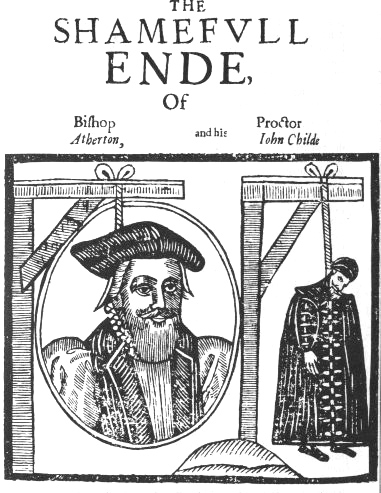
    On this date in 1640, John Atherton achieved the unenviable distinction of being the only Anglican bishop hanged for buggery.* (His proctor, and alleged lover, John Childe, got the same treatment a few months later.)


    Suppose a Devill from th’infernall Pit,
    More Monsterlike, then ere was Devill yet,
    Contrary to course, taking a male fiend
    To Sodomize with him, such was the mind
    Of this Lord Bishop, he did take a Childe
    By name, not years, acting a sinne so vilde
    -From the text of the pamphlet this image decorates

    The Oxford-educated Englishman was appointed Lord Bishop of Waterford and Lismore by King Charles‘s hated governor Thomas Wentworth.

    It may well have been the internecine politics of the day that claimed Atherton’s life, just as the civil wars they engendered in the ensuing decades claimed the original trial records.

    While posterity is left to speculation, Atherton was defended in print in those years as well. (Defended as no homo, that is — not defended on principle against ubiquitous anti-gay laws.) If it wasn’t really a voracious sexual appetite (not exclusively same-sex**), goes this argument, it was intra-Protestant infighting, with Atherton’s successful clawback of land for the weak Irish Anglican church stepping on the toes of the local land barons who had recently expropriated it.

    This politics outside the boudoir argument gets compelling treatment in Mother Leakey and the Bishop, a historical investigative thriller that links Atherton to a weird ghost story† in his native Somerset — that of “Old Mother Leakey,” the Minehead ghost.

    Mother Leakey was Atherton’s mother-in-law, and Somerset family members claimed she haunted them — including with a message for the bishop that one of his sisters-in-law actually went to deliver in Ireland. The message isn’t known; in legend, this was a warning from beyond against the prelate’s ungodly behavior; in reality, it was more probably a family shakedown.‡

    Despite the skepticism of the Leakey family’s own contemporaries, the facts, allegations, suppositions, and pure flights of fancy somehow managed to blend and recombine into a lasting tale of the paranormal that Minehead still retails to this day.

    And it goes right back to the public opprobrium Bishop Atherton endured — as described in that 1641 hanging pamphlet:

    “demonstrates the link between the stories of Mother Leakey and Bishop John Atherton … in a highly readable and often entertaining fashion”

    … through pride, high fare, and lustfull life,
    Incest committed with the Sister of his wife,
    For which he sued his pardon, and then fled
    To Ireland, where a worser life he led

    …

    He surely warned was to mend his life,
    By his own Sister Master Leakies wife,
    Which Master Leakies Mother being dead,
    And in her life-time conscious how he led
    His lustfull life, her Ghoast in gastful wise
    Did oft appeare before her Sisters Eyes,
    But she feare-strucken durst not speak unto it,
    Till oft appearing forced her to doe it:
    Then thus she spake, Mother in Law what cause
    You from your rest, to my unrest thus drawes?
    Who answered, daughter tis the wicked life
    Your Brother leads, warne him to mend his life;
    If not, then plainely tell him tis decreed,
    He shall be hangd, bid him repent with speede:
    Then shall my restless spirit be at rest,
    And not till then; Thus vanisht. She addrest
    Herselfe for travaile, Into Ireland went
    With this sad message unto him was sent:
    Which how he tooke to heart may plaine appeare
    By the slight answer he returned her,
    What must be, shalbe: If I must, I must dye,
    Mariage, and hanging, come by destiny.
    Thus scoft her counsell, sent her back, and when
    Shee was returnd, he grew farre viler then
    He was before, if Viler man may be,
    For one bad Act before, committed three.

    * According to Who’s Who in Gay and Lesbian History, Atherton and Childe were the second pair of alleged homosexual lovers executed in the British Isles. The first was the Earl of Castlehaven in 1631, along with his manservants.

    ** “[O]ne should note the compound sexual nature of the ‘sodomy’ charge in this context, a portmanteau omnibus of non-procreative sex, which is what ’sodomy’ was widely held to be.”

    † Walter Scott footnotes this legend in Rokeby: “Mrs Leakey … dispatched her [daughter-in-law] to an Irish prelate, famous for his crimes and misfortunes, to exhort him to repentance, and to apprize him that otherwise he would be hanged; and how the bishop was satisfied with replying, that if he was born to be hanged, he should not be drowned.”

    ‡ Archbishop William Laud dispatched a team of ghost-whisperers to investigate the Leakey story well before the ectoplasm hit the fan for Atherton, and they weren’t buying: “certainly it is a fiction and a practice … it may be some money business.” Bishop Atherton had left home under a cloud with the suspicion that he’d had an affair with his wife’s sister, and this was part of the eventual Irish complaint against the horny goat.

    On this day..

    1783: Johanna Catharina Höhn, by Goethe’s vote

    “To think is easy. To act is hard. But the hardest thing in the world is to act in accordance with your thinking.”

    -Goethe

    On this date in 1783, Johanna Catharina Höhn lost her head for infanticide … thanks to the vote of the man who wrote the most recognizable infanticide story in literature.

    Eleven years before, then-22-year-old Johann Wolfgang von Goethe had been a firsthand witness to the trial of another infanticide who ultimately lost her head. This case very likely inspired the character Gretchen in Goethe’s best-known work, Faust.

    Faust was a lifelong project for the author, but evidently the same could not be said of empathy for infanticidal mothers.

    As a Privy Councilor to Carl (or Karl) August, Grand Duke of Saxe-Weimar-Eisenach, Goethe was presented with the case of Höhn, a 24-year-old unmarried servant girl who cut her newborn son’s throat.

    Infanticide was an Enlightenment wedge issue touching not only evolving standards of humane criminal justice, but “as the main eighteenth-century area of conflict surrounding social repression and female sexuality.”*

    Was it justice to put mothers to death for infanticide? Was it efficacious for a state to do so — given that such crimes were committed in a state of desperation that might negate deterrence, and that the offenders attracted the pity of potentially unruly scaffold mobs?

    And if the executioner’s sword** was not depended upon to keep women keeping it in their britches, what social policies ought to replace it?

    Infanticide and its prevention was the favorite theme of the criminologists of that time. [Christian] Rothenberger calls attention to the wide discussion of means to care for the poor, to the evil effects of luxury, and then to a “formliche Kindermordlitteratur.”† [L.W.] Seyffarth, the editor of the best edition of [Johann Heinrich] Pestalozzi‘s works, says: “The question how infanticide might be stopped was at that time a burning one.”

    The great interest in infanticide can best be brought to view by the contest for a prize of 100 ducats offered by [Karl Theodor] von Dalberg, intendant of the Mannheim theater, for the best essay on the subject: “What are the best and most practicable means to eradicate infanticide without promoting prostitution?” The contest closed at Whitsuntide, 1781. The offer of the prize was published in most of the newspapers and magazines of that time and was generally accompanied by editorial comments. The editorial in August Ludwig Schlozer‘s magazine Briefwechsel is typical. “There are crimes committed among us,” the editor writes, “which are the most horrible and at the same time the most common, and among these is infanticide; crimes which are related to virtues, virtues which develop into vices, and among these too is infanticide; crimes which experience teaches are not made less frequent by increasing the severity of the punishment, while not to punish them would bring disgrace to mankind and destruction to law and order, and among these too is infanticide … How long shall we lead to the block these unfortunate girls as sacrificial victims, whose love and the natural weakness of their sex, whose adornment of innocence and modesty has made them to be mothers and murderesses?“

    The Duke inclined very strongly to the progressive answer gaining ground at the time, and when Hohn’s case surfaced, he put to his aides the prospect of eliminating the death penalty for infanticide and replacing it with other legal sanctions.

    Those aides produced a mixed response. Goethe, perhaps the duke’s closest advisor, was ultimately in a position to exercise decisive influence on whether to adopt the duke’s proposal. (Whether it was the decisive influence is a matter of some dispute.)‡

    Despite his sensitive portrayal of the fictional Gretchen/Margarete in Faust, the great writer took a distinctly retrograde stance on sparing actual flesh-and-blood women … and Goethe’s position, which he formally voted only 24 days before the execution, carried the day.

    The evidence is clear that there was substantial (though not necessarily unanimous) agreement with the duke’s proposal to abolish the death penalty for infanticide.

    … Without doubt, then, Goethe’s vote carried considerable weight. How could it not? He was the duke’s best friend and thus easily the most powerful member of the Council after Carl August because of his immense influence over him … [and] Goethe unquestionably cast his vote to retain the death penalty for a crime that was widely seen in his time as resulting from social injustice and harbouring wide potential for extenuating circumstances (in principle, not only in particular cases). His vote thus ran entirely counter to his depiction of the case of Margarete in Faust, in which ‘extenuating circumstances’ abound. While the question of Goethe’s guilt is a moral one that need not concern us, his part in the responsibility for retaining the death penalty for infanticide and thus also for the execution of Johanna Hohn is crystal-clear.*

    A Weimar journalist called it “state murder.”

    Hohn’s body was delivered to a Jena professor for anatomization.

    A recent German book, Goethes Hinrichtung (Goethe’s Execution), novelizes the case.

    * W. Daniel Wilson “Goether, his Duke, and Infanticide: New Documents and Reflections on a Controversial Execution,” German Life and Letters, January 2008. This volume includes the (German) text of the previously unpublished Halsgericht, a very detailed “script” for the actual execution. This volume of German Life and Letters also features a ceremonious dialogue between der Scharfrichter, the executioner, and der Richter, the judge, conveying possession of the criminal and legal direction for her punishment, which would all have been enacted in public in the doomed woman’s presence.

    ** Hohn was beheaded with a sword; this was itself a “mercy,” as she could have been dispatched by drowning.

    † Most notably, Die Kindermörderin by Heinrich Leopold Wagner (both German links).

    ‡ Note that the consideration at the level of the Privy Council was formally about whether to abolish the death penalty for infanticide in general — not directly about Hohn’s case, which proceeded on a separate track. It seems to be generally agreed that Goethe and all other parties understood Hohn would live or die based on the statutory decision.

    On this day..

    1761: John Perrott, bankrupt debtor

    On this date in 1761, John Perrott was hanged at Smithfield for fraudulent bankruptcy.

    Perrott was one of the bare handful of British subjects executed during the last century that bankruptcy legislation officially came with hemp teeth; he’s sometimes noted as the last bankrupt put to death, although in reality, he was simply the most famous of the last few.


    John Perrott hanged at Smithfield (detail view; click for full image). From here.

    He got famous in the usual way.

    A once-reputable merchant who blew his fortune in the late 1750s? That backstory does not get you into the Newgate Calendar.

    Fortune blown by siphoning creditors’ money to shady mistress, then refusing to divulge the particulars? Now you’re talking. It’s a wonderful vignette in the annals of moralism to find Perrott on the eve of his execution keeping mum on the subject because he had already received his last Sacrament — the inference being that in speaking, he would only sully his soul with a lie.

    It was an aggravating position for his creditors, who had reason to believe that there remained recoverable cash, in the hands of his “Mrs. Ferne” or elsewhere.

    Creditors always get stuck in a bind when debt goes bad.

    The death penalty for bankruptcy has a long and illustrious history, back to the Roman Twelve Tables with its Shylock-like right for the aggrieved lenders to cut the debtor apart into parts proportional to their lost investments, de debitore in partes secando.*

    Still, that stern corporal stricture has tended to run up against the simple fact that creditors are financially interested parties whose benefit is almost always better served by keeping their debtor among the living where he might be capable of repairing some part of his bond. Slavery, therefore, was often preferred by the ancients and retains a symbiotic relationship to debt to this day: to force the service of a debt, make a man your slave; likewise, to force someone into slavery, make him your debtor. Human traffickers love this tactic.

    At any rate, English bankruptcy law as it evolved was a strange hybrid of public (criminal prosecutions) and private (creditors initiated and paid for the prosecutions). Bluffing a charge at the Old Bailey was just one potential strategem in the contentious relationship between borrower and lender, and not the most effective one, as this Duke law journal article (pdf) by Emily Kadens notes:

    “[I]f this Bill Pass,” [critics of a 1706 bankruptcy measure] warned, “it will never be executed.” The latter prognostication turned out to be virtually correct. Creditors prosecuted infrequently because of the severity of the punishment and the cost and difficulty involved. Even when creditors did bring lawsuits, juries may have been reluctant to convict not only because of the penalty but also because they understood the potential for fraud in the bankruptcy system itself … A man was made a bankrupt by the ex parte declaration of a person claiming to be a creditor … The alleged bankrupt had no right to object … In the meantime, his alleged creditors had taken possession of his assets, leaving him nothing with which he could fight his case, unless he committed a felony by concealing his assets or had friends or family support him.

    That fraud aspect was essential to making it, as Perrott did, so far as the gallows; plain-vanilla bankruptcy was not in itself a capital offense, but a debtor hiding his assets in the process changed matters. The law distinguished the accidental bankruptcy (e.g., the ship with your imports sunk) from the larcenous: “To the misfortunes … of debtors, the law has given a compassionate remedy,” Blackstone notes. “But denied it to their faults.” Which is not to say that many, many debtors did not indulge these “faults.”

    It was nearly two full years from the time Perrott sat his lenders down in a tavern in — naturally — Cheapside to give them the bad news that he was a little bit short, until the time he met the hangman. In that span, auditors picking through the wreck of his estate gradually became aware that the numbers didn’t add up, and his bum business practices (selling 20% below cost to obtain ready cash) still left up to 17,000 missing pounds unexplained.

    By the by, the emergence into the investigation of a paramour, who then turned out to be hiding Perrott-issued banknotes, transformed an ordinary bankruptcy into one of those felonious asset-concealment situations. (And, into fine tabloid fodder for the broadsheets.) When Perrott wouldn’t come clean with the whereabouts of his purloined boodle, his creditors had him up on hanging charges. And when Perrott still wouldn’t come clean — Sacrament and all — he stiffed his lenders at the last by leaving them no way to recover their swag.

    Hopefully, Mrs. Ferne was worth the trouble.

    * More discussion of the Roman jurisprudence here.

    On this day..

    1913: Ernest Austin, the last hanged in Queensland

    On this date in 1913, Ernest Austin was hanged at Brisbane’s Boggo Road Gaol — the last person to suffer that fate in Queensland.

    Austin stalked an 11-year-old girl down a dirt road — one that inconveniently recorded the distinctive prints of his heel-less boot — and raped and murdered her.

    This “mental deficient” (“The State Slays Its Own Creation,” headlined an anti-death penalty newspaper, alluding to Austin’s institutionalized upbringing) was resigned to his fate even prior to conviction. Resigned enough to hurry it along.

    Witness opened the cell door, and found accused standing with an upturned cell bucket by his side. O’Callaghan shook out all the blankets, and found a rope plaited of three strips torn off a blanket. Witness said to accused:—”You should not do anything rash.” Accused replied:—”I will be hanged anyhow.” Witness then said:—”You are not found guilty yet.” Accused said:—”I admit I murdered the girl.”

    Little wonder the government wasn’t interested in clemency.

    Nine years later, Queensland became the first Australian state to abolish the death penalty.

    Austin’s ghost is supposed to haunt Boggo Road Gaol to this day, even though the section of the prison where he died has long since been demolished. The haunting story seemingly rests on an urban legend that Austin was some outsizedly diabolical creature and not the run-of-the-mill pathetic malefactor that a century’s perspective might suggest.

    On this day..