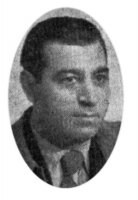
1946: Maliq Bushati, Lef Nosi, and Anton Harapi, of Balli Kombëtar

On this date in 1946,* communist Albania executed three former officials of its deposed wartime government.

Fascist Italy occupied Albania during World War II.

In a situation mirroring that of neighboring Yugoslavia, there were two resistance movements that sometimes maintained an uneasy truce and other times went straight at one another’s throats: the communist National Liberation Movement (LNC or LANC), and the nationalist National Front (“Balli Kombëtar”).

In 1943, when Mussolini’s government collapsed, Nazi Germany took over control of Albania. Wary of postwar domination by communists — and the likelihood that this party would not cede bordering “Greater Albania” regions like the Yugoslavian province of Kosovo — Balli Kombëtar cut a deal with Berlin to run a collaborationist government.

Our principals for this date were all prominent figures in that government: Maliq Bushati, the prime minister; Lef Nosi, a member of the High Regency Council, and Anton Harapi, a Franciscan friar who consented to be the Catholic community’s representative in the governing council.

Needless to say, Balli Kombëtar did not long benefit from German support, and succumbed to the partisan movement — both the domestic LNC, and the allied Yugoslavian partisans under Tito. Its adherents faced the fury of their conquerors.


From left: Maliq Bushati, Lef Nosi, and Anton Harapi.

Those who could, fled to the west to enroll as exile auxilia for the coming Cold War: the attempted 1949 Albanian Subversion was one of the CIA’s earliest regime change attempts — notable in that the covert operation was betrayed to Moscow by the Kremlin’s British intelligence mole Kim Philby, resulting in hundreds of deaths.

* The Internet brings some citations for February 20 instead of February 15; I have not been able to locate the source of the discrepancy. The British diplomatic communique reporting on the trial is my authoritative primary source here: “The trial took place, in eight sessions, in a squalid cinema in Tirana before a house packed by Party members who constantly interrupted and jeered, while three military judges on the stage kept hurling accusations and abuse at the defendants, jointly and severally. All three were held responsible for, among other things, Albania’s entire war losses … Defendant’s counsel was howled down as a ‘fascist’ and never succeeded in making himself heard … The three accused were shot two days afterwards, on 15 February.”

On this day..

25: Aulus Cremutius Cordus

(Thanks for the guest post to Roman Senator and historian Tacitus. It originally appeared in Book IV, Chapter 34 of his Annals, and concerns the undated death of a historian some 30 years before Tacitus’s birth, Aulus Cremutius Cordus — accused of treasonable historying during the oppressive reign of Tiberius.)

In the year of the consulship of Cornelius Cossus and Asinius Agrippa, Cremutius Cordus was arraigned on a new charge, now for the first time heard. He had published a history in which he had praised Marcus Brutus and called Caius Cassius the last of the Romans. His accusers were Satrius Secundus and Pinarius Natta, creatures of Sejanus. This was enough to ruin the accused; and then too the emperor listened with an angry frown to his defence, which Cremutius, resolved to give up his life, began thus: —

Then is there one Cremutius
Cordus, a writing fellow, they have got
To gather notes of the precedent times,
And make them into Annals; a most tart
And bitter spirit, I hear; who, under colour
Of praising those, doth tax the present state,
Censures the men, the actions, leaves no trick,
No practice unexamined, parallels
The times, the governments; a profest champion
For the old liberty.

-The Sejanus character from the 1603 Ben Jonson play Sejanus His Fall. Shakespeare himself appeared in this play when it was performed; however, it was not performed for long and its author was menaced by the Privy Council … seemingly because authorities believed that it “tax[ed] the present state” of late Elizabethan/early Jacobean politics as veiled comment on purged English elites like the Earl of Essex or Walter Raleigh.

It is my words, Senators, which are condemned, so innocent am I of any guilty act; yet these do not touch the emperor or the emperor’s mother, who are alone comprehended under the law of treason. I am said to have praised Brutus and Cassius, whose careers many have described and no one mentioned without eulogy. Titus Livius [Livy], pre-eminently famous for eloquence and truthfulness, extolled Cneius Pompeius in such a panegyric that Augustus called him Pompeianus, and yet this was no obstacle to their friendship. Scipio, Afranius, this very Cassius, this same Brutus, he nowhere describes as brigands and traitors, terms now applied to them, but repeatedly as illustrious men. Asinius Pollio‘s writings too hand down a glorious memory of them, and Messala Corvinus used to speak with pride of Cassius as his general. Yet both these men prospered to the end with wealth and preferment. Again, that book of Marcus Cicero, in which he lauded Cato to the skies, how else was it answered by Caesar the dictator, than by a written oration in reply, as if he was pleading in court? The letters of Antonius, the harangues of Brutus contain reproaches against Augustus, false indeed, but urged with powerful sarcasm; the poems which we read of Bibaculus and Catullus are crammed with invectives on the Caesars. Yet the Divine Julius, the Divine Augustus themselves bore all this and let it pass, whether in forbearance or in wisdom I cannot easily say. Assuredly what is despised is soon forgotten; when you resent a thing, you seem to recognise it.

Of the Greeks I say nothing; with them not only liberty, but even license went unpunished, or if a person aimed at chastising, he retaliated on satire by satire. It has, however, always been perfectly open to us without any one to censure, to speak freely of those whom death has withdrawn alike from the partialities of hatred or esteem. Are Cassius and Brutus now in arms on the fields of Philippi, and am I with them rousing the people by harangues to stir up civil war? Did they not fall more than seventy years ago, and as they are known to us by statues which even the conqueror did not destroy, so too is not some portion of their memory preserved for us by historians? To every man posterity gives his due honour, and, if a fatal sentence hangs over me, there will be those who will remember me as well as Cassius and Brutus.

He then left the Senate and ended his life by starvation. His books, so the Senators decreed, were to be burnt by the aediles; but some copies were left which were concealed and afterwards published. And so one is all the more inclined to laugh at the stupidity of men who suppose that the despotism of the present can actually efface the remembrances of the next generation. On the contrary, the persecution of genius fosters its influence; foreign tyrants, and all who have imitated their oppression, have merely procured infamy for themselves and glory for their victims.

On this day..

1957: József Dudás, Hungarian Revolution wild card

Hungarian politician József Dudás was hanged on this date in 1957, for participation in the previous year’s abortive Hungarian Revolution.

Although he’d been a Communist in his prewar youth, Dudás won election to the postwar government on the Independent Smallholders line. This agrarian opposition party was gradually pushed out of power and eventually suppressed over the course of the late 1940s; Dudás himself ended up getting arrested and detailed for a long visit to the feared Romanian Securitate.

He’d long since been repatriated as a non-political engineer when the Hungarian Revolution briefly cracked open the horizon of possibilities in the autumn of 1956.

Dudás immediately proved himself not so non-political — and a distinct thorn in the side of the Imre Nagy government. He advocated not only for Hungarian Independence (which was also the title of his newspaper) but also for a multiparty reformulation of the Hungarian state, which was a bit much for Nagy to process during the revolution’s two-week lease on life. Dudás’s penchant for off-script revolutionary improvisations, such as putting out feelers to Soviet commanders and also having his militia lynch agents of the temporarily disempowered secret police, made him an unwelcome wild card and Nagy had him arrested shortly before Soviet tanks re-established control.

The Soviets, of course, also had no use themselves for the peasants’ party deputy who’d been trying to subvert Nagy from the right.

On this day..

2016: Nimr al-Nimr, Shiite cleric

On this date in 2016, Saudi Arabia beheaded Shiite Muslim cleric Nimr al-Nimr (familiarly known as Sheikh Nimr) — one of 47 executions carried out in 12 cities throughout the kingdom that included at least four political prisoners (one of them al-Nimr) as well as two foreign nationals.

A prominent dissident who became an emblem of resistance in his predominantly Shiite province of Al-Awamiyah*, al-Nimr had been arrested several times before without blunting his sharp tongue. “People must rejoice at his death,” he offered in June 2012, about the death of militant Wahhabist crown prince Nayef bin Abdul-Aziz Al Saud. “He will be eaten by worms and will suffer the torments of Hell in his grave.”

But here in the terrestrial sphere, Nayef’s death made Salman the crown prince … and queued up Salman’s son, Mohammad bin Salman to become the de facto ruler of the kingdom.

Al-Nimr was seized in July 2012, during crackdowns** on the 2011-2012 “Arab Spring” protests — shot in the leg during the course of his arrest and beaten bloody by his captors. This arrest itself brought thousands into the streets, at least two of whom were shot dead in their own turn as al-Nimr went on hunger strike. By the time al-Nimr was put up on charges in 2014, the aforementioned Mohammad bin Salman — “MbS” of dread popular parlance, infamous for his bonesaws — was well along his rise to power in Saudi Arabia as the hand and the heir who transacted the business of a dementia-addled prince.

Al-Nimr’s October 2014 death sentence for “seeking ‘foreign meddling’ in the kingdom, ‘disobeying’ its rulers and taking up arms against the security forces” drew worldwide condemnation and protests over the ensuing year, a year coinciding with MbS’s overt conquest of political power in Saudi Arabia.

The execution sparked global outrage of varying hues, most sharply from Shiite Iran, where angry protesters attacked the Saudi embassy: not the decisive event but emblematic of Saudi Arabia’s growing enmity with Iran that shapes regional conflicts from Yemen to Iraq to Syria.

* Adjacent to the similarly restive Sunni-ruled, Shiite-majority Gulf monarchy of Bahrain.

** Al-Nimr’s nephew, Ali Mohammed Baqir al-Nimr, is still under a death sentence today that could be ratified by the sovereign at any time. He was arrested in February 2012 for anti-regime protests, when he was only 17 years old.

On this day..

1701: Gottfried Lehmann, Ferenc Rakoczi liberator

On this date in 1701, the Prussian commander of Vienna Castle was beheaded and then quartered for abetting the escape of Hungarian national hero Ferenc (Francis) Rakoczi.

Gottfried Lehmann was the name of this remarkable Pomeranian dragoon, who as Rakoczki’s jailer became convinced that his charge would inevitably be executed.

His conviction on this point was merited: Rakoczi’s maternal grandfather, Petar Zrinski, had been executed for rebelling against the Austrian empire, and his father, also named Ferenc Rakoczi, had been fortunate to avoid the same fate. After Ferenc pere died young, his widow remarried to yet another anti-Habsburg rebel, one who had aided the Turks at the 1683 Battle of Vienna. Thus, our Ferenc Rakoczi — who is also the Ferenc Rakoczi — labored under close imperial supervision through his childhood and into adulthood. No surprise, his flirtation with aiding the French as a fifth columnist during 1700-1701 outset of the multifaceted War of Spanish Succession led speedily to Rakoczki’s arrest as a for disloyalty.

The prospective doomed was blessed with an intrepid wife, Charlotte Amalia, who went to work charming the King of Prussia — whose intercession to Lehmann on Rakoczi’s behalf was impactful since the commandant was Pomeranian and considered Prussia a primary loyalty — and likewise directly charming Lehmann himself. Only the faithless officer’s shade can ever account which proved decisive in the end: the wife’s charisma, the sovereign’s authority, or the prisoner’s own persuasiveness in his daily interactions with the commandant. For any or all of these reasons, Lehmann eventually agreed to facilitate Rakoczi’s escape.

To this end, he supplied Rakoczi with an officer’s uniform and his quarters to change into it, then looked the other way as Rakoczi bluffed his way out the gates where a coach spirited him away. Within a week the fugitive had reached the safety of Polish soil … but far behind him, Gottfried Lehmann was in irons and under torture. He would lose his head on Christmas eve, his body chopped into quarters for his treason — but gain the eternal gratitude of the Hungarian nation.*


(cc) image by Tulipanos.

Events would prove the Habsburg emperors correct to fear this youth — only 25 years old at the time of his Lehmann-aided flight.

Eighteen months later, Rakoczi stood at the head of a war of national liberation that would run for eight years. Rakoczi’s War of Independence did not secure its titular objective, but it stood long afterwards as a signal of Hungarians’ patriotic aspirations.

* He also gained a lifetime annuity for his widow and son from Rakoczi’s purse.

On this day..

1521: The rebel Ribbings

On this date in 1521, the Swedish rebel brothers Lindorm and Peder Ribbing were beheaded in Jönköping.

This event fell during the brief reign of the Danish king Christian II over Sweden, notably distinguished by the previous year’s Stockholm Bloodbath. Christian held Sweden only by force of arms and his continual bloody exertions to put down resistance have blackened his name in Swedish annals as “Christian the Tyrant”.

While the Ribbings were merely minor rebels in a country teeming with umbrage, their executions contributed a particularly atrocious (albeit perhaps folklorish) episode to that tyrannous reputation.

Not only the brothers themselves but their children also were put to death … and the story has it that after Lindorm Ribbing’s eldest son lost his head, his five-year-old brother pitiably implored the headsman, “My good man. Please do not stain my shirt as you did my brother’s or my mother will spank me.” Moved to tears, the executioner then discarded his sword and exclaimed, “Never! Sooner shall my own shirt be stained then I would stain yours.” Both he and the little boy then got the chop from a less sentimental swordsman.

On this day..

1583: Edward Arden, Shakespearean kin

(Thanks to historian William Camden for the guest post, via the 1583 chapter of his Annales. The gentleman in the second paragraph below, Edward Arden — second cousin to William Shakespeare’s mum — was executed on the 20th of December, 1583. -ed.)

And not onely these men troubled the Church at home, but also some which proceeded from these did the like abroad, namely Robert Browne a Cambridge man, a young student in Divinity, of whom the new sectaries were called Browniste, and Richard Harison a pety schoolmaster. for these two presuming but of their owne spirit to judge of matters of Religion, by bookes set forth at this time in Zeland and dispersed all over England condemned the Church of England as no Church, and intangled many in the snares of their new schisme, notwithstanding that their bookes were suppressed by the Queenes authority and soundly confuted by learned men, and that two of the Sectaryes, one after another, were excuted at Saint Edmunds Bury.

On the other side some Papists bookes against the Queene and Princes excommunicate drew some which had the Popes power in great reverence for their obedience, and amongst others they so distracted one Somervill, a gentilman, that in haste he undertooke a journey privily to the Queenes Court, and breathing nothing but blood against the Protestants, he furiously set upon one or two by the way with his sword drawne. Being apprehended, hee professed that hee would have killed the Queene with his owne hands. Whereupon he, and by his appeachment Edward Ardern his wives father, a man of very ancient gentility in the County of Warwicke, Ardern’s wife, their daughter Somervill, and Hall a Priest, as accessaries, were arrraigned and condemned. After three daies Somervill was found strangled in prison; Arderne, being condemned, was the next day after hanged and quartered; the woman and the Priest were spared. This woefull end of this gentleman, who was drawne in by the cunning of the Priest and cast by his own testimony, was commonly imputed to Leicesters malice. For certaine it is that hee had incurred Leicesters heavie displeasure, and not without cause, against whom hee had rashly opposed himselfe in all hee could, had reproached him as an adulterer, and detracted him as a new upstart.

On this day..

1805: Gabriel Aguilar and Manuel Ubalde, abortive Peruvian rebels

On this date in 1805, Cusco‘s Plaza Mayor hosted the hangings of two colonial Peruvian creoles who had aspired to revive the Incan resistance to Spain.

The devastating Tupac Amaru rebellion lay just 25 years in the background here, but these men were not themselves indigenes. They were, however, New World-born, and thus heirs to a resentment at colonial control from half a world’s distance that would within the coming generation separate Peru from Spain.

“Denizens of the lower strata of creole society,” as D.A. Brading writes, the lawyer Jose Manuel Ubalde and the mining entrepreneur Gabriel Aguilar — close friends from a previous association in Lina —

inhabited a world in which Catholic piety, patriotic fervour and personal ambition were fuelled by visions and dreams. For Aguilar obtained Ubalde’s support for proclaiming him Inca emperor of Peru by informing him of a childhood vision in which he had been assured of a great role in his country’s history. Both men agreed that Spanish rule was oppressive and that St Thomas Aquinas had recognised the right to rebel against tyranny. When they conferred with like-minded priests, one cleric cited the prediction of Raynal,* the 1771 representation of the Mexico City Council,** and the example of the ‘Americans of Boston’. But the current of religious emotion that underlay these arguments surfaced when another cleric fell into an ecstasy in Aguilar’s presence, and claimed later to have seen the pretender crowned in the cathedral of Cuzco.

Unfortunately, the path to such a coronation ran through the actions of sympathetic military men — and one of the officers that these conspirators reached out to shopped the plotters before they could set anything in motion.

After their arrest, Ubalde was reminded of the traditional doctrine that, since the Catholic king was God’s image on earth, any challenge to his authority was an attack on God. By way of reply, he insisted on the right of rebellion against tyranny and argued that natural law did not prescribe loyalty to any particular dynasty. After all, the Papacy had just recognised Napoleon as emperor of the French, despite the claims of the Bourbon dynasty to that throne. He went to his execution convinced that Aguilar had been chosen by providence as a creole Maccabee, called to liberate Peru from Spanish rule.

* French Enlightenment figure Guillaume Thomas Francois Raynal anticipated a rebellion that would destroy colonial slave empires from below: “Your slaves stand in no need either of your generosity or your counsels, in order to break the sacrilegious yoke of their oppression … they will rush on with more impetuosity than torrents; they will leave behind them, in all parts, indelible traces of their just resentment. Spaniards, Portuguese, English, French, Dutch, all their tyrants will become the victims of fire and sword.”

** Mexico submitted a notable May 2, 1771 petition to King Carlos III calling for most of the imperial positions in the New World to be staffed by people from the New World rather than home country cronies — and warning that to do otherwise was to invite “not only the loss of this America, but the ruin of the State.” (Source)

On this day..

1620: Michal Piekarski, warhammer wielder

Calvinist nobleman Michal Piekarski was spectacularly executed in Warsaw on this date in 1620 for attempting the life of the Polish-Lithuanian king.

The lengthy reign of Sigismund III Vasa marks Poland’s downward slide out of her golden age, although how much of this trendline is personally attributable to Sigismund embarks scholarly debates well beyond this writer’s ken.

Sigismund III Vasa held both the Polish-Lithuanian and the Swedish thrones in a personal union but he lost the latter realm to rebellion; he meddled unsuccessfully in Russia’s Time of Troubles interregnum; and he faced a rebellion of nobility in 1606-1608 that, although it failed to overthrow him, permanently curtailed the power Polish monarchy.

That conflict with the aristocracy overlapped with a sectarian schism common throughout Europe in the train of the Protestant Reformation — for Sigismund was very Catholic and his nobility divided.

It’s the latter fissure that’s thought to have supplied the proximate motivation for our date’s principal. Piekarski (English Wikipedia entry | Polish), a petty noble, had long been noted as a moody, melancholic man too unstable even to be entrusted with the management of his own estates — the consequence of a childhood head injury.

He was also a staunch Calvinist, but broad-minded enough to find virtue in his opponents’ tactics. In 1610, Catholic ultra Francois Ravaillac had assassinated France’s Henri IV, and it’s thought that Ravaillac’s boldness put the bee into Piekarski’s bonnet.

A decade later, the Pole stung with cinematic flair: he jumped Sigismund in a narrow corridor while the latter was en route to Mass and dealt 1d8 bludgeoning damage by thumping the king in the back with a warhammer; after a second attempted blow only grazed the sovereign’s cheek, the royal entourage subdued Piekarski and started looking up chiropractors.


It’s only a model: replica of the would-be assassin’s instrument on display in Warsaw.

Torture failed to elucidate a coherent motivation from a muddled mind. Reports had him only babbling nonsense, so attribution of the attack to religious grievance remains no more than partially satisfying; there were rumors of other more determined instigators to steer Piekarski’s mind towards regicide for their own ends. (Although he didn’t get the king, he did confer upon the Polish tongue the idiom “plesc jak Piekarski na mekach” — “to mumble like Piekarski under torture”.)

In the end, for Ravaillac’s crime, he took Ravaillac’s suffering: the Sejm condemned him to an elaborate public execution which comprised having his flesh torn by red-hot pincers as he was carted around Warsaw, until reaching a place called Piekielko (“Devil’s Den”) where the hand he had dared to raise against the king was struck off, and then what was left of his ruined flesh was torn into quarters with the aid of four straining horses.

On this day..

1939: Manuel Molina, Valencia socialist

Spanish trade unionist Manuel Molina Conejero was shot in Paterna on this date in 1939. Expect Spanish-language links throughout this post.

A longtime labor activist and (in 1910) co-founder of the mechanical sawmills union, Molina won election as a deputy of the Spanish Socialist Workers Party (PSOE) in 1936 — the left-wing electoral victory that triggered General Francisco Franco’s rebellion and the start of the Spanish Civil War.

Molina was part of PSOE’s moderate faction, led by Indalecio Prieto, and was appointed civil governor of Valencia when Prieto’s rival Francisco Largo Caballero was forced to resign the presidency during the chaotic Barcelona May Days.

He was arrested by the Francoists upon their victory in the civil war.

There’s a street named for him in his home city.

On this day..