1814: Six slaves in Guyana

An alarming rumour, meanwhile, … spread throughout the Colonies; a rumour which, whatever of truth or fact, little or none, might be at the foundation, gathering, as it went, size and gloom, and dust of slander, was calculated to make them all feel very unhappy. The report was that a slave insurrection had been discovered, having its centre on the Berbice West Coast, but extending right and left so as to include all the shore from the Corentyne Coast to Mahaica, about eighty miles; that the negroes had chosen a governor and other officers; that it was their intention to murder all the white men, and take possession of all the rest; that some of the Demerara East Coast negroes were leaders in the rebellion, especially Philip, a member of the church on Le Resouvenir; and that instruction of the negroes was to blame.

…

the account which the negroes gave of the matter was, that there had been formed a society in imitation of the Freemasons, they wishing to have, as well as their buckras or masters, a society of that nature; and that the money collected was to support the poor and defray the expense of their dances, &c.; just as it had been formerly very common for them to assume the names of their masters, or of the Governor or Fiscal, and send invitations to friends to supper or a dance, and appoint a captain of their own as president of the feast; sometimes to put feathers in their hats at holiday time and parade the streets. “No one,” as far as Mr. Wray could learn, “had been injured by them, neither was any property destroyed,” yet on 12th April six of the unhappy people apprehended on the West Coast were executed in New Amsterdam as ringleaders, their heads cut off and fixed upon poles on the different estates to which they belonged; one of them white with age, whose master, Mr. Rader, told Mr. Wray that he denied to the last having any bad intentions. Several others were flogged under the gallows, and some were transported.

A proclamation was subsequently issued to the effect that as “the privilege allowed the slaves of the Colony, of publicly or privately dancing on estates and other places at stated periods, had been perverted by them to purposes of the most dangerous nature, all dancing was forbidden until next year, 1815, or the further pleasure of the Court;” … This was followed, late in the year, by another calling upon the colonists to pay their quota of the expenses incurred in crushing the plot and indemnifying the proprietors of the slaves capitally punished … Better still, the law concerning Sunday labour was amended in favour of the slave, forbidding field-work on that day, except in sudden emergencies; and further enactments were issued limiting and regulating the excessive use of the whip, and forbidding the burial of any slave dying suddenly or by suicide, or in consequence of punishment or hurt, without previously acquainting the authorities …

From The Life and Labours of John Wray, Pioneer Missionary in British Guiana.

On this day..

1548: Gonzalo Pizarro and Francisco de Carvajal

On this date in 1548, the Spanish crown cemented its authority over the territory of the former Incan Empire by beheading its rebellious conquistador authorities.

Gonzalo Pizarro (English Wikipedia entry | Spanish) had served in the force that late elder half-brother Francisco used to destroy the Incas. The poor bloke was always second banana in the conquistador game; when he wasn’t being one-upped by his flesh and blood, he was bailing on the expedition that “discovered” and navigated the Amazon River. (Francisco de Orellana earned those honors instead.)

No, Gonzalo had a more prosaic specialty: killing.

While big bro went off to pacify more territory, Gonzalo along with siblings Hernando and Juan, the Baldwin brothers of New World conquest, chilled in the former Incan capital Cusco and sparked a rebellion in the 1530’s with their iron-fisted rule.

Appointed Governor of Quito in 1541 — he forced the appointment with some exemplary hangings — Gonzalo was just the sort to get a burr in his saddle when the Emperor Charles V promulgated the New Laws requiring slightly less crappy treatment of the natives.

And that was a low bar to clear indeed.

Although the following passage is not particular to Gonzalo Pizarro, gadfly monk Bartolome de las Casas described (perhaps exaggeratedly, but still) the previous Spanish depredations in “Perusia”:

[T]he Spaniards, without the least provocation on their part, as soon as they entred [sic] upon these Territories, did burn at the Stake their most Potent Caciq Ataliba, Prince of the whole Country, after they had extorted from him above Two Millions of Gold, and possessed themselves of his Province, without the least Opposition … As also some few days after, the Ruler of the Province of Quitonia, who was burnt, without any Cause given, or Crime laid to his Charge … and in like manner, burnt the Feet of Alvidis, the greatest of all the Quitonian Lords, and rackt him with other Torments to Extract from him a discovery of Ataliba’s Treasure, whereof as appear’d after, he was totally ignorant …

[T]hese Eyes of mine the Spaniards for no other reason, but only to gratifie their bloody mindedness, cut off the Hands, Noses, and Ears, both of Indians and Indianesses, and that in so many places and parts, that it would be too prolix and tedious to relate them. Nay, I have seen the Spaniards let loose their Dogs upon the Indians to bait and tear them in pieces, and such a Number of Villages burnt by them as cannot well be discover’d: Farther this is a certain Truth, that they snatched Babes from the Mothers Embraces, and taking hold of their Arms threw them away as far as they would from them: (a pretty kind of barr-tossing Recreation.) They committed many other Cruelties, which shook me with Terror at the very sight of them, and would take up too much time in the Relation …

More urgent than “recreation,” Pizarro (and many of the New World’s new landholding elite) were miffed that meddlesome European bleeding hearts types were going to cut into their profit margins.

Pizarro revolted, enlisting the brilliant officer Francisco de Carvajal, a longtime fixture of the Old World battlefield. Now an octogenarian, he had lost neither vigor in command, nor cruelty in conquest. (He played bad cop to Gonzalo’s good cop.) The two killed the guy sent to impose the emperor’s decree.

This uprising forced the next Spanish viceroy to repeal the hated New Laws in order to win political support against Pizarro and Carvajal — a happy outcome for Pizarro’s base, but not for the conquistador himself.

Pedro de la Gasca’s adroit diplomacy caused the entire rebel force to desert before the fight at the “Battle” of Jaquijahuana in Sacsayhuaman.

The two principals were quickly arraigned. Carvajal, at his age, could be wry about being singled out for punishment: “very merciful is the Lord President; for, if the victory had been ours, there would have fallen on this spot nine hundred men.”

Carvajal was hanged and Pizarro beheaded, both of them winding up on pikestaffs at the gates of the city Francisco Pizarro had founded — Lima.

Their partnership — and the arc of Spanish exploits in the New World — is covered in this Google Books freebie.

On this day..

1952: Nikos Beloyannis, the man with the carnation

Before dawn on this date in 1952, four Greek Communists were shot outside Athens for treason.

Nikos (Nicholas) Beloyannis (or Mpeloyannis), the most prominent among them, spent a goodly portion of his adult life in prison for his subversive opinions — first at the hands of the interwar Greek nationalist government, then the Nazi occupation, then the British.

His many years’ service to communism was, unbeknownst to him, even then being horse-traded away as Stalin and Churchill carved up post-World War II spheres of influence.

Uncle Joe ceded Greece to the West — so the reds were left dangling during the Greek Civil War, and guys like Nikos got fitted for left martyrology.


The Execution of Beloyannis, by Peter de Francia.

“The man with the carnation” — it was his signature prop at the mass show trial where he drew a death sentence for “conspiring to overthrow by force the present regime in Greece.”

The trial, and the outcry that greeted its swift and questionable resolution, helped establish an enduring international reputation among fellow-travelers.

(From The Man With The Carnation, released after the fall of the Papadapoulos dictatorship.)

On this day..

1945: Max Schlichting, for realism

On this date in 1945, a Hamburg coal worker was executed for an excessively realistic take on the war effort.

Although — or because — Germany’s administrative infrastructure was falling apart under the Allied onslaught late in World War II, its judiciary had no compunction about doling out death sentences.

While the overall number of cases dealt with by most special courts was much lower than in previous years, due to the gradual collapse of the court system, in these last months of the war some judges passed proportionally more death sentences than ever before. Legal officials continued to justify their brutal sentencing by claiming that this would prevent another ‘stab in the back’.

In other words: Clap louder!

Poor Max Schlichting, a coal worker with an unfortunate communist past, was sentenced to death for Wehrkraftzersetzung — “subversion” or “undermining the war effort,” the same thing they got Remarque’s sister on.

Specifically: he remarked to a soldier, in the aftermath of the American landing at Normandy, that Germany was going to lose the war. An undercover Gestapo spy overheard him.

Although hard evidence of Germany’s situation (German link) would have been difficult for a Hamburger to overlook, Schlichting received no clemency and was executed — six weeks before Hamburg surrendered to the Allies.

His sentence and (banal) last letter are recounted here, in German.

On this day..

1804: Louis-Antoine-Henri de Bourbon-Condé, duc d’Enghien

It was worse than a crime, it was a blunder on this date in 1804.

Napoleon shocked, just shocked, his admirers and more especially his foes by having a royal relative ventilated at Vincennes for the trifling offense of plotting against his life.

The particular allegations against him may have been formulated with greater haste than precision, but the duc d’Enghien actually had been taking English coin to overthrow Republican France for the past decade, and nonchalantly avowed as much at his drumhead tribunal.


The Duke awaiting execution in the predawn gloom in the moat of the Chateau de Vincennes. The pathos of the accompanying dog is mandatory for this scene, as in this Harold Piffard illustration. This spot is now marked with a monument.

After surviving one too many assassination attempts, Napoleon was in the market for someone to make an example of, and the Bourbon scion, hanging about the French frontiers conniving with the English, certainly qualified.

The dispatch of his military commission, which rammed through a conviction the night of the 20th and arranged the fusillade immediately thereafter, raised self-righteous hackles among rival monarchs who had little enough compunction of their own about politically expeditious regicide.

Conventional disdain for the shooting (as with this (pdf) from the Fourth Estate), reached far and wide, and appears in Tolstoy’s War and Peace as a subject for (spurious) gossip in the Russian salons.

The group about Mortemart immediately began discussing the murder of the Duc d’Enghien. The vicomte said that the Duc d’Enghien had perished by his own magnanimity, and that there were particular reasons for Bonaparte’s hatred of him.

…

The vicomte told his tale very neatly. It was an anecdote, then current, to the effect that the Duc d’Enghien had gone secretly to Paris to visit Mademoiselle George; that at her house he came upon Bonaparte, who also enjoyed the famous actress’ favors, and that in his presence Napoleon happened to fall into one of the fainting fits to which he was subject, and was thus at the duc’s mercy. The latter spared him, and this magnanimity Bonaparte subsequently repaid by death.

Pierre Bezukhov, the novel’s spirit-questing Russian noble then in the thrall of the Little Corporal, has the rashness to defend d’Enghien’s execution.

“The execution of the Duc d’Enghien,” declared Monsieur Pierre, “was a political necessity, and it seems to me that Napoleon showed greatness of soul by not fearing to take on himself the whole responsibility of that deed.”

Though that defense went over like a lead balloon with the partygoers (and with Tolstoy), others have ventured to stand in the breach for the Corsican, who assuredly attracts far more opprobrium as a commoner shooting a royal traitor than he would have had their bloodlines been reversed. Bonaparte enthusiasts, like those of the Napoleon podcast, are particularly susceptible to such impolitic sentiment.

[audio:http://napoleon.thepodcastnetwork.com/audio/tpn_napoleon_20060920_011.mp3]

But Louis-Antoine-Henri normally gets better sympathy than that, as he did with the like of Chateaubriand, who resigned his Napoleonic commission in outrage.

And his death — far more notable than anything he did in life — is supposed to have occasioned the quip, “C’est pire qu’un crime, c’est une faute”: “it is worse than a crime, it is a blunder.” (Or, “it is worse than a crime, it is a mistake.”) Often attributed to Talleyrand, it was more likely uttered by his machiavellian mirror image, Joseph Fouche.

(See here for more on the phrase’s lineage. Talleyrand was so strongly in support of d’Enghien’s death that he is sometimes accused of steamrolling Napoleon on the subject. The wily minister destroyed some evidence and effected a timely volte-face when Bonaparte fell.)

The First Consul — he would crown himself Emperor later in 1804 — never had use for any such soft-pedaling, and unapologetically avowed the Duke’s execution literally to the end of his life.

Dying in exile on St. Helena years later, it is said, Napoleon read a calumny upon the d’Enghien shooting in the English press and promptly hauled out his already-completed will to insert in his own hand his lasting justification for the affair.

I caused the Duc d’Enghien to be arrested and tried, because that step was essential to the safety, interest, and honour of the French people, when the Count d’Artois* was maintaining, by his own confession, sixty assassins at Paris. Under similar circumstances, I should act in the same way.

* The Comte d’Artois was, at the time of Napoleon’s writing, the heir presumptive to the restored Bourbon monarchy — and he did indeed succeed in 1824 as Charles X. In 1804, the future king was in exile in Britain funding hits on Bonaparte and kindred counterrevolutionary stuff. For adherents of the much-disputed theory that Napoleon was poisoned in his island captivity, d’Artois figures as a possible instigator of the murder.

On this day..

1789: Catherine Murphy, Britain’s last burning at the stake

On this date in 1789, Catherine Murphy was led past the hanging bodies of her husband and their other male codefendants at Newgate Prison, secured to a stake, and put to the last burning at the stake in English history.

The convicted coiners — counterfeiting rated as high treason at the time — were the last heirs to gender-specific execution methods before the Treason Act of 1790 gave coin-shaving ladies equal access to the halter.

Though Murphy thereby earned an unenviable historical footnote, the de facto practice on the scaffold had long since been changed to spare lawmen the spectacle of a woman roasting to death. Murphy, in fact, was killed by hanging — and the “burning” part of the sentence only imposed upon her corpse. (This, however, was still more than enough: NIMBYing prison neighbors appalled by the stench of burning flesh had lent their support to the Treason Act’s reforms.)

On this day..

1551: Alice Arden, husband killer

On this date in 1551, Alice Arden was put to death for one of 16th century England’s most shocking crimes.

Stuck in what one gathers was a dull marriage of political convenience, Alice Arden took up with a lover, Richard Mosby.

Although the whole scene was tolerated by her husband, Alice and Richard conspired to have Thomas murdered, because nobody would ever suspect the vivacious wife and her paramour to be behind the unexplained death of her husband. (And, Alice reckoned, Thomas “was so evil beloved that no man would make inquiry after his death.”) Holinshed‘s chronicle saw fit to include this tabloid-esque crime in its narrative of English history.

Arden’s wife, Mistress Alice, young, tall, and well favoured of shape and countenance, formed a criminal connection with a paramour, named Mosbye, a black, swart man. Mosbye had been servant to Sir Edward North, Alice’s father in law; and then settled as a tailor in London. The infatuated wife, lost to all sense of duty and morality, conspired with Mosbye to put an end to her husband’s existence, in order that she might marry the profligate black, swart man.

They employed as their confederates one John Green, a Faversham tailor; George Bradshaw, a goldsmith of the same town; and one Black Will, of Calyce (Calais), a murderer, which murderer was privily sent for to Calyce by the earnest sute, appoyntment, and confederate of Alice Arden and Thomas Mosbye.

The conspirators watched Master Arden walking in Poule’s (St. Paul’s Cathedral, the nave of which was a public promenade in those days), but could not find an opportunity to murder him; they then lay in wait for him on Rainham Down, and a second time in the Broomy Close (two places near Faversham), but on all these occasions failed in obtaining an opportunity.

The wicked wife then laid a plot for murdering her husband in his own house. She procured the services of Mosbye’s sister, Cicely Pounder, and of two of Arden’s domestic servants, Michael Saunderson and Elizabeth Stafford. On a particular day selected Sunday, too Black Will was hidden in a closet at the end of Arden’s parlour. After supper, Arden sat down to play some kind of game with Mosbye; Green stood at Arden’s hack, holding a candle in his hand, to shaddowe Black Will when he should come out; and the other conspirators had their cue. At a given signal in the game, Black Will came with a napkyn in his hand, and sodenlye came behind Arden’s back, threw the said napkyn over his hedd and face, and strangled him; and forthwith Mosbye stept to him, and strake him with a taylor’s great pressing iron upon the scull to the braine, and immediately drew out his dagger, which was groat and broad, and therewith cut the said Arden’s throat.

Having failed to convincingly position the body, and thereby leading police straight back to her house, Alice was immediately implicated in the crime. The conspiracy unraveled and the various people involved were brought to swift and merciless justice, including one poor bastard who had known nothing of the plot but had inadvertently supplied the credentials of that colorful assassin “Black Will” by decrying him as a murderous villain.

Alice Arden herself was burned in Canterbury while her confederates suffered various executions in various places around a country duly scandalized by the bold crime.

Six lives were taken for that of a worthless miser who connived at his wife’s infidelity. It was a sign of the horror inspired by husband murder among the Elizabethans. (Source*)

Indeed, the homicide and resulting executions kept as public scandal so long that the tale was reproduced as an Elizabethan tragedy, Arden of Faversham, in the 1590’s.

A possible uncredited Shakespeare play, it can be read for free in The Shakespeare apocrypha

Gentlemen, we hope youle pardon this naked Tragedy,
Wherin no filed points are foisted in
To make it gratious to the eare or eye;
For simple trueth is gratious enough,
And needes no other points of glosing stuffe.

FINIS.

Intriguingly, Richard Helgerson argues in Adulterous Alliances: Home, State, and History in Early Modern European Drama and Painting that this play restores some relevant political context to the Arden crime that Holinshed, perhaps deliberately, obscures. The Arden of Faversham victim is an apparatchik of the Duke of Somerset, a connection perhaps exaggerating Thomas Arden’s rank but not his position as the king’s man, with some important sponsors. Alice Arden and Richard Mosby, too, were national-level elites, Helgerson says.

The very (still-standing) Arden house was obtained through the English Reformation‘s dissolution of the monasteries; the London transplant Arden apparently used his (some must have felt) ill-gotten lands and power to impinge upon the prerogatives of his neighbors.

Helgerson doesn’t quite have an ah-ha conclusion to the tale, but the suggestion of a more layered meaning lurking behind what typically plays as straight Tudor police blotter throws a different light on the affair.

Arden’s appropriation of the abbey lands in Faversham finds its counterpart in Mosby’s appropriation of Alice Arden’s body … Seen this way, adultery is no longer a purely private crime … [but] rather a vehicle for thinking about history, for thinking, in particular, about that “improvement in the sovereignty” that was responsible both for the emergence of politic history and for the dissolution of the English monasteries, including Faversham Abbey.

* This source also supplies the date of March 14. However, the date is difficult to come by generally, and it may not be fully dependable.

On this day..

1615: St. John Ogilvie

On this date in 1615, Scotland’s only post-Reformation Catholic martyr was hanged at Glasgow Cross.

The Protestant-born Ogilvie had been educated in Europe and there fallen under the sway of the Catholic faith forbidden in his homeland. He converted, trained as a Jesuit, and at his own request returned to minister to the secret Catholic population in Glasgow.

Within a year he was in irons, awaiting a death sentence he refused to spurn with a timely submission to King James‘ spiritual supremacy. Ogilvie greeted his conviction for treason — and like most Catholic martyrs in the British Isles, he protested his loyalty in vain — with the words,

God have mercie upon mee! … if there bee heere anie hidden catholikes, let them pray for me, but the Prayers of Heretickes I will not have.


John Ogilvie? (See Update below)

There’s a multilingual Jesuit text celebrating Ogilvie available free from Google books.

Glaswegians can watch for more demonstrative tribute at St. Andrew’s Cathedral, which is poised to produce a monumental mural by Peter Howson.

Part of the Themed Set: The Church confronts its competition.


Update: Friend of the blog Louise Yeoman, whose guest post on a witchcraft execution remains one of the best pieces in this humble space, has an interesting correction to offer on Saint J.O. According to Yeoman, disemboweling “was not part of Scots law until 1708, when the British government wanted to hang draw and quarter some of those involved in the abortive Jacobite uprising of that year and were shocked to find that Scotland had no such penalty.” She’s backed by this contemporaneous account of Ogilvie’s death, which observes that even the “quartering” part of the sentence was not carried out.

So, what gives with the image, if Ogilvie’s corpse wasn’t carved up?

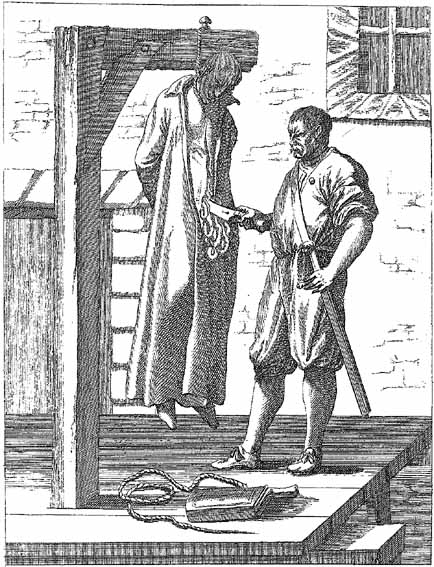
It’s from this (U.S.) Library of Congress page which marks it as a representation of Ogilvie in a late 17th-century text of Bohemian Jesuit propagandist Matthias Tanner. That provenance, of course, would be consistent with a bit of sanguinary exaggeration. It’s also possible that it’s mislabeled on the Library of Congress page, whose identification of it seems a bit oblique.

Working as I am from secondary sources, I tread cautiously here and welcome further clarification or correction.

On this day..

1937: Alexander Yulevich Tivel

On this date in 1937 — probably — one of the numberless obscurities consumed by Stalin’s purges was convicted and presumably shot for “preparing to commit a terrorist act against [NKVD head] Yezhov.”

Alexander Yulevich Tivel, a Jewish bureaucrat who had the misfortune to have been in a party organ too close to Zinoviev, was disappeared by the NKVD one day in 1936.

His fate forms the opening hook for J. Arch Getty’s The Road to Terror: Stalin and the Self-Destruction of the Bolsheviks, 1932-1939 — “the story of the Stalinist terror writ small.” (Here’s a review)

We do not know whether he was physically tortured by his interrogators, but there is ample evidence that countless others were. Even high-ranking officials under arrest were beaten or, as Molotov would put it, “worked over.” Ten years later, a high-ranking police official described interrogation procedures in a letter to Stalin. First, prisoners were offered better conditions — better food, mail, and so on — in return for a confession. If that failed, appeals to the prisoner’s conscience and concern for his family followed. The next step was a solitary-confinement cell without exercise, a bed, tobacco, or sleep for up to twenty days … Finally, the use of “physical pressure” was authorized …

Tivel was probably executed on the same day [of his conviction]. Unlike many others who were badgered and tortured by the NKVD, he had not confessed.

His wife and mother-in-law to internal exile. His son would suffer the stigma of being the child of an executed traitor.

The widow Eva Tivel, reports Getty, grappled for years with the unresponsive bureaucracy until she finally cleared Sasha Tivel’s name.

On 23 May 1957, twenty years after Tivel’s execution and after Eva’s many letters and appeals, Tivel’s sentence and party expulsion were overturned … [as] “based on contradictory and dubious materials.”

On this day..

1836: The defenders of the Alamo, much remembered

On this date in 1836, Mexican forces commanded by President Antonio Lopez de Santa Anna overran the Alamo — and executed those few of its defenders who survived the day’s battle.

“Remember the Alamo!”

This most memorable battle of the Texas Revolution has since retained its place in the founding mythology of Texas and its draw as a tourist destination in San Antonio, no matter the complexities on the ground. (You can watch the earliest surviving film treatment, The Martyrs of the Alamo, free online. D.W. Griffith made it the same year he made Birth of a Nation.)

That Alamo of blood and legend, and the countervailing interpretations it eclipses, are much beyond our scope here, but we are attracted to notice the reputed summary execution of five to seven defenders who had surrendered or otherwise been captured during the fight. (A few dozen mostly civilian noncombatants in the former mission also survived, and were not executed.)

According to Robert Scott, Santa Anna was empowered by a Mexican resolution holding (not without cause) that

“foreigners landing on the coast of the Republic or invading its territory by land, armed, and with the intent of attacking our country, will be deemed pirates.”

Who counted, at this moment, as “foreigners” among the Anglo settlers trying to break away from Mexico and their supporters among from the United States to which Texas would eventually attach poses a historiographical riddle. But then, Santa Anna wasn’t there to write a dissertation, but to win a war — and he was said to be sorely annoyed at the defenders having tied him down for a week and a half.

King of the Wild Frontier

Covered by most any definition of “foreigner” would have been the Alamo’s most famous defender, Tennessee frontiersman and former U.S. Congressman Davy Crockett. He had arrived in Texas just a few months before, on a rendezvous with destiny.*

It’s a matter of dispute whether Crockett was among those last few executed; in an event this emotionally remembered, every version of the Crockett death scene — from “found dead of injuries amid a heap of Mexican casualties” to “cravenly bargained for his life” — gores someone’s ox.

Even if the account of Crockett’s presence among the executed derives from a disputed source — well, this blog has not scrupled to highlight the fictional and the mythological, those executions whose resonance transcends factual accuracy.

And even if Davy Crockett was not among those anonymous souls put to death this day, it is by his name that they have their tribute, as in the 2004 film** The Alamo:

* Destiny by way of Walt Disney.

** This Disney film diddles with the Crockett legend that Disney helped to inflate in the 1950’s — to the annoyance, of course, of traditional-minded Alamo partisans.

On this day..