1945: Lena Baker

What I done, I did in self-defense, or I would have been killed myself. Where I was I could not overcome it.

-Lena Baker’s final statement

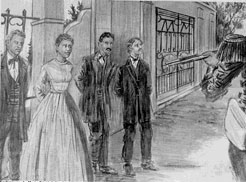
The state of Georgia has only ever electrocuted a single woman: African-American maid Lena Baker, put to death on this date in 1945 for murdering her abusive employer.

Baker was a sharecropper and a former sex worker hired to care for white mill owner Ernest Knight as he recuperated from a broken leg. This, as Baker’s biographer Lela Bond Phillips puts it, “developed into a sexual relationship.”

A twisted, sometimes-violent relationship.

Both Knight and Baker were alcoholics, and the Knight liked to keep his domestic in the gristmill for days on end.*

As an interracial liason, it was also entirely taboo; Knight’s son tried everything to separate his dad from this scandalous arrangement, including moving the family and beating up Baker.

Knight pere was even more committed to keeping her.

On the night of April 29-30, 1944, the elder Knight locked Baker up in the mill, after she’d attempted to flee him. Baker testified that after Knight got back from church — it was Sunday, after all — Baker tried to leave over Knight’s threats. The two fought over Knight’s pistol, and the fight ended when the pistol discharged through Knight’s head. As to how it went off or who pulled the trigger, Baker said she didn’t know.

Although the irascible, hard-drinking Knight wouldn’t have won any popularity contests among his white neighbors, this breach of the color line was prosecuted both vigorously and speedily: a one-day trial that August (the all-white, all-male jury goes without saying, right?) sufficed to send the maid to her death.**

She’s (obviously) the subject of the 2008 film Hope & Redemption: The Lena Baker Story.

* Virtual imprisonment of domestic labor: not a thing of the past.

** In 2005, the Georgia Board of Pardons and Paroles — which turned down Baker’s clemency application in early 1945 — issued a posthumous pardon suggesting that a non-death penalty manslaughter charge would have been the more appropriate conviction. Baker’s family and defenders read that as vindication; there’s a detailed NPR story about it here.

On this day..

1942: Jakub Lemberg and family

(Thanks to Meaghan Good of the Charley Project for the guest post. -ed.)

On this date in 1942, on the first day of Purim, Jakub Lemberg was executed together with his family in the Nazi ghetto in Zdunska Wola, Poland.

Lemburg, a 43-year-old internist and pediatrician, was head of the Judenrat in Zdunska Wola and thus it was his task to do the Nazis’ dirty work, such as putting together lists of his fellow-Jews for deportation.

He revealed himself to be a man of exceptional character and courage, and the circumstances of his death, as recorded in Louis Falstein’s The Martyrdom of Jewish Physicians in Poland, should not be forgotten:

The Gestapo chief ordered Dr. Lemberg to deliver ten Jews to be hanged for the ten hanged sons of Haman. Dr. Lemberg replied that he could deliver only four Jews: himself, his wife and their two children. Hans Biebow, “the Butcher of Lodz,” seized Dr. Lemberg and turned him over to the executioners, who killed him in the cemetery.

The Zdunska Wola ghetto was liquidated five months later. And in 1947, Biebow got his.

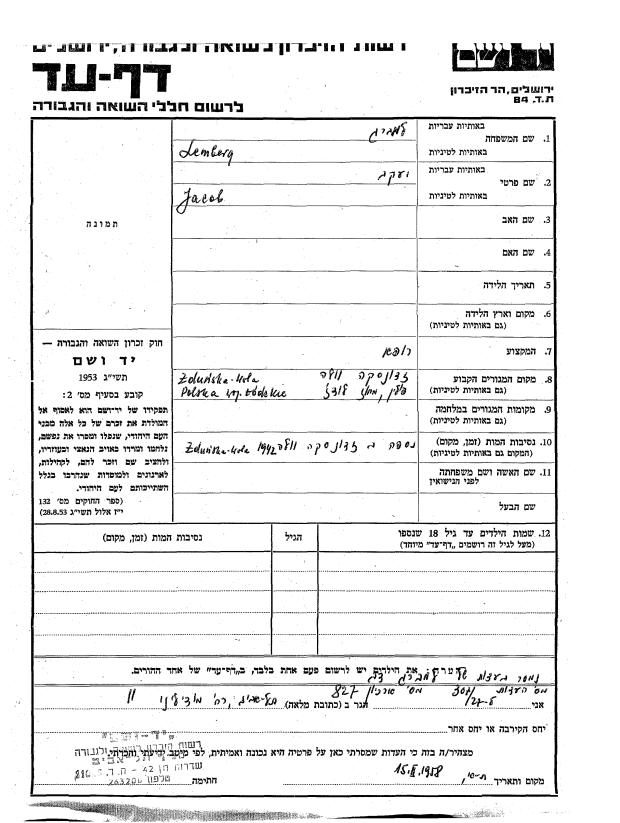
Here’s an image of Lemberg testimony (in Hebrew) from the Yad Vashem database.

On this day..

1845: Maria Trinidad Sanchez, Dominican Republic heroine

We’ve previously noted in these pages Francisco del Rosario Sanchez, one of the Dominican Republic’s founding heroes, who in 1861 was shot for propounding independence.

Martyrdom was the family business.

On February 27, 1845, his sister Maria Trinidad Sanchez (Spanish link) had been, well, shot for propounding independence. (More Spanish)

That date, February 27, also happens to be the Dominican Republic’s Independence Day celebration — because a year to the date before her death, Maria Sanchez, her brother, and others of the anti-colonial La Trinitaria proclaimed independence from a bloody 22-year Haitian occupation.

Maria Sanchez, together with another woman named Concepcion Bona, made the first Dominican Republic flag.


Sanchez and Bona’s original flag for the Dominican Republic.

This was all well and good, until the resulting head of state steered the Dominican Republic towards recolonization by Spain, as a hedge against reconquest by Haiti. La Trinitaria types took an understandably dim view of this gambit, so busting them up was part of the deal.

Many of the country’s founding heroes, including brother Francisco, were chased into exile; Maria was rounded up by the new government and tortured for information about the Trinitarian “plots” against the new regime. She refused to name any names, and was shot on the country’s first independence anniversary.

On this day..

1677: Five witches at the Gallowgreen of Paisley

On this date in 1677, Janet Mathie, Bessie Weir, Margaret Jackson, John Stewart, and Marjory Craig were hanged for having bewitched a Sir George Maxwell of Pollok.

These unfortunates were “sacrificed on the altar of popular superstition”, in the words of a later broadside — one element of that superstition being the belief in the superordinary insight of the deaf-dumb.

God hath taken away the tongue and ear of the dumb, and hath given them a rich gift of knowledge in the room of it; and by this would teach all of us his goodness to his creatures, and that we should study humility and sobriety of mind.

This is a culture working with some embarrassingly primitive forensics to begin with.

So, when the Pollok lord started ailing, the indications by “a young deaf and dumb girl, of unknown origin,” to the effect that a local family was doing him mischief by stabbing a wax effigy, well, that was enough to open a case. When they found a wax effigy right where the girl pointed, “The prosecution wanted no stronger proof.”

So they got the 14-year-old daughter (she was spared execution this date) to confess, and tortured her brother into agreeing that the devil appeared as a cloven-hooved Negro, and our unnamed detective-girl miraculously found not one, not two, but three different effigies all attributed to the diabolical voodoo parties to cinch the condemnation.

It’s rather embarrassing what tripe did then and can still now pass for persuasive indicia of guilt among parties already committed to convicting someone. Like show trial victims, even the condemned were swept into the act of auto-denunciation — one final tenuous strand to link an outcast to her community, even from the stake. At least, some of them were.

John and Annabel exhorted their mother to confess, reminding her of all the meetings which she had had with the devil in her own house, and that “a summer’s day would not be sufficient to relate what passages had been between the devil and her.” But Jennet Mathie was a stern, brave, high-hearted Scotch woman, and would not seal her sorrow with a lie. “Nothing could prevail with her obdured and hardened heart,” so she and all, save young Annabel, were burnt; and when she was bound to the stake, the spectators saw after a while a black, pitchy ball foam out of her mouth, which, after the fire was kindled, grew to the size of a walnut, and flew out into sparks like squibs. This was the devil leaving her. As for Bessie Weir … the devil left her when she was executed, in the form of a raven; for so he owned and dishonoured his chosen ones.

“The dumbe girl, Jennet Douglas, now speaks well, and knows Latine, which she never learned, and discovers things past!” says Sinclair. But she still followed her old trade. She had mesmeric visions, and was evidently a “sensitive;” and some of the people believed in her, as inspired and divine, and some came, perhaps mockingly, to test her. (From E.L. Linton)

Sometimes, at least, these malevolent professional accusers get their comeuppance.

The dumb girl herself was afterwards carried before the great council at Edinburgh, imprisoned, scourged through the town, and then banished to “some forraigne Plantation,” whence she reappears no more to vex her generation. God forgive her! She has passed long years ago to her account, and may her guilty soul be saved, and all its burning blood-stains cleansed and assoilzed!

On this day..

1971: Ousmane Balde, Barry III, Magassouba Moriba, Loffo Camara, Keita Kara Soufiana, and many others in Conakry

On this date in 1971, at least four former members of Guinea’s government were publicly hanged for supposed complicity in the previous year’s Portuguese invasion from neighboring Guinea-Bissau.*

The coup-threatened government of Sekou Toure was trying to send a message:

It did not scruple to make examples of men and women in very high places. Ousmane Balde (or Baldet) was Guinea’s former Finance Minister, Magassouba Moriba an Interior Minister, Barry III (also known as Ibrahima Barry; the link is French) the former Secretary of State. Keita Kara Soufiana had been Chief of Police. Loffo Camara was a National Assembly member.

Besides the quality of its reprisal victims, Conakry went in for quantity, too. Somewhere close to 100 death sentences were handed down with the barest of legal pretense, and the majority of them actually carried out on and around this date.

Personally arranging the grisly tableau for our hanged ex-ministers was a captain, Diarra Traore, who would one day help to overthrow the Guinean government, become Prime Minister … and wind up executed himself for his trouble.

* Guinea-Bissau was at that time still a Portuguese possession, known as Portuguese Guinea.

On this day..

1999: Recak Massacre

(Thanks to Meaghan Good of the Charley Project for the guest post. -ed.)

On this day in 1999, Serbian militants killed approximately 40 to 45 Kosovo Albanians near the village of Reçak in Kosovo. The victims allegedly included a twelve-year-old boy and at least one woman.

Depending on who you listened to, it was either a massacre against innocent civilians, or a military action against guerillas.

The New Kosova Report, adopting the former point of view, summarizes in a 2008 article:

In the early morning of 15 January, 1999, forces from Serbian Interior Ministry (MUP) and Yugoslav Army (VJ) moved into the village with tanks and began to shoot at houses sheltering civilians. After ransacking all the houses, they gathered 28 Albanian men and boys and ordered them to head towards a hill outside the village for questioning. There they were sprayed with machine guns and 23 of them died. Only five survived by pretending they were dead. Another 22 people were shot and/or decapitated at different places in the village. Some in a ravine behind the village, while others in front of their houses.

A local villager named Shefqet Avida gave photographer and BBC Radio reporter Melanie Friend an account which was later quoted in Friend’s book No Place Like Home: Echoes from Kosovo.

Policemen — Serbs — were hiding here, expecting them. I heard the Serbs saying, “Anyone under fifteen years old, don’t touch, but upwards of sixteen or seventeen years old, just kill them …” The people, when they were captured here, were made to stay in line, and every one of them was shot, and after that with a … very nice knife … they took eyes from the faces and hearts from the chest, and the Serbs later said, “That’s not true, we didn’t do that,” the mice, they’d eaten them. […]

Serbian police were shooting until four or five in the afternoon. When the observers arrived in the morning, we went with them to see the place where the people were murdered. Three of us stayed here all night to guard the bodies. […] Thirteen members of my family were killed there.

The Serbs denied having murdered civilians and claimed all those killed were all Kosovo Liberation Army fighters, shot during a skirmish with Serbian forces. To this day, many maintain the entire thing was staged, a hoax set up by the KLA in order to get support for their side.

Trying to sort the matter out, the European Union dispatched forensic experts to the scene from Finland. Helena Ranta, one of the experts, concluded that “There were no indications of the people being other than unarmed civilians.” When her opinion was broadcast in a press release, many mistook it for being the opinion of the entire group of scientists.

The Finns’ official report, however, has never been released. Dr. Ranta, a forensic dentist, later accused officials from the Ministry for Foreign Affairs of pressuring her to go against the Serbs.

Yugoslav and Belarusian scientists also examined the bodies and said they believed all the dead were KLA combatants. In response, critics blasted them for using allegedly out-of-date and unscientific testing methods.

News of the killings made headlines all over the world and incited NATO to finally get involved in the war. A couple of years later, Yugoslav dictator Slobodan Miloševic was brought up on war crimes charges; ordering the Reçak killings was one of them. It was later removed from the indictment for lack of evidence, however. (Miloševic died before his trial was concluded.)

In 2001, a Kosovo Serb police officer was sentenced to fifteen years in prison for participating in the killings. Outside observers, including the United Nations and Amnesty International, criticized the trial proceedings, accusing the Kosovo war crimes tribunal of ethnic bias and politically motivated decision-making. As of this writing, no one else has been called to account for what happened in Reçak.

On this day..

1629: Anna Gurren, in the Mergentheimer Hexenprozess

On this date in 1629, the German city of Mergentheim burned its late mayor’s widow for witchcraft.

Anna’s remains: the inventory of the late sorceress’s estate taken by its new owner, the city of Mergentheim.

Witch-hunting was a growth industry for Thirty Years’ War-torn Germany in the late 1620s.

Not long before, a Mergentheim Teutonic knight had been petitioned for help extracting a schoolboy from Wurzburg, where the absentee father feared he was running with a devilish crowd. Once the authorities heard that witchy stuff, all the inhuman gears came to life.

Instead of returning the tyke to his concerned dad, Wurzburg arrested the boy, strongarmed him into admitting his Satanic ties, and burned him at the stake. Nine years old.

That was Wurzburg. But back where the allegation originated, writes H.C. Erik Midelfort, “the discovery in Mergentheim that children might be guilty of witchcraft was to have serious consequences.”

Like a fresh plague outbreak, a witch persecution broke out in Mergentheim and neighboring Markelsheim, with some schoolchildren hounded by inquisitors within a few weeks of their compatriot’s execution over in Wurzburg. From there, it became epidemic all over town. By October 1628, the first witches were shrouded in flames for their neighbors’ edification. Over the course of 1629, the peak year for the Mergentheimer Hexenprozess, 91 humans were put to death as Satanic wizards — not counting those who were tortured to death.

Nor was this strictly confined to the weakest prey, your outcasts and servants.

Our victim today was big game, a wealthy city elite, and she wasn’t the only such. These must have made some kind of hedgerow gossip, but the general hysteria of the place made it dangerous to sustain any public controversy even about the downfall of the recently well-connected.

Midelfort, again, on the very relatable circumstance of a prosperous innkeeper who was a little too incensed for his own good at seeing Anna Gurren die.

Thomas Schreiber had a strong sense of justice. When the trials in Mergentheim had run only two months, he had already lost faith in the judicial procedure. On December 1, 1628 when Martha, wife of Burgermeister Hans Georg Braun, was executed, Schreiber was heard by many persons exclaiming that she had been done a gross injusice. Schreiber even let slip that “King Nero” had also conducted such bloodbaths. Six weeks later Schreiber was again appalled when the extremely wealthy widow of Lorenz Gurren was convicted of witchcraft and executed on January 12, 1629. When attending the execution of the lady, he had the temerity to express amazement over her confesion. The Amtmann Max Waltzen turned to him and said pointedly, “Ha, ha, those who know the devil should not be so amazed.” That kind of talk perturbed Schreiber, and when magistrates began avoiding him, he prepared to flee. During this time he repeatedly denounced the court for its unjust trials and declared that “if anything happens to me, let every pious Christian fear for himself.” He also prayed that “God might preserve everyone from Neuenhaus [the jail and torture chamber], for even the most pious if put in there would be found to be a witch.” The trials, he insisted, were bloodbaths, and the magistrates were out to “wash their hands in my blood.”

Schreiber fled town on February 1, having heard that people had started denouncing him. But he didn’t make it long.

He, too, was dead by the end of May — as a confessed (just like he predicted) witch.

On this day..

1900: Louisa Josephine Jemima Masset

(Thanks to Meaghan Good of the Charley Project for the guest post. -ed.)

On this day in 1900, 36-year-old Louisa Josephine Jemima Masset (also called “Louise” in some accounts) was hung for the murder of her young son the previous year. She was the first woman, indeed the first person, to be executed in London in the brand spanking new 1900s.

Her crime, even by today’s standards, was shocking and there is little doubt that had it occurred today, Louisa would be featured on blogs with names like People You’ll See In Hell. (Actually, she got a TV miniseries in the early 1990s.)

The story of the murder and Louisa’s trial and death were recorded in detail in John J. Eddleston’s A Century of London Murders and Executions. Capital Punishment U.K. provides additional details, and the trial records can be seen here.

Our story begins a little after six on Friday, October 27, 1899, when a lady at the Dalston Junction train station in London found the body of a small boy shoved behind the door to the women’s lavatory. The child was naked, bloody and partially covered with a black shawl, and a bloodstained brick lay nearby.


Dalston Junction: Mind the gap. (cc) image from Matt From London

The post-mortem determined that the child had been beaten “with much violence” on the head and face, but the actual cause of death was suffocation. He probably died only about an hour or two before his body was found. There was no indication of his identity, so his description was published in the newspapers with hopes that someone would recognize him.

Someone did: the following Monday, a children’s nurse named Helen Eliza Gentle came forward and identified the murdered boy as Manfred Louis Masset, age three and a half, who had been in her charge until the previous Friday.

Manfred was illegitimate and had been in Helen Gentle’s care since shortly after birth. Louisa, his mother, doesn’t seem to have been the maternal type. She paid 37 shillings a month for his care and would visit him once every two weeks and take him to the park. The money supposedly came from Manfred’s father in France; Louisa herself earned a living as a day governess and gave piano lessons.

The arrangement with Helen Gentle ended when Louisa told Helen that she was sending Manfred to France to be with his father. Helen handed the child over to her at 12:45 p.m. on October 27, only hours before his death.


The day before giving him up, Helen Gentle took this picture of the tot to remember him by.

When she was tracked down at her brother-in-law’s house, Louisa denied having harmed her son and stated she didn’t even know he was dead until she read about it in the newspaper. She admitted the story about taking Manfred to France a lie and said she only wanted to transfer him to another carer, as she thought Nurse Gentle wasn’t educating him properly. Louisa claimed she had met two women, one of them a schoolmistress, in the park a few weeks earlier. She arranged to enroll Manfred for the price of £18 per annum, and handed the little boy over on October 27.

When pressed, however, Louisa couldn’t remember much about these women or their school. The police smelled a rat and took her into custody for murder.

At Louisa’s trial in December, she stuck to her story about giving Manfred to a schoolmistress. She said she’d handed him over at the train station at 4:00 p.m., along with a £12 deposit towards his school tuition, then took the 4:07 train to Brighton. No one at the station saw the two women Louisa described. However, three witnesses at the train station remembered seeing Louisa and Manfred, who was crying, hanging about the station for over an hour on the afternoon of Manfred’s death: one of those same witnesses saw and spoke to Louisa at the station at 6:50 p.m., nearly two hours after Louisa claimed to have left, and said her little boy wasn’t with her anymore.

The icing on the cake was when the brick used to batter Manfred was shown to be same kind as those in Louisa’s garden.

Louisa’s story was partially true; she did go to Brighton that day, hours later than she said, and Manfred’s clothes turned up in the waiting room of the train station there. Eudor Lucas, Louisa’s next-door neighbor, said they had spent the weekend together in Brighton, sleeping in the same bed, and he had “had connection” with her.

The jury must have been outraged by their blatantly immoral behavior, and in any case the evidence against Louisa was overwhelming. The jury got the case on December 18 and took thirty minutes to convict her. She was hung just three weeks later.

On this day..

Feast Day of St. Anastasia

Christmas Day is all about that Jesus fellow, but for a break from the usual gold, frankincense, and myrrh, spare a thought for St. Anastasia of Sirmium — whose feast date and purported execution date December 25 also is. She’s the only Christian martyr with a Christmas celebration,* and an apt choice for the depth of winter since her name means “dawn” or “rebirth”.

Byzantine icon of St. Anastasia from the Hermitage, holding a vial that alludes to her antitoxin powers.

Centuries of namesakes have shared that moniker, like the youngest daughter of the executed Romanov family, on the basis of the Great Martyr’s having died during the persecution of Diocletian; though this circumstance scarcely makes her unique, no less a source than the Catholic Encyclopedia avers that the ancient martyrology linking her to St. Chrysogonus “is purely legendary, and rests on no historical foundations.” (It’s possible that multiple historical Anastasias were conflated into a single legendary person.)

Despite later generations’ ignorance of what this early keeper of the faith was really about, she became associated — again, possibly thanks to nothing more sharing the same name as the facility’s local Roman matron — with an early church in Rome, the “titulus sanctae Anastasiae.” Today ruined, this was an important church in the capital of the faith during late antiquity, and helped vault St. Anastasia into the first rank of holy intercessors. She’s even mentioned by name in the Canon of the Mass.

Her celestial department protecting against potions and poisons has, today, a distinctly retro vibe about it; “the last remnant of the former prominence enjoyed by this saint and her church” is the Christmas Dawn Mass, likely the day’s most lightly-attended service at your local Catholic or Anglican parish, wherein Anastasia is invoked by name.


Cathedral of St. Anastasia in Zadar, Croatia, where the saint’s relics repose. (cc) image from Paradasos.

* In western Christendom only.

On this day..

1529: Desle la Mansenee in the Luxeuil Trial

“In 1529, the Inquisitor General of Besancori, a Dominican friar named Jean Boin, visited incognito the village of Anjeux in the bailiwick of Luxeuil, Franche-Comte, and noted down the gossip of the villagers, which centered on 27-year-old Desle la Mansenee,” begins this vignette in the only part of Nigel Cawthorne’s Witches: History of Persecution that Google books preview will cough up.

You know this isn’t going to end well.

Our incognito Inquisitor swiftly decloaked and transformed Desle la Mansenee from grist for the neighbors’ grapevine into ash for their garden plots by torturing her into confessing to — oh, you know, the usual stuff. Dancing at witches’ sabbats and flying on broomsticks and banging the devil. That sort of thing.

People, these are infernal agents. It doesn’t get any worse than that. You’ve got to use tough tactics to get information, not just start salacious rumors and hope they’ll come clean.

On this day..