1986: Mamman Jiya Vatsa, warrior-poet

On this date in 1986,* Nigerian Major-General Mamman Jiya Vatsa was shot (along with nine others) by command of his childhood friend — the dictator Ibrahim Babangida, whom Vatsa was allegedly plotting to overthrow.

A gifted writer since youth, Vatsa was just a nameless twenty-something junior officer in the early 1970s when he emerged onto the national literary scene.

In the 15 years before his death, Vatsa churned out 20-plus volumes, mostly poetry. He had a special inclination for writing for children.

Simultaneously, his star ascended in his professional sphere.

Risen to General, Vatsa was part of the Supreme Military Council of the previous dictator.

But by December of that year,
Vatsa and dozens of others were arrested.

Testimony against them — much of it of the speculative or torture-induced variety — described a ring of officers piqued at the Babangida coup (Vatsa was out of the country when it occurred) and keen to undo it. The scheme would have been only one of many such hatched or imagined in an unstable political situation that surely made the new big man nervous.

In the end, “only” ten (the nine others are named here) were stood up against the wall for the alleged plot. Many others, however, were imprisoned or purged, a lasting injury to the Nigerian brass that particularly crippled its air force.

Babangida, of course, rejected clemency appeals from the Vatsa family he knew well. He has since justified his harshness by arguing that Vatsa would have continued plotting against him in prison or in forced retirement. “Rawlings did it in Ghana,” Babangida said. “And you know Vatsa was very stubborn.”

The fatal tribunal’s judge** is less certain, and is hardly the only one to doubt Vatsa’s guilt outright.

I don’t know, nobody ever asked.
That was how some heroes died.
They died.

-Vatsa, “They Died” (Voices from the Trench)

* Some sources give March 6 as the execution date, but contemporaneous western press reports (admittedly an impeachable source) prefer the 5th. For instance, the March 6 Chicago Tribune says the executions occurred on “Wednesday” (the 5th).

** Ironically, Vatsa himself had once sat on a tribunal for another group of failed putschists, the 1976 Dimka coup.

On this day..

1623: Amboyna Massacre

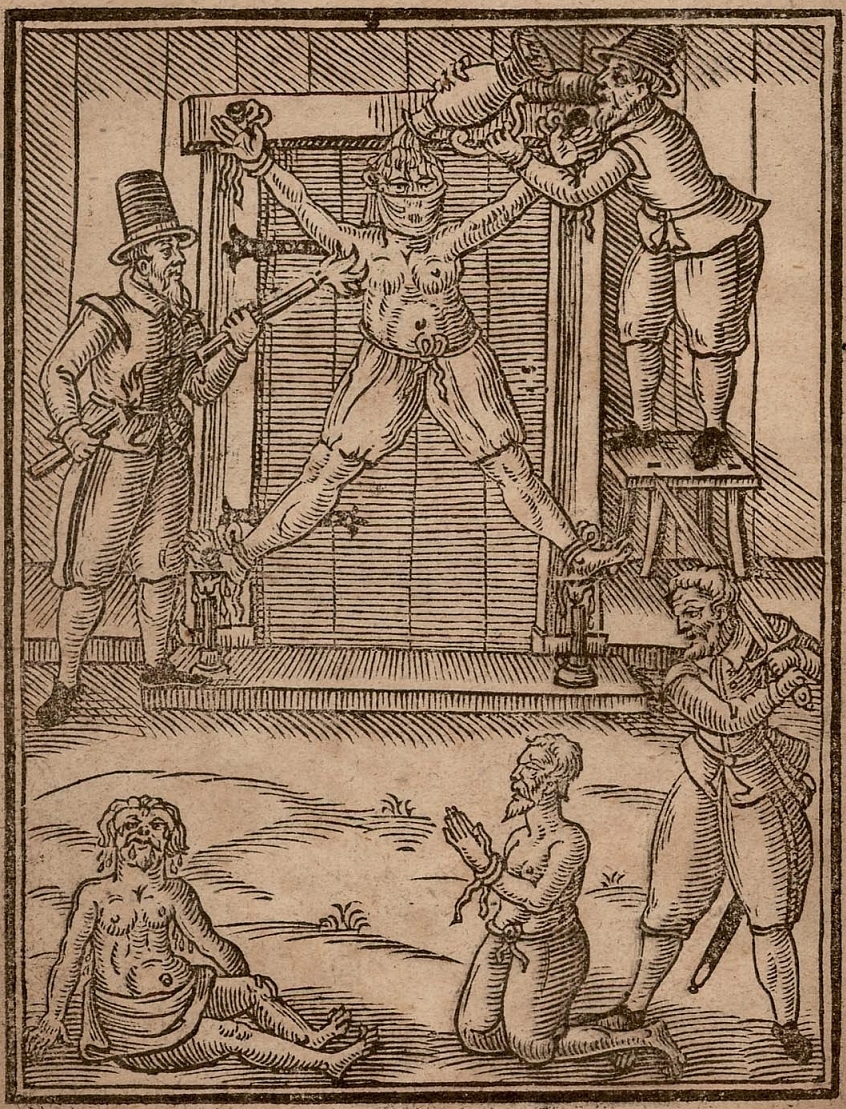
On February 27,* 1623, the Dutch East India Company beheaded twenty who had been waterboarded into confessing to a terrorist plot.

English prisoner suffering “waterboarding” faux-drowning torture, published under the name “A true relation of the unjust, cruell, and barbarous proceedings against the English at Amboyna in the East-Indies 1624”.

The torturers “poured the water softly upon his head until the cloth [wrapping his head] was full, up to the mouth and nostrils, and somewhat higher, so that he could not draw breath but he must suck in all the water.” More nasty description.

(cc) Image from Flickr | BiblioOdyssey

Posh Spice

As in modern times, this scenario originated with resource competition in the Muslim world … in this case, competition for spice, in Indonesia.

European colonialism had pitted the Dutch East India Company against its British counterpart on the archipelago, both scrabbling after the lucrative trade in cloves and pepper, with garnishes of nutmeg, cinnamon, mace, and ginger.

The two rival powers had, as we lay our story, recently come to a tense truce, dividing the commerce between them — and swapping mutual accusations of violating that pact. The arrangement basically gave the Dutch a bigger slice of the pie, so we’ll find them when the cloves hit the fan having the balance of power on their side.

Terrorists

We’re going to oversimplify to set the scene.

On Ambon Island, one of the very “Spice Islands” (i.e., the Moluccas) — at the Dutch-controlled fortification of a trading post also shared by the English — the Dutch merchant-governor Herman van Speult heard that a Japanese mercenary had asked about the Dutch fortifications.

The security-conscious van Speult ordered that unfortunate soldier interrogated under torture.

As tends to happen when the interrogators in such a case are convinced of a ticking time bomb situation, the torture uncovered a ticking time bomb situation.

The mercenary got the Dutch to stop burning and drowning him by “revealing” a highly implausible** English plot to seize the Dutch fort, with 20 guys or so and no prospect of imminent outside aid. Wouldn’t you know it: when the supposed confederates named by the mercenary were similarly tortured, they too admitted the plot. Van Speult’s English opposite number, Gabriel Towerson, was one of them.

The Amboyna Massacre followed anon, with Towerson and nine other British East India Company employees beheaded, along with nine Japanese mercenaries and one Portuguese. (The latter ten worked for the Dutch East India Company, not the British. A fifth column!)

They went to their deaths protesting their innocence, and many smuggled out written recantations to that same effect: “tortured … with that extream Torment of Fire and water, that Flesh and Blood could not endure it, and we take it upon our Salvation, that they have put us to Death Guiltless.”

Anger in the English Street

That last quote comes from Karen Chance, “The Amboyna Massacre in English Politics, 1624-1632,” in Albion: A Quarterly Journal Concerned with British Studies (Winter 1998).

As the title of that piece suggests, the Amboyna Massacre outraged Towerson’s countrymen and -women once word finally made it back to the mothership. (In addition to the torture/wrongful execution dimension, the legal authority of the Dutch trading concern to impose judicial punishment on their English counterparts was questionable at best.)

English demands for satisfaction against the perpetrators continued to complicate Dutch-English relations into the reign of Charles I and beyond. Even Oliver Cromwell required, as the price of peace for the First Anglo-Dutch War in the 1650s, punishment of any surviving offenders. (Which was apparently nobody at all.)

And still later, the burgeoning British Empire’s propaganda arm reached for the Amboyna narrative to justify seizing New Amsterdam on the grounds that the Dutch had attempted to spring a massacre on English settlers — “their Amboyna treacherous Cruelty extended itself from the East to the West Indies, and pursued thus the straight channel of Dutch blood”.

As for the trade-jockeying: the Netherlands’ commanding position in Indonesia ultimately squeezed the English out.** But don’t fret for Old Blighty: she turned attention to gobbling up India, and made a lot more bank than did the Dutch spice racket.

* February 27 was the date according to the Julian calendar in use at this time by the British. By the Gregorian calendar the Dutch were using, the massacre took place on March 9.

** For more on both the fanciful nature of the supposed plot, and the economics of the East Indies trade as it unfolded in the 17th century, see D.K. Bassett, “The ‘Amboyna Massacre’ of 1623”, Journal of Southeast Asian History, September 1960.

On this day..

1872: Gomburza

On this date in 1872, reformist Filipino priests Mariano Gomez, Jose Burgos and Jacinto Zamora (together, the first syllables of their surname formed the acronym “Gomburza”) were garroted in Manila for their alleged support of an anti-Spanish mutiny.

These three clerics were leading exponents of liberalization; they notably pressed the rights of the native-born clergy as against the powerful religious hierarchy of imported Spanish priests.

While that critique had a somewhat receptive ear under the forward-thinking governorship of Gen. Carlos-Maria de la Torre, a more reactionary successor did not look as kindly on such agitation.

When naval shipyard workers rebelled in the 1872 Cavite Mutiny — over higher taxes, including a surcharge to avoid forced labor, not over the Gomburza priests’ agenda as such — the colonial administration used it as a pretext to seized the priests and condemn them for subversion.

Alas, Spain couldn’t manage to garrote away its subject peoples’ aspirations.

A bad end for Gomez, Burgos and Zamora was just the start for reform and independence agitation in the Philippines.

On this day..

1940: Isaak Babel

On this date in 1940, Isaak Babel, “the greatest prose writer of Russian Jewry,” was shot in Moscow.

The Odessa-born 45-year-old had managed the difficult trick of maintaining a high-profile writing career in the 1930s Soviet Union without abandoning his artistic integrity. (This meant he published a lot less in that decade, which fact was held against him in his trial: “deliberate sabotage and a refusal to write.”)

A pre-revolutionary friendship with Maxim Gorky and an early affinity for the Bolsheviks had helped see him through such transgressions against Communist ideology as describing Red atrocities during the Russian Civil War, and writing a play about the underbelly of Soviet society.

Babel remains beloved today for that very reason; his Odessa Tales collection of short stories about Jewish gangsters still charms Russians and foreigners alike.

But Gorky died in 1936, and without that elder statesman’s protection, Babel’s insufficiently lockstep scribbling laid him increasingly liable to public denunciation for, e.g., “aestheticism.”

And as sickle follows hammer, miscalibrated revolutionary ardor in Stalin’s Russia led in 1939 to that dread knock on the door, that stay in Lubyanka Prison, that inevitable “confession” of Trotskyism, and that bullet to the head after a perfunctory trial.

Babel’s work is recent enough that it’s mostly not freely available in English. A couple in English and several in Russian are linked here; literary criticisms with plentiful excerpts of Babel’s work are available here, here, and here, among many other places.

Babel was officially rehabilitated during the Khrushchev era.

On this day..

1959: 71 after the Cuban Revolution

From the dark pre-dawn hours through to the middle of the day this date in 1959, Cuba’s fledgling revolutionary government shot over 70* “police officials, soldiers, and others described as spies and informers”** into a pit near Santiago de Cuba.

Enrique Despaigne is the gentleman shown being shot from 1:02 to 1:09 of this period newsreel.

Just days past their New Year’s triumph over the Batista dictatorship, the Sierra Maestra guerrillas were indulging a little out-with-the-old bloodletting. Well, more than a little.

Others had already been shot, and (many) others would follow that fate in the time to come, but this day’s mass execution was the largest and eventually most emblematic of those days. It was ordered by present-day Cuban President Raul Castro, Fidel’s brother.

The biographies of the day’s (nearly literal) hecatomb were largely eclipsed by their deaths as theater, as symbolism, as diplomacy. The man most individually distinctive to many observers was Lt. Enrique Despaigne, whose fusillade for killing 53 people was delayed three hours (pdf) at the camera crew’s behest for the better dawn lighting.

This day’s sentences specifically and the post-revolution executions generally were widely deplored abroad. Liberal Oregon Senator Wayne Morse called it a “bloodbath” on the Senate floor, and implored the Cubans to “withhold executions until emotions cool.”

Cuba rejected the criticism.

One could say that, like Lenin, Castro had taken warning from the Paris Commune‘s self-defeating example of excess leniency.

But the case for that interpretation looks much stronger in retrospect than it did to those living the actual events.† Foreign criticism for Cuba’s 1959 execution binge, though strong, was also strongly colored by an expectation that western powers would soon come to an arrangement with Castro — an anti-imperialist, but not yet a publicly committed Communist.

So the purge of Batista elements generally played as an ugly but fundamentally unworrisome effusion of popular vengeance an unsettled political situation.

As the London Times mildly editorialized, “youthful excesses” notwithstanding, “much of what is being said in Cuba can be put down to the exaltation of victory. When the provisional Government settles down, more realistic appraisals are likely.” (Jan. 13, 1959)

* 71 is the figure most generally reported, and the number given by the contemporary Associated Press reports, but slightly different numbers around that total are sometimes cited (the New York Times reported 75 on Jan. 13, 1959). Whatever their number, some of their names are given here and here; this Spanish-language forum page has victims of the revolution on this date and throughout the month, sourced to the stridently anti-Revolutionary Cuban American National Foundation.

** Quote from the A.P. report as published in the London Times Jan. 13, 1959.

† Castro defended the executions in terms of Nazis, not Communards. Many of those condemned either to death or imprisonment by the revolutionary government were (show) tried for war crimes.

And not without reason:

Santiagans say the series of decrees by former President Fulgencio Batista suspending constitutional guarantees and civil liberties covered a reign of terror in which 500 to 1,000 persons were murdered in Santiago alone. To Santiagans, the firing squads represent justice. (New York Times, Jan. 21, 1959)

On this day..

1645: William Laud, given to the devil

On this date in 1645, Archbishop William Laud was beheaded on Tower Hill for treason.


Portrait of William Laud by Anthony Van Dyck. For this image’s subsequent life in popular circulation (and its contribution to its subject’s beheading) see Mercurius Politicus.

This diminutive “martinet” made himself odious to the rising Puritan party through his rigorous (some would say narrow-minded) enforcement of so-called “High Church” dogma and decor. It was a time when believers were prepared to rend the fabric of the church over a literal fabric, the surplice worn by the clergy — among other innumerable points of doctrinal rectitude.

Laud’s run as Archbishop of Canterbury also happened to coincide with Charles I‘s 11-year personal rule, sans parliament. The overweening divine’s influence on secular as well as religious policy would do his sovereign no favors in the public mind.

Roughly enforcing an unpopular minority position, Laud got the woodblock blogosphere in a tizzy with heavy-handed stunts like having dissenters’ ears cut off.

That’s the sort of thing that’ll give a guy an image problem. The king’s fool, Archibald Armstrong, is supposed to have tweaked our high and mighty subject (and warned the king against his influence*) with the punny aphorism,

Give great praise to the Lord, and little laud to the devil.

Funny because it’s true.

So when Charles ran out of money and finally had to call parliament in 1640, that august representative of the nation had some business with Laud. Ironically — since the prelate was always sensitive about his height — it would involve shortening him.

Laud was impeached as early as December 1640 and soon tossed in the Tower, where his neck awaited the unfolding radicalization of the pent-up Puritans and the onset of armed hostilities in their contest with the obdurate king. (While his hands blessed the allies who preceded him to the block.)


Wenceslas Hollar’s etching of William Laud’s trial.

For more about Laud’s life and work, check out the detailed Britannica entry or this Google books freebie.

* If a warning, it apparently was not heard. This 19th-century publication of Armstrong’s jests cites a 1637 royal order to the effect that

the King’s Fool, for certain scandalous words of a high nature, spoken by him against the Lord Arch-Bishop of Canterbury his Grace … shall have his coat pulled over his head, and be discharged of the King’s service, and banished the Court.

On this day..

c. 560 B.C.E.: Aesop, fabulist

On an unknown date around the 560s B.C.E., the storyteller Aesop is supposed to have been executed in Delphi by being hurled from the Hyampeia rock.

The semi-legendary fable-fashioner is not quite so irretrievable to history as, say, Homer, although assuredly many or all of the tales that have accrued under the heading “Aesop’s Fables” trace to origins other than this man.

Supposed to have lived from the late 7th to mid 6th centuries B.C.E., Aesop is first referenced by history’s first historian, Herodotus.

But by way of summation, we cannot improve upon Plutarch‘s succinct description of Aesop’s fate in his essay, “On God’s Slowness to Punish Evil”. (Available here; a different translation is free online here.)

I’m sure you know the story of how Aesop came here bringing gold from Croesus. He meant to make a magnificent offering to the god,* and also to give every inhabitant of Delphi four minas, but apparently he got angry and fell out with the locals; so he made the ritual offering, but sent the money back to Sardis, because he didn’t think that the people deserved a windfall. They then engineered a charge against him of temple robbery and executed him by pushing him from the famous cliff called Hyampeia.** Subsequently, the story goes on, divine wrath afflicted them with failed harvests and with all kinds of strange diseases, and as a result they used to visit all the festivals where Greeks were assembled and make an announcement inviting anyone who so wished to claim compensation from them for Aesop. Two generations later Idmon of Samos arrived at Delphi; not only was he not a relative of Aesop, but he was in fact a descendant of the people who had bought Aesop as a slave in Samos.† It was only when the Delphians had compensated him that their troubles ceased.‡ (We are also told that this incident was the reason for moving the place of punishment for temple robbers from Hyampeia to Aulia.)

There are many books and media under the Aesop’s Fables branding available for purchase, but you can also find the same content in the public domain at Gutenberg.org and elsewhere.

In any format, they’re timeless. “The Mischievous Dog”, for instance, could have been written especially for bloggers.

[audio:http://www.gutenberg.org/files/19616/mp3/19616-04.mp3]

* Referring to the sacred shrine occupied by the Oracle of Delphi, of course.

** When visiting Delphi, look for Hyampeia marked on your tourist map as “Phleboukos”, one of the Phaedriades surrounding the sacred site. Hyampeia/Phleboukos towers above the Castalian spring. It’s high.

† Besides being a slave, Aesop (at least, the Aesop as legend accumulated) was afflicted with other disadvantages suitable to elevate his mythological wisdom. According to The Life of Aesop:

AESOP (according to Planudes, Cameraius and others) was by Birth, of Ammorius, a Town in the greater Phrygia; (though some will have him to be a Thracian, others a Samian) of a mean Condition, and his Person deformed, to the highest degree: Flat-nos’d, hunch-back’d, blobber-lipp’d; a long mishapen Head; his Body crooked all over, big-belly’d, badger-legg’d, and his Complexion so swarthy, that he took his very Name from’t; for Aesop is the same with Aethiop. And he was not only unhappy in the most scandalous Figure of a Man, that ever was heard of; but he was in a manner Tongue-ty’d too, by such an Impediment in his Speech, that People could very hardly understand what he said.

Be sure to check The Life‘s account of Aesop’s demise, with the undiplomatic Aesop having enraged his hosts with his poor opinion of their digs … and the fables he tells in his defense falling very flat: “He was speaking on, but they pushed him off headlong from the Rock, and he was dashed to pieces with the Fall.”

‡ The Delphians’ search for compensation is directly described by Herodotus’ Histories, written little more than a century after Aesop’s death. Though the execution story itself could be apocryphal, its presence in Herodotus at least makes Greeks’ belief in the event as a real one of their recent past about as credibly documented as anything from 2500+ years ago.

That Aesop belonged to Iadmon is proved by many facts — among others, by this. When the Delphians, in obedience to the command of the oracle, made proclamation that if any one claimed compensation for the murder of Aesop he should receive it, the person who at last came forward was Iadmon, grandson of the former Iadmon, and he received the compensation. Aesop therefore must certainly have been the former Iadmon’s slave.

Evidently, Aesop’s reputation for sagacious wit was well-established in the 5th century B.C. Aristophanes makes respectful references to Aesop in his plays The Wasps, Peace and The Birds — in the latter, the birds’ ignorance is underscored because they haven’t read their Aesop.

On this day..

1982: Suriname’s “December murders”

This was the date in 1982 of the “December murders” (“Decembermoorden”), when 15 opponents of Suriname’s military dictatorship were shot at Fort Zeelandia.

(The 15 people shot each have an entry on the Dutch Wikipedia, accessible through its Decembermoorden entry.)

Though the killings weren’t secret at the time, their circumstances have always been murky, beyond the plain fact of being murders of political dissidents — “counterrevolutionaries,” in the parlance of the “Socialist Republic”.

President Desi Bouterse had seized power in a coup in early 1980, and some of the casualties this day might have been suspected of plotting to pull the same trick on him: at least, several were made to read statements to that effect. Others were regime opponents of a less existential menace: dissident university professors; critical journalists; a prominent former footballer. (When in Paramaribo, take in a match at Andre Kamperveen Stadion, which is named for him.)

Bouterse took political responsibility for the slaughter while claiming not to have ordered it. But it’s long been said that Bouterse was actually present for the shootings, personally interviewing/interrogating/”judging” the prisoners. (That’s what the massacre’s lone survivor, the since-deceased Fred Derby, said. (Dutch link))

Decades later, Bouterse — now an ex-dictator — is finally facing trial for the December murders, including fresh evidence of his involvement in the day’s notorious affair.

On this day..

1945: Anton Dostler, gone commando

On December 1, 1945, German General Anton Dostler was shot by the American military at Aversa, Italy, for war crimes.

Gen. Dostler readied for execution, from the U.S. National Archives. Click for larger image, or click here for the post-execution photo.

Specifically, General Dostler was condemned for having ordered the summary execution of American saboteurs who had been taken behind enemy lines.* Dostler was the first German general tried by an American military commission, and the first put to death for war crimes.

And his sentence did not sit well with all.

There had been a group of German saboteurs captured in the United States during the war who had themselves been executed (after becoming the subject of Supreme Court landmark Ex parte Quirin). Here, a mirroring act on the German side brought a death sentence for its (supposed) author.

Dostler’s scenario therefore raised interesting questions of war crimes law, jurisdiction … and politics.

The essential legal difference between the German saboteurs and the OSS men shot at La Spezia was that the latter were found to have been taken in uniform. If uniformed, they were entitled to prisoner of war status; if not, then a summary execution might have been (however repugnant) permissible.

It seems to be generally agreed, and even conceded by Dostler’s defense, that the saboteurs were indeed in uniform, though the notes of the trial are rather vague on the point; there’s an intriguing indication that the defense disputed the notion that the captive saboteurs’ uniform had the necessary “fixed distinctive sign recognizable at a distance.” (Time said that “they wore no insignia, had turned their field jackets inside out.”)

In a do-over, Dostler’s defense might have dug very deep into what met the Geneva Convention’s definition of a uniform.**

For the Germans, however, the saboteurs’ fate was decided by Hitler’s notorious Commando Order, inflicting immediate death on any enemy personnel (uniformed or not) captured behind German lines.†

Understandably, then, Dostler’s counsel seems to have been much more interested in pursuing the “superior orders” defense, and did so with gusto: in this early landmark trial, it was an as-yet untested strategem even though the Allied Powers had decided as a matter of policy not to protect potential war criminals on that basis. Not only was the FĂĽhrerbefehl at work in general, but Dostler had kicked this specific decision upstairs to the office of Gen. Albert Kesselring, which had insisted upon the executions (to the point of directly phoning the fortress which held the Americans to ask why they weren’t dead yet).

Dostler defense attorney Col. Claudius Wolfe appeared to strike a chord with the tribunal’s career military officers in his closing summation, impressing upon them the danger to military order or to their own persons of establishing a precedent that subordinates can be held accountable for illegal orders from above.‡

We won the war this time, but no one knows who will win the next time. We might lose and then you gentlemen might find yourselves sitting where this man is now sitting…

If we find this man guilty because of political pressure or because he lost the war and is in our power, we might as well not have won the war. (New York Times, Oct. 12, 1945)

But a more immediate precedent was at stake: the many imminent war crimes trials including the Nuremberg proceedings. Many of those would never get off the ground if a “superior orders” plea could work for someone as high-ranking as a general — or if the first war crimes trial out of the gate resulted in an acquittal.

A son of one of Dostler’s defense team makes a hotly-stated case for the general here; some factual errors (e.g., the “Roosevelt administration”) detract from the piece, but his recollection of the backstage machinations as related by his father are fascinating if true.

Video of Dostler’s execution is available, in its original silent cut.

* A description of the attempted operation, with helpful maps, is here (pdf). Coincidental — but perhaps informative for the Third Reich’s decision-making apparatus — was the fact that the La Spezia saboteurs were captured on March 24, 1944, the very same date as a reprisal mass execution in Rome for a partisan attack the day before that had claimed 33 Germans.

** Here (pdf) is a review of the current legal terrain around the “uniform” issue, significantly shaped by World War II. Executive summary: commanders should give awfully wide latitude to hostiles wearing less-than-standard uniform unless said hostiles are clearly using their wardrobe as a ploy to get the drop on your guys.

† Actually, the text of the Commando order directed that enemy “commandos” should without quarter “be exterminated to the last man, either in combat or in pursuit” (a “no quarter” order being illegal itself, but not relevant here); but, that those who somehow managed to be captured should be handed over to the SS. German officers seem to have understood, probably accurately, that the high command simply wanted them dead and wasn’t fussy about distinguishing the circumstances. Dostler’s guys (per the Oct. 13, 1945 London Times) contended that Hitler’s citation in the FĂĽhrerbefehl of Allied atrocities made the German policy in reality a Geneva Convention-legal reprisal order.

‡ A German officer down the chain of command, Alexander zu Dohna-Schlobitten, actually refused to sign the execution order for the Americans because — yes — the order violated the Geneva Conventions. The Wehrmacht sacked him, but did not prosecute him, for his scruples.

Part of the Daily Double: Lesser War Criminals.

On this day..

1911: Ah Q

On this date in 1911, the fictional title character of Lu Xun’s The True Story of Ah Q was shot in “Weichuang village,” China.

Ah Q wins another victory. Image from the Marxist Internet Archive.

A modern masterpiece that remains standard reading in China, The True Story of Ah Q was also one of the first literary pieces in the vernacular. Published in 1921 and set in the events of the Xinhai Revolution ten years prior, the novella/short story acidly satirizes China through the biography of the absurdly hapless Ah Q.

Lu Xun (or Lu Hsun) presents the reader a peasant whose real name is literally unknown — an everyman, and no man at all — and proceeds to characterize this discomfiting allegory: a weakling, a bully, a chauvinist, a fool, whose pluck is all folly born of a bottomless capacity for convincing himself that each new failure and humiliation of his abject life is a victory. (In 1933, the American journalist Edgar Snow asked Lu Xun if there were still manh Ah Qs in China. “It’s worse now,” Lu Xun replied. “Now it’s Ah Qs who are running the country.”)

The second and third chapters detail many such “victories.” Through them, the Chinese tongue gained the phrase “the spirit of Ah Q” to indicate determined self-deception.

This story is well worth reading, which can be done for free here.

Though specific calendar dates are scarcely at all alluded to in the narrative itself, the timing of the “climactic” execution — it is an empty death tragic only in its dearth of tragedy, for a revolution that from the author’s standpoint of hindsight was still struggling with the country’s colonial legacy of weakness and backwardness — can be deduced from the text.

Its action takes place in the confused days immediately following the town’s going over to the revolution, which swept through the Chinese provinces in late October and early November of 1911.*

The robbery that precipitates Ah Q’s execution takes place on a night with “no moon”; according to the year’s lunar chart, there was a new moon on the night of Nov. 20. (The December new moon is much too late to make sense.) In the story, it is “four days later” that Ah Q is arrested at night, then drug out for interrogation the next morning (the 25th); returned to his cell and recalled the morning after (the 26th) to sign a confession;** and after one more night in custody,&dagger hauled to an execution he does not even realize is taking place until the last moment.

Suddenly it occurred to him — “Can I be going to have my head cut off?” Panic seized him and everything turned dark before his eyes, while there was a humming in his ears as if he had fainted. But he did not really faint. Although he felt frightened some of the time, the rest of the time he was quite calm. It seemed to him that in this world probably it was the fate of everybody at some time to have his head cut off.

He still recognized the road and felt rather surprised: why were they not going to the execution ground? He did not know that he was being paraded round the streets as a public example. But if he had known, it would have been the same; he would only have thought that in this world probably it was the fate of everybody at some time to be made a public example of.

Ah Q suddenly became ashamed of his lack of spirit, because he had not sung any lines from an opera. His thoughts revolved like a whirlwind: The Young Widow at Her Husband’s Grave was not heroic enough. The words of “I regret to have killed” in The Battle of Dragon and Tiger were too poor. I’ll thrash you with a steel mace was still the best. But when he wanted to raise his hands, he remembered that they were bound together; so he did not sing I’ll thrash you either.

“In twenty years I shall be another …”‡ In his agitation Ah Q uttered half a saying which he had picked up himself but never used before. The crowd’s roar “Good!!!” sounded like the growl of a wolf.

At that instant his thoughts revolved again like a whirlwind. Four years before, at the foot of the mountain, he had met a hungry wolf which had followed him at a set distance, wanting to eat him. He had nearly died of fright, but luckily he happened to have an axe in his hand, which gave him the courage to get back to Weichuang. He had never forgotten that wolf’s eyes, fierce yet cowardly, gleaming like two will-o’-the-wisps, as if boring into him from a distance. Now he saw eyes more terrible even than the wolf’s: dull yet penetrating eyes that, having devoured his words, still seemed eager to devour something beyond his flesh and blood. And these eyes kept following him at a set distance.

These eyes seemed to have merged into one, biting into his soul.

“Help, help!”

But Ah Q never uttered these words. All had turned black before his eyes, there was a buzzing in his ears, and he felt as if his whole body were being scattered like so much light dust.

As for any discussion of the event, no question was raised in Weichuang. Naturally all agreed that Ah Q had been a bad man, the proof being that he had been shot; for if he had not been bad, how could he have been shot? But the consensus of opinion in town was unfavourable. Most people were dissatisfied, because a shooting was not such a fine spectacle as a decapitation; and what a ridiculous culprit he had been too, to pass through so many streets without singing a single line from an opera. They had followed him for nothing.

* According to this footnote, it can be more specifically dated to the fall of Shaoxing, which would have been early November.

** Ah Q has no idea he is signing a confession; an illiterate, he makes his mark with a circle — fixated only on making it a perfect circle, at which endeavor he naturally fails “victoriously.”

† During Ah Q’s last night on earth, the scene cuts to two local officials arguing about the prisoner’s fate, where the man’s life is forfeit in some other mean contest of the municipal pecking order — “Punish one to awe one hundred! See now, I have been a member of the revolutionary party for less than twenty days, but there have been a dozen cases of robbery, none of them solved yet; and think how badly that reflects on me. Now this one has been solved, you come and argue like a pedant. It won’t do!”

‡ According to this footnote, “‘In twenty years I shall be another stout young fellow’ was a phrase often used by criminals before execution, to show their scorn of death.”

On this day..