1862: Martin Dumollard, l’assassin des bonnes

It’s the sesquicentennial of France’s beheading of Martin Dumollard, one of the earliest — some even venture the earliest — serial killers in the modern record.

From Madame Tussaud’s Chamber of Horrors, this is no mere death mask — but the actual skin of the killer. More pictures here, including Dumollard’s creepy house.

This dull peasant spent at least the latter half of the 1850s (and maybe the first half, too) visiting Lyon where he would lure impecunious girls with the promise of good wages in a domestic position.

We know very well that there was no job awaiting these young women, but the twist is that Dumollard wasn’t a sex-killer, either — he just wanted to throttle his marks, drink their blood, and steal their poor clothes and meager possessions to re-sell them.

So, a strange, scary man: here’s his French Wikipedia page; most of the resources about him are in French, but this little biography should suffice to orient the Anglophone.

And in Second Empire France, with its haunting specters of Communism and nationalism, the migration of country bumpkins like Dumollard into urban areas, and the existential threat posed the entire polity by the rise of neighboring Prussia … in that France, Dumollard’s shocking spree really agitated the id of the respectable French bourgeoisie.

Relentless and grim — Dumollard had actually seen his own father put to death when the family fled as refugees to Italy during his boyhood — the illiterate, middle-aged murderer as presented to the public heedlessly stuffed his face with food while maintaining a near-total disinterest in the criminal case that would claim his head. He’d also shown no interest in subterfuge, leading the courts to castigate police for not detecting him years earlier even though several girls had escaped from him. His wife abetted the whole thing, dutifully washing out the victims’ stained clothes before market days. (She got a sentence of hard labor.)

Dumollard must have looked to his betters like some vengeful golem arisen from the soil, a homicidal automaton not even impelled by any recognizable human avidity, and a frightening warning of what might befall them.

According to Albert Borowitz, the unveiling a few months later of Jean-Francois Millet’s unnerving painting The Man with the Hoe raised hackles in France (and it did raise hackles) partly because of the farmer’s perceived resemblance to Martin Dumollard.


L’homme à la houe (The Man with the Hoe), by Jean-Francois Millet. “A monster without brow, dim-eyed and with an idiotic rictus, planted in the middle of a field like a scarecrow,” wrote Paul de Saint-Victor of this painting. “No trace of intelligence humanizes this brute at rest. Has he just been working, or murdering? Does he dig the land or hollow out the grave?

“The public voice has found his name: it is Dumollard, gravedigger of the good.”

On this day..

1905: Two murderers beheaded in French Indochina

On this date in 1905, this happened in French Indochina:

“Annamites” — a term that will not get you a warm welcome in Southeast Asia today — were residents of the French protectorate of Annam. It, along with Tonkin to its north and Cochinchina to its south, comprise present-day Vietnam: “Annamite” was also sometimes generalized as a colonialist synonym for all Vietnamese. (Here’s a 1947 Life magazine article by William Bullitt that does just that in its warning about the burgeoning war wherein “Annamites — half starved and weakened by malaria, gentle by nature but courageous” had started “kill[ing] every Frenchman they can.”)

Postcard pictures on this post via BeheadedArt.com, which delivers what it promises. (Clicker beware.)

On this day..

1906: The would-be assassins of General Rafael Reyes

BOGOTA, Colombia, Tuesday, March 6. — The three men who on Feb. 10 attempted to assassinate Gen. Reyes, the President of the Republic of Colombia, were shot to-day at the spot where the attack took place.

-New York Times, March 8

Reyes had parlayed a successful military career into politics (Spanish link), and was the elected-ish but also dictatorial president of Colombia.

He had the misfortune to ascend to this illustrious post on the heels of a bitter civil war that had seen its Panama department break clean away. To Reyes’ administration would fall a variety of civil society infrastructure projects (more Spanish): constitutional reform, military modernization, a central bank, reconciliation with the Liberal party.

Marco Salgar (left) and Roberto Gonzalez, two of the failed assassins.

He couldn’t make these omelets without breaking a few eggs and his authoritarian power was challenged with at least two coup attempts and multiple assassination plots, as well as a bid by other Colombian territories to break away and join up with Panama.

But the most notorious angry-with-Reyes event was the 10th of February 1906 — also the title (Spanish again) of a book of photographs documenting the incident — when three gunmen ambushed Reyes on the outskirts of Bogota and somehow all managed to miss both the president and his daughter.

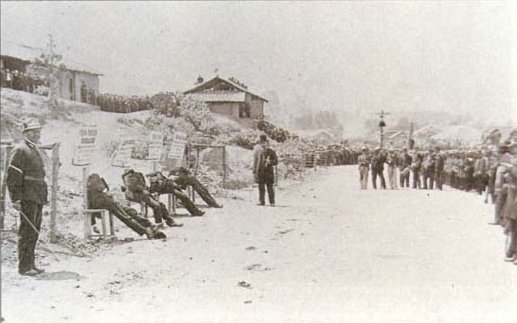
Reyes’ vengeance was extrajudicially old-school: the executions he arranged were not permitted under Colombian law at all, and by having them publicly shot at the scene of the crime, he added a downright medieval twist of lese-majeste.


Images from here. These are the three shooters mentioned by the Times, as well as a fourth accomplice.

However rough his methods, Reyes did accomplish some important reforms for his country, and he did have the grace to resign his position in 1909 under fire for financial and diplomatic mismangement. (The man’s five-year administration has its own periodization in Colombian historiography: the quinquenio.) There have been worse entries in the annals of dictatorship.

On this day..

1945: Lena Baker

What I done, I did in self-defense, or I would have been killed myself. Where I was I could not overcome it.

-Lena Baker’s final statement

The state of Georgia has only ever electrocuted a single woman: African-American maid Lena Baker, put to death on this date in 1945 for murdering her abusive employer.

Baker was a sharecropper and a former sex worker hired to care for white mill owner Ernest Knight as he recuperated from a broken leg. This, as Baker’s biographer Lela Bond Phillips puts it, “developed into a sexual relationship.”

A twisted, sometimes-violent relationship.

Both Knight and Baker were alcoholics, and the Knight liked to keep his domestic in the gristmill for days on end.*

As an interracial liason, it was also entirely taboo; Knight’s son tried everything to separate his dad from this scandalous arrangement, including moving the family and beating up Baker.

Knight pere was even more committed to keeping her.

On the night of April 29-30, 1944, the elder Knight locked Baker up in the mill, after she’d attempted to flee him. Baker testified that after Knight got back from church — it was Sunday, after all — Baker tried to leave over Knight’s threats. The two fought over Knight’s pistol, and the fight ended when the pistol discharged through Knight’s head. As to how it went off or who pulled the trigger, Baker said she didn’t know.

Although the irascible, hard-drinking Knight wouldn’t have won any popularity contests among his white neighbors, this breach of the color line was prosecuted both vigorously and speedily: a one-day trial that August (the all-white, all-male jury goes without saying, right?) sufficed to send the maid to her death.**

She’s (obviously) the subject of the 2008 film Hope & Redemption: The Lena Baker Story.

* Virtual imprisonment of domestic labor: not a thing of the past.

** In 2005, the Georgia Board of Pardons and Paroles — which turned down Baker’s clemency application in early 1945 — issued a posthumous pardon suggesting that a non-death penalty manslaughter charge would have been the more appropriate conviction. Baker’s family and defenders read that as vindication; there’s a detailed NPR story about it here.

On this day..

1561: Cardinal Carlo Carafa, papal nephew

On this date* in 1561, the once-powerful Cardinal Carlo Carafa was put to death by strangulation in Rome’s Castel Sant’Angelo — victim of deadly Vatican politics.

Fruit of a powerful Neapolitan noble house — it was a Carafa who stuck fig leafs on Michelangelo nudes — Carlo Carafa went out on campaign in the dynastic wars chewing up the peninsula in the 16th century. In some outlandish vindictive pique, he elevated an offense from a Spaniard into not only a reason to switch sides to the French, but a reason to do stuff like massacre Spaniards in a captured hospital. Class act all the way.

When the boy’s (similarly pro-French) Carafa clansman ascended St. Peter‘s throne as Pope Paul IV in 1555, Carlo Carafa beat his sword into a galero as the Catholic Church’s newest cardinal-nephew.**

In this capacity, he had the whip hand in Vatican foreign policy in the late 1550’s … until the growing reports of his reprobate lifestyle led Paul IV to demote him. Virulently anti-Protestant, the obnoxiously upright Paul had been preoccupied intensifying the Inquisition. He took personal umbrage once convinced of his relative’s unworthiness: “He had planned to make his reign the period of great reforms,” writes Kenneth Meyer Setton. “The corruption of Cardinal Carlo Carafa had made a travesty of his efforts.”

These travesties included rumors of the love that dare not speak its name. Poet Joachim du Bellay, according to Who’s Who in Gay and Lesbian History, made sport of ecclesiastical buggery in Les Regrets:

now you should mourn
handsome Ascanio himself, Ascanio, O pity!
Ascanio, whom Carafa loved more than his own eyes:
Ascanio, whose face was handsomer
than that of the Trojan cupbearer, who pours for the gods

(Carafa had a plentiful menu of heterosexual scandals attributed, too. And other good stuff like starting an idiotic war of choice — with Spain, of course — that despoiled Church coffers and reversed the Vatican’s strategic interests.)

In such a state of disgrace — and more importantly, having been stymied in their anti-Spanish foreign policy — the Carafa house and faction was in line for something more serious than public humiliation when the disappointed octogenarian pontiff passed away later in 1559.

Upon the succession of a rival Medici pope, Pius IV, Carlo Carafa was hailed before a kangaroo court with his brother and partner-in-dissipation Giovanni on a rap sheet with every real and imagined indiscretion of their wild years.† Carlo was strangled and Giovanni Carafa beheaded.

Despite the nephews’ undoubted viciousness, their executions were basically about power and policy.

And though they had also screwed up policy, the next pope decided to look forward-backward, not backward-backward. In 1567, Pius V posthumously rehabilitated the naughty dead Carlo; today, you’ll find his now-vindicated remains interred at the family chapel in Rome’s Santa Maria sopra Minerva cathedral.

“The people wish to be deceived; let them be deceived.”

Carafa

* Seems like the best-sourced date, albeit uncertain — as discussed in this biography.

** Cardinal-nephews are the etymological source of the word nepotism.

† Carafa’s defense attorney was the noble Marc’ Antonio Borghese, father of a then-prepubescent kid named Camillo who would grow up to be Pope Paul V.

On this day..

1865: Antone Richers, Galveston deserter

On this date in 1865, the Confederate forces defending Galveston, Texas shot Antone Richers for desertion.

With the U.S. Civil War into its mopping-up phase, the Texas port was bracing for the Union to land an irresistible force. Many soldiers inclined less to brace than to bow: with the handwriting on the wall for any fool to see, the grey army suffered an epidemic of judicious desertions.

Antone Richers was one of these. Just, maybe not so judicious.

Richers was retrieved from the drink when the stolen boat he was attempting to ride out to the Union blockade capsized, and the upright Confederate officer who pulled him out wouldn’t take a bribe to keep keep quiet about it.

Condemned “to be shot to death with musketry” for his trouble, Richers died this date in especially pitiable fashion. According to Battle on the Bay: The Civil War Struggle for Galveston, a newspaper report of the execution ran thus:

A sharp rattle of musketry, and the prisoner fell dead, several balls having passed through his breast … The saddest part of the story remains to be told. The friends of [the prisoner] had sent Rev. Father Ansteadt on the day before the execution, by hand car, to Houston, as bearer of documents addressed to General Walker, showing that [Richers] was not of sound mind, and setting forth other reasons why he ought to be respited. The telegraph line between [Galveston] and Houston broke down the evening before the execution, and remained down [until] fifteen minutes after the execution. No intelligence from General Walker could therefore reach [Galveston]. But as soon as the telegraph operated, a dispatch was received from General Walker, dated the night before, containing an order for the respite of Anton [Richers]. It was too late — the man was dead.

It was Galveston’s second and last military execution of the war.


Galveston’s Confederate monument, erected by the Daughters of the Confederacy: “Dignified Resignation”. (cc) image from Patrick Feller.

On this day..

1942: Jakub Lemberg and family

(Thanks to Meaghan Good of the Charley Project for the guest post. -ed.)

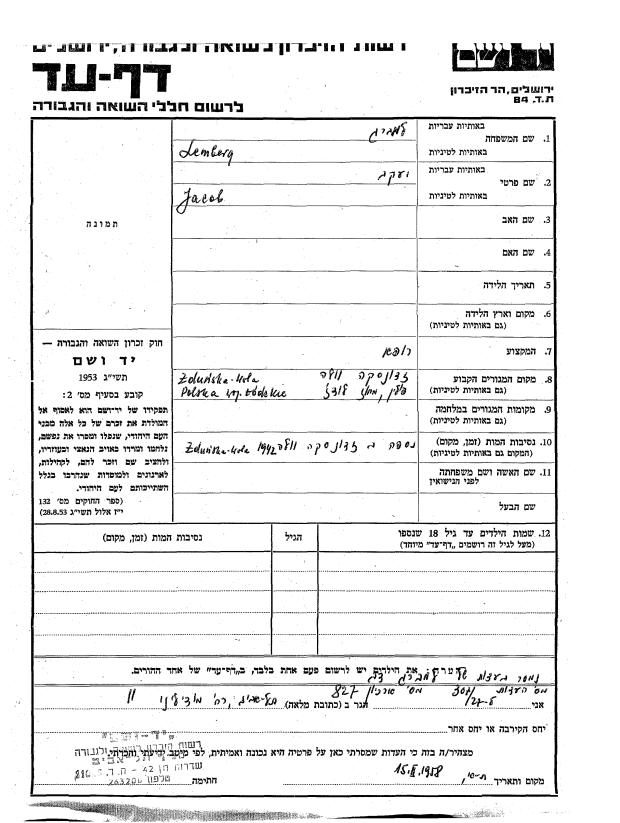
On this date in 1942, on the first day of Purim, Jakub Lemberg was executed together with his family in the Nazi ghetto in Zdunska Wola, Poland.

Lemburg, a 43-year-old internist and pediatrician, was head of the Judenrat in Zdunska Wola and thus it was his task to do the Nazis’ dirty work, such as putting together lists of his fellow-Jews for deportation.

He revealed himself to be a man of exceptional character and courage, and the circumstances of his death, as recorded in Louis Falstein’s The Martyrdom of Jewish Physicians in Poland, should not be forgotten:

The Gestapo chief ordered Dr. Lemberg to deliver ten Jews to be hanged for the ten hanged sons of Haman. Dr. Lemberg replied that he could deliver only four Jews: himself, his wife and their two children. Hans Biebow, “the Butcher of Lodz,” seized Dr. Lemberg and turned him over to the executioners, who killed him in the cemetery.

The Zdunska Wola ghetto was liquidated five months later. And in 1947, Biebow got his.

Here’s an image of Lemberg testimony (in Hebrew) from the Yad Vashem database.

On this day..

1864: Martin Robinson, treacherous guide

On this date in 1864, a Union officer frustrated of a design to raid Richmond during the U.S. Civil War hanged a local African-American guide whom he thought had intentionally misled him like Susanin.

The account of an army chaplain attached to the 5th New York Cavalry explains:

The guide, a negro, had misled us during the night, and, to obviate the delay of retracing our steps. Col. Dahlgren, on the representations of the negro that an excellent ford was to be found at Dover Mills, concluded to cross at that point. After two hours’ halt we again moved on, and soon reached Dover Mills, but only to meet disappointment.


Dover Milles, Civil War era illustration

The negro had deceived us, no ford existed at this point nor any means of crossing the river. He then stated that the ford was three miles below: this was obviously false, as the river was evidently navigable to and above this place, as we saw a sloop going down the river.

… he came into our lines from Richmond … [and] was born and had always belonged in the immediate vicinity of Dover Mills, was very shrewd and intelligent, and it would seem impossible that he should not know that no ford existed in the neighborhood, where he had seen vessels daily passing. Col. Dahlgren had warned him that if detected acting in bad faith, or lying, we would surely hang him, and after we left Dover Mills, and had gone down the river so far as to render further prevarication unavailing, the colonel charged him with betraying us, destroying the whole design of the expedition, and hazarding the lives of every one engaged in it, — and told him that he should be hung in conformity with the terms of his service. The negro became greatly alarmed, stated confusedly that he was mistaken, thought we intended to cross the river in boats, and finally said that he had done wrong, was sorry, etc. The colonel ordered him to be hung, — a halter strap was used for the purpose, and we left the miserable wretch dangling by the roadside.

Our correspondent terms this the case of the “Faithless Negro”, but posterity has the luxury of a less paranoiac reading than indulged by a troupe of hotheaded commandos deep in enemy territory all a-panic as their expedition implodes. The James River was just plain swollen with winter rains. Bad luck all around.

A Goochland County marker marks the spot of the botched crossing and subsequent execution.

But we’re really just getting started. Stay tuned for some serious blowback from this bootless military debacle.

The full story of the raid is a tangled and contested affair, but it’s well worth perusing in detail. To sum up:

This expedition’s leader, Col. Ulric Dahlgren, abandoned the effort and in the attempt to fall back, rode into a Confederate ambush the next day. He died in the fusillade, while his men were captured.

The body of this late Col. Dahlgren, on whose authority our misfortunate guide was put to death, was found by the Confederates to bear some startling papers* … indicating that the intent of his ill-starred expedition was not merely to liberate starving northern prisoners, but that “once in the City it must be destroyed & Jeff. Davis and Cabinet killed.”

Within days, the story was abroad and Richmond newspapers floridly outraged at this proposed breach of chivalrous warfare.

Though Confederate General Robert E. Lee was able to quash public demands for the Dahlgren party’s summary execution, the documents may indeed have marked a turning point in the war’s conduct, a public announcement of total warfare sufficient for the South to “inaugurate a system of bloody retaliations.”** If so, it was a well-timed license: the Confederacy was in the process of being steamrolled and would soon require recourse to more desperate strategems.

After Dahlgren, argues Come Retribution: The Confederate Secret Service and the Assassination of Lincoln, “there was an increase in Confederate clandestine activity designed to encourage the antiwar faction in the North to organize and revolt” — even including a mirror-image Confederate cavalry raid on Washington D.C. with an eye towards capturing Lincoln.

There are, in fact, some historians who postulate that it was “bloody retaliation” for Dahlgren’s attempt on the Confederate president that ultimately led southern agents to initiate the late-war plots against Abraham Lincoln’s person — resulting ultimately in Lincoln’s assassination:

Ulric Dahlgren, and [his] probable patron [U.S. Secretary of War] Edwin Stanton set out to engineer the death of the Confederacy’s president; the legacy spawned out of the utter failure of their effort may have included the death of their own president.

That is some blowback.

Books exploring the alleged link between the Dahlgren Papers and the Lincoln assassination

* It must be said that the Dahlgren papers have been continually contested as frauds from the moment they were known, though many historians do indeed consider them legitimate. We are in no position to contribute to that debate, and for the purposes of this post’s narration the question is immaterial: the papers, forged or not, certainly existed, were widely publicized, and genuinely angered many southerners.

** These words are the demand of the March 8, 1864 Richmond Dispatch.

On this day..

1856: Auguste Chapdelaine, saintly casus belli

On February 29, 1856, local Chinese officials in Guangxi beheaded French missionary priest Auguste Chapdelaine — and handed his countrymen a pretext for war.

Chapdelaine (English Wikipedia page | French) had gone illegally to the Chinese interior to proselytize Christianity.

The local mandarin Zhang Mingfeng was no doubt disposed to take such an harsh line against this provocation by virtue of the ongoing, Christian-inspired Taiping Rebellion, which had originated right there in Guangxi and was in the process of engulfing all of southern China in one of history’s bloodiest conflicts.

So Chapdelaine and his associates were snapped up, put to a few days’ dreadful torture, and on this date a Chinese convert and Chapdelaine were both summarily beheaded. (A female convert, Agnes Tsaou-Kong, expired under torture around the same time.)

Pietistic accounts of believers’ last extremes are here and here.


(Images from this French page.)

It took months for word of this martyrdom to reach French consular officials, and many months more for the gears of international diplomacy to turn — but when they did so, France pressed a demand for reparations.

Since pere Chapdelaine had been acting illegally in the first place, the Qing’s obdurate Viceroy Ye(h) adamantly refused to offer Paris satisfaction.

By 1858, this intransigence sufficed to license French entry (alongside Britain) into the Second Opium War, from which the Europeans won by force of arms a noxious treaty guaranteeing their right to push Christianity in China, extracting a couple million silver taels in damages, and (of course) assuring their right to traffic opium into China.

It would be rather ungenerous to hold all the ugly imperial consequences personally against our day’s martyr. August Chapdelaine was canonized by the Catholic Church in 2000 as one of 120 Martyrs of China.

China was not impressed by this celebration of a onetime colonial catspaw, and met the Vatican’s “anti-China” celestial promotion announcement with one of its own — charging that Chapdelaine “collaborated with corrupt local officials, raped women and was notorious in those areas [where he preached].”

On this day..

1476: The Garrison of Grandson, by Charles the Bold

On this day in 1476, the 412-strong garrison of Grandson, Switzerland surrendered to Charles the Bold during the Burgundian Wars … and was executed en masse by hanging and drowning.

Detail view (click for the full image) of a mounted Charles the Bold under a forest of hanged men.

Charles — less generously known as “Charles the Rash” or “Charles the Terrible” — was the Duke of Burgundy, an ancient territory whose warlike inhabitants were celebrated back to The Nibelungenlied

Upon his single person the sword-strokes fell thick and fast. The wife of many a hero must later mourn for this. Higher he raised his shield, the thong he lowered; the rings of many an armor he made to drip with blood … Then men saw the warrior walk forth in full lordly wise. As the strife-weary man sprang from the house, how many added swords rang on his helmet! Those that had not seen what wonders his hand had wrought sprang towards the hero of the Burgundian land. (XXXII)

In the 15th century, the swords ringing on Burgundian helmets were those of the French and the Habsburgs, who squeezed the mighty duchy on either side.

Charles the Bold fought the expansionist Burgundian Wars as a project to strengthen his duchy’s independence. But it would have the exact opposite effect.

The Swiss had been pulled into the anti-Burgundian league, and taken the city of Grandson, inducing an irritated Charles to put it to a fearful bombardment that threatened to overrun the place in short order.

Sources vary by partisan affiliation as to whether the besieged garrison surrendered at its antagonist’s discretion (Burgundian version) or on a pledge of mercy (Swiss version). But in the actual event, no mercy at all was given. To a man, the prisoners were strung up on trees and drowned in the adjacent Lake of Neuchatel — a warning to the Swiss not to mess with Burgundy.

It was bluster that Charles’s men could not back up when their opponents fought back … and after this, who was going to surrender?

A couple days later, the Swiss relief force arrived too late to bail out the garrison. Instead, it trounced the Burgundians in battle, sending them fleeing “without looking back, helter-skelter” as Charles, “exasperated beyond measure by the stupid cowardice of his troops, rode amongst them with drawn sword, striking them furiously, in the vain effort to bring them to a standstill.”

The victorious Swiss made off with a fantastic booty from the abandoned Burgundian camp, but also recovered a more dolorous prize.

There were found sadly the honorable men still freshly hanging on the trees in front of the castle whom the tyrant had hanged. It was a wretched, pitiable sight. There were hung ten or twenty men on one bough. The trees were bent down and were completely full. There hanged a father and a son next to each other, there two brothers or other friends. And there came the honorable men who knew them; who were their friends, cousins and brothers, who found them miserably hanging. There was first anger and distress in crying and bewailing.

Charles was plenty distressed himself at his embarrassing reversal, and boldly (or rashly) regrouped, marched on the Swiss again — and had Burgundian power decisively shattered at the Battle of Murten that June. The following January, a dispirited Charles died in another losing battle, leading most of the once-imperious realm of Burgundy to settle into French hands, where it remains today.

On this day..