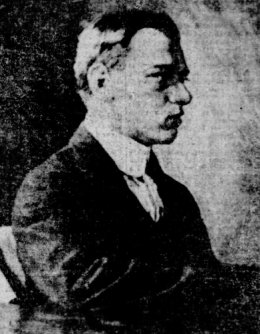
1860: John Guthrie, antislavery horse thief

On this date in 1860 in “Bleeding Kansas” — the frontier zone of dirty war by and against the Slave Power where John Brown got his start — a man named John Guthrie was hanged under scant-to-no color of law.

The site of this execution is still known as Guthrie’s Mountain or Mound … and it’s even alleged that the spot is still ill-omened by the event, and that the dying Guthrie “assailed his executioners for lynching an innocent man,” prophesying that “each of them would meet a horrible death” which curse the imminent U.S. Civil War carried into effect.

For a fuller account, see this pdf of a 1982 Kansas History article, “Guthrie Mound and the Hanging of John Guthrie”.


I know a story I think worth preserving of a Bourbon county execution without benefit of clergy, but it was not a lynching. I have had the story from a lot of people, including two eyewitnesses — not participants, of course. Away back in the later territorial days, when Bourbon county was in the ‘region beyant the law,’ a young man named Guthrie was caught up near Mapleton riding somebody else’s horse. Everybody knows that at that time in those parts, horse stealing and nigger chasing and homicide were offenses in a class by themselves. The hardheaded and hard-fisted farmers thereabouts gathered in a hurry. But there were no courts that they respected or had reason to respect. What to do?

Just across the river south of Mapleton in the Little Osage bottom is a little round hill about three hundred feet high shaped almost exactly like an overturned soup bowl. They adjourned to the top of that hill. There they elected a judge and a sheriff and a prosecuting attorney. They selected a jury and tried their man, who admitted his guilt. After the verdict and the proper sentence, the sheriff had no place to keep the man, so he executed the sentence at once by hanging him to the limb of a jack oak tree nearby. His body was buried where it was cut dawn. It is there yet.

From what I have been told I am quite satisfied that that trial was quite as regular and formal as many cases in the regular courts of that day, though not sanctioned by the law.

By the way, that hill is the same ‘pretty little hill’ where Lieut. Zebulon M. Pike ate the fried venison steak that September morning in 1806, as he notes in his journal. It is still called Guthrie mountain, and is one of the real beauty spots of old Bourbon.

C.E. Cory, 1932

The horse-thief story has different versions, in which Guthrie is either innocent of the charge or not. For what it may be worth, the 1860 New York Times also reported a “very imperfect” version of this take.


However, there’s at least one primary document suggesting that “thieving” may have been a pretext for killing the man over his anti-slavery stance.

Mapleton, K. T., Feb. 12, 1860. “MY DEAR PARENTS: … Last Sunday night about 1 o’clock a man named John R. Guthrie was hanged about a mile and a half from here on the top. of what is known as Tigret Mound. He was left suspended until Monday eve. His corpse was in plain sight from here as he hung. The proslavery’s hung him for an alleged crime of horse stealing. They arrested him without authority or shadow of law and never gave him even a mock trial, as has generally been the case. The country is again in commotion. I know not what will be the result, the probability is that unless Montgomery takes the field again it will soon blow over and give them a chance to hang the next ones that gets in their way.

Free Stater (i.e., anti-slavery) Alpheus H. Taylor

On this day..

1940: Nikolai Yezhov, terror namesake

In the terrible years of the Yezhovshchina, I spent seventeen months in lines outside the prison in Leningrad [queuing to deliver food to or get news of imprisoned loved ones: in her case, her son Lev]. One day somebody in the crowd identified me. Standing behind me was a woman, with lips blue from cold, who had, of course, never heard me called by name before. Now she started out of the torpor common to us all and asked me in a whisper (everyone whispered there):
‘And can you describe this?’
And I said: ‘I can.’
Then something like a smile passed fleetingly over what had once been her face.

-Poet Anna Akhmatova

On this date in 1940, the first name in Stalin’s terror got his just deserts.

Well. The first name after Stalin’s own, a point energetically made by Nikolai Yezhov’s daughter* in her fruitless post-Soviet attempts to rehabilitate the man.

But clearing a fellow’s name is a tough task when that name is the mother tongue’s very metonym for political persecution: the Soviet Union’s mind-bending late-1930s witch hunt for internal enemies, known as the Yezhovshchina.

From late 1936, when he eliminated his predecessor Genrikh Yagoda (later executed, of course), until his own fall from power in at the end of 1938, Yezhov presided over the apex of Stalinist terror, averaging hundreds of political killings daily — perhaps north of 600,000 for the two-year period, plus a like number disappeared into the Gulag’s freezers. (Just browse this here site’s ‘1937’ tag for a taste.)

Departments and regions received quotas for executions as if they were tractor factories. Security officials well understood that their own heads would be next on the block for any perceived shortcoming; Yezhov had thousands of them arrested, too. (pdf)**

We are launching a major attack on the Enemy; let there be no resentment if we bump someone with an elbow. Better that ten innocent people should suffer than one spy get away. When you chop wood, chips fly.

-Yezhov

The “Bloody Dwarf” — surely there is some of Yezhov in the Master and Margarita character Azazello, the Satan/Stalin figure’s murderous and diminutive attendant — rode this tiger unto his own destruction.


Stalin and other Soviet VIPs with (front right) Nikolai Yezhov.

The same photo ‘updated’ after Yezhov’s fall. (For a similarly chilling photographic disappearance, see Vladimir Clementis.)

As Yezhov had once displaced and killed his mentor Yagoda, so Yezhov’s own nominal underling Beria would displace Yezhov.

Power in the NKVD shifted towards Beria over the course of 1938 until Yezhov’s own resignation that November. The former boss was quietly arrested the next April and barely troubled his skilled torturers before copping to the usual litany of official self-denunciations: corruption, economic sabotage and “wrecking”, treasonable collaboration with the Germans, plus a bisexual personal life. (That last one was true.)

Bound for historical infamy, Yezhov salvaged a shred of dignity in the last, when he was “tried” a few hours before death and renounced those confessions — albeit from the twisted standpoint of a man still unquestioningly committed to the man and the system that had destroyed him.

It is better to die, but to leave this earth as an honorable man and to tell nothing but the truth at the trial. At the preliminary investigation I said that I was not a spy, that I was not a terrorist, but they didn’t believe me and applied to me the strongest beating. During the 25 years of my party work I have fought honorably against enemies and have exterminated them. I have committed crimes for which I might well be executed … But those crimes which are imputed to me by the indictment in my case I did not commit …

My fate is obvious. My life, naturally, will not be spared since I myself have contributed to this at my preliminary investigation. I ask only one thing: shoot me quietly, without tortures …Tell Stalin that I shall die with his name on my lips.

And indeed, Yezhov knew from plenty of personal experience how this script ended. It was called the Yezhovshchina for a reason.

The judges pretended to deliberate for half an hour. Ezhov fainted at the verdict, then scrawled a petition for mecy; it was read out over the telephone to the Kremlin and rejected. Ezhov was taken in the dead of night to a slaughterhouse he himself had built near the Lubianka. Dragged screaming to a special room with a sloping cement floor and a log-lined wall, he was shot by the NKVD’s chief executioner, Vasili Blokhin. Beria gave Stalin a list of 346 of Ezhov’s associates to be shot. Sixty of them were NKVD officers, another fifty were relatives and sexual partners. (From Stalin and His Hangmen: The Tyrant and Those Who Killed for Him

* Natalia Khayutina is actually Yezhov’s adoptive daughter. Her birth parents were killed … in the Yezhovschina.

** “I purged 14,000 chekists,” Yezhov later said. “But my guilt lies in the fact that I did not purge enough of them.”

On this day..

1537: “Silken Thomas” FitzGerald, Earl of Kildare

On this date in 1537, an Irish lord and his five uncles were hanged and beheaded at Tyburn for revolting against Henry VIII: the last act in an entire cycle of executions.

The Rumored Execution

Thomas FitzGerald‘s father, the king’s Lord-Deputy of Ireland, had been summoned to London to answer the complaints of his rivals and there committed to the Tower.

Said rivals then cunningly circulated reports that dad had been beheaded, inducing the hot-headed (and finely-appareled) heir Thomas to renounce his allegiance and rebel with a dramatic retinue of 140 silk-bedizened gentlemen.

The Summary Execution

The Earl of Kildare hadn’t really been executed at all: he just died of shock and grief upon reading the reports of what his son had got up to in his absence.

Stuff like, besieging Dublin Castle where he hunted down the fleeing Archbishop (a longtime enemy of the Kildares) and had him instantly put to death.

(This might have been more pardonable had he at least managed to take Dublin Castle.)

The Maynooth Pardon
(Euphemism for Execution)

Instead, Silken Tom holed up in Maynooth Castle where he soon found himself on the receiving end of a siege.


Maynooth Castle in its present, romantically ruined state. (cc) image from Bart Busschots.

Thomas and his silk went off to find some allies to relieve it, hoping to play a Catholic-resentment card against Henry VIII’s rift with Rome.

But the local response was desultory and while the new Earl of Kildare was busy beating the bushes, the English took the castle — issuing to its garrison the “Maynooth Pardon”, the ironical sobriquet for executing most of the lot.

Silken Thomas’s Execution

His rebellion having been all downhill since the big silken resignation, Thomas was eventually induced by promises of safekeeping to surrender himself to the royal mercy.

But said mercy was not forthcoming, and he endured a year-plus locked up in something less than his trademark finery — “I have had neither hosen, doublet, nor shoes, nor shirt but one; nor any other garment but a single frieze gown … so I have gone wolward, and barefoot and barelegged,” he complained in a letter — until, attainted by the Irish Parliament, he was executed with his kinsmen.

Although the Kildare title disappeared for a time, Thomas FitzGerald’s young but hunted half-brother escaped to the continent, bounced all over Europe for a decade, picked up an education, fought the Turks, and returned to receive his family’s peerage re-granted so he could practice alchemy in his castle as “the Wizard Earl”.

When next in Kildare Town, stand a drink or two for these hearty bygone Geraldines at the Silken Thomas pub.

On this day..

1951: The first four of the Martinsville seven

On this date in 1951, the first of two batches comprising the “Martinsville Seven” — black, all — went to the Virginia electric chair for gang-raping a white woman. (The remainder were executed on Feb. 5)


Newspaper scan (click for larger image) via Mr. Beaverhousen (cc).

Somewhat forgotten today, the Martinsville Seven were in their day the locus of radical activism against Jim Crow in the South — very much like Willie McGee, who was put to death in Louisiana later that same year.

In fact, this case generated a bit of a legal milestone: a month before the executions began, the U.S. Supreme Court declined an appeal seeking relief on the then-novel grounds of equal protection — rather than due process.

The argument was that the Old Dominion’s superficially race-neutral rape statute was anything but; that argument was buttressed by data showing that Virginia had executed 45 black men for raping white women from 1908 to 1950, but never once in that period executed any white man for raping a black woman. (The high court only declined to take the appeal; it wouldn’t get around to explicitly ruling equal protection claims based on racial patterns out of bounds until 1987’s McCleskey v. Kemp.)

This seems to be the debut use for this gambit, bound to become an increasingly powerful one both in and out of the courtroom during the civil rights movement.

And it was available — and necessary — here because the Martinsville Seven basically looked guilty as sin. Their confessions and the victim’s accusation and the testimony of a young eyewitness said that, drink-addled, they had opportunistically grabbed a white Jehovah’s Witness housewife when she was proselytizing on the wrong side of the tracks.

Eric Rise, author of The Martinsville Seven: Race, Rape, and Capital Punishment, noted in a scholarly article,*

certain striking characteristics distinguished the proceedings from classic “legal lynchings.” The evidence presented at trial clearly proved that nonconsensual sexual intercourse with the victim had taken place. All seven defendants admitted their presence at the scene, and although some of the men may not have actually consummated the act … The prosecution emphasized the preservation of community stability, not the protection of southern womanly virtues, as the dominant concern of Martinsville’s white citizens. Most significant, the trial judge made a concerted effort to mute the racial overtones of the trials. Although white juries decided each case, blacks appeared in every jury pool. Race-baiting by prosecutors and witnesses, notably evident at Scottsboro and other similar trials, was absent from the Martinsville proceedings. By diligently adhering to procedural requirements, the court attempted to try the case “as though both parties were members of the same race.”**

The standard playbook for fighting a “legal lynching” case was leveraging outrage over a plausibly innocent convict and an outrageous kangaroo court.†

Paradoxically, by taking these elements out of the mix (relatively speaking), the Martinsville Seven perfectly isolated the extreme harshness of the penalty and the structural discrimination under which it was imposed. The NAACP took up the case on appeal strictly for its discriminatory characteristics, steering for its part completely clear of any “actual innocence” argument.

These challenges posed discomfiting questions that jurists shrank away from. The Virginia Supreme Court, in denying an equal protection application, fretted that actual legal relief could mean that “no Negroes could be executed unless a certain number of white people” were, too. Timeless.

Though a later U.S. Supreme Court would completely overturn death-sentencing for rape, based in part on its overwhelming racial slant, justices have generally avoided meddling to redress broad statistical patterns rather than identifiable process violations specific to particular cases.

Those questions of substantive — rather than merely procedural — equality in the justice system remain potently unresolved, still part of Americans’ lived experience of the law from death row to the drug war to driving while black. As if to underscore the point in this instance, just two days prior to the first Martinsville executions, the Wall Street bankster acting as American proconsul in conquered Germany pardoned imprisoned Nazi industrialist Alfried Krupp, and restored him to the fortune he had amassed working Jewish slaves to death during the war. It was a very particular quality of mercy the U.S. showed the world in those days. (The Martinsville case was known, and protested, worldwide.)

Carol Steiker (she used to clerk for liberal Justice Thurgood Marshall, who as an NAACP lawyer worked on the Martinsville case) argues‡ that the Martinsville Seven’s legacy is linked to their later obscurity, for “[t]heir attempt to present statistical proof of discrimination in capital sentencing represents a ‘road not taken'” — neither in 1951, nor since.

The road taken instead had Joe Henry Hampton, 22, Howard Hairston, 21, Booker Millner, 22 and Frank Hairston, 19 electrocuted one by one this morning in 1951. Their three co-accused, John Clabon Taylor, 24, James Luther Hairston, 23, and Francis DeSales Grayson, 40, followed them on February 5.

* “Race, Rape, and Radicalism: The Case of the Martinsville Seven, 1949-1951” in The Journal of Southern History, Aug., 1992.

** This quote an actual trial admonishment of the judge, Kennon Whittle.

† Graded on a curve: this is still Jim Crow Virginia. Six trials were wrapped up at warp speed in 11 days, with a total of 72 jurors — each one white. The implied comparison is something along the lines of, all seven tried together in the course of an afternoon, with a good ol’ boy defense attorney mailing it in.

‡ Review of Rise’s book titled “Remembering Race, Rape, and Capital Punishment” in the Virginia Law Review, Apr., 1997

On this day..

1632: Aris Kindt, Rembrandt subject

We can trace to this date the event commemorated in young Rembrandt van Rijn‘s striking The Anatomy Lesson of Dr. Nicolaes Tulp … resolving to the public hanging the same day* of the Lesson‘s ashen exhibit, a robber by the name of Aris Kindt.


The Anatomy Lesson of Dr. Nicolaes Tulp.

Art history footnote: notice that the cadaver’s navel is a stylized “R”: the artist was playing around with his signatures during this period. Also, note the hand under dissection. The scene was actually re-enacted in 2006 to establish that Rembrandt’s done the forearm tendons incorrectly — it does look wonky. Additionally, the very fact that the anatomist is beginning with the arm rather than the usual trunk has led to speculation over whether this was an artistic choice or the doctor’s actual procedure in the thrall of a temporary medical vogue.

The 25-year-old painter had only moved to Amsterdam at the end of the previous year.

He broke through almost immediately with a commission — it was his first major group portrait and it would become known as his first major masterpiece (source), instantly establishing his preeminence in the city’s art scene — from the Amsterdam Guild of Surgeons to render one of its most important events: the annual public dissection of a criminal.**

Prior to the systematic medicalization of the corpse, when anatomizing a human was still a fraught and transgressive act, Netherlands cities were permitted only one such exposition per year. Its subject could only be a male criminal who would be given a Christian burial thereafter. (Contrary to the English model, posthumous dissection was not used to intensify a death sentence with a further terror.)

The affair would have been crowded not only with other doctors but city council members, intellectuals, and well-dressed respectable burghers. Anyone, in short, who was anyone (they paid for the privilege).

And, of course, its overseer, Nicolaes Tulp; Rembrandt’s framing will leave you no doubt as to which figure in the painting is in charge. The city’s most respected surgeon, Tulp was the Guild’s Praelector Anatomiae, “reader in anatomy”, dignified with the responsibility of publicly lecturing on the unfolding dissection.

The silent but essential final party was Aris Kindt, the alias of a Leiden†-born criminal around Rembrandt’s own age named Adriann Adriannsz. His life was forfeit as a recidivist thief who had lately mugged a gentleman for his cloak.

This common crook’s ghastly lifeless image‡ is more alive for us in posterity than nearly any of his more law-abiding contemporaries. The expressive composition surrounding him is pregnant with all of the moment’s paradoxes: the advance of humanism on the back of a cruel penal regime; the exaltation of the mind with the unsentimental commodification of the flesh; excellence and status bowing over that old emblem of mankind’s final equality in the tomb.

Evil men, who did harm when alive, do good after their deaths:
Health seeks advantages from Death itself.

-Dutch intellectual Casper Barlaeus in 1639 (quoted here)

Rembrandt must have agreed: he painted the Guild’s criminal dissection again in 1656.

* Some sources give January 16, 1632 for the execution. This possibility appears to me to be disbarred by the apparent January 17 dating of a Rembrandt portrait of Marten Looten; indeed, confusion over this Rembrandt-related January date may even be the ultimate source of the misattribution, if January 16 is indeed mistaken. Scholarly sources overwhelmingly prefer the 31st, apparently from primary documentation that both the hanging and a Tulp lecture took place on that date. (See, e.g., the out-of-print seminal academic work.)

** The 17th century Dutch left a number of similar “anatomy lesson” works. That same Amsterdam guild commissioned a new one every few years as part of its keeping up appearances; the last had been a 1619 portrait from Nicolaes Eliaszoon Pickenoy, The Osteology Lesson of Dr Sebastiaen Egbertsz.

† Speaking of Leiden: see this pdf thesis for a very detailed excursion into the anatomizing scene as practiced in that city.

‡ Needless to say, we can hardly presume that this painting is strictly representational. Still, this is Kindt for us, even if Kindt looked nothing like the fellow being taken apart.

On this day..

2011: Ahmed Ali Hussein, enemy cleric

On this date last year, the Islamist Somali al-Shabaab publicly shot a man named Ahmed Ali Hussein in Mogadishu.

The 44-year-old, reportedly an ecclesiastic member of the rival al-Ictisam sect, was allegedly induced to confess that he’d been working with American intelligence. He was chained up and riddled with hundreds of bullets while neighbors were made to watch.

“In the documents we have, Ahmed Ali Hussein has worked with United States’ Federal Bureau Investigation (FBI) for 16 months,” an al-Shabaab spokesperson explained. Hussein was not permitted to defend himself.

So, extrajudicial killing of cleric on uncontested secret evidence of aiding the enemy. Put Somalia down for the cutting edge of jurisprudence.

On this day..

1912: Albert Wolter, white slaver

A century ago today, 20-year-old Albert Walter strolled the 15 feet from the death cell to the Sing Sing electric chair, calling out “Good-bye boys” to his fellow-prisoners as he died for the murder of 15-year-old Ruth Wheeler in a possible white slavery crime two years earlier.

Wolter left a note steadily — all the reports remark on the youth’s sangfroid; he took a nap while the jury went to deliberate with his life in its hands — avowing his innocence, and indulging the “hope there may come a time when the conscience of the perpetrator will overpower him, and he will come to the front and acknowledge his guilt.” He charitably added for “those who have maliciously prosecuted and killed me, for them I pray God’s forgiveness.”

Lots of New Yorkers would have had to ask it.

Despite his cool under fire, Wolter was overwhelmingly acclaimed the guilty party, the evidence against him being as close to airtight as circumstantial gets.

Newsmen ravenous for virginals despoiled by outlanders instantly sunk fangs into the story of the layabout 18-year-old German immigrant — idle lifestyle the product of parasitism upon the drudgery of a young countrywoman toiling 12-hour days at a bakery — who lured the “saintly” stenographers’ school graduate to his apartment with the promise of work and had her charred and headless trunk bundled up on the fire escape by morning. (Other charred remains, and Wheeler’s monogrammed signet ring, were retrieved from inside the apartment.)

Reporters soon sketched the persona of a burgeoning little pimp who had already routed several girls into prostitution. In amid the decadence and displacement of fin de siecle industrialization, you couldn’t ping a more heart-racing (pdf) moral panic than white slavery.*


Sale in a Roman Slave Market, by Jean-Leon Gerome (1883).

Congress was at that very moment in the process of legislating the (still-extant) Mann Act named for the Illinois legislator who sponsored it after a notorious 1909 Chicago case.

But the Big Apple, as the country’s largest city and its gateway for Europe’s polyglot huddled masses, was the reputed center of the whole reputed business.

This illustration from Fighting the Traffic in Young Girls is outstandingly captioned:

“THE FIRST STEP. Ice cream parlors of the city and fruit stores combined, largely run by foreigners, are the places where scores of girls have taken their first step downward. Does her mother know the character of the place and the man she is with?”

The men and the women who engage in this traffic are more unspeakably low and vile than any other class of criminals. The burglar and holdup man are high-minded gentlemen by comparison. There is no more depraved class of people in the world than those human vultures who fatten on the shame of innocent young girls. Many of these white slave traders are recruited from the scum of the criminal classes of Europe.

And in this lies the revolting side of the situation. On the one hand the victims, pure, innocent, unsuspecting, trusting young girls — not a few of them mere children. On the other hand, the white slave trader, low, vile, depraved and cunning, — organically a criminal.

-Chicago U.S. District Attorney Edwin Bell, prefacing the bodice-ripping 1910 Fighting the Traffic in Young Girls**

While the Empire State enacted its own Wolter-inspired law charging schools with vetting the employers who recruit their graduates, Wolter entered the criminal justice system on greased lightning (just like he left it). He was a condemned murderer within five weeks of Ruth Wheeler’s death.†

Wolter himself (evidently surprised to learn that he was old enough for the death penalty; that may not have been the case where he was from) tried to put the blame on a phantom Teuton, one “Frederick Ahner” who was the mastermind in Wolter’s own fall and who must have done the Wheeler business while Wolter was out at the park. That’s “the perpetrator” to whom Wolter’s last letter refers: his conscience never led Ahner to so much as materialize, much less to confess.

The fate of Wolter’s bakery-girl cohabitant — and, one might think, prospective accessory — Katchen “Katie” Mueller was very different. She precipitously aligned herself with her lover’s prosecutors, urged “My dear Al” to confess (almost successfully), and got respectable patronage “to break away from the life she had been leading”. A year after Wolter’s electrocution, Mueller’s redemptive next marriage made the society pages.

* Wolter may have been (pdf; see p. 61 footnote) a specific inspiration of the 1919 Theodore Dreiser play “The Hand of the Potter”, which is all about the era’s white slavery panic.

** Similar dubious (pdf) vice-crusader porn is to be had in (among many other period pieces) a 1911 tract by another Chicago prosecutor, Clifford Roe. Though The Great War on White Slavery is in the public domain, I haven’t been able to locate a complete text online — only this excerpt.

† On the other hand, the then-protracted period of 22 months required to proceed from conviction to execution made Wolter “dean of the death house” by the time he died.

On this day..

1697: John Fenwick, bitter

The Franco-Dutch War of the 1670s lifted to power the young stadtholder William of Orange, and made him a couple of noteworthy lifelong enemies.

One was the Sun King, Louis XIV of France, whose decades-long rivalry with William tracked William’s interesting career all the way to the throne of England.

William III, equestrian. Consider yourself foreshadowed.

Another was Sir John Fenwick, an English nobleman whom William supposedly slagged* when they were fighting together in the Low Countries — and who likewise still carried the enmity when William had become his sovereign.

On this date in 1697, the latter rivalry came to a fatal end for John Fenwick on the headsman’s block. The funny thing was that the stroke turned out to cost King William III his own life as well.

You couldn’t say that Fenwick came late to the Jacobite cause; he’d been a strong adherent of the beleaguered Catholic-esque Stuart dynasty, and signed off on the 1685 execution of its previous Protestant challenger Monmouth.

But if it prosper, none dare call it treason. In 1688, the Low Countries prince with the low estimation of Baronet Fenwick hopped the channel and successfully overthrew the last Stuart monarchking James II.

With the Glorious Revolution, Fenwick’s personal and political were very conveniently aligned in loyalty to the exiled James … except that his formerly patriotic loyalty to James was now the traitorous cause of Jacobitism.

Fenwick kept up his Jacobiting in the 1690s, got arrested and released once, and then finally found himself implicated in a plot to murder William. Though his allies managed to spirit one of the potential witnesses against him away to the continent, Parliament passed — ever so narrowly — a bill of attainder to condemn Fenwick to death. (There’s a more detailed account of the legal and political maneuverings here and here.)

The State his Head did from his Body sever,
Because when living ’twas his chief Endeavour
To set the Nation and its Head together.

That’s politics. Even kings themselves are in mortal peril around here.

A failed assassin in life, Fenwick would blunder Gavrilo Princip-like into accidental success … but only after his own execution.

As a condemned traitor, Fenwick’s estate was seized by the crown, and the king personally claimed his prey’s equine ride (either a horse with a sorrel coat, or a horse named Sorrel, or both).** Not long after Fenwick’s death, this horse stumbled on a molehill, throwing its royal rider. William broke his collarbone in the accident, developed pneumonia, and died — leading Jacobite sympathizers to dote on the animals (both horse and mole) who had authored their enemy’s misfortune.

Illustrious steed, doubtless most worthy of the sky,
To whom the lion, bull, and bear would give place;
What happy meadows bore thee happily?
What happy mother gave you her nutritious teats?
Is it from the land of Erin you are come to oblige your country,
Or is it Glenco or the Fenwick race which produced you?
Whoever thou art, mayst thou prosper, I pray memorable one: and
May saddle never more press thy back, nor bit thy mouth.
Avenger of the human race, when the tyrant dies,
Mayst thou thyself enjoy the liberty thou wilt give to others.


A lovely sorrel enjoys the liberty of a happy meadow. (Nutritious teats not pictured.) (cc) image from SMALLORBIGOFMEN.

* During the Dutch campaign, William “had reflected very severely upon his [Fenwick’s] courage, which occasioned his making returns that provoked the Prince to say, that if he had been a private person he must have cut Sir John’s throat.” Just your basic primate poo-flinging.

** Leaving aside his ultimate fate, quite an understandable move by William: the Fenwicks were famous for their horse husbandry.

On this day..

1961: Wasyl Gnypiuk, sleep-killer

(Thanks to Meaghan Good of the Charley Project for the guest post. -ed.)

On this day in 1961, a Polish/Ukrainian immigrant with the unpronounceable name of Wasyl Gnypiuk was hanged for murder in Lincoln, England.

The 34-year-old Gnypiuk was living in a toolshed in Worksop when he murdered his 62-year-old landlady, Louise Surgey, on July 17, 1960. He had spent some time in Nazi concentration camps during World War II, and suffered terrible nightmares as the result of his ordeal. The night of the murder, he broke into Surgey’s house while she was sleeping, drank some of her liquor, and passed out.

Gnypiuk — so he later claimed — had a dream where he was fighting Nazis. When he woke up, Surgey lay dead at his feet: he had strangled her in his sleep.

The authorities treated his claims with understandable skepticism. He didn’t help his case by trying to hide the body and stealing some money that had been lying around the house. He had a two-day trial in November and was duly convicted and sentenced to death. Gnypiuk was the last person to be hanged in Lincolnshire before the UK abolished the death penalty in 1965.

The truth about what happened will never be known for sure, but Gnypiuk is still regularly listed among cases of homicidal sleepwalking.

On this day..

1894: George Painter, Chicago infamous

While there may be serious doubt about the wisdom of capital punishment it is at present imposed by the law of this State, and if it is to be applied in any case then it should be in this … Any man who will live off of the shame of a woman and beat her from time to time as he would a dog, and finally kill her, must expect to suffer the penalty of the law.

-Illinois Gov. John Altgeld denying clemency to George Painter (Jan. 25, 1894)

On this date in 1894, the Land of Lincoln bloodily botched (but ultimately accomplished) the hanging of George Painter.

Painter died for the sordid murder of prostitute-lover-income source Alice Martin.

Painter insisted he was out at the pub when Martin was throttled and bludgeoned to death in their mutual bed, but the timelines left the alibi leaky and a patch of bloodiness on the reprobate’s coat undid him.

Despite swearing his innocence on pains of being “condemned to a flaming hell for all eternity” and winning three gubernatorial reprieves as his appellate lawyers scrounged up sketchy supportive testimony from various lowlifes, matters were pretty solidly against him by the end. So much so that the seemingly-sturdy rope, “of the same coil with which the anarchists were hanged,” snapped jaggedly when Painter was dropped.

The condemned killer’s body carthwheeled from the jolt of the rope’s end, crashing headlong into the concrete floor. Doctors advised that Painter’s neck was broken and life gone or ebbing … and puzzled executioners, unsure what to do with this unusual semi-successful botch, hauled the hemorrhaging near-corpse back up the scaffold, strapped it up, and dropped it again. You can’t be too careful.

We came by this story on the website of Robert Loerzel’s Alchemy of Bones, a wonderful book about another infamous turn-of-the-century Chicago homicide. (Loerzel’s post gives the train-wreck Painter case a much more detailed rubbernecking.)

Although the subject of Loerzel’s book, the immigrant sausage-maker Adolph Luetgert, was not put to death for his trouble, we were thrilled that the author sat down with Executed Today to find out a little bit about how criminal justice looked in Chicago on the eve of the 20th century.

Book CoverET: One of the aspects that you cover in Alchemy of Bones that’s also present in the Painter case is circumstantial evidence of uncertain probative value. What’s a definitive piece of evidence to a late 19th-century juror?

RL: Obviously if we had a time machine and we could go back 100 years and reinvestigate some of these cases with today’s forensic science, I think we would find a lot of cases of miscarriages of justice. It’s hard to tell looking at these cases today when all you have is these newspaper articles and court transcripts. You can look at it with common sense and try to determine from what people are saying whether there might be some element of doubt.

Today there’s been this huge change with the introduction of DNA evidence and we’ve suddenly discovered that a huge number of people on death row or in prison who are innocent. And that has caused a lot of people to question the reliability of eyewitness testimony and the identification of suspects.

All these things — the testimony of witnesses who say they saw something or said, yeah, that’s the guy — that’s what people in the 19th century were being convicted on. We’re talking about an era when even fingerprints weren’t being used yet.

In the Luetgert case one of the key things was that they found some bone fragments. The Luetgert case is one of these rare murder cases where for all intents and purposes there was no body found. We have some of those cases still today where someone is missing; all the circumstances seem to point to the fact that someone is dead. And prosecutors and police face an additional hurdle — they have to persuade a court that a murder actually happened.

With those sorts of cases, you had some bones that were found. The forensic science of the time — you coudn’t run a DNA test on it. Part of the question was, were those bone fragments even human? Is it possible that pig bones or cow bones were found in a sausage factory? Of course it was possible.

The Luetgert trial was one of the first cases which had testimony from anthropologists, which was a pretty new field at the time. They brought in some experts from the Field Museum.

How did that go?

It wasn’t necessarily the greatest start — but it was sort of like the criminal justice system started to take some baby steps toward bringing science into the courtroom.

Later, in the 1920s or 30s, there was a landmark case called Frye. They still today have the Frye rule — when courts look at a witness to determine if he is an expert. In the Luetgert case, they didn’t do that, and it was kind of a carnival. A high school chemistry teacher was one of the people they put on the stand to testify about the bones.

Luetgert’s crime, murdering his wife and dissolving her or possibly stuffing her into the sausages, was so much more infamous than Painter’s. Why didn’t Luetgert get the death penalty?

Then as now, it was somewhat arbitrary which criminals would get the death penalty and which would get a prison sentence.

In Illinois during that era, there were a lot of people convicted of crimes and sent to prison for much less than a life sentence. They had a system there of “indeterminate sentence” where they would sentence someone to a wide range of possible terms, maybe from two years to 50 years; it was really flexible and vague with the idea that it was a more humane way of dealing with criminals.

It probably also put the thought in the minds of jurors that, do we want to put this guy in prison and he might be getting out in a few years?

In the Luetgert case, there was some outrage that if you were going to convict a person of this crime, you have to sentence him to death. Some people thought that they sentenced him to life in prison because, what if his wife is still alive? There were all these stories coming out at the time of the trial where people thought they had seen Mrs. Luetgert.

So there was the thought, what if we hang him and a year later, Mrs. Luetgert shows up?

None of the jurors ever came right out and said it, but it’s possible that that doubt played some role in the decision not to sentence him to death.

Luetgert’s case got national media attention which Painter’s did not. Was it a milestone for that kind of treatment? What was the media landscape for crime reporting at the time?

There were a few other cases during that era, so it’s hard for me to say that this was the first. But it was certainly an early example of a sort of 19th century equivalent of what we experience with, for instance, the O.J. Simpson trial.

Newspapers covered it in great depth. In Chicago they had a dozen newspapers at the time; they would print page after page of transcripts and reports — far more detailed than anything you see in trial coverage in newspapers now.

The prosecutor, who later became Governor of Illinois, had six scrapbook volumes of newspaper coverage, with clips from Los Angeles and Buffalo and Baltimore and New York.

It actually looks like a lot of newspapers around the country did what we today call news aggregating. We complain about sites like the Huffington Post … well, a 19th century newspaper in a small town in Iowa would just publish a huge long excerpt of a story from a Chicago newspaper. And sometimes they would credit it and sometimes they wouldn’t.

Compared to present-day one- and two-paper cities, that’s still quite a difference.

There’s a lot of media out there now. If you look on the web, blogs, news aggregator sites, TV and radio. We still have a lot of media coverage now, it’s just spread out into a lot of different channels.

I was frankly shocked when I was researching how detailed some of the articles were. It helped me as a researcher. Interestingly, the readership included a lot of people who were not necessarily well-educated, yet newspapers wouldn’t hesitate to run page after page of transcripts. Nowadays, I think you’d have an editor saying, “give me 10 inches.”

Having written the book on the case, do you think Luetgert was rightly convicted?

I believe so. More than the forensic testimony, Adolph Luetgert’s behavior after his wife disappeared sort of points to a guilty conscience. He feared that certain people would go to the police and he either offered them jobs or threatened them.

Though this is precisely the sort of fuzzy circumstantial evidence those 19th century juries were acting on.

That’s absolutely true. In some of these cases you look at, what’s the difference between a man acting suspicious and an innocent man being wrongfully accused? There’s some overlap there.

On this day..