1455: Kunz von Kauffungen, Altenburg Prince-Robber

On this date in 1455, the German knight Kunz von Kauffungen was beheaded at the Freiberg marketplace for the trifling offense of kidnapping a couple of Saxon princes.

Kunz von Kauffungen (English Wikipedia link | German) fought on the side of Frederick II, Elector of Saxony in the colorfully christened Saxon Fratricidal War. That’s no ornamental prose: it was literally a war between siblings, namely the aforesaid Frederick and his little brother William III, Landgrave of Thuringia.*

While captaining a unit for Frederick, Kunz had his lands ravaged by William’s guys; eventually he even got outright captured and had to spring for a crippling 4,000-florin ransom.

The warring brothers settled things in 1451, but Kunz found to his fury that his postwar meaningful ahems around the Elector of Saxony did not meet with any compensation reciprocating the fortune ruined in the Elector’s service. (During the war Kunz had been given some captured property of one of William’s supporters, but the terms of the peace reverted everything to its original owner.)

Kunz skulked, and sued, and eventually Frederick flat-out banished him. But his grievance was never met, and in that day German nobles felt themselves entitled to force redress via feuds and private wars entirely alien to our post-Westphalian states.

Kunz’s personal contribution to the annals of noble vendetta was the Altenburg Prinzenraub — the Altenburg Prince-Robbery, which consisted of, well, robbing Frederick of his two sons Ernest** and Albert.

On the night of July 7-8, 1455, Kunz and his retainers snatched the two boys, aged 14 and 11 respectively, from Altenburg. The kidnapping went pear-shaped almost immediately: starting for Bohemia on the 8th, Kunz was captured by some concerned citizen or other, liberating Albert. Various legends make it monks, villagers, or a heroic collier.

His buddies took Ernest to an abandoned medieval mine shaft, today known as the “Prince Cave”. After holing up three days — and catching the news of Kunz’s ignominiously easy capture — this party arranged to turn Ernest back over in exchange for an amnesty, and scuttled away.

Kunz, of course, was not so lucky. A black paving-stone in Freiburg is said to mark the spot where his severed head came to rest on the 14th of July, 1455.

* Data point for the nature vs. nurture debate: the father of Frederick and William was known as Frederick the Belligerent or Frederick the Warlike.

** This is the “Ernest” referenced by the the Ernestine line — a lineage ancestor to present-day royal families of Belgium and Great Britain.

On this day..

1654: Gerard the conspirator, and the Portuguese envoy’s brother

On this date in 1654, the gore-soaked annals of Tower Hill added the names of two of Protectorate England’s highest criminals.

John Gerard was only an ensign from the army of the late King Charles I, but he gave his name to a one of the great royalist conspiracies of the 1650s.

Gerard — alternately rendered Gerrard or Gerhard by his contemporaries — led a plot to assassinate Lord Protector Oliver Cromwell. It would ultimately yield some 40 arrests, enough to arouse suspicion that the entire thing was a trap laid as part of the vigorous counterespionage game between the exiled royal heir and the Puritan government.

Initially condemned to hang — which was indeed the fate on this same date of one fellow conspirator, schoolteacher Peter Vowell — Gerard successfully petitioned for beheading instead, where he made a great show of courage and fidelity.

When he came to (or rather leap’d upon) the Scaffold (for he was so far from flagging when to tread that Tragical stage, that many observ’d hos sprightfully he seem’d to skip up the steps to it, as if he had gone to dance there rather than to die) his grim Executioner presented himself to him, to whom with a cheerful smile he said, “Welcom honest friend”; And desiring to see his Ax, he took it into his hands, and kissing it, with a pretty glance of his eye (which was a natural loveliness in him) towards the Minister, he said, “This will do the Deed I warrant it.”

The Sheriff stopped him delivering an address he had scribbled down, rightly expecting that it tended to the seditious. Nothing daunted, Gerard prayed with his minister, and

[t]hen turning himself to the people, and putting off his Hat, he told them, That he was not permitted to speak a few words according to his intention, yet he doubted not but what he would have said would come to their eyes, thought it must not come to their ears: “But this I desire all to take notice of,” and this he spoke (with a double vehemence) “that I die a faithful subject and servant to King Charles the second, whom I pray God to bless and restore to his Rights; and had I ten thousand thousand lives I would gladly lay them all down thus for his service.”

Execution ceremonies of the period tended to the elaborate, and the condemned could not easily be balked of their featured role. Although the Sheriff interrupted him here, and pressed him under a scorching sun to reveal more conspirators, Gerard put him off and “call’d for some small beer” to quench his thirst, which he did indeed receive. Oh for the days when a traitor could kick back with a frosty during his execution.

[Gerard] calls for the Block: and viewing it (as with delight) laid himself down upon it to see how it would fit, and was so far from sinking at the sight of it, that he almost play’d with it: and rising quickly pulls a little paper-book out of his pocket, which he gave to the Minister, willing him to find that particular Prayer which was proper for that occasion, but the crowd being great, he could not quickly find it, so that he kneeled down with the book open a while in his hand as if he had read; but quickly shut it, and prayed with great expressions of fervency by himself.

When he had done, the Lieutenant said something to him (as it seems) concerning his Brother Charles that had witnessed agianst him; (I know not what the Lieutenant said, for he spake low) but Mr. Gerrard spake aloud, and replyed passionately, “O Christ Sir! I love my poor Brother with all my heart, he is but a youth and was terrified, I know how he was dealt with; tell him I love him as well as ever I lov’d him in my life.”

forgiving the Executioner and saluting the Minister with his last embrace and kisses, he bow’d himself to the stroak of death, with as much Christian meekness and noble courage mix’d together, as I believe was ever seen in any that had bled upon that Altar.


Much less the pitied by the Tower Hill crowd was the executioner’s second act that date, don Pantaleon de Sa.

This Iberian noble, in town while his brother the Count of Penaguiao negotiated a treaty, got into a quarrel and escalated it egregiously, descending on the tony New Exchange shopping center on The Strand with a score of armed retainers looking to get his satisfaction.

This would be offense enough but don Pantaleon compounded matters by actually shooting dead some luckless sod who only happened to resemble his recent antagonist. Cromwell had his men invade the diplomatic residence where don Pantaleon tried to claim refuge, an act that perhaps would have been accomplished by an angry mob had he not done so.

International affairs proceeded apace, the commerce of nations proving very much thicker than blood for the Portuguese ambassador. On the very morning of his brother’s execution, the Count signed his treaty and set sail for home from Gravesend, leaving his belligerent brother to pay the forfeit of English justice.

The fruit of such costly statecraft was an English-Portuguese affinity to long outlast the pains of Tower Hill.

The trading relationship cemented in the 1654 treaty set the stage for a political arrangement as well when Gerard’s beloved Charles II was restored to the throne and made a Portuguese princess his queen.

So profitably were English merchants rewarded for moving Portuguese freight that by the next century, long after anyone could remember don Pantaleon or his marketplace quarrel, Portuguese wine displaced French as Britons’ libation of choice.

On this day..

1731: Jose de Antequera, Paraguayan comunero rebel

On this date in 1731, Jose de Antequera had his head cut off in Lima for leading a comunero rebellion against the Spanish crown in Paraguay.

Antequera, a judge, began his revolution legally in 1721 by affirming an impeachment the city council of Asuncion (Paraguay’s present-day capital) against the unpopular Spanish governor. Antequera, conveniently, also happened to be the guy who would succeed the unpopular territorial governor.

The conflict between the two would-be governors spiraled into a wider revolt for local autonomy pitting criollo settlers against the crown, though it would likely be overstating matters to call this a true bid for independence. One notable sore spot between the two parties was the prerogatives of Jesuit Reductions: these mission settlements for Christianizing natives (particularly prominent in Paraguay for the Guarani people) had originally been placed at the far fringes of Spain’s New World reach, and they enjoyed a wide autonomy, sustaining themselves economically with the yerba mate trade. For the Guarani, these were also welcome refuges from the brutal encomiendas; Guarani militias stoutly repelled slave raiders.

For these prerogatives, the Jesuits and the Guarani were loyal to the Spanish crown as against the local settlers better inclined to view the Reductions (and the potential slaves who inhabited them) as assets they’d like to get their own hands around. Antequera accordingly expelled the Jesuits near Asuncio and for a few years his word was law in Paraguay. Guarani troops mustered by the crown helped put the rebellion down, taking Antequera into custody and forwarding him to the notoriously severe Marquis of Castelfuerte, the Peruvian viceroy.

Society at Lima was in [Antequera’s] favor. Great efforts were made to delay his trial. But the viceroy was resolved to punish him, and sentence of death was passed. The judges, the university, the municipality, petitioned for pardon, as well as the people of all classes. The stern old marquis refused to listen, and Antequera was brought out for execution in the great square of Lima on July 5, 1731. There were cries for pardon, and the mob began to throw stones. Hearing the tumult, the viceroy came out on horseback and ordered his guards to fire. Antequera fell dead, as well as the two priests by his side, and several others. The viceroy then ordered the body to be taken to the scaffold and beheaded. His conduct received the approval of the king by decree of September, 1733. (Source)

The Spanish had not heard the end of Antequera.

During his imprisonment, Antequera befriended and inspired a fellow-prisoner named Fernando Mompo. After Antequera’s execution, Mompo returned to Paraguay brandishing the late rebel governor’s banner: “The authority of the commune is superior to that of the King himself!” Mompo launched a recrudescence of the comunero rebellion in the early 1730s. Mompo too shared Antequera’s fate.

A change in the political winds decades later led to the Spanish king Charles III himself expelling the Jesuits — and posthumously exonerating Jose de Antequera.

On this day..

1589: Hemmerlein, chief-ranger of the Margrave

On this date in 1589, Hans Volckla of Onoltzbach, alias Hemmerlein, was beheaded by Nuremberg.

In early modern Germany’s crazy quiltwork of rivalrous fiefdoms and principalities nominally confederated in the Holy Roman Empire, the free imperial city of Nuremberg and its surrounding lands stood irritatingly athwart the non-contiguous Margravate of George Frederick — who ruled Ansback to Nuremberg’s southwest, and also Brandenburg-Bayreuth to Nuremberg’s northeast.

Local rivalries in this period could easily boil over into micro-wars, and this had happened before between Nuremberg and the Margravate. In 1502, George Frederick’s grandfather* had raided the disputed village of Affalterbach causing several hundred casualties; in 1552, that long-running dispute saw the village burned to the ground.

Tensions were running high again (or still) in the late 1580s,** and the margrave’s chief ranger did not mind making provocations out in the disputed (and unpopulated) frontiers. According to Nuremberg executioner Franz Schmidt, our man Hans Volckla, alias Hemmerlein, “had been so bold as to seize the snares of the fowlers” and “took wares from the pedlars.”

Moreover, he led a little gang that shot three men fatally in 1587. Nuremberg declared him an outlaw.

Nuremberg, for its part, tried to check the poaching threat through the use of informers. We know of one man in particular, one Michael, resident of the wealthy nearby town of Furth whose sovereignty was likewise the subject of regional squabbling. (The town’s emblem is still today a three-leafed clover, said to represent (pdf) the “triple government” of Nuremberg, Ansbach, and the Prince-Bishopric of Bamberg.)

Like 20% or more of Furth’s population, Michael was Jewish — but Nuremberg didn’t mind so long as he caught poachers, which he did. George Frederick did mind: he had Michael put to death in 1596, and buried under an insolent marker reading “Michael, Nuremberg Jew, Betrayer.”

But this date our concern is Hemmerlein, and it was a serious concern of Nuremberg as well: they meant to cut off the head of a man in the train of the very tetchy next lord over. Only weeks earlier, on May 28th, Nuremberg had likewise executed a man named Hans Ramsperger as a betrayer and a spy for the Margrave, but at least that man was a Nuremberger.

Schmidt remembered that in preparation for Hemmerlein’s execution “some cannon were placed on the walls, some sharpshooters posted, and precautions taken against an attack by the Margrave’s men. Orders were also given to me, Master Franz the executioner … that I should put him to death on the bridge or elsewhere in case the Margrave’s men attacked us, so that they might not find him alive.”

In the event, there was no attack and the execution went off without incident in the early morning.

* He openly encouraged allied nobles to shake down Nuremberg merchants, according to Hillay Zmora.

** Nuremberg erected its Zeughaus armory in 1588.

On this day..

1413: Pierre des Essarts

On this date in 1413, France’s treasurer Pierre des Essarts was beheaded and gibbeted on Montfaucon.

The backdrop for this disorderly drumhead execution is a popular rebellion of Parisian artisans and laborers. Known as the Cabochien Revolt after one of its leaders, the butcher Simon Caboche (“Simon the Skinner”), it dovetailed with an intra-French civil war pitting Armagnacs against Burgundians.


Armagnac vs. Burgundy. (Rimshot.)

With the mentally incapacitated Charles VI on the French throne, de facto executive power on the regency council that called the shots in his stead was violently contested by these rival factions.

The Burgundian Duke John the Fearless mounted a systematic push to nail down ultimate say-so in the French government. Were there electoral maps in Hundred Years’ War France — for this civil conflict took place even while English armies were ravaging the countryside — Paris would have been colored wine-red: mercantile Burgundy, whose territories ran up to the trade-happy Low Countries, espoused the more urban economic outlook and favored constraining the king’s own prerogatives — both going interests for Parisian burghers. John the Fearless won popularity proposing those old political chestnuts for the City of Light: tax abatement paid for by reeling in waste and corruption. By contrast, “Armagnac” branded the feudal and royalist party, led by Charles, Duke of Orleans.*

This volatile solution went bang when the Cabochiens rose in Paris a few days after Easter, trapping the king in the city. Though they had some sympatico with the Burgundians, John the Fearless’s attitude towards the Cabochiens is difficult to state with certainty — somewhere between outright conniving with them, and using his popular esteem to rein in the mob. Either way, backlash against the Cabochiens would redound to the favor of the Armagnacs — Backlash against things like hanging the provost on Montfaucon.

Pierre des Essarts had actually been elevated to his post by John the Fearless himself, after the latter took Paris in hand 1409 and executed a previous royal chamberlain, Jean de Montaigu. The Cabochiens, however, besieged him in the Bastille and finally drug him out to prison.

“Many Parisians, who in the previous year had shown great attachment to [Pierre des Essarts] … then changed their minds, which I do not understand,” one chronicler complained (Source). “One cannot explain this love of change, which always torments the capricious rabble. They became deeply resentful of him, harboured a mortal hatred of him, and demanded that another provost replace him.” (According to Karen Green’s introductory essay on the remarkable author Christine Pizan, an observer to these events, it was des Essarts’s willingness to cooperate with Armagnac factors charging peculation on the part of Burgundians that made him a target for his former allies.)

Though they amount to just a blip historically, the Cabochiens for a few months in 1413 stalked elites’ nightmares like the Jacobins would later do. That May, a mob barged into the royal palace of St. Paul and arrested the queen’s brother, adding him to several dozen crammed into prison on their say-so, and eventually having des Essarts’s head on a pike.

And just in time. By August, the wealthier part of the Cabochien movement had been bought off with some reforms, leaving the remnants ripe for smashing — and John the Fearless, popularity waning, ready to abandon Paris to the Armagnacs.

* The Armagnac name arrived via the Duke of Orleans’s marriage to the daughter of the Count of Armagnac. As Orleans was a mere strapling at this point (having inherited young because Burgundy assassinated his father), Armagnac guided the policy.

A few years on from the narrative in this post, Orleans would be captured at the Battle of Agincourt and spend a quarter-century as an English prisoner. Since he had plenty of time to kill, he made his name during his relaxed captivity as a poet. Whatever ravages he might have committed in service of civil strife in his youth, probably none lies heavier on his soul than launching the industry of Valentine’s Day schlock.

On this day..

1794: Rosalie Lubomirska, mother of Balzac’s antagonist

On this date in 1794, the Polish princess Rosalie Lubomirska was guillotined during the Paris Terror.

The hottest thing to come out of Chernobyl before 1986, the glamorous young Lubomirska had it all going for her before Europe turned revolutionary.

Her support for the reformist Patriotic Party in her homeland required her flight on to France when a Russian invasion defeated that movement in 1792. Indeed, short as her own thread was cut, Rosalie Lubomirska was only barely outlived by the Polish-Lithuanian Commonwealth itself.

But escaping to her friend Marie Antoinette in France might not have been the savviest choice.

The irrepressible Melanie “Madame Guillotine” Clegane, author of such topical historical fiction as The Secret Diary of a Princess: A Novel of Marie Antoinette, has everything you need to know about Rosalie Lubomirska’s activities from that point in this post: going royalist after the execution of Louis XVI, taking Vendee rebels into her salon and/or bed, and seeing her lovers precede her to the guillotine while she desperately bought time by feigning pregnancy.

She left behind a young daughter. In much later years, this little girl grown up and married to noted Orientalist scholar Waclaw Seweryn Rzeuwski would manifest as a side character in a very different story: she is “Aunt Rozalia”, whose niece was Ewelina Hanska, the admirer turned wife of the novelist Honore de Balzac. Aunt Rozalia was a bitter foe of Ewelina’s declasse romance with the bourgeois scribbler and to judge by the correspondence of the lovers was continually trafficking in rumors that Balzac — who was in actuality a legendary workaholic — was a gambler, boozer, or suchlike dissipated wastrel.

Balzac gave his antagonist the gift of literary immortality by using her as an inspiration (one inspiration: his own mother was another) for the titular killjoy spinster in his novel Cousin Bette.

On this day..

1977: Jerome Carrein, the second-last in France

At dawn this date in 1977, child murderer Jerome Carrein was guillotined in the courtyard of Douai prison. He was the second-last person executed in France’s history.*

He was a vagabond ex-convict who slept most nights in the slough of rural Arleux, cadging food enough off relatives and a pitying local barkeep.


The Marsh at Arleux by Jean-Baptiste-Camille Corot (1871)

It was a more bestial appetite that saw him into the guillotine’s annals: on October 27, he pursuaded an eight-year-old schoolgirl, the daughter of his benefactor publican, to come along with him. Once he had her in the swamps, Carrein attempted to ravish little Cathy Petit. As Cathy struggled, Carrein later explained — he confessed almost immediately — “I saw red. I felt lost in the idea that she would denounce me, so I threw her in the pond.”
Her drowned corpse was discovered the next day.

The growing reluctance of the French state to slice off heads in the 1970s did not express itself in interminable wait times on death row. Carrein was condemned to death on July 12, 1976, during the run-up to Christian Ranucci‘s execution for a similar abduction/child murder.

That conviction was vacated a few months later for a trial irregularity, but the retrial took place in the wake of another high-profile trial: anti-death penalty crusader Robert Badinter had successfully defended a man named Patrick Henry from the guillotine in yet another nationally known child murder case, winning a life sentence instead. There was no small public outcry over this outcome, and Carrein’s prosecutor explicitly called on the jury in his second case to avenge with severity to Carrein the “rape of public conscience” perpetrated by leniency to Henry. (London Times, June 24, 1977)

Pierre Lefrance, speaking for Carrein’s defense, ventured his own appeal to the jurors’ wider sensibilities — in this case, of the growing likelihood that capital punishment was nearing the end of the line in France: “Were the death penalty to be abolished at last in the next year or two, would you wish that Carrein was the last man guillotined in France?”

The invaluable French-language guillotine.cultureforum.net has a forum thread on this case; be sure to note the appearance on page 3 of a poster claiming to be the daughter of Jerome Carrein’s first wife.

* It was also the first execution of France’s last official chief executioner, Marcel Chevalier.

On this day..

1310: Badoer Badoer, Venetian rebel

A Venetian rebel was beheaded on this date in 1310.

Our grim tale actually tacks back to an altogether different death: the sudden January 31, 1308 demise of Azzo VIII d’Este, lord of Venice’s neighbor Ferrara.*

The resulting power vacuum saw Venice under the Doge Pietro Gradenigo tangle for influence in Ferrara with the Papal States of Pope Clement V.

This controversial intervention briefly put a Venetian puppet ruler in charge of Ferrara, but it also led Clement to excommunicate Gradenigo and place La Serenissima under a papal interdict.

The moral force which the condition of society lent to such a measure was immense … It paralyzed trade; it dried up the sources of industrial wealth; it laid a country under every civil and religiou disability; it shed over society an atmosphere of gloom; it affected every relation of life … At home it fomented agitation, gave colour and pretext to the worst motives, and evoked all the latent distempers of the public mind. Abroad, it legitimized rebellion, imparted to moribund antipathies a new vitality, and transformed wavering allies into open enemies. (From History of the Venetian Republic, vol. II, whose detailed narrative of the events relevant to this post continues in Volume III)

Clement also had more temporal weapons to fight with, and he used them to ruthless effect.

In August 1309, papal troops overran the Venetian garrison at the Ferrara fortress of Tedaldo and handled the prisoners like they had the Dolcinians, choking the Po with Venetian corpses.

Conditions were ripe for some disturbances in La Serenissima. The Ferrara thing was a complete debacle, and not only was the same guy still in charge, but his previous foreign policy resume basically consisted of being repeatedly outmaneuvered by Genoa.

Hotheads of three leading families of the Venetian opposition who had vainly counseled neutrality in the Ferrara affair, the Quirini, the Badoer, and the Tieopolo, embarked an audacious plot to mount a coup d’etat toppling the Doge and the whole Ground Council of noblemen by whom he ruled. The conspirators were to act on the morning of June 15 — but hours before that, a vacillating confederate had betrayed them. As a result, when the ferocious Marco Quirini arrived at the Piazza San Marco that morning with his men-at-arms, the Doge had a surprise force waiting to rout him under a furious downpour.

Quirini at least had the honor of dying in hopeless battle for his cause. His son-in-law and co-conspirator Bajamonte Tiepolo, who was to arrive at the same square via the Mercerie, dithered and showed up only when Quirini was already defeated and dead. Legend has it that a woman named Giustina Rosso killed Tiepolo’s standard-bearer dead by hurling (or just accidentally dropping) a mortar upon the rebels as they advanced up the street. (Present-day tourists traversing this upscale shopping street can catch a small bas-relief commemorating this character near the clock tower where the Mercerie opens onto St. Mark’s.)

Tiepolo belatedly charged the square, and was like Quirini repulsed; however, he was able to fall back across the Grand Canal, cutting the bridge against his pursuers, and holed up in a makeshift fortress hoping for reinforcements from the last-arriving of their fellows, Badoer Badoer.

The latter, however, was intercepted on his way to reinforcing the revolutionaries’ position and taken prisoner, which defeat of his hopes led Tiepolo and Doge alike to prefer a negotiated surrender to the charnel house that would have resulted from storming the redoubt. His followers were amnestied and Tiepolo himself sent into exile.

But Badoer Badoer was not covered by this deal. The Council he had proposed to overturn instead tried him for treason, and voted his condemnation on June 22 — a sentence put into immediate effect.

The exiled Tiepolo’s home was razed to the ground and replaced with a column eternally damning his memory:

This land belonged to Bajamonte
And now, for his iniquitous betrayal,
This has been placed to frighten others
And to show these words to everyone forever.

That column today has been removed to a museum — evidently one needs special permission to find it — but a worn stone outside a souvenir shop labeled “Loc. Col. Bai. The. MCCCX” marks the spot where it stood for four centuries.

The plot’s other legacy to Venice was the Council of Ten, a sort of inner secretariat of the Grand Council. Introduced in July 1310 as an emergency measure, the Ten soon became a permanent feature of the state, and an increasingly powerful one into the 17th century. The “temporary” council ended up lasting until the Napoleon finally toppled a by-then tottering Venetian Republic in 1797.

* In the Inferno, Dante accuses Azzo of assassinating his father.

On this day..

1962: Gottfried Strympe, purported terrorist

The novel East German polity was coming in the late 1950s to a crossroads that saw security paranoia ratchet up dramatically.

Emigration to West Germany accelerated considerably as the 1960s began, eventually giving rise to the infamous Berlin Wall.

In the countryside, forced collectivization implemented in 1960 produced resistance all its own. Agricultural output plummeted (the knock-on effects of a 1959 drought helped too); according to Patrick Major’s Behind the Berlin Wall: East Germany and the Frontiers of Power, groceries and everyday household items became markedly more difficult to procure in the early 1960s, sapping productivity throughout the economy as city workers queued for hours and black-market exchanges proliferated.

Following the Soviet Union’s great tradition of attributing economic trouble to running-dog wreckers, East Germany introduced the death penalty for politically motivated economic sabotage* — for example, the 206 cases of arson it attributed among 862 rural fires in 1960. (Figures as per Major.)

Our figure today, Gottfried Strympe, fell foul of these laws. In reality, he was no cackling secret agent but a disturbed loner.

He lurked about the eastern city of Bautzen opportunistically by turns the petty thief or the peeping tom.

Unfortunately for Strympe, who did some spells in psychiatric wards, his deviance extended past the titillation of spying a Hausfrau in her bustier to the much more menacing diversions of pyromania.

The poor man needed a social worker; what he got was the executioner. The charge sheet dramatically attributed his 28 acts of arson (crimes that each caused only minor property damage, and no human casualties) to the inspiration of “West German and American imperialists.”

Strympe, you see, had often visited a father (deceased in 1958) in West Berlin, back before the Wall sealed that city. Of course on those trips, Strympe picked over a Whitman’s sampler of western decadences, from pornography to Social Democracy. On this basis, the Stasi attributed his incendiarism to “terrorism” rooted in “an antisocial attitude strengthened by his stays in West Berlin.”

Strympe had a public show trial, the better that “the population of Bautzen will recognize the danger of communication and travel to West Berlin” (with props of said population — workers’ and civic groups — obligingly supplying the requisite demands for the traitor’s execution).

He was beheaded by Fallbeil at Leipzig on June 21, 1962.

* See Politische Strafjustiz in der Ära Ulbricht: Vom bekennenden Terror zur verdeckten Repression by Falco Werkentin.

On this day..

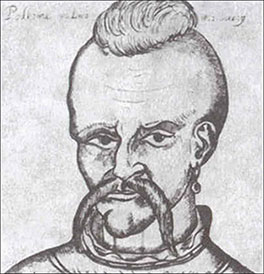
1578: Ivan Pidkova, Cossack hetman

On this date in 1578, Cossack hetman Ivan Pidkova lost his head in Lviv.

Pidkova* — the name means “horseshoe” and alludes to the horsemanship that would be de rigueur for a Cossack leader — had risen by his aptitude to leadership of the Zaporozhian Cossacks in present-day Ukraine.

His death was a bid to promote himself from the steppe to power over neighboring Moldavia, and in fairness to Ivan Moldavia was worth a go.

Its throne was held at that time by a new guy named Peter the Lame, and although the nickname just referred to Peter’s physical deformity, he was a creature of the Ottoman court who scarcely knew Moldavia before he became its vassal ruler in 1574. He was twice temporarily deposed before finally voluntarily resigning in 1591 so that he could retire to the comforts of Italy.

The first deposition came courtesy of our man Pidkova.

Claiming kinship with Peter’s late predecessor Ivan III,** Pidkova seized Iasi and proclaimed himself hospodar of Moldavia until the arrival of Ottoman reinforcements refuted the conceit.

This whole border region between the Polish-Lithuanian Empire to the north and the Ottomans to the south was a perennial trouble spot. Putatively subjects of the Polish crown, the refractory Cossacks were known to raid Ottoman territory illicitly and provoke diplomatic headaches on both sides of the border.

At this particular moment — 1578, that is — the Polish king Stephen Batory had only just concluded a truce with the Ottomans. As Batory had war with Russia to worry about, he was more than keen to keep his southern frontier calm; Polish troops captured the Cossack pretender and had him put to an exemplary death.


Monument to Ivan Pidkova in present-day Lviv. Image (c) stacy2005ua, a prolific photographer of Lviv’s environs whose work can be enjoyed at FaceAndHeart.com or on Flickr, and used with permission.

Ukraine’s national bard Taras Shevchenko celebrated Ivan Pidkova in an eponymous 1839 poem:

There was a time in our Ukraine
 When cannon roared with glee,
A time when Zaporozhian men
 Excelled in mastery!
They lived as masters — freedom’s joy
 And glory were their gain:
All that has passed, and what is left
 Is grave-mounds on the plain!
High are those ancient tumuli
 In which were laid to rest
The Cossacks’ fair white bodies
 In silken cerements dressed.
High are those mounds, serene and dark
 Like mountains they appear,
Their gentle whispers in the wind
 Of freedom’s fate we hear.
These witnesses of ancient fame
 Hold converse with the breeze;
The Cossacks’ grandson reaps the grass
 And sings old memories.
There was a time when in ukraine
 Even distress would dance,
And sorrow in a tavern drank
 In honeyed brandy’s trance.
There was a time when life was good
 In that Ukraine of ours …
Recall it then — perhaps the heart
 May briefly bathe in flowers.

II.

A murky cloud from Liman’s shore
 Covers the sun from sight;
The sea is like an angry beast
 That groans and howls with might.
It floods the mighty Danube’s mouth.
 “My fellows, come with me
Within our barks! The waves are wild.
 Let’s have a merry spree!”
The Zaporozhians rushed out;
 The stream with ships was roiled.
“Roar on, O sea!” they all sang out,
 As waves beneath them boiled.
Billows like mountains round them surged,
 They saw no land, no sky.
Yet not a Cossack heart grew faint,
 Their eagerness ran high.
A bold kingfisher flies o’erhead
 As on they sail and sing;
The brave otaman in the van
 Leads on their mustering.
He strides the deck, and in his mouth
 His pipe grows cold from thought;
He casts his glances here and there
 Where exploits may be wrought.
He curled his long black whiskers,
 He twirled his forelock free,
Then raised his cap — the vessels stopped:
&nbsp:”Death to the enemy!
Not to Sinope, comrades,
 Brave lads beyond all doubt!
We’ll drive on full to Istanbul
 To seek the Sultan out!”
“Well spoken, our fine chieftain!”
 They roared in chorus back.
“I thank you, lads!” He donned his cap.
 Again the seaward track
Beneath their keels began to boil;
 And once more thoughtfully
He paced the deck in mute content
 And gazed upon the sea.

That translation is via The Poetical Works of Taras Shevchenko; the original in Ukrainian can be enjoyed here. The exact text of that poem also comprises the lyrics of this jam:

* Or Ioan Potcoava, as Ivan came from Romanian stock.

** Moldavia’s own “Ivan the Terrible” — no relation to his Russian contemporary, of course.

On this day..