1909: Les Chauffeurs de la Drome

At daybreak this date in 1909, three French rural bandits dubbed “Les Chauffeurs de la Drôme” were publicly guillotined in Valence to the hurrahs of a great crowd.

Most of the (plentiful) information online about these charmers is in French; in their day about 1905 to 1908 they enjoyed quite a lot of notoriety in southern France for their bloody crime spree, comprising at least 11 murders amid numerous home invasion burglaries. They were a throwback gang whose niche the 20th century would eradicate as surely as they themselves. In the time before ubiquitous mass communication and high-speed transport, a sufficiently bold band of robbers could have their way with a rural residence miles from any possible aid: this was one of the great terrors of Europe, and early crime broadsheets from centuries previous dwell often on the terrors of an isolated farmer or miller made prey in his own home by a band of cutthroats.*

The root of the word chauffeur is the French verb “to heat” — think stoking an engine, for the word’s familiar meaning of professional driver — and the specialty of the Chauffeurs de la Drome was torturing their hostages by scorching their feet with hot irons until the sufferers yielded up the hidey-holes of whatever treasure they had on premises. Their trial was a fin-de-siecle circus, and their executions likewise to a discomfiting degree. Though nothing specifically scandalous occurred as the chauffeurs were snuffed out on a public street, there are a number of pictures of this event, some of them made into postcards and circulated.

This was a trend not very much appreciated by the French government, but of course such images make arresting historical artifacts.

We’re here featuring select images of Octave David. When David walked the few steps through a sea of early-rising spectators to the portable guillotine erected on the streetcar tracks directly in front of the prison gates, his companion Pierre Berruyer had already been beheaded. (The chauffeurs were nos. 126 through 128 in the prolific Anatole Deibler’s career.)

He would have glimpsed Berruyer’s headless trunk already rolled into the large box that would soon receive his body as well. (The box had accommodations for four.) And while the execution team washed down the blade between uses, the grotesque bloody puddles and remains of fresh gore were a constant source of complaint. All three executions were completed in a six-minute span; it’s safe to assume that the smell and the feel of Pierre Berruyer’s violent death surrounded David as he walked to the used chopper. As the events here transpired, the third robber Urbain Liottard still awaited his own turn just inside the prison walls — in a few moments, Liottard would see two steaming neckless corpses stacked up in the rude bin gaping to receive him.


Looking alarmingly Christlike, the half-naked form of the condemned murderer emerges from the prison’s maw amid a throng of indistinct, black-clad voyeurs.


David reaches the guillotine; the assistant executioners are about to tip him onto the board that will carry him into place. The identification on these photos is from Bois de Justice, an invaluable site on the history of the guillotine; I’m unsure from my own observation whether to equate the figure in these pictures with the one in the first, above.


One of the beheadings (I’m not certain that it’s David’s) has been completed; the body and head are being transferred to their receptacles. Again, Bois de Justice has details on this scene.


Following one of the beheadings, the visibly stained blade is raised for cleaning before the third criminal is brought out.

* For some examples, see Joel Harrington’s The Faithful Executioner, a book we’ve previously profiled.

On this day..

1290: Zavis of Falkenstein

On this date in 1290, the vaunting nobleman Zavis of Falkenstein was beheaded below the walls of Hluboka Castle.

For from this eminence ye shall discern
Better the acts and visages of all,
Than in the nether vale among them mix’d.
He, who sits high above the rest, and seems
To have neglected that he should have done,
And to the others’ song moves not his lip,
The Emperor Rodolph call, who might have heal’d
The wounds whereof fair Italy hath died,
So that by others she revives but slowly,
He, who with kindly visage comforts him,
Sway’d in that country, where the water springs,
That Moldaw’s river to the Elbe, and Elbe
Rolls to the ocean: Ottocar his name:
Who in his swaddling clothes was of more worth
Than Winceslaus his son, a bearded man,
Pamper’d with rank luxuriousness and ease.

-Dante’s ungenerous assessment of Wenceslaus in the Purgatorio

The Bohemian Premyslid dynasty was at the height of its power in the 13th century. King Ottokar II, ruling a vast swath of central Europe, twice mounted unsuccessful bids for election to the imperial throne.

The second man to defeat him, Rudolph,* Ottokar refused to recognize, and open warfare ensued between the men — a war that Rudolph won when Ottokar was killed in battle in 1278.

The late sovereign left to his six-year-old son Wenceslaus II a reduced patronage, a betrothal to Rudolph’s daughter, and a strong domestic noble faction like to oppose the crown internally.

Zavis of Falkenstein was among the foremost of the many complications afflicting the young Wenceslaus. His Vitkovci family had been among the late Ottokar’s most potent domestic opponents,** and Claudius-like slithered right into the royal bed with Ottokar gone. Zavis paid court to the widow of his great foe, the Queen Regent Kunhunta, and married her in 1285. He was the first man in the kingdom for several years.

Wenceslaus, still a teenager, was becoming frantic at the prospect of Zavis usurping him altogether. When Kunhunta died and Zavis left town to marry again, the monarch turned the tables on his “protector”. When Zavis returned to Prague, he found himself clapped in prison. Wenceslaus then packed Zavis up for a Bohemian tour, where the hostage was brandished at belligerent Vitkovci fortresses to force their submission. Hluboka Castle, commanded by Zavis’s brother, refused to knuckle under, so the threat — and Zavis — were executed.

When your South Bohemia holiday stops over for a visit to this still-extant castle consider a stay at Hluboka nad Vltavou‘s four-star Hotel Zavis z Falkenstejna. Zavis himself is interred much further south at the borderlands’ Vyssi Brod monastery, which also boasts a jeweled crucifix donated for the salvation of the ambitious magnate’s soul.

* Rudolph I (Formerly Count Rudolph IV) was the first Habsburg king.

** Ottokar founded the city of Ceske Budejovice to project his power into the Vitkovci’s South Bohemia stomping-grounds. The city is still going strong; from its name derives the disputed Budweiser beer brand.

On this day..

509 B.C.E.: The Sons of Brutus

August 21 is the harvest-time feast of Consualia, honoring the Roman god of grain storage, Consus.

We mark on this occasion the legendary capital punishment inflicted by Lucius Junius Brutus when he was consul of the ancient Roman Republic upon two rebels — his own sons, Titus and Tiberius.

The great Brutus had been one of the leaders of the revolt that expelled Rome’s last king, Lucius Tarquinius — reputedly after the king’s son raped Lucius’s kinswoman Lucretia. (Brutus was also Tarquin’s nephew.)

Upon completing his coup, Brutus immediately summoned the populace to swear an oath that no king would ever rule Rome again. So potent was the civic memory of this event that even centuries later when the Republic was well gone, Rome’s emperors dared not appropriate such an incendiary title as “King”.

But that was for a later time, after the winners wrote the history.

The exiled Etruscan king, subsequent Romans’ eternal watchword for tyranny, got the boot about 510 B.C.E., and in 509 was still hanging about looking for an opportunity to re-seat his dynasty. The plot he hatched is known as the Tarquinian conspiracy, and Brutus, to his grief, would discover that his own children had adhered to it. The statesman’s willingness to put his own flesh and blood to death for the security of Rome would long stand as a parable of manful patriotism.

Our account here is from Livy (line breaks have been added for readability), and the excuse to approximate this undated execution to summer’s harvest-time is bolded therein.

liberty was well nigh lost by treachery and fraud, a thing they had never apprehended. There were, among the Roman youth, several young men of no mean families, who, during the regal government, had pursued their pleasures without any restraint; being of the same age with, and companions of, the young Tarquins, and accustomed to live in princely style.

Longing for that licentiousness, now that the privileges of all were equalized, they complained that the liberty of others has been converted to their slavery: “that a king was a human being, from whom you can obtain, where right, or where wrong may be necessary; that there was room for favour and for kindness; that he could be angry, and could forgive; that he knew the difference between a friend and an enemy; that laws were a deaf, inexorable thing, more beneficial and advantageous for the poor than the rich; that they allowed of no relaxation or indulgence, if you transgress bounds; that it was a perilous state, amid so so many human errors, to live solely by one’s integrity.”

Whilst their minds were already thus discontented of their own accord, ambassadors from the royal family come unexpectedly, demanding restitution of their effects merely, without any mention of return. After their application was heard in the senate, the deliberation on it lasted for several days, (fearing) lest the non-restitution might be a pretext for war, and the restitution a fund and assistance for war. In the mean time the ambassadors were planning different schemes; openly demanding the property, they secretly concerted measures for recovering the throne, and soliciting them as if for the object which appeared to be under consideration, they sound their feelings; to those by whom their proposals were favourably received they give letters from the Tarquins, and confer with them about admitting the royal family into the city secretly by night.

The matter was first intrusted to brothers of the name of Vitellii and those of the name of Aquilii. A sister of the Vitellii had been married to Brutus the consul, and the issue of that marriage were young men, Titus and Tiberius; these also their uncles admit into a participation of the plot: several young noblemen also were taken in as associates, the memory of whose names has been lost from distance of time. In the mean time, when that opinion had prevailed in the senate, which recommended the giving back of the property, and the ambassadors made use of this as a pretext for delay in the city, because they had obtained from the consuls time to procure modes of conveyance, by which they might convey away the effects of the royal family; all this time they spend in consulting with the conspirators, and by pressing they succeed in having letters given to them for the Tarquins. For otherwise how were they to believe that the accounts brought by the ambassadors on matters of such importance were not idle?

The letters, given to be a pledge of their sincerity, discovered the plot; for when, the day before the ambassadors set out to the Tarquins, they had supped by chance at the house of the Vitellii, and the conspirators there in private discoursed much together concerning their new design, as is natural, one of the slaves, who had already perceived what was going on, overheard their conversation; but waited for the occasion when the letters should be given to the ambassadors, the detection of which would prove the transaction; when he perceived that they were given, he laid the whole affair before the consuls. The consuls, having left their home to seize the ambassadors and conspirators, crushed the whole affair without any tumult; particular care being taken of the letters, lest they should escape them.

The traitors being immediately thrown into chains, a little doubt was entertained respecting the ambassadors, and though they deserved to be considered as enemies, the law of nations however prevailed.

The question concerning the restitution of the tyrants’ effects, which the senate had formerly voted, came again under consideration. The fathers, fired with indignation, expressly forbad them either to be restored or confiscated. They were given to be rifled by the people, that after being made participators in the royal plunder, they might lose for ever all hopes of a reconciliation with the Tarquins. A field belonging to them, which lay between the city and the Tiber, having been consecrated to Mars, has been called the Campus Martius. It happened that there was a crop of corn* upon it ready to be cut down, which produce of the field, as they thought it unlawful to use, after it was reaped, a great number of men carried the corn and straw in baskets, and threw them into the Tiber, which then flowed with shallow water, as is usual in the heat of summer; that thus the heaps of corn as it stuck in the shallows became settled when covered over with mud: by these and the afflux of other things, which the river happened to bring thither, an island was formed by degrees. Afterwards I believe that mounds were added, and that aid was afforded by art, that a surface so well raised might be firm enough for sustaining temples and porticoes.

After plundering the tyrants’ effects, the traitors were condemned and capital punishment inflicted. Their punishment was the more remarkable, because the consulship imposed on the father the office of punishing his own children, and him who should have been removed as a spectator, fortune assigned as the person to exact the punishment.

Young men of the highest quality stood tied to a stake; but the consul’s sons attracted the eyes of all the spectators from the rest of the criminals, as from persons unknown; nor did the people pity them more on account of the severity of the punishment, than the horrid crime by which they had deserved it.

“That they, in that year particularly, should have brought themselves to betray into the hands of Tarquin, formerly a proud tyrant, and now an exasperated exile, their country just delivered, their father its deliverer, the consulate which took its rise from the family of the Junii, the fathers, the people, and whatever belonged either to the gods or the citizens of Rome.”

The consuls seated themselves in their tribunal, and the lictors, being despatched to inflict punishment, strip them naked, beat them with rods, and strike off their heads. Whilst during all this time, the father, his looks and his countenance, presented a touching spectacle, the feelings of the father bursting forth occasionally during the office of superintending the public execution.


Bummer: Jacques-Louis David‘s 1784 painting, Lictors Bring Home the Sons of Brutus.

This Brutus was an ancestor of the Brutus who helped assassinate Julius Caesar, and that later et tu, Brutus is commonly represented as having been convinced to turn against his friend and patron by, in part, the example of his legendary namesake.

O, you and I have heard our fathers say,
There was a Brutus once that would have brooked
The eternal devil to keep his state in Rome
As easily as a king.

-Cassius to Brutus in Shakespeare’s Julius Caesar (Act 1, Scene 2)

* “Corn” meaning not American maize, of course — which was not available before the Columbian exchange — but the word’s earlier meaning of whatever was the local grain: wheat, barley, and millet in Rome’s case. (The word corn derives from the Latin granum.)

On this day..

1480: The Martyrs of Otranto

On this date in 1480, Ottomans invading Otranto, Italy conducted a mass execution of prisoners.

Landing at the southern Italian city on July 28, the Ottoman force quickly overwhelmed Otranto. (Otranto rashly slew the messenger come to offer a merciful capitulation, only to find that its garrison began deserting within days.) On August 11, the Turks took the city by storm. Thousands died on that day’s bloodbath, including the Archbishop of Otranto.

Surviving women and children were sold into slavery. Men over age 15 had the choice of conversion — or death.

“Now it is time for us to fight to save our souls for the Lord!” a Christian shoemaker is said to have exhorted his 800 fellow prisoners. “And since he died on the cross for us, it is fitting that we should die for him.”

The acclaim greeting this call signaled inflammation ahead for the Turkish headsmen’s rotator cuffs. They had 800 faithful souls to dispatch to their eternal reward this date at the place still known as the Hill of Martyrs. (When in Otranto, visit it by taking the via Ottocento Martiri, just off via Antonio Primaldo — that’s the name of the militant shoemaker.)


The remains of the Otranto martyrs, arrayed as relics in the Otranto cathedral. (cc) image from Laurent Massoptier.

Historical novel set during these vents.

This, at least, is the most pious version of the story. The mass execution certainly did occur, but some latter-day historians like Francesco Tateo have argued that martyrdom is not attested by any of the contemporaneous sources, and the specifically religious understanding of events was only read in after the fact.

On whatever grounds one likes, Italy’s fractious city-states were deeply alarmed by the appearance on their shores of the all-conquering Turks. “It will always seem as if the funeral cross is borne before me while these barbarians remain in the boundaries of Italy,” wrote the Florentine humanist Poliziano.* (Source, a nonfiction book which covers Otranto in some detail.)

In the ensuing months, they rallied together vowing to expel the invaders.

Fortunately for this coalition, the Ottoman sultan Mehmed the Conqueror died in May 1481, and a brief period of internal conflict within the Ottoman empire over the succession perhaps led it to allow its Otranto outpost to wither on the vine. The Turks made peace and withdrew from their potential beachhead not long after, having held the city for just over a year. The bodies of the martyrs were said to have been found uncorrupted by decay.

The Catholic church beatified the 800 martyrs in 1771, but their final elevation to sainthood occurred only in 2013, just three months ago as I write this. They were in the very first group canonized by the new Pope Francis — although the canonization was approved by his predecessor Benedict XVI on the same day that Benedict resigned his pontificate. Considering current relations between the respective faiths, it was seen as a potentially impolitic move.

“By venerating the martyrs of Otranto, we ask God to protect the many Christians who in these times, and in many parts of the world, are still victims of violence,” Pope Francis said at the canonization Mass, diplomatically not naming any of those parts of the world.

* At the same time, Florence (in common with other Italian polities) had trade and diplomatic relations with the Ottomans.

On this day..

1812: Hölzerlips, Blood Court prey

On this date in 1812, the German bandit Hölzerlips — that’s just “Philip of the Woods”, despite what your dirty mind was thinking — was beheaded with three compatriots at Heidelberg.

They were part of a gang of six vagrant souls (the other two were spared on account of youth) who, finding everything displaced in the time of the Napoleonic wars, made their daily bread robbing around the Spessart in southern Germany.

In this capacity they racked up at least 15 known incidents of highway robbery, going so far as to kill a Swiss merchant on the road in 1811.

Captured shortly thereafter, Heidelberg grandees considered them (in)famous enough to merit a staged Blutgericht (“Blood Court”) followed by beheading this date, a spectacle that drew 30,000 gawking spectators in its day.


Friedrich Rottmann: Blutgericht über Hölzerlips Bande, 1812

On this day..

1976: Christian Ranucci, never yet rehabilitated

On this date in 1976, Christian Ranucci, 22, was guillotined in Marseilles … with the last words addressed to his attorneys, “Réhabilitez-moi”.

If that has not yet occurred, it has not been for want of trying.

Many people think Ranucci was the last person executed by France; in fact, this is not correct. But the confusion is understandable: Ranucci has persisted in the headlines and the public imagination owing to a running controversy over whether he was wrongly convicted. It’s a vexing case rife with ambiguous circumstantial evidence, and observers are usually able to see in it what they want to see.

On June 3, 1974, two incidents — a minor traffic accident, and the request by a young man of a local mushroomer to help his car out of a muddy gallery where it was stuck — placed a gray Peugeot 304 at La Pomme, outside Marseilles. This also happened to be the date that 8-year-old Maria-Dolores Rambla was abducted from St. Agnes by an unknown man in a red sweater reportedly driving a gray Simca 1100, a vehicle that would be possible to mix up with the Peugeot 304.

When news of the abduction broke on the radio the morning of June 4, the people who saw the Peugeot(s) later called it in as a tip.

Police got to the bespectacled young Ranucci (English Wikipedia entry | French; most of the links from here on out are French) via the accident. His car didn’t stop for the other motorist, but limped on down the road another kilometer. The other driver’s vehicle was inoperable, but that driver sent a passerby to follow the hit-and-run Peugeot’s path to see if he could track down a license plate number. Indeed he did do that.

And when that good citizen called police, he said he had seen the driver running into the nearby woods with either a sizable package or a small child. (The story has … evolved.) You can see where this is going: when the area was searched after the tip came in, poor Maria’s dead body was steps away from the spot the car stopped. She’d been knifed to death.

The mushroom-gallery, for its part, yielded up a red pullover sweater like the one the abductor wore, and a bloody knife.

After 17 hours’ grilling by the police, Ranucci broke down and confessed. He would later retract the confession, blaming police pressure. (Here in 2013, everybody does know — right? — that false confessions happen with alarming frequency, and that they’re widely associated with exonerations.)

As open-and-shut as this sounds, Ranucci’s many defenders have found a great deal wanting in the case

Journalist Gilles Perrault has been on about this case for decades. His L’ombre de Christian Ranucci drew a 50,000 euro judgment for defaming the Marseilles police.

Among the sticking-points for skeptics:

  • There’s the inconsistency in the reported make and model of the vehicle vis-a-vis what Ranucci was driving.
  • None of the eyewitnesses to the abduction could identify Ranucci in a lineup … until the lineup was pared down to make it a gimme. Sloppy lineup work has been a significant factor in wrongful convictions; on the other hand, eyewitnesses are extremely unreliable in general.
  • The recovered red pullover was much too small for Ranucci, possibly suggesting that this apparent link to the observed abductor did not reach all the way to the accused.
  • Mr. Red Pullover Simca 1100 was allegedly seen attempting other abductions at times and places that made it certain that he was not Christian Ranucci.
  • Questionable handling of physical evidence by investigators.

That’s basically just to scratch the surface. Here (pdf) is a much lengthier exegesis of the potentially exculpatory evidence, in French. Here’s an English summary covering the same stuff on a site whose resources are mostly also in French. (“We do not assert Christian Ranucci is innocent.”) Countless additional search hits en francais await the interested researcher.

Ranucci himself insisted against advice on pursuing an actual-innocence defense, rather than mounting a mitigation case focusing on avoiding the guillotine while conceding guilt. He was convicted on just a 9-3 jury vote.

But neither in his own time nor latterly has that case gained much purchase on the conscience of his prosecutors. The President who denied Ranucci’s clemency petition, Valéry Giscard d’Estaing, has recently given his 1976 decision a vote of confidence; the father of the victim feels likewise.

On this day..

Feast Day of St. James the Greater

It’s a big day today in the Galician city of Santiago de Compostela, because the twenty-fifth of July is the feast of its patron and namesake* St. James the Great.

One of the original Apostles (literally, he and his brother John are the first two whom Jesus calls in the Gospels), James also had the distinction of apparently being the first Apostle to die for Christ.** His execution at the hands of Herod Agrippa† is reported in Acts 12:2;‡ it’s the only apostolic execution in the New Testament.

This, of course, occurred on the southeastern fringe of the Mediterranean, so it’s a wonder that James’s bones came to repose at a Spanish city literally situated on Finisterre, the far western edge of the world as far as Europeans saw it. The Lord works in mysterious ways.

It’s certainly plausible — though impossible to substantiate — that James evangelized in Spain prior to his execution. The whole Mediterranean was a Roman lake. More towards the outlandish is the patriotic story (pdf) that James’s relics were miraculously discovered there in 813 at the moment when Muslim expansion into Iberia gave the hard-pressed Christian kingdoms the greatest possible need for a morale boost.§

James became for those souls Saint James Matamoros, Moor-slayer, and started turning the tide of fictional battles and blessing his own very real chivalric order.


Saint James gets his Moor-slaying on.

“A knight of Christ’s squadrons,” Cervantes wrote. “St. James the moorslayer, one of the most valiant saints and knights the world ever had, and that now the heavens have … this great knight with the vermilion cross has been given by God to Spain for its patron and protection.”

James’s martial prowess is entirely posthumous: when the Son of God recruits him, he’s a humble piscator at labor mending his nets (there are some less-bellicose present-day churches going under the name “Saint James the Fisherman”). Gibbon could not but marvel at the “stupendous metamorphosis [that] was performed in the ninth century, when from a peaceful fisherman of the Lake of Gennesareth, the apostle James was transformed into a valorous knight, who charged at the head of Spanish chivalry in battles against the Moors. The gravest historians have celebrated his exploits; the miraculous shrine of Compostella displayed his power; and the sword of a military order, assisted by the terrors of the inquisition, was sufficient to remove every objection of profane criticism.”

But mythmaking exercises a historicity all its own, and the James legends offered a rallying-point for Spain’s Christians. He stands to this day the patron of Spain as well as a number of places colonized by Spain.

Pilgrims have ever since that stupendous metamorphosis of the 9th century made the journey to the apostle’s purported resting-place; this Way of St. James, actually comprising several different possible routes covering hundreds of kilometers on foot, has in recent years emerged as a major tourist draw. The Way terminates, of course, at Santiago de Compostela and the enormous cathedral there where repose James’s relics.

Saint James’s Day, 25 July, is its celebratory culmination.

James so overawes July 25 on the liturgical calendar that it’s a mere footnote to add that this same day also pays homage to Saint Christopher, a historically dubious Christian martyr from the third or early fourth century Roman Empire.

Christopher is rather nifty, because he’s sometimes depicted in iconography as cynocephalic — that is, having the head of a dog. At least the rest of him is human, unlike Saint Guinefort the Greyhound. (No lie. It’s a doggie saint, albeit of the distinctly unofficial variety. To stamp out folk veneration, an incensed preacherhad the dead dog disinterred, and the sacred wood [where it received offerings] cut down and burnt, along with the remains of the dog.”)

* The name “Santiago” derives from our saint’s name in Latin, Sanctu Iacobu. This is also the source, and James the intended honorary, for other places on the map named Santiago, such as Santiago, Chile.

** Assuming you don’t count Judas Iscariot, of course.

† Herod Agrippa is not to be confused with his grandfather Herod the Great — the Biblical Massacre of the Innocents guy — nor with his uncle Herod Antipas — the guy who punted Jesus’s prosecution back to Pontius Pilate. Three different Herods; three different New Testament heavies.

‡ James’s death in Acts 12 is followed immediately by Saint Peter staging a supernatural jailbreak out of the same prison. The latter goes on to evangelize for another 20-odd years.

§ The holy remains reached that resting point, goes the legend, only by perilously navigating a path of dragons, pagans, and wagons.

On this day..

1635: Hans Ulrich Schaffgotsch, man in the middle

On this date in 1635,* the German aristocrat and general Hans Ulrich [von] Schaffgotsch lost his head in Regensburg.

Schaffgotsch (German Wikipedia entry: most information about him online is in German) would have appeared to have won the birthright lottery. Sure, he was no king, but being born to a hereditary Silesian baron of distinguished blue-blood lineage, and being dynastically married to a princess, put him squarely within the 1 percent’s 1 percent.**

Schaffgotsch caught one very bad break: he was born to come of age during the Thirty Years’ War.

The Schaffgotsch family had different branches going, but Hans Ulrich’s was Protestant — and this was also the predominant faith in early 17th century Silesia. (It adhered to the unsuccessful Bohemian Revolt.)

Doctrinal differences aside, Schaffgotsch had favorable terms from the Catholic emperor. He also made himself good friends with a fantastically wealthy duke named Albrecht von Wallenstein. Wallenstein was a little shaky on the religion question himself; he’d been raised Protestant and converted to Catholicism for unknown reasons.

When the Thirty Years’ War came calling again late in the 1620s, Wallenstein used his capacious wealth to field a large army in service of Ferdinand, and Schaffgotsch went right along as the generalissimo’s able adjutant. But Ferdinand, who was short on both cash and troops to call his own, soon came to fear this capable general upon whom he overmuch depended. When the opportunity arose, the sovereign abruptly relieved Wallenstein of command in 1630 — only to have to reinstate him in 1632† when his replacement got killed.

It turns out Ferdinand did have good cause for suspicion. Wallenstein was dissatisfied with the emperor’s treatment as well, and covertly treated with the Protestant league to switch sides or overthrow the emperor and rule in Bohemia. The detection of these plans in Vienna led Ferdinand to have Wallenstein judged by a secret court, then assassinated in 1634.‡

As his aide, Schaffgotsch too was soon dealt with. Unlike the dangerous Wallenstein, Schaffgotsch was a small enough target to arrest and prosecute in the conventional way — which happened in 1635. Schaffgotsch obstinately refused under torture to admit any involvement in treason, but he was condemned to death all the same.

The Silesian aristocrat might have felt hard done by, but he relieved some annoyance with an old-fashioned shopping spree. Schaffgotsch went out in style (German link) by plumping for black drapings for the scaffold, ordering a custom coffin, doing up all his servants in black mourning garb, and bribing the executioner of Regensburg to behead him seated in a chair. (The lord rooted himself so firmly in his seat that his head flew off at the sword’s stroke without his body toppling over.)

Afterwards, Schaffgotsch’s body was laid out for last respects for two days in Regensburg Blauen Krebs inn, which still exists to this day. (And has the story on its website.)

* Gregorian date. With Catholic and Protestant powers both going at it, dating gets confusing in this period; it would have been July 13 per the Julian calendar still in use by most Protestants, and this date is also sometimes attributed.

** Click here for some appealing views of Kynast (Chojnik), one of Schaffgotsch’s castles.

† Wallenstein commanded Habsburg forces at the Battle of Lutzen in November 1632, where Sweden’s King Gustavus Adolphus was killed.

‡ Wallenstein’s treachery and death are the topic of Schiller’s play Wallenstein.

On this day..

1793: Joseph Chalier, Jacobin martyr

On this date in 1793, Joseph Chalier was guillotined in Lyon(s).

Chalier (English Wikipedia entry | French*), a knockabout silk merchants’ agent from Lyon, oddly became that city’s exemplary Jacobin fire-eater and the leading spirit in its Jacobin clubs. He was elected to the Lyon municipal council in 1792, and while in Paris even took part in the August 10, 1792 insurrection deposing Louis XVI.

Lyon, France’s “second city” and the hub of a considerable silk-weaving industry, was not nearly so amenable as Paris to the French Revolution’s radicals: indeed, the wartime anathema most of Europe had laid upon regicidal France devastated the weaving trade, and the particular grievances of established silk weaver artisans were here advanced but there complicated by the advent of the Revolution.**

Consequently, liberal Girondins, merchant elites, some craftsmen, and even outright royalists made a formidable coalition checking radical Jacobins in municipal politics. (Chalier even warned the National Assembly of this dynamic.)

Jacobins could never quite get political control of the city, until political crisis toppled the Lyon government in March 1793 and finally put Chalier et al in the saddle. (They immediately erected a public guillotine, of course.)

Their brief ascendancy expired 80 days later, when a municipal revolt put Chalier and his allies in chains, and reasserted more moderate control — just as the moderate Gironde was being expelled from the National Convention. After terse negotiations between Lyon and Paris hit a quick impasse, Lyon guillotined Chalier. “My death will cost this city dear,” Chalier warned his tribunal.

The next month, it lay under a terrible siege by the central government.

In the aftermath of that conquest, the Committee of Public Safety ruthlessly suppressed the seditious Lyonnaise, even going so far as to decree (without effect) the forfeit of the city’s very name — henceforward to be known as Ville-Affranchie, the Liberated City.

Hastening to the city and then hastening back to make political hay of the bloodbath, Committee of Public Safety member Collot d’Herbois “sent to Paris — over and against Robespierre‘s religion — quite another god, a horrible fetish, the head of Chalier, thrice crushed by the Girondin blade.”† This ghastly relic was then paraded in triumph in Paris for Collot d’Herbois’s heroic homecoming, its former owner apotheosized into the Revolution’s martyrs’ pantheon alongside Marat.

As a result, one can still today see porcelain busts of Chalier, of the type widely manufactured in early 1794 for posturing in churches, homes, civic clubs, and anywhere else a display of conspicuous patriotic sentiment might be advisable.


Chalier’s bust. By David Monniaux (self photo) [GFDL (http://www.gnu.org/copyleft/fdl.html), CC-BY-SA-3.0 (http://creativecommons.org/licenses/by-sa/3.0/) or CC-BY-SA-2.5-2.0-1.0 (http://creativecommons.org/licenses/by-sa/2.5-2.0-1.0)], via Wikimedia Commons.

* One of the best biographical resources on Chalier is an 1887 French scholarly article available (for free) from JSTOR.

** See David Longfellow, “Silk Weavers and the Social Struggle in Lyon during the French Revolution, 1789-1794” in French Historical Studies, Spring 1981. Despite the title, this article also explicates the background of labor dynamics in the Lyon silk industry and its history of class conflict going back to the 17th century.

Jules Michelet, quoted by Chantal Thomas and David F. Bell in “Terror in Lyon”, SubStance, Vol. 27, No. 2, Issue 86: Special Issue: Reading Violence (1998).

On this day..

1960: Manfred Smolka, East German border guard

On this date in 1960, Manfred Smolka was guillotined in Leipzig.

Smolka was among three million East Germans or more who escaped over the border to West Germany in the 16 years after the defeat of the Nazis divided the country.

In the earliest years, people sluiced over the long border just anywhere. By Smolka’s time, that perimeter was buffered by an “internal border” that made it difficult for ordinary people to approach near enough to West Germany to escape. Consequently, most emigration by the the late 1950s occurred in the divided city of Berlin — a flow that East Germany would finally stanch in 1961 with the ultimate in immigration reform, the Berlin Wall.


One of the Cold War’s iconic photographs: East Berlin border guard Conrad Schumann leaps over the barbed-wire barrier into West Berlin on Aug. 15, 1961, just days after construction of the Berlin Wall began.

Like that more famous later escapee, Manfred Smolka (German link, as are most that follow) was a border guard; indeed, he was an officer. That gave him the ability, in 1958, to be far enough within the “internal border” to defect into West Germany

The very next year, he arranged to meet his abandoned wife and daughter on the Bavaria-Thuringia frontier to smuggle them over, too. Alas, it was a trap (pdf) laid by the feared East German secret police, the Stasi.


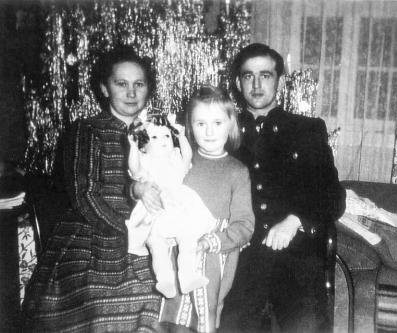
Happier times: Manfred Smolka with his wife and child.

According to press reports, Smolka was actually on West German soil when the Stasi men captured him.* (The Stasi were often up for a bit of kidnapping.)

West Germans were outraged by Smolka’s capture and subsequent death sentence for “military espionage,” but the case was deemed an apt one for the education of East Germany’s border security agents.

Only with post-Cold War German reunification could his family examine his file. “I am innocent, I can prove it a hundred times,” they read in the last letter the onetime defector wrote to his family — a letter which had never been delivered. “You need not be ashamed of me.” In 1993, a reunified, post-Cold War Germany officially agreed and posthumously rehabilitated Manfred Smolka.

There’s a few minutes of documentary video about him, in German, here.

* By a July 5, 1960 account in the London Times, Smolka was shot at and wounded as he crossed into East Germany but still managed to “crawl” back to West Germany — where his pursuers did not fear to follow him.

On this day..