1943: Marianne Elise Kurchner condemned for a joke

(Thanks to Meaghan Good of the Charley Project for the guest post. -ed.)

Sometime in the summer of 1943 in Nazi Germany, a young woman from Berlin named Marianne Elise Kürchner was guillotined for telling a joke.

Kürchner, who worked at an armaments factory, told the following joke to a coworker who denounced her:

Hitler and Göring are standing atop the Berlin radio tower. Hitler says he wants to do something to put a smile on Berliners’ faces. So Göring says: “Why don’t you jump?”

Not exactly a side-splitter. More like a neck-splitter: making jokes at Hitler’s expense was, in theory at least, a capital crime.

Mind you, most people who made nasty wisecracks about the Nazis faced no consequences at all. They were rarely denounced, and if they did come before a court they were usually given a warning, or at most a few months of “re-education” in Dachau.

The Nazis did occasionally use sedition as an excuse to arrest and execute people who’d gotten on their bad side for one reason or another, but ordinary Germans initially had little to fear.

However, as the tide of war began to turn against Germany, the punishments for sedition became ever more severe.

Marianne was called up before the People’s Court, whose president, Roland Freisler, was famous for both his long raving speeches berating defendants, and his death sentences. She admitted to making the joke but said she hadn’t been herself at the time, feeling bitter about the recent loss of her husband at the front.

Freisler would have none of it. In fact, he considered Marianne’s status as a war widow to be an aggravating factor. “The People’s Court,” Rudolf Herzog said of this case in his book Dead Funny: Humor in Hitler’s Germany, “made it a point of pride to take no account of individual suffering.” In his ruling, Friesler wrote:

As the widow of a fallen German soldier, Marianne Kürchner tried to undermine our will to manly defense and dedicated labor in the armaments sector toward victory by making malicious remarks about the Führer and the German people and by uttering the wish that we should lose the war … She has excluded herself from the racial community. Her honor has been permanently destroyed and therefore she shall be punished with death.

The People’s Court’s judgment was rendered on June 26, 1943. Marianne lost her head shortly thereafter.

On this day..

1804: Georges Cadoudal, Chouan

On this date in 1804, royalist counterrevolutionary Georges Cadoudal was guillotined in Paris with eleven of his chouan brothers-in-arms.

Cadoudal (English Wikipedia entry | the much more detailed French) was the French Revolution’s ultimate antagonist, a Breton notary (and commoner, obviously) who obstinately resisted the bloody progress of those years to the last of his strength.

His decade of royalist adventures (French) reads* like an adventure novel, a mind-bogglingly perilous series of revolts, captures, escapes, rappelling, martial exploits, diplomatic intrigue, terrorist plotting, high principles, low politics … a desperately heroic (or anti-heroic) struggle using every resource of a changing world to claw back the lost age of Bourbons.

After that dynasty’s last (up until then) king was guillotined in 1793, the intrepid Cadoudal staked his life to the 1793 Vendee rising, mounted an insurrection at Brest, and became one of the principal leaders of the anti-revolutionary Chouannerie fighting les bleus around northwest France through the 1790s.

Beaten but not bowed, Cadoudal took refuge in England when those campaigns came to grief following the royalist debacle at Quiberon, but he was never one to retire to the exile social circuit. Cadoudal remained an active schemer against the France of a rising Napoleon Bonaparte, and he was backed now by Britain’s statecraft … and her gold.

Spurning a proffered arrangement with the Corsican — who, say what one will, could recognize ability when he saw it — Cadoudal instead oversaw a dramatic 1800 assassination attempt on Napoleon that didn’t get the dictator but blew a bunch of Parisian bystanders to smithereens.

This effort having failed, our persistent intriguer slipped back into France to attempt an even bolder venture to kidnap Napoleon and elevate the Duke of Enghien — the going Bourbon candidate, who lurked on the French frontier to rush into the power vacuum.

This didn’t work either. As outlandish as the idea seems with benefit of hindsight, it was hardly a crackpot plan — as attested by the credentials of its participants.

“All Europe laughs at the conspiracy in Paris; it was, however, a well-built machine. Men, money, everything was ready. Bonaparte was to be taken alive and carried out like lightning from one post to the sea and the English fleet … I am inconsolable that it missed its mark. Those who criticize the French princes that they do not risk themselves while others fight for them, they will be the first to cry: What madness! How childish! [that d’Enghien risked himself] That is how men are made.”

Joseph de Maistre (Source)

Which is a long way of saying that it still comes down to wins and losses.

Having lost, the Bourbon pretender (he’s a pretender because he lost, of course) d’Enghien was arrested and immediately shot for his trouble; Cadoudal, taken on the streets of Paris,** was around long enough to see the hated Bonaparte take sufficient warning from the conspiracies against him to vest his governance in the imperial dignity. That was proclaimed on May 18. (The famous coronation wasn’t until December.)


Happy now, Georges? Napoleon on his Imperial throne, by Jean-Auguste-Dominique Ingres.

“We have done better than we hoped,” the doomed Cadoudal remarked caustically from his dungeon. “We intended to give France a king, and we have given her an emperor.”

He was rock-ribbed in his royalism to the very last.

He’d met Napoleon face to face years before in an abortive parley — when Cadoudal was offered, and rejected, the bribe of a lucrative Republican military commission — and now Cadoudal’s proposed victim let it be known to him that mercy was his for the asking. The indignant Breton scorned as dishonorable the very idea of supplicating Napoleon, even when the invitation was refreshed as he underwent the fatal toilette on his final day. His dozen-strong party went to their deaths this date taking heart from following the very footsteps of their martyred king.


The Execution of Georges Cadoudal, by Armand de Polignac … who portrayed several scenes of the conspirators.

A very lovely mausoleum in his native village of Kerleano preserves Cadoudal’s remains (reburied honorably there after his Bourbon Restoration finally came to pass), and his memory.

* A descendant wrote this now-public-domain book about our man.

** Reproached for orphaning a policeman’s family as he resisted capture, Cadoudal sneered, “then you should have sent a bachelor.”

On this day..

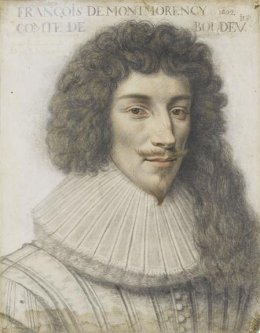
1627: Francois de Montmorency and his second, for dueling

On this date in 1627, the Comte de Bouteville plus his cousin Des Chapelles lost their heads for fighting a duel — ultimately (because of the execution) one of the most notorious duels in French history.

Though this is the duel that everyone knows, Francois de Montmorency-Bouteville (English Wikipedia entry | French) had engaged in 22 such affairs of honor between the tender ages of 15 and 28. Like as not, he was the duellist par excellence in an age where demanding lethal satisfaction was all the rage among devil-may-care aristocratic straplings.

And this, of course, is why he was nominated for condign punishment in Louis XIII’s struggling anti-dueling campaign. One might say he nominated himself.

Dueling, a mano-a-mano vindication of feuds between fops, was an archaic holdover of Burgundian clan violence turned preposterous baroque ritual of conspicuous consociation.

It was also incredibly epidemic in France at this period.

During the reign of Louis’s predecessor Henri IV, 7,000 to 8,000 people are reported to have died in duels, which works out to the suspect rate of one per day for the entire period. Then again, France did have an excess supply of noble progeny whose violent impulses were no longer preoccupied by fratricidal religious warfare.*

Henri IV had tried to ban dueling, even in 1610 executing for lese majeste a couple members of his own guard who defied the ban. Just weeks later, and for no reason connected to dueling, Henri was assassinated. Then-nine-year-old heir Louis XIII was in no position at the time to follow up his father’s policy, and the naughty sport continued to flourish.

“Duels had become so common among the French nobility that the streets of Paris usually served as the field of combat,” according to the Mercure Francois. And as Richard Herr described in his “Honor versus Absolutism: Richelieu’s Fight against Dueling” (The Journal of Modern History, September 1955; this is also the source of all other quotes in this post), they often arose over utterly trivial “slights.”**

Typical was a duel in Lent of 1626 in which Bouteville [i.e., the subject of our post] with two seconds engaged the Comte de Thorigny and his two seconds. The fight was over a dispute between Thorigny and the Marquis de Chalais, who was in prison accused of treason. Bouteville was merely defending the honor of a friend. All six spent the night before the engagement in an inn outside Paris, and in the course of a fairly amicable conversation, they expressed regret that being good friends, they were going to kill each other over another gentleman’s quarrel. But they agreed that they had gone too far to be able to abandon the project without loss of honor. The next day Bouteville killed Thorigny after the latter’s sword broke.

By the 1620s, Louis was old enough to make another run at this intractable elite-on-elite crime wave, and did so with the full encouragement of his famous consigliere Cardinal Richelieu. Depriving the aristocracy of this weird extra-judicial prerogative fit right into the latter’s going campaign to centralize the French state and bring its quarrelsome lords to heel.

What with all those duels he liked to fight, Francois de Montmorency-Bouteville was a great test case. Fighting a public duel in January 1627 — at which his second was slain — made Bouteville a target, and he fled to the Netherlands for safety.

Our fugitive figured he’d send word that a pardon would be appreciated, and everything would blow over like it always did. But Louis was determined to disabuse this type of any privilege to commit public mayhem, and refused to grant Bouteville his absolution.

Honor offended — his default state, to judge by his career — Bouteville vowed angrily to “fight in Paris and in the Place Royale!” This he did on May 12, 1627, slipping back into France for the express purpose of dueling Guy Harcourt, the Marquis de Beuvron. And Bouteville disdained a private fight for the occasion, insisting, as he had declared, on a daytime melee where everyone could see it at the grand new Place Royale (today, Places des Vosges).


At least the setting was operatic. (cc) image from Christophe Alary.

Bouteville and Beuvron fought to a bloodless stalemate and agreed to call it a draw. But Bouteville’s second Des Chapelles mortally wounded Beuvron’s second.

Everyone fled, and while Beuvron made it out of the country, Montmorency and Des Chapelles were nabbed, and condemned to death by the Parlement of Paris for violating Louis’s royal edict against duels.

From the king’s standpoint, this was just about the most egregious possible arrangement of factors.

  • The guy was a serial offender, and he was already a fugitive for his last duel.
  • The fight had produced a fatality.
  • Worst, the whole scene — sneaking back into Paris, fighting openly within the potential view of the sovereign — had been overtly staged to scorn the royal ban.

If Louis intended his decree to mean anything at all, he had to come down hard on this one. “It is a question of cutting the throat of duels or of your majesty’s edicts,” Richelieu summarized.

But as clear-cut as were the case indicia, this was still a hard one for Louis, and even for the usually-ruthless Richelieu. Bouteville was a well-born noble, with powerful friends and family who were also close to the king, and they besieged the royal person with petitions for mercy. A sorrowing but firm Louis had to personally refuse mercy to Bouteville’s tearful wife. “Their loss affects me as much as it does you,” he said. “But my conscience prevents my pardoning them.”

Although the poor wife couldn’t make any headway for clemency, she had the better of Bouteville’s swordsmanship off the field of honor. The doomed duke bequeathed one last rapier thrust to posterity by leaving his widow-to-be pregnant with a posthumous son who eventually generalled French armies to any number of routs of the Dutch in the late 17th century.

And while Richelieu’s memoirs would depict this instance of executive implacability as a decisive turn, Herr argues that it was nothing but a brief interruption. The pernicious hobby was back in all its glory within a couple of years, an evil that even Richelieu could never master. France’s aspired-to absolutism could not reach that ancient and intimate noble right save in the very most exemplary case.

In Dumas’s Three Musketeers, set in 1620s France, D’Artagnan is charged by his father in the opening pages to “[n]ever fear quarrels … Fight on all occasions. Fight the more for duels being forbidden, since consequently there is twice as much courage in fighting.” And indeed, it is by blundering into silly duels (e.g., the “offense” caused by bumping into Porthos while hurrying down the stairs, the latter of whom considers D’Artagnan’s apology discourteously perfunctory) that D’Artagnan becomes the fourth of their cadre … because Richelieu’s men arrive to break up the illegal D’Artagnan-vs.-Musketeer melees, and D’Artagnan joins with his “foes” to defend, all for one and one for all, their privilege as gentlemen to slaughter one another.

The dueling phenomenon faded significantly under Louis XIV, but still not completely: Voltaire almost fought a duel in 1726; the artist Manet dueled a critic in 1870; and YouTube will favor the viewer with a number of 20th century professors and litterateurs settling long-forgotten affairs of honor — like disputes over wartime collaboration after World War II — in ceremonial swordfights. Dueling pistol shooting (at human silhouettes) was even an event at the 1906 Olympics.†

And elsewhere in Germany, Russia, and everywhere Europe touched, duelling persisted with new practitioners into the 19th and even the 20th and even the 21st centuries.

* Also worth noting relative to the casualty numbers: at this time, each side’s seconds also fought in addition to the principals. A move for taking seconds out of the fight eventually prevailed, long before the end (if there has been a real end) of dueling, but in 1627 that time was not yet come.

** Across the Channel at this time, Francis Bacon was making much the same complaint against English duels.

† This event was an “Intercalated Games” falling between the natural 1904 and 1908 Olympiads. It’s an outlier historical experiment during the modern Olympics’ uncertain early years, and though it was officially sanctioned at the time and winners walked away with proper medals, the International Olympic Committee no longer recognizes the Intercalated Games as an official Olympics.

On this day..

1945: 8 American flyers at Fukuoka

On this date in 1945 — morning after a devastating U.S. air raid that destroyed much of Fukuoka — eight previously-captured American airmen* were summarily executed there in retaliation.

In a precedent that dated back to the Doolittle raids, Japan officially considered as a prospective war criminal any enemy airman who could be connected to indiscriminate bombing. Tokyo didn’t follow this logic to the point of executing all downed Americans — indeed, late in the war, beleaguered Japanese civilians became increasingly hostile towards the government for allowing excess legalism to stand in the way of exacting some satisfying revenge for the cities burning under American bombs — but it did execute some, and it had sanctioned legal theorems that could have accommodated quite a bit more bloodletting.

Finding Tokyo short of prison space, the government ordered on May 1, 1945, that the various armies should no longer send to the capital any downed airmen they captured. In the chaos of the war’s last months, this would create the context for local commanders at the Western Military District in Fukuoka to put those legal theorems to seriously nasty use.

Four captured airmen held in Fukuoka were stuck in an indeterminate judicial process which the army realized was going nowhere slowly. The others were just plain underfoot. Over the period of May-June, between a couple of ambiguously-worded orders and the officers’ annoyance at having to divert scarce resources to these captives, an understanding formed if “the air raids increased and conditions became more chaotic, the prisoners would be executed without a trial.”

Well, as U.S. papers exultantly reported on June 20,

About 3,000 tons of … incendiary bombs … were released by the B-24s from low level starting about three a.m. … The three cities [Fukuoka, Toyotashi and Shizuoka] were tasting for the first time the bitter flames of war, roaring over factories, shops and thousands of congested homes.

Timothy Lang Francis, whose “‘To Dispose of the Prisoners’: The Japanese Executions of American Aircrew at Fukuoka, Japan, during 1945” from the November 1997 Pacific Historical Review traces the confluence of factors that made possible this day’s executions, describes the fate that was unfolding for Fukuoka’s eight captive airmen at about the same time those words were going to press.

All were blindfolded and had their hands tied in front. Several swords were obtained from the Legal Section. [Yusei] Wako** then told the twenty or so assembled Japanese that, “in compliance with the Commanding General†’s orders, we were going to execute the plane crash survivors.” One officer, Lt. Michio Ikeda of the Medical Section, volunteered himself, and Wako ordered Probationary Officer Tamotsu Onishi, since he was skilled in kendo, to assist him as a third executioner. Sato watched the proceedings from one side.

The first flyer was brought to the edge of the pit and made to sit on his haunches. Wako then ritually washed one of the swords and stood behind the prisoner, slightly to the left. Raising the sword above his right shoulder with both hands, Wako brought it down on the flyer’s neck. “Both the body and head fell into the pit,” remembered Wako; “I washed my sword and ordered the guard to bring another flyer to the pit. I killed this flyer exactly the same way I had killed the first one.” Onishi then executed a third prisoner in the same manner.

In the pause that followed, Lt. Kentaro Toji, an officer attached to Western Army Headquarters, approached Sato. According to his pretrial affidavit, Toji said to Sato, “My mother was killed in the air raid on Fukuoka this morning, and I think it would be fitting that I be the one who execute these American flyers.” Sato told him to wait while Wako ordered Ikeda to execute the fourth flyer. Toji, after borrowing a sword from Onishi, beheaded the last four prisoners. The pit was then filled with dirt.

This is all well and good, but Tokyo’s orders to its armies had been to do the juridical legwork on these cases themselves — and not just to summarily kill prisoners. So, in a bit of ex post facto bureaucratic butt-covering, the Western District Army’s legal section proceeded to close the matter by shipping the central government a report saying that all these prisoners had been killed during the previous night’s air raid. Problem solved!

No known direct connection to this particular atrocity, but there’s a recent documentary about an elderly Japanese man who used to serve at Fukuoka that looks worth the watching.

* Six of the eight were Robert J. Aspinall, Merlin R. Calvin, Jack V. Dengler, Otto W. Baumgarten, Edgar L. McElfresh, and Ralph S. Romines. The other two remain unidentified. These eight were, maybe, the lucky ones: Fukuoka had had 16 prisoners from downed bombers, but the other eight weren’t around to be beheaded because they’d previously been given over to the local hospital to suffer ghastly deaths in vivisection experiments.

** A Judge Advocate who had also been involved in the Doolittle trials.

† Gen. Isamu Yokoyama. When he’d been briefed prior to the June 19 raid that the army was fixing to just dispose of its prisoners if it came to that, Yokoyama had done the Pontius Pilate act and informed Wako, “I have decided to concern myself only with the decisive battle and hereafter do not bother me with the problem of the flyers.”

On this day..

1842: Charles Stoddart and Arthur Conolly, Great Game diplomats

On this date in 1842,* British diplomats Charles Stoddart and Arthur Conolly were summarily beheaded by a Central Asian potentate as London’s ill-chosen intervention in Afganistan came to a disastrous conclusion.

The backdrop is “the Great Game”,** the long-running chess match for supremacy in Central Asia between an expanding Russian Empire and Great Britain, with its imperial position in India.

Seeking to pre-empt a Russian move into Afghanistan, Britain invaded in 1839. This was the First Anglo-Afghan War: it would have, for the Brits, an inglorious end.

Our day’s featured principals were among the postscript casualties of that catastrophe, never-avenged losses for an empire that had overreached itself.

Stoddart, an intelligence officer, had been dispatched northward to the ancient silk road city of Bokhara intending enlist the allegiance, or at least the benign neutrality, of its emir, Nasrullah Khan. Today Uzbekistan’s fifth-largest city, Bokhara was then an independent state .

[I]n the nineteenth century, the executions carried out there with genuine cruelty, as well as the tales told by travelers gave the city a reputation of being a forbidden, closed, and hostile place. It was “despotic” Bukhara, and the Europeans projected onto it their own oriental fantasies: with citadel, dungeons, palaces, and city walls bolted shut at night, all helping to set the scene.

(Vibe on some the oriental fantasy in the 1911 volume The Emir of Bokhara and His Country, or this volume on Russian Central Asia, which by then included Bokhara.)


Scenic! Bukhara’s historic citadel, the Ark, where Stoddart (and later Conolly) were imprisoned (and later executed). (cc) image from elif ayse.

Into this scene, our Brit entered clumsily, immediately irritating the ruler he intended to supplicate. Reportedly (though the fact has been disputed), he was on the brink of execution when he acceded to save his life to Nasrullah’s formulaic offer of clemency in exchange for conversion to Islam.

In any event, Stoddart languished for years, alternately imprisoned and in the custody of the (better-received) Russian mission. Though the latter had also been charged by its sovereign to retrieve the ill-favored English emissary as a gesture of Great Powers goodwill (and to deprive England of any rationale for intervention that his captivity might offer), Stoddart seems to have been too stubbornly prideful to get out via St. Petersburg while the getting was good.

Instead, he waited on the arrival of countryman Arthur Conolly, who showed up in late 1841 on a mission to secure Stoddart’s release. But Stoddart’s situation little improved, considering Nasrullah Khan’s wary reaction to this second British interloper.

Word has it that the Bukharan prince was piqued that correspondence to him did not arrive over the signature of the British monarch herself, but merely some subcontinental subaltern — as well as, we might think understandably, suspicious at his guests’ motivations and mission.

The captor’s uncertain attitude towards his prisoners was resolved by Britain’s catastrophic loss of Kabul and the subsequent massacre of an entire 16,000-strong army as it attempted to retreat.

Seriously, the whole army. To a man. Except for one guy.


Remnants of an Army, by Elizabeth Butler, depicts the only British subject on retreat from Kabul to reach Jalalabad, William Brydon.

Battles don’t get much more decisive than that.†

Reasoning‡ that the routed British were now of no conceivable threat, nor his prisoners of any conceivable benefit, Nasrullah Khan now accused them of espionage and abused them with impunity.

The two were cast into an Indiana Jones-esque “bug pit,” an oubliette infested with … well, you know.§

Later, finding illicit writing materials secreted on his captives’ persons, the mercurial Nasrullah disposed of them outright.

their quarters were entered by several men, who stripped them, and carried them off to prison … In stripping Colonel Stoddart a lead pencil was found in the lining of his coat, and some papers in his waist. These were taken to the Ameer, who gave orders that Colonel Stoddart should be beaten with heavy sticks until he disclosed who brought the papers, and to whom he wrote. He was most violently beaten, but he revealed nothing; he was beaten repeatedly for two or three days. On Friday, the 8th or 9th (the 7th) of Jemmadee-ool-Eovel (17th of June), the Ameer gave orders that Colonel Stoddart should be killed in the presence of Captain Conolly, who was to be offered life if he would become a Mahomedan. In the afternoon they were taken outside the prison into the street, which is a kind of small square. Their hands were tied across in front. Many people assembled to behold the spectacle. Their graves were dug before their eyes. Colonel Stoddart exclaimed aloud at the cruelty and tyranny of the Ameer. His head was then cut off with a knife.

The chief executioner then turned to Captain Conolly, and said — “The Ameer spares your life if you will become a Mussulman.” Captain Conolly answered, “Colonel Stoddart has been a Mussulman for three years, and you have killed him, you killed Yoosoof too; I will not be a Mussulman, and I am ready to die.” Saying which he stretched forth his neck. His head was then cut off.

London Times, Aug. 22, 1843, reporting the testimony of a dubious local semi-ally

The veracity of this faint bulletin from a distant and inaccessible realm nevertheless remained in some doubt. Friends of the lost men, despairing of obtaining definitive word of their fate, commissioned a strange but courageous missionary named Joseph Wolff to brave his own sojourn to Bokhara to investigate.

Wolff barely escaped with his own life, but seemingly confirmed the sad story and published a Narrative of his travels in 1845 (Part 1, Part 2).

* The initially reported June 17 execution date was subsequently contested by Joseph Pierre Ferrier, who argued that the chronology instead pointed to the next Friday, June 24. The matter appears to me permanently unresolvable.

** Ironically, the sportive phrase “the Great Game” was itself attributed to Arthur Conolly for whom, in the end, events turned out to be quite other than playful.

† Britain recaptured Kabul in reprisal later in 1842, upon which pretext it was able to declare its honor vindicated and depart Kabul (sans massacre), ending the war. Certain latter-day occupations of that “graveyard of empires” might envy their forebear’s talent for declaring victory and leaving.

‡ Correctly. Nasrullah Khan faced no British reprisal for his treatment of Stoddart and Conolly, notwithstanding the attempt by some friends to use their sad fate as some sort of casus belli. This public domain book from 1845 bears a dedication to Queen Victoria in “hope of directing your Majesty’s attention to the cruel sufferings and alleged murder of two British officers … abandoned in an unaccountable manner, by your Majesty’s Government … [in circumstances] degrading to the British nation;” the same man had previously published an “Appeal to the British Nation” in an “endeavour to excite the public sympathy.” Sympathy or no, the two British officers stayed abandoned.

§ Bug tortureenhanced interrogation was actually authorized during the Bush administration for the insect-averse Abu Zubaydah. The gentleman approving that technique, Jay Bybee, is now a federal circuit judge.

On this day..

1944: Johanna Kirchner, Frankfurt antifascist

“Keep Goethe‘s words in mind. ‘Die and become’. Don’t cry for me. I believe in a better future for you.”

-Johanna Kirchner’s last letter to her children

On this date in 1944, former social worker Johanna (“Hanna”) Kirchner was beheaded in Plotzensee Prison for treason.

(cc) image from Fran Behnsen of a Kirchner commemoration plaque in Frankfurt’s St. Paul’s Church.

Kirchner English Wikipedia entry | German) co-founded with Marie Juchacz after World War I the still-extant Workers’ Welfare organization: Arbeiterwohlfahrt, or “the self-help of the workers.”

These self-helping workers — both members of the socialist Social Democratic Party; Juchacz was a Reichstag member — had to flee to League of Nations-administered Saarland with the rise of the Nazi dictatorship … and from there, soon enough, on to France.

There the Vichy government arrested her in 1942 (Juchacz got out to the United States), and deported Kirchner to Germany to answer as a traitor.

She had a sentence of “only” ten years at hard labor, but the case was unexpectedly reopened in 1944 so that the cartoon villain of fascist jurisprudence, Roland Freisler, could give her a spittle-flecked death sentence for having “treasonably rooted herself in the evilest Marxist high-treason propaganda.”

Kirchner’s native Frankfurt has a Johanna-Kirchner-Straße, and in the 1990s awarded a Johanna-Kirchner-Medaille to anti-fascists.


View Larger Map

On this day..

1388: Three evil counselors of Richard II

On this date in 1388, James Berners, John Beauchamp, and John Salisbury were convicted by the “Merciless Parliament” of treason, and put to immediate death.

You could say that relations between the branches of government were a bit on the frayed side, since crown and parliament had civil war for political primacy. Parliament won.

It just wasn’t quite one of those all-out, kill-you-when-we’re-done wars to depose the king outright. (That would come later.) “We do not rebel or arm ourselves against the King except in order to instruct him,” one of the rebelling Lord Appellant told His Majesty.

“Instructing” Richard II meant politically isolating him and then mercilessly — hence the resulting parliament’s name — attainting his aides and allies for treason.

So all that spring, young Richard II helplessly “presided” over a parliament where his supporters were condemned on trumped-up charges.

This date was the turn for Sir John Beauchamp of Holt and Sir James Berners (or Barnes), two guys noble enough to suffer “merely” beheading, plus Sir John Salisbury, who was far enough down England’s class hierarchy that he got to endure the full drawing and quartering treatment.


Berners may have been the father of a 15th century prioress and author, Juliana Berners.

This woman wasn’t the type to keep to her cloister and meditate: Berners wrote books on her vigorous pastimes of heraldry, hunting, and hawking. Her Treatise of Fishing with an Angle remains one of the seminal books for the sport of angling.

On this day..

1474: Peter von Hagenbach, war crimes milestone

On this date in 1474, Peter von Hagenbach was tried in a remarkable judicial proceeding in the Rhine city of Breisach, found guilty, and publicly beheaded by the end of the day.

This Alsatian knight in the train of Charles the Bold had been installed by that Burgundian duke as his satrap in in the Upper Rhine, in lands that Burgundy held on lease from the Habsburgs.

He made a legendary villain of himself in the early 1470s:

His regime of arbitrariness and terror extended to murder, rape, illegal taxation and wanton confiscation of pivate property, and the victim[s] of his depredations included inhabitants of neighbouring territories as well as Swiss merchants on their way to and from the Frankfurt fair … the outrages of Hagenbach, remarkable even by the standards of the late fifteenth century, greatly contributed to forging what, until then, had been considered impossible, that is, alliances against Burgundy by all her neighbours: Austria, Berne, France, and the towns and knights of the Upper Rhine, all formerly at loggerheads with one another.

After overturning Burgundian authority in the Upper Rhine, that unique alliance aired its many grievances with Hagenbach at a unique tribunal. There, the ex-knight was prosecuted before judges drawn from the several Germanic and Swiss principalities who had allied against him.


Breisach: seems like a nice place to oppress. (cc) image from Routard5.

This unusual procedure gained a special prominence in the 20th century postwar era as historical precedent for “war crimes” prosecutions. Since that time, there’s been a going debate over just what kind of precedent it really makes.

Executed Today is pleased to welcome Prof. Gregory Gordon of the University of North Dakota law school — a rising star in international human rights law.

Gordon wrote a 2012 paper re-examining the Hagenbach case attempting to reconcile both the legal and historiographical perspectives on Peter von Hagenbach.

ET: You characterize the present-day understanding of the Hagenbach case as proceeding from Georg Schwarzenberger‘s recovery of the incident further to providing legitimizing precedent for the Nuremberg tribunals. Between 1474 and World War II, did anyone think of this case as one with a wider import for jurisprudence? (And if not, do we know anything about how Schwarzenberger unearthed it?)

GG: To the extent anyone did, from my research, it would have been historians, not jurists per se. Hagenbach was the object of a fair amount of historical scholarship but that had evolved over the years. In the initial period after the trial, Hagenbach was portrayed as the quintessential bogeyman. But over the centuries, historians began to view him in a different light. By 1945, a more nuanced view of Hagenbach had been established. I have not researched Schwarzenberger’s biography in great detail. So I’m not sure how his eureka moment arose. What is clear is that the Nuremberg trial caused him to focus on Hagenbach (my sense is that Hagenbach was fairly well known in Europe — his supposed mummified head was on display in an Upper Alsace museum, for example — but given the absence of anything resembling Nuremberg before Nuremberg, people tended to ignore the details of the Hagenbach legal proceedings).

And my sense is that Schwarzenberger had an agenda — he realized the case could help legitimize what many would claim to be illegitimate ex post facto law at Nuremberg. So he relied on the earlier historical accounts of the Hagenbach case (it seems he based his seminal Manchester Guardian article primarily on the account of French historian Prosper de Barante). And thus he created a fissure between legal scholars and contemporary historians.

Who tried Hagenbach, under what authority, and how were the different interested parties formally represented? Whose idea was all this? What can we tell of the public atmosphere surrounding the trial — was there bottom-up pressure to do this?

After the League of Constance (consisting of various regional polities fed up with Hagenbach) paid off his debt for him, Archduke Sigismund of Austria resumed control over the Upper Alsace territory mortgaged to Charles the Bold. And thus Sigismund made the decision to have Hagenbach tried by the international ad hoc tribunal (another inexplicable link in the chain: Hagenbach escaped lynch-mob justice on Easter Sunday, April 10, 1474 — only thanks to Breisach resident Friedrich Kappelar’s decision to arrest him and await instructions from Sigismund).

Diebold Schilling the Elder made this illustration of the proceedings for a chronicle in 1485.

Sigismund’s decision to convene an ad hoc international tribunal was utterly remarkable for the time. And it is not clear how or why Sigismund came up with it (although historians suggest it had something to do with the prominent position Hagenbach held as representative of the Duke of Burgundy).

Numerous representatives of sovereigns from around the region, twenty-eight in all — including sixteen knights, sat as part of this international ad hoc tribunal.

Eight of the judges were nominated by Breisach, and two by each of the other allied Alsatian and Upper Rhenanian towns [Strasbourg, Sélestat, Colmar, Basel, Thann, Kenzingen, Neuburg am Rhein, and Freiburg im Breisgau] as well as by Berne, a member of the Swiss Confederation, and Solothurn, allied with Berne.

In fact, each sovereign represented a member of the League of Constance (Berne being the only representative of the Swiss cantons).

Thomas Schutz, the chief magistrate of Ensisheim, was designated as the tribunal’s presiding judge. The nominal trial prosecutuor was the new Alsatian bailiff chosen by Sigismund to replace Hagenbach — Hermann von Eptingen. Eptingen, for his part, chose Heinrich Iselin, one of the commissioners from Basel (one of the League of Constance’s members), to present the prosecution’s case to the court. The other representative from Basel, Hans Irmy, took on Hagenbach’s representation. At some point later in the trial, Iselin resigned because, as the evidence came in, he felt the case lacked merit (and even made a motion to withdraw the charges). He was then replaced by Hildebrand Rasp. Hagenbach also requested additional attorneys and the tribunal assigned him two attorneys — one from Colmar and one from Selestat.

The trial was held in open air before the Breisach mayor’s residence and was attended by “a multitude” of people from Breisach and surrounding towns. It appears as if it were somewhat of a circus atmosphere.

Is there a degree to which the pre-modern characteristics of the belligerents — Burgundian duchies, Swiss cantons, the Holy Roman Empire patchwork — set a contradictory precedent for the postwar world?

Let me quote my paper:

Nothing in history leading up to that moment in 1474 would have suggested the remarkable course of action taken by Sigismund. It is tempting to see that decision as an historic anomaly that would not be repeated for centuries to come. But on closer inspection, Sigismund’s choice to hold a trial before an international court fits well within the historical narrative of that era.

It was a time of religious and political disintegration. The Holy Roman Empire was fading into irrelevance and the Catholic Church was on the verge of losing its European hegemony. It was the eve of the nation-state — a unique moment when the old collective structures were dying and the new ones had yet to be born. Given the interstitial political turbulence, the time was ripe for a plural approach to law enforcement in the cosmopolitan geographic center of Europe. Hagenbach’s inter-regional depredations, which helped forge a rare pan-Germanic consensus, provided the perfect forum to experiment with international justice during that fragmented time. The Westphalian order, already on the horizon, would foreclose any such future experiments until Nazi brutality put a chink in the Westphalian armor and inspired an unprecedented transnational justice operation in the wake of a truly global war. In that sense, although on much different scales, Breisach and Nuremberg have much in common. And should the nation-state ever manage to reassert its absolute supremacy again, Breisach will undoubtedly be on the lips of future international jurists seeking, as before, to end impunity at the expense of sovereignty.

You discuss a revisionist thesis about Hagenbach that essentially says he wasn’t a monster, and even that he was a forward-thinking but star-crossed reformer. Why do you think that we can, in fact, conclude that there’s something to the claim that Hagenbach was tyrannous or criminal? What do you consider the most credible charges, and the ones that to his judges would have distinguished Hagenbach from a run-of-the-mill brutal lord or military commander?

What evidence supports the view that the good burghers of Alsace were the victims of Sir Peter’s violence? Their treatment of the wayward knight after his arrest is most revealing in this regard.

While torture may have been commonplace in ordinary criminal inquisitions of the time, the severity of torment inflicted leads one to believe it was inspired by and directed at the kind of mass, depraved criminality of which Hagenbach has traditionally been accused. Significantly, in this regard, in addition to enduring horrific torture, he was stripped of his knighthood. Degradation of knighthood was exceedingly rare in the Middle Ages and reserved only for the most extreme and infamous crimes.

And there is other evidence to suggest Hagenbach’s culpability for atrocities. Most telling perhaps is the trial record itself.

Hans Irmy, it must be remembered, mounted a valiant and spirited defense to the very end. And yet the record does not reveal his even attempting to refute the charge that Hagenbach planned to exterminate the citizens of Breisach or that he murdered the four petitioning residents of Thann. At most, he offered the rejected defense of superior orders. Nor did Irmy (or Hagenbach, for that matter), directly deny the rape charges (merely objecting that taking women in this fashion was common practice and/or he had paid for services rendered). Rape, as opposed to murder, appears to have been Hagenbach’s preferred weapon of terror and atrocity.

And there is a plausible explanation for why Hagenbach would have wanted to murder the citizens of Breisach.

Hagenbach was aware of other towns that had plotted to kill him during the previous year and, when requesting entry to create defensive fortifications in anticipation of an attack by the League of Constance, he had already been denied admittance with his troops into Thann and Ensisheim. He was only able to gain entry into Breisach because his mercenaries were already present there. Given the animosity shown him in these other towns and the previous conspiracy to kill him, Hagenbach did not want to take any chances. Killing Breisach’s citizens would have permitted him to use the town as a defensive fortification without the risk of an uprising from its citizens.

Did Hagenbach slaughter thousands of innocent civilians in concentrated liquidation campaigns? There is no evidence to suggest he did — he was not a fifteenth century proto-Nazi. But the record suggests that he terrorized the local population by murdering civilians, raping numerous women and conspiring to commit a large-scale massacre in Breisach. It should be noted that the rape charges are the most persuasive as there are numerous examples and they were never directly refuted.

And Hagenbach’s back story further validates this view of him. He was the product of a Burgundian ducal culture that was steeped in and glorified violence — the reflection of its bellicose chief, Charles the Bold (known to his enemies as Charles the Terrible). The duchy was in almost a permanent state of war with one enemy or another during Charles’s reign. Charles the Bold’s Burgundy was in the practice of laying siege to towns and routinely killing civilians who resisted — Liege, Dinant, Neuss — all were subjected to horrific violence by Burgundian troops, and Hagenbach played a leading role in the first two. And within that violent culture, Hagenbach was Charles’s fiercest, most loyal lieutenant. In that regard, Sir Peter’s steadfast reliance on superior orders at trial speaks volumes.

And it is not to be overlooked that a criminal disposition was apparent even before Hagenbach cast his lot with Charles the Bold. The reported kidnapping of Marquard Baldeck, the Swiss banker for whom Hagenbach demanded ransom, is telling in that regard. As noted previously, Hagenbach supposedly demanded ransom from Baldeck’s family and the scheme was scuttled only when Philip the Good ordered Baldeck released without any extortion payment. Hagenbach also seems to have fabricated a murder plot against Charles the Bold, which he falsely pinned on a court rival to have him eliminated.

Add to this Hagenbach’s contempt for the emerging bourgeoisie and townspeople, as well as a deep animosity toward the Swiss, and his stewardship of the Upper Rhine represented the perfect storm. By 1474, he had indeed become the scourge of the Sundgau. In this regard, it is interesting to note Burgundy expert Richard Vaughan’s insight that, in fact, it may have been Hagenbach driving policy and tactics in Charles’s Alsatian territory, not the other way around:

Many of Hagenbach’s activities were undertaken at [Charles’s] express command, though often as a result of representations made to him by Hagenbach in the first place. It is possible, for example, that Charles only agreed to sign the treaty of St. Omer on Hagenbach’s persuasion. In the duke’s letters to Hagenbach of 8 August 1470 he orders him to undertake the siege and conquest of Ortenberg castle, ‘in accordance with your memorandum (advertissement)’, which seems to imply that Charles was here acting on detailed advice to take Ortenberg sent him by Hagenbach. As to other mortgaged places, the bailiff wrote to Charles describing how he had seized possession of Landser and seeking the duke’s approval, which was given on 6 January 1474. . . . On 26 December 1470 he wrote congratulating Hagenbach on taking Ortenberg . . .”

Finally, it should be pointed out that Hagenbach may be responsible for atrocities in the region, even if he personally did not commit or order or was unaware of all of them. In particular, the Picard and Wallon mercenaries he hired toward the end of his reign had a well-known reputation for being unruly, violent and hostile toward the local Alsatian population. French historian Emile Paul Toutey, for example, describes Picard soldiers engaging in mass rape of Breisach’s women toward the very end of 1473. These troops may have acted on their own initiative but Hagenbach was their superior and, at the very least, he bore command responsibility. And this may also have contributed toward the writing of Hagenbach’s black legend.

Did the Hagenbach case, in your opinion, actually break new legal ground relative to what had occurred up through 1473? Does it have any analogues you’re aware of over the next century or two, prior to the advent of the Westphalian system?

In my opinion, nothing in the historical record up through 1473 suggests the possibility (certainly not the likelihood!) of what actually took place in 1474.

Eminent German historian Hermann Heimpel does note that the contemplated trial was consistent with other legal actions in late fifteenth century Swabia. What must have seemed entirely unprecedented, though, was the make-up of the court that would sit in judgment of Peter von Hagenbach. He was not to be tried by a local judge. Instead, numerous representatives of sovereigns from around the region, twenty-eight in all — including sixteen knights — would sit as part of an international ad hoc tribunal. Nothing after this, until the Versailles Treaty’s Article 227 contemplated international ad hoc tribunal trial of Kaiser Wilhelm II post-World War I (which never took place since the Dutch refused to extradite), even suggested such a procedure.

Hagenbach tried to raise a “superior orders” type of defense, claiming that Charles the Bold had ordered him to do the nasty things that were imputed to him. The dismissal of this defense does sound pretty modern, but was it mere expedience on the part of the court since it had no way to compel evidence from Charles the Bold?

That’s a great question! I don’t think so. Why? Because Hans Irmy asked for a trial continuance to contact Charles the Bold to appear before the tribunal and corroborate Hagenbach’s claims of superior orders. The tribunal flatly denied the motion for continuance. There was not even an attempt to contact the Duke of Burgundy. Like the decision to try Hagenbach before an ad hoc international tribunal, the decision to deny the motion (and flatly reject the defense) seems nothing other than ground-breaking. In short, it was an epochal precedent.

What interpretive conflicts does this case raise for you when considering it as a legal scholar, versus as a historian? How do you think people today should understand Peter von Hagenbach’s prosecution?

Again, I quote from my paper:

My piece attempts to identify and resolve certain vertical and horizontal dissonances in Hagenbach scholarship. With respect to the former, this has amounted to an exercise in historiographic and historical archeology. The recent attention lavished on the case by international criminal law (ICL) experts is informed by a cartoonish conception of the defendant — an ultra-violent, sexually depraved monster who ran amok for years along the Upper Rhine and terrorized its population. Consistent with that interpretation, the authorities who captured and tried him engaged in a righteous and visionary justice enterprise. They came out on the winning side of a Manichean struggle that gave birth to ICL and ennobled its pedigree.

Digging deeper, though, one finds a very different narrative developed initially by nineteenth century historians and embraced by most of their twentieth century confreres. They saw Hagenbach as a would-be administrative reformer whose efforts were thwarted by xenophobic subjects and a parsimonious superior. In trying to transform a fragmented archipelago of city-states into a cohesive governmental entity, Hagenbach was despised because he threatened an ingrained culture of seigneurial privilege and parochial complacency. In his efforts to redeem property put in hock by Sigismund, he likely reinforced views of Burgundy as excessively acquisitive and bent on conquest (this was exacerbated by Charles’s own efforts to accede to the imperial throne). And in levying taxes to pay for good government, Hagenbach stoked local fears of financial servitude and ruin. But in doing the Duke’s bidding, he did not have the Duke’s support. And so he was left to flounder, his undoing hastened by his admitted crass and prurient behavior. They point out that his trial, a marketplace spectacle based on torture-extracted confessions, was little more than drumhead justice. It was akin to executing Charles the Bold in effigy. Peter von Hagenbach may not have been the most adroit governor and perhaps he did manifest contempt for the rising merchant and urban classes. But, the revisionists would contend, his final deserts were not just at all.

Digging deeper still, the bottom layer of historiography consists of the journalistic rough draft and the first generations of historians that followed. It is largely consistent with the modern ICL expert view but without the larger historical perspective and legal focus. And it is more regionally tinged and archaic. This layer is at once more reliable, given its comtemporaneity or relative proximity, and less reliable, given the inherent biases of its initial chroniclers and the disproportionate influence they exerted on sixteenth through eighteenth century historians.

But my piece demonstrates that each layer is not necessarily inconsistent with the others. In fact, there are many points of convergence. And it is there that a unified, coherent narrative can be stitched together. Hagenbach was coarse and confrontational. But he was also hardworking and loyal and wanted to do right by his master. His entire career had been built on pleasing Charles the Bold. He undoubtedly meant to reform and upgrade the administration of his Alsatian fiefdom. And consequently resentment of the bailiff grew over the years as he pushed while the Alsatians pulled. Hostilities boiled over in 1473 and matters came to a head in 1474. Charles’s loyal lieutenant with a criminal past and odd sexual predilections felt increasingly boxed in and he eventually lashed out. The almost exclusive procedural focus of his defense at trial strongly supports accounts of the resulting crime spree.

It should also be noted that modern Hagenbach scholarship is characterized by a certain horizontal dissonance as well — between jurists and historians. Given the historical points of convergence just noted, however, these two schools ought to find common ground too. Certain views of the revisionist historians concerning the Hagenbach judicial proceedings are not without merit. The Breisach ad hoc tribunal may not have been a kangaroo court but it bears no resemblance to the well-oiled machine of modern international criminal justice administration. The defendant was hideously tortured for days before the trial. He was given no notice of the charges or allegations against him in advance of the hearing. He had no time to speak with a lawyer before standing in front of the judges. The proceeding itself was held on a market square in a circus atmosphere and concluded within a matter of hours. He was not able to call his most important (and only) witness to the stand – Charles the Bold. And there is no indication of a high burden of proof or that any such burden even rested with the prosecution. The Breisach Trial was certainly not the paragon of due process.

On the other hand, this was the late Middle Ages — centuries removed from our modern notions of due process. Torture was part of standard pre-trial procedure at that time. And the trial itself seems relatively fair for that era. Hagenbach was represented by a zealous advocate in Hans Irmy and he was given two additional lawyers of his choice. There is as well a flip side to the “public spectacle” aspect of his trial — transparency. Hagenbach could have been summarily condemned in front of a secretive Star Chamber but his trial was held in public (and that was consistent with local custom). He was able to confront witnesses called against him. He had twenty-eight finders of fact (compared to twelve in the modern jury system). And Charles the Bold, his sole designated witness, was not allowed to testify because the defense of superior orders was rejected ab initio. As well, the proceedings lasted from early in the morning until late at night — which could equate to two or three modern court days. There seems to have been significant deliberation among the twenty-eight judges suggesting that a consensus was cobbled together after carefully sifting through the evidence. In an age of witch-hunts, trials by ordeal, the Star Chamber, and the Inquisition, this was an exceedingly fair trial.

And in many ways it seems inappropriate to use twenty-first century ICL terminology to analyze a fifteenth century judicial proceeding. But if that terminology is used, this piece has demonstrated that the Breisach Trial has many of the hallmarks of a modern international atrocity adjudication. As a threshold matter, regardless of anything else, it is the first recorded case in history to reject the defense of superior orders. In itself, that distinction invests the trial with universal historic importance in the development of atrocity law.

On this day..

1671: Zrinski and Frankopan, Croatian conspirators

He who dies honorably lives forever.

-Fran Frankopan

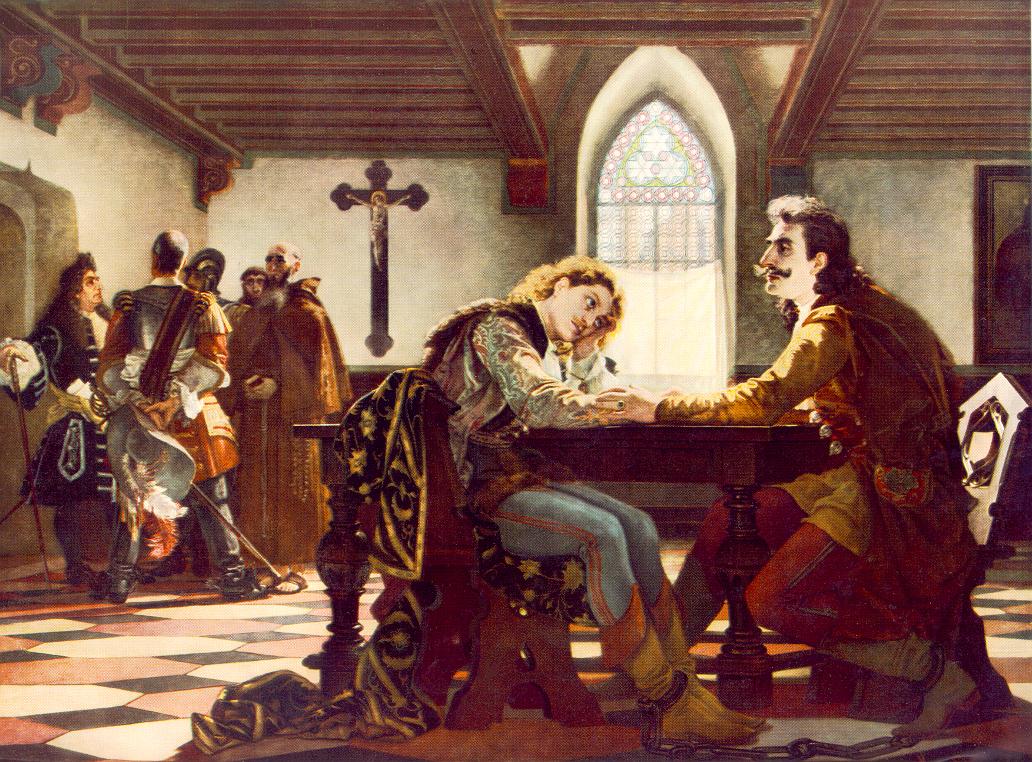
On this date in 1671, Croatian noble Fran Krsto Frankopan and his brother-in-law Petar Zrinski were beheaded by the Austrian empire at Wiener-Neustadt Prison.

The Zrinski-Frankopan Conspiracy — or Magnate Conspiracy — was the product of great powers chess in central Europe … and specifically, of the frustration of these lords in the frontier zone between the Austrian and the Ottoman Empires at being a sacrificial pawn.

Instead, they’d take control of their own destiny and be a self-sacrificial pawn.

Croatia and Hungary had been on the perimeter of Hapsburg authority for generations, and seen the rising Ottomans push well into Europe.

In the latest of innumerable wars, the Austrians had trounced the Ottomans, potentially (so the Croats and Hungarians thought) opening the door for reconquest of lost territory. Croatia in particular had been nibbled away by Ottoman incursions into a “remnant of a remnant.” Emperor Leopold I thought otherwise: he had Great Games to play in western Europe as well and didn’t find this an auspicious moment to go all in in the east.

Rather than following up his victory by trying to run the Turks out of their half of divided Hungary, or out of Transylvania, Leopold just cut an expedient peace on status quo ante terms quite a bit more favorable to Istanbul than the latter’s military position could demand.

The aggrieved nobles started looking around for foreign support to help Hungary break away.

This scheme never came to anything all that palpable, perhaps because the operation’s leading spirit Nikola Zrinski got himself killed by a wild boar on a hunt, and definitely because no other great powers wanted to get involved in the mess.

Zrinski (or Zrinyi) was also a noteworthy Croatian-Hungarian poet, as were the remaining conspirators.

The boar-slain’s younger brother Petar, his wife Katarina, and Katarina’s half-brother Fran Frankopan, also better litterateurs than conspirators, inherited the scheme’s leadership, and its penalty.


Zrinski and Frankopan in the Wiener-Neustadt Prison, by Viktor Madarasz (1864)

Royal vengeance against the plot shattered two mighty noble houses: the Zrinskis were all but destroyed by the seizure of their estates. The Frankopans — an ancient and far-flung family whose Italian Frangipani branch was even then about to yield a pope — were done as major players.

After these executions, anti-Hapsburg sentiment metastasized in Hungary into outright rebellion.

But in what was left of Croatia, the loss of the two largest landholders spelled the end of effective resistance until the era of 19th century romantic nationalism — when our day’s unfortunates were recovered as honored national heroes.

Zrinski and Frankopan are pictured on modern Croatia’s five-kuna bill, and were both reburied in Zagreb Cathedral after World War I finally claimed the Austrian Empire. (They also got memorial plaques in Wiener-Neustadt) Their mutual relation Katarina Zrinski, who avoided execution but was shut up in a convent, was a writer as well, and has ascended to the stars of founding patriotess, seemingly the go-to namesake for most any Croatian women’s civic organization. (Dudes honor the House of Zrinski by slapping the name onto sports clubs.)

On this day..

1857: Francis Richeux, witnessed by Tolstoy

On this date in 1857, a robber-murderer named Francis Richeux was publicly guillotined in Paris before a crowd of 12,000 to 15,000 people.

One of those onlookers was a 28-year-old Russian noble, fresh from the Crimean War and abroad on his first European trip: Leo Tolstoy.*

Overcome with curiosity, Tolstoy (as he recorded in his diary; here it is in Russian)

rose at seven o’clock and drove to see an execution. A stout, white, healthy neck and breast: he kissed the Gospels, and then — Death. How senseless … I have not received this strong impression for naught. I am not a man of politics. Morals and art I know, love, and [understand]. The guillotine long prevented my sleeping and obliged me to reflect.

And he developed the impression into a full-on rant that same day, in his running correspondence with Russian litterateur Vasily Botkin. The following is as translated in Dialogues with Dostoyevsky: The Overwhelming Questions.

The spectacle made such an impression on me that it will be long before I get over it. I have seen many horrors in war and in the Caucasus, but if a man were torn to pieces in my presence it would not have been so repulsive as this ingenious and elegant machine by means of which they killed a strong, hale, healthy man in an instant. There [in war] it is not a question of the rational [will], but the human feeling of passion, while here it is a question of calm and convenient murder finely worked out, and there’s nothing grand about it. The insolent, arrogant desire to carry out justice, the law of God. Justice, which is determined by lawyers every one of whom, basing himself on honor, religion, and truth, contradicts each other. With these same formalities they have murdered both the king and Chenier, both republicans and aristocrats.† . . Then the repulsive crowd, the father explaining to his daughter what a convenient and ingenious mechanism it is, and so forth. The law of man — rubbish! The truth is that the state is a conspiracy not only for exploitation, but chiefly to corrupt its citizens. But all the same states exist, and moreover in this imperfect form. And they cannot pass from this system into socialism . . . For my part, I can only see in all this repulsive lie what is loathsome, evil, and I do not want to, and cannot, sort out where there is more and where there is less. I understand moral laws, the laws of morality and religion, binding on no one, that lead people forward and promise a harmonious future; I feel the laws of art which always bring happiness; but the laws of politics constitute for me such an awful lie that I cannot see in them a better or worse. All this is what I felt, understood, and recognized today. And this recognition at least to some extent relieves the burden of the impression for me . . . From this day forward I will not only never go to see such a thing again, but I will never serve any government anywhere.**

He wasn’t kidding about that long insomnia, either: the impression startled him, permanently. Recalling the effect years later in his Confessions, Tolstoy still attributed to it an important confirmation of his egalitarian philosophy.

When I saw the head separate from the body, and how they both thumped into the box at the same moment, I understood, not with my mind but with my whole being, that no theory of the reasonableness of our present progress can justify this deed; and that though everybody from the creation of the world, on whatever theory, had held it to be necessary, I know it to be unnecessary and bad; and therefore the arbiter of what is good and evil is not what people say and do, and is not progress, but is my heart and I.

Tolstoy developed the same theme further a few years later in What Is to Be Done? … the shade of the long-forgotten Francis Richeux still haunting the great man of letters.

Thirty years ago in Paris I once saw how, in the presence of thousands of spectators, they cut a man’s head off with a guillotine. I knew that the man was a dreadful criminal; I knew all the arguments that have been written in defence of that kind of action, and I knew it was done deliberately and intentionally, but at the moment the head and body separated and fell into the box I gasped, and realized not with my mind nor with my heart but with my whole being, that all the arguments in defence of capital punishment are wicked nonsense, and that however many people may combine to commit murder — the worst of all crimes — and whatever they may call themselves, murder remains murder, and that this crime had been committed before my eyes, and I by my presence and nonintervention had approved and shared in it. In the same way now, at the sight of the hunger, cold, and degradation of thousands of people, I understood not with my mind or my heart but with my whole being; that the existence of tens of thousands of such people in Moscow — while I and thousands of others over-eat ourselves with beef-steaks and sturgeon and cover our horses and floors with cloth or carpets — no matter what all the learned men in the world may say about its necessity — is a crime, not committed once but constantly; and that I with my luxury not merely tolerate it but share in it. (PDF source | Original Russian)

* Among Tolstoy’s other activities in Paris was hanging around Turgenev … but the two mostly irritated one another. Nevertheless, they shared a distaste for the guillotine, at least to judge by Turgenev’s repulsion at seeing it in action years later.

** Two days after the execution, Tolstoy left Paris for Geneva. Execution-disgust is a suggestive speculation, although Henri Troyat argues that it merely gave him a “dramatic excuse” to stop putting off travel plans he had already made.

On this day..