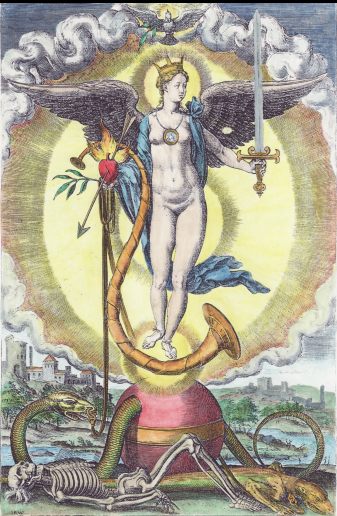
1559: The remains of David Joris, Anabaptist fugitive

On this date in 1559, the corpse of “Johann van Brugge” — recently exposed as underground Anabaptist leader David Joris, even though Brugge/Joris was three years dead — was burned in Basel.

The flame-bearded Joris (English Wikipedia entry | the more detailed Dutch) was a glass-painter by trade who came to the fore of the Anabaptist movement following its catastrophe at Muenster.

His home city of Delft in 1528 had flogged him and bored his tongue for his religious scruples, but Joris maintained a strong following among the re-baptized in that city. Many of those followers had occasion to try their faith against the torturers’ tongs, and dozens of arrestees impressively concealed their leader’s whereabouts from his enemies. The man’s own mother was executed in 1539.

He could only duck in and out of Delft — once he had to slip out in a basket innocuously loaded onto a boat* — or any other city. From the 1530s, his was a life on the run in Reformation Europe, where Anabaptists were no safer from Protestants than they were from Catholics.

(Sample dangerous heresy: Joris was a very early adopter of the idea that the devil was best understood as an allegorical figure, not an actual entity.)

With a literal price on his head he wandered to Strassburg, to England, back to the continent in Westphalia and Oldenburg, Strassburg again, then Antwerp, and on to Basel, Switzerland in 1544.

In Deventer in 1542 his ecstatic Wonder Boeck was printed. (We recommend the engravings.)

In Basel our hunted man was able to settle in as Brugge and live out the balance of his life, still pouring out voluminous writings in secret — a very impressive retirement considering his notoriety and his distinctive facial hair. Joris was in his fifties when he died: the years of rough living on the run had done him no favors.

Three years after his death, his son-in-law — who disagreed with Joris theologically — exposed his real identity. Basel had nothing left to do about it but to visit on his bones the punishment David Joris’s living flesh escaped to the end of his days.

* From Gary Waite’s “Staying Alive: The Methods of Survival as Practiced by an Anabaptist Fugitive, David Joris” in the January 1987 Mennonite Quarterly Review.

On this day..

1554: Guillaume Dalencon, defrocked priest

Felix Platter is our narrator for Guillaume Dalencon’s death at the stake on this date in 1554.

This book portrays the 16th century through the remarkable Platter family.

Platter (English Wikipedia entry | German) was a 16-year-old Swiss student, and we find him on the midpoint of his family’s upward arc in the world. His father, Thomas, had as a child been put out of the house by his impoverished mother and made his way for a time as a beggar; by dint of lifelong struggle and application, he had gained a precarious foothold among the bourgeoisie of Basel. Thomas Platter nurtured still greater ambitions for his son.

Accordingly, the very genial Felix, who had never before traveled, set out in 1552 on the 400-mile journey to the city of Montpellier in southern France. Young Platter was an energetic diarist, and his impressions of the journey and of Montpellier were published in English as Beloved Son Felix. (That’s how Felix’s father addressed him in letters.) Though the book is out of print, it’s available online at archive.org.

One of its immediately striking features is the omnipresence of danger and death. Platter luckily left Basel just ahead of a plague outbreak, but he nearly lost his life in the frightening Jurthen forest. Taking shelter from the rain there in “a wretched inn” at a squalid hamlet called Mezieres, Platter and his companion found the place full of aggressive Savoyard peasants, and having no choice but to stay overnight they blockaded their door with a bed and kept a waking vigil all night with weapons at the ready. Three hours before dawn, they crept through the snoring mass of drunken thugs and slipped away, and a good thing it was too: the boys’ French guide told them as they set out that he had overheard the brutes plotting to murder the hapless travelers that morning.

The bandit “Long Peter”, who was then active in this forest, was eventually caught and executed on the breaking-wheel in Berne. Only in his old age did Platter learn that the brigand’s confession included a declaration that he had planned, but failed, to kill some students in Mezieres.

They had escaped by the skin of the teeth, but seemingly every page of the journal finds others who succumbed to the many paths to abrupt death the 16th century had to offer. (Not a few of them are corpses that Platter stole from their graves with fellow-students in order to anatomize.) This was, too, the age of spectacular public execution: the travelers’ road on October 18th, 1552, passed numerous “bodies of men hanging from the trees” and as darkness fell Platter gave himself a fright when he nearly rode into one. By the 20th they approached Lyons, where they beheld “several men hanging from gibbets and others exposed on wheels.” As they entered that city, they passed a Protestant “being led out to be burnt outside the gate; he was in his shirt with a truss of straw fastened on his back.”

Platter makes no further comment on this sight, but it must have touched him with pity — if not fear. Platter had been born in Basel about the same time that John Calvin, fleeing French persecution, arrived there; it was in Basel that Calvin first published his seminal theology Institutio Christianae religionis. To this faith, predominant in Swiss cities but illicit in France, Platter too subscribed. The French Wars of Religion loomed around the corner in the next decade, and Montpellier would become a Huguenot stronghold during that conflict. While Platter was there, an uneasy peace prevailed between growing ranks of Protestants and the official religion. The University of Montpellier attracted numerous Protestant students (the city lay in the heart of the Languedoc, a center of resistance to the papacy from long before the Reformation), and Platter’s own mentor, the brilliant doctor Guillaume Rondelet, had ambiguous religious affiliations.

Day to day, these students kept their heads down in matters religious and went about mostly unmolested. Taking a vocal stand on theological controversies here would be to embark upon a different path than Thomas Platter had in mind for his son, for heretics were among the many executions Platter recounts in his journal.

Guillaume Dalencon, the boy learned, was a former priest of Mountauban, “unfrocked on the 16th of October” when it was discovered that he had gone Protestant and brought back heretical books from Geneva. “Dressed in his priestly robes, he was brought on to a platform before the bishop” for his defrocking. “After protracted ceremonies in Latin he was divested of his chasuble and the rest, and given secular clothing. Hishead was then shaved, and two fingers were cut off his hand. After this he was delivered to the civil justice and once more thrown into prison.” The secular power took it from there.

On the 6th of January Guillaume Dalencon, unfrocked eleven weeks before, and since then held in prison, was condemned to death. In the afternoon a man carried him on his shoulders out of the town towards the monastery, to the place of execution. A pyre had already been built there. Beind the condemned man two other prisoners walked, one a cloth shearer, in his shirt, with a bale of straw fastened to his back; the other of good appearance, and well dressed. Both of them had recanted and denied the true faith. [i.e., both had recanted Protestantism under the threat of execution. -ed.] Dalencon, however, sang psalms all the way. At he pyre, he sat down on a log and himself took off his clothes as far as his shirt, and arranged them beside him tidily, as though he would be putting them on again. He exhorted the other two, who were about to apostasize, so touchingly that the sweat stood out in great drops, as big as peas, on the forehead of the man in the shirt. When the monks, formed in a curve around him, and mounted on horseback, told him that it was time to make an end, he leapt joyously on to the pyre and sat down at the foot of the stake that rose in the center of it. This stake was pierced by a hole, through which ran a cord with a running noose. The executioner put the cord round Dalencon’s neck, tied his hands across his breast, and placed near him the religious books he had brought from Geneva. Then he set fire to the pyre. The martyr remained seated, calm and resigned, with his eyes raised towards heaven. When the fire reached the books the executioner pulled on the cord and strangled him; his head dropped to his breast and he made no further movement. Little by little the body was reduced to cinders. His two companions stood at the foot of the fire, where they were made to watch his sufferings, and could feel the heat of the flame.

After the execution they were both taken to the Hotel de Ville. Near there, in front of the church of Notre-Dame, a platform had been set up, with a statue of the Virgin on it, before which they would have to recant. The crowd had to wait for them for a long time. At last only one of the two men was brought out. The cloth shearer had refused to abjure and demanded that he should be executed without mercy for having failed his beliefs. He was therefore taken back to prison. The other man, who seemed to be a man of substance, was placed on his knees before the statue of the Virgin, with a lighted candle in his hand. A clerk read out various charges, to which he had to reply. In this way he saved his life, but he was sent to the galleys and there put in chains.

On the following Tuesday, the 9th of January, it was the turn of the cloth shearer again. He was strangled and burnt as the priest had been. He showed great courage, and no less repentance for having come so near to denying his faith. It had rained on that day, and the fire would not burn. The victim, who was not completely strangled, endured great suffering. At last the monks of the neighbouring monastery brought some straw, and the executioner took it and sent for oil of terebinth from my master’s pharmacy to ignite the fire. Afterwards I reproached the assistants who had given it to him, but they advised me to hold my tongue, for the same fate could befall me also, as a heretic.

During these affairs an extraordinary phenomenon occurred. On the 6th of January, immediately after the execution of the first man, it began to thunder violently. I heard it plainly and so did many others with me; but the priests deried us and said that it was the smoke from the burning of heretics that produced that effect.

On this day..

1556: Hemu

This date in 1556 saw the Second Battle of Panipat in India … and the consequent beheading of the losing commander.

Hem Chandra Vikramaditya was the unfortunate object of this treatment, a remarkable Hindu who was born a commoner and died a king.

The early 16th century saw the birth of the Mughal Empire as Turkic Muslim tribes led by the conqueror Babur swept away the Pashtun sultanates in north India. The First Battle of Panipat back in 1526 cinched this conquest.

In this unsettled environment, an able man could rise. Few were abler than Hem Chandra, more familiarly known to posterity as Hemu.

Born to a family of Hindu priests in a time when Hindu kings had not ruled his homeland for centuries, Hemu first came to prominence as a merchant supplying provisions, and later armaments, for the imperial army. He proved so capable that Islam Shah took him on as an adviser.

Now, despite the Mughal conquest, Islam Shah was actually an Pashtun. A weak succession after Babur had thrown the Mughals into retreat, and most of their once and future territory was now under the temporary authority of the Sur Empire.

Following Islam Shah’s death in 1554, the political situation for the Sur Empire fell into confusion. A boy-emperor successor was murdered to give way to a drunk, and Hemu emerged as the de facto authority in the chaotic realm … which in practice meant racing around dealing with various military threats.

Hemu put down the many internal revolts that flowered after Islam Shah’s death, but his greater problem was the resurgent Mughals.

Babur’s heir Humayun had been driven into exile in Persia years ago. Now he returned at the head of an army to retake his patrimony. Even when Humayun himself died in the process (he fell down a flight of stairs*), he bequeathed Hemu a potent foe in the form of his teenage heir Akbar — the sovereign who would eventually be esteemed the Mughals’ greatest emperor.

Even so, Hemu was routing all who stood against him. The onetime merchant had proven himself “one of the greatest commanders of the age,” in the words of Victorian historian John Clark Marshman. “He never shrank away from the battlefield and when the fight was most fierce, he did not bother for his personal safety and always fought with his adversaries courageously along with his comrades.”

On October 7, 1556, Hemu whipped Akbar at the Battle of Delhi. Entering the ancient capital, Hemu proclaimed himself emperor under the regnal name Raja Vikramaditya. And why not, after all? The kingdom already only maintained itself by Hemu’s own brilliance; he’s reputed to have had an undefeated combat record at this point.

But sometimes a single loss is all that’s needed.

Hemu was the first Hindu emperor in 350 years, but he only held the position for a month.

The new emperor again met Akbar (and Akbar’s regent Bairam Khan) on the fifth of November at Panipat, and this time the Mughals won. Hemu’s valorous exposure to danger proved his undoing when he was struck in the face by an enemy arrow.

As his once-unconquerable army routed, the captured Hemu was taken as a prisoner to his rival ruler — unconscious, and already dying. Again, the accounts vary;** in the classical version, Akbar nobly refuses to put the captive to death. Elphinstone‘s History of India, glossing some earlier Muslim historians, writes that

Bairam was desirous that Akbar should give him the first wound, and thus, by inbruing his sword in the blood of so distinguished an infidel, should establish his right to the envied title of ‘Ghazi’ or ‘Champion of the Faith’; but the spirited boy refused to strike a wounded enemy, and Bairam, irritated by his scruples, himself cut off the captive’s head at a blow.

However, there are other versions of this story in which the 14-year-old Akbar is not so reticent.

Whoever chopped it, the severed head was sent to Kabul to cow Hemu’s Pashtun supporters, while the torso was publicly gibbeted outside Purana Quila. Hemu’s followers were massacred afterwards in numberless quantities sufficient, so it is said, to erect minarets of their skulls.

Akbar ruled the Mughal state until his death in 1605.

* Humayun’s monumental tomb is a UNESCO World Heritage Site today.

** See Vincent A. Smith, “The Death of Hemu in 1556, after the Battle of Panipat,” Journal of the Royal Asiatic Society of Great Britain and Ireland (July 1916). Smith’s opinion is that Akbar probably did cut off Hemu’s head personally, but might later have spun the incident in a less distasteful direction.

On this day..

1556: Joan Waste, in Windmill Pit

On this date in 1556, Derby hosted the incineration of a young blind woman who refused to renounce her Protestantism.

The ascendance of Queen Mary briefly restored Catholicism as England’s official religion. The previous decades’ Protestant reforms, however, had been achieved with bloodshed and could only be undone with more bloodshed. (That’s why she’s “Bloody Mary”: because she executed a bunch of people, and because the Protestants who executed a bunch of people won out and got to do the naming.)

In the wrong place at the wrong time was Joan Waste, who though blind proved a deft hand at knitting ropes to support her poor family. Inspired by hearing Scripture in the Queen’s English during Anglican services shaped by Cranmer, Joan scrimped and saved the earnings of her poor profession until she could afford a Bible … specifically (and problematically for the new old faith), one printed in English rather than Latin. Being blind, she then had to recruit friends, townspeople, or other parishioners to read it to her.

This made her a pretty easy target when England reinstated Catholic heresy laws in 1555, although presumably not one selected by the public relations department. Pious Joan preferred the stake to renouncing her heresies.

After enduring an execution sermon from the Catholic churchman Anthony Draycot, Foxe’s martyrology describes the fate of “the poor, sightless object” — which doesn’t look the most felicitous build of a noun phrase — who “was taken to a place called Windmill Pit, near the town, where she for a time held her brother by the hand, and then prepared herself for the fire, calling upon the pitying multitude to pray with her, and upon Christ to have mercy upon her, until the glorious light of the everlasting Sun of righteousness beamed upon her departed spirit.”

The old Windmill Pit execution site can still be found in Derby today. There’s a local legend, of Victorian manufacture, that Joan cursed the location with the words: “never shall this pit, of which ye are about to make a pit of fire, hold drop of water more.”

On this day..

1555: William Hunter, reader

On this date in 1555* — crying, “away, thou false prophet!” at the priest sent to hector him in his last moments — William Hunter was burned in Brentwood, Essex for Protestantism.


Hunter at the stake, from Foxe’s Book of Martyrs.

Here in the last brief moment of official Catholicism under Queen Mary, our apprentice silk-weaver was caught reading the Bible for himself in the local chapel.

Called in for questioning, both Hunter and the civil authorities decided it was worth his life to dispute the doctrine of transubstantiation. Catholic pro, Hunter con, of course.


(cc) image from Bopuc.

So that was that.

A couple of years later, the very justice who had first examined Hunter received a grant to found a school. Brentwood School is still going strong in its fifth century, and on its grounds — directly adjacent, in fact, to the school’s first purpose-built room** — rests a stone for the edification of the generations of Anglican pupils who followed. It honors the young man who died to crack open a book.

WILLIAM HUNTER. MARTYR. Committed to the Flames March 26th MDLV.
Christian Reader, learn from his example to value the privilege of an open Bible. And be careful to maintain it.

An elm tree planted at that spot came to be known as the Martyrs Elm.


1847 illustration of Brentwood School and the Martyrs Elm.

* This is the date per Foxe’s Book of Martyrs; others give March 27. The memorial stone carries the day for our purposes in view of contradictory sourcing.

** The legend that Brentwood School was founded as the justice’s penance for dooming Hunter seems to be unfounded.

On this day..

1555: John Hooper

On this date in 1555, English Calvinist John Hooper fell victim to Mary Tudor’s abortive bid for Catholic restoration.

A onetime monk on the receiving end of the Dissolution of the Monasteries, Hooper got the evangelical bug by reading Zwingli and became more un-Catholic than the anti-pope.

That meant that in quasi-Catholic Anglican England, he had to hot-foot it over to the continent a couple of times to keep out of trouble.

Even when more aggressive reformers took the lead after Henry VIII died, Hooper proved a gadfly; he’s noted for setting off the decades-long “vestments controversy” with his denunciation of the “Aaronic” ceremonial garb donned by priests.

(Hooper himself had to work out a compromise just to be ordained in garb sufficiently modest to satisfy his conscience.)

He survived the fall of his patron Edward Seymour, but the death of Edward VI and the ensuing succession of the Catholic Queen Mary Tudor was Hooper’s demise. Historians may debate whether “Bloody Mary” really deserves her unkind nickname, but had she left a proto-Puritan loose cannon like Hooper unmolested, she would have indeed been a little lamb.

Hooper — naturally — took solace from the Word, “as St. Paul that loved the policy, laws, order, and wisdom of the Romans, yet disliked very much the vice and naughtiness of Nero, unto whom he submitted, and willingly brought into servitude both his body and goods, and rebelled not, though Nero was a naughty emperor, for his office sake, which was the ordinance of God.”

A large collection of Hooper’s writings (including the foregoing) is available at this Google books freebie.

On this day..

1554: David van der Leyen and Levina Ghyselius, Anabaptist martyrs

On this date in 1554, Anabaptists David van der Leyen and Levina Ghyselius were burned at the stake in Ghent.*

Looks like it hurt.


In the year 1554, there was imprisoned at Ghent, in Flanders, for following Christ and living according to God’s commandments, a young brother named David, who, when examined, freely confessed his faith. Being asked what he thought of the sacrament, David said, that he considered it nothing else than idolatry. Then a priest said to him, “Friend, you err greatly, that you so readily confess your faith, for it will cost you your life, if you do not change your mind in time.” Thereupon David sweetly replied, “I am ready to shed my blood for the name of Christ, even though it should be here in this place; for God is my salvation, who will keep me, and preserve me from all evil.” The priest said, “It will not be as good as though you were put to death secretly here in this place; but you will be burnt publicly at the stake, for an everlasting reproach.” He was then brought into the court, where he was condemned to death, and his sentence was read, namely, that he had fallen from the true faith into heresy, and was therefore, according to the imperial edict, sentenced to be strangled and burned. David said, “No one will ever be able to prove by the Scriptures, that the faith for which I must now die is heresy.”

There was also sentenced to death with him a woman named Levina, who rather forsook, not only her six dear children, but also her temporal life, than her dear Lord and Bridegroom Jesus Christ. Arriving on the scaffold, David attempted to kneel down in order to offer up his prayer to God, but he was prevented, and they were immediately driven away to the stakes, standing at which, David said to Levina, “Rejoice, dear sister; for what we suffer here is not to be compared with the eternal good that awaits us.” (Rom. 8:18) When about to offer up their sacrifice, both exclaimed, “Father, into thy hands do we commend our spirits.” A little bag of gunpowder was tied to each of them, whereupon they were strangled and burned. But there happened a manifest miracle of God; for though they were completely burned, and the fire was as good as extinguished, David was seen to move his head, so that the people exclaimed, “He still lives.” The executioner seized the fork, and thrust it three times into his bowels, so that the blood flowed out; yet even after this he was still seen to move, hence, the executioner threw a chain around his neck, and bound him to the stake, and thus broke his neck.

Thus these two valiantly fought their way through, firmly trusting in God, who did not let them be confounded, since they had firmly built their building upon the only foundation; wherefore they shall never perish, but abide forever.

Martyrs Mirror

* The very birthplace of the then-sitting Holy Roman Emperor, Charles V.

On this day..

1550: The leaders of the Prayer Book Rebellion

On this date in 1550, the leaders of England’s Prayer Book Rebellion were hanged, drawn, and quartered at Tyburn.

When Henry VIII dropped dead in 1547 and pitched his contentious realm and dubious progeny into the mid-Tudor crisis, Henry’s old theological henchman Thomas Cranmer really got to work.

During the unsteady regency of Henry’s sickly heir, Cranmer would push frenetically to make the religious reformation that his former boss never completely backed. The Archbishop sent to the continent for Protestant theologians like Peter Martyr who could help him “do away with doctrinal controversies and establish an entire system of true doctrine.”

The piece de resistance of Cranmer’s project was his Book of Common Prayer — a reformed liturgy, and in English, to go with the new English Bible. Many centuries — and revisions — later, it’s still the basis of Anglican services and of rites in many other Protestant denominations.

In 1549, it debuted to decidedly mixed reviews.

Enforced by Parliament’s Act of Uniformity, the Book of Common Prayer replaced all Latin liturgies on Whitsunday 1549, and for many of England’s Catholics, it was one affront too many. (The country’s bumpy economic realignment couldn’t have helped matters.)

On Whitmonday, traditionally-minded parishioners in West Devon unimpressed* with this newfangled vernacular service forced their local cleric to break out the old vestments and say Mass in Latin. State attempts to enforce the ban soon produced a martyr for the cause — one William Hellyons, melodramatically impaled on a pitchfork — and a march to Exeter that spiraled into outright revolt, heavy with suppressed Cornish nationalism.

We, the Cornishmen, whereof certain of us understand no English, utterly refuse this new English.

Religion, theology, the liturgy, the text of the Scripture … these were things that early modern Europeans were ready to fight and die for.

Yet the most problematic demand made by the men of Cornwall was probably not for the dead tongue of Latin, but for a partial reversal of the Dissolution of the Monasteries.

Since this considerable plunder of Church wealth had been widely redistributed to the English gentry, talk about repossessing it really emptied the pews of potential allies.

At any rate, neither Latin nor monastic restoration would be provided as carrots; London under Lord Protector Edward Seymour instead put down the rising with the more customary stick.

After the bloody Battle of Clyst Heath and the conclusive Battle of Sampford Courtenay, English troops rounded up and summarily executed survivors and sympathizers.

Such principals as remained were reserved a more awful fate: drawing and quartering at Tyburn. These seem to be the chaps who endured it:

  • Henry Bray, Mayor of Bodmin
  • Landowner and military leader Humphrey Arundell
  • Landowner John Wynslade
  • Thomas Holmes
  • John Bury

Bill Ind, Anglican Bishop of Truro, made news in 2007 acknowledging “that the English government behaved brutally and stupidly” in crushing the rebellion.

The Book of Common Prayer was never translated into Cornish, a circumstance sometimes credited with speeding the tongue‘s demise.


A stone commemorates the Prayer Book Rebellion at Penryn. (cc) image from Drewhound

* Petitioning:

We wyll haue the masse in Latten, as was before.

We wyll haue the Sacrament hang Oller the hyeghe aulter, and there to be worshypped as it was wount to be, and they whiche will not thereto consent, we wyll haue them dye lyke heretykes against the Holy Catholyque fayth.

We wyll haue . . . images to be set vp again in euery church, and all other auncient olde Ceremonyes vsed heretofore, by our mother the holy Church.

We wyll not receyue the newe seruyce because it is but lyke a Christmas game, but we wyll haue oure old seruice of Mattens, masse, Euensong and procession in Latten as it was before.

On this day..

1553: Prince Mustafa, heir to Suleiman the Magnificent

On this date in 1553, the capable heir apparent to Ottoman Emperor Suleiman the Magnificent was strangled at dad’s order — casualty of the the realm’s lethal harem politics.

If ’tis state thou seekest like the world-adorning sun’s array,
Lowly e’en as water rub thy face in earth’s dust every day.
Fair to see, but short enduring is this picture bright, the world;
‘Tis a proverb: Fleeting like the realm of dreams is earth’s display.
Through the needle of its eyelash never hath the heart’s thread past;
Like unto the Lord Messiah bide I half-road on the way.
Athlete of the Universe through self-reliance grows the Heart,
With the ball, the Sphere—Time, Fortune—like an apple doth it play.
Mukhlisi, thy frame was formed from but one drop, yet, wonder great!
When thou verses sing’st, thy spirit like the ocean swells, they say.

-Prince Mustafa, about himself

Suleiman’s first-born son by his first concubine, Mustafa seemed well-positioned to emerge in the Ottomans’ fratricidal succession.

The racket: when the current sultan dies, all his sons by his various concubines make a rush from their provincial outposts for the capital and fight it out, the winner killing off his half-brothers to consolidate his rule.

This disorderly ascension made, while dad still lived, for fraught internal politicking among the sons for the inside track: the most prestigious positions, and the assignments closest to Istanbul. The various mothers of the contenders jockeyed just as aggressively on behalf of their various entrants in the imperial sweepstakes.

Mustafa was the capable eldest son in a kingdom at its very acme,* but to his misfortune, and the empire’s too, he found himself pitted against one of the ablest women ever to call the Ottoman harem home: Hürrem Sultan, also known as Roxelana (or Roxolana).

A Ukrainian woman kidnapped to the harem by Tartar slavers, Roxelana enchanted Suleiman and soon became his favorite. Therefore, Roxelana also became the rival, with her son and her own potential heir, to Mustafa and his mother.

As the story is told, Roxelana at length contrived to convince Suleiman that Mustafa was in cahoots with the rival Safavid Empire to supplant Suleiman on the throne; Suleiman had his firstborn summoned to his tent on campaign in Anatolia, and straightaway put to death. He’s supposed to have sat by the body in grief for days afterwards, and barely averted a revolt by his elite Janissaries, who much favored the talented Mustafa.

“This terrible tragedy exercised an effect on Ottoman affairs resembling that which the Massacre of St. Bartholomew had on the history of France,” according to The Cambridge Modern History (vol. 3). Roxelana’s unimpressive son “Prince Selim, in whose favour the crime was committed, was the first of a series of degenerate Sultans, sunk in pleasure-seeking or stricken with Imperial mania, under whose sway the Empire went to ruin.”

Consequently, Mustafa is still mourned in Turkey as a tragic turning-point; visitors pay homage to his tomb at Bursa.

Westerners had word of this fascinating palace intrigue through diplomatic correspondents who were not privy to the actual harem, and adopted the story themselves while imaginatively filling in the orientalizing details. Inevitably these imaginings have helped shape the story as it comes to us.

The scenario blending the familiar and the exotic — a European in the court of the Turk; a slave woman dominating the conqueror; fratricidal princes and the alluring seraglio — all set in the heart of the feared Muslim state proved irresistible to literary interlocutors. These made of Suleiman, Mustafa (Mustapha), and Roxelana moral fables, theater (endorsed by Samuel Pepys!), symphony

… and opera (many librettos, this by Hasse):

Not to mention, of course, more titillating fare.

* The PBS documentary Islam, The Empire of Faith does engrossing coverage of Suleiman (including his relationship with Roxelana and the execution of Mustafa) in these video segments: 3, 4, 5.

On this day..

1554: Thomas Wyatt the Younger, with the Queen’s life in his hands

On this date in 1554, rebel leader Thomas Wyatt the Younger tied on his own blindfold and laid his head on the block, having declared that not “any other now in your durance [i.e., the Tower] was privy to my rising”.

That remark exculpated the Princess Elizabeth, who just days before had been ominously rowed to the Tower on suspicion of having known of or involved herself in Wyatt‘s abortive revolt.

And Wyatt had had to do more than talk the talk to keep the future Queen Elizabeth I out of the executioner’s way.

Sore afraid that Wyatt’s rebellion had been engineered with the connivance of her Protestant half-sister, the Catholic Queen Mary Tudor had had Wyatt tortured to implicate her.

Wyatt held firm to Elizabeth’s innocence.

Had he not, the princess might have followed her mother to the scaffold, instead of becoming one of the realm’s most illustrious monarchs* — a fraught situation aptly portrayed at the outset of the 1998 Cate Blanchett flick Elizabeth.

It wasn’t only religion that made the political situation in 1550s England so perilous.

Mary Tudor’s marriage to Philip of Spain had roused fears of Spanish political domination. This, much more than theology, triggered the plot that took Thomas Wyatt’s head off his shoulders.

Against this specter of Iberian influence, Wyatt and some fellow-nobles attempted to raise coordinated insurrections in early 1554. Most fizzled or were busted by authorities before they could get going. Wyatt’s alone, in quarrelsome Kent, ignited: he marched 4,000 men on the city of London and for a moment seemed to have a real prospect of capturing it before the crown rallied the city.

A paroxysm of vengeful executions in February 1554 claimed nearly 100 participants in the rebellion, their mutilated bodies demonstratively hung up around town. (It also claimed Lady Jane Grey, the lately defeated rival contender for Mary’s throne, whom the latter now realized was too dangerous to be left alive.)

It could have been uglier, though.

Despite her “Bloody Mary” reputation, the Queen went fairly easy on this dangerous challenge to her authority, making some high-profile examples but paroling most of the rank-and-file traitors in a hearts-and-minds clemency campaign.

The namesake rebel, however, was never going to be in that bunch. He was kept on a bit in the Tower while Mary’s goons “laboured to make Sir Thomas Wyatt confess concerning the Lady Elizabeth … but unsuccessfully, though torture had been applied.”

“Much suspected by me, nothing proved can be, Quoth Elizabeth prisoner”

Having kept his head under torture, Wyatt lost it on this date — and readied Elizabeth’s to wear the crown.


If you find the Elizabethan age worth celebrating, spare an extra thought this date for Thomas Wyatt the Younger’s eponymous old man.**

This Henrician poet is supposed to have been Anne Boleyn‘s last lover before Henry VIII.

In Henry’s snakepit, youthful frolics could come back to bite you; Wyatt the elder was actually imprisoned for adultery with the queen, only ducking the fatal charge thanks to some pull with Thomas Cromwell.

Wyatt pere wrote a melancholy poem about this depressing turn of his fortunes, but considering his times, you’d have to say he was born under a good sign.

A few years later, he was again on the hook for treason, and (Cromwell having been beheaded in the interim) saved by the fortuitous influence of Queen Catherine Howard, who was herself not long before a fall and a chop. (After that, Lady Wyatt, famous for her gallantries, was supposed to be in the running to become King Henry’s sixth wife even though she was still married to Thomas.)

The elder Wyatt managed to die naturally before trying his luck with a third treason charge.

* Many a slip ‘twixt a cup and a lip, but that turn of ill fate for Elizabeth could have set Mary, Queen of Scots on her way to becoming one of England’s most illustrious monarchs, instead of going to the scaffold.

** The illustrious family ties go the other direction, too. Thomas Wyatt the Younger was the grandfather of Francis Wyatt, the first English royal governor of the New World territory named for Queen Elizabeth: Virginia.

On this day..