1629: Jeronimus Cornelisz and other Batavia mutineers

It was 2 Oct 1629, Dutchman Jeronimus Cornelisz was noosed along with 15 other men by the Dutch East Indies Company for a reign of terror that included mutiny and murder off the coast of Australia.* Six others would eventually hang in the infamous affair, two marooned on the Australian mainland, and many more punished for the gruesome atrocities committed on the Southern Ocean.

Cornelisz was not such an assuming character when he boarded the vessel Batavia in 1628.

This definitive history of the Batavia mutiny is by one of the web’s best history bloggers, Mike Dash. He reprinted an interview largely about this book here.

Rather, he was a marginally failed merchant, someone who could buy his way on board as an under-merchant** and sail to the southern seas for the prospect of a new life. It has been speculated (here, for instance) that his move to Indonesia was motivated by a desire to put oceanic distances between himself — an apothecary who couldn’t make it in Haarlem — and prosecutors pursuing Anabaptists and other heretics. It didn’t help, either, that his infant child had recently died of the disgracing condition of syphilis. All that is enough to send a man to Indonesia, apparently.

Though Cornelisz was not a successful businessman, he was an energetic protagonist from his own station in life and could, eventually, win over any suggestible person with his intelligence and wit. It didn’t take long to do just that to the ship’s skipper, Ariaen Jacobsz — who already held a grudge against the Batavia‘s upper-merchant (and fleet commander), Francisco Pelsaert.

In due time their thoughts turned to the ship’s valuable cargo — silver and trade goods headed for the Mughal Empire. As night follows day, the next thoughts turned to mutiny.

Cornelisz pulled in people from each of the major groups onboard† to help with his mutiny without attracting the attention of the Pelsaert. All the plot needed was a kickstart to turn enough people against the commander.

In the part where the villain reveals his plot, Cornelisz’s goes like this: A group of hooded mutineers assaults the mostly widely lusted-after woman among the socialite passengers, Lucretia (Creesje) Jans; once the assault is reported, the commander must respond; but if the assailants are well-hidden, he must make an example arbitrarily, which pushes his men towards mutiny.

And, like a movie villain’s evil plot, Cornelisz’s didn’t come off.

The captain punished nobody for the assault, as Creesje could not identify the assailants. The shipboard mutiny withered on the vine. But lucky for Cornelisz, the captain had no inkling that the ship’s under-merchant was involved — though he was pretty sure the skipper and boatswain had something to do with it.

In the midst of those days of planned insurrection, the Batavia hit a slightly larger speed bump. On June 4, the vessel ran aground on Morning Reef.

There were few casualties from the initial crash, and the remainder escaped in groups, crammed onto small coral islands in the remote but plausibly survivable Houtman Abrolhos chain off the west coast of Australia.

The ship’s complement was eventually transferred to Beacon Island and Traitors Island — with limited water (but plenty of silver!), it was clear to Pelsaert there would be few people left if they didn’t get some help. Off went the captain with 47 crew and passengers in a longboat, leaving more than 250 behind to fend for themselves on the isles.

Two months later, Pelsaert found himself in the colonial city Batavia (today, the Indonesian capital Jakarta) appealing to the local authorities at the Dutch East Indies Company for a ship to rescue his stranded crew and passengers. He was quickly given the Sardam — another vessel in his fleet — with a skeleton crew to pick up the passengers (oh, and all that silver).

But he wasn’t going to need all those passenger quarters.

Cornelisz, as under-merchant, had technical rank in the emergency, and he had taken over the situation at the islands when the commander left. The refugee pharmacist reveled in the power, certainly amplified by the dozen chests of treasure the Batavia carried.

So here’s your motivation: a fortune in booty and the South Seas as your playground. This is the stuff of rum wishes and buccaneer dreams.

And Lord of the Flies nightmares.

Sensing the the time was ripe to lighten the group’s victual needs, Cornelisz‡ sent 15 men to search a larger island visible to the west for water. This journey, Cornelisz was convinced, would be fruitless, so any possible power rivals he could find went off. As well, Cornelisz shipped a larger group to Long Island to get more space.

And then began the killing.


Detail view (click for the full image) of a 1647 engraving of the carnage on Beacon Island. Cornelisz had a good 110 homicides on his soul’s account by the time it was all said and done.

Some 20 mutineers formed a tight inner circle with fantasies of having their way on the island until the rescue boat could be commandeered for piracy. The purpose of the killings was simply to knock the number of residents down closer to 40 or 45 so that the mutineers would be overwhelmingly dominant when the rescue boat came. That’s a tough task when starting with almost 200 people.

At first, killings proceeded under faux-juridical cover: theft and slander were enough to endanger everyone in these cramped quarters, so Cornelisz would have his men claim illegal activities were afoot and kill one or more of the people he considered either threats or non-entities among the group.

A few loyal footsoldiers did most of the killing, along with some pressed into service with the threat of violence; pretty soon the numbers on the island had dwindled noticeably.

With vague ideas of riches and a growing bloodlust, killing essentially became sport. Families were done to death wholesale, by whatever means were available — drowning, slitting throats, bludgeoning. Those liable to fight back might be jumped by a group at the beach, sometimes getting all of the above.

And before you go thinking murder was the only thing the mutineers had on their minds, they retained at least a few women (including Creesje) as private consorts.


Now is the time to mention that Cornelisz was personally acquainted with notorious (and then-imprisoned) degenerate artist Johannes van der Beeck. This is van der Beeck’s Faun and Nymphs.

But remember those doomed guys searching for water two islands over?

Turns out they found it, along with ample food, and they were now occupying the largest island in the chain.

They, along with 30 or so who escaped Cornelisz’s clutches over the course of two months, were the Resistance, and they were full of incriminating knowledge about what had been going down over on psycho isle.

One of the original group, Wiebbe Hayes, had taken charge of the island’s affairs, and he had done quite well. Those living on what is now known as West Wallabi Island were far better off than their Beacon counterparts.

Back on Beacon, Cornelisz was forced to ration water — even to his favorites — and had thoughts that the High Islanders might scupper his search party takeover plot. So late in July, he sent an amphibious landing team to attack High Island. Cornelisz’s men were met with a line of opposition at the beach, armed with pikes made of driftwood with nails. The mutineers retreated.

Weeks later, Assault II began; like most sequels, it fell on its face. Assault III, Cornelisz decided, should include cunning, cunning like an ostensible negotiation to trade the clothing Cornelisz had hoarded for water and food.

Hayes was even a little more cunning that that, and when Cornelisz and his four top lieutenants came ashore and began sweet-talking, he and his men seized four of them. (The fifth, Wouter Loos, escaped.)

Knowing that having mutineers on his island would be trouble, Hayes convened his council, which swiftly decided to dispatch any prisoner not named Jeronimus: that one was tossed in a pit and given birds to pluck for Hayes’ army.

Two weeks went by before the mutineers (now led by Loos) got up the courage to attack again, but by the time they took to the channels and began a long-range gun assault, the Sardam was in the archipelago. Hayes got to Pelsaert first and informed him of the planned mutiny. Pelsaert trained all his weapons on the mutineers’ boat until they decided to disarm.

The trials were done in the Dutch way, including some amount of torture. Pelsaert finally decided he had enough evidence against the mutineers, and his small tribunal passed 16 death sentences. (One was commuted to exile.) That included a half dozen who had one or more hands lopped off before their passage to the gallows.


Detail view (click for the full image) of the mutineers’ execution.

Three weeks later, when the Sardam returned to Batavia, five more of the rescued mutineers were executed, and a sixth — the boatswain involved in the assault on Creesje — was put to death while Pelsaert was out.

Once word got out, Cornelisz’s heinous crimes were known around the world and Southern sailors heard the tales for hundreds of years to come.

Pelsaert, meanwhile, was partly blamed for the incident and saw the Company seize his assets: he was dead within a year. As for Hayes, he was promoted, but his further adventures are unknown.

The remains of the shipwreck that commenced this hecatomb are still visible at Houtman Abrolhos, from cannons off the original Batavia to the fort built by Wiebbe Hayes and his men — everyday monuments to a hellish ordeal.

* Technically the first European settlers in Australia.

** Dutch merchant vessels were headed by an upper-merchant, who had control over decisions on the ship and represented the overriding interest of the Dutch United East India Company. In addition, an under-merchant was taken aboard as his second-in-command Company man. The skipper was considered head of the crew and placed in charge of navigational concerns, but his role was subordinate to the upper-merchant.

† Like all Dutch merchant vessels, the Batavia featured four major classes of people on board:

  • a standard crew to run the vessel;
  • a complement of soldiers who were generally kept below-decks but could be recruited to maintain order and would disembark at the destination;
  • a group which tended to shipboard needs (surgeon, cook, and so on);
  • and merchants and passengers, who had social standing over the rest.

‡ Technically, Cornelisz was part of a three-member council in charge of the shipwrecked. The initial council was selected from among the socially significant survivors, but Cornelisz used his rank to quickly dissolve that group and appoint two of his own future mutineers as his cohorts. Needless to say, the judiciary wasn’t independent after that.

On this day..

1628: Milady de Winter, Three Musketeers villainess

Late this night* in 1628 was the fictional execution of The Three Musketeers antagonist Milady de Winter.

Milady de Winter, as the heroine of Agnes Maupre’s revisionist French graphic novel series (Author interview | Another (Both in French)).

This conniving minx bears the fleur-de-lis brand of a teenage crime upon her shoulder — a very naughty beauty-mark indeed — but becomes a secret agent of Cardinal Richelieu. (Richelieu is a point of friction for the Musketeers right from the start.)

This novel — which has long been in the public domain (Text at Gutenberg.org or ClassicReader.com | Free audio book at Librivox.org) — features Milady continually bedeviling the protagonist d’Artagnan. He loves her; she keeps trying to kill him. Pretty typical for these grim annals. (She also used to be Athos’s wife, years ago, until he tried to murder her. Long story.)

To skip to the end of things, Milady is portrayed as having orchestrated at Richelieu’s behest the (actual, historical) assassination of the Musketeers’ buddy the (actual, historical) Duke of Buckingham, which Milady accomplishes by seducing and manipulating his (actual, historical) assassin, John Felton. In reality, Felton was motivated by the stirring Republican sentiment that would soon generate a revolution; in Dumas, he’s a horny dupe who beholds his seductress escaping by sea even as he’s placed under arrest.

Buckingham was (actually, historically) murdered on August 23.

The fictional narrative picks up on August 25, when the escaped Milady writes to Cardinal Richelieu from the safety of Boulogne. Unbeknownst to her, her hours are numbered.

Milady proceeds the next morning to a convent in Bethune where she chances to encounter the mistress of her old foe d’Artagnan … and, by that night, to slay said mistress with poison just ahead of the arrival of the Musketeers.** But the Musketeers are able to track the escaping murderess down by the next evening. There, they subject her to a snap “trial”:

“We wish to judge you according to your crime,” said Athos; “you shall be free to defend yourself. Justify yourself if you can. M. d’Artagnan, it is for you to accuse her first.”

D’Artagnan advanced.

“Before God and before men,” said he, “I accuse this woman of having poisoned Constance Bonacieux, who died yesterday evening.”

He turned towards Porthos and Aramis.

“We bear witness to this,” said the two Musketeers, with one voice.

D’Artagnan continued: “Before God and before men, I accuse this woman of having attempted to poison me, in wine which she sent me from Villeroy, with a forged letter, as if that wine came from my friends. God preserved me, but a man named Brisemont died in my place.”

“We bear witness to this,” said Porthos and Aramis, in the same manner as before.

“Before God and before men, I accuse this woman of having urged me to the murder of the Baron de Wardes; but as no one else can attest the truth of this accusation, I attest it myself. I have done.” And d’Artagnan passed to the other side of the room with Porthos and Aramis.

“Your turn, my Lord,” said Athos.

The baron came forward.

“Before God and before men,” said he, “I accuse this woman of having caused the assassination of the Duke of Buckingham.”

“The Duke of Buckingham assassinated!” cried all present, with one voice.

“Yes,” said the baron, “assassinated. On receiving the warning letter you wrote to me, I had this woman arrested, and gave her in charge to a loyal servant. She corrupted this man; she placed the poniard in his hand; she made him kill the duke. And at this moment, perhaps, Felton is paying with his head for the crime of this fury!”

And so forth.

Then these obviously impartial judges judge her guilty, and have the executioner of Lille — whom they have thoughtfully procured in advance — chop off her head and dump her in a river.

“The executioner may kill, without being on that account an assassin,” said the man in the red cloak [i.e., the executioner himself], rapping upon his immense sword. “This is the last judge; that is all. Nachrichter, as say our neighbors, the Germans.”

Extrajudicial is as extrajudicial does. And in this case, Richelieu is just as happy to be rid of his duplicitous agent and, admiring the protagonist’s moxie, commissions d’Artagnan a lieutenant in the Musketeers. D’Artagnan is the fourth of the titular “three Musketeers”, so this denouement means that he’s finally made it … and he should stand by for duty in sequels continuing to mix-and-match Dumas’s fictional characters with actual, historical events.

Indeed, in the next volume of the series, Twenty Years After, it’s Milady’s vengeful son Mordaunt who acts as Charles I‘s executioner.

This date’s captivating femme fatale has appropriately been portrayed by a ravishing host of silver screen sirens including Lana Turner, Mylene Demongeot, Antonella Lualdi, Faye Dunaway, Rebecca de Mornay, Emmanuelle Beart, and (most recently as of this writing), Milla Jovovich.

* August 27-28, right around midnight. Dumas isn’t specific as to pre- or post-midnight.

** In the novel, it’s Madame de Chevreuse who has arranged this rendezvous of d’Artagnan with his lover — another actual, historical person whom we have met elsewhere in these pages.

On this day..

1623: Daniel Frank, the first hanging in the USA

On this date in 1623 one Daniel Frank was condemned to hang for theft in the Jamestown colony. It was the first hanging to take place in that part of the British North American colonies that eventually broke away as the United States.

Frank is actually not the very first entry in Watt Espy’s encyclopedic 15,000-plus catalogue of “American” executions — he’s the second. In 1608, George Kendall had been shot for a mutinous plot, also in Jamestown, Virginia. We don’t have a firm date for that event.

But rigorous calendaring, like lenient penal theories, took a back seat in the tiny and tenuous New World colony. Jamestown was the successor to Walter Raleigh‘s failed Roanoke settlement, which disappeared without a trace — and planted in harsh and distant environs, Jamestown had a couple of brushes with the very same fate.


Jamestowne, surrounded by Indian settlements and illustrated wilderness. Excerpt from 1608 map of John Smith (yes, the Pocahontas guy) found here.

Still, this was a delicate balance: Jamestown didn’t have the resources to countenance potential recidivism, but it also didn’t have the resources to go killing productive colonists — or scaring away potential productive colonists. A draconian 1612 Laws Divine, Moral and Martial evidently never sent anyone to the gallows, but was rolled back all the same in 1619 for fear of disaffecting investors.

Sithence we are not to bee a little carefull, and our young Cattell, & Breeders may be cherished, that by the preservation, and increase of them, the Colony heere may receive in due time assured and great benefite … so profitable succeeding a Commodity, as increase of Cattel, Kine, Hogges, Goates, Poultrie &c. must of necessity bee granted …

wee do strictly charge and command, that no man shall dare to kill, or destroy any Bull, Cow, Calfe, Mare, Horse, Colt, Goate, Swine, Cocke, Henne, Chicken, Dogge, Turkie, or any tame Cattel, or Poultry, of what condition soever; whether his owne, or appertaining to another man, without leave from the Generall, upon paine of death.

-The 1612 legal code, topically.

Daniel Frank — “Daniell Francke” to ye olde time Virginians — drew a hanging sentence for stealing and killing a calf belonging to George Yeardley, a major landowner and the former (and future) colonial governor of the Virginia terrtory. Frank, we can assume, was in a state of agonizing hunger when he undertook this desperate act.

Though Mr. Espy’s register of historical executions is an astounding resource, double-checking the dates is a recommended practice. In this case, I believe he’s used a highly fragmentary original record (pdf) and mistakenly ascribed the legal proceedings to the last previous date heading, March 1, 1622. [This would be March 1, 1623 by current reckoning; see footnote here.] This date has been repeated by any number of sources.*

But the narration very clearly states that “the tryall of Danyell Francke and George Clarke vppon Tewsday the fyfth of August 1623” proceeded on the charge of

felonyously steal[ing] and kill[ing] one Calf ye goodes and Chattles of Sr: George Yardley kn[ight] of the woorth and Pryce of three poundes sterling. And after the saide Daniell Francke had killed the said Calfe, Thow the saide George Clarke as Access[orie] to the saide Felony didst help the saide Daniell Fra[nck] to carry the saide Calfe into thy owne house, a[nd] didst helpe to dress eate and spend the same, contrary to the peace of our Sou’ainge Lorde the Ki[ng] his Crowne and Dignitie.

Both men “Receaved sentenc of Death Accordinge to Lawe. Daniell Francke was executed: George Clarke repriued” — either because Clarke was merely an accessory, or as Martha McCartney plausibly speculates, because the gunsmith Clarke was a lot more valuable to the colony than the indentured laborer Francke.

The latter had to make do with his milestone distinction: The first documented hanging in the future US, and the first known execution under normal criminal law.

* My reading of the date is also corroborated (and Espy’s undermined) by a February, 1623 [i.e., 1624] record of the colony’s deaths “since April last.”

On this day..

1627: Francois de Montmorency and his second, for dueling

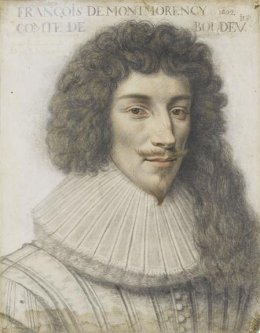
On this date in 1627, the Comte de Bouteville plus his cousin Des Chapelles lost their heads for fighting a duel — ultimately (because of the execution) one of the most notorious duels in French history.

Though this is the duel that everyone knows, Francois de Montmorency-Bouteville (English Wikipedia entry | French) had engaged in 22 such affairs of honor between the tender ages of 15 and 28. Like as not, he was the duellist par excellence in an age where demanding lethal satisfaction was all the rage among devil-may-care aristocratic straplings.

And this, of course, is why he was nominated for condign punishment in Louis XIII’s struggling anti-dueling campaign. One might say he nominated himself.

Dueling, a mano-a-mano vindication of feuds between fops, was an archaic holdover of Burgundian clan violence turned preposterous baroque ritual of conspicuous consociation.

It was also incredibly epidemic in France at this period.

During the reign of Louis’s predecessor Henri IV, 7,000 to 8,000 people are reported to have died in duels, which works out to the suspect rate of one per day for the entire period. Then again, France did have an excess supply of noble progeny whose violent impulses were no longer preoccupied by fratricidal religious warfare.*

Henri IV had tried to ban dueling, even in 1610 executing for lese majeste a couple members of his own guard who defied the ban. Just weeks later, and for no reason connected to dueling, Henri was assassinated. Then-nine-year-old heir Louis XIII was in no position at the time to follow up his father’s policy, and the naughty sport continued to flourish.

“Duels had become so common among the French nobility that the streets of Paris usually served as the field of combat,” according to the Mercure Francois. And as Richard Herr described in his “Honor versus Absolutism: Richelieu’s Fight against Dueling” (The Journal of Modern History, September 1955; this is also the source of all other quotes in this post), they often arose over utterly trivial “slights.”**

Typical was a duel in Lent of 1626 in which Bouteville [i.e., the subject of our post] with two seconds engaged the Comte de Thorigny and his two seconds. The fight was over a dispute between Thorigny and the Marquis de Chalais, who was in prison accused of treason. Bouteville was merely defending the honor of a friend. All six spent the night before the engagement in an inn outside Paris, and in the course of a fairly amicable conversation, they expressed regret that being good friends, they were going to kill each other over another gentleman’s quarrel. But they agreed that they had gone too far to be able to abandon the project without loss of honor. The next day Bouteville killed Thorigny after the latter’s sword broke.

By the 1620s, Louis was old enough to make another run at this intractable elite-on-elite crime wave, and did so with the full encouragement of his famous consigliere Cardinal Richelieu. Depriving the aristocracy of this weird extra-judicial prerogative fit right into the latter’s going campaign to centralize the French state and bring its quarrelsome lords to heel.

What with all those duels he liked to fight, Francois de Montmorency-Bouteville was a great test case. Fighting a public duel in January 1627 — at which his second was slain — made Bouteville a target, and he fled to the Netherlands for safety.

Our fugitive figured he’d send word that a pardon would be appreciated, and everything would blow over like it always did. But Louis was determined to disabuse this type of any privilege to commit public mayhem, and refused to grant Bouteville his absolution.

Honor offended — his default state, to judge by his career — Bouteville vowed angrily to “fight in Paris and in the Place Royale!” This he did on May 12, 1627, slipping back into France for the express purpose of dueling Guy Harcourt, the Marquis de Beuvron. And Bouteville disdained a private fight for the occasion, insisting, as he had declared, on a daytime melee where everyone could see it at the grand new Place Royale (today, Places des Vosges).


At least the setting was operatic. (cc) image from Christophe Alary.

Bouteville and Beuvron fought to a bloodless stalemate and agreed to call it a draw. But Bouteville’s second Des Chapelles mortally wounded Beuvron’s second.

Everyone fled, and while Beuvron made it out of the country, Montmorency and Des Chapelles were nabbed, and condemned to death by the Parlement of Paris for violating Louis’s royal edict against duels.

From the king’s standpoint, this was just about the most egregious possible arrangement of factors.

  • The guy was a serial offender, and he was already a fugitive for his last duel.
  • The fight had produced a fatality.
  • Worst, the whole scene — sneaking back into Paris, fighting openly within the potential view of the sovereign — had been overtly staged to scorn the royal ban.

If Louis intended his decree to mean anything at all, he had to come down hard on this one. “It is a question of cutting the throat of duels or of your majesty’s edicts,” Richelieu summarized.

But as clear-cut as were the case indicia, this was still a hard one for Louis, and even for the usually-ruthless Richelieu. Bouteville was a well-born noble, with powerful friends and family who were also close to the king, and they besieged the royal person with petitions for mercy. A sorrowing but firm Louis had to personally refuse mercy to Bouteville’s tearful wife. “Their loss affects me as much as it does you,” he said. “But my conscience prevents my pardoning them.”

Although the poor wife couldn’t make any headway for clemency, she had the better of Bouteville’s swordsmanship off the field of honor. The doomed duke bequeathed one last rapier thrust to posterity by leaving his widow-to-be pregnant with a posthumous son who eventually generalled French armies to any number of routs of the Dutch in the late 17th century.

And while Richelieu’s memoirs would depict this instance of executive implacability as a decisive turn, Herr argues that it was nothing but a brief interruption. The pernicious hobby was back in all its glory within a couple of years, an evil that even Richelieu could never master. France’s aspired-to absolutism could not reach that ancient and intimate noble right save in the very most exemplary case.

In Dumas’s Three Musketeers, set in 1620s France, D’Artagnan is charged by his father in the opening pages to “[n]ever fear quarrels … Fight on all occasions. Fight the more for duels being forbidden, since consequently there is twice as much courage in fighting.” And indeed, it is by blundering into silly duels (e.g., the “offense” caused by bumping into Porthos while hurrying down the stairs, the latter of whom considers D’Artagnan’s apology discourteously perfunctory) that D’Artagnan becomes the fourth of their cadre … because Richelieu’s men arrive to break up the illegal D’Artagnan-vs.-Musketeer melees, and D’Artagnan joins with his “foes” to defend, all for one and one for all, their privilege as gentlemen to slaughter one another.

The dueling phenomenon faded significantly under Louis XIV, but still not completely: Voltaire almost fought a duel in 1726; the artist Manet dueled a critic in 1870; and YouTube will favor the viewer with a number of 20th century professors and litterateurs settling long-forgotten affairs of honor — like disputes over wartime collaboration after World War II — in ceremonial swordfights. Dueling pistol shooting (at human silhouettes) was even an event at the 1906 Olympics.†

And elsewhere in Germany, Russia, and everywhere Europe touched, duelling persisted with new practitioners into the 19th and even the 20th and even the 21st centuries.

* Also worth noting relative to the casualty numbers: at this time, each side’s seconds also fought in addition to the principals. A move for taking seconds out of the fight eventually prevailed, long before the end (if there has been a real end) of dueling, but in 1627 that time was not yet come.

** Across the Channel at this time, Francis Bacon was making much the same complaint against English duels.

† This event was an “Intercalated Games” falling between the natural 1904 and 1908 Olympiads. It’s an outlier historical experiment during the modern Olympics’ uncertain early years, and though it was officially sanctioned at the time and winners walked away with proper medals, the International Olympic Committee no longer recognizes the Intercalated Games as an official Olympics.

On this day..

1629: Anna Gurren, in the Mergentheimer Hexenprozess

On this date in 1629, the German city of Mergentheim burned its late mayor’s widow for witchcraft.

Anna’s remains: the inventory of the late sorceress’s estate taken by its new owner, the city of Mergentheim.

Witch-hunting was a growth industry for Thirty Years’ War-torn Germany in the late 1620s.

Not long before, a Mergentheim Teutonic knight had been petitioned for help extracting a schoolboy from Wurzburg, where the absentee father feared he was running with a devilish crowd. Once the authorities heard that witchy stuff, all the inhuman gears came to life.

Instead of returning the tyke to his concerned dad, Wurzburg arrested the boy, strongarmed him into admitting his Satanic ties, and burned him at the stake. Nine years old.

That was Wurzburg. But back where the allegation originated, writes H.C. Erik Midelfort, “the discovery in Mergentheim that children might be guilty of witchcraft was to have serious consequences.”

Like a fresh plague outbreak, a witch persecution broke out in Mergentheim and neighboring Markelsheim, with some schoolchildren hounded by inquisitors within a few weeks of their compatriot’s execution over in Wurzburg. From there, it became epidemic all over town. By October 1628, the first witches were shrouded in flames for their neighbors’ edification. Over the course of 1629, the peak year for the Mergentheimer Hexenprozess, 91 humans were put to death as Satanic wizards — not counting those who were tortured to death.

Nor was this strictly confined to the weakest prey, your outcasts and servants.

Our victim today was big game, a wealthy city elite, and she wasn’t the only such. These must have made some kind of hedgerow gossip, but the general hysteria of the place made it dangerous to sustain any public controversy even about the downfall of the recently well-connected.

Midelfort, again, on the very relatable circumstance of a prosperous innkeeper who was a little too incensed for his own good at seeing Anna Gurren die.

Thomas Schreiber had a strong sense of justice. When the trials in Mergentheim had run only two months, he had already lost faith in the judicial procedure. On December 1, 1628 when Martha, wife of Burgermeister Hans Georg Braun, was executed, Schreiber was heard by many persons exclaiming that she had been done a gross injusice. Schreiber even let slip that “King Nero” had also conducted such bloodbaths. Six weeks later Schreiber was again appalled when the extremely wealthy widow of Lorenz Gurren was convicted of witchcraft and executed on January 12, 1629. When attending the execution of the lady, he had the temerity to express amazement over her confesion. The Amtmann Max Waltzen turned to him and said pointedly, “Ha, ha, those who know the devil should not be so amazed.” That kind of talk perturbed Schreiber, and when magistrates began avoiding him, he prepared to flee. During this time he repeatedly denounced the court for its unjust trials and declared that “if anything happens to me, let every pious Christian fear for himself.” He also prayed that “God might preserve everyone from Neuenhaus [the jail and torture chamber], for even the most pious if put in there would be found to be a witch.” The trials, he insisted, were bloodbaths, and the magistrates were out to “wash their hands in my blood.”

Schreiber fled town on February 1, having heard that people had started denouncing him. But he didn’t make it long.

He, too, was dead by the end of May — as a confessed (just like he predicted) witch.

On this day..

1628: John Felton, assassin of the Duke of Buckingham

The rack, or question, to extort a confession from criminals, is a practice of a different nature: this being only used to compel a man to put himself upon his trial; that being a species of trial in itself. And the trial by rack is utterly unknown to the law of England; though once when the dukes of Exeter and Suffolk, and other ministers of Henry VI, had laid a design to introduce the civil law into this kingdom as the rule of government, for a beginning thereof they erected a rack for torture; which was called in derision the duke of Exeter’s daughter, and still remains in the tower of London: where it was occasionally used as an engine of state, not of law, more than once in the reign of queen Elizabeth but when, upon the assassination of Villiers duke of Buckingham by Felton, it was proposed in the privy council to put the assassin to the rack, in order to discover his accomplices; the judges, being consulted, declared unanimously, to their own honour and the honour of the English law, that no such proceeding was allowable by the laws of England.

–William Blackstone, Commentaries on the Laws of England, vol. iv (via Harper’s)

Although the jurisprudence of 17th century England with its proscription of legal torture* still stacks up favorably next to that of Berkeley law professors, it certainly did not stand in the way of assassin John Felton‘s execution on this date in 1628.

Felton, an army officer passed over for promotion, stabbed to death nobby royal favorite George Villiers, Duke of Buckingham at Portsmouth — a private grievance fused to a widespread public one. Reams of laudatory verse churned out in the two months between crime and punishment suggest the popular opprobrium for the duke.**

Or you, late tongue-ty’d judges of the land,
Passe sentence on his act, whose valiant hand
Wrencht off your muzzels, and infranchiz’d all
Your shakl’d consciences from one man’s thrall?
But O! his countrie! what can you verdict on?
If guiltie; ’tis of your redemption.

Felton’s victim, the Duke of Buckingham — portrayed in 1625 by Rubens.

Villiers, “handsomest-bodied” scion of the minor gentry, had parlayed his comeliness into power as the favorite (and possibly the lover) of King James I. He had, as Alexandre Dumas put it in The Three Musketeers (in which adventure Buckingham is an important character) “lived one of those fabulous existences which survive, in the course of centuries, to astonish posterity.”†

Buckingham latched himself to the king’s 20-something son and heir Charles I and became a dominant influence in foreign policy as well as wildly unpopular in England. He raised Protestant hackles with Machiavellian statecraft like angling for a Spanish queen and aiding the French against the Huguenots, and since he exercised a share of the royal power he vigorously upheld the rights of the crown as against those of the commons. An opponent once compared him to Sejanus.

Indeed, Buckingham helped the youthful Charles, king since March of 1625, set the tetchy tone for his relationship with Parliament that would define his rule and ultimately cost the monarch his own head. When Parliament demanded Buckingham “be removed from intermeddling with the great affairs of State” as a condition for coughing up any more money, Charles haughtily dissolved Parliament rather than give up his favorite.

That forced the king into sketchy expedients like the “forced loan” and, when the money disputes continued after Buckingham’s death, the king’s eventual legislature-free Personal Rule that set up the Civil War.

So one can see how the sudden 1628 murder of this resented courtier, to whom was imputed every fault and abuse of Charles himself, would have been celebrated. “Honest Jack” — the assassin’s widely-honored nickname — was likewise credited with every perceived virtue of the Parliamentarian party. Juridically, the man was doomed — but in the popular eye,

[t]he passage of Felton to London, after the assassination, seemed a triumph. Now pitied, and now blessed, mothers held up their children to behold the saviour of the country; and an old woman exclaimed, as Felton passed her, with a scriptural allusion to his short stature, and the mightiness of Buckingham, “God bless thee, little David!” Felton was nearly sainted before he reached the metropolis. His health was the reigning toast among the republicans.

In fact, the man who had recently tutored future literary giant (and future Cromwellian agent) John Milton was sentenced by the Star Chamber have an ear cut off for drinking Felton’s health. (The sentence was remitted thanks to some pull with Archbishop William Laud.)

While he’s sometimes described — or dismissed — as merely a disgruntled careerist, the assassin’s own ideological commitment ought not be downplayed. Whatever Felton’s personal pique, the assassination was unambiguously political: our killer had returned from war wounded and melancholy and proceeded to marinate in the era’s anti-monarchical currents. In time, Felton came to understand — surely in concert with many of his countrymen now forgotten by time — that there was a greater good to be served by the sin of murder.

He had left behind in his trunk a few propositions that underscored his state of mind: “There is no alliance nearer to any one than his country” and “No law is more sacred than the safety and welfare of the commonwealth.” He justified himself at trial in similar terms, and did so without desiring to escape the extremities of the law that his crime demanded.

Felton had really expected to be killed in the act of the assassination himself. To that end, he had left a note pinned in his hat that is as good an elegy for him as any a republican ballad. “That man is cowardly and base and deserveth not the name of a gentleman that is not willing to sacrifice his life for the honor of his God, his king, and his country. Let no man commend me for doing it, but rather discommend themselves as to the cause of it, for if God had not taken away our hearts for our sins, he would not have gone so long unpunished.”

While Felton played his part in the generations-long struggle to subordinate king to parliament, the most immediate beneficiary of this affair was not so much the Commons as it was the noble rival who usurped the late Buckingham’s power — the Earl of Strafford.

* Certain though we are of the human rights commitment of Felton’s prosecutors, the man himself made sure of it by dint of a deft bit of interrogatory jujitsu. Menaced with the prospect of torture, he cheerfully resigned himself to it — “Yet this I must tell you by the way,” he added. “That if I be put upon the rack, I will accuse you, my Lord of Dorset, and none but yourself.”

That’s the way to convince judges not to torture you.

** An entirely less negative remembrance commemorates Buckingham and “accursed” Felton at the Portsmouth Cathedral.

† Felton also appears in The Three Musketeers, committing the murder of Buckingham at the instigation of the seductive fictional villain Milady de Winter just days before the musketeers execute Milady herself.

On this day..

1629: John Dean, boy arsonist

(Thanks to Meaghan Good of the Charley Project for the guest post. -ed.)

On or about this day in 1629, one John Dean, described in court documents as “an infant between eight and nine years,” was hanged in Abingdon, England for setting fire to two barns in the nearby town of Windsor.

According to Historia placitorum corone: The history of the pleas of the crown, Volume 1 by William Axton Stokes and Edward Ingersoll, this juvenile felon was indicted, arraigned and found guilty all on the same day, February 23, “and was hanged accordingly.” The actual date of his execution is not known, but it can’t have been long afterward. The wheels of British justice ground very quickly in those days, though not so fine.

The age of criminal responsibility in England at the time was seven years old. (It was later raised to eight, and in 1963 to ten, where it remains; there have been calls to raise it again.) Accordingly, anyone seven years or older could be charged with a crime and face the same penalties as someone seventeen or forty-seven — including the death sentence.

This does not mean that vast numbers of children were executed, however; quite the contrary. As Capital Punishment U.K. notes, “Death sentences were certainly routinely passed on 7 -13 year olds but equally routinely commuted. Girls were only typically hanged for the most serious crimes whereas teenage boys were executed for a wide range of felonies.”

The same source notes that little John Dean was probably the youngest child ever executed in England.

For reasons lost to history, he was not given the usual commutation: although there is no mention that anyone was hurt or killed in the fires, the judge found that John had “malice, revenge, craft and cunning,” and refused to recommend a reprieve. Perhaps the boy had a prior criminal record.

Thus did John Dean secure a footnote in history; were it not for his death no one would remember him today. Somehow, I doubt he would have thought it was worth it.

On this day..

1622: Not quite Squanto (Tisquantum), Pilgrim befriender

On this date in 1622, or very close to it, the Patuxet Native American Tisquantum (better known as Squanto) was about to be yielded by Plymouth Colony Governor William Bradford to Wampanoag chief Massasoit for immediate execution … when the unannounced appearance of a strange ship fortuitously saved him.

Squanto is most famous as the Indian godsend who saved the Mayflower Pilgrims at the Plymouth Bay colony from starvation by teaching those pious wayfarers how to live off the land in the New World.

In that capacity, he made possible (and participated in) the “First Thanksgiving” harvest gorger in 1621 that figures as the antecedent of the modern American holiday. Our day’s principal has therefore been portrayed on the stage by generations of schoolchildren from Cape Cod Bay to California.

But this was only the tail end of one of the most remarkable lives in history.


Photo of Tisquantum bust by N. Ayad of Cupids Cove Chatter. Photo was taken courtesy of the Pilgrim Hall Museum, Plymouth, MA, United States.

As a youth, Squanto was kidnapped from his native soil by English explorer George Weymouth, who sold him into slavery in Europe. Squanto wound up in London in some sort of forced-labor capacity, before hitching a ride back to the Americas with Captain John Smith — the Pocahontas guy.

It was thanks to this improbable abduction and return trip that Squanto was available to materialize out of the woods, speaking the Queen’s English on this alien continent, in the nick of time to save the Plymouth immigrants from disaster.**

However, because Squanto was a real person and not a Disney character, he began exploiting his privileged intermediary position for his own advantage.

According to Plymouth Gov. William Bradford’s chronicle Of Plymouth Plantation,

Squanto sought his own ends and played his own game, by putting the Indians in fear and drawing gifts from them to enrich himself, making them believe he could stir up war against whom he would, and make peace for whom he would. Yea, he made them believe they kept the plague buried in the ground, and could send it amongst whom they would, which did much terrify the Indians and made them depend more on him, and seek more to him, than to Massasoit. Which procured him envy and had like to have cost him his life; for after the discovery of his practices, Massasoit sought it both privately and openly, which caused him to stick close to the English, and never durst go from them till he died.

Seeking Squanto’s life both privately and openly, Massasoit sent messengers to the Plymouth colony requesting the Machiavellian diplomat’s return in accordance with the colony’s treaty arrangements with the Wampanoag.

Bradford ducked and dilated, not wanting to give up this valuable asset, but the precarious colony also needed the amity of its Indian neighbors.

Massasoit remained insistent, according to the account of Edward Winslow,

entreating [Bradford] to give way to the death of Tisquantum who had so much abused him … [Massasoit] sent his own knife and [two messengers] therewith to cut off his head and hands and bring them to him

Bradford was on the point of yielding to this demand when a strange boat appeared unannounced — and the guv hit the “pause” button on everything.

he would first know what boat that was ere he would deliver him into their custody (not knowing whether there was a combination of French and Indians). Mad with rage and impatient at delay the messengers departed in great heat.

The delay turned out to be permanent … which for Squanto was only a few more months before he caught ill† and died later in 1622.

The ship that quite unknowingly bought Squanto this extra purchase on life had nothing at all to do with the drama unfolding between Bradford and Massasoit: it was the Sparrow, the advance party of the coming Wessagusset (or Weymouth) colony which would plant itself adjacent to the Plymouth settlers and completely crash and burn.

And the Pilgrims and the Indians lived happily ever after.

* This site asserts May 31 was the date that the Sparrow came ashore at Plymouth. Most sites are slightly less specific, noting only that the ship arrived in very late May.

** Among Squanto’s good deeds for the fledgling colony was tracking down a boy who got lost in the wilderness. The boy was John Billington, the eponymous son of the first man hanged in the Plymouth Colony.

† Some suspect that Squanto’s “illness” wasn’t so accidental, and the frustrated Wampanoag chief simply dispensed with the diplomatic rigmarole and poisoned him off.

On this day..

1623: Amboyna Massacre

On February 27,* 1623, the Dutch East India Company beheaded twenty who had been waterboarded into confessing to a terrorist plot.

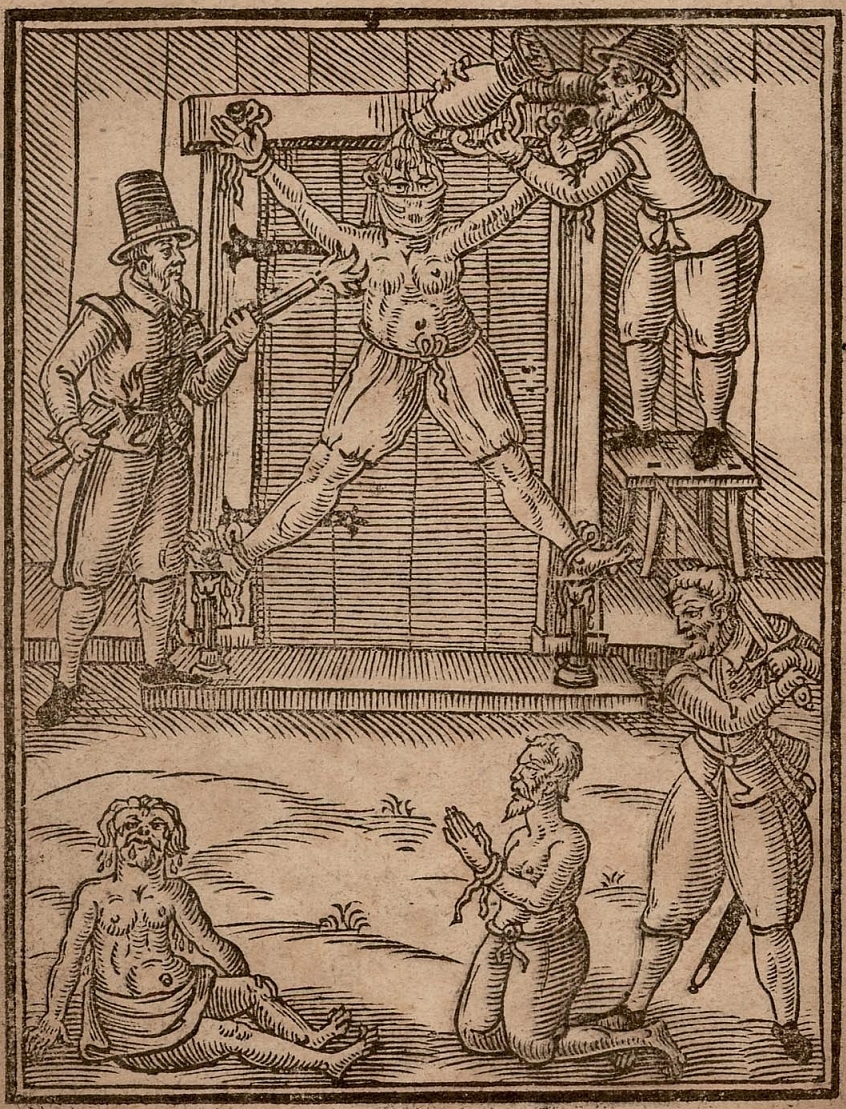
English prisoner suffering “waterboarding” faux-drowning torture, published under the name “A true relation of the unjust, cruell, and barbarous proceedings against the English at Amboyna in the East-Indies 1624”.

The torturers “poured the water softly upon his head until the cloth [wrapping his head] was full, up to the mouth and nostrils, and somewhat higher, so that he could not draw breath but he must suck in all the water.” More nasty description.

(cc) Image from Flickr | BiblioOdyssey

Posh Spice

As in modern times, this scenario originated with resource competition in the Muslim world … in this case, competition for spice, in Indonesia.

European colonialism had pitted the Dutch East India Company against its British counterpart on the archipelago, both scrabbling after the lucrative trade in cloves and pepper, with garnishes of nutmeg, cinnamon, mace, and ginger.

The two rival powers had, as we lay our story, recently come to a tense truce, dividing the commerce between them — and swapping mutual accusations of violating that pact. The arrangement basically gave the Dutch a bigger slice of the pie, so we’ll find them when the cloves hit the fan having the balance of power on their side.

Terrorists

We’re going to oversimplify to set the scene.

On Ambon Island, one of the very “Spice Islands” (i.e., the Moluccas) — at the Dutch-controlled fortification of a trading post also shared by the English — the Dutch merchant-governor Herman van Speult heard that a Japanese mercenary had asked about the Dutch fortifications.

The security-conscious van Speult ordered that unfortunate soldier interrogated under torture.

As tends to happen when the interrogators in such a case are convinced of a ticking time bomb situation, the torture uncovered a ticking time bomb situation.

The mercenary got the Dutch to stop burning and drowning him by “revealing” a highly implausible** English plot to seize the Dutch fort, with 20 guys or so and no prospect of imminent outside aid. Wouldn’t you know it: when the supposed confederates named by the mercenary were similarly tortured, they too admitted the plot. Van Speult’s English opposite number, Gabriel Towerson, was one of them.

The Amboyna Massacre followed anon, with Towerson and nine other British East India Company employees beheaded, along with nine Japanese mercenaries and one Portuguese. (The latter ten worked for the Dutch East India Company, not the British. A fifth column!)

They went to their deaths protesting their innocence, and many smuggled out written recantations to that same effect: “tortured … with that extream Torment of Fire and water, that Flesh and Blood could not endure it, and we take it upon our Salvation, that they have put us to Death Guiltless.”

Anger in the English Street

That last quote comes from Karen Chance, “The Amboyna Massacre in English Politics, 1624-1632,” in Albion: A Quarterly Journal Concerned with British Studies (Winter 1998).

As the title of that piece suggests, the Amboyna Massacre outraged Towerson’s countrymen and -women once word finally made it back to the mothership. (In addition to the torture/wrongful execution dimension, the legal authority of the Dutch trading concern to impose judicial punishment on their English counterparts was questionable at best.)

English demands for satisfaction against the perpetrators continued to complicate Dutch-English relations into the reign of Charles I and beyond. Even Oliver Cromwell required, as the price of peace for the First Anglo-Dutch War in the 1650s, punishment of any surviving offenders. (Which was apparently nobody at all.)

And still later, the burgeoning British Empire’s propaganda arm reached for the Amboyna narrative to justify seizing New Amsterdam on the grounds that the Dutch had attempted to spring a massacre on English settlers — “their Amboyna treacherous Cruelty extended itself from the East to the West Indies, and pursued thus the straight channel of Dutch blood”.

As for the trade-jockeying: the Netherlands’ commanding position in Indonesia ultimately squeezed the English out.** But don’t fret for Old Blighty: she turned attention to gobbling up India, and made a lot more bank than did the Dutch spice racket.

* February 27 was the date according to the Julian calendar in use at this time by the British. By the Gregorian calendar the Dutch were using, the massacre took place on March 9.

** For more on both the fanciful nature of the supposed plot, and the economics of the East Indies trade as it unfolded in the 17th century, see D.K. Bassett, “The ‘Amboyna Massacre’ of 1623”, Journal of Southeast Asian History, September 1960.

On this day..

1624: Marco Antonio de Dominis, posthumously

On this date in 1624, the recently-deceased body of unscrupulous Croatian prelate Marco Antonio de Dominis was burned at Rome’s Campo dei Fiori, along with all his manuscripts.

Hypothesizing

As a precocious young man Dominis taught mathematics, rhetoric and philosophy; in 1611, he produced a scientific treatise on the formation of rainbows through light refraction, De radiis visus et lucis. A century later, Isaac Newton would write* in Opticks that

it is now agreed upon, that this Bow is made by Refraction of the Sun’s Light in drops of falling rain. This was understood by some of the Antients, and of late more fully discover’d and explain’d by the famous ANTONIUS DE DOMINIS Archbishop of Spalato.**

More opportune was his advocacy of a moon-induced tide, which idea his contemporary Galileo erroneously scorned.†

Though he makes a “great men of Croatian science” list, the scientific dabblings are not what the man was chiefly known for.

Apostatizing

A caricature of Dominis made an appearance, around the time of the man’s bodily demise, in Thomas Middleton’s play A Game at Chess, as the “fat bishop” who switches sides from black to white and back.

And that’s the man’s legacy, in a nutshell.

Elevated to Bishop of Senj, and then Spalato, he got the Inquisition after him and raised dust for England and the Anglican church in 1616.

They called you great-bellied-Doctour, made fat under Antichrist; and some there were also that sayd, that before you ranne away from the Pope, you got your owne Neece with child, and that feare to be punished for it, made you trudge away with your great load of flesh in such hast.

John Floyd

In Albion the absconded archbishop settled into a fine tenured appointment on the king’s dole to denounce the papists like only a convert can do. As A Game at Chess would indicate, he also earned fame for his avarice and gluttony, and who knows how many other deadly sins.

The rep for opportunism grew when Dominis defected back to Holy Mother Church upon the election of an old intimate as Pope Gregory XV. His well-worn welcome in England as anti-papal vituperator had, too, become complicated by the progress of the proposed Spanish Match to wed Prince Charles to Europe’s leading Catholic monarchy — an ultimately abortive project, but nearing the acme of its fortunes at the time Dominis returned to Italy.

(The Spanish Match is the protracted political and diplomatic dance whose progress A Game at Chess allegorically tells. Dominis arranged his return to the Catholic fold through the Spanish ambassador in England, making the former a fit character for the playwright to project the double-dealing and skullduggery of the rivals’ negotiations.)

Theosophizing

Unfortunately for our unprincipled Renaissance man, Gregory himself yielded up the ghost almost immediately and left the Church in the hands of the aggressive Urban VIII. (Urban is the guy who forced Dominis’s old tidal rival Galileo to retract heliocentrism.)

Dominis — who seems to have been an ecumenical guy, maybe just a fancy way of saying he could accommodate any doctrine amenable to his ambition‡ — was evidently still trafficking with the unorthodox even after he returned, recanted, and renounced. (Renunciation in English | Latin).§

One contemporary reportedly said of Dominis

he was a malecontent knave when he fled from us, a railing knave while he lived with you, and a motley parti-coloured knave now he is come back.

The Inquisition imprisoned Dominis, and his death in Castel Sant’Angelo was not sufficient to end heresy proceedings against such as he left behind.

[H]is body was put into a well-pitched coffin, and that into another greater than it … until such time as the cause of the said Archbishop, still depending, should be determined by the Sacred Congregation; that according to their sentence, whatever justice did require, might be done upon him.

The sentence being framed and ready to be put in execution, the said body was … taken the twentieth of this present month of December, forth from the convent where it was left, and carried to the church of Minerva, and there laid upon a table in an eminent place, together with his picture and a little sack of books which he had printed; and where it stood all the night.

The next morning … the most illustrious and most reverend lods cardinals, supreme inquisitors, with many others … proceeded unto a definitive sentence, which was, to declare him unworthy of the favour of the Holy See apostolic, to deprive him of all his honour, benefit, or dignity, confiscate his goods, and give him over to the secular powers, as de facto they then gave him over, that he and his picture, together with the books he had written, should be burned …

INSCRIPTIO

MARCUS ANTONIUS DE DOMINIS,

LATE ARCHBISHOP OF SPALATRO,

Most impiously bent his style against the Church of God, which had extraordinarily well deserved of him; having wounded her and stabbed her through, he so left her without cure, and wretchedly betook himself to the English altars, that thence the swine might the more securely gruntle against the Pope and Catholics. Returning home again, but no convert, his apostatic spirit he forsook not. He died (and the voice of a penitent man would he had not uttered) impenitent. (Source)

* Dominis is still today sometimes credited as the first to explain both primary and secondary rainbows, in preference to Descartes, who nailed them 20 years later. According to The Rainbow Bridge: Rainbows in Art, Myth, and Science, that gave far too much credit to Dominis for either originality or accuracy, and may have been written intentionally to undercut Descartes. (R.E. Ockenden made the same claim about Newton’s exaggeration in “Marco Antonio de Dominis and His Explanation of the Rainbow” in the not-exactly-current Dec. 1936 Isis).

Maybe Newton explicator and Executed Today guest blogger Thomas Levenson of the Inverse Square blog could refract some light on this.

** Spalato, i.e., Split, the scenic Dalmatian city where the great Roman Emperor Diocletian famously retired to tend his cabbages.

† “Lately,” Galileo sniffed, “a certain prelate has published a little tract wherein he says that the Moon, wandering through the sky, attracts and draws up toward itself a heap of water which goes along following it.” As cited in Understanding the Heavens: Thirty Centuries of Astronomical Ideas from Ancient Thinking to Modern Cosmology.

There’s an interesting treatment of Galileo’s stubborn adherence to a wrong idea about the tides in a history-of-ideas context in “Galileo’s Claim to Fame: The Proof That the Earth Moves from the Evidence of the Tides,” by W. R. J. Shea in The British Journal for the History of Science, Vol. 5, No. 2 (Dec., 1970)

‡ Though he’s frequently read as a mere trimmer, it’s possible to give Dominis a much more sympathetic take. King James VI and I and the Reunion of Christendom argues that

it is difficult to explain his movements on this basis alone. Both in his journey to England and in his journey to Rome he took great risks, and in both cases gave up a reasonably secure position for one much less certain. Hacket, in the late seventeenth century, saw him not only as a place-seeker but as a man obsessed with an idea: “He lived and died with General Councils in his Pate, with Wind-Mills of Union to concord Rome and England, England and Rome, Germany with them both, and all other Sister-Churches with the rest, without asking leave of the Tridentine Council.” … [he] died for an ecumenical ideal which is only now, perhaps, beginning to be understood and appreciated … [and his] move [back to Rome] was the desperate attempt of a lonely, egotistical, and gifted man to find personal and spiritual fulfillment and, at the same time, to help to restore unity and coherence to a Europe being torn apart by religious conflict and war.

§ The Catholic Encyclopedia has Dominis re-relapsing when his pension expired along with Pope Gregory.

On this day..