1949: Jake Bird

(Thanks to Meaghan Good of the Charley Project for the guest post. -ed.)

Contrary to what all the slasher films would have you believe, an ax does not make a very good murder weapon. Axes are big. They are heavy. They are difficult to conceal. When used they create a big mess. And if you are caught with one, it’s hard to come up with a suitably innocuous explanation for it.

Nevertheless, this was Jake Bird’s weapon of choice on October 30, 1947, when he broke into Bertha Kludt’s home and killed her and her seventeen-year-old daughter, Beverly June.

Perhaps if he had used a different weapon, things would have turned out differently. As it was, the two women’s screams — and that’s another problem with the ax: unless you can wield it like Gimli, the victim is going to survive the first blow and start hollering — attracted two police officers, who apprehended Bird after a foot chase.

This excellent History Link article provides a thorough account of Bird’s life and crimes. 45 years old at the time of his arrest, he was a drifter and a ne’er-do-well with an extensive criminal record. He’d spent a third of his life in prison for various offenses. Bird openly confessed to the Kludt killings, saying the murders were the result of a botched burglary.

One of the police officers who testified at the trial admitted he beat the daylights out of Bird after his arrest. Naturally, the defense moved to throw out the murder confession on the grounds that it was obtained under force, but the judge ruled that the police brutality and Bird’s statements were “unrelated” and so the confession was admitted into evidence.

This was the attorney’s only attempt to defend his client; he called no witnesses and presented no evidence at the trial.

In all fairness, it must be said that Bird was spattered with gore when he was arrested, they found his fingerprints in blood at the crime scene and on the ax, and he’d left his shoes at the Kludt house. So the confession didn’t figure to be exactly decisive.

This would be a fairly unremarkable murder case, but shortly after his arrival on Death Row, Bird suddenly discovered he had an excellent singing voice. For the next several months he detailed 44 murders from all across the country which he claimed he’d committed during his wanderings. Most of his victims were women.

Bird’s claims, if true, would make him one of America’s most deadly serial killers, right up there with the much more famous Ted Bundy and the Green River Killer, Gary Leon Ridgway. One inevitably wonders if all of his statements were genuine. Henry Lee Lucas, another violent drifter much like Bird, admitted to hundreds of homicides and captivated police from all over the nation before it was discovered that many of his confessions were lies.

Police in several states did find Bird credible, though. Bird was calm and ready for his hanging, which went off without a hitch. He willed his estate, valued at $6.15, to his appeals attorney.

On this day..

1946: Public Execution in Debica

On this date in 1946, market day in the southeastern Polish town of Debica, three captured fighters* from the anti-communist Freedom and Independence (WiN) movement were publicly hanged.

This salutary, and surprise, hanging was a nasty public message during the dirty post-war war to consolidate communist authority in Poland.

The message, however, was not exactly meant for a world wider than Poland itself, so the fact that it was captured in a grainy photograph snapped by WiN agent Józef Stec and subsequently smuggled out to the West was not at all to the liking of Polish authorities.

According to a WiN eyewitness report also presumed to have been filed by Stec,

First the MO [local militia], the UB, and the military occupied the execution square holding their machine guns ready to fire. Then, a car came with uniformed individuals who placed the noose on the hook. After a short time the same car brought three condemned men in white shirts. Their hands and legs were tied with barbed wire. A Jewish prosecutor read the sentence and passed the condemned into the hands of the executioner. Before the execution, one of the condemned yelled: “Long live the Home Army. Long live General Anders and General Bor-Komorowski. Down with the commies. Brothers persevere or you’ll die like us. I swear before God that I have never been a bandit [as communist authorities designated them]. I am dying for the Motherland. Lord forgive them [the executioners] because they know not what they are doing.

* The victims were Józef Grebosz, Józef Kozlowski, and Franciszek Noster, according to the 2003 monograph After the Holocaust: Polish-Jewish conflict in the wake of World War II, by Marek Jan Chodakiewicz. This monograph is also the source for Stec’s quoted report on the hanging.

On this day..

1941: Not Shaike Iwensky, “standing in line to be killed”

(Thanks to Meaghan Good of the Charley Project for the guest post. -ed.)

On this day in 1941, seventeen-year-old Shaya “Shaike” Iwensky came within seconds of being shot by the Einsatzgruppen outside the city of Daugavpils, Latvian SSR. Sheer dumb luck — and a slight miscalculation by the Germans — saved his life.

Shaike was born and raised in Jonava, Lithuania and fled to Daugavpils with his brother when the Germans invaded the Soviet Union in June 1941. On June 29, he was arrested along with the other Jewish male adults in town. His brother, who was fifteen years old, was arrested alongside him, but released the same day because of his age.
For the next week and a half, Shaike was held in a crowded prison cell, fed almost nothing, and forced to work during the day.

On July 8, he noted “a change for the worse in our guards, an extraordinary meanness … In my worst fears, I could not have conjured up the kind of hell in which I now found myself.”

That day he and his comrades were stuck in a truly Sisyphean ordeal: forced to roll rocks up a hill, three men to a rock. They kept losing their grip and the rocks would slide back.

That night some other prisoners told him they had been forced to dig huge ditches, which were covered in chlorine.

The next day, the eighteenth day of Operation Barbarossa, Shaike found out what the ditches were for:

A series of shots … a short interruption and again shots … and again … It wasn’t long before we got the confirmation of what we’d been suspecting all along. One of the men in a neighboring cell stuck his head in the doorway, and said, “They are killing Jews. From the washroom window someone saw people lined up in the yard. They are from the first floor.”


Though this testimony specifically concerns a different massacre, in November of 1941, it gives a sense of the environment.

A couple of hours later, Shaike and the others from his part of the prison were ordered to leave and take all their belongings. They were marched down to the basement and made to empty their pockets into the “knee-deep rows of wallets, documents, pictures, watches, trinkets worthless to anyone else.” Then they were marched into the yard and formed into groups of twenty. Hoping to at least die with people he knew, Shaike stuck together with his old friends from Jonava.

The blue sky was almost clear, with only here and there a wisp of cloud. I looked up, and the thought hit me hard: I will never see the sky again.

It is said that, when a person faces death, his whole life flashes before him. But my thoughts were disjointed, disorderly; they tumbled through my mind rather like the flimsy clouds above, forming, changing shape, disappearing and reappearing … Catching myself picking at a hangnail, I thought, How silly. In a few minutes it will make no difference at all …

It occurred to me that reality was often quite unlike what we expect it to be. People standing in line to be killed didn’t look very different from those waiting to buy bread. Their faces, their eyes betray nothing of what is going on in their minds. People stand in line under the hot sun, they move ahead, then their times comes to die, and it is over.

Shaike and his friends waited in line for over two hours in the heat. He had not thrown out his handkerchief and was glad to have it to wipe the sweat from his face. Finally he and his group of twenty arrived at the gate … but when the soldiers came out, they didn’t escort them to the ditches. Instead they ordered everyone to turn around and march back to the prison.

That evening, the prisoners were ordered out again and taken to the killing ground, and then they realized what had happened: the Nazis had spared them because they had run out of ditches. The Jews had to cover the mass graves with earth, stamping down on the bodies and packing them together, and also to dig new trenches, presumably for themselves, until evening when they were sent back to the prison again.

That night, Shaike and some of his friends hid in an empty cell under blankets. The Nazis didn’t find them the next morning when they ordered the survivors out to get shot. They hid in the cell for two days before they were caught. Fortunately the Latvian guards who found them didn’t realize who they were, and merely beat them and tossed them in with some prisoners who’d arrived that same day.

Eventually, Shaike was released from the prison and taken to the Daugavpils Ghetto. He would eventually escape from there and spent some time living in the woods with a Soviet partisan detachment, going back and forth between there and the ghetto. Finally he was captured and taken first to the Stutthof Concentration Camp, then to Dachau. There he was liberated by Americans on April 29, 1945. At twenty years old, he was the sole survivor of his family.

Shaike moved to the United States in 1948 and changed his name to Sidney Iwens. He wrote a book about his experiences, titled How Dark the Heavens: 1400 Days in the Grip of Nazi Terror. Sidney Iwens died in Florida in 2010, at the age of eighty-four.

On this day..

1945: Dr. Achmad Mochtar, quiet hero

On this date in 1945, Japanese forces occupying Indonesia cut off Dr. Achmad Mochtar’s head for a medical experiment gone horribly awry.

Officially, Dr. Mochtar had been responsible for a supposed vaccine whose administration killed hundreds of Indonesian forced laborers.

Latter-day research, however, indicates that it was the Japanese military who administered the vaccine (Indonesian link), an experimental tetanus-cholera-typhoid-dysentery combination shot, getting a trial run before it was administered to Japan’s own soldiers. When this drug proved lethal to most of its recipients, Mochtar and his staff at the Eijkman Institute were arrested in 1944 and subjected to harrowing torture.

According to Jakarta-based British researcher Kevin Baird, Mochtar agreed to take the fall for the experiment in exchange for the release of his colleagues.

“We think of this sort of heroism as the reserve of military men and not learned intellectuals,” Baird told the Guardian. “Achmad Mochtar was not only a hero of Indonesia, but a hero of science and humanity.”


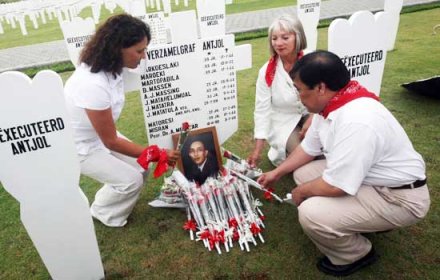
Present-day Eijkman Institute director Sangkot Marzuki (right), and two descendants of the executed man, Monique Mochtar (left) and Jolanda Mochtar (center) lay flowers at a 2010 memorial event after the doctor’s location in a mass grave was discovered. Achmad Mochtar’s name also graces a Sumatran hospital.

On this day..

1943: Marianne Elise Kurchner condemned for a joke

(Thanks to Meaghan Good of the Charley Project for the guest post. -ed.)

Sometime in the summer of 1943 in Nazi Germany, a young woman from Berlin named Marianne Elise Kürchner was guillotined for telling a joke.

Kürchner, who worked at an armaments factory, told the following joke to a coworker who denounced her:

Hitler and Göring are standing atop the Berlin radio tower. Hitler says he wants to do something to put a smile on Berliners’ faces. So Göring says: “Why don’t you jump?”

Not exactly a side-splitter. More like a neck-splitter: making jokes at Hitler’s expense was, in theory at least, a capital crime.

Mind you, most people who made nasty wisecracks about the Nazis faced no consequences at all. They were rarely denounced, and if they did come before a court they were usually given a warning, or at most a few months of “re-education” in Dachau.

The Nazis did occasionally use sedition as an excuse to arrest and execute people who’d gotten on their bad side for one reason or another, but ordinary Germans initially had little to fear.

However, as the tide of war began to turn against Germany, the punishments for sedition became ever more severe.

Marianne was called up before the People’s Court, whose president, Roland Freisler, was famous for both his long raving speeches berating defendants, and his death sentences. She admitted to making the joke but said she hadn’t been herself at the time, feeling bitter about the recent loss of her husband at the front.

Freisler would have none of it. In fact, he considered Marianne’s status as a war widow to be an aggravating factor. “The People’s Court,” Rudolf Herzog said of this case in his book Dead Funny: Humor in Hitler’s Germany, “made it a point of pride to take no account of individual suffering.” In his ruling, Friesler wrote:

As the widow of a fallen German soldier, Marianne Kürchner tried to undermine our will to manly defense and dedicated labor in the armaments sector toward victory by making malicious remarks about the Führer and the German people and by uttering the wish that we should lose the war … She has excluded herself from the racial community. Her honor has been permanently destroyed and therefore she shall be punished with death.

The People’s Court’s judgment was rendered on June 26, 1943. Marianne lost her head shortly thereafter.

On this day..

1945: 8 American flyers at Fukuoka

On this date in 1945 — morning after a devastating U.S. air raid that destroyed much of Fukuoka — eight previously-captured American airmen* were summarily executed there in retaliation.

In a precedent that dated back to the Doolittle raids, Japan officially considered as a prospective war criminal any enemy airman who could be connected to indiscriminate bombing. Tokyo didn’t follow this logic to the point of executing all downed Americans — indeed, late in the war, beleaguered Japanese civilians became increasingly hostile towards the government for allowing excess legalism to stand in the way of exacting some satisfying revenge for the cities burning under American bombs — but it did execute some, and it had sanctioned legal theorems that could have accommodated quite a bit more bloodletting.

Finding Tokyo short of prison space, the government ordered on May 1, 1945, that the various armies should no longer send to the capital any downed airmen they captured. In the chaos of the war’s last months, this would create the context for local commanders at the Western Military District in Fukuoka to put those legal theorems to seriously nasty use.

Four captured airmen held in Fukuoka were stuck in an indeterminate judicial process which the army realized was going nowhere slowly. The others were just plain underfoot. Over the period of May-June, between a couple of ambiguously-worded orders and the officers’ annoyance at having to divert scarce resources to these captives, an understanding formed if “the air raids increased and conditions became more chaotic, the prisoners would be executed without a trial.”

Well, as U.S. papers exultantly reported on June 20,

About 3,000 tons of … incendiary bombs … were released by the B-24s from low level starting about three a.m. … The three cities [Fukuoka, Toyotashi and Shizuoka] were tasting for the first time the bitter flames of war, roaring over factories, shops and thousands of congested homes.

Timothy Lang Francis, whose “‘To Dispose of the Prisoners’: The Japanese Executions of American Aircrew at Fukuoka, Japan, during 1945” from the November 1997 Pacific Historical Review traces the confluence of factors that made possible this day’s executions, describes the fate that was unfolding for Fukuoka’s eight captive airmen at about the same time those words were going to press.

All were blindfolded and had their hands tied in front. Several swords were obtained from the Legal Section. [Yusei] Wako** then told the twenty or so assembled Japanese that, “in compliance with the Commanding General†’s orders, we were going to execute the plane crash survivors.” One officer, Lt. Michio Ikeda of the Medical Section, volunteered himself, and Wako ordered Probationary Officer Tamotsu Onishi, since he was skilled in kendo, to assist him as a third executioner. Sato watched the proceedings from one side.

The first flyer was brought to the edge of the pit and made to sit on his haunches. Wako then ritually washed one of the swords and stood behind the prisoner, slightly to the left. Raising the sword above his right shoulder with both hands, Wako brought it down on the flyer’s neck. “Both the body and head fell into the pit,” remembered Wako; “I washed my sword and ordered the guard to bring another flyer to the pit. I killed this flyer exactly the same way I had killed the first one.” Onishi then executed a third prisoner in the same manner.

In the pause that followed, Lt. Kentaro Toji, an officer attached to Western Army Headquarters, approached Sato. According to his pretrial affidavit, Toji said to Sato, “My mother was killed in the air raid on Fukuoka this morning, and I think it would be fitting that I be the one who execute these American flyers.” Sato told him to wait while Wako ordered Ikeda to execute the fourth flyer. Toji, after borrowing a sword from Onishi, beheaded the last four prisoners. The pit was then filled with dirt.

This is all well and good, but Tokyo’s orders to its armies had been to do the juridical legwork on these cases themselves — and not just to summarily kill prisoners. So, in a bit of ex post facto bureaucratic butt-covering, the Western District Army’s legal section proceeded to close the matter by shipping the central government a report saying that all these prisoners had been killed during the previous night’s air raid. Problem solved!

No known direct connection to this particular atrocity, but there’s a recent documentary about an elderly Japanese man who used to serve at Fukuoka that looks worth the watching.

* Six of the eight were Robert J. Aspinall, Merlin R. Calvin, Jack V. Dengler, Otto W. Baumgarten, Edgar L. McElfresh, and Ralph S. Romines. The other two remain unidentified. These eight were, maybe, the lucky ones: Fukuoka had had 16 prisoners from downed bombers, but the other eight weren’t around to be beheaded because they’d previously been given over to the local hospital to suffer ghastly deaths in vivisection experiments.

** A Judge Advocate who had also been involved in the Doolittle trials.

† Gen. Isamu Yokoyama. When he’d been briefed prior to the June 19 raid that the army was fixing to just dispose of its prisoners if it came to that, Yokoyama had done the Pontius Pilate act and informed Wako, “I have decided to concern myself only with the decisive battle and hereafter do not bother me with the problem of the flyers.”

On this day..

1944: George Stinney, Jr., age 14

(Thanks to Meaghan Good of the Charley Project for the guest post. -ed.)

On this date in 1944, a five-foot-one-inch, ninety-pound prisoner walked into the death chamber of the Central Correctional Institute in Columbia, South Carolina and was executed in the electric chair.

He was so small that the guards had trouble strapping him into the chair and fitting the electrodes on. When the first jolt of electricity hit him, the mask fell off his face, revealing an expression of horror.

His name was George Junius Stinney Jr., and at fourteen years, seven months and twenty-six days, he was the youngest person to be legally executed in the U.S. in the 20th century. In spite of this startling distinction, his death went practically unnoticed in the press.

Stinney, a black youth from a poor family in the town of Alcolu, was condemned for the double murder of two white girls he knew: Betty June Binnicker, age 11, and Mary Emma Thames, age 8. The girls had gone out on their bicycles on March 23, 1944, and along the way they saw Stinney and his sister and asked where to look for flowers. The Stinneys said they didn’t know.

The next day, the two girls’ bodies were found in a muddy, water-filled ditch. They had both sustained severe head injuries; their skulls were shattered. A fifteen-inch railroad spike was found nearby.

A few hours later, Stinney was arrested and locked in a room with several police officers and no one else. According to later testimony, at first he claimed the girls had suddenly attacked him and he hit them with the railroad spike in self-defense. However, a short time later he gave a second statement confessing to premeditated murder.

Stinney allegedly stated he had wanted to have sex with Betty June, but he couldn’t do so until the younger girl was out of the way, so he killed Mary Emma with the railroad spike. Betty June ran away, but Stinney caught up with her. When she resisted his sexual advances, he killed her too and dragged both bodies into the ditch. That’s the story.

When the townspeople found out that Stinney had confessed and would be charged with murder, a lynch mob formed outside the jail. Authorities took the boy to another jail in Columbia, fifty miles away, for his own safety; fearing for their own lives, Stinney’s family also fled town.

The trial took place on April 24, one month and one day after the murders, beginning at 2:30 p.m. Virtually the only evidence against Stinney was the testimony of the sheriff who heard the confession: there was no written record of the confession. Stinney’s defense attorney, who planned to run for state office, did not contest the confession and called no witnesses, but only claimed his client was too young to be held responsible for the murders. However, under South Carolina law at the time, a fourteen-year-old was legally an adult.

The jury was sent out at 5:00 p.m. and returned with a guilty verdict just ten minutes later.

There was no appeal.

Some local churches and the NAACP asked the governor for a commutation, citing Stinney’s age — but the governor allowed the execution to proceed. The entire drama from homicides to execution spanned less than 90 days.

One of Betty June Binnicker’s sisters reflected fifty years later, “Everybody knew that he done it, even before they had the trial they knew that he done it. But I don’t think that they had too much of a trial.”

More than sixty-five years after Stinney died, a community activist called for the case to be reopened, suggesting Stinney may have have been innocent. The evidence against him was absurdly slight. He had no history of violent behavior, and it seems unlikely that this short, slender boy would be strong enough to overpower two girls and beat them to death. Stinney’s brother, now a pastor in Brooklyn, said the family always believed in his innocence. Both his brother and his sister recalled that he had been a smart boy, a good student and artistic, and their family had been a close and loving one.

As one article noted, “Stinney’s trial and subsequent execution were suspicious at best and a miscarriage of justice at worst … This was South Carolina in 1944, with a black male defendant, two young white female victims, and an all white, male jury. Stinney never stood a chance.”


Stinney-inspired scene from the TV movie Carolina Skeletons.

On this day..

1944: Johanna Kirchner, Frankfurt antifascist

“Keep Goethe‘s words in mind. ‘Die and become’. Don’t cry for me. I believe in a better future for you.”

-Johanna Kirchner’s last letter to her children

On this date in 1944, former social worker Johanna (“Hanna”) Kirchner was beheaded in Plotzensee Prison for treason.

(cc) image from Fran Behnsen of a Kirchner commemoration plaque in Frankfurt’s St. Paul’s Church.

Kirchner English Wikipedia entry | German) co-founded with Marie Juchacz after World War I the still-extant Workers’ Welfare organization: Arbeiterwohlfahrt, or “the self-help of the workers.”

These self-helping workers — both members of the socialist Social Democratic Party; Juchacz was a Reichstag member — had to flee to League of Nations-administered Saarland with the rise of the Nazi dictatorship … and from there, soon enough, on to France.

There the Vichy government arrested her in 1942 (Juchacz got out to the United States), and deported Kirchner to Germany to answer as a traitor.

She had a sentence of “only” ten years at hard labor, but the case was unexpectedly reopened in 1944 so that the cartoon villain of fascist jurisprudence, Roland Freisler, could give her a spittle-flecked death sentence for having “treasonably rooted herself in the evilest Marxist high-treason propaganda.”

Kirchner’s native Frankfurt has a Johanna-Kirchner-Straße, and in the 1990s awarded a Johanna-Kirchner-Medaille to anti-fascists.


View Larger Map

On this day..

1944: Admiral Inigo Campioni

On this date in 1944, Italy’s fascist rump government shot its former naval commander in Parma.

Inigo Campioni (English Wikipedia page | Italian) was both a Senator and the Admiral in charge of Italy’s main battle fleet when war came in 1940.

Knocked for overcaution during a few engagements with the British, he was relieved of his leading command position by the end of that year.

Come September 1943, he was at the island of Rhodes when Italy agreed to an armistice with the Allies. This was actually quite an unlucky spot to be, since the Germans, anticipating this development, had prepared a lightning Dodecanese Campaign to seize Italy’s positions in the Greek islands.

Many Italians resisted the German incursion, and suffered some of the war’s more infamous massacres for their trouble.

Campioni, who likewise recognized the government that signed the armistice, was captured within three days.

Unlike those recalcitrant Italians who met a summary fate, the admiral’s stature made him worth the trouble of trying to persuade. He was shipped first to a camp in Poland then to a prison in the northern Italian fascist statelet still headed by his former boss, Mussolini.

Campioni just kept refusing to recognize this Italian Social Republic: even to the end, he had a reprieve from shooting on offer for the price of an expedient word.

For never speaking that word, and instead suffering the fusillade with fellow-admiral Luigi Mascherpa, Admiral Campioni has been well-honored in posterity.

On this day..

1942: José Abad Santos, Chief Justice

On this date in 1942, Jose Abad Santos was shot by the Japanese forces occupying the Philippines.

Brother of a famous socialist agitator who fought the Japanese from the bush, Jose Santos had an impeccably mainline elite career: university degrees in America, corporate lawyering gigs, followed by a stint in the Ministry of Justice and elevation to the high court.

In December 1941, Santos administered the oath of office to re-elected president Manuel Quezon even as the archipelago was being invaded by the Japanese. Quezon would evacuate, forming a government-in-exile.

Santos preferred to stay, and would spend his last remaining weeks as the Philippines’ Acting President.

“It is an honor to die for one’s country,” he would say to his son, after their capture. (The son survived.) “Not everybody has that chance.”


Santos (who’s also been on stamps) is pictured in the back left on the 1000-peso bill. (The woman at bottom front is another executed patriot, Josefa Llanes Escoda.)

On this day..