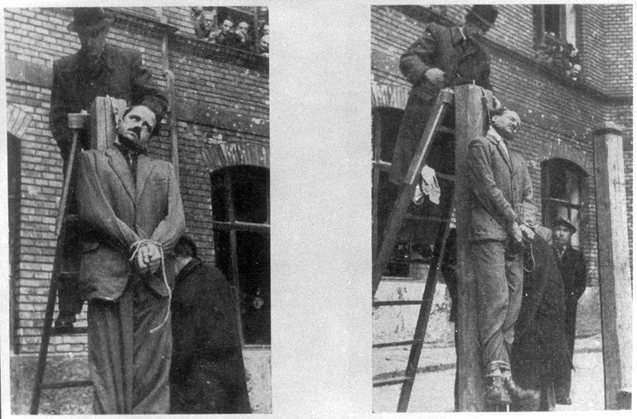
1946: Laszlo Baky and Laszlo Endre, Hungarian Holocaust authors

On this date in 1946, fascist Hungarian politicians Laszlo Baky and Laszlo Endre were executed by hanging in Budapest for their role in the decimation of Hungarian Jewry.

These two charmers were major figures in Hungary’s horrible final months of World War II.

Post-Stalingrad, the Hungarians had realized they were yoked to the losing side and started looking for an exit strategy; instead, early in 1944, they got a German occupation.

This occupation lifted the virulent anti-semites Baky and Endre into national power, because along with keeping Hungary in the Axis coalition, the Nazis also forcibly overcame its junior partner’s former reticence about Jewish genocide.

Adolf Eichmann arrived into Nazified Hungary and used our day’s two principals (along with another executed collaborator, Andor Jaross, they’re known as the “deportation trio”) as his instruments. Within months, hundreds of thousands of Hungarian Jews were being shipped to the gas chambers. This period is one of the waypoints of pernicious Nazi race theory, when the collapsing German regime spent military resources urgently needed at the front to organize the mass slaughter of Jews.*

And they had to work fast, because by that next winter the Red Army was seizing Budapest. These enthusiastic fascist operators did not fare well by the postwar government.

Most photos from Kuruc.info (the garishly branded ones) and the Yad Vashem database (the not garishly branded).


Laszlo Endre under arrest.


Both men, just prior to their execution.

* To do justice to the breadth of the human capacity, this is also the time and place where we find Raoul Wallenberg minting lifesaving Swedish passports by the thousands.

On this day..

1947: Hisakazu Tanaka, Hong Kong occupier

On this date in 1947, Hisakazu (or Hisaichi) Tanaka was shot by the Chinese Koumintang for war crimes committed during the Japanese occupation of China.

Tanaka headed the Japanese Twenty-Third Army from March 1943 through the end of the war; for the last year or so of that period, he was also the last governor of Japanese-occupied Hong Kong.

Captured in Canton at the end of the war, Tanaka was tried by the Allied occupiers for permitting the execution of a downed American airman on April 6, 1945. That unnamed airman had been tried in wartime Japan for targeting civilians during his bombing raid, a judgment that Tanaka’s tribunal vociferously disputed.

Though he drew a hanging sentence for that offense, it was not carried out: instead, the doomed general was handed over to the Chinese nationalists to answer for the depredations of his 23rd army.

No surprise, the outcome there was pretty much the same.

On this day..

1945: Lena Baker

What I done, I did in self-defense, or I would have been killed myself. Where I was I could not overcome it.

-Lena Baker’s final statement

The state of Georgia has only ever electrocuted a single woman: African-American maid Lena Baker, put to death on this date in 1945 for murdering her abusive employer.

Baker was a sharecropper and a former sex worker hired to care for white mill owner Ernest Knight as he recuperated from a broken leg. This, as Baker’s biographer Lela Bond Phillips puts it, “developed into a sexual relationship.”

A twisted, sometimes-violent relationship.

Both Knight and Baker were alcoholics, and the Knight liked to keep his domestic in the gristmill for days on end.*

As an interracial liason, it was also entirely taboo; Knight’s son tried everything to separate his dad from this scandalous arrangement, including moving the family and beating up Baker.

Knight pere was even more committed to keeping her.

On the night of April 29-30, 1944, the elder Knight locked Baker up in the mill, after she’d attempted to flee him. Baker testified that after Knight got back from church — it was Sunday, after all — Baker tried to leave over Knight’s threats. The two fought over Knight’s pistol, and the fight ended when the pistol discharged through Knight’s head. As to how it went off or who pulled the trigger, Baker said she didn’t know.

Although the irascible, hard-drinking Knight wouldn’t have won any popularity contests among his white neighbors, this breach of the color line was prosecuted both vigorously and speedily: a one-day trial that August (the all-white, all-male jury goes without saying, right?) sufficed to send the maid to her death.**

She’s (obviously) the subject of the 2008 film Hope & Redemption: The Lena Baker Story.

* Virtual imprisonment of domestic labor: not a thing of the past.

** In 2005, the Georgia Board of Pardons and Paroles — which turned down Baker’s clemency application in early 1945 — issued a posthumous pardon suggesting that a non-death penalty manslaughter charge would have been the more appropriate conviction. Baker’s family and defenders read that as vindication; there’s a detailed NPR story about it here.

On this day..

1942: Jakub Lemberg and family

(Thanks to Meaghan Good of the Charley Project for the guest post. -ed.)

On this date in 1942, on the first day of Purim, Jakub Lemberg was executed together with his family in the Nazi ghetto in Zdunska Wola, Poland.

Lemburg, a 43-year-old internist and pediatrician, was head of the Judenrat in Zdunska Wola and thus it was his task to do the Nazis’ dirty work, such as putting together lists of his fellow-Jews for deportation.

He revealed himself to be a man of exceptional character and courage, and the circumstances of his death, as recorded in Louis Falstein’s The Martyrdom of Jewish Physicians in Poland, should not be forgotten:

The Gestapo chief ordered Dr. Lemberg to deliver ten Jews to be hanged for the ten hanged sons of Haman. Dr. Lemberg replied that he could deliver only four Jews: himself, his wife and their two children. Hans Biebow, “the Butcher of Lodz,” seized Dr. Lemberg and turned him over to the executioners, who killed him in the cemetery.

The Zdunska Wola ghetto was liquidated five months later. And in 1947, Biebow got his.

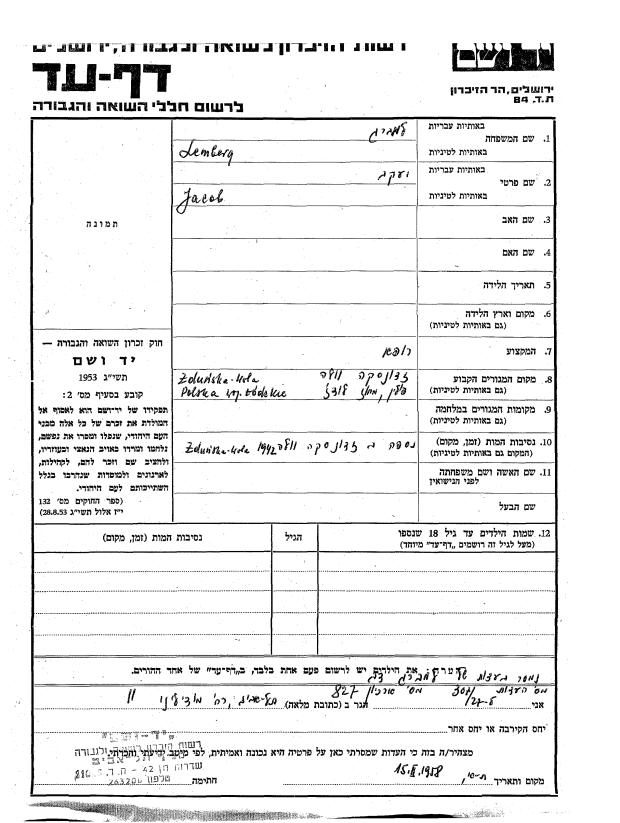
Here’s an image of Lemberg testimony (in Hebrew) from the Yad Vashem database.

On this day..

1942: Five Jews in Sokal

(Thanks to Meaghan Good of the Charley Project for the guest post. -ed.)

The synagogue at Sokal.

On this day in 1942, the Nazis shot five Jewish men from Sokal, which was then part of Poland and now belongs to the Ukraine.

During the first years of the war, the Germans had designated Sokal as a Judenstadt (literally “Jew-town”), a central destination point for all Jews expelled from nearby towns and villages. Or, as diarist Moshe Maltz put it, “A solitary island in a sea of blood.”

It was Maltz, an Orthodox Jew and native of Sokal, who recorded the executions described in this entry. He kept regular notes throughout the war about the plight of Sokal’s Jews — not a diary exactly, but a chronicle, meant for the benefit of history.

On February 24, five Jews from Sokal were taken to a place somewhere on the outskirts of town and shot. One of them was Yeshaye, son of Yankel the coachman. In 1940, during the period of Soviet occupation, Yeshaye had been a coachman working for the NKVD. Now the Gestapo called him and ordered him to turn over to them the reins of his horses. They said to him, “We’ll give you three days to deliver those reins to us. If we don’t get them by that time, we’ll have you shot.” Yeshaye thought that the Gestapo must be joking. How could he go on working as a coachman without his reins? Unfortunately for Yeshaye, the Gestapo men were in dead earnest.

Also among the five shot was Dr. Knopf, a lawyer who had converted to Christianity. The Germans had ordered him to dismiss his Gentile maid so that she could be sent to work in Germany. Knopf petitioned the Gestapo to let him have his maid back. That’s why the Germans shot him. Despite his baptism, he was simply not an Aryan. The third victim was blind Yankel, who was found guilty of buying and slaughtering a calf. Under German occupation regulations, cattle can be slaughtered only by officially approved butchers.

In October 1942, the Jews of Sokal were confined to a ghetto. The following month Maltz wrote, with the same dispassionate tone, of the murder of his fourteen-month-old daughter at the hands of the Nazis.

Later in November he escaped from the ghetto with his wife and surviving son. They had made an arrangement with a Polish woman who lived nearby, and moved into her hayloft, above the pigsty.

Eventually fourteen people from three families in all would come to live in the hayloft. All of them survived except Maltz’s sister, who died of fever while in hiding. The others staggered out into daylight, barely able to walk, when the Russians liberated the area in July 1944.

Maltz and his entire family eventually emigrated to the USA.

After his death in 1993, his diary was translated and published under the title Years of Horror, Glimpse of Hope: The Diary of a Family in Hiding. In 2009, a Pennsylvania State University professor made a prize-winning documentary based on the book, called No. 4 Street of Our Lady. You can watch it on Netflix or read an article about it here.

On this day..

1942: Icchok Malmed

(Thanks to Meaghan Good of the Charley Project for the guest post. -ed.)

On this day in 1942, Icchok Malmed* was hanged on Kupiecka Street in the Bialystok Ghetto for throwing acid in a Nazi’s face and blinding him.

Zchor tells the story:

When the Nazis attacked the house at 29 Kupiecka Street, rounding up all of its residents into the street, a bold young man, Izchok Malmed, whipped out a jar of acid from his pocket, hurling it in the face of a Nazi soldier, who was blinded at once. Seeking revenge, the sightless Nazi fired his revolver several times, hitting another Nazi soldier and instantly killing him. In the melee, Malmed vanished.

Commandant Friedl, after learning what had happened, ordered that one hundred men, women and children living in the area where the incident occurred be rounded up and force-marched to a nearby garden, where they were lined up against the wall of an adjacent bet hamidrash and shot with machine guns.

Afterward Nazi soldiers captured another group of Jews, forcing them to dig a large pit for the bodies of the one hundred martyrs. A thin layer of earth covered them. Some were still alive, their hands groping upward through the earth.

The Nazi soldier accidentally shot by his colleague whom Malmed had blinded was carried to the Judenrat building, and his body was placed on [Judenrat Chairman Efraim] Barasz’s desk. Friedl then proclaimed to Barasz, “See what your Jewish criminals have done. Now we shall take revenge. You shall see what we can do.” Friedl issued an ultimatum for the perpetrator of the crime to surrender within twenty-four hours. Failing that, the entire ghetto would be destroyed with everyone in it.

Barasz knew the Nazis meant what they said. He sent word to Malmed to give himself up and thereby save thousands of Jewish lives. As soon as Malmed heard, he surrendered himself to the Nazis.

Tamarof’s diary described in detail Malmed’s courage. Asked why he killed the Nazi soldier, he replied: “I hate you. I regret I only killed one. Before my eyes my parents were murdered. Ten thousand Jews in Slonim were liquidated before me. I have no regrets.” Tamarof tried to slip poison to Malmed but failed. Even the police could not get near the prisoner.

The next morning, Izchok Malmed, a hero of the ghetto, was hanged in the square where he had performed his act of courage. Despite the horrible torture to which he had been subjected, Malmed cursed the Nazi murderers. After several minutes of hanging on the gallows, the rope broke and the body fell to the earth. Instantaneously, the Nazis riddled Malmed’s corpse with bullets and re-hanged the body for another forty-eight hours.

Kupiecka Street was renamed Malmed Street after the war. Near the site of Malmed’s execution is a plaque reading, in Polish and in Hebrew, “Icchok Malmed, the hero and fighter of the Bialystok Ghetto, was killed here by the Nazi murderers on 8 February 1943. In his honor.”

* The Zchor account spells his name “Izchok” but on the memorial plaque it says “Icchok”. It’s a form of the name Isaac.

On this day..

1940: Nikolai Yezhov, terror namesake

In the terrible years of the Yezhovshchina, I spent seventeen months in lines outside the prison in Leningrad [queuing to deliver food to or get news of imprisoned loved ones: in her case, her son Lev]. One day somebody in the crowd identified me. Standing behind me was a woman, with lips blue from cold, who had, of course, never heard me called by name before. Now she started out of the torpor common to us all and asked me in a whisper (everyone whispered there):
‘And can you describe this?’
And I said: ‘I can.’
Then something like a smile passed fleetingly over what had once been her face.

-Poet Anna Akhmatova

On this date in 1940, the first name in Stalin’s terror got his just deserts.

Well. The first name after Stalin’s own, a point energetically made by Nikolai Yezhov’s daughter* in her fruitless post-Soviet attempts to rehabilitate the man.

But clearing a fellow’s name is a tough task when that name is the mother tongue’s very metonym for political persecution: the Soviet Union’s mind-bending late-1930s witch hunt for internal enemies, known as the Yezhovshchina.

From late 1936, when he eliminated his predecessor Genrikh Yagoda (later executed, of course), until his own fall from power in at the end of 1938, Yezhov presided over the apex of Stalinist terror, averaging hundreds of political killings daily — perhaps north of 600,000 for the two-year period, plus a like number disappeared into the Gulag’s freezers. (Just browse this here site’s ‘1937’ tag for a taste.)

Departments and regions received quotas for executions as if they were tractor factories. Security officials well understood that their own heads would be next on the block for any perceived shortcoming; Yezhov had thousands of them arrested, too. (pdf)**

We are launching a major attack on the Enemy; let there be no resentment if we bump someone with an elbow. Better that ten innocent people should suffer than one spy get away. When you chop wood, chips fly.

-Yezhov

The “Bloody Dwarf” — surely there is some of Yezhov in the Master and Margarita character Azazello, the Satan/Stalin figure’s murderous and diminutive attendant — rode this tiger unto his own destruction.


Stalin and other Soviet VIPs with (front right) Nikolai Yezhov.

The same photo ‘updated’ after Yezhov’s fall. (For a similarly chilling photographic disappearance, see Vladimir Clementis.)

As Yezhov had once displaced and killed his mentor Yagoda, so Yezhov’s own nominal underling Beria would displace Yezhov.

Power in the NKVD shifted towards Beria over the course of 1938 until Yezhov’s own resignation that November. The former boss was quietly arrested the next April and barely troubled his skilled torturers before copping to the usual litany of official self-denunciations: corruption, economic sabotage and “wrecking”, treasonable collaboration with the Germans, plus a bisexual personal life. (That last one was true.)

Bound for historical infamy, Yezhov salvaged a shred of dignity in the last, when he was “tried” a few hours before death and renounced those confessions — albeit from the twisted standpoint of a man still unquestioningly committed to the man and the system that had destroyed him.

It is better to die, but to leave this earth as an honorable man and to tell nothing but the truth at the trial. At the preliminary investigation I said that I was not a spy, that I was not a terrorist, but they didn’t believe me and applied to me the strongest beating. During the 25 years of my party work I have fought honorably against enemies and have exterminated them. I have committed crimes for which I might well be executed … But those crimes which are imputed to me by the indictment in my case I did not commit …

My fate is obvious. My life, naturally, will not be spared since I myself have contributed to this at my preliminary investigation. I ask only one thing: shoot me quietly, without tortures …Tell Stalin that I shall die with his name on my lips.

And indeed, Yezhov knew from plenty of personal experience how this script ended. It was called the Yezhovshchina for a reason.

The judges pretended to deliberate for half an hour. Ezhov fainted at the verdict, then scrawled a petition for mecy; it was read out over the telephone to the Kremlin and rejected. Ezhov was taken in the dead of night to a slaughterhouse he himself had built near the Lubianka. Dragged screaming to a special room with a sloping cement floor and a log-lined wall, he was shot by the NKVD’s chief executioner, Vasili Blokhin. Beria gave Stalin a list of 346 of Ezhov’s associates to be shot. Sixty of them were NKVD officers, another fifty were relatives and sexual partners. (From Stalin and His Hangmen: The Tyrant and Those Who Killed for Him

* Natalia Khayutina is actually Yezhov’s adoptive daughter. Her birth parents were killed … in the Yezhovschina.

** “I purged 14,000 chekists,” Yezhov later said. “But my guilt lies in the fact that I did not purge enough of them.”

On this day..

1943: Jarvis Catoe

(Thanks to Meaghan Good of the Charley Project for the guest post. -ed.)

On this date in 1943, serial killer Jarvis Theodore Roosevelt Catoe was fried in the federal chair for the murder of Washington D.C. resident named Rose Abramowitz.

The 25-year-old victim, who had married only a month before, had hired Catoe to wax her kitchen floor.

Instead he raped and strangled her, left her sprawled on her bed and made off with $20.

Abramowitz wasn’t Catoe’s first victim and she would not be his last — although she was his first white victim; the previous ones had been black like Jarvis himself. This article summarizes Catoe’s career: homicides in New York City and Washington, beginning in 1935, as well as multiple robberies, rapes, indecent exposures and attempted kidnappings. To add insult to injury, an innocent man, James Matthew Smith, was convicted in his first murder and had already served several years of a life sentence by the time of Catoe’s arrest.

Time magazine called him a “one-man crime wave.” The D.C. police’s failure to catch him resulted in serious public embarrassment for the department and a dressing-down before Congress. Not bad for a killer so obscure his name isn’t even in Wikipedia.

Catoe’s last victim was Evelyn Anderson, a waitress in the Bronx. After he strangled her and left her body in an alley he took her purse and watch and gave it to a lady friend, who gave it to another friend, who gave it to a man who pawned it for $20. The New York Police, who had been checking the local pawn shops, found the watch and traced it through its various handlers, finally landing on Catoe, who had moved back to Washington by then.

He confessed to seven murders that he could remember, but reckoned the real body count was “about ten.” Most, but not all, of his victims had been sexually assaulted. A classic sexual sadist, Catoe stated he suffered from “spells” where he had an uncontrollable urge to kill. These spells tended to happen after he’d been reading detective stories and looking at pornography.

Catoe later retracted all his statements, saying he’d been “sick and weak” and the police and badgered him into making up stories. The jury didn’t buy it: in the Abramowitz trial, they were out for only eighteen minutes before voting for conviction and the death penalty.

He walked into the death chamber singing.

On this day..

1943: Rosanna and Daniel Phillips

Executions on New Year’s Day have not been unheard-of in U.S. history, but it’s been Auld Lang Syne since the last such event — a North Carolina double-gassing on this date in 1943.

The previous year, January 1, 1942, had seen the Tar Heel state host the Rose Bowl at Duke University’s stadium: that was just 25 days after Pearl Harbor, and the California coast was considered a potential target. With war in the Pacific trending America’s way, however, the tournament of Roses — although still not the associated parade — was back in Pasadena on New Year’s 1943. So instead, North Carolina did this.*

Daniel and Rosanna Phillips, black sharecroppers, died consecutively in the Raleigh Central Prison gas chamber for the ax murder of their farm owner a mere five months before.
This laboring couple, lovers living out of wedlock (they married after the murder), seem to have had a violent relationship with one another; their 13-hour trial would feature the defendants’ mutual recriminations of black magic, and allegations by each that the other one was the real killer. (Theft appears to have been the motive.)

(The lengthiest accessible summary of this case that I’ve been able to find is in this pdf of a lengthy journal article, “Black Female Executions in Historical Context” (scroll all the way to p. 77).)

The U.P. wire report (as run in the New York Times, Jan. 2, 1943) says that the pair forgave each other by the end. Still, Daniel was gassed first “at the request of the State Parole Commission, on the possibility that he might make a last-minute statement exonerating his wife,” which would have spared Rosanna. One wonders if she was still in a forgiving mood when she found out that he hadn’t breathed the word that might save her.

At least some newsmen also reported a malfunction in the chair’s cyanide-dropping rack for Rosanna’s execution, which required guards to re-open the chamber after its strapped and hooded subject had been sealed in, and putz about the mechanism while she waited.

* Actual reason to do this on New Year’s Day: the mere happenstance of automatically scheduling execution dates a set number of days after the defendants’ last appeal failed.

On this day..

1942: Three Bialystok Jews

(Thanks to Meaghan Good of the Charley Project for the guest post. -ed.)

On this day in 1942, three anonymous Jewish residents of the Bialystok Ghetto in Nazi-occupied Poland were hung in the public square across the street from the Judenrat (Jewish Council) building. The three worked at the ghetto’s oil factory, and had been caught smuggling sunflower seeds.

The residents of the ghetto paid little attention to the execution, accepting it with resignation. It was hardly remarked on.

But this event was yet another small indication of dire events looming in the near future. Compared to those in other Nazi ghettos, such as those at Warsaw and Lodz, the Bialystok Jews had it pretty good. The ghetto, noted Sara Bender in her 2008 book The Jews of Bialystok During World War II and the Holocaust, was “organized, industrious, and even prosperous. Unlike other ghettos, it never experienced starvation or abject poverty.”

And it was seen as relatively safe. This day’s sort of vicious, arbitrary executions for minor rule infractions, which were so common elsewhere, were not at all frequent in Bialystok. Neither were the mass deportations that had by late 1942 decimated almost all the other ghettos.

Well, Bialystok’s turn was coming.

Unbeknownst to the Bialystokers, just as the sunflower seed smugglers were meeting their end, the powers that be in Berlin were debating the future of the ghetto. The Nazis in immediate charge of the ghetto wanted to keep it, and had logical reasons for doing so: namely, that it was a center of great industry, producing all kinds of goods for the German Army at almost no cost.

Killing off tens of thousands of hardworking slaves during wartime makes about as much sense as hanging three people over sunflower seeds, but this is what Berlin decided to do.

In early- to mid-February 1943, there was a surprise Aktion in the ghetto: 2,000 were killed and a further 10,000 deported to the Treblinka Extermination Camp. About 30,000 remained.

Once it was over, most of the surviving Bialystokers breathed a sigh of relief and hoped against hope that the worst was over — while a small underground group quietly organized an uprising for when the time came.

The rebellion, however, never really had time to get off the ground. When the final deportation occurred in August 1943, almost everyone went quietly in shock to their deaths. A cell of less than 100 fighters put up a few days’ struggle, enough to earn a footnote in history, before the last of the ghetto blew away with the ashes.

On this day..