1941: Eight Russian POWs at Flossenburg

Seventy years ago today, eight unknown Russians — prisoners of the Wehrmacht’s ultimately self-defeating thrust into the Soviet Union — hanged at Flossenburg concentration camp.

By way of a moving 1995 New York Times article, these anonymous Red Army men give us a glimpse at the world of the pink triangle.

Between 10,000 and 15,000 homosexuals may have been incarcerated in the camps, Dr. [Klaus] Mulller said, out of approximately 100,000 men who were arrested under Paragraph 175 of the German criminal code, which called for the imprisonment of any “male who commits lewd and lascivious acts with another male.” (The law was silent on lesbianism, although individual instances of persecutions of lesbians have been recorded.)

Perhaps 60 percent of those in the camps died, Dr. Muller said, meaning that even in 1945, there may have been only 4,000 survivors. Today, Dr. Mliller knows of fewer than 15.

Their travails did not end at liberation. They were still officially regarded as criminals, rather than as political prisoners, since Paragraph 175 remained in force in West Germany until 1969. They were denied reparations and the years they spent in the camps were deducted from their pensions. Some survivors were even jailed again.

Old enough to be grandfathers and great-grandfathers, the survivors scarcely courted attention as homosexuals, having learned all too well the perils of notoriety. “It is not easy to tell a story you were forced to hide for 50 years,” Dr. Mullers said.

One of the first men to break his silence was the anonymous “Prisoner X. Y.,” who furnished a vividly detailed account of life as a homosexual inmate in the 1972 book, The Men With the Pink Triangle, by Heinz Heger, which was reissued last year by Alyson Publications.

By a coincidence that still astonishes him, Dr. Muller said, Prisoner X. Y. — “the best documented homosexual inmate of a camp” — turned out to be Mr. [Josef] Kohout.


The Men With the Pink Triangle inspired the play Bent, later made into a motion picture.

After his arrest in 1939, Mr. Kohout was taken to the Sachsenhausen camp and served at the Klinker brickworks, which he called “the ‘Auschwitz’ for homosexuals.” Prisoners who were not beaten to death could easily be killed by heavy carts barreling down the steep incline of the clay pits.

In 1940, he was transferred to Flossenburg. On Christmas Eve 1941 inmates were made to sing carols in front at a 30-foot-high Christmas tree on the parade ground. Flanking it were gallows from which eight Russian prisoners had been hanging since morning. “Whenever I hear a carol sung –no matter how beautifully — I remember the Christmas tree at Flossenburg with its grisly ‘decorations,’ ” he wrote.

On this day..

1949: Traycho Kostov, Bulgarian purgee

On this date in 1949, leading Bulgarian communist Traycho (Traitcho, Traicho) Kostov was hanged in Sofia.

A journalist and agitator from way back, Kostov was a casualty of the postwar political chasm between east and west.

He’d been the number three man in Bulgaria’s communist hierarchy at the time of his fall in January of 1949, but had also been considered close to Yugoslavia’s independent socialist leader Josip Broz Tito. Like Tito, Kostov was a little too into his own country’s national economic sovereignty as against the purported greater good of a Soviet-dominated eastern bloc.

Stalin had overtly split with Tito in 1948. Over the next few years, Soviet satellites in eastern Europe would systematically eliminate perceived Titoist elements — and submit to economic integration on Moscow’s terms.

So a propagandist could write, comparing Kostov to the Hungarian minister who had swung for Titoism just weeks before, that

[i]f Laszlo Rajk could be regarded as the right arm of Tito’s plans for Eastern Europe, Traicho Kostov, member of the Bulgarian Politburo and Deputy Premier, was certainly his left arm. I sat in a crowded court in Sofia in December, 1949, heard and watched Traicho Kostov and ten other accused and dozens of witnesses testify to a Yugoslav plan for Bulgaria every whit as diabolical and bloodthirsty as that for Hungary. In reality there was only one overall strategic plan with “Operation Rajk” and “Operation Kostov” as tactical moves.

Specifically, “Operation Kostov” entailed spying for western (plus Yugoslavian) powers and plotting to overthrow the People’s Republic.

Although his enemies had browbeaten Kostov into political self-denunciation at party summits, the man stoutly repudiated guilt at trial — which was not necessarily the norm in the show trial genre.

Kostov’s ten fellow defendants received prison terms rather than the rope, and some of them were alive to enjoy the official rehabilitation that followed Stalin’s death.

On this day..

1944: French collaborator in Rennes

This U.S. Army photo from a few months after D-Day is filed simply thus:

“Photo taken at the instant bullets from a French firing squad hit a Frenchman who collaborated with the Germans. This execution took place in Rennes, France.” Himes, November 21, 1944.


Click to see a larger image of this stunning photo — or, take in this huge copy.

On this day..

1943: Not Anatoly Kuznetsov, insignificant little chap

(Thanks to Meaghan Good of the Charley Project for the guest post. -ed.)

On November 1, 1943, a fourteen-year-old boy named Anatoly Kuznetsov came within seconds of execution in his hometown of Kiev in Nazi-Occupied Ukraine. As he admitted decades later, his crimes were numerous and all were worthy of the death penalty, according to the laws of the Germans. They included such grave sins as stealing beets, breaking curfew and sticking up an anti-Nazi leaflet.

By the time I reached the age of fourteen, I had committed so many crimes on this earth that I should have been shot many times over. […] Moreover, I was not a member of the Party or the Komsomol, nor a member of the underground; I was not a Jew or a gypsy; I did not keep pigeons or have a radio set; I did not commit any crimes openly; and I did not get taken as a hostage. I was in fact a most ORDINARY, unexceptional, insignificant little chap in a peaked cap.
But if the regulations drawn up by the authorities had been observed scrupulously, according to the principle of ‘If you did it you pay the penalty,’ then I had LOST THE RIGHT TO BE ALIVE twenty times over.

I persist stubbornly in remaining alive, while the number of my crimes increases in a catastrophic manner, so that I have stopped counting them. All I know is that I am a terrible criminal who has still not been caught.

The closest young Kuznetsov actually came to being killed was on November 1, 1943.

His very existence in Kiev had become a capital offense by then: all the civilians were supposed to have followed the German Army as it retreated from the city ahead of the advancing Russians, on pain of instant death.

Yet Kutznetsov stayed, hiding in abandoned buildings and bombed-out ruins, drinking rainwater, eating whatever he could find. By November 1 he had been dodging the evacuation order for over a month. And so he was called to account:

At that moment I heard a noise. I started, raised my head and saw a German soldier carrying a rifle; then I caught sight of another one on the street outside … When I thought they were not looking in my direction I dodged round the corner of the house, again cowering down rather stupidly, not looking round and averting my eyes from them in a sort of superstitious belief that they would not see me. I heard someone shout, “Hey! … Hey!” and I straightened up and stopped.

The soldier eyed me very sternly. He was a dark-haired, stocky fellow of about thirty, rather awkward in his movements, wearing old, muddy boots. His was a very ordinary, everyday type of face … In German he said:

“Come here.”

I took a few steps along the wall.

“You’ll be shot,” he said sternly, and started to raise his rifle.

It was, apparently, loaded, since he did not shoot the bolt. Another German came up, took him by the arm and said something in a very calm and indifferent tone, which sounded roughly like: “Don’t do it, there’s no point.” (That’s what I thought he said.)

The second soldier was rather older, quite an elderly man, with sunken cheeks. The dark-haired one answered him back and turned his head away for a moment. In that brief moment—I realized—I ought to have jumped up and dashed away… The dark one simply raised his rifle, turned his head for a moment, said something to the elder one, and that was the last moment of my life. […]

Right in front of my face — not in the cinema, or in a picture or in a dream — I saw the black hole at the end of the barrel, and had in my nose the unpleasant smell of gunpowder (meanwhile the elder German apparently went on saying something, but the dark one — alas! — wouldn’t listen); ages seemed to pass and there was no shot.

Then the end of the barrel dropped from my face to my chest and I realized at once in amazement that that, apparently, was how I was to be killed — shot in the chest!

Then he lowered the gun altogether. […]

He had only to squeeze his finger. I suppose on November 1st every year I ought to remember and thank that finger, the forefinger on his right hand, which let me live.

Five days later, the Red Army arrived and Kiev was liberated.

Kuznetsov would grow up to write a memoir and documentary history of his experiences during the occupation, including his aforementioned brush with death. The book, Babi Yar: A Document in the Form of a Novel, is considered a classic in the literature of World War II and the Holocaust. Parts of it have already been quoted on Executed Today.

Kutznetsov died in London in 1979. He was forty-nine years old.

On this day..

1941: Forty-eight French hostages

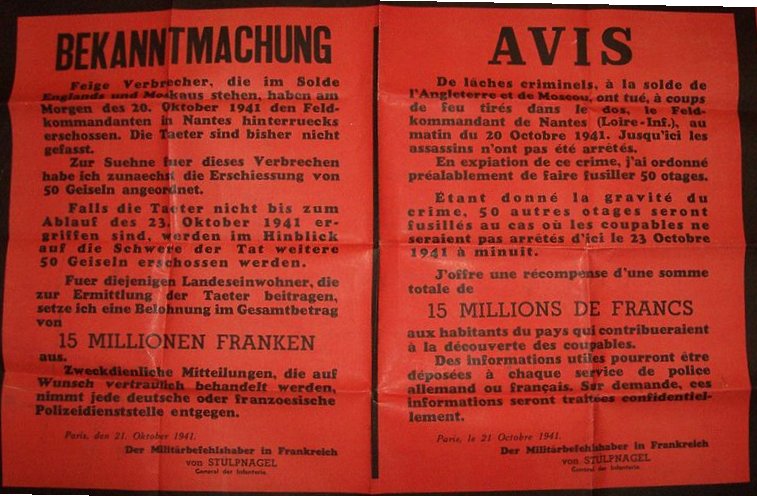
On “a beautiful autumn day” this date in 1941, four dozen French leftists were executed by that country’s occupiers as punishment for the murder of a German officer.

On October 20, 1941 — sixteen months into the German occupation — a pair of Communist commandos assassinated the Feldkommandant of Nantes, Lt. Col. Karl Hotz (French link).

News of this crime went straight to Adolf Hitler himself, who personally ordered a fearful reprisal.

The list of the executed hostages as published Oct. 23 in L’oeuvre

Accordingly, the collaborationist Petain government was induced to select 50 persons from among the ranks of detained German political prisoners. Pierre Pucheu, who would later be executed himself,* intentionally selected Communist types in an effort to confine the retaliation to fellow-travelers.

On this date, those 50 — well, 48, but who’s counting?; the numbering can get dodgy in these mass-execution scenarios — were put to death at three different locations: five at Fort Mont-Valerien; sixteen at Nantes; and most notoriously, 27 internees of Choisel (French link) at Chateaubriant.**

In three different batches of nine, the 27 reds and trade unionists were fusilladed into the ranks of Gallic martyrdom. They remain among the most emblematic French martyrs of the occupation; there’s a cours des 50-Otages named for them in Nantes, and various streets that bear individual victims’ names — such as Rue Jean-Pierre Timbaud in Paris. (Timbaud was a Communist steelworker.)


Monument to the martyrs of Chateaubriant. Image (c) Renaud Camus and used with permission.

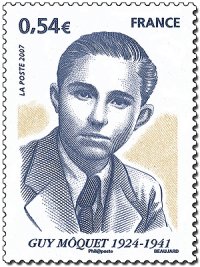
The youngest, 17-year-old Guy Moquet (you can find his name on the Paris Metro) was the son of an exiled Communist parliamentarian (French link).

He made headlines in 2009 when current French President Nicolas Sarkozy had added to the educational curriculum the reading of Moquet’s brave-but-sad last letter to his family: the decision drew some rather mean-tempered fire because of Moquet’s political persuasion. In the end, the text bore a fairly universal reading that could play inoffensively to posterity — like its postscript injunction,

“You who remain, be worthy of the 27 of us who are going to die!”

There’s a thorough roundup of the Oct. 22 executions (including poetic tribute) here.

* Vindicating Winston Churchill’s prophecy to the Times upon receiving news that “These cold-blooded executions of inocent people will only recoil upon the savages who order and execute them.” (Oct. 25, 1941, as cited in the The Churchill War Papers, vol. 3)

** Fifty more were supposed to be executed if the assassins weren’t promptly turned in, but that second batch never took place. (There was, however, a different batch of 50 executed on October 24 in retaliation for a different political assassination. Maybe they just all ran together.)

Part of the Themed Set: Illegitimate Power.

On this day..

1943: Willi Graf, anti-Nazi medic

On this date in 1943, anti-Nazi student activist Willi Graf was beheaded at Munich’s Stadelheim Prison.

Graf was a conscientious Catholic whose disaffinity for Naziism manifested in an early refusal to join the Hitler Youth: he did a short stint in prison in 1938 for having continued associating with a banned Catholic youth league.

This subversive fellow might have been destined for the chop regardless in the black years to come, but for a thoroughgoing radicalization, he was drafted into the army as a medic and got a front-row seat on the Holocaust and the horrors of the eastern front.

During a 1942 study leave back in Munich, Graf met White Rose resistance figures Hans and Sophie Scholl and began participating in that circle’s distribution of illicit anti-Nazi leaflets.

He was arrested within months and condemned on April 19, 1943 to die as a traitor — though actual execution of the sentence waited several months on the Gestapo’s vain exertions to extract from their prey actionable information on other collaborators.

A number of schools around Germany are named in Graf’s honor.

On this day..

1941: Eugene Johnson, the first electrocuted in Louisiana

On this date in 1941, the U.S. state of Louisiana joined the 20th century (or at least the late 19th) with its first electrocution.

Louisiana’s electric chair did debut very late in the game. The great surge of adoption for this uniquely American way of death was the 1910s and 1920s. Louisiana was the last state to begin electrocuting prisoners save one — West Virginia.

But in 1940, the state legislature had finally joined the trend sweeping the South and voted for voltage.

So on March 7, 1941, Louisiana hanged its last hangings.

Eugene Johnson, the next to die, has no purchase on death penalty annals but his accidental milestone as the first to die seated: a black man condemned for killing a white farmer is just about your standard-issue condemned man in the interwar South. (The more things change …)

Johnson’s death this date would inaugurate the nickel-and-dime execution solution that Baton Rouge came up with to keep its various parishes right in the thick of the retribution business: the portable electric chair soon christened Gruesome Gertie, which trucked around to the local jails and courthouses meting out motorized justice.

This particular chair, though a latecomer and a modest overall contributor by the standards of Louisiana’s neighbors, would make itself the subject of highest jurisprudence a few years later by not merely botching but failing the execution of one Willie Francis — and then again in the 1980s as the subject of another man’s near-miss legal challenge to the constitutionality of electrocution.

Having always found five friends on the high court, the illustrious furniture retired in 1991 with 87 souls to its electrodes (including that of Willie Francis the second time around: he lost his appeal). Gertie lives on adorning the set of the Angola Prison Museum — and the Academy Award-winning film Monster’s Ball.

Part of the Themed Set: Americana.

On this day..

1941: Nguyen Thi Minh Khai, Indochina Communist cadre

On this date in 1941, Vietnamese Communist cadre Nguyen Thi Minh Khai was shot as an anti-France insurrectionary.*

Khai (Vietnamese Wikipedia page | English) surely fit the description: she was a leader of the Indochinese Communist Party in the 1930’s, working directly with Ho Chi Minh in his Hong Kong exile. She would return in 1936 to the city later named for that redoubtable revolutionary as its ranking agitator.

Khai, the most famous of the Indochinese Wars’ vast ranks of women fighters, would marry fellow revolutionary Le Hong Phong, the chairman of the party, who died in prison in 1942. Khai’s sister’s marriage made Khai sister-in-law to the revolution’s military lion Vo Nguyen Giap.**

But her prominent position also made her a target.

Arrested by the French late in 1940, she was tortured and condemned to death. She was shot with other cadres, shouting last words that the decades yet to come would pretty well vindicate.

Long live the Communist party of Indochina. Long live the victorious Vietnamese revolution. (Source)

Readers whose Vietnamese is stronger than mine — i.e., extant in any form whatsoever — might get something out of this video:

As a national heroine, Nguyen Thi Minh Khai is the namesake of any number of public spaces in Vietnam, like schools and roads.


Paradoxical historiography: the street address visible to the right of the photo brands a revolutionary name onto an upscale coffee shop in Ho Chi Minh City. (cc) image from Lawrence Sinclair.

* Some sources give an April 1941 execution date, particularly April 25. I believe this may actually be the date Khai was condemned. There are also some sources indicating a guillotine execution; though the guillotine was certainly available, the bulk of the sources seem to say that Khai was shot.

** Giap is still going strong after all these years; he just turned 100 a few days ago. Khai’s sister was not as lucky; she died in French custody at the prison American pilots would later refer to as the “Hanoi Hilton”.

On this day..

1941: Sixteen Yugoslav partisans and one German soldier

On this date in 1941, this happened.

These sixteen blindfolded Yugoslav Partisans about to be shot at Smederevska Palanka were joined in death by one conscientious German soldier who refused to help carry out the massacre. (Or not. See comments.)

The Partisans were Tito’s Communist guerrilla movement against the Nazi occupation and while they were up against it at this early date, they would in due time wind up on the winning side and help birth the postwar government.

Their legacy remains in every European sports page as the namesake of the Belgrade sports association Partizan founded immediately after the war. It’s the umbrella entity for the frequent Serbian football and basketball champions as well as a variety of other sports. (Current world tennis no. 1 Novak Djokovic played for Partizan, for instance.)

On this day..

1949: Husni al-Za’im, Syrian president

On this date in 1949, Syrian President Husni al-Za’im and his Prime Minister Mohsen Berazi were seized in a military coup, conducted to a court martial, and immediately put to death.

An ethnic Kurd, al-Za’im had cut his teeth in the armed forces of two different empires — the Ottoman and the French — before Syria attained independence following World War II.

The ambitious al-Za’im had got out from under a Vichy-era prison sentence for corruption and established himself as army chief of staff in time for the 1948 Arab-Israeli War.

Syrian forces’ underwhelming performance in this campaign set the stage for what would follow — both for al-Za’im and, arguably, down to the present day.

Syria actually sported an open and democratic polity; it had a successful election in 1947. But the civilian leaders were essentially wealthy landowners who, having successfully led the movement for independence, had scant agenda for actual governance save enriching themselves and their allies. It was “an edifice of nepotism and mismanagement … [a] creaking network of family patronage and administrative venality.”

A stagnant economy, kleptocratic elite, and political malaise came into sharp focus with the debacle of the Arab-Israeli War. Arab commander Fawzi al-Qawuqji would charge that feckless Arab elites ran the war “from behind their office desks, and in accordance with their own personal interests, ambitions, and whims.”

Encouraged by the United States — just then breaking into the growth industry of short-sighted oil patch coups — al-Za’im overthrew the civilian government to “put things right and restore this nation its honour, its dignity and its freedom.”

This undergraduate thesis makes a case for the Za’im coup as the turning point normalizing and privileging military intervention in Syrian politics. This was the fear of a young American diplomat in Syria, who reckoned American support for the coup “the stupidest, most irresponsible action a diplomatic mission like ours could get itself involved in … we’ve started a series of these things that will never end.”

So it was that on this date the next domino toppled, a counter-coup that ended al-Za’im’s installment of the dictatorship series most abruptly.

Colonel Sami Hinnawi, an officer who had served under Husni Zaim, then sat as president of a “higher war council” of 12 senior officers, which tried the President and Prime Minister and condemned them to death. Sentence was carried out at once at the Mezza fortress near Damascus. Mohsen Berazi was shot first. He protested, although Husni Zaim, who stood by waiting his turn, urged him to be quiet.

London Times, Aug. 15, 1949

Hinnawi last another year before a relative of Mohsen Berazi assassinated him in revenge, and on it went. It was during Syria’s sequence of unstable military juntas in the 1950s that the young Hafez al-Assad earned his stripes in the Syrian air force.

Assad would eventually execute a much more permanent takeover, rule the country for 30 years, and upon his death in 2000, bequeath leadership to his son Bashar — a fellow who, as of this writing, stands in some danger of winning an entry of his own in these pages should his ruthless crackdown against pro-democracy protesters prove unavailing.

On this day..