Two years ago today, Japan resumed executions after a break of more than a year with four hangings.
Septuagenarians Yoshio Fujinami (wheelchair-bound) and Yoshimitsu Akiyama (partially blind) both needed the guards’ assistance to reach the trap at Tokyo Detention Center, a mere hour after they were informed of their imminent demise.
Two other prisoners, 64-year-old Michio Fukuoka and 44-year-old Hiroaki Hidaka, were simultaneously hanged in Osaka and Hiroshima, respectively.
Hidaka, a serial killer, had dropped his appeals and thus died a mere 12 years after his crimes. Fukouka died maintaining his innocence of three murders from 1978-81 he said police torture had forced him to confess. The oldest men were on the hook for killings dating to 1975 and 1981. (Much more from The Japan Times.)
Talk about justice delayed.
In Japan’s strange death penalty system, the condemned might await death for decades only to be hanged, as these were, with next to no warning. Their families and supporters did not hear about it until after the deed was done.
These hangings, though protested, were not altogether unexpected, for a break in the Japanese Diet around the end of the year often heralds an appearance on the public stage by the gallows. (Look for them in 2008 as the Diet goes out of session starting today.) And a turnover at the top of the Justice Ministry had replaced a pol disinclined to authorize any hangings, the source of the long break between executions during a decade when Japan’s use of the death penalty has generally been intensifying.
Although at least one particularly pressing motivation for this date’s hanging will not be present this year. After the long hiatus, an anonymous official told a newspaper,
We absolutely wanted to avoid ending the year with zero executions.
On this date in 2003, Liu Yong’s situation took a very abrupt turn for the worse.
The wealthy Communist Party member and Shenyang city legislator had been sentenced to death 20 months before in a corruption case for ordering the murder of a tobacco vendor as part of a mafioso racket of graft, extortion, black marketeering, and kindred mayhem.
When that sentence was reduced on retrial on a showing that Liu’s confession was extracted by torture, public outcry at the appearance of a well-connected insider getting off scot-free led the Supreme Court to take the unprecedented step of yet again re-trying a criminal case itself.
“According to China’s legal system, a criminal case can usually be tried only twice,” as China Daily lightly put it.
Amnesty International is less measured, and alleges that the irregular Supreme Court hearing was ordered by political insiders to buttress the credibility of the country’s anti-corruption drive — and to avoid setting any precedent that evidence of torture should mitigate criminal sentencing. (China certainly found defenders for the trial (the link is to an ugly layout of raw HTML).)
The high court handed down its sentence this very day, after which Liu was immediately hailed to one of China’s mobile execution vans, given a lethal injection, and cremated.
On this date in 2005, North Carolina executed 67-year-old immigrant Elias Syriani at Raleigh’s Central Prison for the murder of his wife — despite the emotional clemency intervention of the couple’s children.
Syriani, an ethnic Assyrian driven from his native Jerusalem by al nakba who moved to the U.S. from Jordan through marriage to a Jordanian immigrant, had a stormy marriage hit the rocks in 1990. Teresa filed for divorce after a few years facing Elias’s violent objections to her westernized behavior.
Syriani responded by jumping her when she drove home one night, and stabbed her to death with a screwdriver in front of their 10-year-old child.
This case meandered forgettably through the bowels of the criminal justice system; the traumatized children moved on (.pdf).
Until the year before Syriani met his fate, when the mysteries of the human heart flipped the script.
The four children visited Syriani and found themselves forgiving their mother’s murderer … and forging an unexpected bond with the father they hadn’t known for a decade. They called it a miracle, a gift from their late mother to go from “hate, absolute hate, to love in a split second.”
The children — by then grown — became Syriani’s advocates for executive clemency, posing an unusual challenge for Gov. Mike Easley: in an environment that (rhetorically, at least) often counts on survivors’ rage and grief as arbiters of punishment, would he spare a father for killing a mother when the children said execution would redouble the family’s injury?
“After careful review of the facts and circumstances of this crime and conviction, I find no convincing reason to grant clemency and overturn the unanimous jury verdict affirmed by the state and federal courts.” (Easley)
The following are excerpts from an interview with the film’s Producer/Director Linda Booker originally conducted by Sean O’Connell of The Charlotte Weekly.
When did you first hear about/become interested in this story?
Back in July 2005, I was checking the weather on a local news website and scanning the headlines when the article about the Syriani siblings forgiving their father caught my eye. I think at first it interested me because I have been involved with our local domestic violence agency as a volunteer and fundraiser, but as I read the article something about their reconciling with and forgiving their father really touched me. At this point they had begun to share their story with the public and had just appeared at a domestic violence conference in Charlotte called “Hope to Heal.”
At what point did you get the idea to film the story in documentary form? How long did it take to complete the film?
It was an immediate reaction for me upon reading the article that their story might make a compelling documentary film. I printed it out and carried it around with me. But I was still finishing up interviews and editing my first documentary project “Millworker: the Documentary” so I didn’t act on it right away. Then several months later I learned that they would be speaking in Chapel Hill, close to where I live, and I thought, “okay, if I feel this strongly about this, here’s my chance to meet them and film their discussion.” So there I was, a relatively new filmmaker and very nervous about that first step, but I received permission to film that night. That’s also when I first heard about and met Meg Eggleston, who had been writing letters and visiting Elias Syriani on death row for four years and the Syriani sibling’s attorney Russell Sizemore, who was helping them through their father’s clemency appeal pro-bono. I came to learn that Meg’s friendship with Elias was an essential part of their father’s transformation and was such an interesting story in itself.
I started filming in October 2005, edited in the fall of ’06 and started doing preview screenings in early ’07. Since then the film has screened at film festivals and many grassroots screenings with various non-profits and faith groups as sponsors in the U.S. especially in North Carolina.
The Syriani children are open and honest in the film. Did you have trouble accessing them? Were they open to the idea of participating in the film, even though at this point it could not help their father?
I started filming interviews with Meg Eggleston and Russell Sizemore first who trusted that I was not trying to do a sensationalized story, but that I recognized the Syriani’s story of forgiveness was inspirational, regardless of the outcome of the clemency appeal. The Syrianis knew that I was working with Meg & Russ, but out of respect for all they were going through, I did not push the issue of their participation. About six months after the appeal, I wrote them about participating and subsequently we went to California and Chicago in the summer of ’06 to film interviews with them. While they know that a part of the discussion around the film will be capital punishment, the Syriani siblings have expressed that they want their story to live on in hope that their experience of surviving a domestic violence tragedy and the healing that came from forgiveness will touch people’s hearts and help others.
I think it’s because this case is so unique, but I found the film’s stance on the death penalty unclear. Can you, as the filmmaker, clarify your thoughts on the death penalty?
Well, I’ll take that as a compliment, because the documentaries I admire aren’t pounding you over the head with the filmmaker’s opinion. I can tell you that making this film made me face how I felt about the death penalty and I spent a lot of time researching and doing some deep thinking about the issue.
Needless to say it’s very complex, and it is completely understandable that feelings of anger and retribution can occur when you have lost a loved one to violence. We need to do more for those dealing with the aftermath of murder with as much support, assistance and counseling services as possible, especially children. But as I went to restorative justice forums and have met many people who belong to organizations such as Murder Victims Families for Reconciliation, I kept hearing stories about how the death penalty was causing more grief, stress and division in families that had experienced murder. Between making the documentary and doing the research, I came to the conclusion that I couldn’t support a system of justice that can possibly create more pain and victims in its wake and that was also irreversible and arbitrary.
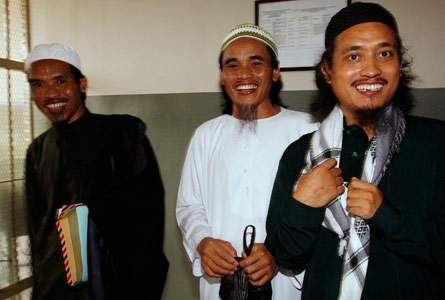
On this date — mere hours ago as of this writing — three of the most infamous terrorists in two nation’s histories were shot in a jungle clearing on Indonesia’s Nusa Kambangan Island.
“At around 00:15 am (1715 GMT Saturday) the three convicted men on death row, Amrozi, Mukhlas and Imam Samudra, were executed by firing squad,” said attorney general’s office spokesman Jasman Panjaitan.
“The autopsy results show that all three are dead. The family members are now bathing the bodies.” (Source.)
The men were taken from prison and tied to wooden crosses in the Indonesian prison island’s forest, where they were shot simultaneously by three separate firing squads for the October 12, 2002 bomb attack on the island of Bali that claimed 202 lives.
Though taking place in Indonesia, the strike was aimed at westerners vacationing at a tourist hot spot. Eighty-eight Australians were slain, along with 76 other (predominantly European) foreigners. The only shred of regret the late executees ever betrayed was that the infidel body count wasn’t higher.
The mediagenic murderers display a range from insouciant to jocular in most of their photos. The ever-grinning Amrozi — in the middle — was known as the “smiling assassin.”
The three facing death today* have occupied most of the intervening six years endeavoring to transmute their criminal celebrity into the dearer coinage of martyrdom through the doubtful influence of the Philosopher’s Stonemass media.
Indonesia has appeared to sidle towards this execution, ginger at inflaming Islamic radicals; Australia, which has no death penalty itself, has been controversially mum and bombing victims and their families conflicted.
It remains to be seen whether the high-profile case has legs among militants. But its undertones of race, religion and national sovereignty are being very closely watched by one group of Australians in particular: the Bali Nine, Australian nationals in Indonesian custody for drug smuggling.
Three of the nine are currently on death row, reportedly “somber” at this day’s shootings — no doubt aware that they could be next.
Update: True to the publicity-savvy rep, Imam Samudra reportedly knocked out a nasheed or nasyid just before his execution that’s now a hot ringtone download.
[audio:Imam_Samudra.mp3]
* A fourth man was also death-sentenced, but that sentence was vacated on appeal.
On this date in 2001, former pop singer and shaman Mona Fandey was hanged with two accomplices at Kajang Prison outside Kuala Lumpur, closing the noose on one of the world’s weirdest and most sensational recent crimes.
Aging B-list pop crooner Maznah Ismail — “Mona Fandey” was her stage name — had transitioned to a gig as a high-rent spiritualist and healer, known locally as a bomoh.
In that capacity, she and hubby Mohd Affandi Abdul Rahman landed a politician with more money than sense. After collecting a bunch of cash from him, they got him to lie down with his eyes closed as part of a ritual that was supposed to make money fall from the skies. Instead, the couple’s assistant Juraimi Hussin chopped off his head, and Mona went on a shopping spree.
The effect of the grisly celebrity murder was heightened by Mona’s cheery demeanor throughout the trial and thereafter, as if a murderess’ notoriety was the pinnacle she never achieved as an entertainer.
She and her husband maintained an unsettling placidity about their demise to the very end. Some sources say she uttered the mysterious remark, “I will never die” just before her hanging. (Others have everyone silent.)
The end of the three killers was hardly the end of such a headline-grabbing case in the public memory. Her cell is becoming a protected “heritage site”, and her story has been treated on screens both small and silver.
Polling data reveals interesting things about U.S. public opinion and the death penalty. If you ask an open-ended question about the death penalty –- for example, “Do you feel the death penalty is appropriate for certain egregious crimes?” –- then you usually see somewhere around a 65 to 35 percent split in favor. On the other hand, if you ask which is preferred – the death penalty or life in prison without parole, the results tend to be closer to 50-50.
Upon occasion, another question is asked: Do you feel an innocent person has been put to death in the U.S.? The results are pretty emphatic: Americans don’t trust their government to get it right, and they do believe innocent people have been executed, by a ratio of about three to one.
So the question fairly arises: Have innocent people been executed in the U.S. in what we sometimes refer to as the “modern era,” i.e., since executions were allowed to resume in 1976?
Enter Cameron Todd Willingham.
On Feb. 17, 2004, Cameron Todd Willingham was strapped to a gurney in a Texas death chamber as he declared his innocence for the last time. Minutes later, he was executed by lethal injection. In December of the same year, the Chicago Tribune uncovered secrets behind the Willingham case, addressing questions left unanswered and raising doubts left unacknowledged.
The Fatal Fire
Cameron Todd Willingham with one of his purported victims — his daughter, Amber.
On Dec. 23, 1991, Willingham was at home with his three daughters. His wife, Stacy, left their home in the morning to pay the bills and shop for Christmas gifts at a Salvation Army store. The family had been struggling that year; Todd, as everyone called him, had recently been laid off, and Stacy was supporting the family with her wages from a bar. The Willinghams were two months behind on rent, and they had even stopped paying some bills in order to save money for Christmas.
Willingham recalled waking up briefly as his wife was leaving the home around 9 a.m. When he heard their one-year-old twins, Karmon and Kameron, crying, he woke up to feed them and went back to sleep. About an hour later, his two-year-old daughter Amber woke him with her cries, and the house was already full of smoke. Willingham remembers not being able to see “anything but black” toward the front of the house.
The circuits were popping throughout the home as Willingham frantically went to his daughters’ bedroom. At this point, his hair caught on fire, and he was able to see little more than the glowing of the ceiling. Willingham called out for his children and felt along the floor and bed for them, but he could not find them. This is when debris began falling from the ceiling, causing him to burn his shoulder. He fled the home through the front door.
After fleeing his house, he asked his neighbors to call the fire department and screamed to them, “My babies is in there and I can’t get them out.” A neighbor, Mary Barbee, then asked other neighbors to place the call because her own telephone was disconnected. Willingham reported that, while this was happening, he tried to re-enter his home, but it was too hot. Then, he knocked out two bedroom windows with a pool cue, but could not get into the bedroom.
Buvin Smith arrived on the scene after hearing the neighbor’s call over a radio scanner. Smith remembered restraining Willingham from going onto the porch, and heard him yelling that his “babies were in the house” and noticed that he was “acting real hysterical.”
A Circumstantial Case
Almost immediately, Willingham became a suspect. According to the Chicago Tribune, prosecutors often are able to rely on circumstantial evidence in cases when a child dies and the parent survives. In this case, the prosecution convinced the jury that Willingham killed his children because they interfered with his beer-drinking, dart-throwing lifestyle. The jury believed it.
Neighbors told investigators that they did not believe Willingham tried hard enough to save his children. In fact, Barbee said that she saw Willingham standing by the fence as heavy smoke came out of the windows. Also, she told investigators that Willingham seemed more concerned with moving his car away from the burning house as the windows blew out than with saving his children.
Willingham’s wounds were treated shortly after the fire. Firefighters did not think that his burns were severe enough had he indeed searched for his daughters in the manner he described. His shoulder, back, and hair were burned, but his bare feet were not burned at the bottom.
Police stated that, the day after the fire, Willingham complained about not being able to find a dartboard in the wreckage of his home. Others mentioned hearing loud music and laughter in the following days as the couple attempted to salvage their belongings.
A police chaplain grew suspicious that Willingham’s hysterics during the fire were not genuine. The chaplain, George Monaghan, noted that Willingham seemed “too distraught.”
In addition to these evaluations of Willingham’s behavior, fire investigators reported over 20 indicators of arson. These include the “crazed glass,” or the web-like cracks in the glass. Until more recent research was completed, arson specialists believed this to be a clear indication that an accelerant had been used in the fire. The fire experts also noted that the fire had reached a stage known as flashover, when a fire reaches such a high temperature that an explosion results. This further supported their reasoning that an accelerant had been used.
Willingham was charged with murder on Jan. 8, 1992, just two weeks after the fire. In August of the same year, his trial began, after Willingham turned down a deal from the prosecution and insisted that he was innocent. During the trial prosecutors presented inmate Johnny E. Webb as a witness. He testified that Willingham confessed at the county jail to killing his children in order to cover up the fact that his wife, Stacy, had been physically abusing them. Webb, a recovering drug addict, was taking psychiatric medication to relieve post-traumatic stress syndrome. The prosecution also presented as witnesses the neighbors who claimed that Willingham should have done more. Fire investigators Doug Fogg and Manuel Vasquez also testified at Willingham’s trial. Both of these investigators testified in court that the fire was caused by arson.
Both of these investigators testified to assumptions about fire that have been scientifically proven to be wrong.
Forensic Evidence Reconsidered
When the Chicago Tribune investigated the case, several experts reviewed documents, trial testimony, and video documentation of the fire scene and concluded that the original investigation was terribly flawed. Gerald Hurst, a Cambridge University-educated chemist, and John Lentini, John DeHaan, both private consultants specializing in fire investigation, along with Louisiana fire chief Kendall Ryland, examined the materials. They suggest that this fire may have been simply accidental.
After the Chicago Tribune investigation, Lentini worked with the Innocence Project to assemble an independent, peer-review panel of arson experts. The five-member panel –- with a combined 138 years in high-level fire investigation experience –- issued a 44-page report (.pdf) on the case.
They determined that “each and every one” of the forensic interpretations made by the state’s experts at Willingham’s trial was not scientifically valid. For example, the original investigators determined that an accelerant was used because wood cannot burn hot enough to melt aluminum. In fact, according to these leading experts, it can.
The 1991 investigators also claimed that the brown rings on the Willingham’s front porch indicated accelerant usage. Experts called this “baseless speculation,” explaining that fire-hose water often leaves brown rings on surfaces after evaporation.
Was it Known Before the Execution?
This information didn’t only come to light recently. Shortly before Willingham was executed, Hurst reviewed the case and issued a report that dismissed every single indicator of arson Fogg and Vasquez had originally cited. What was done with this report? Texas judges and Gov. Rick Perry turned it aside, confident of Willingham’s guilt.
Jury members are less confident now. One jury member asked, “Did anybody know about this prior to his execution? Now I will have to live with this for the rest of my life. Maybe this man was innocent.”
There has not been “a single case—not one—in which it is clear that a person was executed for a crime he did not commit. If such an event had occurred in recent years, we would not have to hunt for it; the innocent’s name would be shouted from the rooftops.”
On this date in 2005, Nguyen Van Van, the onetime coach of Vietnam’s national taekwondo team, was shot for murder in Ho Chi Minh City.
The wire story does not appear to be available in a current archive but was secondhandedly cited here and here. Here’s how it ran:
Martial arts master executed
From correspondents in Hanoi
January 14, 2005
A FORMER coach of the Vietnamese national tae kwon do team was executed by firing squad in Vietnam for murder, a court official said today. Nguyen Van Van was put to death today at Long Binh execution ground in the southern Ho Chi Minh City, an official from the city People’s Court said.
A municipal appeal court handed down in June 2004 the death sentence to Van, who was only sentenced to life imprisonment at his first trial in March of the same year, for murdering a man in an ambush on December 19, 1996.
The incident took place at a cafe after one of Van’s sons got involved in a brawl with a customer. Accompanied by family members, Van stormed into the cafe where he injured the cafe owner and stabbed to death his brother-in-law, Le Hong Quan.
It was but one instance of retaliatory violence ensuing upon the former dictator’s hanging Dec. 30, with scores killed around the country — many in a similar fashion.
The residents of the city’s Haifa Street will long remember the events of Sunday morning. As shop owners raised their shutters and stall holders set out their stock, three minibuses roared to a halt.
Gunmen jumped out and pulled blindfolded prisoners on to the street. Ropes were tied to lampposts and electricity poles. Those hostages who resisted were shot. Others who were still alive had nooses tied around their necks and were then suspended in mid air to choke to death.
All were left hanging, and the victims received little sympathy from those who witnessed the events.
“We watched as all these blindfolded men were hung up and some were shot in the head,” Imad Atwan, a supermarket worker said.
“Altogether there were 23 bodies. We are all Sunni people here so we supported the gunmen. Some of them are the guards of our neighbourhood.”
…
The discoveries were not limited to Haifa Street. People murdered in the same way had been found in Al Doura district and Amriya, in western Baghdad.
The interior ministry estimates that 200 Iraqis were taken hostage after Saddam was sentenced to death.
On this date in 2002, a young murderer from the northern Nigerian state of Katsina became the first person executed under that country’s controversial introduction of sharia law two years before.
Yakubu was convicted of stabbing to death a woman and her children, and according to the BBC was initially to be stabbed to death using the same knife. The sentence was moderated to hanging, perhaps to avoid inflaming sectarian sensibilities.
Yakubu went from a guilty plea to death within three months, apparently because he failed to pursue any form of appeal, which might well have availed him: Nigeria’s federal government has pledged to stay sharia executions. Yakubu is in fact believed to not only be the first Nigerian executed under sharia — but also the last.
(It should be noted that just last month, Amnesty International charged Nigeria with carrying out executions in secret over a period of years. Although there was no explicit sharia connection documented in that expose, such behavior counsels caution with any assertion about recent death penalty activities in Nigeria.)


 The wealthy Communist Party member and Shenyang city legislator had been sentenced to death 20 months before in a corruption case for ordering the murder of a tobacco vendor as part of a mafioso racket of graft, extortion, black marketeering, and kindred mayhem.
 Aging B-list pop crooner Maznah Ismail —

