1556: Hemu

This date in 1556 saw the Second Battle of Panipat in India … and the consequent beheading of the losing commander.

Hem Chandra Vikramaditya was the unfortunate object of this treatment, a remarkable Hindu who was born a commoner and died a king.

The early 16th century saw the birth of the Mughal Empire as Turkic Muslim tribes led by the conqueror Babur swept away the Pashtun sultanates in north India. The First Battle of Panipat back in 1526 cinched this conquest.

In this unsettled environment, an able man could rise. Few were abler than Hem Chandra, more familiarly known to posterity as Hemu.

Born to a family of Hindu priests in a time when Hindu kings had not ruled his homeland for centuries, Hemu first came to prominence as a merchant supplying provisions, and later armaments, for the imperial army. He proved so capable that Islam Shah took him on as an adviser.

Now, despite the Mughal conquest, Islam Shah was actually an Pashtun. A weak succession after Babur had thrown the Mughals into retreat, and most of their once and future territory was now under the temporary authority of the Sur Empire.

Following Islam Shah’s death in 1554, the political situation for the Sur Empire fell into confusion. A boy-emperor successor was murdered to give way to a drunk, and Hemu emerged as the de facto authority in the chaotic realm … which in practice meant racing around dealing with various military threats.

Hemu put down the many internal revolts that flowered after Islam Shah’s death, but his greater problem was the resurgent Mughals.

Babur’s heir Humayun had been driven into exile in Persia years ago. Now he returned at the head of an army to retake his patrimony. Even when Humayun himself died in the process (he fell down a flight of stairs*), he bequeathed Hemu a potent foe in the form of his teenage heir Akbar — the sovereign who would eventually be esteemed the Mughals’ greatest emperor.

Even so, Hemu was routing all who stood against him. The onetime merchant had proven himself “one of the greatest commanders of the age,” in the words of Victorian historian John Clark Marshman. “He never shrank away from the battlefield and when the fight was most fierce, he did not bother for his personal safety and always fought with his adversaries courageously along with his comrades.”

On October 7, 1556, Hemu whipped Akbar at the Battle of Delhi. Entering the ancient capital, Hemu proclaimed himself emperor under the regnal name Raja Vikramaditya. And why not, after all? The kingdom already only maintained itself by Hemu’s own brilliance; he’s reputed to have had an undefeated combat record at this point.

But sometimes a single loss is all that’s needed.

Hemu was the first Hindu emperor in 350 years, but he only held the position for a month.

The new emperor again met Akbar (and Akbar’s regent Bairam Khan) on the fifth of November at Panipat, and this time the Mughals won. Hemu’s valorous exposure to danger proved his undoing when he was struck in the face by an enemy arrow.

As his once-unconquerable army routed, the captured Hemu was taken as a prisoner to his rival ruler — unconscious, and already dying. Again, the accounts vary;** in the classical version, Akbar nobly refuses to put the captive to death. Elphinstone‘s History of India, glossing some earlier Muslim historians, writes that

Bairam was desirous that Akbar should give him the first wound, and thus, by inbruing his sword in the blood of so distinguished an infidel, should establish his right to the envied title of ‘Ghazi’ or ‘Champion of the Faith’; but the spirited boy refused to strike a wounded enemy, and Bairam, irritated by his scruples, himself cut off the captive’s head at a blow.

However, there are other versions of this story in which the 14-year-old Akbar is not so reticent.

Whoever chopped it, the severed head was sent to Kabul to cow Hemu’s Pashtun supporters, while the torso was publicly gibbeted outside Purana Quila. Hemu’s followers were massacred afterwards in numberless quantities sufficient, so it is said, to erect minarets of their skulls.

Akbar ruled the Mughal state until his death in 1605.

* Humayun’s monumental tomb is a UNESCO World Heritage Site today.

** See Vincent A. Smith, “The Death of Hemu in 1556, after the Battle of Panipat,” Journal of the Royal Asiatic Society of Great Britain and Ireland (July 1916). Smith’s opinion is that Akbar probably did cut off Hemu’s head personally, but might later have spun the incident in a less distasteful direction.

On this day..

1931: Omar Mukhtar, Libyan revolutionary

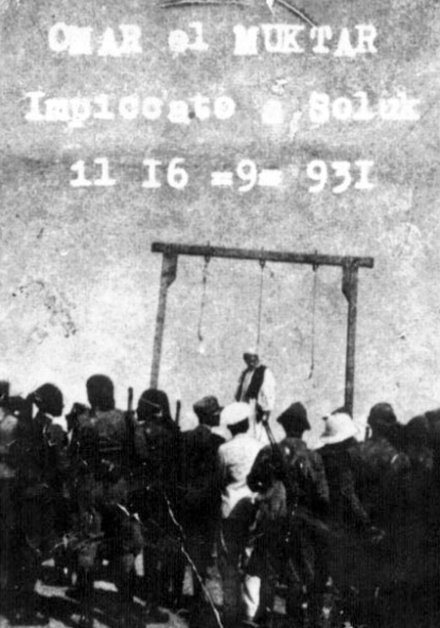
On this date in 1931, Libyan independence martyr Omar [al-]Mukhtar was publicly hanged by the Italians at their concentration camp in Suluq.

Mukhtar (English Wikipedia entry | Italian) was born an Ottoman subject back in 1858 and had lived long enough to see his native Libya seized in the 1911-12 Italo-Turkish War.

Mukhtar, a religious teacher and follower of the Senussi movement, became the leader of the Libyan resistance that dogged the Italian occupation. Mukhtar proved an energetic and successful desert guerrilla fighter, and he had to be given the Italians’ mechanized military.

The Italians executed an estimated 4,000 Libyans in the 1920s, and drove hundreds of thousands into concentration camps, and gradually, only gradually, gained the upper hand on their adversaries.

Captured in battle after he abandoned a 1929 truce, Mukhtar was denied prisoner-of-war status and subjected to a snap military tribunal in one of the small coastal enclaves actually controlled by Italy — “a regular trial and consequent sentence, which will surely be death,” as the Italian general directed. It surely was.

He’s played by Anthony Quinn in the 1981 film Lion of the Desert — a better movie than you might think given that it was bankrolled by Muammar Gaddafi.

A national hero for contemporary Libyans across any social divide you’d care to name, Omar Mukhtar was valorized by the rebels who recently overthrew the aforementioned Gaddafi (here’s Mukhtar on a billboard in rebel-held Benghazi). “The whole world knows what Omar al-Mukhtar did,” Mukhtar’s 90-year-old son told media during the civil war. “That’s where they get their energy from. Ask the youth, they’ll tell you they are all the grandsons of Omar al-Mukhtar.”

His steely profile can be seen on Libya’s 10 10 dinar note.

On this day..

1480: The Martyrs of Otranto

On this date in 1480, Ottomans invading Otranto, Italy conducted a mass execution of prisoners.

Landing at the southern Italian city on July 28, the Ottoman force quickly overwhelmed Otranto. (Otranto rashly slew the messenger come to offer a merciful capitulation, only to find that its garrison began deserting within days.) On August 11, the Turks took the city by storm. Thousands died on that day’s bloodbath, including the Archbishop of Otranto.

Surviving women and children were sold into slavery. Men over age 15 had the choice of conversion — or death.

“Now it is time for us to fight to save our souls for the Lord!” a Christian shoemaker is said to have exhorted his 800 fellow prisoners. “And since he died on the cross for us, it is fitting that we should die for him.”

The acclaim greeting this call signaled inflammation ahead for the Turkish headsmen’s rotator cuffs. They had 800 faithful souls to dispatch to their eternal reward this date at the place still known as the Hill of Martyrs. (When in Otranto, visit it by taking the via Ottocento Martiri, just off via Antonio Primaldo — that’s the name of the militant shoemaker.)


The remains of the Otranto martyrs, arrayed as relics in the Otranto cathedral. (cc) image from Laurent Massoptier.

Historical novel set during these vents.

This, at least, is the most pious version of the story. The mass execution certainly did occur, but some latter-day historians like Francesco Tateo have argued that martyrdom is not attested by any of the contemporaneous sources, and the specifically religious understanding of events was only read in after the fact.

On whatever grounds one likes, Italy’s fractious city-states were deeply alarmed by the appearance on their shores of the all-conquering Turks. “It will always seem as if the funeral cross is borne before me while these barbarians remain in the boundaries of Italy,” wrote the Florentine humanist Poliziano.* (Source, a nonfiction book which covers Otranto in some detail.)

In the ensuing months, they rallied together vowing to expel the invaders.

Fortunately for this coalition, the Ottoman sultan Mehmed the Conqueror died in May 1481, and a brief period of internal conflict within the Ottoman empire over the succession perhaps led it to allow its Otranto outpost to wither on the vine. The Turks made peace and withdrew from their potential beachhead not long after, having held the city for just over a year. The bodies of the martyrs were said to have been found uncorrupted by decay.

The Catholic church beatified the 800 martyrs in 1771, but their final elevation to sainthood occurred only in 2013, just three months ago as I write this. They were in the very first group canonized by the new Pope Francis — although the canonization was approved by his predecessor Benedict XVI on the same day that Benedict resigned his pontificate. Considering current relations between the respective faiths, it was seen as a potentially impolitic move.

“By venerating the martyrs of Otranto, we ask God to protect the many Christians who in these times, and in many parts of the world, are still victims of violence,” Pope Francis said at the canonization Mass, diplomatically not naming any of those parts of the world.

* At the same time, Florence (in common with other Italian polities) had trade and diplomatic relations with the Ottomans.

On this day..

1541: Cristóvão da Gama, Portuguese crusader in Ethiopia

On this date in 1541, Cristóvão da Gama — “the most chivalrous soldier of a chivalrous age” — was beheaded in Ethiopia.

This moment was the apex of Lisbon’s empire-building, most vividly symbolized by Cristovao’s famous dad, explorer Vasco de Gama. In the Age of Discovery, Caravels bore Portuguese colors from Brazil to Japan.

Alas, Portugal’s global maritime empire of coastal colonies and remote ports was immediately menaced by rival powers like the also at-its-apex Ottoman Empire.

Young Cristovao would be ground up in this conflict whose mixture of geopolitics and sectarianism overtly smacked of those old-time Crusades.

After a jaunt to India in the train of his older brother, appointed the Portuguese governor of India, Cristavao was sidetracked on a return voyage for an intervention on the Christian side in a raging local war. For Europeans who for generations had trafficked in the vague and fantastical rumors of mythical Abyssinian ruler “Prester John”, putting a thumb on the scale for Ethiopian Christians against the rampant Arabs must have been nigh irresistible.

Let’s listen in.

Joao III and his government, faced with mounting debts as the costs of military operations in the East steadily grew, were now forced to re-evaluate their global commitments … the new viceroy, Estevao da Gama, was ordered to destroy the Turkish fleet in Suez …

Estevao da Gama’s raid into the Red Sea became one of the best remembered episodes in the history of the Portuguese Estado da India. The fleet assembled at Massawa on the African shore and then proceeded to Suakin which was burnt and plundered. Part of the fleet then returned to Massawa while the rest sailed on to Suez where the Turkish ships proved to be securely based and inaccessible. On the shore of Sinai, as close to Jerusalem as the Portuguese were ever to come, Estevao da Gama enacted some of the rituals of crusading chivalary and made a number of knights before returning to Massawa. Meanwhile, Dom Joao de Castro, who accompanied the expedition, used the time to produce his famous guide to the Red Sea, the Roteiro do Mar Roxo, complete with the meticulous drawings of the ports and anchorages, a masterpiece of Portuguese Renaissance geography and science.


One of Joao de Castro’s drawings. (Source, a Portuguese pdf)

Meanwhile the Portuguese at Massawa had suffered extreme privations and a hundred of them had deserted, having been persuaded by [untrustworthy Potuguese-descended Ethiopian ambassador Joao] Bermudes of the richness and wealth of the interior. Their fate was to be captured and massacred by Ahmed Gran. Estevao da Gama now dispatched a force of four hundred soldiers under the command of his brother, Cristovao da Gama, into the interior to assist the Ethiopian king. Cristovao da Gama advanced from the coast with a force much the same size as that which Cortez had led into Mexico in 1519. He had with him horses, arquebuses and eight small cannon. His first objective was to link up with the fugitive Ethiopian king and his followers, but da Gama got separated from his supplies and was forced to fight a superior Somali force supported by Turkish mercenaries. The result was catastrophe. The small Portuguese army was badly mauled and da Gama himself fled wounded from the battlefield and was taken prisoner.

The capture of the viceroy’s brother, son of the great admiral, carried with it huge importance for the Turks. After being ritually humiliated (his beard being set on fire and his face buffeted with the shoes of his negro servant) Cristovao da Gama was beheaded.* For the Portuguese this was a disaster, the symbolic significance of which far transcended the military consequences of the defeat. However, the Christian church had long experience of turning catastrophe into triumph and, soon after the news of Cristovao da Gama’s death reached the outside world, rumours of miracles began to circulate.** Da Gama became one of the first martyrs of the new church overseas which in a hundred years of expansion had had all too few heroic deeds to celebrate.

After the death of their commander fewer than two hundred of the original army survived, but they were able to meet up with the Christian Ethiopian forces and, when the next campaigning season started in 1542, the combined army inflicted a heavy defeat on the Muslims, a defeat which took on a decisive complexion when it was realised that the leader of the jihad, Ahmed Gran, had been killed in the battle.

Da Gama’s expedition had been mounted from the resources of the official empire and had been commanded by one of the leading fidalgos of the Estado da India. However, few of da Gama’s soldiers returned to India Instead they settled in Ethiopia and married Ethiopian women, establishing a ‘Portuguese’ community that mirrored the ‘Portuguese’ communities in Aythia, Bengal, Kongo and elsewhere where soldiers had offered their military expertise to local rulers an had been content to settle and make their fortures far removed from the jurisdiction of the Portuguese Crown.

Although da Gama’s own end was unfortunate, his surviving force’s exploits on a side badly pressed could arguably be considered the decisive factor enabling Christianity to survive in Ethiopia’s highlands interior. Prester John would have been proud.

* “I write what I heard, it may well be that it was thus, for all that is barbarous and cruel about the Moorish king can be believed. The body, after death, was dismembered and sent to various places … because once when Granha was speaking with Dom Christovao, he asked him: ‘If you had me in your power, as I have you, what would you do to me?’ Dom Christovao, with great resolution and freedom replied, ‘If I had you in my power, I would have you killed, the head I would send to one place and the quarters I would distribute to other places’ (naming them, but I do not recall them). And Granha, they say that it was because he heard this, scattered the body to various places.”

** “Directly they cut off his head, God worked a great and manifest miracle through it, which was, that in the place where they slew him a fountain of running water gushed out, which had never been seen before: its water, through the goodness and power of God, gives sight to the blind, and cures those ill of other diseases. It appears that this miracle is like the one that God did in Rome for His Apostle St. Paul. The remains of the body of D. Christovao smell sweetly, giving forth so delightful an odour, that it seems rather of heaven than of earth.”

On this day..

1925: Sheikh Said Piran, Kurdish rebel

Early this morning this date in 1925, just hours after his condemnation for an eponymous rebellion against the newborn Turkish Republic, Sheikh Said Piran was publicly hanged.

This founding member of the Kurdish anti-Ankara martyrology had sparked a momentarily-successful rising against Turkey, fired by grievances that have not ceased to resonate since.

The secular nationalist Kemal Ataturk‘s intent to “Turkify” its peoples. The Kurdish populace’s frustrated national ambitions, indifferently bartered away by distant great powers dismembering the Ottoman Empire.* Ataturk’s abolition of the Caliphate.

“Oppressive and vile towards the Kurds,” Sheikh Said declared. (pdf)

For several years we have been able to read in the newspapers and official documents about the oppression, insults, hatred, and enmity that the Turk Republic [sic] accords to the Kurdish notables and dynasties. There is a lot of evidence available from authentic sources that they want to subject the Kurdish elite to the same treatment to which they subjected the Armenians

The February revolt quickly made him master of the majority-Kurdish eastern province of Diyarbakir, but a massive Turkish counterattack drove him east, encircled him, and had the Sheikh in irons by mid-April.

The government arrogated martial law powers to itself and appointed Orwellian courts called Independence Tribunals to prosecute Kurdish elites, rebels or no. (Some Kurdish intelligentsia were hailed to Diyarbakir from Istanbul.) Hundreds hanged, without even counting wholesale extrajudicial retribution against Kurdish civilians.

the repression of the 1925 rising was accomplished with a brutality which was not exceeded in any Armenian massacres. Whole villages were burnt or razed to the ground, and men, women and children killed.


Mass hanging of Kurds at Diyarbakir, May or June 1925 (Source)

Despite prosecutors’ avowed intention to extirpate the separatist sentiment “root and branch,” it hasn’t exactly put the whole Kurdish issue to bed.

Just ask Kurdish guerrilla Abdullah Ocalan, who received on this very same date 74 years later his own Turkish death sentence (since commuted).

* A past-is-prologue artifact from the time: the “Issue of Mosul“, a prickly international relations dispute over control of the historic city, accurately suspected to be sitting on a lot of oil.

Turkey claimed it as part of its historic heartland, but Great Britain had seized it just before World War I ended and wound up hanging onto it for the embryonic Iraqi state. Kurds who also considered it part of their homeland got short shrift altogether. It’s still disputed today among Iraqis, situated as it is just on the edge of Kurdish Iraq.

On this day..

2010: An al Shabaab rebel commander

According to a Reuters report, it was on this date last year that an al Shabaab militant was publicly shot in Somalia by a pro-government militia.

Al Shabaab — “the youth” — is an offshoot from the (now-history) Islamist alliance involved in that whole Black Hawk Down unpleasantness.

You might remember them from this summer’s World Cup: they’re the guys who bombed World Cup viewers in Uganda, killing 76. Al Shabaab (allegedly al Qaeda-linked) basically controls southern Somalia with its allies.

“We don’t normally kill al Shabaab members,” explained a spokesman for the Ahlu Sunna Waljama’a paramilitary, in cheerily chilling terms. “We arrest them and make them understand that Islam means peace.”

The unnamed character we notice this date apparently failed to “understand,” and was shot for not renouncing his affiliation.

“This commander insisted that all people were infidels except his group … We will execute al Shabaab members who insist that it can be right to kill the innocent. What else are we supposed to do to those who believe they will go to paradise for killing us and the whole human race?”

The execution nevertheless failed to quell the intractable Somali Civil War.

Part of the Themed Set: 2010.

On this day..

2009: A day in the death penalty around the world

Capiital punishment may be an ancient historical phenomenon, but it’s hardly ancient history.

The executions that several of the 21st century world’s more aggressive death penalty users coincidentally carried out a year ago today testify together to the enduring place (and variegated guises) of the headsman in modernity.

China

Three prisoners were reported killed in Jinan in China on Jan. 15, 2009.

Two were men who had been serving prison terms for separate crimes when they incurred a death sentence for a violent (though seemingly non-lethal) escape attempt.

Liu Junjie, 35, and Wang Bing, 31, broke out of the prison in Zibo City on December 8, 2007 as a truck was moving out of the prison gate, according to a statement from the Shandong Provincial High People’s Court.

They hit a prison worker and two policemen with iron bars and choppers as they forced their way out. They were later caught as they fled along a road.

Former cabbie Bo Lijun shared that fate for a series of thefts, rapes, and murders.

According to the court, Bo raped and suffocated a female barber on Oct. 23, 2002 in Dongying.

Bo attempted to rape a female passenger in a wooded area near Dongying on July 29, 2006. Although he abandoned the rape attempt, he clubbed her to death for fear she would inform the police, and he buried the body at the site.


Saudi Arabia

One Mushabeb Al-Ahmari was beheaded in the province of Asir for “killing a compatriot with a machine gun” (who he killed and why was not reported).

Al-Ahmari was a minor when he was sentenced. The statement said his execution was delayed until he came of age.


United States

62-year-old James Callahan suffered lethal injection in Alabama Jan. 15, 2009, after 26 years on death row for raping and murdering a Jacksonville State University student in 1982. Callahan

requested a last meal of two corn dogs, french fries and a Coke … spent the day visiting with family and spiritual supporters … receive[d] communion at 4:30 p.m.

Callahan’s will bequeaths to his son $36.42 from his prison account, a black and white Radio Shack TV, two watches, a Walkman, some headphones, a leather belt, two pairs of boots, one pair of Nike tennis shoes, food items and legal papers.


Updated: Somalia

(This incident was not brought to our attention until after the post was already up, but in the peripatetic spirit of the entry, we thought it suitable to append.)

Somali politician Abdirahman Ahmed (also known as Waldiire) was shot by an Islamist militia in the port of Kismayo on Jan. 15, 2009.

Perhaps the first pol executed by Islamists, Ahmed was once the spokesman for a faction in the Somali civil war. He was put to death for collaborating with the Ethiopians who invaded Somalia at U.S. behest. As the Ethiopians were Christian, this behavior qualified as “apostasy” to the militants’ sharia court.

In January 2009, Ethiopia was in the process of withdrawing its military presence in its war-torn neighbor.

On this day..

1924: Ali Reshti and Sayyid Husain, to placate America

On this date in 1924, diplomatic maneuvering, oil patch politics, and a dead American consul put two Iranian teenagers in front of a firing squad.

Largely forgotten today, the affair which prompted their execution helped Cossack commander Reza Khan‘s ongoing consolidation of power, culminating in another year’s time with his conquest of the Persian throne itself.

By the summer of 1924, he was by title Prime Minister and his domestic opponents could read the writing on the wall: he had made a premature bid for formal executive authority in 1923 only to be rebuffed.* At the same time, he was engaged in the perilous oil game with an attempt to use American companies to break a British oil monopoly.

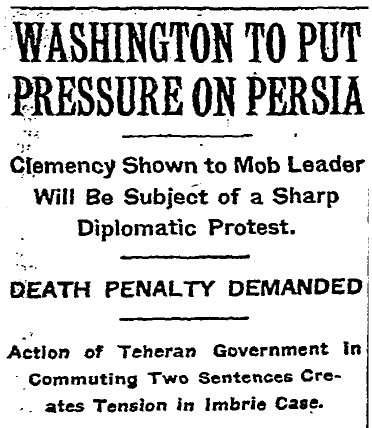
On July 18, 1924, American Vice Consul Maj. Robert Imbrie and his civilian countryman Melvin Seymour were attacked by a Tehran mob while photographing a well which had become a Moslem devotional site for purported miraculous healings. Imbrie was beaten to death; Seymour was lucky to survive … and it soon emerged that soldiers from the nearby barracks had not only failed to protect the Americans but actually taken part in the assault.

Iran’s emerging strongman lost no time in making the most of it.

The event gave [Reza Khan] … the excuse for declaring martial law and a censorship of the Press … Numerous arrests have been made, chiefly of political opponents of the Prime Minister. (British military attache Col. W.A.K. Fraser)

It’s like Lenin said, you look for the person who will benefit and, uh, you know, uh, you know, you’ll, uh, you know what I’m trying to say …

Assuming one discerns some measure of design in the Imbrie murder, and the convenient outburst of anti-Baha’i paranoia that sparked the fatal incident, one can go a couple of different directions at this point.

  1. That the Prime Minister’s foes, allied with British oil interests (the British angle was so widely believed in Iran at the time that press censorship forbade the incendiary charge), were firing up the rowdies in an attempt to shake his power. This 1924 American cable makes that case:

    “It had the earmarks from the beginning of an artificially inspired movement, of which the organized powers of evil were quick to take advantage in order to create disorder for the Government … Reza Khan found himself faced with a situation before which he was powerless. The fanaticism of the crowd was so incited by the continuous preaching of the Mullahs that any act on his part would have been interpreted as treason to Islam and prima facie evidence that he was a Bahai; hence his unfortunate orders to the military and the police not to intervene under any circumstances in religious demonstrations and under no circumstances to fire.”

  2. That Pahlavi’s own agents fomented the disorder. According to Michael Zirinsky‘s review of the case, another American official speculated that Reza Khan himself hoped a foreigner would die “so that he could declare martial law and check the power of the Mullahs.”

Which, in the event, is exactly what happened.

The U.S. made a great show of demanding exemplary justice, and it had the leverage to do so: Iran (how times change!) wanted American support and American oil exploitation.

Three were condemned to death for their parts in the riot, and after the first, a young soldier named Morteza said to have incited the mob, was shot on Oct. 2, the government announced leniency for the other two.

Not good enough.


“When you are dealing with a government like Persia … if you ask them to execute a Moslem for the death of a Christian … if they do it, you accomplish more for the prestige of your country than if they paid a million.” -a young Allen Dulles, in 1926 testimony to the U.S. House of Representatives.

At American insistence, those other two were recalled to death after all: 17-year-old mullah Sayyid Husain (various alternate transliterations – e.g., Seyid Hussein), who was supposed to have raised the riot-triggering “Baha’i well-poisoner” accusation in the first place, and 14-year-old camel driver Ali Reshti.

Zirinsky once again:

With the ending of the Iran-U.S. dispute by the execution of Ali and Husain on November 2, 1924, Reza was free to leave the capital city. He had support from the foreign legations, he had secured financing for the army, he had reestablished discipline in the Cossack Brigade, and by executing Sayyid Husain — a mullah — he had demonstrated his domination over the clergy … in the course of the next months’ campaign, he completed the unification of Iran and ensured that his government would get all the [Anglo-Persian Oil Company] royalties…

While the Imbrie affair was not the only critical event of Reza’s seizure of total power in Iran, it came at a critical moment in his rise … he used the murder to his best advantage.

And they all lived happily ever after.

* The future Shah’s future rival Mohammed Mossadegh was among the Iranian Majlis members who blocked Reza Khan’s attempt to rule Iran as a republic in 1923.

** “Blood, Power, and Hypocrisy: The Murder of Robert Imbrie and American Relations with Pahlavi Iran, 1924,” International Journal of Middle East Studies, vol. 18, no. 3 (Aug. 1986). Zirinsky quotes an American diplomat who believed Reza Khan was actually intentionally trying to create a situation where a foreigner would be killed, to give him a pretext for bringing his nation to heel with foreign support.

On this day..

1996: Dr. Mohammad Najibullah

On this date in 1996, the man who once ruled ruled Afghanistan under the aegis of a superpower succumbed to the tender mercies of his country’s fundamentalist insurgency.

Mohammad Najibullah was the last president of the Soviet-backed Democratic Republic of Afghanistan. Unfortunately for Najibullah, he was on the job when Moscow decided to throw in the towel on the Soviet-Afghan War.

After losing the subsequent civil war, the former President was trapped for a nervous few years in Kabul — blocked from joining his family in flight to India by the offices of former Soviet client and present-day American client Abdul Rashid Dostum.

When Kabul finally surrendered to the Taliban in 1996, the hated onetime Communist viceroy — whose stepping-stone to that post was heading the hated Afghan secret police — had a problem.

At the instigation of future Taliban second-in-command Mohammad Rabbani, Najibullah and his brother were hauled out of the U.N. compound where they had taken refuge, publicly beaten, tortured and castrated, and strung up on a traffic barricade.

There was a new sheriff in town.


On this day..

2006: Three Sulawesi Christians

On this date in 2006, Catholics Fabianus Tibo, Marianus Riwu and Dominggus da Silva were shot in the Central Sulawesi capital of Palu for inciting murderous anti-Muslim riots six years before.

The riots in question occurred in Poso, a hotspot of Christian-Muslim conflict that over 1,000 lives from 1999-2001. According to the Jakarta Post (September 25, 2006),

Tibo, Marinus and Dominggus were convicted of leading a Christian militia that carried out a series of attacks in May 2000 in Sulawesi, including a machete and gun assault on an Islamic school where dozens of men were seeking shelter.

Though a 2001 treaty stabilized the situation, tension remained, occasionally flaring into violence.

The 2001 death sentences of Christian activists also remained, a legacy of the open conflict. Small wonder that their execution triggered further unrest, not only in Poso but in Silva’s hometown in predominantly-Christian West Timor. And aftershocks for months to come — the murder a month later of a prominent Christian cleric, for instance — quelled by security forces sweetened with a bit of goodwill rebuilding.

Jakarta ignored international as well as domestic clemency appeals in carrying out the executions, including from the European Union and the the Vatican. The latter’s argument may have been somewhat compromised under the circumstances by Pope Benedict XVI’s impolitic citation just days before of a 14th-century Muslim-bashing text.

Apart from the humanitarian objections, others more specific to the case were raised in vain: that the trio executed had not been witnessed killing anyone personally, and that the sentences were disproportionate to that received by anyone else convicted in that era’s violence.

But such contentions were easily outweighed by the simultaneous progress of the Bali Bombers case, with the imminent likelihood of a triple-execution of Muslim militants … and the prospect of political fallout if only one faith’s martyrs were let off the hook.

On this day..