1940: Isaak Babel

On this date in 1940, Isaak Babel, “the greatest prose writer of Russian Jewry,” was shot in Moscow.

The Odessa-born 45-year-old had managed the difficult trick of maintaining a high-profile writing career in the 1930s Soviet Union without abandoning his artistic integrity. (This meant he published a lot less in that decade, which fact was held against him in his trial: “deliberate sabotage and a refusal to write.”)

A pre-revolutionary friendship with Maxim Gorky and an early affinity for the Bolsheviks had helped see him through such transgressions against Communist ideology as describing Red atrocities during the Russian Civil War, and writing a play about the underbelly of Soviet society.

Babel remains beloved today for that very reason; his Odessa Tales collection of short stories about Jewish gangsters still charms Russians and foreigners alike.

But Gorky died in 1936, and without that elder statesman’s protection, Babel’s insufficiently lockstep scribbling laid him increasingly liable to public denunciation for, e.g., “aestheticism.”

And as sickle follows hammer, miscalibrated revolutionary ardor in Stalin’s Russia led in 1939 to that dread knock on the door, that stay in Lubyanka Prison, that inevitable “confession” of Trotskyism, and that bullet to the head after a perfunctory trial.

Babel’s work is recent enough that it’s mostly not freely available in English. A couple in English and several in Russian are linked here; literary criticisms with plentiful excerpts of Babel’s work are available here, here, and here, among many other places.

Babel was officially rehabilitated during the Khrushchev era.

On this day..

1953: Lavrenty Beria, Stalin henchman

On this date in 1953, Stalin’s feared minister Lavrenty Beria was shot — finally on the receiving end of the cruelty he had administered to countless Soviet citizens.

Lavrenty Pavlovich was, like Stalin, a Georgian peasant, albeit one generation younger.

He won his way into Stalin’s confidence from the 1920’s, and in 1938 replaced Nikolai Yezhov as head of the KGB predecessor NKVD. Yezhov did much of the bloody work of the Great Purge, and was himself in turn purged. The cunning Beria must have taken note.

Though his initial project was to clean up the excesses of the Yezhovshchina — releasing thousands of innocent convicts, making the gulag camps less homicidal and more effective and keeping prisoners alive long enough to get some work out of them, that sort of thing — it wasn’t long before Beria cast a terrifying shadow of his own. (Beria was Yezhov’s deputy, so it’s not like he walked into the job without the requisite qualifications for mass murder.) He wrote the memo proposing the execution of Polish officers that led to the Katyn massacre.

To the more everyday repressive operations of the Soviet secret police, Beria added his notorious (perhaps propagandistically exaggerated?) personal peccadilloes: nothing to trouble the boss, just a little penchant for seducing, or raping, and at his pleasure murdering, comely young lasses.

Soviet author Sergei Dovlatov sketched his character in this imagined vignette (translated by Executed Today friend Sonechka from the Russian original here):

As is well known, winsome high school girls were delivered to Lavrenty Beria’s house. Then his chauffeur presented a bouquet of flowers to the next victim. And rendered her home. This was an established ceremony. Suddenly, one of the damsels became unruly. She began to struggle and scratch. In short, held her ground and did not succumb to the charms of the Internal Affairs minister. Beria told her:

-You can leave.

The young woman descended the stairs. The chauffeur, not expecting such a turn of events, handed her over the prepared bouquet. The girl, somewhat more composed now, addressed the minister who was standing on the balcony:

-You see, Lavrenty Pavlovich! Your chauffeur is more courteous than you are. He gave me a bouquet of flowers.

Beria sneered and dully uttered:

-You are mistaken. It is not a bouquet. It is a funeral wreath.

More consequential for his fate was his position among the handful of Stalin’s closest associates, in which capacity he maintained himself for a remarkably extended period of time. This made him one of the people with a shot at succeeding Stalin, which in turn put him in the middle of the furious political infighting Uncle Joe was pleased to subject his subordinates to.

And the natural enmity between sovereign and heir — the one whose interest is the other’s death — may have even led Beria to poison Stalin in March 1953 when he was on the verge of a falling-out himself. Foreign Minister Vyacheslav Molotov (he of the pact, and the cocktail) remembered in his memoir Beria boasting after Stalin’s sudden and mysterious death,

“I did him in! I saved all of you!”

Briefly the official #2 man in the post-Stalin state, he would again preside over a political liberalization that belied his monstrous personal reputation.

But this pallbearer of Stalin soon followed his former master to the grave. Outmaneuvered by rivals Nikita Khrushchev, Georgy Malenkov, and Molotov, Beria was purged as a traitor in the summer of 1953 and secretly executed Dec. 23, 1953 with six confederates after a summary trial before the Supreme Court. (One of the expedients laid at his feet in that affair was a set of executions he had ordered in a 1941 purge).

According to a chapter by Michael Ross and Anne E. Wilson in Memory, Brain and Belief, after Beria’s fall, subscribers to the Great Soviet Encyclopedia

were instructed to destroy the article on Beria and were provided additional information on the Bering Strait to fill the gap in the pages.

Beria’s heirs actually applied to the post-Soviet government for a reversal of the conviction under laws granting victims of politically motivated prosecutions right of redress. The Russian judiciary turned them down.

On this day..

1906: Zinaida Konoplyannikov, assassin

On this date in 1906, less than three weeks after she had assassinated tsarist general Georgiy Alexandrovich Min (Russian biography), revolutionary Zinaida Vasilevna Konoplyannikov was hanged at Schlisselburg fortress near St. Petersburg.

Konoplyannikov is mostly noted in Russian sources online (for instance, here and here).

The daughter of a soldier and a peasant, she was educated — hardly a given for a low-born girl in the late 19th century — and taught in the Baltics and St. Petersburg around the turn of the century. By her profession, the plight of her similarly unprivileged students helped radicalize her.

She had a couple arrests for the usual subversive stuff (distributing illicit propaganda and the like) during Russia’s brief flowering towards liberalism in the 20th century’s early years. Those years would be bloodily reversed as tsarism reasserted itself after the revolutionary moment of 1905.

Konoplyannikov avenged herself on one of the great villains (from her standpoint) of that reversal, G.A. Min — commander of the Semenyovsky Life Guards regiment which bloodily bombarded Moscow’s Red Presnia working-class district to crush the last bastion of revolutionary sentiment in December 1905 at the cost of more than 1,000 lives.

Konoplyannikov gunned him down at a Peterhof train station the following August; in a closed military courtroom (giving her no opportunity to use the trial as an oratorical platform), the assassin was condemned to hang in less than an hour.

She was reported to have died calm, sure in the approaching victory of her cause:

the history of the Russian nation is a record of blood … the autocratic and bureaucratic structures are maintained only by violence … You cannot build anything upon the place of the old without first destroying the old. If it is impossible to catch ideas with bayonets, it is also impossible to resist bayonets with ideas only …

No repressions, no arrests, no prisons, no exiles, no shootings, no punitive expeditions, no pogroms, will stop the rising national movement.

I die with one thought: forgive me, forgive me, my people! I have so little to give you — only this, my life. I die full of faith in what will come … when the throne will crumble, and over the Russian plain, a broad, bright sun of freedom arise.

According to Abraham Ascher, Min’s assassination so spooked Tsar Nicholas II that for a time he refused to leave his room … a evocative and emblematic summary of the Romanov dynasty’s ultimately fatal dilemma.

On this day..

1952: Night of the Murdered Poets

As night fell this evening in Moscow, 13 prominent Soviet Jews were shot in Lubyanka Prison on trumped-up charges of treason and espionage.

“The Night of the Murdered Poets”, as it’s come to be remembered, wasn’t so much about the poetry; “only” five of the victims fit that description.

But as Joshua Rubenstein put it, “only the martyred Yiddish writers are mentioned at August 12 commemorations; the other defendants who lost their lives, as well as the sole survivor Lina Shtern, are rarely if ever remembered, perhaps because their careers as loyal Soviet citizens do not fit comfortably into an easy category for Westerners to honor … Stalin repaid their loyalty by destroying them.”

Falling victim to Stalin was such a particularly tragic fate because they were, in the main, good Communists:* good enough to have been part of the Jewish Anti-Fascist Committee, a World War II organ dedicated to rallying support for the Soviet Union against Nazi Germany.

Such national particularism — any port in a storm! — was all well and good when Moscow had the Wehrmacht at its gates and a short supply of friends, but it increasingly ran dangerously afoul Soviet officialdom as the 1940’s progressed. It was a bastion of sectarian identity rather than socialist universalism; its celebration of the Jewish soldier and of Jewish wartime travails cut against the narrative of Soviet sacrifice and heroism; its overseas links to the United States (where it toured in wartime) and the new state of Israel made it suspect, or at least vulnerable.

Thin excuse for mass execution, to be sure, but in a structure of generalized antisemitism run by a trigger-happy dictator …

In 1948-49, fifteen JAC members were arrested. One would die in prison; the aforementioned Lina Stern, a scientist, would receive a term of exile and return to Moscow when this purge’s victims were rehabilitated after Stalin’s death.

The thirteen others were tortured and condemned by a rigged (but secret, since many of the accused wouldn’t cop to public self-denunciations) trial

Years before his arrest, Markish would write words to make a eulogy for many a disillusioned Soviet citizen … and literally so in his case, since the verse was cited at his trial as evidence of his “pessimism”:

Now, when my vision turns in on itself,
My shocked eyes open, all their members see
My heart has fallen like a mirror on
A stone and shatters, ringing, into splinters.

Piece by piece I’ll try to gather them
To make them whole with stabbed and bleeding fingers.
And yet, however skillfully they’re glued,
My crippled, broken image will be seen.

* Naturally, being a good Communist did not keep one safe from Uncle Joe.

On this day..

1940: Vsevolod Meyerhold

It is thought to be on this date in 1940 that the Soviet theater director Vsevolod Meyerhold was shot on a fabricated espionage charge.

Meyerhold costumed as Ivan the Terrible.

Meyerhold (English Wikipedia page | Russian) was one of Russia’s great theatrical innovators in the early 20th century.

Pioneering non-representational theater — and a training method, “biomechanics”, to facilitate them — his star shone bright in the avant garde firmament of the early Bolshevik Republic.

But Meyerhold’s schtick was most definitely not Uncle Joe’s fave, socialist realism.

And that meant, come the 1930’s, Meyerhold had a problem.

His career (Russian link) died out over that chill decade and the director himself was arrested in 1939 and tortured into confessing to spying.

(Shortly after his arrest, his wife was “mysteriously” killed.*)


Meyerhold in custody.

Meyerhold recanted the confession and sent Foreign Minister Molotov a pitiable appeal detailing his treatment.

I was made to lie face down and beaten on the soles of my feet and my spine with a rubber strap … For the next few days, when those parts of my legs were covered with extensive internal haemorrhaging, they again beat the red-blue-and-yellow bruises with the strap and the pain was so intense that it felt as if boiling water was being poured on these sensitive areas. I howled and wept from the pain … When I lay down on the cot and fell asleep, after 18 hours of interrogation, in order to go back in an hour’s time for more, I was woken up by my own groaning and because I was jerking about like a patient in the last stages of typhoid fever

The director was officially rehabilitated in the post-Stalin thaw, but some of his work — like a collaboration with another artistic heretic, Prokofiev, on Boris Godunov — is only now being found and staged.

More about Meyerhold at the Moscow Meyerhold Memorial Museum

* According to The Secret File of Joseph Stalin:

Her body had 17 knife wounds, and her eyes had been cut out, apparently from the superstitious fear that they retained the image of her murderers. The only things taken from the apartment were documents.

On this day..

1987: Valery Martynov, betrayed by Aldrich Ames and Robert Hanssen

On this date in 1987, a once-promising American intelligence asset was executed with a single gunshot to the head in Moscow — his treachery exposed by two of the most infamous Soviet moles in U.S. intelligence history.

A Lieutenant Colonel in the KGB posted to the Soviets’ official Washington, D.C. offices in 1980, Martynov had turned in 1982 and begun funneling intelligence to the CIA and FBI under the cryptonym “Gentile”. Truth be told, he was a mediocre source, but he was a younger officer with the chance to grow into a more important asset in the years ahead.

Fate had sized him up as an extra in someone else’s story instead.

In 1985, “the year of the spy” to those in the know for the volume of important cloak-and-dagger work, the Soviets landed two highly-placed moles in the American intelligence world — Aldrich Ames of the CIA and Robert Hanssen of the FBI.

Both those notorious turncoats shopped Martynov (among others); duly informed, Russian spymaster Victor Cherkashin conned Martynov into returning to Moscow where he could be arrested.

Here’s a 2001 New York Times account on how it went down:

[Soviet counterintelligence officer Vitaliy] Yurchenko, unhappy with his lot as a defector [after coming over to the Americans in August 1985], suddenly redefected back to the Soviet Union in early November [1985, still]. Mr. Cherkashin has said in a previous interview that Mr. Yurchenko’s redefection presented an opportunity to lure Valeriy Martynov, a K.G.B. officer in the Washington station working for the F.B.I., back to the Soviet Union: The K.G.B. arranged for Mr. Martynov to serve as a member of an honor guard escorting Mr. Yurchenko back to Moscow.

When they arrived back in the Soviet Union, it was Mr. Martynov who was arrested; Mr. Yurchenko was given a job at the K.G.B. again.

No honor among thieves.

Martynov left a widow, Natalia, and two children. But he is remembered and written about exclusively in the context of the men who sold him out, who taken separately or together rate among recent history’s most catastrophic intelligence failures. (Or triumphs, depending on your point of view.)

Martynov’s ultimate tragedy, of course — one he shares with his more infamous American betrayers in this shadowland chess match — is that not by all the information he provided, and neither by his life nor his death, was the Cold War protracted or abbreviated by one single hour.

Books about the Ames and Hanssen cases

On this day..

1938: Seventeen former Bolshevik officials from the Trial of the 21

(Thanks to Dmitri Minaev of De Rebus Antiquis Et Novis for the guest post. Be sure to read his corollary piece on cameos by some of this day’s victims in Bulgakov’s Master and Margarita.)

On 15 March 1938, 17 former executives of the Communist Party were executed at the “special object” Kommunarka near Moscow.

As head of the NKVD, Yagoda had arranged show trials before. This time, the shoe was on the other foot.

The names of some of them are found in any history book’ others were totally unknown even in 1930s. Alexey Rykov and Nikolay Bukharin were the topmost (well, almost) leaders of the USSR. Nikolai Krestinsky was a member of the Central Committee Secretariat and the Soviet ambassador to Germany. Christian Rakovsky was a diplomat, the head of the government of the Ukrainian SSR. Genrikh Yagoda was the minister of internal affairs, head of NKVD (the late name of Cheka). P. Kryuchkov was an officer of OGPU (an NKVD department) and the secretary of Maxim Gorky, the “official writer” of the communist USSR.

The others were ex-finance minister of the USSR Grigory Grinko, the general secretary of the Communist Party of Uzbekistan Vladimir Ivanov, ex-prime-minister of the Uzbek SSR Faizullo Hojayev, ex-minister of foreign trade of the USSR Arkady Rozengoltz, ex-minister of agriculture Mikhail Chernov, Isaac Zelensky, S. Bessonov, Akmal Ikramov, Vasily Sharangovich, Prokopy Zubarev, Pavel Bulanov, Veniamin Maksimov-Dikovsky and the doctors Lev Levin, Ignaty Kazakov and Dmitri Pletnyov (one of the founders of the Soviet cardiology).

There were 21 of them under trial, but three (Pletnyov, Rakovsky and Bessonov) were sentenced to imprisonment* and the date of execution of Yagoda remains unknown. The others all died this day.

Railroaded

“The trial of the 21” was officially known as “the case of the anti-Soviet right-Trotskyite block”. They were accused of “treason, espionage, sabotage, terror, undermining Soviet military power and provoking foreign countries to attack the USSR”. The other accusations were: a conspiracy to restore capitalism and to separate the Soviet republics and the Far East from the USSR; ties with foreign intelligence (including that of Nazi Germany, via Trotsky or directly); preparation of military aggression against the USSR; organizing peasants’ revolts in the USSR; the murders of Kirov, Menzhinsky, Kuibyshev, Maxim Gorky and his son Maxim Peshkov; and attempts to assassinate Lenin, Stalin and N. Yezhov (note this name).

After having his memory jogged, Krestinsky remembered that he really was part of the right-Trotskyite conspiracy.

Only the three doctors were provided with a legal defense. The others “voluntarily” refused.

All of them confessed to committing most of the various supposed crimes, although several had unavailing caveats. Krestinsky denied the charges, but it took only one day to convince him of his “failing” memory. “I fully and completely admit that I am guilty of all the gravest charges brought against me personally, and I admit my complete responsibility for the treason and treachery I have committed,” he said on the next day. Bukharin denied some of the charges brought against him. The doctors insisted that they killed Menzhinsky because of fear of Yagoda. Yagoda himself confirmed that he participated in the murder of Gorky’s son Peshkov, but said that motives were personal and not anti-Soviet.

According to the documents found in the archives, Bukharin, Rykov and Krestinsky were sentenced to death on 2 March, on the first day of the process. It could be an error, but on the other hand, it could indicate that the sentence was determined before the trial.

Neverending Story

The first draft of this article started like this: “This story began in …”

Then I stopped and scratched my head. The date when this story really began is not very clear. Some would argue that it began in 1922 when Stalin became the general secretary of VKP(b), others might say that it started in 1918, when the Bolsheviks dissolved the Constituent Assembly, and so on. What is clear is that 1937, when many of those twenty one were arrested, was not the beginning.

Then I decided to begin the other way round: “This story ended in…”

And once again I stopped. This trial had too many interesting corollaries and, of course, the story did not end in 1938. So, in the end the article became a mess of jumps in time to and fro. We are nearly as far removed today from Stalin’s purges as the purges were from the age of Russian serfdom — and those trials throw a shadow across the entire span of time.

Terror

Here’s a small extract from the series of events that preceded and followed the trial. In 1936 Bukharin and Rykov zealously supported the prosecutions of Zinoviev and Kamenev, two other old faithful Bolsheviks, accused by Stalin in opposing the policy of the party. The campaign ended with their trial and execution. Bukharin wrote letters to Stalin:

“I have always sincerely supported the line of the party and Stalin … These are the glorious milestones: industrialization, collectivization, elimination of kulaks, two great five-year plans, concern for the working man, new technologies and stakhanovism, wealthy life, the new constitution.”

“It’s great that the rascals [Zinoviev and Kamenev] were shot. The air became cleaner.”

Bukharin kept busy awaiting trial by writing Philosophical Arabesques … and three other books.

In 1925-1926, when Stalin organized the first campaign against Zinoviev and Kamenev, Bukharin and Rykov also applauded him. “I hand the broom to comrade Stalin,” said Rykov, “to wipe our enemies away.” Yet earlier, Bukharin and Rykov together with these “enemies” Zinoviev and Kamenev helped Stalin to repel the attempts of Trotsky to become the leader of the Soviet state after the death of Lenin.

Bukharin was not an idiot. He understood that he was not any different from Zinoviev. He was the first candidate to replace Stalin if something happened to Stalin — which made him automatically suspect in the eyes of the boss.

Moreover, he was a Bolshevik and he knew the habits of Bolsheviks very well. Caricaturist Boris Yefimov recalled that on 1 December 1934, when Bukharin learned of the assassination of Kirov, he told the other people who were in the room: “Kirov was killed in Leningrad. Now Koba will shoot us all.” (Koba was Stalin’s nom de guerre) But, being a professional revolutionary and conspirator, he knew only one strategy for survival: hypocrisy.

In this 1927 photo at Lenin’s mausoleum, two of today’s victims — Rykov (on the far left) and Bukharin (by his side) — share the platform with Joseph Stalin (far right). Between them is Kalinin, the rare old Bolshevik who managed to survive the 1930’s. (Source)

This strategy did not guarantee success with Stalin. The proof for this may be found in what happened during and after the trial.

Ostracism

Let’s have a look at the newspapers of 1938.

From the resolution of the meeting of the workers of the institute of physiology of the Ukrainian Academy of Sciences and the institute of experimental biology and pathology of the Ukrainian ministry of health care.

With the deepest resentment and indignation we hold up to shame the traitors of their motherland, the mercenaries of the fascist secret services, mean Trotskyite-Bukharin’s scoundrels. The history of humanity hardly knows other examples of similar crimes.

We proclaim that the fascist mercenaries will never succeed in dismembering the great Soviet Union and in handing the flourishing socialist Ukraine to the capitalists. We add our voices to the voice of the many million Soviet people demanding to exterminate all the mean traitors, spies and murderers.

From the resolution of the third conference on physiology of the Academy of Sciences of the USSR.

The traitors Bukharin, Rykov, Yagoda and others did not disdain any means in their vile job. These traitors never eschewed any mostrous crime.

The doctors Pletnyov, Kazakov, Vinogradov and Levin in this repellent union consciously used the trust of their patients to kill them. History never saw such crimes. Death to these murderers! Destroy all the gang of the “right-trotskyite” block!

From the article “We demand merciless retaliation against the vile traitors of our great Motherland”.

Having sold themselves to the fascists, plotting with the diplomats and the general staffs of some aggressive imperialist states, a despicable handful of human degenerates, servants of the fascist cannibals, led by a Gestapo agent, gangster Trotsky, sold our socialist motherland and its treasures to the most evil enemies of the human progress.

We demand from our Soviet court merciless retaliation against the vile traitors! We demand the extermination of the despicable degenerates!

The last article was signed by many outstanding scientists: the chairman of the Academy of sciences Komarov, professor Valeskalns, academics Keller, Bach, Vavilov, Gorbunov and others. N. Vavilov died in prison in 1943. N. Gorbunov was sentenced to death and executed in 1938. I am not certain about the others, but about 70% of the members of the Central Committee of the Communist party who supported Stalin’s proposal to arrest Bukharin and Rykov were later arrested themselves, and many of them died or were killed.

Here’s another quotation from a newspaper:

While accepting responsibility for the endless chain of dreadful bloody crimes which history never saw before, Bukharin attempts to give an abstract, ideological, sissy nature to his concrete criminal guilt. He fails to do so, the court and the prosecutor easily discern these attempts, but this trick is very typical for Bukharin’s nature of the right-Trotskyite political prostitute.

The pretensions of the garrulous, hypocritically vile murderer Bukharin to look as an “ideologist” lost in theoretical blunders are hopeless. He will not succeed in separating himself from the gang of his accomplices. He will not succeed in averting full responsibility for the chain of monstrous crimes. He will not wash his academic hands. These hands are stained with blood. These are the hands of a murderer.

I ask myself, “If you must die, what are you dying for?” With startling vividness a black void immediately rises before my eyes. “There is nothing to die for, if one wants to die unrepentant. If, on the contrary, one repents, everything fine and good that shines in the Soviet Union acquires in one’s mind a new dimension.” In the end it was this thought that completely disarmed me. I went down on my knees before the Party.
Bukharin

This article was written by a gifted poet, journalist Mikhail Koltsov on 7 March 1938. He was shot by NKVD on 2 February 1940, less than two years later.

By the way, N. Yezhov (the “assassination” target of Bukharin’s party), who replaced Yagoda as the head of NKVD, was also arrested and executed in 1940 as a spy and conspirator.

Krestinsky, Ikramov, Hojayev and Zelensky were acquitted in 1963.

On 4 February 1988 the Supreme Court of the USSR ruled that confession cannot be interpreted as a proof of guilt and acquitted ten out of twenty one victims. (I could not find information on the cases of Grinko, Bessonov, Sharangovich, Zubarev and Pletnyov.) The sentence against Yagoda, to whose ruthless secret police history has been less generous, was left in force.

* Pletnyov, Rakovsky and Bessonov, the three to avoid death sentences at the Trial of the 21, were later summarily executed together with 154 other political prisoners when the Nazi armies approached the city Oryol in September 1941.

On this day..

1775: Yemelyan Pugachev

On this date in 1775, the Russian Empress Catherine the Great had Cossack rebel Yemelyan Pugachev chopped to pieces in Moscow for sustaining a major insurrection whose effects would haunt Russia for decades to come.

Pugachev’s Rebellion was the most spectacular specimen in populous family tree of 18th century peasant uprisings.

Most such disturbances were local and fundamentally unthreatening. Pugachev’s was neither.

The Cossack commander raised a revolt in the Urals in 1773, styling himself the long-lost tsar Catherine had overthrown a decade before.

Catherine was slow to see the import, but this hinterlands pretender set up a state-like bureaucracy and began issuing ukases as tsar — and one can readily discern from their content why he attracted a following:

We bestow on all those who formerly were peasants and in subjugation to the landowners, along with Our monarchic and paternal compassion … tenure of the land and the forests and the hay meadows and the fisheries and the salt lakes, without purchase and without obrok, and we liberate all the aforementioned from the villainous nobles and from the bribe takers in the city–the officials who imposed taxes and other burdens on the peasants and the whole people … [T]hose who formerly were nobles living on estates are enemies to Our power and disrupters of the empire and oppressors of the peasantry, and they should be caught, executed and hanged, they should be treated just as they, who have no Christianity, dealt with you peasants.

The insurrection speedily metastasized, and by the time a force sufficient to quash it was deployed, it had stretched itself from the Urals to the Volga.

Alexander Pushkin used the story of Pugachev’s rebellion for The Captain’s Daughter (text in English | Russian), which has been adapted to film several times — most recently in 2000.

Catherine the Great, for her part, was deeply shaken by the affair, and the “enlightened despot”, while maintaining traffic with the era’s liberal intellectual ferment, decisively turned against any reform to serfdom. Catherine’s choice, reinforced by her successors, to uphold their security with nothing but repression maintained Russian serfdom until 1861 on a staggering scale — an anchor dragging down the economy just as industrializing western Europe opened a development gap whose effects persist to this day.

On this day..

1937: Teido Kunizaki

On this date in 1937, Japanese intellectual Teido Kunizaki was shot as a “spy of the Japanese army” in Moscow.

The reader is not deceived to infer from the date and place the dread hand of Stalin’s NKVD at the height of the Soviet purges. The fate of the Soviet Union’s tiny community of Japanese emigres, one of the hidden chambers in a house of horrors, only became fully understood after the Soviet Union collapsed.

The leader of the Japanese section of the German Communist Party in Weimar Germany, Kunizaki’s opposition to Japanese intervention in China and involvement in a publication as subversively titled as Revolutionary Asians had made him unwelcome in Germany shortly before Hitler took power.

But arriving in Russia in September 1932 with his German wife, he stepped into a struggle for power within the Japanese Communist Party’s Russian organs.

According to Tetsuro Kato, the professorial Kunizaki was among those denounced by another seminal Japanese communist, Kenzo Yamamoto — a working-class activist who distrusted intellectuals.

Kunizaki’s execution this day was only one of many wrought on the Japanese party by the Soviet secret police in the dangerous exchange of accusations and denunciations. On this date, Yamamoto himself was already in prison; early in 1939, he would swallow the same draught as Kunizaki — denounced, as it emerged after the Cold War, by yet another of Japan’s revered old Marxists.

In the 1920s and 1930s, there were about 100 Japanese who dreamed of living in “the paradise of the working class” and went to the USSR. These people were mainly communists, who were oppressed by the imperial police in Japan. There were also ordinary workers, intellectuals and artists who were not communist … Almost all Japanese living in the USSR [in the 1930’s] faced the same destiny. The exact number of victims is not yet known, but I now estimate there to have been about 80 Japanese [shot by the NKVD].

On this day..

1941: Zoya Kosmodemyanskaya

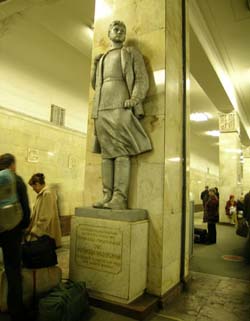
On this date in 1941, Soviet partisan Zoya Kosmodemyanskaya was hanged by the Wehrmacht for sabotaging buildings behind German lines near Moscow.

A statue of Zoya Kosmodemyanskaya stands vigil over Moscow’s World War II-era Partizanskaya metro station. Image used with permission.

One of the most famous Soviet war heroines and the first woman decorated as Hero of the Soviet Union during World War II, the 18-year-old had quit school to volunteer for a partisan unit only a few weeks before her hanging as Russia mobilized against Hitler’s race towards Moscow.

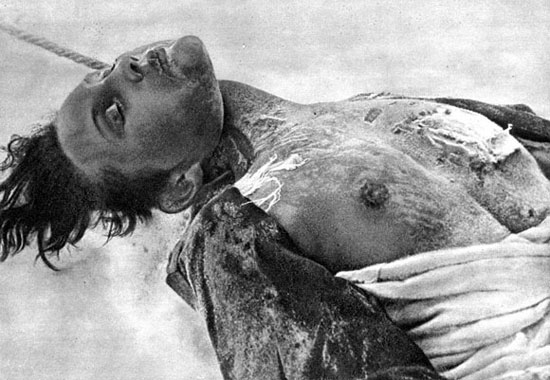
Known simply as “Tanya”, the nom de guerre which was the only information she volunteered during two days of torture, the power of the press offered her apotheosis into a propaganda coup for the Kremlin, and a symbol of courage that would long outlive Stalin. Before the public execution, the Nazis paused to photograph the scene; Kosmodemyanskaya availed the lull to harangue the Germans — “you can’t hang all 190 million of us!” — and call on the Russian villagers present to resist occupation.

Her bayoneted, mutilated body hung on the gibbet until the Red Army recaptured the village; witnesses related the tale of her dying heroism to a newsman.

It was only after the story of “Tanya” hit the press in January 1942 that her identity was established … and then promulgated widely. Anonymous and obscure in death, Zoya Kosmodemyanskaya would inspire millions and become the heroic emblem of other women partisans.


Soviet propaganda poster unabashedly modeled on the already-iconic image of Zoya Kosmodemyanskaya’s abused corpse.

Zoya, a 1944 Soviet film, was scored by Dmitri Shostakovich.

Part of the Themed Set: Women Against Fascism.

On this day..