Supreme Court justice Anacleto Diaz and his two sons were among 300 Filipinos machine-gunned by the Japanese on this date in 1945 during the Battle of Manila.
The distinguished 66-year-old jurist had served in his youth in the forces of independence fighter Antonio Luna. Diaz was captured by the Americans, and honed his English so well as a POW that he later built a career as a legal scholar in the American-governed archipelago. He was appointed to the Philippines Supreme Court by U.S. President Franklin Delano Roosevelt.
Diaz and his comrades were far from the only civilians to suffer during the bloody monthlong Battle of Manila: Japanese troops conducted intermittent atrocities both wholesale and retail, collectively known as the Manila Massacre. Japan’s commanding general, Tomoyuki Yamashita, was hanged as a war criminal in 1946 due to the Manila Massacre in a highly controversial case — since the Manila Massacre’s atrocities couldn’t be attributed directly to Yamashita’s own orders. But the U.S. war crimes tribunal found, and the U.S. Supreme Court agreed, that the subordinate troops’ actions redounded to the account of their superiors who “fail[ed] to discharge his duty as a commander to control the acts of members of his command by permitting them to commit war crimes.”
This is one of the foundational cases for that opportunistically observed precedent known as “command responsibility” (indeed, this is the “Yamashita Standard”).
As one might guess by the late date and the juridical aftermath, this Battle of Manila ended in an American victory reconquering a now-devastated Philippines capital, and driving the Japanese from the Philippines — making good Gen. Douglas MacArthur‘s famous promise to return there.
On this date in 1943, days before their city was liberated, five members of the anti-occupation resistance were shot in Krasnodon in the Donbass.
That eastern Ukrainian city* had fallen under German-Italian-Romanan occupation in July 1942.
In response, some 100 local teens banded together into an anti-fascist underground — the Molodaya Gvardiya, or Young Guard. (English Wikipedia entry | Russian) Most of their number would give their lives in resistance.
During the few months of occupation, the Young Guards managed an impressive record of sabotage operations and propaganda coups. It busted 90 people out of the Germans’ concentration camp, and got the hammer and sickle hung up on government buildings to mark the silver anniversary of Red October. In December, the Young Guards managed to destroy the labor bureau (and its list of intended conscripts) on the eve of a planned deportation, sparing 2,000 people that dreadful fate.
The Germans finally got their hooks into the Young Guards and started mass arrests at the start of January. They brought in most of the Young Guards for torture and execution — smashing up the organization in their very last weeks in town.
The five put to death this date were the last of those martyrs, and the more tragic in that the occupiers were even then gearing up to evacuate as the Red Army closed in. (The Soviets took the city on February 15.) They were:
Oleg Koshevoy’s interrogation. Image from MolodGuard.ru’s stupendous images collection.
In September 1943, three Soviet citizens were publicly executed in the liberated city on charges of having aided the Germans in suppressing the Young Guards.
The Young Guards’ youth and intrepidity made them extremely congenial to the Soviets’ wartime demand for martyrs. At the urging of his Ukrainian deputy Nikita Khrushchev — who himself hailed from the Donbass — Stalin approved a number of the Young Guards (including this date’s Koshevoy and Shevtsova) as Heroes of the Soviet Union.
The Guards valorized in a 1945 novel, and then a 1948 film based on that novel. (Russian links, both.)
They’ve featured in postage stamps, public artwork, and every manner of patriotic commemoration ever since. They’ve even come in for a bit of post-Soviet “ownership” conflict (over the Guards’ degree of Communist Party affiliation) between Ukraine’s Russian- and Soviet-leaning east and the nationalist-sympathizing west.
Today the “Molodaya Gvardiya” brand might be most immediately recognizable as a youth organ of Vladimir Putin’s party — no connection to the young partisans, of course.
* Not to be confused with the Russian city of Krasnodar.
On this date in 1949, Dr. Hiroshi Iwanami was hanged on Guam for murdering ten American POWs during World War II.
The commanding officer of the naval hospital on Japan’s South Pacific stronghold of Truk, Iwanami was condemned by the postwar U.S. Navy war crimes tribunal for overseeing — and rather reveling in — the sadistic murders of ten American POWs that fell into his hands in 1944.
From the Newcastle (NSW, Australia) Morning Herald & Miners’ Advocate, July 16, 1947
In addition to murder, Iwanami was charged with “preventing the honorable burial” of bodies and with “dissection” and “mutilation” of them. Iwanami had used all ten of his victims for so-called medical experiments. Four of his January 1944 victims had tourniquets placed on their arms and legs by Iwanami for long periods. Two of the POWs had their tourniquets removed in two hours, and the other two at the end of seven hours. The latter two died immediately of shock, but the former survived. On the same day, four others were injected with streptococcus bacteria to cause blood poisoning. All four developed high fevers and soon died.
On February 1, 1944, the two survivors from the tourniquet experiment were marched to a hill in back of the hospital. Naked, with their legs stretched out as far as possible, the men were tied to stakes. Iwanami’s staff then placed a small explosive charge three feet in front of each foot of each victim. The resulting explosion blew off the feet of the men, but both victims survived. Their amazing endurance was short-lived, because Iwanami ordered the men strangled; an aide accomplished the task with his bare hands. Their bodies were returned to the hospital, where they were dissected, and all vital organs were placed in specimen jars. Only some of the organs from the blood poisoning victims were kept, and their bodies were tossed off a nearby cliff.
During an evening meal near the end of July 1944, Iwanami asked his staff if they would assist him in experiments on two more POWs. Instead of answering quickly in the affirmative, the men asked about the value of such experiments. Refusing to discuss the issue, Iwanami ordered his men, instead, to participate in the execution of the two POWs. This time there was no opposition to the order. The two Americans were suspended from a bar placed between two trees. With the order to “stab with spirit,” the hospital staff then began their bayonet practice. There was little left of the bodies after the practice was over, and those bodies, one of them headless, were buried near the scene of the execution. Shortly before his capture, Iwanami had the bodies exhumed and thrown into the sea.
… the trial was as bizarre as the defendants. Three of Iwanami’s old hospital staff members committed suicide, leaving word that they would rather die than testify against their commanding officer. Another, Lt. Shinji Sakagami, took great pride in the fact that he had strangled two POWs. A staunch advocate of the Japanese war effort and, like so many of his colleagues, convinced that death was better than surrender, he hoped his actions in Truk would serve as a warning to the future enemies of Japan. Iwanami was sentenced to death, although he attempted to cheat the hangman. Smuggling a small, sharpened pencil into his holding cell, Iwanami stood at one end of the tight quarters, shouted “Banzai,” and vaulted against the opposite wall. The pencil was held close to his heart, but it did little damage. Both witnesses on the scene and the commission wondered why a surgeon would have failed to aim the pencil properly. Iwanami’s hanging proceeded as planned, and the most generous verdict for a member of his staff was ten years in prison.
On this date in 1944, Soviet partisan Zinaida Portnova was executed by the Germans occupying Belarus.
The youngest-ever female Hero of the Soviet Union (she was posthumously decorated in 1958), the Leningrad-born Portnova had a rude start in insurgency when the German blitz swept past her summer camp in Belarus and trapped her behind lines.
Said to have been radicalized when occupying soldiers struck her grandmother, the girl joined the youth arm of the local resistance, dubbed the “Young Avengers”.
From surveilling enemy troop deployments and assembling weapons caches, Zinaida Portnova graduated to sabotage and ambushes … and capture. Even then she pulled off an action hero escape by snatching a gun and shooting her way out of custody, only to be re-arrested shortly thereafter.
On this date in 1945, Polish Gentile Karolina Juszczykowska was executed at the prison in Frankfurt am Main for her attempt to save two Jewish men in Tomaschow, Poland, the previous year. She was 46 years old.
The people she tried to rescue have never been identified; only their first names, Paul and Janek, are known. According to Karolina, she met them on the street and they offered her 300 zloty a week to hide them. She kept them in her home and locked them inside when she went off to work during the day; they slept on the floor at night.
The arrangement lasted only about six weeks before they were betrayed.
The Gestapo raided Karolina’s home on July 23, 1944 and found Janek and Paul hiding in the cellar. Karolina was arrested and the two men were summarily executed.
Karolina emphasized that she only took them in because she needed the money to support herself. The judges who presided over her case seemed to believe her and, although they issued the mandatory death sentence, recommended clemency, writing, “The accused is in a difficult financial situation and succumbed to the temptation to improve her life.”
Karolina was indeed poor. “I have no assets,” she said in her statement to the police, “and don’t expect to have any in the future.” She’d worked menial jobs her whole life: farm work, construction, domestic service, and most recently in the kitchens of Organization Todt, the Third Reich’s civil and military engineering division. She had never been to school and was completely illiterate; she signed her police statement with three crosses.
But, as Yad Vashem points out when writing of her case, no matter what she said, it’s highly unlikely that Karolina Juszczykowska’s reasons for hiding Jews were primarily mercenary.
The wartime Polish economy had shattered, inflation had soared, and 300 zlotys wouldn’t have even been enough to cover the costs of feeding two extra people. No rational person would risk her life for that — the sentence for a Pole caught helping Jews was nearly always death.
found it impossible to explain to anyone who did not live through those times why they acted as they did. In war, there were no rules. The familiar seemed strange, and the bizarre seemed normal. In retrospect, rescuers’ behavior, in some instances, was not understandable even to them. How could they have endangered their families? How could they have done what they did or said what they said?
In Fogelman’s estimation, many rescuers were motivated by simple morality, either of a religious or purely personal kind.
Moral rescuers had a strong sense of who they were and what they were about. Their values were self-sustaining, not dependent on the approval of others. To them, what mattered most was behaving in a way that maintained their integrity. The bystanders who ultimately became rescuers knew that unless they took action, people would die …moral rescuers typically launched their rescuing activity only after being asked to help or after an encounter with suffering and death that awakened their consciences. Scenes of Nazi brutality touched their inner core and activated their moral values … For the most part, when asked for help, moral rescuers could not say no.
We will never know for sure, but it could have happened like this: In 1943, Karolina, while working for Todt, either witnessed or heard about the liquidation of the Tomaschow Ghetto and the accompanying violence and brutality. Most of the ghetto’s Jews were sent to Treblinka in January 1943; the last few hundred were taken away in May. Janek and Paul went into hiding and managed to stay off the radar for a year or so, but by the time they met Karolina they’d been run to ground and were desperate. They asked for her help. She couldn’t say no.
Although Karolina’s judges recommended she be pardoned, the death sentence was carried out anyway. There were no survivors and all we know about this case comes from court documents. But her sacrifice did not go unnoticed.
On May 17, 2011, over 65 years after her death, Israel recognized Karolina Juszczykowska as Righteous Among the Nations, its official honorific for Gentiles who aided Jews during the Holocaust.
AP caption: “The expression on the face of this Hun posing for the camera standing by the gallows from which a woman is hanging, Jan. 3, 1945 shows a lack of concern. The name and nationality of the unfortunate woman is unknown. One of the many victims of Nazi terror. The German soldiers seem to be quite used to this kind of sights for them a picture like this is just a souvenir.” (Via)
We owe this discomfiting executioner’s-eye view from the ranks of German soldiers as they gun down Poles in the town of Bochnia on December 18, 1939 to a partisan attack two days prior by a Polish underground organization called White Eagle. Fifty-six civilians were executed in retaliation.
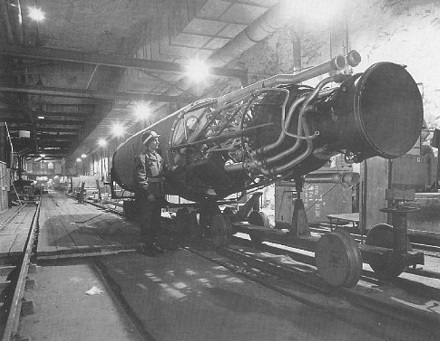
Casting about the Third Reich for a suitable spot to base the missile team, the rocketeers settled on the Kohnstein, a hill in Thuringia already hollowed out by gypsum mines. This tunnel network was readily adapted into a subterranean munitions factory called Mittelwerk — difficult for the Allies to find, and once they found it, difficult to bomb.
A U.S. Army soldier poses with a half-assembled V-2, one of about 250 such rockets found in the Mittelwerk labyrinth when the facility was captured.
With the facilities and the big brains in place, only one thing was missing: millions of man-hours of labor.
Nazi Germany had that in plentiful supply.
Beginning in late 1943, concentration camp inmates at Buchenwald began to be funneled out to a new facility, Mittelbau-Dora. Initially just a Buchenwald sub-camp, Dora grew over the course of 1944 into an immense facility holding 50,000 prisoners — a handful of German undesirables, but mostly captured foreign nationals: French, Dutch, Polish, Czech, and Russian. Short of food, sleep, and clothing for the 1944-1945 German winter, they were systematically worked to death in the Mittelwerk shafts to build a better bomb.
Our day’s principal, Hans Möser/Moeser (English Wikipedia entry | German) was an SS-Obersturmführer who made a living throughout the war years pulling guard detail in a number of concentration camps.
On May 1, 1944, Möser was transferred from Auschwitz to Mittelbau-Dora. It was the last job he would ever hold, but were Möser on the market today his C.V. would laud his team-player orientation and project management skills on a high-priority initiative. No doubt he was just the sort of reliable agent who understands how things are done that the world’s mad bombers need at their back.
“Ninety percent of the prisoners lived and worked in the tunnel of the mine,” testified one German who worked at Dora as a secretary and doctor’s aide.
As a result of the uninterrupted work in the mines and the absence of any installation for forced draft and ventilation, there prevailed a stuffy cold atmosphere, which made breathing difficult. The prisoners also slept in the subterranean tunnel in big chambers hewed out of the rocks, in five beds on top of each other. Already in 1944 3,500 prisoners used to sleep in such a room. In the tunnel of the mine there was no ater, the prisoners got absolutely insufficient quantities of tea for drinking purposes. But for weeks they were not able to wash themselves. As a result of the heavy work in the mines and of the bad food numerous prisoners died from exhaustion during their work.
According to that same testimony, the camp received a frightful order on Good Friday, which fell on March 30 in 1945: drive every last prisoner into those tunnels and bring down the caves around them. “No prisoner should be allowed to fall into Allied hands alive.”
The facilities themselves, too, were to be destroyed as part of Hitler’s scorched-earth “Nero Decree” intended to deny the benefit of German industry and infrastructure to the arriving conquerors. But Hitler’s War Production Minister Albert Speer was intentionally ignoring that order, a decision that might well have helped him avoid hanging at the Nuremberg trials.
Mittelwerk was a valuable capture indeed for the Allies. The Americans who first occupied it, and then the Russians who took it over a few months later, ransacked it for parts and technical specifications. The V-2 was the first man-made object to reach space, blasting at the speed of sound to the edge of orbit before plummeting back with its payload into the heart of London or wherever. It’s the ancestor of the long-range, intercontinental ballistic missiles that would come later, as well as the space programs of the countries who could build such missiles.
And of course, it wasn’t just the parts.
Wernher von Braun himself was the top prize of all — the young genius (he was just 33 when World War II ended) with the weapons of the future in his skull. As Germany collapsed in 1945, von Braun and his team of engineers had resolved to surrender themselves to the Americans rather than the Russians, but they too were subject to an order given the SS to execute the scientists if their capture appeared imminent. The Fuhrerbunker knew as well as the Allies how valuable this asset was.
In the event, von Braun managed to give himself up to a surprised American private. He disappeared into American custody, the crown jewel of “Operation Paperclip” that grabbed some 1,500 scientists from Germany and helpfully whitewashed their past misdeeds — misdeeds like Nazi party affiliation, and participating in slave labor camps.
Firing guided rockets into space was one thing. Unfortunately for our man Möser, his own skill set of bullying subordinates was not in short supply for either of the Cold War antagonists.
Möser was the one defendant (among 15) condemned to death at the resulting trial of Dora camp personnel. Rocket scientists, naturally, were not present for the occasion; Wernher von Braun and his team were hard at work at this time at Fort Bliss, Texas adapting the V-2 to the American Hermes program.
But at Dora, it had been Möser’s job to oversee camp discipline and labor strength for the slaves doing the grunt work manufacturing von Braun’s brainchild. Testimony convinced the court that the SS man had done this far too brutally, and perhaps with sadistic pleasure.
Several witnesses testified Möser frequently beat prisoners and participated in executions, often shooting at the men who were hanged for camp infractions — while they were hanging, or after they were taken off the gallows. (And of the latter, some already dead and some still alive.) “The accused told the twelfth witness that it was a pleasure to give the mercy shots, like shooting a deer.”
Möser for his part countered that he took no joy himself in the beatings and killings that he had to conduct as part of his job — and that the camp commandant had early on reprimanded him for leniency, threatening that “in view of the importance of the V-weapons operation, this could be interpreted as sabotage because it reduced the work efficiency.” How’s that for a hostile work environment?
(There’s a large .pdf of the entire trial summary here. Möser’s section begins on page 36 of the pdf (page 68 per the numbering in the scanned book pages).)
His presence on this here site betrays the outcome. On this date in 1948, Hans Möser was hanged at Landsberg Prison along with several other (unrelated) convicted war criminals.
On this date in 1942, the Japanese military occupying the atoll of Tarawa beheaded 17 New Zealand Coastwatchers, along with five civilians.
Tarawa, a fishhook-shaped atoll that belongs to the Republic of Kiribati, was one of many specks of South Pacific land to which Australia and New Zealand deployed World War II Coastwatchers.
These small teams of mixed civilian and service personnel, as well as locals, kept up 24-hour watch for Japanese naval movements.* The tips provided by coastwatchers in the Solomon Islands during the Guadalcanal campaign led Vice Admiral William Halsey to exclaim that “the coastwatchers saved Guadalcanal, and Guadalcanal saved the Pacific.”
But their lonely forward positions also potentially exposed coastwatchers to considerable danger.
Even as Guadalcanal was unfolding in August and September in 1942, Japan was fortifying the occupied Gilbert Islands** (present-day Kiribati) in the wake of the Makin Island raid. Seventeen coastwatchers in the Gilberts were swept up in the process, and transferred to Tarawa along with five civilians (three British, one Australian, and one New Zealander). There they were held at the atoll’s old lunatic asylum, on the islet of Betio.
On Oct. 15, Allied planes bombed Tarawa. One of the captives got loose and ran onto the beach, frantically trying to signal the bombers. Instead, the Japanese — who fretted prisoners on their occupied islands becoming a fifth column in the event of an attack — summarily executed not only the signaler but all their captives.
“I saw the Europeans sitting in line,” one Tarawa local remembered later.
One Japanese started to kill the Europeans. He cut off the head of the first European, then the second, then the third, then I did not see any more because I fainted. When I came to, I saw the Japanese carrying the dead bodies to two pits.
In November 1943, a U.S. amphibious invasion took back the island at the bloody Battle of Tarawa. Twelve hundred Americans, and several times that many of the island’s Japanese defenders and Korean war slaves, were slain.
Old gun emplacements from that battle — as well as a monument to the New Zealand coastwatchers — can still be found on Tarawa.†
Catch these sights while they last. The average height above sea level for Kiribati is two meters, making global climate change liable to send the nation’s scattered islands to Atlantis. Kiribati residents have already begun turning up in Australia and New Zealand as climate change refugees.
* When the occasion arose, coastwatchers also rescued stranded Allied servicemen. After LTJG John F. Kennedy’s torpedo boat was rammed by a Japanese aircraft carrier in August 1942, it was a pair of Solomon Island natives dispatched by an Australian coastwatcher who found the future U.S. President and his surviving crew.
** Seven other coastwatchers besides those beheaded this date had been captured in the Gilberts when Japan first (but lightly) occupied it following Pearl Harbor. They survived the war as POWs in mainland Japan.
† There was a monument to the dead coastwatchers from shortly after the war. The remains of the seventeen, however, were long neglected by the New Zealand government, and have only recently been turned up … by Americans scouring Betio for casualties from the Battle of Tarawa.
On an unspecified Saturday afternoon in September 1944, a Dutch Jew was hanged before a crowd of thousands in Blechhammer, a Nazi forced-labor camp that was a subcamp of Monowitz, which was in turn a subcamp of Auschwitz.
Witness Israel J. Rosengarten, describing the event forty-five years later, identified the executed man as “Raphaelson” and described him as “about twenty-four years old … a very capable carpenter.”
Yad Vashem’s Central Database of Shoah Victims’ Names includes an entry for a Rudolf Israel Raphaelsohn that seems to fit: he was born in Berlin in 1922, spent the war in the Netherlands, and perished in Blechhammer in 1944. His individual page of testimony describes his occupation as “sawmill owner.” This is probably, but not definitely, our man.
Rosengarten wrote about Raphaelson’s execution in his book Survival: The Story of a Sixteen-Year-Old Jewish Boy, published in 1999. According to him, Raphaelson was a Kapo, meaning he had certain privileges and a position of leadership over other Jews in the camp, sort of like a prison trusty.
He met his death through sheer bad luck.
By 1944, Blechhammer was being bombed by the Americans on a regular basis. As Rosengarten records,
This Kapo had seen a bomb lying on the ground, which had not exploded. It was split open, but the mechanism had not detonated. The Kapo saw a yellow powder lying in the middle of the split bomb. He obviously did not realize it was dynamite. Because we had no washing powder in the camp, he got the idea of smuggling some of that yellow powder into the camp in a parcel to see if it could be used as a washing powder.
While he was busy taking the powder in, he was caught by an SS man. He was whipped until he fell down. Next, when he came into the camp he was sent to the Politische Abteilung. The SS of the political department drew up a protocol in which it was stated that Raphaelson … had “plundered” the dynamite and that he had done it with the intention of committing “sabotage.” His deed was stamped as a “terror against the Third Reich.” Raphaelson was then forced to sign the statement.
And then … the SS let him go.
He was not relieved of his position as Kapo. He was not transferred to a punishment detail. A whole four weeks passed by and the incident was never mentioned, and the inmates, who had enough to worry about in their difficult day-to-day existence, forgot all about it.
Raphaelson’s execution took everyone completely by surprise. Everyone came back to camp after a hard day’s work and noticed the SS were all in dress uniform and parading them around as if some important holiday was being celebrated.
The inmates weren’t allowed to go to their barracks as normal. Instead they were assembled in the center of camp, where a gallows had been set up.
It turned out the confession Raphaelson had been signed had been sent all the way up to the leadership of Auschwitz for them to decide what to do about it, and they had taken their time. Only now, a month later, had the SS in Blechhammer gotten their answer, and now the “saboteur” had to pay the price for his “crime.”
“The whole thing,” Rosengarten noted sardonically, “had the appearance of a lawful trial and a truly democratic tribunal.” He happened to be standing in the front row, so had an intimate view of the proceedings:
After a very long wait, the stool was pushed away from under his feet with a firm kick. A panicked chill passed through us as if time were falling away. But then it seemed the rope was not holding. Suddenly, it broke in two. Raphaelson fell unhurt to the ground. Everybody present stood amazed.
We all hoped now that Raphaelson would be given mercy because of that unusual event. But such a thing was, of course, unthinkable for the SS. The rope was repaired and once again the boy was placed on the stool. Again it was kicked away. But the unbelieveable happened again! The rope broke in two a second time!
A sort of providence seemed to have insinuated itself. Everything we saw was so unusual, so unreal! But the Nazis did not give up. For the third time, the Kapo was placed upon the stool, and the noose was put around his neck. Because of what had happened, Raphaelson came more and more to his senses. He seemed to be more clearly aware of what was going on. All of the sudden he yelled, “Friends! Do not lose courage! Those who today want to murder us will themselves soon be kaput!” The two SS who stood next to him could not believe what they were hearing. “Hold your beak, you!” they shouted. Quickly they again kicked the stool away. And then Raphaelson sank down. For a couple of long minutes we had to look him in the eyes. After that, he was no longer among the living.
After Raphaelson finally expired, the six thousand prisoners were required to stand there another fifteen minutes, then march around the scaffold so everyone could see him. “Only after this,” Rosengarten recorded, “were we allowed to crawl quietly and dejectedly to our barracks.”
Israel Rosengarten survived several concentration camps and death marches before he was liberated in Buchenwald on April 11, 1945. By then, he was near death from starvation and exhaustion.
After he recovered his health he went home to Belgium and discovered he was, at eighteen years of age, the sole survivor of his large family.

 The distinguished 66-year-old jurist had served in his youth in the forces of independence fighter Antonio Luna. Diaz was captured by the Americans, and honed his English so well as a POW that he later built a career as a legal scholar in the American-governed archipelago. He was appointed to the Philippines Supreme Court by U.S. President Franklin Delano Roosevelt.

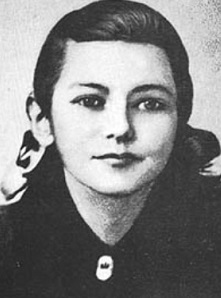 The youngest-ever female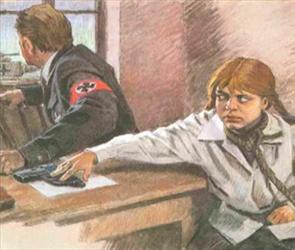
 The people she tried to rescue have never been identified; only their first names, Paul and Janek, are known. According to Karolina, she met them on the street and they offered her 300

 Our day’s principal, Hans Möser/Moeser (


