1864: Bill Sketoe, hole haunt

On this date in 1864, a hulking Methodist minister by the name of Bill Sketoe was hanged in Newton, Alabama … but his ghost story was only just beginning.

Sketoe’s life is nearly as spectral as his death, but he is known to have been a longtime denizen of Newton’s Dale County where he preached the gospel and fathered a biblically-appropriate brood of seven children.

The easiest version says that Sketoe deserted the Confederate army to care for his sick wife. However, there’s no documentary evidence that Sketoe actually served under arms in the Civil War, although two of his sons did. He might actually have been suspected of aiding Unionist raiders haunting the forests — men like John Ward, a local pro-Union guerrilla with whom Confederate guards had just days before fought a skirmish.*

For whatever reason, a local Confederate cavalry militia under one Captain Joseph Breare seized the preacher near the Choctawhatchee River on December 3, 1864, and hanged him to a convenient tree.

Now, Bill Sketoe was a large man, and the bough of the Post Oak that supported his noose bent to his weight until Sketoe’s toes touched the ground. For an ad hoc execution, an ad hoc solution: one of Breare’s so-called “Buttermilk Rangers” simply dug out the ground around Sketoe’s feet until they dangled free in the hole and their owner could strangle to death properly.

Beloved Alabama storyteller Kathryn Tucker Windham immortalized “The Hole That Will Not Stay Filled”, one of the chapters of her 13 Alabama Ghosts and Jeffrey. Local legend, it seems, held that whenever someone later filled in Sketoe’s dangling-pit — with dirt, rubbish, or anything else — it would be mysteriously un-filled within hours.

Unfortunately the present-day skeptic will not be able to put geist to test because “Sketoe’s Hole” was destroyed in a 1990 flood, and is today covered over with tons of rocks supporting a bridge strut — too much infill even for spooks. (Though not enough to deter visitors.)

Sketoe’s executioner Joseph Breare resumed his law practice after the war … until a falling tree killed him during a storm in 1866.

* David Williams develops the John Ward connection in Rich Man’s War: Caste, Class, and Confederate Defeat in the Lower Chattahoochee Valley. A few months later an incursion of different irregulars led by a Dale County Confederate officer who deserted to the Union, Joseph Sanders, precipitated the Battle of Newton.

On this day..

1644: Goodwife Cornish

(Thanks to Meaghan Good of the Charley Project for the guest post. -ed.)

Sometime in December 1644 in Maine, one Goodwife Cornish was executed for the murder of her husband, Richard Cornish. Her first name has been lost to history.

The couple had married in the town of Weymouth in the Massachusetts Bay Colony in 1634. It was a match made in hell.

According to Daniel Allen Hearn, writing of this case in his book Legal Executions in New England, 1623-1960, Richard Cornish was “a tireless worker” but his wife as “a woman of loose habits.”

The couple moved north to the settlement York in modern-day Maine in 1646, and “Goodwife Cornish wasted no time in reestablishing her notoriety.”

In 1644, Goodman Cornish’s body was found floating in the York River. He’d been killed in an unusual way: impaled on a stake, then placed in his canoe, which was weighted with stones. As Hearn records:

A cry of murder was raised. The sensational news swept the town and surrounding countryside. Had hostile Indians killed Richard Cornish? Probably not. Although the man’s skull had been crushed as if by a war club no one could imagine an Indian being so wasteful as to purposefully sink a good canoe. Such a craft would have been desirable plunder to an Indian. Moreover, what Indian, it was asked, would squander precious time by weighting down a canoe when he could be making good his escape? For these reasons it was determined that the murder of Richard Cornish was the work of some crafty white person. Suspicion fell upon the wife of the decedent. She had openly despised her husband. She was also rumored to have committed adultery.

Goodwife Cornish, when questioned, denied having murdered her husband.

But she admitted to multiple extramarital affairs and named her latest boyfriend as Edward Johnson. The authorities subjected both of them to “trial by touch,” acting on the old superstition that a murdered person’s corpse would bleed if the killer touched it.

When Goodwife Cornish and Goodman Johnson were brought before Richard Cornish’s body and made to touch it, blood supposedly oozed from his wounds. The ensuing trial, Hearn says, was “a farce.”

Much was made of Goodwife Cornish’s infidelity, but the only actual “evidence” against either her or Johnson was the fact that they’d both flunked the touch test. “It was reputation more than anything else,” Hearn notes, “that counted against Goodwife Cornish.”

Johnson was ultimately acquitted, but Goodwife Cornish was convicted of murder and condemned to die. Having maintained her innocence to the end, she was hanged in York.

On this day..

1922: James Mahoney, Seattle spouse slayer

On this date in 1922, James Mahoney hanged in Washington’s Walla Walla penitentiary for one of Seattle’s most notorious crimes.

Two years prior, a 36-year-old Mahoney had been released from that same prison after serving time for assault and robbery, then moved into a Seattle boarding house with his mother and sister.

He soon struck up a romantic involvement with the house’s owner, Kate Mooers. She was 68 years young, but James Mahoney was broad-minded enough to admire her wealth.

On April 16, 1921, the night the two lovebirds were supposed to hop a train for their honeymoon in Minnesota, James Mahoney hired a company to move a steamer trunk to Lake Union, and load it into a rowboat. Kate Mooers was never seen again, but Mahoney resurfaced in Seattle ten days later claiming that she’d decided to extend her honeymoon with a long jaunt to Havana, Cuba. In the meantime, well, hubby would be looking after her affairs.

Alerted to the suspicious events by Mooers’s nieces, police kept Mahoney under surveillance for three weeks as he gobbled up his wife’s assets. He was finally arrested before he could skip town, but only on charges of forging documents during his embezzlement binge. For harder charges to stick, Kate Mooers had to be located.

According to a HistoryLink.org profile,

Captain [Charles] Tennant had a theory and ordered divers to begin searching the bottom of the northeast end of Lake Union near the University Bridge for a steamer trunk. Finally, having survived 11 weeks of criticism, the police found the trunk containing Kate Mahoney’s body. It bobbed to the surface on August 8, 1921, almost exactly where Captain Tennant said it would be. The autopsy revealed that Kate had been poisoned with 30 grains of morphine, stuffed in the trunk, then had her skull smashed with a heavy blunt instrument. Two days later, Jim Mahoney was charged with premeditated murder.

Resigned to his fate as his appeals dwindled away, Mahoney was reported to be in excellent spirits in his last days. He also made a written confession on the eve of his execution, forestalling his sister’s desperate attempt to claim the murder as her own in order to stay the hangman’s hand. (The sister still caught a jail term for forging Kate’s signatures.)

Now you must be brave and forget me. My whole life has been a torture to those who love me, and even as a little boy I used to dream of dying this way, and my dream has at last come true.

… If my soul can do you any good in the next world I will always be watching over you. Good-bye and God bless you all.

-Jimmie

On this day..

2000: Kiyotaka Katsuta, Japan’s “most evil” killer

On this date in 2000, Japan hanged three fifty-something murderers.

While Takashi Miyawaki and Kunikatsu Oishi were rather garden-variety criminals who killed family members over private vendettas, Kiyotaka Katsuta had been impressively dignified by one of his judges as the “most maliciously evil criminal in Japanese history.”

The former firefighter was convicted of eight murders but twice or even thrice that number might lie upon his soul.

He got started in 1972, strangling and robbing a Kyoto bar hostess.

Having found a workable m.o., Katsuta murdered and stole from (police suspected rapes, too, but couldn’t prove it) another four women over the 1970s. Then he moved on to armed robbery of men, stealing a gun from a policeman and killing at least three (with others wounded) in his various stickups — deeply shocking in Japan where guns are hard to own and firearm crime vanishingly rare.

Katsuta was so notorious after his 1983 arrest that a movie came out based on his crime spree.

In the will scribbled out during the few minutes he had left after being informed of his imminent execution, Katsuta professed that he had “managed to lead myself to a spiritual state of resignation.”

One of his victims’ family expressed a different form of closure — that Katsuta’s hanging “has made us feel we at long last have become able to close a chapter in our anguish, although we still feel never able to forgive the perpetrator.”

On this day..

1284: Alice Bowe and her friends

(Thanks to Meaghan Good of the Charley Project for the guest post. -ed.)

At some unspecified day in November 1284, in Edward I’s England, Alice Bowe or Alice at the Bowe (not the garden designer of the same name) was burned at the stake for murder, and seven of the men who took part in her same crime were hanged.

Alice and sixteen others had lynched a guy who’d attacked their friend.

Alfred Marks’s 1908 book Tyburn Tree: Its History and Annals, available for free here, tells the story:

In the year 1284, the 13th of Edward I., Laurence Ducket, goldsmith, having grievously wounded one Ralph Crepin in Westcheape, fled into Bow church, to the which, in the night time, entered certain evil persons, friends unto the said Ralph, and slew the said Laurence, lying in the steeple, and then hanged him up, placing him so by the window as if he had hanged himself, and so was it found by inquisition: for the which fact Laurence Ducket, being drawn by the feet, was buried in a ditch without the City: but shortly after, by relation of a boy, who lay with the said Laurence at the time of his death, and had hid himself there for fear, the truth of the matter was disclosed.

Wherefore a certain woman, Alice atte Bowe, the mistress of Crepin, a clerk, the chief causer of the said mischief, and with her sixteen men, were imprisoned, and later, Alice was burnt, and seven were drawn and hanged, to wit, Reginald de Lanfar, Robert Pinnot, Paul de Stybbenheth, Thomas Corouner, John de Tholosane, Thomas Russel, and Robert Scott. Ralph Crepin, Jordan Godchep, Gilbert le Clerk and Geoffrey le Clerk were attainted of the felony and remained prisoners in the Tower.

The church was placed under an interdict by the archbishop: the doors and windows stopped up with thorns. But the body of Laurence was taken from the place where it lay, and given burial by the clergy in the churchyard. After a while, the bishop of Rochester, by command of the archbishop, removed the interdict.

On this day..

1933: Thomas Thurmond and John Holmes lynched in St. James Park


This still-notorious lynching — America’s seminal lynching for the broadcast media era — has been portrayed several times on the silver screen.

On this day..

1881: Four Black Friday hangings

November 25, 1881, was the day after Thanksgiving. And that date was a true “Black Friday” on the American gallows: four distinct murderers, all African-American men, were hanged in four different cities on this date in 1881.

We’re cadging entirely from the New York Herald of Nov. 26, and all quotes (as well as the pictured headline) source to that journal.

Richard James (South Carolina)

Richard James hanged in Marion, South Carolina for the previous year’s murder of a local shopkeep, David M. Harrell.
James insisted on his innocence, and even “turned upon the preacher with indignation” at in his cell on his last day when importuned to unburden himself of his sin. He “swore by all that was holy that he knew nothing of the crime, and was ready to face his Maker with this oath on his lips.”

James, “a light colored negro about thirty two years old” who “looked capable of committing any crime” and had a bad reputation in town, had been tried with his two brothers, Benjamin and Lewis for having waylaid the Harrell on his way home from closing the store.

A mixed-race jury (nine whites, three blacks) convicted the first two but acquitted Lewis. Benjamin had already been executed some weeks previously.

Henry Johnson (South Carolina)

Shortly afternoon that same day, Henry Johnson hanged in the jail in Sumter while “the housetops and fences near the jailyard were crowded with negroes, who heightened the scene by melancholy exclamations.”

Johnson, who converted to Catholicism the week before his death, occupied his last morning writing to a sweetheart in Port Royal, S.C. (He sent her some wooden buttons to remember him by, and demanded that she never marry.)

While he went mildly, his crime was “one of the most cold-blooded and unparalleled murders ever known in South Carolina.” (Of course, newspapers say this about every crime.)

John Davis, a good and hard working colored man was going through Hope Swamp on his way to the forest, where he was employed to cut cross ties for the railroad [but] he was followed by one Henry Johnson, also colored, who shrouded himself from view by the thick undergrowth. Thus, Indian like, he thirsted for his victim’s blood, and followed David step for step with the greed of a hungry panther until they arrived at a point where the depth and loneliness of the swamp was best suited for the tragedy that was enacted. The desired spot having been reached, Johnson, without uttering a word, raised his gun and fired, shooting John Davis in the middle of the back. Davis dropped dead in his tracks instantly. Johnson then caught him by his heels and dragged him to a hollow log, in which he placed Davis and then covered the log all over with … straw and leaves.

And then Johnson went to Davis’s house, where he knew he would get a good reception since Davis’s wife fancied him.

Explaining that Davis had had to go into town on business and would not be back for a day or three, Johnson made himself “not only lord of Davis’ house, but his much beloved wife.” He tried to lay the blame on a local fellow named Orange Isaacs whom Johnson by all appearances sincerely believed to be a sorcerer.

Joseph Harris (Tennesee)

In Rogersville, Tenn., Joseph Harris hanged for slaying two men in November 1880 in a crime that aroused so much local hatred that he was stashed away in Nashville until two days prior to the execution to prevent the appearance of lynch law.

Unlike the South Carolina condemned, Harris’s hanging was fully public, and a fair concourse of onlookers braved freezing temperatures to satisfy themselves with the course of justice.

Harris had targeted the outgoing proprietor of a country farm called Marble Hall. John Brown, having sold the estate, had sent his family on to their next lodgings in Bristol while he remained at Marble Hall with a 17-year-old stable hand named Heck to sell off the remaining livestock and close up affairs.

Those affairs were closed for good on November 23, when the room that Brown and Heck occupied was discovered on fire, its inhabitants having had their brains bashed in. $500 Brown had recently pocketed from the sale of his hogs was missing.

Sang Armor (Georgia)

Sang Armor not only had the most unusual name of November 25’s grim harvest, but was distinguished as the first-ever public execution (or execution of any kind) in Taliaferro county, Georgia. Taliaferro is currently (circa 2010 census) the least populous county east of the Mississippi with a population of just 1,717.

Armor was egged on by the crowd at his gallows to give up the names of accomplices whom he had previously implied had aided him in the murder of an elderly white man, but he remained “sullenly silent on the subject and talked only on religious matters.” The scaffold was erected in Ellington meadow, on the land of his victim, Amos Ellington.

“The feeling against Armor was very strong,” concludes the report, “especially among the colored men, several of whom he tried to implicate in the crime.”

Not Squire Clark (South Carolina)

It wasn’t all doom and gloom. Squire Clark, who was supposed to hang in Lexington, S.C., was respited until December 23.

Clark, sentenced to be die in a strange case where a body was found on a railroad tracks, mutilated by passing trains, had been convicted circumstantially for having killed the fellow before dumping his remains on the tracks. Convicted, overturned on appeal, convicted again, and ultimately commuted to a penal sentence, Clark never made it into the executioners annals.

The estate of his victim later sued the railroad for negligence in having run over the remains of W.S. Hook no fewer than three times.

On this day..

1797: Figaro the Elder and Jean Louis, Charleston slaves of Dominguan exiles

On this date in 1797, two French slaves were hanged in Charleston for plotting rebellion.

This plot was the product of the liberation-minded aftermath of the Haitian Revolution … although whether the product was in the minds of the slaves, or those of the paranoid slaveowners, is still up for debate.

As the great slave revolution unfolded, many of Saint Domingue’s white planters had fled abroad. Charleston, South Carolina was a major destination, one of several Atlantic cities in the U.S. that received these refugees in quantity* — lugging along as many slaves as they could. “My Fellow-Citizens know your goodness,” said one of their number in an address to the South Carolina legislature, “and anticipate the Share you are about to take in their Calamities.” The state government accordingly granted relief money to these put-upon immigrants; the British themselves are thought to have been kicking into the relief kitties in Charleston as part of 18th century covert ops to check the spread of Jacobinism.

With the Haitian Revolution and its beneficiaries aligned (for the moment) with the French Revolution,** these French exiles fit right in with pro-British federalists to a continental reactionary backlash.

Revolutionary France’s consul in Charleston (he was U.S. ambassador by the time of the events in this post) maneuvered against that city’s planter exiles (“colonial aristocrats,” as he called them†) and eyed hemispheric emancipation, according to this book.

Yet the very flight of Saint Domingue planters also brought like a contagion the idea and experience of successful revolt in the breast of those refugees’ own chattel slaves … and in the midnight terrors of those slaves’ owners. As early as August 1793, rumor gripped Charleston that a slave revolt was in the offing. Jittery Southern states began passing laws to restrict slave imports from the West Indies who might be carriers of the virulent dream of liberty.

It was in this context that Charleston authorities discovered in 1797 “a conspiracy of several French Negroes to fire the City and to act here as they formerly done at St. Domingo.”

These several Negroes denied the plot, for a while.

Eventually, and surely encouraged by what me might today dignify “enhanced” interrogation, one of them turned state’s evidence. This “Figaro the Younger” — there were two named Figaro arrested for this same plot‡ — was the property of one Jacques Delaire, one of the Dominguan community’s more belligerent aristocratic grandees. Figaro the Younger’s evidence, though only a “partial confession” was enough to doom two of his fellows.

After the condemnation of Jean Louis, he turned to the two Figaros and said, “I do not blame the whites, though I suffer, they have done right, but it is you who have brought me to this trouble.”

(A French freedman named Mercredi hanged for the same affair a week later.)

For testifying against his mates, Figaro the Younger saved his own life and was sentenced to be transported to Suriname. En route, the pressure of his leg irons caused “a swelling about the ankles which turn’d into a sore & … a mortification of the flesh ensuing his toes rotted & one of his feet drop’d of[f] entirely.”

The southern anti-slavery cause was soon crippled, too.

Especially after the 1800 Gabriel Prosser revolt, any dalliance with emancipation, republicanism, revolution, became practically unutterable, as if to speak the words would conjure up the flames of Cap-Francais. “Beyond a reasoned fear of domestic insurrection seems to have lain a desire to banish the reality of St. Domingo,” as Winthrop Jordan put it.

But the threat and the example of Haiti long stalked the imagination of those caught in the toils of the South’s peculiar institution. And more literally than that, as Robert J. Alderson notes,

Captain Joseph Vesey … was [one] of the dispensers of [refugee relief] aid, [and] many Domingan refugees made calls on him. When the Domingan planters visited, their slaves had a chance to speak with one of Captain Vesey’s slaves, Denmark Vesey.

* For example, see Gary Nash, “Reverberations of Haiti in the American North: Black Saint Dominguans in Philadelphia” in Pennsylvania History, Vol. 65 (1998). Philadelphia was at the time still the U.S. capital.

** Said alignment between revolutionary Haiti and the mother country was, of course, tenuous and not permanent.

There’s a report in the Paris archives from this period of the French consulate’s low opinion of Charleston’s Dominguans: “tricky people, at the end of their resources that vengeance towards their country and despair may lead to anything. Among the French whom we have here, there are some very good patriots who know what the hospitality of the country demands of their gratitude, but the number is small.”

‡ The Figaro plays and some of their operatic adaptations were culturally current in the 1780s and 1790s. That includes Mozart’s Marriage of Figaro but not yet Rossini’s Barber of Seville with its definitive Figaro aria … although such would be very poor excuse not to post the latter.

On this day..

1720: Edward Hunt, the first counterfeiter executed in colonial Pennsylvania

On November 19, 1720, Edward Hunt was hanged in Philadelphia. He was the only Pennsylvanian executed for treason prior to the American Revolution — that treason being not the betrayal of the state (in the sense we might think of it today), but counterfeiting.

In the bitterness of his scaffold speech, which disdains the customary acknowledge-my-guilt, pray-for-my-soul form of the genre to complain about his case, Hunt made plain that he was not reconciled to the justice men had rendered him.

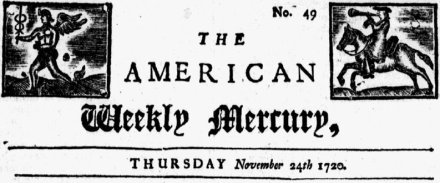
The American Weekly Mercury of Thursday, November 24 published “this extraordinary Piece” only with a preface complaining that “it is evident, that the following Speech was intended to misrepresent the Administration and Justice of this Government, as well as to infuse both ill Principles and Practices into the Minds of the People.”

The Dying Speech of Edward Hunt, formerly taken in Rebellion at Preston, and transported a bound Servant to the Island of Antigua, before his Execution upon the 19th Instant, at Philadelphia, where he had been legally convicted of High Treason, and most justly condemn’d for his Counterfeiting Spanish Silver Coin, made current* by Act of Parliament within all his Majesties Colonies in America.

It may be expected, that I should say some thing now concerning my Life and Conversation, which i must with Sorrow own to God and the Word has not been according to the Precepts and Principles of the Church, in which I was bred and educated: But with a sincere repentance and hearty Sorrow I do lament all the Errors of my past Life, firmly believing in my Saviour Jesus Christ, in whose Merits and ever flowing Mercy I do only trust for Salvation and Pardon, who has promised Eternal Life on no other Terms to the most Righteous upon Earth.

As to the Crime that now I suffer for in particular, I must own it is an Offence against the Laws, which I hope God will pardon me since he knows that I did not do it with any Design to cheat or defraud any one, or to make a Practice of Coining; but being ignorant of the Breach of any Laws of God or Man, I thought I might cut those Impressions as innocently as any other, or the Stamps that the Gentlemen of this place imploy’d me about, to make Farthings.** I am an English Subject, and desired to have the Privilege of the Laws of England, but it was not granted in any Point, except in Condemning me.

I am the first unhappy Instance of this kind that ever suffered in the King’s Dominions, pray God it may be a Warning to all, not to offend wilfully in the same that I did through Ignorance: For if I had known it, I would not have taken all the World to have done it. God give me a patient Resignation to submit to his blessed Will, in whatsoever he please.

I do heartily ask Forgiveness of all that I have offended in any manner of way, and do sincerely forgive all that have injured or offended me; particularly Mr. John Moore and Morris Birchfield, and the Evidence that swore against me in that Tryal. I do solemnly declare, That I know not any thing, or have been guilty of any one thing laid to my Charge in that Matter, or any of the other things laid to my Charge, by John Butler, either in England or Ireland.

I did petition the Honourable Governor for a Reprieve, until the King’s Pleasure was known concerning me, being I could not be tried by the Laws of England in all Points, as a Church of England Man ought to be: But it was a Privilege too great for me to obtain. Pray God to forgive them all, and every one that has a hand in taking away my Life any manner of way, and that my Blood be not required at their Hands, for they know not what they do. I am on Earth judged and condemned to die for the Breach of a Law of Man that was not duly published, which for that Reason I transgress’d it ignorantly, though the first that suffers for the Transgression of unknown Laws, or that was sentenced according to the Laws of England, without the Privilege of a Subject, which I desired of the Judge, which I know was not qualified by the same Laws to try me.

I do not know what Advantage there can be to any in my Death, and that I could not appeal to my King, neither before nor after my Tryal. I do not speak this because I am not in Charity with all the World, I do, from the Bottom of my Heart, forgive all in Obedience to my Saviour’s Command and Example, who suffered more for me, being innocent, and had not only done no Harm, but Good, and pray’d even for is cruel Persecutors and Murderers, and promised, That those that follow his Examples in this World by patiently enduring the Cross, shall reign with him to all Eternity: To Him therefore I commit all, an my poor Wife, beseeching him to help her, and be her Support and Comfort, and preserve her poor Soul free from the Polutions [sic] of the World, that through his precious Merits we may meet where we shall be both happy to all Eternity, in the merciful Arms of our dear Lord and Saviour Jesus, who I do beseech to receive my poor Soul.

According to Kenneth Scott’s Counterfeiting in Colonial America, Edward Hunt’s wife, Martha, got a £500 fine and a lifetime prison sentence for misprision of treason. (If that book is up your alley, Scott has an even more specific Counterfeiting in Colonial Pennsylvania.)

* Early colonial American commerce was severely hampered by a shortage of English/British currency. As a result, coins minted in Spain’s lucrative southern territories served as the colonies’ primary currency in the 17th and 18th centuries, particularly the iconic eight-real silver “pieces of eight”.

This is the reason why the currency of the present-day U.S. isn’t an “American pound sterling” but the almighty dollar: Dutch colonists had brought a coin called the leeuwendaalder to their former New Amsterdam (New York) province, the name deriving from the German thaler. As the pieces of eight corresponded to the thaler/daalder, it inherited the same name. Indeed, the “Spanish Dollar” remained legal tender in the post-colonial United States until 1857.

This is also the reason for reckoning of the eight constituent bits that comprised the dollar, and hence of the American colloquialism “two bits” to denote $0.25 … and, later, the adjective “two-bit” to man something cheap, mean, or small-time.

** They may have been Spain’s coins, but it’s wildly implausible that any Englishman could think he could counterfeit “innocently.”

On this day..

1922: Taffy Long, Herbert Hull, and David Lewis, Rand rebels

RAND MINING RECOVERY.

LOWER WORKING COSTS.

(From our correspondent.)

JOHANNESBURG, Oct. 28. The Rand Daily Mail, in an article dealing with the economic situation of the Union, gives striking figures illustrating the steady advance of the gold industry on the march towards prosperity.

Profits for the July-September quarter show an increase of £1,136,000 over the previous quarter. This has been accomplihed not only by lowering wages, but by all-round improvement in efficiency per unit, mining costs having fallen from 25s. 8d. in 1921 to 20s. 5d. in September, 1922 …

[T]he Rand Daily Mail says that these facts “represent unmistakable omens of coming prosperity which should steel the downhearted farmer to greater effort and encourage the suffering industrialist throughout the Union, and transform the pessimism of the merchant into healthy confident and hope.” (London Times, Oct. 30, 1922)


THREE RAND EXECUTIONS.

ANTI-GOVERNMENT RIOT.

(From our correspondent.)

JOHANNESBURG, Nov. 17. The bitterest feeling prevails among the workers over the refusal to reprieve the three men, Long, Hull, and Lewis, who were condemned to death for murder in connexion with the Rand revolt, and were executed at Pretoria to-day.

Appeals for mercy poured in till almost the last moment, and an open-air mass meeting was held, in which prominent Communists took part. At this meeting angry and threatening speeches were made; the names of General Smuts and Sir Lionel Phillips were boohed, and the crowd attempted to break into the Town Hall, severely injured a detective, and was finally dispersed by armed police. The public generally approves the Government’s firmness. The condemned men sang the Red Flag on the scaffold. (London Times, Nov. 18, 1922)


“Come dungeons dark or gallows grim the sun will be our parting hymn.”

FUNERAL OF RAND MURDERERS.

COMMUNIST APPEAL TO CHILDREN.

(From our correspondent.)

JOHANNESBURG, Nov. 19. Remarkable scenes recalling the funeral of the victims of the great strike of 1913 were witnessed at the burial of the remains of Long, Lewis, and Hull, who were executed on Friday. The coffins, in separate hearses, were followed by thousands of workers, with banners and regalia, representing every trade union. “The Red Flag” was sung at the graveside and addresses were delivered, in which members of Parliament, of the Provincial Council, and Town Councils participated.

The latest development of Communist propaganda in Johannesburg is the distribution broadcast among children and students as they are leaving their schools and colleges of a pamphlet denouncing as “legalized murder and a blot on history” the execution of the men convicted of murder at special treason courts. (London Times, Nov. 20, 1922)

On this day..