1730: Patrona Halil, Ottoman rebel

On this date in 1730, Patrona Halil, the virtual ruler of the Ottoman capital at the head of a popular rabble, was lured to Istanbul’s Topkapi Palace on the pretext of receiving an imperial honorific — and there seized by the sultan’s guards and put to summary death.

An Albanian shopkeep and Janissary, Halil (English Wikipedia entry | Turkish) had been at the fore of an extraordinarily successful rebellion that bears his name in Turkish histories.

Very recently the mortal terror of Europe, the Ottoman Empire was into its midlife crisis by the early 18th century — a long transition, as it would transpire, into its terminal “sick man of Europe” stage.

Incensed at the splendor of the grandees during the so-called “Tulip Period” — elites’ 1720s fad for that flower, which accompanied years of decadent, and perhaps impious, openness towards Europe — struggling* Istanbul artisan guilds revolted in 1730 over taxes imposed to pay for war with Persia.

Not for the last time, the impositions of the taxman only served to catalyze wider grievances that had already been mounting. Janissaries cast a gimlet eye on the sultan’s dalliances with European military innovations — which those feudal infantrymen rightly perceived as an existential threat. Everyday Turks and the ulama alike resented the cultural inroads of the West. In the paroxysm of 1730, these factions combined with the petite bourgeois guilds to shake the Porte far more deeply than some riot ought.

There had been many rebellions in Istanbul before, but this was the first to show a syndrome that was thereafter often repeated: an effort to Westernize military and administrative organization propounded by a section of the official elite, accompanied by some aping of Western manners, and used by another interest group to mobilize the masses against Westernization.*


Jean-Baptiste van Mour, a Flemish painter residing in Istanbul at the time. He’s notable for numerous paintings of the Tulip Era Ottoman Empire, including that of the sword-brandishing Patrona Halil further up this post.

The rebellion forced the execution of the grand vizier, and the abdication of Sultan Ahmed III in favor of his nephew Mahmud. Rioters sacked the estates of the wealthy and put a definitive end to the Tulip Period by trashing the delicate gardens emblematic of their sybaritic lords.

For nearly two months, the impertinent Halil was virtually the master of the capital. He rode with the new sultan to the ceremony investing him with Osman’s sword; he dictated appointments for his rude associates, like a Greek butcher named Yanaki who was to become Hospodar of Moldavia. At Halil’s whim, Mahmud was forced to order mansions put to the torch and (of course) that hated war tax rescinded.

Halil probably ought to have been better on his guard against the maneuver the sultan executed this date — and was always likely to attempt in some form. Then again, what he had already achieved, however briefly, was outlandish, and pointed to weaknesses in the Ottoman state far more durable than Halil himself. By slaying the insurgent chief, Mahmud got himself some breathing space: popular dissatisfaction, however, was too widely rooted to be destroyed at a single stroke, and would resume again with intermittent disturbances and purges well into 1731, with a successor revolt in 1740.†

And over a still longer arc, the parties of the Halil revolt would guard their prerogatives so jealously and effectively over the generations to come as to fatally compromise the capacity of the sultanate to compel the modernization that the Empire required. Patrona Halil’s revenge was two centuries in coming … but it was worth the wait.

* According to Robert W. Olson’s “The Esnaf and the Patrona Halil Rebellion of 1730: A Realignment in Ottoman Politics?”, Journal of the Economic and Social History of the Orient, September 1974, the major beefs of the esnaf (guilds) were a spiral of inflation brought by the devaluing Ottoman currency, the influx of immigrants to the capital, and taxes.

** Serif Mardin, “Center-Periphery Relations: A Key to Turkish Politics?”, Daedalus, Winter 1973.

† See Olson, “Jews, Janissaries, Esnaf and the Revolt of 1740 in Istanbul: Social Upheaval and Political Realignment in the Ottoman Empire”, Journal of the Economic and Social History of the Orient, May 1977.

On this day..

1526: 2,000 Hungarian prisoners after the Battle of Mohacs

The Sultan, seated on a golden throne, receives the homage of the viziers and the beys, massacre of 2,000 prisoners, the rain falls in torrents.

-Sultain Suleiman the Magnificent (writing of himself in the third person), diary, 31 August 1526

On this date in 1526, two days after the pivotal Battle of Mohács, the Ottomans executed all their Hungarian captives from that battle.

After the 1490 death of Hungary’s greatest king Matthias Corvinus, the Hungarian kingdom began to crumble. Ottoman incursions ate away at that realm’s Balkan possessions.

Squeezed between two stronger empires, Hungary’s King Lajos II put a ring on the non-Turkish one by marrying a Habsburg princess. Fair enough.

Less successful statecraft was his decision not to cut a deal for peace with the Turks and instead force a decisive confrontation … especially since that battle was a tactical debacle. Eschewing a coy retreat towards nearby friendly forces, the belligerent Hungarian nobles hurled their heavy cavalry straight at the numerically superior Turks, basically duplicating the gameplan that the West’s last Crusaders had used when they got their lances handed to them by the Ottomans a century before at Nicopolis.

And those who did not learn from history were here doomed to repeat it. “The Hungarian nation will have twenty thousand martyrs on the day of the battle, and it would be well to have them canonized by the Pope,” a priest is reported to have said when he heard about the decision. By sundown, the Hungarians were routing in disarray, the wounded Lajos himself falling into the Danube in the disorder and drowning in his heavy armor.


Well, we’re boned. The Battle of Mohacs, by Hungarian painter Mor Than (1856).

“May Allah be merciful to him, and punish those who misled his inexperience,” said Suleiman of his 20-year-old opposite number. “It was not my wish that he should thus be cut off, while he had scarcely tasted the sweets of life and royalty.”

Not so tender were Suleiman’s pities for those 2,000 anonymous prisoners of war … and, for that matter, for anyone in the surrounding countryside unfortunate enough to find him- or herself in the path of the now-unchecked Ottoman force.

The cavalry, knowing no mercy, dispersed into the provinces of the wicked one like a stream overflowing its banks and, with the fiery meteors of its sparkling sabers, burned every home to the ground, sparing not a single one…. The contemptible ones were slain, their goods and families destroyed…. Not a stone of the churches and monasteries remained.

Within the fortnight the Turks were sacking defenseless Buda(pest); they would take it for good in 1541 and hold it for 145 years, pressing the Ottoman frontier deep into Europe. It wouldn’t be a Hungarian polity that recaptured it, but the Habsburg empire into which the Magyar wreckage was subsumed — retaking Buda in 1686 in the counterattack after the failed Ottoman Siege of Vienna.

On this day..

1714: Constantine Brancoveanu and his sons

Three centuries ago today, Wallachian prince Constantine Brancoveanu was beheaded in Istanbul with his four sons.

Brancoveanu (English Wikipedia entry | Romanian) had fallen foul of the Sublime Porte, which dominated Wallachia, by dallying with the Ottomans’ European rivals, the Habsburgs and the Russians.

During the then-current installment the oft-renewed Russo-Turkish War derby, he actually massed armies for a potential swing all the way to the anti-Ottoman team. Breaking those up and returning Peter the Great’s gifts after the Russian clock got cleaned did not a tribute of loyalty make in the eyes of Turkey.

Not only Contantine but his entirely family — wife, four sons, and six daughters — were carried thereafter to Istanbul prisons. On the Feast Day of the Blessed Virgin, in the presence of the Sultan himself and of Christian diplomats who would be sure to put the word out, his four sons Constantine, Stefan, Radu and Matei were beheaded in his presence, as was the Wallachian treasurer Enache Vacarescu. The 60-year-old prince exhorted them as they endured their martyrdoms to remain steadfast, until at last he too lost his head. (Istanbul Christians managed to give the bodies honorable burials after fishing them out of the Bosphorus. The remains were later translated to Bucharest.*)

Most of the web sites about Branacoveanu and family are in Romanian; he was in his quarter-century reign a great cultural patron. The first Romanian Bible was completed in his time, and he undertook a great building program whose distinctive architectural stile still bears his name — Brancovenesc.

The Romanian Orthodox church conferred upon the martyred family the laurels of sainthood in 1992, a fine time to honor Romanian independence from foreign domination although of course by that time the Ottomans were yesteryear’s news and the outside heavy in question was the Russians.


Brancoveanu and his sons, from a mural at a monastery Brancoveanu founded.

Constantine also has a full panoply of secular miscellany in his honor: roads, statues, ballads, a metro station named after him, and so forth.

* At least, the alleged remains; it is well not to turn a forensic lens on saintly relics, and when Brancoveanu’s tomb was opened at the bicentennial of his death the skeleton therein appeared by the state of its teeth to be that of a man half Brancoveanu’s age. (Source)

On this day..

1622: Samuel Korecki, defeated magnate

On this date in 1622, the swashbuckling Ruthenian nobleman Samuel Korecki was strangled by the Ottomans.

Korecki English Wikipedia entry | Polish) was a szlachcic of the Polish-Lithuanian Commonwealth at that empire’s early 17th century peak.

Korecki’s clan hung its zupans at Korets, in present-day western Ukraine, and the young Samuel fought gleefully in the early 1600s in the train of the legendary commander Stanislaw Zolkiewski when the Polish army was ravaging Russia.

Samuel Korecki married the daughter of Jeremi(ah) Mohila or Movila, a boyar who contended for the Moldavian at the turn of the century; it was by this link that he too became drawn into the politics of that frontier realm, along with several other powerful families of the Polish-Lithuanian Commonwealth. This period is known as the Moldavian Magnate Wars.

Though a dependency of the Ottomans, Moldavia had proven appealing in the past for Polish adventurers. The late Mohila had bequeathed power in Moldavia to his son Constantine but after some years Constantine’s tributary payments to Istanbul started to lag. His resulting deposition by the sultan saw Constantine flee to Polish territory — and his brother-in-law Korecki come to his aid by mounting an armed expedition meant to depose the Ottoman replacement.*

Korecki was captured by the Turks in the process, dramatically escaped via Greece and Italy (and a celebrity-making papal audience into the bargain), then returned to the field only to be captured again at the Battle of Cecora in 1620.

This decisive Ottoman victory portended ill and not just for Korecki personally.


19th century woodcut illustrating the death of Samuel Korecki. (Source)

As our man was hauled back to Istanbul (he would not escape a second time), the rampant Turks drove for Ukraine with the intention of taking a bite out of it for the Sublime Porte.

The Poles were able to stanch the advance with a stand at Khotyn, but the Commonwealth would shift into an unmistakable decline thereafter; by mid-century, rebellious Cossacks had taken Ukraine over to Russian protection, while Swedish incursions from the north so greatly reduced Poland’s reach that the period is known as the Deluge. (For his part, the teenage Ottoman sultan Osman II went home from this campaign determined to reform the Janissary corps whom he blamed for the unsatisfying stalemate of Khotyn; these dangerous slave-soldiers vetoed the plan by murdering Osman instead.)

* Moldavia was a secondary foreign policy concern for the Ottomans, who were absorbed in this period by war with Persia.

On this day..

1800: Suleiman al-Halabi, assassin of General Kleber

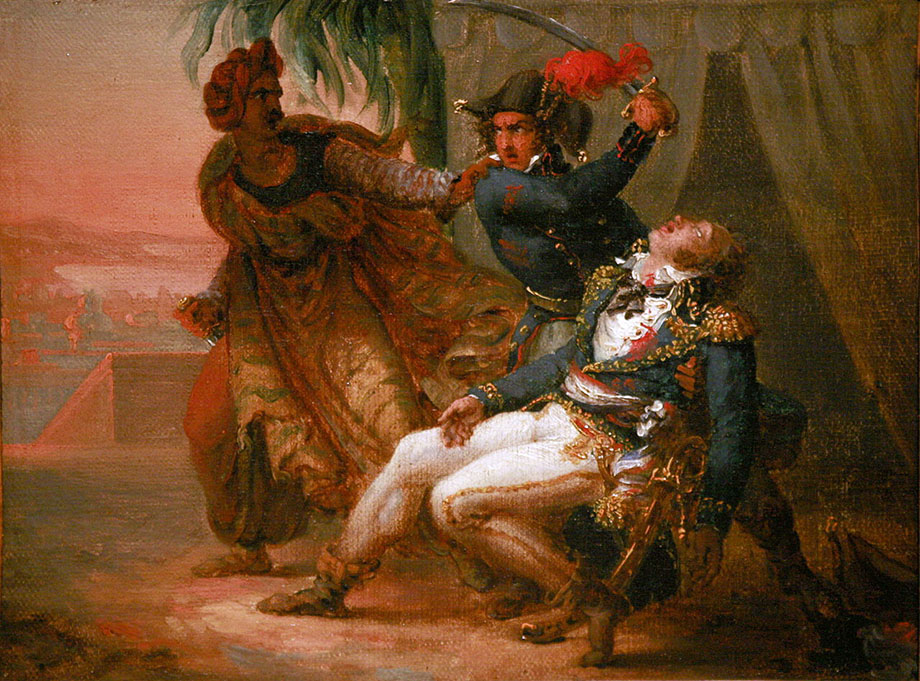
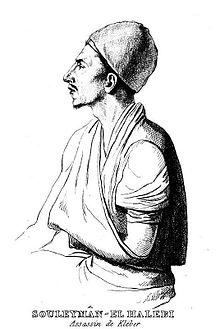
On this date in 1800 — which was the same date they buried his victim — the 23-year-old student Suleiman al-Halabi was put to death in Cairo for assassinating French General Jean Baptiste Kleber.

Casualty of the brief Napoleonic adventure in Egypt, Kleber had received supreme command of the expedition when Napoleon himself returned to France the previous year — a mission which involved running the English naval blockade that trapped the Armee d’Orient.

Kleber, a product of the French Revolution’s military meritocracy who had attained his rank capably suppressing the Vendee royalists, was certainly up to the martial tasks at hand. He routed a larger Ottoman-English-Mamluk force in March of 1800, and then smashed a revolt in Cairo.

But the Napoleonic invasion often figures as a periodization marker for this region: the germ of liberalism and nationalism that would tear apart the Ottoman Empire and set the scene for a recognizably modern Middle East. So it’s somewhat fitting that Kleber would be undone by a figure who could be lifted from the evening news,* the anti-occupation insurgent.

Suleiman al-Halabi (English Wikipedia entry | French) was a Syrian Kurd hailing from Aleppo. (“al-Halabi” means “of Aleppo”)

He had been in Cairo to study, but after a return visit home was induced by the Turks to attend himself to punishing the invader instead. He then made his way back to to Egypt where, disguising himself as a beggar, where he was able to approach the general innocuously and dagger him to death.

The French, of course, had just a few years before this point introduced its most distinctive execution device in place of the ghastly old methods, and employed it with egalite for commoner and king alike. Nor was France, as an imperial power, reluctant about exporting its invention to the every corner of earth.

But in this particular instance, the French decided to prioritize, er, cultural sensitivity.

The committee, after carrying through the trial with all due solemnity and process, thought it necessary to follow Egyptian customs in its application of punishment; it condemned the assassin to be impaled after having his right hand burned; and three of the guilty sheikhs to be beheaded and their bodies burned.

The “guilty sheikhs” in question were men to whom the killer had confided — not his plan, exactly, but the fact that he was on a jihad mission. Hey, close enough.

As for Suleiman al-Halabi himself,

The executioner Barthèlemy sat down on Suleiman’s belly, drew a knife from his pocket, and made a large incision to widen the rectum, then hammered the point of the stake into it with his mallet. Then he bound the patient’s arms and legs, raised the stake the air and mounted it in a prepared hole. Suleiman lived for four hours, and he had lived longer save that, during the absence of Barthèlemy, a soldier gave him a drink which caused his immediate death.

(Impaling victims could live for agonizing days, but the water caused Suleiman, mercifully, to quickly bleed out.)

Not content with going all Vlad the Impaler, the French then paid homage to the invasion’s scientific sub-theme** by shipping Suleiman’s remains back to France for use as an anthropological exhibit.† His skull still remains at the Musee de l’Homme to this day. What’s left in his homeland(s) is a martyr’s memory.

According to the scholar al-Jabarti, whose chronicle is one of the principal sources on this episode, the investigation indicated that Suleiman undertook his mission for no ideology save his family’s desperate need of the purse the Porte was willing to offer. But in the ensuing decades’ growth of nationalism and, eventually, anti-colonialism, the brave young Muslim dying on a spike to slay the French commander could not help but be viewed in an exalted light. (Notably, at the acme of Arab nationalism, the Egyptian writer Alfred Farag celebrated Suleiman as an avatar of resistance in a 1965 play. “I do not kill for revenge,” Farag’s Suleiman avers — and when pressed for the reason, he has a one-word reply: “Justice.”)

* Indeed, the name has been in the news: there’s a Suleiman al-Halabi neighborhood in Aleppo that has seen fighting during the ongoing Syrian civil war. Since it’s even a Kurdish neighborhood one can’t but suspect that it’s named for the man featured in this post; however, I haven’t been able to establish that with certainty. If any reader knows, a comment would be most welcome.

** Napoleon brought a corps of scientists and intellectuals along on his invasion, kicking off the modern Egyptology craze. His mission also uncovered the Rosetta Stone — although that artifact now resides in the British Museum because of the aforementioned naval blockade.

† According to Dark Trophies: Hunting and the Enemy Body in Modern War, phrenologists hailed Suleiman’s skull as an outstanding exemplar of criminality and fanaticism.

On this day..

1480: The Martyrs of Otranto

On this date in 1480, Ottomans invading Otranto, Italy conducted a mass execution of prisoners.

Landing at the southern Italian city on July 28, the Ottoman force quickly overwhelmed Otranto. (Otranto rashly slew the messenger come to offer a merciful capitulation, only to find that its garrison began deserting within days.) On August 11, the Turks took the city by storm. Thousands died on that day’s bloodbath, including the Archbishop of Otranto.

Surviving women and children were sold into slavery. Men over age 15 had the choice of conversion — or death.

“Now it is time for us to fight to save our souls for the Lord!” a Christian shoemaker is said to have exhorted his 800 fellow prisoners. “And since he died on the cross for us, it is fitting that we should die for him.”

The acclaim greeting this call signaled inflammation ahead for the Turkish headsmen’s rotator cuffs. They had 800 faithful souls to dispatch to their eternal reward this date at the place still known as the Hill of Martyrs. (When in Otranto, visit it by taking the via Ottocento Martiri, just off via Antonio Primaldo — that’s the name of the militant shoemaker.)


The remains of the Otranto martyrs, arrayed as relics in the Otranto cathedral. (cc) image from Laurent Massoptier.

Historical novel set during these vents.

This, at least, is the most pious version of the story. The mass execution certainly did occur, but some latter-day historians like Francesco Tateo have argued that martyrdom is not attested by any of the contemporaneous sources, and the specifically religious understanding of events was only read in after the fact.

On whatever grounds one likes, Italy’s fractious city-states were deeply alarmed by the appearance on their shores of the all-conquering Turks. “It will always seem as if the funeral cross is borne before me while these barbarians remain in the boundaries of Italy,” wrote the Florentine humanist Poliziano.* (Source, a nonfiction book which covers Otranto in some detail.)

In the ensuing months, they rallied together vowing to expel the invaders.

Fortunately for this coalition, the Ottoman sultan Mehmed the Conqueror died in May 1481, and a brief period of internal conflict within the Ottoman empire over the succession perhaps led it to allow its Otranto outpost to wither on the vine. The Turks made peace and withdrew from their potential beachhead not long after, having held the city for just over a year. The bodies of the martyrs were said to have been found uncorrupted by decay.

The Catholic church beatified the 800 martyrs in 1771, but their final elevation to sainthood occurred only in 2013, just three months ago as I write this. They were in the very first group canonized by the new Pope Francis — although the canonization was approved by his predecessor Benedict XVI on the same day that Benedict resigned his pontificate. Considering current relations between the respective faiths, it was seen as a potentially impolitic move.

“By venerating the martyrs of Otranto, we ask God to protect the many Christians who in these times, and in many parts of the world, are still victims of violence,” Pope Francis said at the canonization Mass, diplomatically not naming any of those parts of the world.

* At the same time, Florence (in common with other Italian polities) had trade and diplomatic relations with the Ottomans.

On this day..

1656: The Chief Black and White Eunuchs of Topkapi Palace

On this date in 1656, an Istanbul mutiny against debasing coinage resulted in thirty-odd high officials hanged at the gates of the Blue Mosque.

In Ottoman periodization, 1656 is the end point of the Sultanate of Women — a century-plus span stretching all the way back to Roxelana when powerful harem women consistently defined Topkapi Palace intrigue, often alongside shaky male executives.

Many of the sultans in that span were minors, as was the the putative head of state for our scene, 14-year-old Mehmed IV. Their succession was invariably achieved by the skillful maneuvering of their mothers, who then figured to graduate to Valide Sultan, “Mother Sultan” and wield considerable power in their own right. In Mehmed’s case, Mother Sultan was a Ukrainian former slave named Turhan Hatice … but you can just call her the power behind the throne.

(Actually, Turhan was initially aced out of the powerful Valide Sultan gig by Mehmed’s paternal grandmother when Mehmed inherited the throne at the age of six; Turhan herself was only about 20 years old at that time. Turhan had that woman assassinated in 1651 to swipe the position.)

Come the 1650s, the Ottomans were mired in a long war with Venice over control of Crete — ultimately a Pyrrhic victory for the Ottomans in view of the enormous cost.

One of the ongoing costs of that conflict was currency depreciation; silver coins were so hard to come by that European traders made tidy money hauling debased silver-coated copper coins to sell in Istanbul — and had no shortage of buyers who knew exactly what they were getting and were happy to have it. According to Caroline Finkel, “1000 aspers of [official coinage] was valued at less than one hundred aspers in the market-place.”

Janissaries* aggrieved at being paid in rubbish “marched to the Hippodrome, vociferously demanding that those who had deceived Sultan Mehmed by implementing the debasement be killed.”

That’s an experience to drop your gonads when you’re 14 years old. The Janissaries, the capital’s elite warrior clique, had the sultanate by the short and curlies and were known to enforce their whims to the detriment of the empire’s interests. They had, indeed, revolted over currency depreciation in the 1580s; they also deposed Mehmed’s uncle, 17-year-old Sultan Osman II, when that young man tried to curb Janissaries’ dangerous power.

Undoubtedly these mutinous Janissaries would have enforced their demands with similar desperation. Jenkins says that the execution of the Mother Sultan was one of those demands, but at least the teen sultan was able to cross her name off the hit list. The various attendants, aghas, and eunuchs who irritated the Janissaries were not so fortunate.

Ah, the eunuchs.

We’ve titled our post with the most titillating of this date’s targets of Janissary wrath. Ottoman Eunuchs** came in the “Black” and “White” varieties, as in black and white races; because Islam prohibited castration, they were obtained by slavers in Africa or in the Balkans, where Christians and Jews did the dirty work.

European “White Eunuchs” from the Balkans had their testicles removed; these were sought by the hundreds as palace bureaucrats in Istanbul. African “Black Eunuchs” from Egypt or Ethiopia typically had their entire genitalia cut off, and had the more powerful position of serving the royal persons. (They had usurped that role in the late 16th century from the formerly preeminent white eunuchs.)

Each racial set had its own hierarchy and its own chief. The Chief Black Eunuch was the master of the harem and a powerful, trusted emissary of the Valide Sultan: it was her black eunuch that Turhan Hatice had sent to murder Mehmed’s original Valide Sultan.


A black eunuch — I think? — looms over a new concubine in Alexander Russov’s 1891 Bought for the Harem. Lest one think this sort of lascivious Orientalism is solely the relic of a bygone age, check out the Harlequin bodice-ripper of the same title.

These chief eunuchs, and especially the chief black eunuchs, were among the sacrificial executions the Janissaries required for their obedience. Mehmed did not attempt to protect them; one doubts that he could have done so.

The sultan’s acquiescence in these executions set him up for a 39-year reign, the longest since Suleiman the Magnificent. But it was also under Mehmed that the Sultanate of Women gave way to the civil administration. Later that same year of 1656, continuing crisis forced the appointment of Koprulu Mehmed Pasha as Grand Vizier.

The Albanian Koprulu wielded virtually dictatorial powers and founded a whole dynasty of Ottoman Grand Viziers† that dominated Ottoman politics into the 18th century.

* The Janissaries were infantry; their less-(in)famous cavalry counterpart, the Sipahis, also participated in this 1656 mutiny.

** Eunuchs persisted in the Ottoman sultanate right up until the end of World War I, and ex-eunuchs (well, still eunuchs) of the ex-Sublime Porte were still to be found in Turkey as late as the 1970s. One of them recounted the experience of being kidnapped and castrated in Ethiopia for export to the Ottoman palace.

† Including Kara Mustafa Pasha, the Ottoman commander executed for losing the Battle of Vienna.

On this day..

1561: Sehzade Beyazit, inevitably

On this date in 1561, the Persian Shah abandoned Ottoman prince Sehzade Beyazit to the vengeance of his “magnificent” father.

A late and sad casualty of Istanbul’s pivotal family tragedy, Beyazit was actually a son of Suleiman the Magnificent‘s favorite wife, the freed Ukrainian slave Hurrem Sultan or Roxelana.

Unfortunately, he wasn’t the first son.

After Roxelana engineered the execution of heir apparent Mustafa on spurious grounds, Beyazit and his brother Selim were the last princes standing.

The natural rivalry between the two for eventual power was surely colored by the clear portent Mustafa’s execution had sent that the succession game was rigged for Selim. After several years of growing estrangement, Beyazit finally revolted outright only to be defeated in battle by Selim in 1559.

The loser found refuge in Persia, but only long enough for the Safavids to negotiate the price of his surrender to the hands of Suleiman … whose executioner went on the road to the Persian city of Qazvin to strangle not only Sehzade Beyazit but his four sons, too.

Extirpating the treasonable branch of the family tree cleared the succession for Selim, whose eight-year turn in power would be remembered as moment the hitherto-all-vanquishing Ottomans began their long, slow slide to Sick Man of Europe status. Particularly given that coda, Suleiman’s own

long reign is flawed by tragedy more subtle than the hubris which had overcome his ancestor Bayezit the Thunderbolt; more consequential than the gilded misery reserved for later sultans. The higher men rose in the empire, the closer they got to the bowstring; and the reign of Suleyman seems in retrospect coiled round with a silken garotte …

When the Austrian ambassador took leave of Suleyman in his old age, it was scarcely a living being he described, but a sort of metaphor of empire, rotting and majestic, fat, made up, and suffering from an ulcerous leg.

There’s more about this misfortunate lesser son in Turkish here, and a Turkish poem he wrote beseeching his father’s forgiveness here.

On this day..

1916: Joseph Hani, abandoned

“Mr Joseph Hani was hanged for treason in the Burj at 5 a.m. At 8 a.m. 40 families deported.

-Diary of Mrs. Harry Dorman, April 5, 1916*

The unfortunate Joseph Hani — Yusuf al-Hani — was among the worthies of Beirut’s Maronite Christian community to petition the French consulate for western aid in detaching Lebanon from the Ottoman Empire.

With the development of World War I, the French ambassador Francois Georges-Picot abandoned the embassy … without removing or destroying this sort of incriminating correspondence. As a result, the Turks ransacked the embassy and identified several dozen of reproachable loyalty to the Porte to put to death.

May 6 — Martyrs’ Day — honors these victims, but Hani was among the very first of them.

While most of the other Maronite signers were able to fly, Hani stuck around to face the music. A British agent was able to contact the implicated characters in Aley Prison, and received the plaintive answer,

‘Where are the English? Where are the French? Why are we left like this?’

* I believe an ancestor of the current president of the American University of Beirut, Peter Dorman. The source of the diary citation is Nicholas Z. Ajay Jr.’s “Political Intrigue and Suppression in Lebanon during World War I” in International Journal of Middle East Studies, Apr., 1974.

On this day..

1799: Constantine Hangerli, tax man

On this date* in 1799, Constantine Hangerli was deposed from his post as Prince of Wallachia by a Moorish executioner.

A veritable watchword for bad times, Hangerli was one of a clutch of disposable puppet rulers situated on the Wallachian throne by the Ottomans around the turn of the 19th century.

As had often before been the case, Wallachia was sorely pressed at this time by the cumulative exactions of its native boyars, the Ottoman Porte, and the plunder taken by the expeditions of rising Bosnian warlord Osman Pasvan Oglu.

Our man is famous, in particular, for the “Hangerli winter” of 1798, just after his elevation — when a confiscatory tax regime seized most of the countryside’s lifestock. Hangerli had a message for the generally currency-poor common man who objected to the much-despised per-head duty on cattle.

Pay the taxes, and you won’t be killed.

Hangerli’s real problem this year wasn’t the unmourned misery of his overtaxed serfs, but the Ottoman commander sent to rein in the Bosnians. Pasvan Oglu whipped that expedition, and its general Hussein Kucuk turned up at Hangerli’s doorstep late in 1798.**

Since it was dangerous for Ottoman generals to lose, Kucuk evidently arrived intending to put some blame on Hangerli — or at least, Hangerli thought that was the case. Secret dispatches from both parties to Istanbul ensued.

Whoever it was who schemed first, Kucuk schemed best. Selim III (later to die of palace scheming himself) decreed Hangerli’s immediate execution and dispatched a kapucu, one of the frightening envoy-executioners (two different men, in this case) who carried such decrees to their victims.

* I believe this may be per the Old Style/Julian date still in use in the Orthodox world.

** Having executed Rigas Feraios in Belgrade en route.

On this day..