764: St. Stephen the Younger, iconodule martyr

This is the supposed martyrdom date, in the year 764 or perhaps 765, of St. Stephen the Younger in Constantinople at the hands of an iconoclastic emperor.

Ancient and “dark ages” history characteristically comes with all kinds of problems arising from the paucity and prejudice of primary sources. Byzantium’s century of Iconoclastic controversy is a fine example.

In this period from approximately 726 to 842, the empire was rent by a conflict between iconophiles or iconodules — proponents of the use and adoration of religious imagery in Christian worship — and iconoclasts — who abhorred same as a form of sacrilegious idolatry.

This was deadly serious stuff in the way that only Byzantine sectarian conflict could be, but the controversy was not strictly about defining the Biblical injunction on graven images. As the excellent History of Byzantium podcast explains in its iconoclasm episode,* it likely manifests “an empire-wide reaction to the trauma of defeat” — battlefield defeat by the rising armies of Islam, and with it a shaken confidence in the favor of God. (Islam’s hard line against idolatry surely can’t be coincidental.)

But in posterity we are reduced to these muddy qualifiers because as the winning party in the dispute, iconodules wrote the history. That’s no moralistic stab: iconoclasts, too, burned the enemy’s tracts when they had the opportunity; had they prevailed in the end, they would have blurred out the background, motivations, and achievements of their rivals as readily as the iconodules did and leave those who followed to read between the lines of a partisan history. Indeed, Bissera Pentcheva’s recent Icons and Power: The Mother of God in Byzantium even contends that the legendary centrality of icons to Byzantine religiosity was an invention of the post-iconoclastic era, with events like the Marian icon’s saving Constantinople during the Avar siege of 626 backfilled to replace the original story about Marian relics working the divine intervention.


Iconoclasts plastering over an icon.

The iconoclastic era opens in the late 720s; according to the (iconodule, naturally) saint and historian Nicephorous, its immediate trigger was the devastating 726 eruption of the Greek island Thera (Santorini) — and affrighted by the apparent divine wrath, “the impious emperor Leo [III] started making pronouncements about the removal of the holy and venerable icons.” He’s alleged to have taken down a particularly revered icon of Christ on Constantinople’s Chalke Gate.

Nevertheless, it is difficult to get a firm fix on what specific anti-icon policies Leo promulgated, if indeed there were any at all. (The Greek term for “pronouncements” could be understood simply as “comments” instead of “edicts”.) It is Leo’s son Constantine V, succeeding the purple in 741, who clearly brings an overt imperial turn against icons, for “He cannot be depicted. For what is depicted in one person, and he who circumscribes that person has plainly circumscribed the divine nature which is incapable of being circumscribed.” Constantine convened an ecumenical council that ruled for his anti-icon position and set about removing images from churches.

Against this campaign was ranged the bulk of the clergy — church vs. state is another possible and difficult-to-measure dimension of the whole dispute, although Constantine’s ability to win the acquiescence of hundreds of bishops must complicate this interpretation.

The great champion of and martyr for the iconodule position in this time was St. Stephen the Younger. That’s “younger” vis-a-vis the original St. Stephen, Christianity’s protomartyr.

As befits that exalted company, this monk and hermit was credited by his adherents with a supernatural power in the iconoclasm debate.

A man blind from his birth visits the saint with suppliant outcry for relief. “If you hast faith in God,” he replies, “if thou art a worshipper of His image, thou shalt behold the light and the beauty of hidden things.” Scarcely had the words gone forth, when the blind man rejoiced in beholding light. A woman brings to him her son “grievously vexed with a devil,” and a distressing scene is described. Stephen bids a disciple to apply the sign of the Cross to the whole afflicted body. The saint calls upon God with many tears. Finally he delivers the boy safe to his mother, when the image of Christ has been adored. An infirm soldier comes with entreaty for relief. The saint bids him adore the images of Christ and His Mother, and immediately he is restored. The soldier afterwards repudiates image-worship before the Emperor, who at once promotes him to the rank of centurion. Leaving the imperial presence he would mount his horse; the horse rears, throws him to the ground, and tramples him to death. Such is the life of the younger Stephen as related with awe-struck delight in Greek and Roman martyrologies. (Source)

And so forth.

The emperor is alleged by the hagiographies to have sought Stephen’s destruction for many years, being continually frustrated even to the point where Stephen’s torturers in prison seemed unable to finish him off. “Will no one rid me of this monk?” Constantine cries, anticipating Thomas a Becket by a good four centuries. His soldiers finally clubbed to death the obdurate cleric on November 28, 764. (For a critique of Stephen’s hagiography, including a death date that proves questionable (no surprise), see this pdf.)

But not for the first time, an imperial innovation in theology failed to outlast the patronage of its sovereign. After Constantine’s death, Empress Irene** restored the iconodules to favor† — and set the stage (after some hiccups) for a great flowering of Orthodox icons in the centuries to come.

* Also see Episode 75, delving into Constantine’s iconoclasm.

** The fact that the extant remnant of the Roman Empire had no emperor — merely a woman ruler — formed part of the rationale for the western church crowning Charlemagne “Holy Roman Emperor”. This slap in the face to Constantinople could occur because a papacy long deferential to Byzantium had at last broken with the East in the mid-8th century … in part, over iconoclasm.

Emperor Leo V restored official iconoclasm in 813 for another 29-year run as imperial policy before the movement’s final defeat.

On this day..

Feast Day of Saints Cosmas and Damian


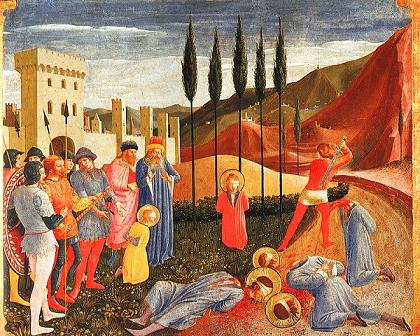
The Martyrdom of Saints Cosmas and Damian, by Fra Angelico.

September 27 is the traditional* feast date of early Christian saints Cosmas and Damian.

Martyred in Syria during the Diocletian persecution, these Arabian brothers were reputedly physicians who did not charge their patients, even for premium services like transplanting an entire leg.


Cosmas and Damian graft an Ethiopian’s leg onto a white patient.

This has made them patron saints to doctors, surgeons, pharmacists, and dentists but decidedly not to insurers.

They were once much more widely known and revered than today, back when the mysteries of medicine and of faith intertwined with one another. The two are named in the Canon of the Mass, and multiple churches in Europe dubiously claim the honor the ancient doctors’ relics; their skulls alone reside simultaneously in Bremen, Vienna, and Madrid, while a church in Venice allegedly holds their non-cranial remains. Visitors to the Roman Forum will behold the beautifully preserved pagan Temple of Romulus, which was rededicated in 527 as the basilica of Santi Cosma de Damiano and still hosts weddings beneath its impressive Cosmas and Damian mosaic.

The saints’ day is observed in Brazil, where children on September 27 receive candies (Cosmas and Damian also count confectioners and children among their devotees). St. Anthony’s Church in Utica, New York, also hosts an annual Cosmas and Damian pilgrimage attracting thousands of people from across North America.

As two men intimate with one another who traveled and ministered together, they are sometimes speculatively ventured as early gay exemplars. (They’re traditionally accounted as brothers.)

* The Vatican’s 1969 calendar revision moved the feast to September 26, leaving September 27 to St. Vincent de Paul.

On this day..

258: St. Cyprian, Bishop of Carthage

The Christian bishop of Carthage, Cyprian, was condemned by Roman authorities on this date and immediately beheaded.

Not one of your dubious ancient martyrs fogged with legend, Cyprian was a major public figure in his own time; dozens of epistles and treatises of his survive. An epidemic that ravaged the Roman Empire in the 250s and 260s is known from his description of it; hence it is remembered as the Plague of Cyprian.

The real-life Cyprian had different plagues to fight.

The essential challenge of Cyprian’s day — and the one that would see him to martyrdom — was the onset of anti-Christian persecution after the relative tolerance of the 240s. Cranky senator turned general Decius claimed the purple in 249 on a programme of traditional values that included a demand that all* obtain a magistrate’s certificate confirming that they had performed public sacrifice to the pagan gods. We don’t want anyone tempting divine vengeance here.

The Christian community had grown, little molested of late, to encompass many peaceable adherents who were not necessarily prepared to sell their lives over a stick of incense. Now, it fragmented under the Decian persecution — which was applied by different governors with varying levels of severity. Some Christians made the requisite sacrifices; others paid bribes to get the paperwork. Some fled to hiding: Cyprian himself did so, and some Christian ultras criticized him for failing to embrace martyrdom.

Decius died in 251, leaving the Christian minority with a controversy over how to handle the so-called lapsi who had made some concession to the idols of Rome: perspectives arrayed from the most lax (welcome everyone back with minimal hassle) to the most punitive (expel them all: this was the Novatian heresy). Cyprian had a middle-ground position in this dispute; his De Lapsis preserves his intervention, accepting readmission but under conditions of suitable penance administered by the clergy.

In such a case there remains only penitence which can make atonement. But they who take away repentance for a crime, close the way of atonement. Thus it happens that, while by the rashness of some a false safety is either promised or trusted, the hope of true safety is taken away.

But you, beloved brethren, whose fear is ready towards God, and whose mind, although it is placed in the midst of lapse, is mindful of its misery, do you in repentance and grief look into your sins; acknowledge the very grave sin of your conscience; open the eyes of your heart to the understanding of your sin, neither despairing of the Lord’s mercy nor yet at once claiming His pardon. God, in proportion as with the affection of a Father He is always indulgent and good, in the same proportion is to be dreaded with the majesty of a judge. Even as we have sinned greatly, so let us greatly lament. To a deep wound let there not be wanting a long and careful treatment; let not the repentance be less than the sin. Think you that the Lord can be quickly appeased, whom with faithless words you have denied, to whom you have rather preferred your worldly estate, whose temple you have violated with a sacrilegious contact? Think you that He will easily have mercy upon you whom you have declared not to be your God? You must pray more eagerly and entreat; you must spend the day in grief; wear out nights in watchings and weepings; occupy all your time in wailful lamentations; lying stretched on the ground, you must cling close to the ashes, be surrounded with sackcloth and filth; after losing the raiment of Christ, you must be willing now to have no clothing; after the devil’s meat, you must prefer fasting; be earnest in righteous works, whereby sins may be purged; frequently apply yourself to almsgiving, whereby souls are freed from death.

This is more or less the position the Church as a whole arrived at — a fairly liberal readmissions policy in the scheme of things. Unfortunately for Cyprian and his flock, the question would soon grow pressing once again: the emperor Valerian resumed the persecution in 257.

Cyprian was first sent into exile, then brought to Carthage for examination at a villa thronged with his supporters, who are said to have roared in support when Cyprian refused to sacrifice and demanded, “Let us be beheaded with him!”

The bishop attained his hieromartyr‘s laurels directly after the verdict, with Carthage’s Christians clamboring alongside him to the execution grounds. Afterwards, the faithful collected his remains and interred them lovingly, erecting a church over the bones that the Vandals would eventually ravage.

Even in his death under persecution, Cyprian’s biography reflects the growing weight of Christianity in Rome — not least in the fact that it was consequential enough to attract imperial backlash under the right circumstances. The reluctance of provincial magistrates to make hecatombs of their neighbors whatever the edicts demanded has been widely noted — like the proconsul Antoninus, who sent away confessing Christians who wished to solicit their own martyrdoms with the exasperated words, “if you are thus weary of your lives, is it so difficult for you to find ropes and precipices?”

“The life of Cyprian is sufficient to prove that our fancy has exaggerated the perilous situation of a Christian bishop,” Edward Gibbon wrote — a paradoxical observation to make of a martyr, but we notice that Cyprian’s noisy Christian supporters don’t seem to have been harried even in the midst of the prelate’s execution. Thereafter, “the funeral of Cyprian was publicly celebrated without receiving any interruption from the Roman magistrates; and those among the faithful, who had performed the last offices to his person and his memory, were secure from the danger of inquiry or of punishment. It is remarkable, that of so great a multitude of bishops in the province of Africa, Cyprian was the first who was esteemed worthy to obtain the crown of martyrdom.”

* Jews were exempted; Romans had respect for the antiquity of that monotheistic religion which was not extended to the novel concoctions of Christianity.

On this day..

1629: Louis Bertran, martyr in Japan

On this date in 1629, Spanish Dominican Louis Bertran was burned at Omura, Japan for evangelizing, along with two Japanese-born converts known as Mancius of the Holy Cross and Peter of the Holy Mother of God.

Bearing the Gospel to the far-flung corners of the globe was sort of the family business: Bertran’s more famous relative and namesake, Louis Bertran(d), ministered to the New World so tirelessly that he’s been unofficially known as the Apostle of South America.

For two generations by this point, Christianity had struggled under intensifying official persecution — the shogunate deeply suspicious of the infiltration of western clerics who so often it seemed from Japan’s neighbors to bring along with them some patron king’s overweening navy.

Just a few years on from these martyrdoms, Japan closed itself to outside interference altogether. (More or less.)

On this day..

Feast Day of Popes Cletus and Marcellinus

Back before being pope meant jeweled slippers and your own guillotine, the bishopric of Rome — at least as chronicled in the early histories of the Church — was a virtual halfway house to a pagan executioner.

Granted, the very earliest pontiffs are mostly ciphers to posterity; little dependable information about most of them survives. We have sketchy documentation, conflated names, and traditions of legendary hagiography further to the glory of Christianity’s earliest fathers. They are almost universally ranked as both saints, and martyrs.

But is it really right that literally none of these heirs of St. Peter for three centuries reached leadership positions by dint of being venal political hustlers? Or that none just dropped dead of some inglorious disease before they could exalt their deaths in martyrdom?

Persecutions of Christianity were not, after all, literally continuous throughout this age; indeed, prominent as they are in our latter-day remembrance, instances where they turned deadly were likely rather few and far between. Roman governors had provinces to administer; not many of them viewed hunting down and killing otherwise law-abiding cultists as the most important thing to prioritize.

“Christians and pagans could live on very good terms with each other,” Victor Duruy writes in his History of Rome, and of the Roman People, from its Origin.

Asper declared openly that he was disinclined to prosecutions of that kind … Severus furnished them the reply which permitted him to discharge them … Candidus treated them as contentious persons, and sent them back to their towns with these words: “Go, and be at peace with your fellow-citizens.” “Unhappy men,” said another to them [i.e., to Christians seeking their own martyrdom], “if you are resolved to perish, are there not ropes or precipies enough for you?” and he drives them from his tribunal.

Little as we know of these men, it is a sure thing that, pre-Constantine, they did run some risk of life and limb to profess Christianity under the noses of Rome’s rulers. Even a period of toleration could turn ugly with the rise of a hostile emperor or some chance shift of the political winds; the first persecution, after all, is supposed to have been initiated by Nero as an expedient to deflect anger over the Great Fire of Rome. But despite this site‘s use of the martyrology, we can hardly take for granted that any early Christian of significance was put to a baroque death by bloodthirsty Romans.

April 26 is or was the shared feast date of two of these popes from Rome’s antiquity — both of them traditionally considered martyrs, but both now on the outs with Rome’s official chronicle. It’s a reminder that even the ancient past isn’t really past and that history, like religion, is not so much holy writ as an eternal process of becoming.

Pope Cletus was the third pope, and the second in a row after Peter’s direct successor Pope Linus to make you think of a cartoon character. One early chronology named Cletus and Anacletus (or Anencletus) as the third and fourth popes; it is generally understood now that these were merely two different names for one single man. In 1960 a distinct July 13 feast for “Saint Anacletus” was removed from the calendar, collapsing everything to April 26.

Still, basically nothing definite is known of Pope St. Cletus — including the occasion or circumstances of his death, which may well have been promoted to a martyrdom simply from reverence of Cletus’s Erdos numberChrist number of 3 or less. Cletus is said to have ordained 25 priests, and died in the year 88 or 92. He was ultimately removed from Catholicism’s liturgical calendar in 1969, though he still remains in the Roman Martyrology.

Near the opposite chronological end of Rome’s era of official intolerance we find Pope St. Marcellinus.

Marcellinus was the 29th pope, and had the tiara* when the Diocletian persecutions began in 303. While such information as survives about Marcellinus is also not very substantial, it is quite interesting.

When anti-Christian persecutions did crop up, those Christians who weren’t in active pursuit of martyrdom had a difficult choice to make: either apostasy, or punishment. Confronted in the breach with a demand to make the requisite obeisance to the gods of Rome, many ordinary Christians preferred the expedient burning a few sacrificial herbs to the prospect of, if not death, prison, torture, exile, harassment, property seizure, or whatever else was on offer for their sect at that moment. These were the lapsi — the lapsed ones.

Such episodes tended to create post-persecution friction between the go-along, get-along crowd on the one hand, and the purists who refused any such accommodation on the other. Could lapsi be re-admitted to the communion after renouncing their faith to please a Roman proconsul? (Broadly speaking, the official church did welcome lapsi back with some kind of penance and absolution.)

Pope Marcellinus is interesting because he too is said to have lapsed under the initial pressure of Diocletian’s persecution. The Liber Pontificalis, likely combining distinct traditions that were in circulation about Marcellinus, says that he burned incense to the Roman gods when it was demanded of him — and that only afterwards did he repent his weakness and confess Christianity unto martyrdom.

It is not at all certain that Marcellinus did apostatize, but it is clear that a story to that effect (disputed by ex-apostate St. Augustine, among others) was out there in late antiquity — and it’s a bit suspicious that Marcellinus’s name is omitted from some early lists of popes. (It’s possible he was being conflated with his successor, Marcellus: the opposite of what happened with Pope Cletus.) It’s also very uncertain that Marcellinus was in fact martyred; the Catholic encylopedia considers his “in all probability, a natural death” in 304. And it was probably not in April that this death occurred.

Given all those question marks, Marcellinus’s April 26 celebration was booted from the liturgical calendar in the same 1969 cleanup that fixed Pope Cletus.

* The papal tiara did not yet literally exist at this point, of course.

On this day..

Feast Day of Saints Agape, Chionia, and Irene

In honor of Good Friday (in 2015), we pay tribute today to the Diocletian-era Christian martyrs Agape, Chionia and Irene.

The three virgin sisters whose names mean Love, Purity, and Peace in Greek were not, per tradition, actually martyred all together. However, they do share an April 3 feast date.

They are said to have made their illicit faith conspicuous to the governor of Macedonia by refusing to eat meat that had been burned as a pagan sacrificial offering. Agape and Chionia suffered immediate martyrdom, while Irene escaped to the mountains only to be captured and burned later with her Christian books.

The remarkable medieval canoness and playwright Hrotsvitha of Gandersheim — by some reckonings the West’s first known dramatist since antiquity — made the women the focus of her 10th century play Dulcitius, which is available online in English here:

IRENA. You wretched Sisinnius! Do you not blush for your shameful defeat? Are you not ashamed that you could not overcome the resolution of a little child without resorting to force of arms?

SISINNIUS. I accept the shame gladly, since now I am sure of your death.

IRENA. To me my death means joy, but to you calamity. For your cruelty you will be damned in Tartarus. But I shall receive the martyr’s palm, and adorned with the crown of virginity, I shall enter the azure palace of the Eternal King, to Whom be glory and honour for ever and ever!

Bad Gandersheim‘s Roswitha Prize is awarded (nearly) annually in Hrosvita’s honor. It’s the oldest German literary laurel that’s conferred exclusively upon women.

On this day..

1155: Arnold of Brescia

At some point in the first weeks of June 1155 — nobody knows the exact date, but it precedes June 18 — the Roman authorities disposed of Arnold of Brescia.

For a decade the tongue of a fragile new Roman Republic, Arnold was a student of the cutting-edge theologian (and castrated romantic) Peter Abelard. Arnold held the temporal pretensions of the Vatican invalid, a theology sublimely according with the popular revolt that from 1143 overturned Rome’s overweening princes and even slew a pope in a melee on the Capitoline.

The Senate long forsaken was re-founded by this new Republic and an equestrian order re-founded to resume to the rights of a now-growing middle rank. The slain pope’s successor became a refugee tenant of the neighboring cities, orchestrating crusades against Turks, Moors, and Wends — but dying at Tivoli in 1153 still awaiting a prince who would restore his own person to the authority of the Eternal City.

That prince, however, had just begun to stir. The Hohenstaufen king Frederick I had concluded in the months before Pope Eugenius’s death a compact to restore the pontiff, which policy dovetailed nicely with an intent to show the German power against other wayward cites in Italy. It was Frederick’s Italian subjects, and conquests, who gave this man the distinctive name by which history recalls him: Barbarossa, or “red-beard”.

All these years — or at least, from 1145, when he surfaced in the rebellious city from past years’ exile in Zurich — Arnold of Brescia’s “eloquence thundered over the seven hills.” (Gibbon)

Blending in the same discourse the texts of Livy and St. Paul, uniting the motives of Gospel, and of classic, enthusiasm, he admonished the Romans how strangely their patience and the vices of the clergy had degenerated from the primitive times of the church and the city. He exhorted them to assert the inalienable rights of men and Christians; to restore the laws and magistrates of the republic; to respect the name of the emperor: but to confine their shepherd to the spiritual government of his flock. Nor could his spiritual government escape the censure and control of the reformer; and the inferior clergy were taught by his lessons to resist the cardinals, who had usurped a despotic command over the twenty-eight regions or parishes of Rome.

The absentee pope excommunicated Arnold in 1148. It was to no effect until Barbarossa’s legions neared the city.

As King Frederick approached, Pope Adrian IV* applied a deft turn of the screw by laying Rome itself under an interdict, depriving his quarrelsome flock of both spiritual balm and pilgrim revenue and at long last forcing the heresiarch’s ejection.

Arnold was seized in Tuscany and delivered to the Roman curia for punishment; the record of when or where this occurred is lost, but it is specified in the particular that his corpse was reduced to ashes that were scattered to the Tiber — proof against the prospect of a plebeian graveside shrine.

On June 18 even as his soldiers tamed Rome’s resisting republicans, Barbarossa accepted the crown of the Holy Roman Empire from the hands of Pope Adrian in St. Peter’s Basilica.**

Though Arnold had vanished into the Tiber’s silt, the thirst of his former flock for spiritual succor beyond that which the worldly Vicar of Christ could offer did not die so easily. Succeeding movements — indeed, perhaps, one continuous movement — took up Arnold’s objection to the clergy’s worldly emoluments and his summons to plain virtue. There are the Arnoldists to start with, but a bare few years after Arnold’s death emerge Peter Waldo of the heretical Waldensians, as well as the Cathars in southern France; a generation on finds St. Francis of Assisi, giving way to 13th and 14th centuries thick with oft-suppressed popular reform currents — the Beguines, the Apostolic Brethren, even the Fraticelli who criticized other followers of the aforementioned St. Francis for having already abandoned the poverty of his order.

Later Protestants would claim all these, and Arnold too (Arnold reportedly opposed infant baptism), as their forebears, which is why we have the nice Colosseum’s-shadow picture above from Foxe’s Martyrs’ Mirror. Just how literally one should take that lineage might be a matter of debate, but there is little doubt that Arnold of Brescia’s critique maintained its potency into that era and keeps it still in the modern age — one reason that the incinerated firebrand could still make a powerful subject for a risorgimento writer like Giovannini Battista Niccolini 700 years later.

* Born Nicholas Breakspear, Adrian remains to this day the only English pope ever.

** Popes and Holy Roman Emperors were most usually rivals rather than allies in peninsular politics; indeed, the Roman Republic had issued its own summons to Frederick’s predecessor to come to its aid — and rule Rome with its support — to humble the pretensions of the papacy. Arguably, Barbarossa missed a trick by not availing that potential alliance and instead exalting the pontifex maximus in the manner of his coronation: Barbarossa probably thought so himself often enough during his running rivalry over the ensuing generation with Pope Alexander III.

On this day..

1782: The Gnadenhutten Massacre

You recall the time when the Jesus Indians of the Delawares lived near the Americans, and had confidence in their promises of friendship, and thought they were secure, yet the Americans murdered all the men, women, and children, even as they prayed to Jesus?

Tecumseh, to William Henry Harrison in 1810

This date in 1782 marks one of the more appalling single atrocities in the United States’s long destruction of indigenous Native Americans — the Gnadenhutten Massacre.

This incident during the American Revolution took place in the Ohio River basin, a vast and fertile flashpoint whose part in not only the revolution but the antecedent French and Indian War perhaps entitles it to claim the midwifery of the coming American empire.

After victory in the French and Indian War, the British closed the area west of the Appalachian mountains to European settlement. This proclamation:

  • Made good a wartime pact Britain had made to secure the support of the Iroquois, Lenape (Delaware) and Shawnee tribes; and
  • Trailed facts on the ground the moment it was issued.

European settlements and land claims already existed in the supposed Indian Reserve, and land-hungry settlers did not let the supposed frontier deter them from advancing new ones. Confrontations between these arriving claimants and the native inhabitants not infrequently came to atrocious resolutions.

By 1768, a new treaty pushed the line further west, effectively ceding to the colonists everything south of the Ohio River — present-day Kentucky and West Virginia.*


Map of the disputed area: the frontier moved from the yellow line along the Applachians to the orange line along the Ohio.

Ohio Country, the remaining territory in dark green shading north of the Ohio River, lay at the time of the American Revolution between the British garrison at Fort Detroit and colonial outposts along the nascent United States’s western marches, such as Fort Pitt (Pittsburgh).

The Lenape Indians in Ohio Country had a difficult calculation to make as to which side (if any) and how to support during the British-American fighting. The question split the Lenape internally.

In this cauldron, a strange morsel: Lenape who were Moravian** Christian converts had established a little missionary village. “Gnadenhutten” literally means “huts of grace”.

As one might imagine, Gnadenhutten and its sister settlements of pacifistic, Christian Lenape stood in a terribly ambiguous position in the brutal irregular war going on around them. Their fellow Lenape distrusted them because they were Christians; their fellow Christians, because they were Lenape.

Suspected by the British of being friendly enough with the American colonists to pass intelligence to their eventual murderers, these converts were in 1781 forced out of Gnadenhutten by British-allied Lenape to a new settlement aptly named “Captive Town”.

Starving there in the ensuing winter, the Moravians dispatched nearly 100 of their number back to Gnadenhutten to retrieve food abandoned at that settlement.

The Moravians were still at their village when a raiding party of Pennsylvanians descended on the town. Under no authority but the militiamen’s own festering grievances from the ongoing dirty war, the Pennsylvanians rounded up the Delaware and heartlessly declared their deaths.

Here were Indians who would pay for the violence Indians had done. And they were the best kind: the kind who didn’t fight back.

After spending a night praying and preparing for the end, the Moravian Lenape were systematically butchered on the morning of March 8† with mallet blows and scalpings.

Depending on your source, there were either 90 or 96 scalps to take that morning – women, men, and children in nearly equal proportions. At least one young boy survived the death squad and reported the massacre. Nor were all the militia themselves at peace with their deed.

one Nathan Rollins & brother had had a father & uncle killed took the lead in murdering the Indians, & Williamson was opposed to it; & Nathan Rollins had tomahawked nineteen of the poor Moravians, & after it was over he sat down & cried, & said it was no satisfaction for the loss of his father & uncle after all. — So related Holmes Jr. who was there — who was out on both Moravian campaigns, & Crawford’s. (Source)

Ah, Crawford’s campaign.

Later in 1782, another expedition of frontiersmen under Col. William Crawford set out “to destroy with fire and sword” a different Lenape settlement in Ohio. Instead, the Lenape met and routed the expedition, taking Crawford prisoner. He and the other captives from that misadventure would be burned to death, in part to avenge Gnadenhutten.

This, and whatever like tit for tat could be exacted in the field, was all the justice the Lenape could ever hope to have for the hecatomb of Gnadenhutten. American authorities declined to prosecute or sanction any members of the militia.


“Here triumphed in death ninety Christian Indians March 8, 1782”: inscription at the base of a memorial obelisk in Gnadenhutten. (cc) image from Mike Drabik.

* This might have been a nice solution, except that said treaty was made by the Iroquois — and only the Iroquois. For the Shawnee who actually lived and hunted in this cessation, this was two outside powers bartering their land. They didn’t mean to give it up on the say-so of the Iroquois. Another nasty frontier war followed, and even when that was won by Virginian militia, dissatisfied Shawnee continued targeting settlements in Kentucky; it’s partly for this reason that the Declaration of Independence slates King George III with having “endeavoured to bring on the inhabitants of our frontiers, the merciless Indian Savages whose known rule of warfare, is an undistinguished destruction of all ages, sexes and conditions.”

For more on the long and tragic Shawnee struggle in this period, see “‘We Have Always Been the Frontier’: The American Revolution in Shawnee Country” by Colin G. Calloway in American Indian Quarterly, Vol. 16, No. 1 (Winter 1992).

** The Moravian Church‘s name harkens to its Czech origins. It’s a successor to the reform tradition of Jan Hus.

† There are a few cites out there for the day before or the day after March 8.

On this day..

Feast Day of Saint Agnes

January 21 is the feast date and traditional martyrdom date (in the year 304) of Agnes of Rome, a 13-year-old put to death in the Diocletian persecutions who has the distinction of being among the seven women mentioned by name in the Catholic Canon of the Mass.

Agnes means “chaste” in Greek,* and this was precisely the problem.

As prosperous as she was pulchritudinous, she was pious even moreso and spurned the many suitors for her hand and bed. Eventually one or the other of them peevishly reported her as a Christian.

Upon arrest, the abstinent youth was allegedly subjected to an official program of sexual assault, including displaying her naked in public and forcing her into a brothel. It’s said that divine intervention prevented her violation in these ordeals. (The flowing locks in the Ribera portrait of her at right are part of that myth, supposed to have sprouted long enough to save her from her public shaming.)

Considering that her defining characteristic is her virginity, Agnes has quite the lurid legend — and that does not exclude her very martyrdom. Per the erotically-charged poetic account of the 4th-5th century Christian poet Prudentius,** Agnes rejoiced sensually in the executioner sent to to render her to her heavenly bridal-bed:

I rejoice that there comes a man like this,
A savage, cruel, and wild warrior,
Rather than a languid, soft,
Womanish youth fragrant with perfume,
Come to destroy my life with the death of my honor.

This lover, this one at last, I confess, pleases me.
I shall rush to his eager steps
And not demur from his hot ardor.
I shall welcome the entire length of
His blade into my bosom, drawing the sword-blow
To the depths of my breast.

Original Latin here from Prudentius’s Liber Peristephanon (Crowns of Martyrdom)†

Agnes, whose purported relics are interred in the Roman church Sant’Agnese in Agone, is the patron saint of an entire pantheon of feminine sexual incipience: chastity, virgins, young women, and betrothed couples.‡

Little surprise, then, that the legend arose in Christendom that a maid could invoke the vision of her future husband by performing certain suggestive rituals — like lying supine and naked on her bed — on the eve of St. Agnes (that is, the night of January 20).

It’s upon this occasion that Keats pins his narrative poem The Eve of St. Agnes§ (full text here or here), in which a young woman performing these rites is in her dreamlike state deflowered by the desired suitor her family forbids — and then the two slip away by night “o’er the southern moors.”

Beyond a mortal man impassion’d far
At these voluptuous accents, he arose,
Ethereal, flush’d, and like a throbbing star
Seen mid the sapphire heaven’s deep repose;
Into her dream he melted, as the rose
Blendeth its odour with the violet,–
Solution sweet: meantime the frost-wind blows
Like Love’s alarum pattering the sharp sleet
Against the window-panes; St. Agnes’ moon hath set.


The Eve of St. Agnes, by John Everett Millais (1863) shows Keats’s Madeleine about to disrobe before taking to bed on that occasion. The Keats poem was very popular with Millais’s pre-Raphaelite crowd.

* It’s also similar to the Latin word for lamb, agnus; consequently, the lamb is Agnes’s usual iconographic symbol.

** Prudentius, best-known for his seminal allegorical verse Psychomachia, composed a number of hymnal poems. Some are still in use today — such as “Of the Father’s Love Begotten”.

† Translation has a few tweaks of my own but is primarily that of Colbert I. Nepaulsingh in “The Afrenta de Corpes and the Martyrological Tradition,” Hispanic Review, Spring, 1983.

‡ She’s also the patron saint of rape victims.

§ Tennyson later wrote a short poem of his own touching the same theme, “St. Agnes’ Eve”.

On this day..

404: St. Telemachus, gladiator-slayer

January 1, 404 is the date of the last known gladiatorial combat in Rome, and therefore also the traditional martyrdom date of St. Telemachus — who gave his life to end the games.

Rome’s infamous bloodsport dated to the foggy natal days of the Republic, perhaps beginning as funerary rituals borrowed from the Etruscans or Campanians. Its efflorescence into ubiquitous public entertainment diversified for special occasions by stupefyingly wasteful grotesques like naval battles in a flooded stadium or exotic animal fights marks — moralistically if not materially — the empire’s decadence and decline. Fitting indeed that Rome’s most impressive lower-class rebellion originated with a gladiator, Spartacus.

The spectacle was as popular as it was dangerous. For trainers and recruiters, it was also enormously lucrative, yet it was simultaneously distasteful in its own time and gladiators (for their brief lives) were a stigmatized caste.

No public crime scandalized Rome’s Senatorial class historians like an emperor who showed genuine relish for the games. Cassius Dio had to personally sit in the stands and applaud the notorious tyrant Commodus who styled himself Hercules and fought personally on the blood-drunk sands of the Colosseum; he revenges himself in his history expanding sneeringly on his former sovereign’s degrading exploits — Commodus “took great pride in the fact that he was left-handed. His antagonist would be some athlete or perchance a gladiator armed with a wand; sometimes it was a man that he himself had challenged, sometimes one chosen by the people, for in this as well as in other matters he put himself on an equal footing with the other gladiators, except for the fact that they enter the lists for a very small sum, whereas Commodus received a million sesterces from the gladiatorial fund each day.” Commodus “of course won” his fights against opponents who had no choice but to yield to the emperor; the bouts were “like child’s play.”

Gladiatorial games’ long-term decline might have set in motion because they were so godawful expensive and a Rome gradually less vast and omnipotent just didn’t have the resources to burn on a new Super Bowl every time some frontier general marched into town to proclaim himself emperor for the next six months.

But Christians especially lodged early and vociferous critiques of the games and curtailing — and finally eliminating — gladiatorial combat is a signal contribution to humanity by the early faith. Tertullian composed a letter, On Spectacles, dedicated to proving to Christians with a weakness for low pleasures that men slaying one another for sport are idolatry and murder.

Christianity’s growing strength in the empire would eventually position it to put a stop to the evil show. The upstart faith’s first regnant champion, Constantine, laid down the first imperial ban on gladiator fights (“Those who were condemned to become gladiators for their crimes are to work from now on in the mines. Thus they pay for their crimes without having to pour their blood.”). As was his wont, Constantine was less than constant about following his own directive, intermittent directives by emperors over the decades to come testify to the ancient sport’s deep-rooted popularity but also to the steady pressure that ascendant Christianity continued to apply against it.

Its fade was gradual, but the closest thing we have to a specific end point is January 1, 404, games sponsored by the teenage Western Roman emperor Honorius to celebrate Stilicho‘s parrying the latest Gothic thrust.

Into this carnage, it is said, strode a Greek monk, Telemachus who publicly objected to the unfolding spectacle. For his trouble he was killed by mob action or official order. The story of what exactly happened has evolved over time but its upshot was that Honorius proceeded to ban the ungodly exhibition. It never again resumed (at least in the West), leaving the field clear in future centuries for Rome’s other degenerate sport, charioteering.

In these games of Honorius, the inhuman combats of gladiators polluted for the last time the amphitheatre of Rome. The first Christian emperor may claim the honour of the first edict which condemned the art and amusement of shedding human blood; but this benevolent law expressed the wishes of the prince, without reforming an inveterate abuse which degraded a civilised nation below the condition of savage cannibals. Several hundred, perhaps several thousand, victims were annually slaughtered in the great cities of the empire; and the month of December, more peculiarly devoted to the combats of gladiators, still exhibited to the eyes of the Roman people a grateful spectacle of blood and cruelty. Amidst the general joy of the victory of Pollentia, a Christian poet exhorted the emperor to extirpate, by his authority, the horrid custom which had so long resisted the voice of humanity and religion. The pathetic representations of Prudentius were less effectual than the generous boldness of Telemachus, an Asiatic monk, whose death was more useful to mankind than his life. The Romans were provoked by the interruption of their pleasures; and the rash monk, who had descended into the arena, to separate the gladiators, was overwhelmed under a shower of stones. But the madness of the people soon subsided: they respected the memory of Telemachus, who had deserved the honours of martyrdom; and they submitted, without a murmur, to the laws of Honorius, which abolished for ever the human sacrifices of the amphitheatre. The citizens, who adhered to the manners of their ancestors, might perhaps insinuate that the last remains of a martial spirit were preserved in this school of fortitude, which accustomed the Romans to the sight of blood, and to the contempt of death: a vain and cruel prejudice, so nobly confuted by the valour of ancient Greece and of modern Europe! (Gibbon)

On this day..