1792: Arnaud de La Porte

Ancien regime minister Arnaud de La Porte was guillotined on this date in 1792* by the new order.

Stock of a long line of Versailles courtiers, de La Porte (English Wikipedia entry | French) followed his father into administration with a specialty in naval finances. He knocked around maritime bureaus from the time he was a whelp of 18 in 1755; he was at last named Louis XVI‘s Minister of the Navy on July 12, 1789 — two days before the Bastille fell.

He had both the wisdom to immediately expatriate himself to Spain, and the loyalty to answer his harried sovereign’s summons to return; by December 1790, he was appointed intendant of the Civil List and minister of the king’s household.

This made de La Porte the bagman in the king’s campaign to buttress the Revolution’s moderating forces — writers, thinkers, and artists in the constitutional monarchist camp, as against the Marats — to which end some 200,000 livres dropped from his fingers every month. All was to little avail.

De La Porte’s position made him a close confidante of the royal family. When the latter attempted the ill-starred flight to Varennes, it was de La Porte who was entrusted to present the absconded king’s Dear John note to his jilted subjects in the Constituent Assembly.

With the king’s embarrassing capture, the Capets’ confinement became ever more uncomfortably close, and with them that of a loyal aide who must have passed a few moments contemplating the Iberian charms he had abandoned to share this bitter draught — until the following summer when Danton et. al. finally overthrew the monarchy on August 10, 1792.


A bad day for Arnaud de La Porte: the storming of the Tuileries Palace on August 10, 1792, by Jean Duplessis-Bertaux.

De La Porte was overthrown with them.

While revolutionary Paris is synonymous to posterity with frightful political trials, it was in the aftermath of the August 10 revolution that they began, and then as novelties. (The guillotine at this point was itself just a few months old.)

Endeavoring to cement their triumph, the revolutionaries constituted a tribunal to try the deposed royalist ministers as traitors for their maneuverings. (They also obviously blocked any prosecution of their own number for massacring hundreds of Swiss Guards who fought to defend the king.) These can be accounted among the first overt political trials of the revolution, the harbingers of the coming Terror and ill omen for the judgments the Revolution would levy against king, queen, and royals all. De La Porte in his closing address to the court fervently hoped his nation would not follow that dark road.

Citizens — I die innocent, notwithstanding that appearances are against me. May my blood, which is to be shed for the expiation of a crime of which I am not guilty, restore tranquility to this empire: And may my sentence be the last unjust arret which shall be pronounced by this Tribunal. (via the London Times, Aug. 30, 1792)

With the post-Napoleonic restoration, the man’s son — also named Arnaud — was created a hereditary baron in recognition of his ancestor’s service to the crown.

* The dates for these trials are very sloppily accounted for; this is also true of Durosoy, whose head was chopped off the next day.

As of this writing, de La Porte’s Wikipedia entries both French and English misdate his execution to August 23 (actually the date his examination began), and one will find sources placing it as late as August 28 whose attribution traces all the way back to the erroneous initial publications of the tribunals. To be sure, the trial against de La Porte had an unusual internal clock reflecting the revolution’s ad hoc process: it unfolded over the two days, and after conviction the accused was beheaded the same day, but not immediately — instead, de La Porte was returned from his court to prison for a few hours, where he dined before going to the scaffold in the evening.

By way of substantiation, we find that under an August 25 dateline (printed in the August 29 edition), the London Times correspondent reports from the scene thus:

The new criminal Tribunal, instituted for the trial of persons supposed to be concerned in treasonable correspondence with the late Executive Government, proceed in a very summary manner on the trial of those persons who have been so unfortunate as to fall into the hands of the mob. M. de la Porte, the late Intendant of the Civil List, was yesterday convicted, after a trial of 37 hours. Sentence of death was immediately passed on him, and at night he was conducted to the Place de Carrousel, where he was executed. During the whole of his examination at the bar, as well as at the place of execution, he behaved with great firmness, and declared his innocence to the last …

The principal evidence against M. de la Porte was, that he had employed the public money to libel the new Constitution, by employing different Journalists to write down the Jacobin faction … The proof against him was so slight and contradictory, that it was with great surprise and indignation that the sober part of the citizens heard of his conviction. He certainly fell a victim to the Royal cause and to justice.

On this day..

1944: Fusilles de la Cascade du Bois de Boulogne

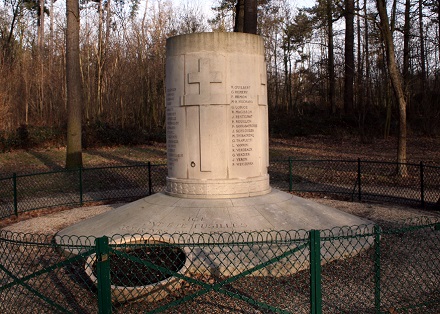
August 16 is a day of reverence in France for the execution on that date in 1944 — just days ahead of the allied liberation of Paris — of 35 young Francs Tireurs partisans.

In a dastardly operation, a French collaborator known as “Jacques” — actually Guy Glebe d’Eu, who was himself executed after the war — who had insinuated himself into resistance networks lured the youths, all aged about 18 to 22, to a purported weapons-smuggling operation. They were unarmed when they arrived, but the Gestapo was not.

By nightfall the victims were being lined up at in the Bois de Boulogne and shot. The site today is marked by a stately monument that hosts public memorials every August 16.


(cc) image by Remi Jouan.


“Pass this oak with respect: it bears the scars of the balls that slew our martyrs.” (cc) image by Mickael Denet.

On this day..

1546: Etienne Dolet, no longer anything at all

On this date in 1546, which was his 37th birthday, the French linguist and translator Etienne Dolet was burned at the stake in Paris over a few little words.

Dolet (English Wikipedia entry | French) was a young polymath with a pugilistic streak both literary and literal. While a law student at Toulouse, he won both a stint in prison and the patronage of King Francis I.

Dolet might have rated the latter a sturdier shield than it proved to be in practice, for his satires — so irreverent as to be heretical in a time when heresy really mattered — landed him back in the clink in Lyons from 1542 to 1544, charged with atheism.

Dolet’s real concern was language: he was a prolific translator of books into French (including some of his own work in Latin), and he produced a lengthy commentary on classical Latin and, in 1540, Europe’s first vernacular treatise on translation.

But for a smart guy he could be a little dumb.

Having pulled strings with the bishop to weasel out of his dungeon, Dolet made tracks for Italy … but then cockily returned to Lyons where he was once again arrested as a heretic. He didn’t get a second chance to learn his lesson.

Dolet’s condemnation turned on a philistine misapprehension of the humanist art of translation.

“While translating, you must not be enslaved to the extent of rendering word for word,” he had counseled in his treatise. “Concentrate on the meaning and handle things so that the intention of the author is expressed, while heedfully maintaining the propriety of both languages.” This is nearly a banality for the modern art of translation, but at the time pitted him against a long Christian tradition that prized textual fidelity over literary elegance.

Rendering a complex bit of Plato into French, Dolet reworked the passage into his target language thus:

Since it is certain that death is not at all among the living: and as for the dead, they no longer are: therefore, death touches them even less. And hence death can do nothing to you, for you are not yet ready to die, and when you have died, death will also not be able to do anything, since you will no longer be anything at all.

If you’re going to be executed over a block of text, that’s a pretty good block.

It’s the anything at all (we added the emphasis) that got Dolet in this instance: Plato had not literally said that, and Dolet’s hostile interlocutors decided to read this flourish of artistry and emphasis as proof of a sly atheist denying the immortality of the soul. No less an authority than the Sorbonne theological faculty signed off on this reading. (Calvin also denounced Dolet; he’s sometimes regarded as a freethinker martyr, which is a more generous spin than “clever asshole.”)

Dolet’s surname chances to double as a declension of the apt Latin verb “to hurt”; en route to the stake, the impious polyglot is said to have exploited the overlap in one final — shall we say dolorous? — witticism:

Non dolet ipse Dolet, sed pia turba dolet
Dolet himself does not suffer, but the pious crowd grieves

On this day..

1617: Eleonora Galigai, Marie de’ Medici favorite

On this date in 1617, Italian noblewoman Eleonora Galigai was beheaded in Paris for witchcraft.

Continuing the French crown’s glorious tradition of importing dubious Italians in the train of a Medici, Eleonora (also known as Leonora or Dianora) shipped over from Tuscany with her mistress Marie de’ Medici when the latter was dynastically married off to Henri IV. Like many in its time it was a marriage of convenience: Henri brought the kingdom — and Marie the money.


Detail view (click for the full panoramic panel) of Peter Paul Rubens‘s Coronation of Marie de’ Medici in [the Basilica of] St. Denis, part of a cycle of Marie de’ Medici paintings Rubens produced on the queen’s commission beginning in 1622.

The coronation depicted above occurred on May 13, 1610 after ten quarrelsome years of marriage, and it was noteworthy timing (some thought suspicious timing) because her husband was assassinated the very next day, leaving Marie to rule France in the stead of her eight-year-old firsborn Louis XIII.

To the boundless irritation of France’s native optimates, the import queen now bestowed an incommensurate favor on her own people, and were the French nobility to draw up their bill of particulars for us the very first name might be Eleonora Galigai’s husband.

This character, Concino Concini by name, was the quick-witted son of a Florentine notary who had hustled his way into that same nuptial entourage. Marrying Eleonora, who was one of Marie’s favorites, put him squarely in the limelight among the regal expats; indeed it was he who had the honor of informing Marie of her late husband’s murder with the cold words “L’hanno ammazzato”: they killed him.

Now (runs an English traveler’s epistle), Marie’s “Countenance came to shine so strongly upon him, that he became her only Confident and Favourite, insomuch that she made him Marquis of Ancre, one of the twelve Mareschals of France, Governor of Normandy; and conferr’d divers other Honours and Offices of Trust upon him.” He lived with his wife in splendor at the Louvre, both of them in the constant orbit of the queen whom they dominated.

Haughty, insolent, low-born, foreign, and possibly complicit in regicide, D’Ancre was widely loathed in France; certainly he had few greater enemies than the growing young king, who would already have been disposed to chafe under his mother’s regency. In Louis’s eyes, this adventurer-marquis was both emblem of his mother’s misrule and (as Marshal of France) a substantive roadblock to his own power.

At last in 1617 — not yet 15 years of age — Louis seized his own realm* by having D’Ancre ambushed crossing in front of the Louvre and murdered by palace guards. Afterwards, a crowd long hostile to the noxious favorite brutally vented its rage on his naked corpse, gleefully shouting at Eleonora those words Concino had made so notorious: l’hanno ammazzato! They were really baying for her blood, too.

And they got it.

With France in hand and public opinion at his back — “I cannot represent to the king one thousandth part of joy of all these people who are exalting him to heaven for having delivered the earth from this miserable burden,” one toady reported; “I can’t tell you in what execration this public pest was held” — Louis’s party began purging the remaining dregs of his mother’s regency.** They soon shut up Eleonora in the Bastille, and had her charged as a sorceress.

* This coup was naturally big news in England as well; there’s evidence of a now-lost play about it within weeks of D’Ancre’s murder.

** The eminence grise himself, Cardinal Richelieu, first attained the summit of the state as a loyal aide to Marie and Concino. Briefly banished from Paris in the wake of Louis’s coup, Richelieu bided his time and won his way back into the confidence of the young king with whom he was to become so closely identified.

On this day..

1962: Roger Degueldre, OAS commando

Thanks to Thomas Kanyak of @ModernConflict for the guest post. -ed.

On this date in 1962, Organisation Armee Secrete (OAS) Delta commando leader Roger Degueldre was executed by firing squad at Fort d’Ivry, near Paris, France.

Degueldre, 37 years old at his death, was one of only three OAS men executed by France for the terrorist excesses in the end game of the Algerian War in 1961 and 1962. Fittingly, that conflict wrenched to a conclusion five days before Degueldre’s death by musketry, with a referendum confirming Algeria’s independence from France. After the January 1960 “Barricades Week” revolt failed, Degueldre swore he “took an oath to keep Algeria French. As far as I’m concerned the oath will be kept. I’ll go to the limit.” He certainly did.

Like many men who joined the French Foreign Legion, Degueldre was the product of a murky past: either a Belgian who joined the SS Wallonie and fought on the Russian front, or a Frenchmen who served in the Resistance in occupied France.

What is known is, he joined the regular Army towards the end of the war, and then enlisted in the Foreign Legion under a nom de guerre. He served in Indochina and was wounded at Dien Bien Phu. In Algeria, he assumed his real name. After being suspected of taking part in the December 1960 riots during President de Gaulle’s visit to Algeria, Degueldre deserted from 1er REP, the French Foreign Legion parachute Regiment, in early 1961. The French Army, after crumpling against Germany, losing in Indochina and being humiliated at Suez, was determined to make a stand in Algeria. But the army’s resolve proved to greatly exceed the nation’s.

As France’s commitment to the fight against the Moslem rebel FLN began to crack, the army’s simmering resentment turned into open revolt, culminating in the failed Generals Putsch of April 1961 and the formation of the Secret Army Organization (Organisation Armee Secrete or OAS) that spring. It was comprised of disaffected soldiers and pieds noirs (black feet, a nickname for the European population of Algeria).

The OAS was structured in early May 1961, and Degueldre was assigned to the Organisation-Renseignement-Operation (ORO) section which was responsible for most of the OAS terrorist violence.

Degueldre’s OAS codename was Delta, and his commandos within the ORO became known as the “Deltas”; they carried out the majority of operation punctuelle (assassinations) from the failed Putsch to Algerian Independence in July 1962.

In Algiers, betrayed, Degueldre was identified slipping away from a OAS meeting in Algiers and arrested by French authorities on 7 April 1962.

“At Caserne des Tagarins, gendarmes toasted Degueldre’s arrest with champagne. They were very relieved. The Captain in charge approached the long, grim, sun baked figure and offered to wager a case of champagne that French Algeria would no longer exist within a few months.

“I won’t be here in a few months to drink it” Degueldre replied simply.

Degueldre went on trial on 27 June at Fort de Vincennes in Paris. After legal maneuvers to unseat a second judge (the first judge resigned, and committed suicide two days after the trial), Degueldre went essentially undefended, refusing to answer questions. After providing no defence witnesses, and hearing the testimony of four prosecution witnesses, Degueldre was convicted by the military court of ten murders and sentenced to death. Upon hearing the verdict, Degueldre smiled.

In Fresnes Prison after the conviction, fellow prisoners discussed going on hunger strike in protest of the death sentence meted out to Degueldre. When Degueldre was informed of the plans for the strike, he curtly replied “there’ll be no strike for me.”

On 6 July 1962, Degueldre was driven to Fort d’Ivry Prison outside of Paris where the sentence would be carried out. An 11-man firing squad delivered a volley of shots, the captain in charge administered the traditional coup de grace, and it was over (there are several versions of the fusille hier matin au Fort d’Ivry; one had it that only one shot of 11 hit Degueldre, and the Captain had to empty his revolver into him). The man described by Jean-Jacques Susini, an OAS leader, as “a magnificent revolutionary” had pour l’honneur de la parole donnee: he kept his oath.

On 23 November 1961, French President Charles de Gaulle delivered a speech to 2,000 assembled military personnel in Strasbourg. This “Lost Soldiers” Speech sought to quell discontent in the Army over the direction of French policy in Algeria after eight years of war.

it’s an illusion to think one can make things be what one desires and the contrary of what they are … at that moment when the state and the nation have chosen the way, military duty is traced out once and for all … outside these limits there can be — there are only — lost soldiers.


Sources:

Wolves in the City, the death of French Algeria by Paul Henissart

A Savage War of Peace: Algeria 1954-1962 by Alistar Horne

Various New York Times articles

@claireparisjazz twitter account

On this day..

1378: Pierre du Tertre and Jacques de Rue, Charles the Bad men

On this date* in 1378, Jacques de Rue and Pierre du Tertre, aides to King Charles II of Navarre, were beheaded at Les Halles.

Both men were casualties of their devious master’s most recent betrayals, part of a career that had honed the double game to nearly sadistic precision.

Navarre spent the latter half of the 14th century fouling up alignments in the Hundred Years’ War by constantly switching his allegiances between England and France. Come the 1370s, he was supposed to be on team France — having paid homage to the French king in 1371 — but was still conniving with the English whose expeditions might one day apply enough pressure to force France to restore him some lost domains.

The last great plot of the man contemporaries knew as Charles the Bad really fell apart in the spring of 1378 when the French detained en route to Normandy Jacques de Rue and Pierre du Tertre, two emissaries of Charles’s “criminal entourage”. They carried coded messages** confirming that Navarre was not only back to scheming with the English, but that he was trying to orchestrate the assassination of the French king by means of poison — plots that Jacques confirmed under torture.

France retaliated by attacking its disloyal partner’s Norman holdings and by year’s end the whole region had been chopped up between the French and the English, never to return to Navarrese hands. His retainers were put to death and their corpses strung up on Montfaucon.

This was the humiliating end to the political life of Charles the Bad: reduced to a client king dominated by France (to his north) and Castile (to his south). It would soon find its parallel in the horror ending of his actual life on New Year’s Day 1387:

Charles the Bad, having fallen into such a state of decay that he could not make use of his limbs, consulted his physician, who ordered him to be wrapped up from head to foot, in a linen cloth impregnated with brandy, so that he might be inclosed in it to the very neck as in a sack. It was night when this remedy was administered. One of the female attendants of the palace, charged to sew up the cloth that contained the patient, having come to the neck, the fixed point where she was to finish her seam, made a knot according to custom; but as there was still remaining an end of thread, instead of cutting it as usual with scissors, she had recourse to the candle, which immediately set fire to the whole cloth. Being terrified, she ran away, and abandoned the king, who was thus burnt alive in his own palace.

* There are some cites for May 21 out there, but the sourcing on June appears stronger to me, and references to the men’s interrogations and trial run to June. The beheading is also referred to as having taken place on a Monday, which fits June 21 (but not May 21) in 1378.

** According to CryptoSchool this is one of the oldest known documents in the history of cryptology. Devised personally by Charles of Navarre, its gambit was to “move the names of princes, castles and cities to other names not their own.” (Chronique Normande)

On this day..

1794: Nicolas Luckner, German marshal of France

On this date in 1794, Nicolas Luckner was guillotined in Paris.

A count with his own manor on the German-Danish frontier, Luckner (English Wikipedia entry | German, where he’s Nikolaus von Luckner) made the sort of cross-national career pivot that was still possible in the pre-revolutionary world by going from commanding hussars against France in the Seven Years’ War to serving in the Bourbon army.

Allegedly convinced that Marie Antoinette had blocked his advancement, Luckner supported the French Revolution, and by 1791 had summited his profession as Marshal of France.

He was the very commander of the Army of the Rhine to whom Rouget de Lisle dedicated the 1792 Chant de Guerre pour l’Armée du Rhin … the marchable tune which later became the Marseillaise. (Luckner’s name also appears on the Arc de Triomphe.)

Things did not go as swimmingly with the Army of the North, where he bogged down in the Low Countries — and the incriminating defection of the Marquis de Lafayette to France’s royalist enemies did him no favors in the court of Jacobin opinion. Luckner was relieved of his command by the impatient National Convention.*

This septuagenarian foreign count showed a lordly blindness to his adoptive country’s situation both fiscal and political by journeying to Paris later in 1793 to complain that his pension was not being funded in full. Other officers had already fallen under the Terror’s blade for command failure, where any shortcoming in the field could be readily conflated with treachery — and Luckner, no surprise, was soon denounced as a royalist.

City hall in the small Bavarian town of Cham, where Luckner was born in 1722, still chimes the Marseillaise every day to honor its native son … whose name also associates with Germany’s World War I naval hero Felix von Luckner, the great grandson of our man Nicolas.

* The Convention’s emissary on this occasion was Choderlos de Laclos … best known now (and then) as the author of the viperous epistolary novel of ancien regime misbehavior Les Liaisons Dangereuses.

On this day..

1591: Four of The Sixteen

When the Huguenot prince turned Henri IV of France finally mastered his realm by attending Catholic services in his capital city with the legendary words “Paris is worth a mass,” he was not merely overcoming some residual sectarian prejudice. There had been civil war in France for the best part of a century, and the bitterness of Catholic opposition to a Protestant king would eventually claim Henri’s life.

And in that conflict, Paris herself was militantly Catholic.

During the last phase of France’s devastating Wars of Religion, suitably titled the War of the Three Henrys, a Paris dominated by the staunch Catholic League held out against a joint siege by the sitting, Catholic king Henri III — who was so much the moderate sellout as to have made common cause with his cousin and heir, the Protestant Henri of Navarre (our future Henri IV).*

We have dealt elsewhere in these pages with those dramatic years, including Paris eventually falling into the hands of a despot clique of Catholic fanatics known as “The Sixteen” — who made so bold as to execute Catholic “politiques” of insufficient zeal.


An armed march of the Holy League in Paris in 1590. (Anonymous painting)

Just days after the signal hanging of jurist Barnabe Brisson in November of 1591, the city was taken back in hand by the Duke of Mayenne, a Catholic whom some radicals wished to advance to the throne.

Mayenne preferred the role of kingmaker, stabilizing the long unrest of his realm. He was horrified by the Sixteen, and on December 4 he seized four of their number — Nicolas Ameline, Barthelemy Anroux, Jean Emmenot and Jean Louchart — and had them summarily hanged at the Louvre. The Sixteen’s days were done.

Mayenne had the wisdom not to follow these exemplary executions with any provocative purges — neither of the other 12 nor other intemperate elements in town — but proclaimed a general amnesty. It was he who, over the months ahead, smoothed the way for Henri IV’s famous mass.

* The third Henri in the War of the Three Henrys was the late Duke of Guise, whom King Henri III had had assassinated. The House of Guise was characteristically an ardent Catholic party in these years, so his murder had helped sunder the allegiance of Paris to her king.

On this day..

1430: La Pierronne, visionary

On this date in 1430, the Breton visionary La Pierronne was handed over to the secular authorities and burnt for blasphemy.

Not much is known of La Pierronne, save that she was a companion and follower of Joan of Arc — one of several women, who all shared Joan’s confessor, an itinerant monk known as Friar Richard. (Not much is known of him, either.)

La Pierronne was captured by the English at Corbeil in the spring of 1430, along with a younger companion whose name is not known. Rumor had it that she and Joan had both taken communion multiple times the previous Christmas, which was an irregular activity but not technically an outlawed one.

Still, cavalier behavior with the Host plus a surfeit of fealty to the Maid put our seer squarely in the sights of the Grand Inquisitor Jean Graverent. It was a preview of the sort of interrogation Joan herself would soon face.*

Like Joan of Arc, La Pierronne maintained that God spoke to her — and not only spiritually but in the shape of a physical apparition. This was clear heresy in the Church’s eyes — a direct ticket to the fire in the absence of speedy abjuration.

On the third of September, both women were presented with their options in the form of a sermon presented in the presence of the stakes that would otherwise receive them. Joan herself would face this test of faith, and would fail it on her first encounter. Here, the younger woman recanted — but La Pierronne held to her visions at the cost of her life.

Two women, who about half a year before had been captured at Corbeil and brought to Paris, had a sermon preached over them in the court before Notre Dame. The elder of these was Pierronne, and she was from Bretagne speaking Breton. She asserted and maintained that dame Joan (the Maid), who fought for the Armagnacs, was a good woman, and that what she did was well done and according to God.

Also she admitted having received the precious Body of our Lord twice in one day. Also she asserted and swore that God often appeared to her in human form, and spoke to her as one friend speaks to another, and that the last time she had seen Him, He was clad in a long white robe with a crimson doublet under it; which is nothing short of blasphemy. And she would never retract this statement that she often sees God clothed in this form, for the which, on this same day, she was sentenced to be burned, and so it was done and she died on the Sunday named persisting in this assertion, but the other woman was set at liberty at the same time.

* Joan had been captured by the Burgundians in May 1430. The Inquisitor Graverent was engaged by a different inquisition when Joan was prosecuted, so he didn’t take part in her trial.

On this day..

1792: Barnabé Farmian Durosoy, royalist journalist

Litterateur Barnabé Farmian Durosoy was guillotined in Paris on this date in 1792.

Playwright, poet, and (most problematically) journalist, Durosoy‘s newspaper Gazette de Paris took issue with the French Revolution’s radical and anti-clerical turn — incurring the dangerous denunciation of Marat.

Durosoy had the boldness to denounce in print the 10 August coup whereby Georges Danton and the Paris Commune* toppled the monarchy.

“If these rebels dare to degrade the king then they dare to judge, and if they judge then their verdict is death!” Durosoy thundered.

He would not even live long enough to see his prophecy fulfilled: the Gazette was immediately suppressed and Durosoy brought to trial as “cashier of all the Anti-revolutionists of the interior.” (Carlyle)

He was the first journalist guillotined in revolutionary France — noting that he died as a royalist ought on the feast day of St. Louis.

* No, not that Paris Commune.

On this day..