Feast Day of St. Catherine of the Wheel

This date annually is the feast of iconic — perhaps mythological — Christian martyr Saint Catherine, said to have been put to death in the 4th century for her faith.

St. Catherine in a 700-year-old stained glass at St. Mary’s Church of Deerhurst. Image courtesy of the Sacred Destinations Travel Guide.

One of the most popular Catholic saints, St. Catherine was reputed to have been a beautiful young maiden of Alexandria — so wise as to convert every pagan scholar sent to dispute her, so devoted as to be mystically betrothed to Christ.

Catherine was condemned by one of the last pagan rulers of Rome to torture on a breaking wheel, which shattered when it touched her — so she was simply beheaded. (The story is related in didactic iconography in this triptych.)

Despite this inauspicious debut, the breaking wheel was Catherine’s iconic attribute, by which her frequent appearances in devotional art can be recognized.

This gruesome instrument of torture was also known as the “Catherine wheel” in medieval Europe, from which English derives the deceptively winsome-sounding name of a firework.

The saint became the patron of those condemned to this horrific death as well as a diverse swath of the wider society: wheelwrights, mechanics, and other laborers who worked with wheels for apparent reasons; teachers, philosophers and scribes for her learning; girls, virgins and young maids for her purity. Single women seeking husbands still offer her supplication:

St. Catherine, St. Catherine, O lend me thine aid
And grant that I never may die an old maid.
A husband, St. Catherine.
A handsome one, St. Catherine.
A rich one, St. Catherine.
A nice one, St. Catherine.
And soon, St. Catherine.

Catholic recountings of the saint’s legend can be read here and here. More St. Catherine’s Day customs are enumerated here.

On this day..

1740: Not William Duell

On this date in 1740, five criminals were hanged at Tyburn.

Sixteen-year-old William Duell was among them. He was hanged — but he did not die. As recounted in The Newgate Calendar:

WILLIAM DUELL was convicted of occasioning the death of Sarah Griffin, at Acton, by robbing and ill-treating her. Having suffered, 24th of November, 1740, at Tyburn, with Thomas Clock, William Meers, Margery Stanton and Eleanor Munoman (who had been convicted of several burglaries and felonies), his body was brought to Surgeons’ Hall to be anatomised; but after it was stripped and laid on the board, and one of the servants was washing it, in order to be cut, he perceived life in him, and found his breath to come quicker and quicker, on which a surgeon took some ounces of blood from him; in two hours he was able to sit up in his chair, and in the evening was again committed to Newgate, and his sentence, which might be again inflicted, was changed to transportation.

Failed hangings were not unheard-of at this time … and if transportation was no mean sentence, the young criminal must have reflected that matters certainly could have gone much worse for him.

On this day..

1910: Hawley Harvey Crippen

On this date in 1910, the notorious wife-murdering doctor Hawley Harvey Crippen was hanged at London’s Pentonville Prison.

The sensational trial, which saw the American-born homeopath convicted for dismembering his shrewish and unfaithful wife Cora in an attempt to take up with his young mistress, fitted Crippen for both a noose and a likeness at Madame Tussaud’s. (More trial background here.) It has also made his case twice a landmark in the history of crime and technology: once at the time of his arrest, and again just last month as of this writing.

The core of a case a jury found so open-and-shut as to require just 27 minutes to convict was the poorly explained disappearance of Crippen’s wife, followed by the discovery of a considerably mutilated female corpse under the Crippens’ home.

Although much of the crown’s evidence was speculative and circumstantial — to say nothing of the bodice-ripping gossip of nymphomania and infidelity — a corpse under the floorboards tends to be a compelling circumstance to a jury.

Presumably that anticipation prompted Crippen to flee the Scotland Yard investigation with his mistress Ethel le Neve under assumed names on an ocean liner bound for Canada. The case made criminological history as the first use of wireless communication to apprehend a suspect when the ship’s alert captain telegraphed Crippen’s presence to land as the ship steamed away — enabling a policeman to board a faster boat and arrest the pair as they docked in Quebec.

In the century since Crippen went to the gallows still maintaining his innocence, the case has endured in popular notoriety. The killer’s life has been novelized, meditated upon and borrowed for fiction, offering a draught of inspiration to Alfred Hitchcock along the way.

Books inspired by the Crippen case …

Given his suspicious behavior, scant had been the credence given Crippen’s protestation of innocence.

Until now.

In a meeting of Edwardian crime and cutting-edge technology, two scientists from Crippen’s home state of Michigan stunningly announced in October that DNA testing proves the body was not Cora Crippen after all.

If true, it would appear to void Crippen’s conviction in its particulars without quite exonerating the hanged man from the natural question: whose was the corpse? The manufacture of clothes on the body dated it to the Crippens’ occupancy of the house.

One of Crippen’s modern sleuths, in a wholly speculative vein, thinks it might harken to an altogether different sort of crime: a botched back-alley abortion, just the sort of thing a financially struggling physician might have been involved in.

Maybe.

But if the test invites a modern investigator to look 97 years backwards, it also suggests a posture of epistemological humility. It’s just possible that the light this test casts on our own time is as searching as that it shines on 1910.

The Prejudice of Science

The Crippen case was a classic 19th century-style detective job — the inspector who made the arrest cut his teeth as a younger man on a Jack the Ripper murder — but it took place on the brink of a revolution in forensic science.

Just a few years before, fingerprinting had been embraced by British and American law enforcement and begun its march towards total institutionalization. On the heels of fingerprinting came a multiplicity of biometric approaches to crime scenes — hair and fiber analysis, blood typology, and most recently and dramatically, DNA.

And they, in turn, have brought a rising faith in science to adjudicate the law.

While the “CSI Effect” — jurors’ expectation of case-breaking scientific evidence — conventionally plays as a hindrance for prosecutors who usually have no such thing, the excess deference given to less-than-conclusive forensic evidence can likewise cut against the defense. Evidence mishandled at crime labs, even cooked outright, factors into numerous recent post-conviction exonerations. The once ironclad credibility of fingerprint evidence has itself been undermined by subsequent forensic advances.

In short, for all its undoubted contributions to criminal justice, forensic science packs along its own set of pitfalls, caveats and blinders reflexively privileging evidence of the laboratory.

This is not a reflex to indulge uncritically. History grants the benefit of hindsight, but rarely the luxury of certitude.
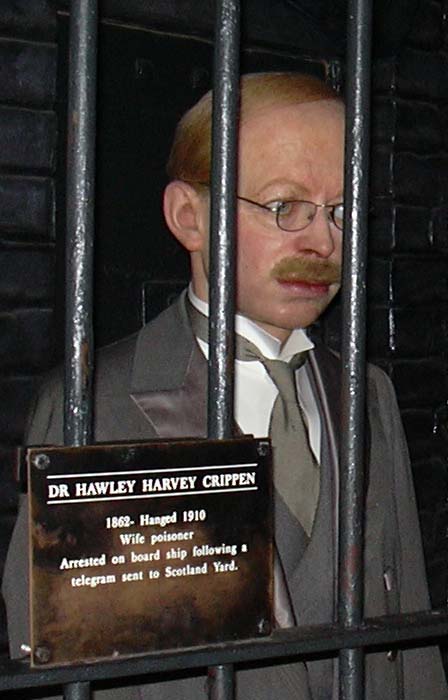
A waxwork Dr. Crippen at Madame Tussaud’s. Image used with permission.

So if the prospect of Crippen’s innocence intrigues, that unexplained body — that sudden flight for Canada — that (permanent) failure of Cora Crippen to resurface — nevertheless remain. They might lead us to question our implicit faith in the finality of DNA’s verdict on history rather than the other way around.

Are we certain that an unbroken line of blood relations really connects Cora Crippen to the modern DNA donors of her “family”?

Are we certain that a reliable chain of custody has preserved the original tissue samples unsullied across a century?

And if we are certain, what do we make of that body after all?

It is humans who must ultimately interpret and contextualize even the firmest forensic science. Whatever we might believe of Dr. Crippen we retain the burden of that belief, with all its intrinsic potential for grievous wrong.

The tales Hawley Crippen has yet to unfold from the grave might or might not shed still another different light on our understanding of what happened at 39 Hilldrop Crescent a century ago.

The gentleman’s place as a continuing attraction at Madame Tussaud’s, however, seems assured.

On this day..

1799: Judith van Dorth

On this date in 1799, Judith van Dorth was shot on the outskirts of Winterswijk for supporting an attempted restoration of the House of Orange to the Dutch throne against the Batavian Republic.

Although the Netherlands had been a Republic for two centuries, it was torn by revolutionary conflict from the mid-1780’s — predating the French Revolution, but finally coming to power in 1795 when its neighbor’s mass conscript armies drove William V of Orange to England.

The 52-year-old van Dorth, an impoverished noble of Orangist sympathies, recklessly tried to raise an internal revolt [linked page in Dutch] backing an English-Russian invasion to restore William in 1799.

The uprising came to nothing, and after the invasion — a footnote in the sweep of Revolutionary Wars — was repelled, van Dorth was condemned for treason by a military tribunal to set an example. [linked page in Dutch]

She was shot within 24 hours near Winterswijk’s Jewish cemetery, and apparently survived the barrage. One of the firing squad had to shoot again when he saw her move — legend has it that this occurred when she had already been packed into her coffin.

She remains the only woman in history executed by a Dutch military court. A biography of her life is available in Dutch.

The House of Orange, one of the most successful of European dynasties, regained power in the Netherlands following the Napoleonic Wars. William V’s great-great-great-great-granddaughter Queen Beatrix reigns there today.

On this day..

1944: An unknown Allied airman

On this date in 1944, in the midst of a worldwide conflagration that would claim 70 million lives, one unknown crew member of an Allied bomber was shot by Nazi SS/SD troops in the woods around Enschede, Netherlands.

From late 1942, the Allies’ massive industrial capacity had sapped the vaunted Luftwaffe, bleeding down the German air force in desperate airborne combat in the Mediterranean and the Eastern front. Crippling losses in July and August 1943 lay Germany’s industrial heart open to devastating bombing and would within a year spell the end of the Luftwaffe as an effective fighting force.

The contest’s stakes were high. This hour-long compilation of contemporaneous U.S. propaganda footage celebrates the decisive effect of air supremacy in western Europe:

With hostile planes darkening Europe’s skies, the Germans called upon ruthlessness to stand in for materiel. Nazi SS chief Heinrich Himmler issued, according to Robin O’Neil, an August 1943 order to show no quarter to captured enemy pilots.

The young man shot this day suffered its effects:

The airman (estimated age 26 years), who was apparently unhurt, was taken by the SS to the cellar of the villa [serving as SS headquarters], where he was kept under guard while arrangements were made for his disposal. These arrangements consisted of the removal of his flying kit, and the substitution of a civilian light-coloured shirt, a pair of dark trousers, and a pair of socks.

In this dress he was put into a security vehicle, his hands handcuffed behind his back, and taken some distance in the grounds of the SS HQ to a spot within the compound where a grave had already been prepared. The airman was marched from the car by an escort of two SS men, one of whom dropped back and shot the airman in the back of the neck. He was buried and the grave was carefully camouflaged.

To this day, the airman’s identity has not been established. It was assumed that he was British or American, most probably American, as the trousers he was wearing were of a dark shade of khaki, and the fact that when he was informed in the car, in English, that he was to be executed, he made an indistinct reply in which the word “America” was uttered.

Countless such executions undoubtedly took place and were lost, forgotten or concealed in the charnel house of war. Thanks to the witness of Dutch prisoners who survived the war, this single act of routine brutality endured not only historically but juridically: little more than a year later, its author, Dr. Karl Eberhard Schongarth — an SS officer who participated in the Wannsee Conference and slaughtered thousands in occupied Poland and Holland — faced a war crimes prosecution for the execution of the anonymous airman.

His actions this date may have been small by the gauge of a bloodthirsty career, but since pre-war treaties explicitly regulated treatment of war prisoners, they also constituted a conveniently plain transgression of the far-from-bright line demarcating “war crimes.” For this one killing, Schongarth was himself hanged as a war criminal in Hamelin, Germany on May 16, 1946.

On this day..

1695: Zumbi dos Palmares

On this date in 1695, Zumbi dos Palmares, the last leader of Brazil’s most famous free colony of fugitive slaves, was captured by the Portuguese and summarily beheaded.

From the very beginning of European settlement in the New Wold, Maroon communities of escaped slaves, free-born blacks, Indians, poor whites, and mixed-race outcasts formed at the fringes of slave states.

Colonial power did not welcome their presence.

Consequently, the community of Palmares faced repeated harassment from the Portuguese and the Dutch West Indies Company from the time of its establishment around 1600 — even as it burgeoned into a kingdom of over 30,000 inhabitants.

Zumbi, a black free-born in Palmares, was kidnapped by such a sortie and raised with a missionary priest who taught him Portuguese and Latin. At 15, he escaped and returned to Palmares, quickly rising to prominence and in 1678 overthrowing his adoptive uncle King Ganga Zumba when the latter attempted to accept peace under Portuguese rule.

Zumbi’s skepticism was vindicated when the followers of Zumba who had defected to Portugal were re-enslaved, but free Palmares soon faced intensified Portuguese pressure. In 1694, artillery finally battered its largest settlement into submission — forcing its ruler into the bush, where he long eluded capture.

In Zumbi’s honor, November 20 is a Brazilian celebration of national pride and especially pride for those of African descent … while the king who would not be a slave has lent his name, somewhat paradoxically, to an international airport.

On this day..

1915: Joe Hill

On this date in 1915, songwriter, poet and labor activist Joe Hill was shot in Utah for the murder of a local butcher.

Even before his execution, the Swedish immigrant was widely thought to have been railroaded for his IWW affiliation.

Though state authorities had little use for the worldwide clemency bid whose backers included U.S. President Woodrow Wilson — powerless to intervene officially, since the execution was a state matter — Hill walked spryly into his martyrdom. The strange post-mortem career of his totemic ashes is the least of the ways Hill lives on.

His dauntless last message to fellow Wobbly Bill Haywood — “Don’t waste any time mourning. Organize.” — is a permanent fixture on pins and placards among every stripe of left activist. The songs he wrote remain in print — and in performance.

And the Depression-era tribute ballad “I Dreamed I Saw Joe Hill Last Night” can seamlessly serenade ripped-from-the-headlines footage, as a Paul Robeson rendition does in these clips of 1998 protests against then-New York City Mayor Rudy Giuliani.

On this day..

1577: Soulmother of Kussnacht

On an uncertain date in November of 1577, a popular medium whose given name is lost to history was burned to death in a lakeside town for claiming to speak with the dead.

The Soulmother of Kussnacht ran a successful enterprise channeling spirits for those who survived them. Though her persecution by a Church ill-disposed to “wise women” seems a given in retrospect, she evidently ran this business openly for well over a decade, and was at least once before brought to the attention of authorities who found her harmless.


Kussnacht as seen in an old postcard. Image reproduced with permission.

Historian Carlo Ginzburg locates Die Seelenmutter within the cosmos of pre-Christian “shamanism” that persisted in Christendom under varying degrees of toleration. In Ginzburg’s Night Battles: Witchcraft and Agrarian Cults in the Sixteenth and Seventeenth Century, which chronicles the Inquisition’s crackdown on a sect of northern Italian occultists, the contemporaneous execution of the Soulmother is both barometer and precedent for Rome’s rising intolerance of heresy.

On this day..

1720: Captain John “Calico Jack” Rackham

On this date in 1720Nov. 18, 1720, the pirate captain “Calico Jack” Rackham was hanged together with his crew by the British governor of Jamaica.

Nicknamed for his flamboyant clothing, the Bristol-born buccaneer plundered the West Indies during the “Golden Age of Piracy”, having ousted his former captain Charles Vane. Rackham is chiefly remembered to history for two who were not hanged with the rest of his crew: Anne Bonny and Mary Read, rare female pirates who served aboard Rackham’s ship.

Immortalized by Daniel Defoe in his pseudonymous A General History of the Pyrates, Bonny and Read came to piracy by different paths but were both every bit the part and leaders aboard their ship — “very profligate, cursing, and swearing much, and very ready and willing to do any Thing on board.” Bonny, at least, was Rackham’s lover — having eloped with him from her husband.

Upon capture, both women “pleaded their bellies” to escape the gallows, and though it’s unclear whether either really was pregnant, it seems the gambit spared both from execution.

Read died in prison shortly after, while Bonny vanished from history — prompting speculation that she had escaped, secured a pardon, been ransomed by her wealthy father, and/or returned again to piracy under a different guise. Reportedly, she castigated Rackham at their last meeting in prison for lying drunk below decks while only the women resisted the capture of their ship: “I am sorry to see you here Jack, but if you had fought like a man, you need not be hanged like a dog.”

As the world’s best-known women pirates, Bonny and Read are recalled as anything from sexualized historical curios to action heroines to proto-feminists.

They feature in Disneyland’s “Pirates of the Caribbean” ride, the Witchblade comic book series, utopian theorizing, popular history … and the occasional action figure.

Update: A much more detailed foray into the lives of these daring women is at Scandalous Women.

Also, I posted this under the wrong date: it should be Nov. 18. Balls.

On this day..

1491: Eight current and converted Jews at an auto de fe

On this date in 1491, the murder of the Holy Child of La Guardia was punished with an auto de fe and the public execution of eight Jews — some practicing, some converted to Christianity (who enjoyed the mercy of strangulation before being burnt) — and three others already dead but exhumed for the occasion.

The auto de fe — literally, “act of faith” — was a public ritual of religious penance for the condemned. Though its performance did not always precede the execution of its participants, it became closely associated with the savagery of the Spanish Inquisition.

In the hysteria of the Holy Child of La Guardia case — one of history’s better-remembered instances of “blood libel” implicating Jews in the ritual murder of Christian children — the result was foreordained.

Knitting together (inconsistent) confessions obtained under torture, the famed Inquisitor Torquemada proved a conspiracy of Jews had kidnapped and crucified a child further to the concoction of a magic potion that depended on the heart of an innocent Christian — despite a fruitless high-and-low search for some missing child who might have been the actual victim.

After this day’s gaudy public slaughter, a cult sprang up around the supposed martyr, adored in a chapel erected where one of the prisoners had once had a home — the very spot, it was said, where the Jews conspired. The Holy Child was a staple of Spanish literature down to the 20th century and is still venerated in La Guardia.

But Torquemada aimed for results well beyond Christendom’s martyrology, and the wretches at the stake would not be this day’s only victims.

John Edward Longhurst argues in The Age of Torquemada that the Inquisitor seized on the Holy Child case to orchestrate “his heart’s desire — the expulsion of all Jews from Spain.”*

Early the next year, the Spanish monarchy obliged, permanently remaking Spain:

If Ferdinand and Isabella were hesitating over expelling the Jews from Spain, the discovery of this latest Jewish plot would surely resolve all doubts. The Auto de Fe of November, 1491, exploited the affair to its fullest, emphasizing not only all the gruesome details of the Murder but the Jewish menace to Christians intended by it. The sentence against the Jew Juce Franco, read aloud to the great crowd at the Auto de Fe, identifies him as a seducer of Christians to the Law of Moses in language that clearly foreshadows the Edict of Expulsion four months later

We may be sure that Ferdinand and Isabella were treated to a lengthy account of this case. It also is clear, from their own observations in the Edict of Expulsion, that Torquemada impressed on them the determination of the Jews to persist in their efforts to seduce Christians to Judaism. As long as they were permitted to remain, the danger of infection would never be eliminated, no matter how harsh the measures employed against them.

* Or, their forcible conversion … which would then keep the Inquisition in business for years to come.

On this day..