2001: Lois Nadean Smith

On this date in 2001, Lois Nadean Smith was executed by lethal injection in Oklahoma for the murder of her son’s ex-girlfriend.

By the standards of the 1,099 executions in the “modern” death penalty in America — those since the 1972 Furman v. Georgia Supreme Court decision — very little especially distinguished Smith‘s case.

Sentenced some 19 years before her death, she had committed a single horrifying and rather tawdry kidnapping and murder. Her guilt was in no question, although she stood trial along with her son — who received a life sentence — and would later argue on appeal that their lawyer had pursued a defense intentionally shifting blame onto her in order to save him.

As a woman, though, Smith was inherently an oddity. This date completed a remarkable year in which Oklahoma, having not put any woman to death since 1903, emptied its women’s death row with three such executions.

Including those three, only eleven women have been executed in the United States since Furman — or, indeed, since the Kennedy administration. There had been no calendar year in which three women were executed in the entire country since 1953 … and no single state had executed three women in one year since Virginia when the women in question were property.*

According to the Death Penalty Information Center:

Death sentences and actual executions for female offenders are also rare in comparison to such events for male offenders. In fact, women are more likely to be dropped out of the system the further the capital punishment system progresses. Following in summary outline form are the data indicating this screening out effect:

  • women account for about 1 in 10 (10%) murder arrests;
  • women account for only 1 in 50 (2.1%) death sentences imposed at the trial level;
  • women account for only 1 in 70 (1.4%) persons presently on death row; and
  • women account for only 1 in 90 (1.1%) persons actually executed in the modern era.**

At the end of a chain of improbabilities, Smith apparently met her death with composure. “To the families, I want to say I’m sorry for the pain and loss I’ve caused you,” she said from the gurney. “I ask that you forgive me. You must forgive to be forgiven.”

* See charts of female executions through 1962 and since 1900, both courtesy of the comprehensive Espy file of all executions in American history.

** This calculation appears to be slightly dated, with women currently accounting almost exactly 1 in 100 persons actually executed. The last 117 American prisoners executed have all been men.

(All stats are as of publication date in December 2007)

On this day..

1952: Rudolf Slansky and 10 “conspirators”

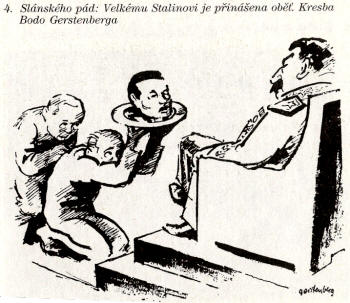
On this date in 1952, eleven high-ranking Czechoslovakian politicians were hanged at Prague’s Pankrac Prison two weeks after a show trial purging unreliable elements from the Communist party.

One of the most infamous show trials in Czechoslovakia saw 14 high-ranking Communists — eleven of them Jews — railroaded for a “Trotskyite-Titoist-Zionist activities in the service of American imperialism”. Three received life sentences. The other eleven went to the gallows.

While the roots of the persecution, especially the undertones of anti-Semitism, sink into the id of the Stalinist Eastern bloc, the most evident proximate cause was the USSR’s assertion of control over its satellite states at a time when Josip Tito was successfully charting a course of independent communism. Purges in Poland, Bulgaria and Hungary had taken place in the years before.

The Soviet agents rounding up suspects for Stalin did not trifle with small game. Rudolf Slansky was General Secretary of the Communist Party and therefore the second-most powerful man in the country; by the time he was tried, after a year in prison under torture, he was publicly denouncing himself.

Otto Sling, whose name became synonymous with forbidden heterodoxy, did likewise — “I was a treacherous enemy within the Communist Party … I am justly an object of contempt and deserve the maximum and the hardest punishment.”

And Vladimir Clementis, the Slovak Minister of Foreign Affairs, was erased from a photo taken with the Czechoslovakian President, a circumstance Milan Kundera reflected upon in The Book of Laughter and Forgetting:

In February 1948, the Communist leader Klement Gottwald stepped out on the balcony of a Baroque palace to harangue hundreds of thousands of citizens massed in Old Town Square … Gottwald was flanked by his comrades, with Clementis standing close to him.

The propaganda section made hundreds of thousands of copies of the photograph taken on the balcony where Gottwald, in a fur hat and surrounded by his comrades, spoke to the people. On that balcony the history of Communist Bohemia began. Every child knew that photograph, from seeing it on posters and in schoolbooks and museums.

Four years later, Clementis was charged with treason and hanged. The propaganda section immediately made him vanish from history and, of course, from all photographs. Ever since, Gottwald has been alone on the balcony. Where Clementis stood, there is only the bare palace wall.

The hanged were rehabilitated in 1963.

Artur London, who received a life sentence and was released after rehabilitation, wrote about his experiences in The Confession, subsequently a 1970 Costa-Gavras film. The wife and son of Deputy Minister of Foreign Trade (and Auschwitz survivor) Rudolf Margolius have also both written memoirs covering the trial.

The younger Margolius in particular, who has staunchly defended his father as an essentially apolitical man and not a Communist apparatchik, has been in the thick of present-day disputes in Czechoslovakia’s successor states over whom is due sympathy and recognition for bygone political crimes.

On this day..

2005: Van Tuong Nguyen

On this date in 2005, Australian national Van Tuong Nguyen was hanged* in Singapore’s Changi Prison for smuggling heroin.

Three years before, in dire financial straits, Nguyen had agreed to act as a drug courier and been caught attempting to carry 396.2 grams — less than a pound — of heroin through the airport of the notoriously execution-happy city-state. He had no criminal history and cooperated with the authorities, but the quantity of contraband on his person incurred an automatic death sentence.

Nguyen became an international cause celebre and the Australian government appealed for clemency — though some detected tepid public notice for the young man of Vietnamese extraction in comparison with white Australians in similar situations.

His family’s two-year campaign mobilizing worldwide pressure to save him was the profile of a 2006 documentary that laid bare the continuing grief left to Nguyen’s family and friends … and their continuing work against the death penalty in his remembrance. This personal tribute of unidentified provenance captures both:

* By Darshan Singh, whose identity as Singapore’s hangman was exposed on the occasion.

On this day..

1581: Edmund Campion, Ralph Sherwin and Alexander Briant

On this date in 1581, three English Catholic martyrs were hanged, drawn and quartered at Tyburn, casualties of the bloody confrontation between religious and secular power of the English Reformation.

Edmund Campion — later sainted — was the towering figure among them and the great attraction for those that thronged the Tyburn scaffold on a rain-drenched Friday.

A brilliant Oxford scholar once tipped as a possible future Archibishop of Canterbury, Campion abjured his Anglican holy orders in favor of Rome — a mortal peril in Elizabethan England.

He slipped away to Ireland, then to the continent and safety. But at age 40, after nearly a decade abroad, the missionary zeal of the converted called him back to Albion as part of a secret Jesuit mission. Hunted from the day he set foot back in Britain, he survived a year on the run, an underground minister to an illicit faith.

Though priestly investiture alone technically made him capitally liable, a government with millions of Catholic citizens grappled for some firmer ground upon which to condemn the renowned intellectual. Since Campion succumbed neither to torture nor to blandishments, nor to the surreal interludes when he was hauled out of his dungeon and made to debate with the Crown’s theologians, he was finally convicted on the strength of made-to-order witness testimony to the effect that his mission had some vague upshot of undermining Queen Elizabeth’s hold on her subjects.

In effect, it was very much like convicting him for his faith: the Anglican-Catholic conflict had crystallized, and dozens of priests would follow the route of Campion in the years to come. Between a mutually implacable state and church, either flesh or soul must burn.

Not a few of those who trod the martyr’s path would take inspiration from the beatific Jesuit — as young Henry Walpole, whose own route to Calvary is said to have begun when he was spattered by Campion’s blood this day and come full circle to his own execution 15 years later. Walpole’s embrace of martyrdom fairly glows from his proscribed tribute to Campion:

Hys fare was hard, yet mylde & sweete his cheere,
his pryson close, yet free & loose his mynde,
his torture great, yet small or none his feare,
his offers lardge, yet nothing coulde him blynde.
O constant man, oh mynde, oh vyrtue straunge,
whome want, nor woe, nor feare, nor hope coulde chaunge.

Yee thought perhapps, when learned Campion dyes,
his pen must cease, his sugred townge be still.
But yow forget how lowd his deathe yt cryes,
how farre beyond the sownd of tounge or quill.
yow did not know how rare and great a good
yt was to write those precious guiftes in bloode.

That famous eloquence was Campion’s legacy, so overwhelmingly so that he presents in the lineup of men who might have written Shakespeare.

His best-know work was “Campion’s Brag”, the scornful nickname his foes gave to an apologia he produced while underground in England … and to whose steady words Edmund Campion proved true this day:

[B]e it known to you that we have made a league — all the Jesuits in the world, whose succession and multitude must overreach all the practices of England — cheerfully to carry the cross you shall lay upon us, and never to despair your recovery [to Catholicism], while we have a man left to enjoy your Tyburn, or to be racked with your torments, or consumed with your prisons. The expense is reckoned, the enterprise is begun; it is of God, it cannot be withstood. So the Faith was planted: so it must be restored.

But Protestant England did withstand the enterprise. The generation to come saw Catholic ideas and writing put to withering siege, Campion’s not least among them. For all the tribute of history to the man of Christlike fortitude, it is by no means apparent that the enjoyments of Tyburn and the kindred “practices of England” did not, after all, lay a cross heavier than English Catholics could bear.

On this day..

1944: Lilo Gloeden, Erich Gloeden and Elisabeth Kuznitzky

On this date in 1944, Berlin housewife Elisabeth “Lilo” Gloeden was beheaded with an axe in Plotzensee Prison, along with her husband and mother.

They had been sentenced — and intentionally made an example of — just three days before for hiding a fugitive from the July 20 Plot to assassinate Hitler.

As Martin Gilbert observes in The Second World War: A Complete History, the fury of Hitler’s domestic crackdown came in inverse proportion to Germany’s fortunes in war.

[The family’s] fate was then publicized, as a warning to anyone else who might try to shelter the enemies of the Third Reich.

The fate of that Reich could not, however, be seriously in doubt. On the day of Lilo Gloeden’s execution, American troops drove the Germans from Mackwiller, in the Saar, inside Germany’s pre-war frontier. In Hungary, the Red Army entered Eger, less than twenty-five miles from the central Slovak frontier.

Part of the Themed Set: Women Against Fascism.

On this day..

1941: Zoya Kosmodemyanskaya

On this date in 1941, Soviet partisan Zoya Kosmodemyanskaya was hanged by the Wehrmacht for sabotaging buildings behind German lines near Moscow.

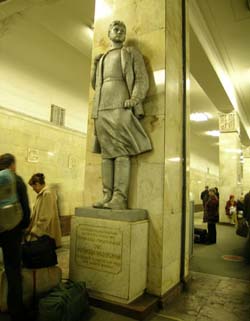
A statue of Zoya Kosmodemyanskaya stands vigil over Moscow’s World War II-era Partizanskaya metro station. Image used with permission.

One of the most famous Soviet war heroines and the first woman decorated as Hero of the Soviet Union during World War II, the 18-year-old had quit school to volunteer for a partisan unit only a few weeks before her hanging as Russia mobilized against Hitler’s race towards Moscow.

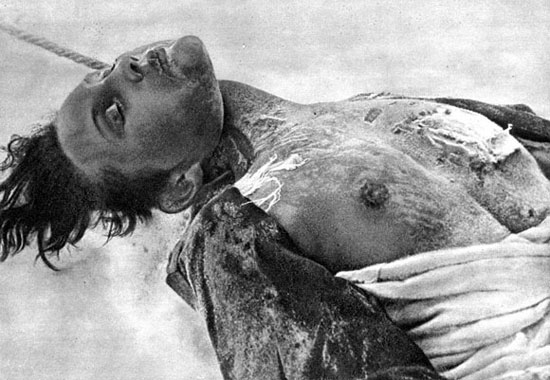
Known simply as “Tanya”, the nom de guerre which was the only information she volunteered during two days of torture, the power of the press offered her apotheosis into a propaganda coup for the Kremlin, and a symbol of courage that would long outlive Stalin. Before the public execution, the Nazis paused to photograph the scene; Kosmodemyanskaya availed the lull to harangue the Germans — “you can’t hang all 190 million of us!” — and call on the Russian villagers present to resist occupation.

Her bayoneted, mutilated body hung on the gibbet until the Red Army recaptured the village; witnesses related the tale of her dying heroism to a newsman.

It was only after the story of “Tanya” hit the press in January 1942 that her identity was established … and then promulgated widely. Anonymous and obscure in death, Zoya Kosmodemyanskaya would inspire millions and become the heroic emblem of other women partisans.


Soviet propaganda poster unabashedly modeled on the already-iconic image of Zoya Kosmodemyanskaya’s abused corpse.

Zoya, a 1944 Soviet film, was scored by Dmitri Shostakovich.

Part of the Themed Set: Women Against Fascism.

On this day..

Themed Set: Women Against Fascism

The entries of today and tomorrow will hardly be the last women, the last anti-fascists, or the last women anti-fascists to grace these pages.

But this small themed set offers a complementary couplet of resistance: women of almost diametrically opposed circumstances who in vastly different ways opposed fascism at the risk (and ultimately, the forfeit) of their lives.

On this day..

1922: Six Greek former ministers of state

On this date in 1922,* on the morning after a revolutionary tribunal held them liable for treason in the catastrophic Greek loss of Smyrna, six former high-ranking political and military officials of the Greek government were shot in Athens.

The long-running national conflict between liberals and monarchists had boiled over during World War I, setting the stage for increasingly bitter internecine conflict played out against the backdrop of a misbegotten foreign adventure.

Greece’s territorial aspirations after World War I.

As the Ottoman Empire — Greece’s neighbor and historical rival — collapsed in the aftermath of the world war, Athens under liberal colossus Eleftherios Venizelos set her sights on a vast pan-Hellenic domain spanning Constantinople, western Anatolia, and the Black Sea coast.

In 1919, backed — even pushed — by the British, Greece occupied Smyrna, a multiethnic economic hub in Asia Minor. But cruelty towards the Turkish population sparked immediate resistance which soon blended insensibly into the burgeoning Turkish National Movement, already on the path towards its destiny of forging the modern state of Turkey.

As the Greek army pressed outwards from Smyrna, it became drawn into full-fledged war. In 1920, the Greek government turned over (as it was often wont to do) and under the ascendant monarchists whose irredentism was not to be upstaged “fantasy began to direct Greek policy” — like a quixotic scheme to march on Constantinople rather than hold a defensible position. Greece’s European allies and sponsors began to cut bait.

September 14, 1922: Smyrna burns.

Far from threatening Constantinople, the Greeks suffered one of their greatest disasters — the “Catastrophe of Asia Minor”, when Ataturk drove them back to, and then out of, Smyrna, emptying the once-cosmopolitan city of thousands of Greek (and Armenian) refugees fleeing a sectarian carnage. Some swam out of the burning city only to be refused aid by ships of nations unwilling to be drawn into the affair politically.

In the dismayed Greek capital, anti-monarchist officers who had been purged by the new government revolted and rounded up the opposition’s leadership. “The Six” who faced public trial for treason included three former Prime Ministers:

With two other ministers of state and a general, they comprised all but one member of the offending monarchist government, a bloody thoroughness the New York Times compared to Robespierre. Western governments temporarily broke off relations.

After the day’s bloody deeds, Venizelos returned from exile to conclude the war on Turkish terms, including “population exchange” — fragrant euphemism — to solidify each government’s demarcation as a nation-state and ratify the destruction of Smyrna (renamed Izmir) as a multiconfessional melting pot.

Today, Smyrna is largely forgotten by those to whom it is not intensely remembered — and among the latter, its meaning is ferociously contested. To Turks, a chapter in their founding expulsion of foreign occupation; to Greeks, the calamitous end of the ancient Hellenic presence in Asia Minor; to each, a touchstone for one another’s atrocities; to others of a less parochial frame of mind, a parable of the perfidy of an entire enemy faith, or a subplot in the great game for Ottoman oil, or as Henry Miller conceived it writing in the antechamber of the second World War, the avatar of a stunted and cynical moral sense among European powers that would lead them to their next great reckoning:

Even the most ignorant yokel knows that the name Attila is associated with untold horrors and vandalism. But the Smyrna affair, which far outweighs the horrors of the first World War or even the present one, has been somehow soft-pedalled and almost expunged from the memory of present day man. The peculiar horror which clings to this catastrophe is due not alone to the savagery and barbarism of the Turks but to the disgraceful, supine acquiescence of the big powers.

Smyrna, like the Boxer Rebellion and other incidents too numerous to mention, was a premonitory example of the fate which lay in store for European nations, the fate which they were slowly accumulating by their diplomatic intrigues, their petty horse-trading, their cultivated neutrality and indifference in the face of obvious wrongs and injustices.

*Greece did not adopt the Gregorian calendar until 1923, the last European country to do so — so the date in Greece on the day of the execution was actually November 15.

On this day..

1987: Jacek Lazar condemned

On this date in 1987, according to the sentence read to him in the climactic scene of The Decalogue no. 5,* Jacek Lazar was condemned to hang for the senseless murder of a taxi driver. (“Lazar” was fictional, but he had a real-life inspiration.)

The movie, plainly reflecting the director’s opposition to the death penalty, is the most overtly political of Krzysztof Kieslowski‘s ten-film cycle exploring the themes of the Ten Commandments. But it is far from tendentious.

The supposed date of the actual execution, depicted here, is not identified.

If one credits the dates, this hanging would be among the last performed in Poland. After April 1988, death sentences were no longer carried out, and Poland formally abolished the death penalty in the late 90’s — thanks in no small part to this film.

* Or Dekalog, per its Polish rendering. This particular installation of the series is also referred to as “A Short Film About Killing”.

On this day..

1919: Felipe Angeles

On this date in 1919, Mexican hero General Felipe Angeles was shot at dawn in Chihuahua, hours after a military tribunal condemned him for rebellion.

Angeles, a humane and cosmopolitan socialist, had tacked a unique course through the dangerous Mexican Revolution. The career artillerist’s military counsel was a high card in the hands of the revolutionaries, and helped to make the coruscating career of Pancho Villa. Crucially, Angeles advised Villa to seize the mines of Zacatecas, dealing a mortal blow to the putschist Huerta government by throttling its currency at the source.

But that brilliant maneuver countermanded an order of the Revolution’s moderate political face, Venustiano Carranza, and both personality conflicts and support for more radically redistributionist measures soon sundered the Villa factions’ alliance with Carranza.

Angeles hitched his destiny to Pancho Villa and is historically recalled as the “angelic” opposite number to the famed guerrilla’s other top military henchman, the murderous Roberto Fierro. The three lend themselves almost implausibly to allegorical literature — “the decisive biographical proof of Villa’s duality … found in the two men closest to him, equidistant and extreme extensions of his nature.” (Enrique Krauze)

Angeles aimed, perhaps, at a statesmanship that might have remembered him the father of his country.

‘It was the recurrent dream of the impotent revolutionary intellectual: to play Plato to some powerful but pliant popular caudillo.’ This may well be an accurate analysis of Angeles, who probably had ambitions to be president of Mexico, with Villa as the power behind the throne but based in Chihuahua, allowing Angeles free rein to implement radical reforms in the capital

… Angeles probably saw Villa as a tabula rasa on which he could imprint his ideology. The problem was that Villa had no taste for abstract thought; as [John] Reed remarked ironically: ‘You had to be a philosopher to explain anything to Villa.’

To the grief of both, Villa neglected Angeles’ expertise when the Villists faced Carranzo at arms. Against advice, Villa abandoned Mexico City, failed to attack when the constitutionalists were tenuous, then spurned guerrilla operations for a frontal assault into the teeth of a foe with numerical superiority and lethal tactical advances culled from the slaughterhouse of World War I.

All was postscript after the Battle of Celaya — Villa maintaining for a few years as a bandit force and famously raiding New Mexico while his strategist drifted into exile in Texas before returning to Mexico on a quixotic peacemaking mission that led him instead to a show trial.

Angeles’ end came with the all the dignity of his romantic age. Before his judges — before all the world — he gave “full and clear expositions of his history and his ideas about everything from politics to ontology. It was clear that he knew this was his end, and he seems to have written a kind of intellectual memoir in the protracted answers … he was not defeated morally so much as physically.”

Angeles himself arranged particulars of his own execution with the Carranza men detailed to shoot him. He enjoys posthumous esteem commensurate with his qualities in life:

On this day..