1949: Nathuram Godse, Gandhi’s assassin

On this date in 1949, Mahatma Gandhi’s assassin was hanged at India’s Ambala Jail, together with one of his co-conspirators.

Often spoken of posthumously as little less than a saint, Gandhi was deeply immersed in the controversial rough-and-tumble politics of his time — India’s independence movement, and the shape of the nascent state. Winston Churchill, for instance, scorned him as “a seditious middle temple lawyer, now posing as a fakir of a type well known in the east, striding half-naked up the steps of the viceregal palace.”

The hatred of a Tory M.P. at the twilight of the empire might be expected, but it was a Hindu nationalist who struck Gandhi down after the partition into a Hindu India and a Muslim Pakistan. Gandhi had vocally opposed partition on the grounds of interreligious tolerance — but he eventually assented to Pakistan’s separation when he became convinced that the alternative was civil war.

Distrusted by Hindu partisans for his “appeasement” of minority groups within India, Gandhi survived numerous attempts on his life. But he sealed his fate by fasting to compel Delhi to make its agreed-upon partition payments to Islamabad even in the midst of war. Nathuram Godse, a Hindu nationalist, gunned him down during evening prayers on January 30, 1948.

(For a less Hollywood take on Gandhi, a five-hour documentary available online surveys his life.)

Godse never betrayed doubt or regret. On the contrary, he cogently justified the murder at trial:

I thought to myself and foresaw I shall be totally ruined, and the only thing I could expect from the people would be nothing but hatred and that I shall have lost all my honour, even more valuable than my life, if I were to kill Gandhiji. But at the same time I felt that the Indian politics in the absence of Gandhiji would surely be proved practical, able to retaliate, and would be powerful with armed forces. No doubt, my own future would be totally ruined, but the nation would be saved from the inroads of Pakistan. People may even call me and dub me as devoid of any sense or foolish, but the nation would be free to follow the course founded on the reason which I consider to be necessary for sound nation-building.

I do say that my shots were fired at the person whose policy and action had brought rack and ruin and destruction to millions of Hindus. There was no legal machinery by which such an offender could be brought to book and for this reason I fired those fatal shots.

Sixty years later, the subcontinent and the world at large seem more strained than ever by the collision between these men’s visions — the secular and egalitarian as against violent religious animosity.

Godse’s old party, the RSS, has become a substantial far-right bloc in the modern political scene. And while the party has always disavowed responsibility for the murder, some still consider Godse a hero. Pakistan, for whose birth Gandhi was slain, totters on the brink of an abyss.

Gandhi, meanwhile, is not only the official “father of his country” but has become the very watchword for nonviolence, his tactics and ideas inspiring such luminaries as Nelson Mandela and Martin Luther King, Jr. But his life and legacy remain live topics of research and dispute.

On this day..

1226: Frederick of Isenberg

On this date in 1226, Count — although he had been stripped of this title — Frederick of Isenberg, a German noble, was broken on the wheel for the murder of his cousin, the Archbishop of Cologne.

The proximate cause of the dispute between the two was said to have been Frederick‘s exploitation for his own benefit of an abbey he administered, to which the Archbishop, Engelbert of Berg, took exception. Underlying the conflict are the the outlines of power politics in fractious medieval Germany.

Engelbert was an aggressive and effective Archbishop, and the power he won for his diocese came at the expense of other claimants. Frederick was not likely the only noble menaced by the inroads of the vigorous bishop. One theory has it that, despite the 47 wounds found on the cleric’s body, the ambush Frederick laid for him aimed only to capture him as a hostage — a not unheard-of negotiating strategem of the period.

No matter Frederick’s intent, what he achieved was excommunication and the loss of all lands, title and wealth — including his castle, razed by the Archbishop’s successor. A year after the murder Frederick was captured returning from Rome, where he had sought to have his excommunication lifted. He suffered one of the more excrutiating forms of execution, his shattered body lingering alive overnight displayed atop a stone pillar.

Engelbert, who in life had been no stranger to worldly politics and himself had been excommunicated in his youth for backing an anti-papal power, was incorporated into the Catholic Church’s martyrology for his death in defense of the abbey and (though never formally canonized) has sometimes been venerated as a saint.

On this day..

1002: St. Brice’s Day Massacre

On this date over a millennium past, according to the chronicle of John of Wallingford, King Ethelred the Unready of England conducted a massacre of Danes living in the realm.

The character of this sanguinary event — named after a fourth-century French bishop whose feast day Nov. 13 happens to be — lies half-buried in history’s shifting sands. Surely the slaughter of every Dane in a Britain then very much in the Scandinavian orbit would have been not only morally reprehensible but logistically unimaginable.

The accepted, albeit sketchy, story has it that to consolidate his own authority — or to check an actual or suspected plot against him — Ethelred ordered the surprise apprehension and summary execution of some sizable number of Danish lords and mercenaries. British historian Thomas Hodgkin characterizes it as a sort of coup d’etat.

On this date, it was the Danes who were unready for Ethelred.

But whatever its true extent or immediate object, it occurred within the context of intensifying conflict between the English crown and Scandinavian aspirants. Ethelred was to spend the better part of his life struggling — both militarily and through the ruinous tribute of Danegeld — to hold back the incursions of the Viking king Sweyn I.

The St. Brice’s Day Massacre exacerbated those tensions. Sweyn’s sister was apparently among those massacred, and — whether driven by vengeance or simply availing a pretext — Sweyn resumed harrying the English kingdom in the following years.

By 1013, Sweyn had driven Ethelred to Normandy and ruled all of England, welding together a Norse empire fringing the whole north of Europe.

But the empire — and England’s place in it — proved an historical cul-de-sac. Authority in England would be contested for another half-century, gradually sapping the crown’s strength until the Norman Conquest in 1066 swept aside Viking power and set England on a course that would redefine its history.

Update: The story of Ethelred, Normandy, and the Vikings told in Episode 3 of Lars Brownworth’s Norman Centuries podcast:

[audio:http://c4.libsyn.com/editions/58550/17915/03-richard-the-good.mp3]

The British History Podcast covers the St. Brice’s Day Massacre in episode 328.

On this day..

1755: Rowley Hanson

On this date in 1755, a young soldier named Rowley Hanson was hanged at Tyburn.

Though the hanging, like many of its era, was for a trifling theft, the account of the Newgate ordinary (chaplain) did not dwell overmuch on the watch he stole from a London barrister.

What wrought his ruin was, the company he fell into, when a drummer [in the army]; and shocking delusion from the most abandoned, and unnatural crew of wretches, that ever the world knew, called Sodomites, first led him into that damnable violation of all laws, natural, civil, and religious.

all he had besides his pay arose from the advantages which he received from those worse than brutes, whom St. Paul has complimented with the name of men, who leaving the natural use of the woman, burned in their lust one towards another; men with men working that which is unseemly, and receiving in themselves that recompense of their error which was meet.

This unfortunate youth, who laid open the way to these short observations, declared himself much more affected with sorrow, for that he had been among so vile a set of wretches, than that he was to suffer death for the robbery … He thanked God, who had thus afflicted him, and given him time to repent; and generally when we conversed he wept very bitterly.

On this day..

1831: Nat Turner

On this date in 1831, the slave Nat — remembered to history as Nat Turner after the surname of his original owner — was hanged, flayed and dismembered for leading the most notorious slave rebellion in antebellum America.

A deeply religious man known to other slaves as “The Prophet”, Nat followed what he took to be divine directive to launch a bloody uprising on the night of August 21-22 in Southampton County, Virginia. Using (at first) axes, knives and clubs to avoid attracting attention to gunfire, Nat’s band slaughtered whites from house to house, freeing slaves as they went. At least 55 whites were killed, and a like number of slaves by white militias that mobilized to put down the revolt … and then hundreds more slaves as far away as North Carolina suspected of some tangential involvement or simmering disloyalty.

The uprising was suppressed within two days, but it rooted so deeply in the conscience of the South that it persists to this day.

“I have not slept without anxiety in three months. Our nights are sometimes spent listening to noises.”
-Slaveowner after the rebellion

Nat Turner embodied slaveowners’ terror of the subject population living about them, outnumbering them, resentfully supporting Southern gentility at the end of a whip — the conundrum Jefferson had described barely a decade before as “we have the wolf by the ear, and we can neither hold him, nor safely let him go.” Arguably, the revolt hardened southern whites against moderating slavery; some legislatures tightened restrictions against teaching slaves to read, thinking that literate slaves like Nat were more liable to uprisings.

Conversely, he was a powerful martyr of resistance in the slave quarters, a symbol of scores of other lesser-known uprisings and of the countless more that lurked in dreams and fantasies, awaiting some spark of outrage, some sudden opportunity, some wild carelessness of death.

He was a figure of literature even before his death — The Confessions of Nat Turner, dictated to a white interrogator, left Nat’s own riveting testimony from the shadow of the gallows; the Virginia-born white novelist William Styron used the same title for a controversial 1967 historical novel which earned a Pulitzer but drew a critical rebuttal from many black writers. (Nat Turner also stalks the memory of Styron’s semi-autobiographical narrator in Sophie’s Choice.) More recently, Nat has received graphic novel treatment.

Historians of every stripe, meanwhile, have struggled over the meaning of the man’s deeds and — especially — his paradoxical legacy as symbol.

Update: The occasion received a tribute in Alabama about the time this post went up.

On this day..

1995: Ken Saro-Wiwa and the Ogoni Nine

On this date in 1995, author Ken Saro-Wiwa and eight fellow activists of the Movement for the Survival of the Ogoni People (MOSOP) were hanged by the Nigerian military junta in Port Harcourt.

Saro-Wiwa, the author of works such as Sozaboy, was already considered among Nigeria’s greatest writers before becoming an activist for the rights of his Ogoni people in the face of Nigeria’s lucrative and ecologically destructive Niger Delta oil trade.

Few benefits of that trade returned to the politically marginalized Ogoni, whose overwhelming response to MOSOP’s organizing soon began choking off oil exploitation in Ogoniland and brought a violent response from the Nigerian dictatorship — operating hand in glove with Shell Oil, as Saro-Wiwa himself noted in his closing remarks to the sham tribunal that convicted him of inciting a murderous riot.

I repeat that we all stand before history. I and my colleagues are not the only ones on trial. Shell is here on trial and it is as well that it is represented by counsel said to be holding a watching brief. The Company has, indeed, ducked this particular trial, but its day will surely come and the lessons learnt here may prove useful to it for there is no doubt in my mind that the ecological war that the Company has waged in the Delta will be called to question sooner than later and the crimes of that war be duly punished. The crime of the Company’s dirty wars against the Ogoni people will also be punished.

In my innocence of the false charges I face here, in my utter conviction, I call upon the Ogoni people, the peoples of the Niger delta, and the oppressed ethnic minorities of Nigeria to stand up now and fight fearlessly and peacefully for their rights. History is on their side. God is on their side. For the Holy Quran says in Sura 42, verse 41: “All those that fight when oppressed incur no guilt, but Allah shall punish the oppressor.” Come the day.

Though Saro-Wiwa’s hanging helped quell Ogoniland sufficiently for Shell to resume production, it left an opposition martyr. Saro-Wiwa’s prison diary was published shortly after his hanging; his son, journalist Ken Wiwa, has written a biography; and separate UK- and Canada-based organizations exist to carry on his memory and work.

The tensions left unresolved in the Delta, meanwhile, have spawned ever more militant resistance movements.

On this day..

1911: Charles Justice

On this date in 1911, Charles Justice was electrocuted by the State of Ohio.

It was an ironic end, since when serving an earlier stint in the state penitentiary shortly after the electric chair was introduced, Justice had hit upon the idea of metal clamps in place of leather straps to more securely hold down the chair’s clientele and avoid burnt flesh.

The improvement, duly implemented, was there awaiting its creator.

On this day..

1520: Stockholm Bloodbath

On this date in 1520, four days after the Danish King Christian II gained the Swedish throne, nearly 100 prominent supporters of Swedish independence were executed en masse as a civil war’s apparent victors purged their enemies.

The Stockholm Bloodbath followed years of conflict between supporters of the Danish-dominated Kalmar Union and independence advocates under the banner of Sten Sture the Younger. With Sture’s death in battle earlier in 1520, the unionists had gained the upper hand. Stockholm, the last outpost of resistance, had held against four months’ siege before accepting a general amnesty in exchange for capitulation.

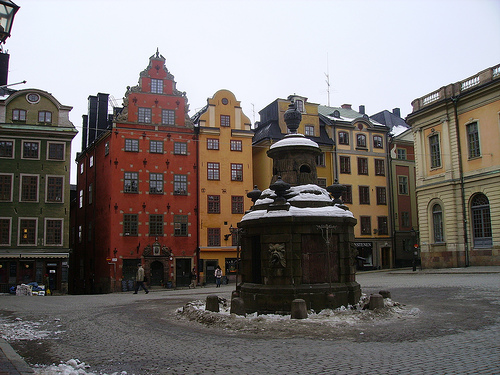
But with the city in hand, Christian — known to Swedish history as “Christian the Tyrant” — had its leaders charged for having deposed during the conflict the pro-union Archbishop Gustav Trolle, construed as an offense against the Church not in the temporal authority’s power to reprieve. Less than 24 hours after this legal maneuver was sprung, public beheadings of prelates, merchants and burgomasters were underway at Stortorget* — and Sture’s remains were exhumed and posthumously burnt at the stake.

Stortorget

It proved a Pyrrhic victory for the Danish party.

Inside of three years, Christian himself had been deposed with multiple lands and factions throughout his realm in open revolt. Gustav Vasa, whose father had been one of the Stockholm Bloodbath’s victims, would not only decisively break Denmark’s hold on Sweden but found the Vasa Dynasty under which Sweden would burgeon into one of Europe’s great powers.

*One Hans Brask survived the purge despite having endorsed the removal of Archbishop Trolle. Brask supposedly placed a note under his seal on this document saying “To this I am forced and compelled.” This cunning device gave the Swedish tongue the word Brasklapp — a secret reservation.

On this day..

1944: Richard Sorge and Hotsumi Ozaki

On the day of the USSR’s October Revolution holiday in 1944, Stalin’s greatest spies were hanged in Japan.

Renowned among espionage aficionados for supposedly forewarning Moscow of the exact date of Germany’s planned surprise attack in 1941, Richard Sorge‘s work in the pregnant years leading up to World War II produced multiple intelligence coups and could lay claim to the uncommon distinction of having materially affected the course of the war.

His signal achievement was establishing, as a foreigner in a highly xenophobic Japan, a spy ring that for years penetrated the highest levels of the Japanese government and the German embassy, giving Moscow an inside look at Axis planning.

Working under the cover of journalism in the German expat community — he had grown up in a mixed German-Russian household in Berlin and won the Iron Cross for his service in the Kaiser’s army in World War I before embracing communism — Sorge struck Hitler from half a world away. His access to the German embassy was untrammeled — indeed, he had an affair with the ambassador’s wife. His lead Japanese collaborator Hotsumi Ozaki was a major public intellectual similarly privy to sensitive information through his contacts.

The two, along with several other Japanese and foreign collaborators, produced a steady diet of top-shelf intelligence, including the (ignored) forecast of Operation Barbarossa. But the ring’s most important coup — arguably a decisive one in the history of the war as a whole — was to inform Moscow in September 1941 that Japan did not intend to attack the Russian Far East. Relieved of the nightmare prospect of a two-front war, Stalin transfered desperately needed Siberian divisions to help throw back the German advance on Moscow.

Japan by 1941 was a dangerous place to operate, however, and the nerve-rattling work — and the alcoholism to which it contributed — were taking its toll on the master spy just as the authorities were closing in. Sorge and his ring were arrested in October 1941.

Sorge’s decisive communique regarding Japanese intentions in the East had not yet borne its fruit. The war had nearly four years yet to run, and Sorge would languish in prison for most of them — long enough to leave fellow detainees with recollections of the captured operative jubilant at Red Army victories. Soviet tanks were at Germany’s doorstep by the time the two went to the gallows, one after the other, with the few minutes’ notice still customary for Japanese hangings to this day.

The spies in history who can say from their graves, the infomation I supplied to my masters, for better or worse, altered the history of our planet, can be counted on the fingers of one hand. Richard Sorge was in that group.

Spy novelist Frederick Forsythe

Sorge’s personal role in the crucible of world-shaping politics have proven a compelling topic for biographers. Among the notable works:

The Soviet government did not officially acknowledge Sorge until 1964, but the case had immediate and widespread interest in Japan. Ozaki inspired an early Kurosawa film, No Regrets for Our Youth:

The espionage ring’s operations were also the subject of a recent multilingual Japanese epic, Spy Sorge:

Part of the Themed Set: Spies.

On this day..

1914: Carl Hans Lody

On this date in 1914, German spy Carl Hans Lody was put to death in the Tower of London during the opening months of World War I.

Lody‘s was the first execution in the Tower since its heyday as the chopping-block of disfavored nobility had passed in the mid-18th century. Times had changed by the era of trench warfare: Lody was not beheaded, but shot inside a wooden shed erected for the purpose in the Tower yard. Ten more German spies, who seem to have had a harder go of infiltrating Britain than their English counterparts had in Germany, would suffer the same fate by war’s end.

A Berlin-born naval officer, Lody had no experience spying but was tapped for the job because he had traveled abroad and spoke English well enough to pass for an American tourist. He was dead scarcely three months after he entered the Isles, though his work may have helped a U-boat sink a British warship.

According to A.W. Brian Simpson in Domestic and International Trials 1700-2000, the case was a legal landmark as the first espionage trial in England held partly in camera — outside the public view. The outcome, however, was a foregone conclusion, and Lody himself didn’t bother to contest his guilt — seemingly fixated on going to his grave with nothing short of the utmost in romantic gentlemanly decorum.

Part of the Themed Set: Spies.

On this day..