1864: The Andersonville Raiders

It’s not hard to understand why the Andersonville Raiders turned criminal. But on this day in 1864, the group was decapitated when six of its leaders were hanged in a quasi-legal action at the most inhospitable prisoner of war camp in the Confederacy.*

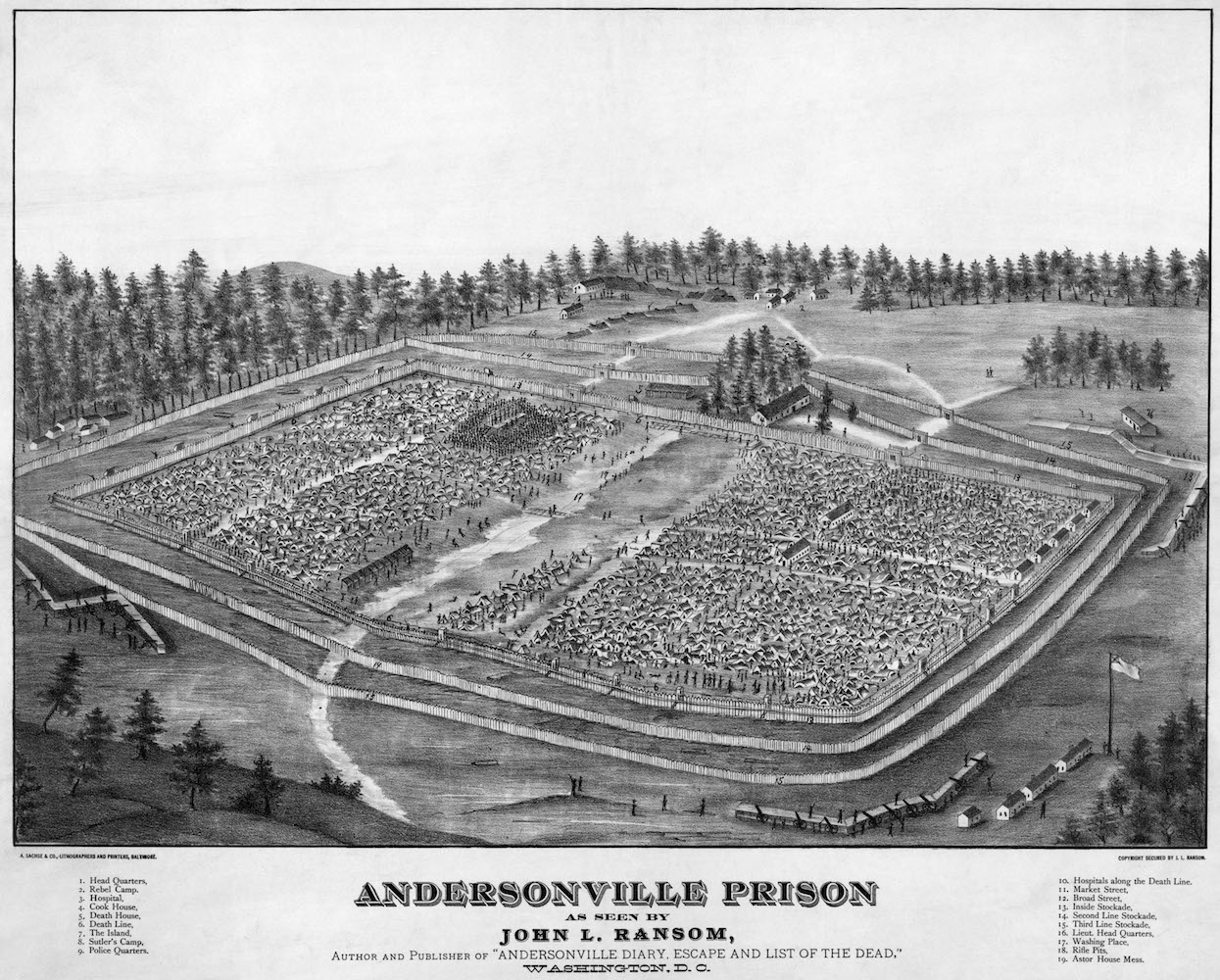
Andersonville Prison was opened in February 1864, 26.5 Georgian acres (about 0.1 square kilometers, or about the size of a square 4 city blocks on a side) of tightly-packed tents with a ditch of water flowing through its center. Its design population was 10-15,000 prisoners; its true population at one point was almost 30,000.** Some 45,000 Union soldiers went in, passing first the outer stockade, then the so-called “dead line” that demarcated the line outside of which they could be shot summarily, and finally into a mass of malnourished, often sickly humanity. Of these, 13,000 never emerged.

The Confederacy, you may recall, was not the war’s winner. As an aspiring nation, the CSA borrowed heavily to fund its arms, then found itself strapped for basic supplies as the war dragged on. By 1863 the nation was already economically depressed, and when a CSA-USA prisoner exchange agreement broke down, the Confederacy found itself with a lot of Union soldiers to house and nowhere to put them. Enter Andersonville: far enough from the North to be “safe”, easily defensible, and in the heart of slave labor to build it. All the Confederacy needed to build some basic housing was wood, which should be … oh wait … war update!…the Union controlled lumber supplies. Guess there won’t be housing.

Prisoners instead got lumped in with their brigade, and (at least initially) basic materials to make some sort of shelter.† New arrivals often showed up without being thoroughly checked over, so they might come in with food and supplies that weren’t already available to other internees.‡ Very quickly, the grounds were littered with Union POWs from around the country, people with vastly different backgrounds and goods. As the camp’s population breached 10,000 and then 20,000,§ there were, of course, inmates with designs on better living.

It’s not hard to see where this is going.

Sometime around May 1864, dozens of them assembled into a loose affiliation. The Raiders were headed by about a half dozen men: Charles Curtis, Patrick Delaney, John Sarsfield, William Collins (“Moseby”), a guy known only as “A. Munn”, and W.R. Rickson (or possibly Terry Sullivan; there’s an unusual disparity in diary accounts on the person’s name, but first-hand diary entries from the moment prefer Rickson) were considered the principal offenders. Each headed a small band of thieves who would trick new entrants, burgle tents, or use violence or threats of violence to amass “wealth” and keep themselves well-fed, well-clothed, and, most importantly to them in this hostile place, alive.

The Raiders had some huge advantages when they committed these crimes. Thanks to their amalgamated resources, they had good odds of being better armed and more fit than their victims — unless those victims were green, in which case they just knew the place better. The thieves started out as midnight raiders who turned tail at the first sign of genuine resistance unless they thought they could readily overpower the victim. By mid-June they were brazen, according to John Ransom: “Raiders … do as they please, kill, plunder and steal in broad day light, with no one to molest them.”

The victims were soldiers who, even if they weren’t killed, were left without resources in a deadly environment. Even the robberies and beatings were, in many cases, a prolonged form of murder, and Union inmates knew it. Indeed, Collins was thought by most to have never directly assaulted anyone, but he was known to steal blankets from the ill.

It’s unclear what the full Raider population was (estimates range from 100 to 500, but most people settle on the 100-200 range). What we can say definitively is that it was large enough to be a problem. Late in June of that year, a group called “the regulators” began taking police-like action against the perpetrators. Inmates brought their complaints to the group, which sought out and punished — usually through head shaving or other non-destructive means — those they found responsible.

On June 29, that problem started getting a real solution when the Raiders assaulted and robbed a prisoner now known only as Dowd. Dowd complained to the guards, and Andersonville’s overseer, Captain Henry Wirz, officially endorsed the Regulators as a police force/tribunal to maintain order. But first he announced an end to inmate rations until the Raiders were given up. (What a guy!)

The Regulators, headed by a man called “Lumber” (or maybe “Limber”) Jim, quickly had 80-100 inmates to deal with. Jury trials were implemented in the spirit of (but without most of the protections of) common law, and most punishments ranged from setting in the stocks to running the gauntlet.


Detail of a panorama sketch of Andersonville (click to see it) makes space for a certain well-attended sextuple hanging.

The ringleaders were also among this bunch. They were assembled on July 11 and executed at a hastily-erected gallows on the north end of camp. As far as the POWs were concerned, the ultimate crime of the Raiders was a violation of the soldier code of death before dishonor. Their bodies were buried separately from other inmates, and the US makes a point of placing no memorial flags at their graves.

To be clear, the Andersonville Raiders were, for most inmates, not the primary problem but an obviously controllable one. Remember that 30% of the interned died, and for the most part those deaths were borne of bad sanitation, hunger, and disease. The removal of the Raiders was a morale boost at best, as Andersonville was still a pee-pee soaked heckhole in which another 10,000 soldiers would die before liberation in May 1865, most of them before the summer’s end.

* It was also known as Camp Sumter, named after the county it resided in.

** The population density at peak was 330,000 people per square kilometer. For comparison, the world’s densest city is Manila, at about 71,000 people per square kilometer.

† It turns out the term “shebang” wasn’t widely-used camp lingo. Drawings and photos of the camp illustrate the variety of dwellings: open sleeping, simple V-tents, structured tents, lean-tos, huts, and shacks were all scattered about the grounds.

‡ They also came with new diseases.

§ The original camp was actually only 16.5 acres, and the population ballooned to 20,000 in early June and 33,000 in August of that year. Ransom notes that the stockade was “enlarged” on July 6. Fall transfers dropped the number to 1,500 and it bumped back up to 5,000 until war’s end. Sanitation issues persisted throughout.

On this day..

1941: George Johnson Armstrong, under the Treachery Act

Marine engineer George Johnson Armstrong on this date in 1941 was hanged at Wandsworth Prison … attaining an unenviable distinction as the first of five Britons executed under the Treachery Act of 1940.

One of the very first laws enacted by the incoming wartime government of Winston Churchill as the Wehrmacht overran France, the Treachery Act anticipated two potential difficulties in punishing various forms of aid that folk might thereafter attempt to extend to the Third Reich.

We’ll let all about those difficulties:

if we rely upon the Treason Act — the main Act, as I have said, is an Act of great antiquity — and other Acts which establish special procedure and special formalities, we shall have a much more complicated and cumbrous procedure than may, in existing circumstances, be justified.

There is also this further point. The law of treason in this country applies, of course, to every British subject wherever that British subject is living, because every British subject owes allegiance to the King. The law of treason also applies to aliens in so far as they owe to the King local allegiance — that is to say, as long as they are resident in this country and enjoying the protection of its laws. It is a very doubtful question indeed whether under the existing law of treason you could proceed against an alien who has come here suddenly, surreptitiously by air or otherwise, for the purposes of wreaking clandestine destruction or doing other acts against the safety of the real. In as much as treason is a crime committed by someone who owes allegiance, it might be well argued that such a person does not owe allegiance to the British Crown.

This act was handy indeed against enemy spies like Josef Jakobs, but it was also employed against five British citizens during and immediately following the war. (We’ve previously met a couple of them in these very pages: Theodore Schurch and Duncan Scott-Ford.) Johnson’s particular offense was to communicate an offer to a German consulate in the United States to help keep the then-still-neutral U.S. out of the war.

A full list of those executed for wartime treachery can be found at CapitalPunishmehtUK.org.

On this day..

1880: A day in the death penalty around the U.S.

A half-dozen murderers hanged in five different U.S. states on this date in 1880.


Cincinnati Commercial Tribune, July 10, 1880. We make the count six, not four.

George Allen Price (Pennsylvania)


Harrisburg (Penn.) Patriot, July 10, 1880.

George Sanford and Richard McKee (Arkansas)


Columbus (Ga.) Daily Enquirer, July 13, 1880.

Alexander Howard (North Carolina), Daniel Washington (South Carolina), and Henry Ryan (Georgia)

(Note: Henry Ryan’s execution is missing from the Espy File of U.S. executions.)

On this day..

1825: Tahvo Putkonen, Finland’s last peacetime execution

Finland’s last peacetime execution occurred on this date in 1825: the instrument was an axe.

Farmhand Tahvo Putkonen, deep in a blue gap celebrating both Christmas and his December 26 name day in 1822, went off his rocker at the party he was hosting because of a guest’s actual or imagined transgression against good manners.

The drunken Putkonen suddenly attacked that guest, farmer Lasse Hirvonen, until this ill-tempered host got kicked out of his own house by the rest of the celebrants. Once he’d convinced everyone that he’d calmed down, he got back in the house and mortally bashed Hirvonen over the head with a firewood log.

Putkonen spent a long-for-the-time 2.5 years appealing against the legal proceedings before they finally struck off his head. So pedants take note: although he has the distinction of being the last peacetime execution, his was not the last peacetime crime that led to execution: one Abraham Kaipainen managed to commit murder (July 31, 1823) and reach the headsman’s block (October 30, 1824) all while Tahvo Putkonen was still fighting his sentence.

The very last executions in Finnish history took place in 1944, during the Continuation War — Finland’s local installment of World War II, fought against the Soviet Union.

Capital punishment is today formally abolished in Finland.

On this day..

1907: Xu Xulin, anti-Manchu assassin

Chinese revolutionary Xu Xulin was executed on this date in 1907.

As a civil servant in Anhui Province, this militant (English Wikipedia entry | German | the far more detailed Chinese) had just one day before assassinated the provincial governor, En-ming, during the ceremonial graduation of a police academy. Xu himself was the academy’s superintendent.

He’d been hoping to touch off a revolution and his hopes, though not ill-founded, were disappointed in this moment. He was beheaded hours later and his heart carved out as an offering to his victim. Xu’s cousin, the feminist Qiu Jin, was executed the following week for the same disturbance.

Surprisingly, Xu’s murder of a Manchu official — the Mongolian peoples who ruled China’s domestic Han majority under the Qing dynasty — directly spurred a national response to his frankly stated ethnic grievances, as the Qing maneuvered (too late, as it would transpire) to implement reforms that could sustain their state through a revolutionary era.

Xu Xilin, during his interrogation, readily confessed that he had killed Enming simply because he was a Manchu … Xu Xilin professed no grudge against Enming personally, nor did he claim that the governor had been particularly hostile toward Han. Rather, Xu’s enmity was directed toward the Manchus in general:

The Manchus have enslaved us Han for nearly three hundred years. On the surface they seem to be implementing constitutionalism, but that’s only to ensnare people’s minds. In reality they are upholding the centralization of authority so as to enhance their own power. The Manchus’ presumption is that once there is constitutionalism, then revolution will be impossible … If constitutionalism means centralization, then the more constitutionalism there is, the faster we Han people will die … I have harbored anti-Manchu feelings for more than ten years. Only today have I achieved my goal. My intention was to murder Enming, then to kill Duanfang, Tieliang, and Liangbi, so as to avenge the Han people … You say that the governor was a good official, that he treated me very well. Granted. But since my aim is to oppose the Manchus, I cannot be concerned with whether a particular Manchu was a good or bad official. As for his treating me well, that was the private kindness of an individual person. My killing of the governor, on the other hand, expresses the universal principal of anti-Manchuism.

The murder of Enming caused tremendous unease among Manchu officials … Because it coincided with a series of revolutionary uprisings in Guangdong that Sun Yat-sen had launched in early May, the assassination was especially upsetting. According to British diplomats, “Everywhere throughout the country the Manchu officials are living closely guarded in their Yamens.” …

[The Empress] Cixi was particularly anxious about Xu Xilin’s anti-Manchuism. At an audience a month later with her foreign minister, Lu Haihuan (1840-1927), the empress dowager was reportedly still wrestling with Xu’s ghost. She insisted to Lu, “The bandit Xu Xilin claimed that there is prejudice between Manchus and Han, but really when we select provincial officials there is no prejudice whatsoever.” More to the point, she issued within five weeks of each other two edicts that were clearly prompted by Enming’s murder. The first, promulgated on 8 July, two days after the assassination, called once more upon her subjects to present proposals for reform, but this time her appeal went beyond the elite of top officials who were authorized to memorialize the throne to the much broader group of junior officials and scholar commoners, who were now permitted to have their ideas forwarded to her by either the Censorate or the provincial officials.

[The second edict, of 10 August] focused specifically on Manchu-Han relations. Cixi maintained, yet one more time, that the Qing dynasty throughout its long history had always treated Manchus and Han impartially, both as officials and as subjects. Nor had it, in recent appointments to the banner system [hereditary provincial military and administrative posts that were overwhelmingly Manchu], distinguished between Manchus and Han … she then called on all officials to offer suggestions on “how to totally eradicate the boundaries between Manchus and Han.”

-Edward J. M. Rhoads, Manchus and Han: Ethnic Relations and Political Power in Late Qing and Early Republican China, 1861-1928

Proposals from various officials ran the gamut, — encouraging intermarriage, abolishing legal privileges still enjoyed by Manchus, suppressing the Manchu language, and moving Manchu cultural practices towards the Han in everything from naming conventions to forms of address. Even Cixi’s Grand Council was shaken up to establish parity between Manchus and Han.

The chilling words of the dead assassin still echoing, the government moved on these proposals with surprising urgency. By the autumn,

the court issued two edicts, ten days apart, that resolved to drastically change, though not abolish, the Eight Banner system. The first edict, handed down on 27 September, ordered … that the provincial garrisons be disbanded over a ten-year period and their inhabitants be prepared to make their own living … The second edict, issued on 9 October, dealt with the customary and legal differences between Manchus and Han, such as the length of the mourning period and the commutation of punishments. It called on the Ministry of Rites together with the Commissioners for Revising and Codifying the Laws to draw up a set of ceremonies and penal codes that would apply uniformly to Manchus and Han, excepting only the imperial lineage.

These two edicts thus accepted many of the proposals advanced by the memorialists after Enming’s assassination …

Meanwhile, in response to the growing demands of the constitutionalist reformers … Cixi, in her own name, issued two other edicts that clarified the vague promise that she had made a year earlier to institute a constitutional regime. On 20 September 1907 she declared that her ultimate intention was to establish “a bicameral deliberative body.” As a preparatory step, she ordered the immediate creation of a Consultative Assembly, appointed the fourth-rank prince Pulun (1874-1926) and the elderly grand secretary Jia’nai as its co-presidents, and charged them, together with the Grand Council, to draw up a detailed plan for this new national assembly. A month later, on 19 October, she authorized the formation of provincial deliberative assemblies as well. Afterward, she sent Pulun to Japan to learn more about constitutional government at first hand.

Cixi died the following year. The Xinhai Revolution ended the Qing dynasty in 1911.

On this day..

2018: Shoko Asahara and six Aum Shinrikyo followers, for the Tokyo sarin attack

Shoko Asahara and six of his followers in the Aum Shinrikyo cult were hanged today in Japan as authors of one of the most infamous terrorist attacks in recent history: the sarin attack on the Tokyo subway of 1995.

Thirteen people died and several thousand more were injured when members of this millenial sect deposited punctured bags of homemade liquid sarin on multiple rail lines of Tokyo’s subway during Monday rush hour.

It was only one of several gas attacks perpetrated by Aum Shinrikyo during the 1990s; just nine months previous, they had killed nine people in a sarin attack in Matsumoto. But it is by far the most notorious. Images of stricken commuters, blinded and suffocating under the nerve agent’s influence, sprawled on the transit platforms or outside them shocked orderly Japan in 1995, especially so since it came fast on the heels of the devastating January 1995 Kobe earthquake.

These comprised “two of the gravest tragedies in Japan’s postwar history,” according to Haruki Murakami’s Underground: The Tokyo Gas Attack and the Japanese Psyche. “It is no exaggeration to say that there was a marked change in the Japanese consciousness ‘before’ and ‘after’ these events.” Japanese Justice Minister Yoko Kamikawa struck a similar chord in announcing the hangings today: “These crimes … plunged people not only in Japan but in other countries as well into deadly fear and shook society to its core.”

Its mastermind Shoko Asahara, the first man executed this morning, emerged soon thereafter into public view a bedraggled and half-blind fanatic, almost the picture of an agent of chaos. Shockingly, his cult had been able to thrive in the early 1990s thanks in part to murdering an attorney who was investigating Aum Shinrikyo back in 1989.

Beyond the seven hanged on July 6, 2018, six additional members of the cult still remain under sentence of death in Japan for the Tokyo subway atrocity.

On this day..

1530: Johnnie Armstrong, border reiver

Scottish “border reiver” John Armstrong of Gilnockie was hanged on this date in 1530 with his followers at Caerlanrig, without benefit of trial.

The job description of the border reiver was to, well, reave the border. These mounted raiders exploited the wide gaps in sovereignty that opened along the ill-controlled England-Scotland border throughout the 16th century (their heyday) and indeed for centuries prior. They plundered vulnerable* farmers both north and south of the notional line. Sometimes the prize was livestock; other times, the “black rent” due your basic protection racket would suffice.

Their presence left an indelible imprint on the Anglo-Scottish marches, from the farmhouse fortresses called bastle houses to provisions in the “March Law” governing the manner of permissible counter-raiding.

Nettlesome as they were, they also stood useful mercenaries hired out for a number of the era’s battles; notably, English-hired reivers held off a much larger Scottish incursion in 1542. Only with the union of the crowns under James VI of Scotland/James I of England were the reivers finally suppressed.**

Johnny/Johnnie Armstrong, the younger brother of Thomas, Laird of Mangerton, is perhaps the most lasting legend among them — thanks to the signal boost he would later receive from Sir Walter Scott. Chief of a reiver band 160 strong, Armstrong made himself enough of a headache for English-Scottish diplomacy that the Scots king James V resorted to treachery to eliminate him. Having dialed up the frontier “prince” for a meeting, James simply had the sharp-dressed marauder arrested and summarily hanged when the reiver came to call. Thirty-six of his fellow reivers died with him.

Johnny Armstrong is the subject and the title of a notable child ballad (no. 169) whose lyrics can be perused in their entirety here; several renditions of its climactic third chapter can be found in the usual places.

John murdred was at Carlinrigg,
And all his galant companie;
But Scotlands heart was never sae wae,
To see sae mony brave men die.

Because they savd their country deir
Frae Englishmen; nane were sae bauld,
Whyle Johnie livd on the border-syde,
Nane of them durst cum neir his hald.

* “Vulnerable” mostly meant, neither in the ambit of a powerful protector, nor of the reiver’s own clan.

** A subsequent echo of the border reivers — in the same vein and the same region, but clearly distinct from them — emerged later in the 17th century in the form of the moss troopers.

On this day..

1828: William Rice but not John Montgomery, who cheated the hangman with prussic acid

(Thanks to Meaghan Good of the Charley Project for the guest post. -ed.)

Just before 6:00 a.m. on July 4, 1828, prison officers arrived at the cell of disgraced ensign John Burgh Montgomery in Newgate Prison‘s condemned hold.

They were there to escort Montgomery to his hanging. The 33­-year-­old would have been one of the last in England executed for for the crime of uttering forged notes — except that his wardens instead found him lying stone dead. With the aid of prussic acid, the counterfeiter had cheated the hangman of half his day’s prey, leaving his prospective gallows partner, thief William Rice, to face the hemp alone.

Although his guards had confiscated his razor and penknife as a routine precaution against suicide, no one had expected Montgomery to take his own life. He had pleaded guilty before the court and seemed resigned to his fate. In custody he was a model prisoner, spent his last days writing to his loved ones, and “addressed himself with great anxiety to his religious offices.”

Nobody was able to figure out how the condemned man came by enough poison to kill thirty people and how he kept it hidden, given that he and his cell were regularly searched.

The Irish-­born Montgomery, Nicola Sly records in her book Goodbye, Cruel World… A Compendium of Suicide,

was said to be a very respectable, well­-educated man, who had once held a commission in the Army. However, after inheriting a considerable fortune, he frittered it away and resorted to passing phony banknotes to support his rather dissipated lifestyle. Given his pleasing looks, gentlemanly appearance and good manners, he was very successful, since nobody thought him capable of any wrongdoing. However, he was caught after becoming careless and making the mistake of committing frequent repeated offense in a small geographical area of London.

Montgomery left behind several letters, marked by expansive tragic romanticism but no hint of suicidal intent. One letter was for the prison surgeon, asking that his body be used for dissection. He said that by this he wanted to provide some positive contribution to the public to make up for his crimes. He asked that his heart be preserved in spirits and given to his girlfriend.

To the girlfriend he wrote,

My dear idolized L.,

One more last farewell, one more last adieu to a being so much attached to the unhappy Montgomery. Oh, my dearest girl. If it had been in the power of anyone to avert my dreadful doom, your kind exertions would have been attended with such success. Oh, God, so poor Montgomery is to die on the scaffold. Oh, how dreadful have been my hours of reflection, whilst in this dreary cell.

Oh, how tottering were all my hopes; the bitterness of my reflection is bitter in the extreme. This will be forwarded to you by my kind friend Mrs. D. I should wish you to possess my writing portmanteau. Oh, I wished to have disappointed the horrid multitude who will be assembled to witness my ignominious exit. Farewell forever,

P.S. Here I kiss fervently.

The jury on the inquest into Montgomery’s death recorded a verdict of felo de se, meaning that Montgomery had willfully and knowingly taken his own life whilst of sound mind. As such, his body was buried in the graveyard of St. Sepulchre­-without-Newgate at night, and without any memorial service.

On this day..

1941: 3,500 Jews at the Khotyn Fortress … but not Adolph Sternschuss

(Thanks to Meaghan Good of the Charley Project for the guest post. -ed.)

On July 4, 1941, a thirteen-year-old Jewish boy named Ephraim Sternschuss began his diary in the Nazi-occupied Zloczow, Poland, with these lines:

Mother knows nothing about Father’s murder. I won’t be the one to tell. But I have to express what I’m feeling … I’ll write down all the details so when I’m old I’ll remember my youth and this World War, even though I’m not sure I’ll live through it.

I’m writing while lying on my back. I can’t move my legs. Mother says I’m in shock. Maybe I am. Maybe I’m so anxious because I can’t tell her about Father, who was drafted yesterday into forced labor and Mother still believes he’s alive.

The eastern Polish town of Zloczow had been annexed by the Soviet Union after the partition of Poland with the Molotov-Ribbentrop Pact in 1939. Zloczow‘s Jews, who at 14,000 people constituted about half of the population, lived in relative safety until the summer of 1941, when the Nazis invaded the Soviet Union.

They arrived in Zloczow on July 2. With the help of enthusiastic local Polish and Ukrainian collaborators, the SS rounded up 3,500 Jews, among them Adolph Sternschuss, Ephraim’s father. The victims were told they would be sent to forced labor — excavating mass graves of Soviet victims, digging anti-tank ditches, and such.

They were, in fact, digging their own graves.

Ephraim described his father’s departure thusly:

Father was taken at 10:00 a.m. An evening earlier Mrs. Reichard came by and told us that at a local Ukrainian meeting, it was decided to carry out an anti-Jewish pogrom the very next day. Unfortunately, Father didn’t believe her because she was such a gossip. Father was sitting in the kitchen when two Ukrainians came in, Warwara from our street and Bojko a tailor …

They told Father to get ready for work. Father changed into an old suit, emptied his pockets of everything except a penknife, a handkerchief and a Soviet ID. They said to give Father bread because “he would return only at two in the afternoon and he’d get hungry until then.” (My god, what hypocrisy!) Mother made two sandwiches with sausage. They also told him to bring a shovel and he kissed Mother and me and went away.

Adolph did not return at two o’clock, and at four that afternoon, Ephraim and his mother, Anna, heard the sound of distant gunfire coming from the Khotyn Fortress. A neighbor came by and told Ephraim there had been a mass shooting (the perpetrators were members of Einsatzgruppe C) and “all the men were killed.”


Khotyn Fortress. (cc) image from Andriy Baranskyy.

Ephraim assumed his father must be dead. He started his diary because he couldn’t bear to speak the dreadful fact aloud, but had to confide in somebody, if only an old school notebook.

What he didn’t know was that Adolph Sternschuss had, in fact, miraculously survived the shooting. The happy news was delivered to Ephraim’s family on July 5: Adolph was alive and hiding with friends of the family.

Around four o’clock the mother of Mrs. Kitai, Mother’s friend, came in and said that Father was alive and staying with them. Hurray! I went wild, jumping, laughing, everything. Mother gave her clean underwear for Father and asked her to tell him to stay there, not to come home, until the situation improved. Mother went out to tell Mrs. Reichard the news, and about an hour later the door opened and Father came in.

I’ll never forget the sight. His black suit was gray with dirt and dust, on his head he wore some wrinkled hat … He held the package of underwear Mother sent him and a small army shovel. When he entered I jumped out of bed and screamed “Mummy!” and ran to him. I kissed him although he was terribly stinking, like a corpse — and he started crying. It was the first time I saw Father cry.

Together with Mrs. Beer we pulled a sofa into the other room and hid the door behind a mirrored chest. We helped Father remove his clothes and then we saw what the Ukrainians were capable of. His whole back was beaten to a black pulp and swollen and he had a hideous bruise on his head.

We washed him and then he ate something and then we put him to bed and he fell asleep. He didn’t say a word.

Over the next few days, Adolph described his ordeal and his incredible survival to his only child, who wrote it all down in detail in his diary. Adolph’s story, as told to Ephraim, is worth quoting almost in full:

At noon I brought him a meal and he told me what he had gone through. I didn’t recognize his monotonous tone, but there, in the darkness of the basement, I sensed that he was reliving his ordeal. Well, in the beginning he worked near the Fortress, burying cadavers of horses.

Then he was transferred to the Fortress itself. At the entrance he was ordered to show his papers, but he lied, claiming he had none. “A man is only an addition to his identity card,” he said as if he were the father I knew.

They worked in two places: the inner court of the prison and the garden. They had to dig up mass graves of corpses killed by the NKVD — Ukrainians and Poles (and some Jews like Dr. Grosskopf and his son-in-law). The bodies were laid out in rows to be identified.

On that occasion, the Ukrainians beat the Jews, accusing them of committing these murders. Naturally, the Germans and the S.S. troops joined in, beating the Jews mercilessly. Father was followed by a short, white-haired butcher who hit him with a stout stick he had pulled out of the fence, and by a tall, blond S.S. soldier who used a coiled rope.

At noon two officers came up to Father and asked his profession. He answered, “Lawyer.” Probably they could tell from his accent that he had studied in Vienna,* but they asked him anyway. When he confirmed it, one of the Germans asked, “You aren’t Jewish, are you?” and Father said he was, and the German, furious, said, “Then I can’t do anything for you,” and the two of them stormed off.

Shortly after, the shooting began …

Around three o’clock they shot Father, but as he happened to already be in the ditch, all four bullets hit the pile of dirt, and Father fell down and pretended to be dead. An hour later it started raining and that’s what saved him: the Ukrainians and Germans were forced to stop shooting and shelter themselves under the roof.

At 9 p.m. sharp Kuba Schnapp and Freimann pulled Father out of the ditch and all three made their escape. Father practically had to be dragged away because both of them, and two corpses, were lying on his left leg. “After playing Indians,” said Father and it seemed to be that he smiled, they slipped through a hole in the fence and parted ways.

Father wanted to enter Winczura’s house but was refused. He then moved on to Barabasz and there, in the attic, were about thirty people. The next day he was forced to leave because of the terrible conditions. He moved over to a client of his, Mrs. Lewant, and stayed in the attic with the Kitai family. From there he returned home.

“One thing is etched in my memory forever,” he said. “I never imagined that Jews could die like that. They were like Romans. Proud, erect, silent. Thus they were killed.”

Seventy years later, one “old, toothless” witness, one of the fifteen remaining Jews still living in the area, recalled the massacre: “The earth shifted for days. They couldn’t bury them fast enough.”

Unfortunately, Adolph didn’t live long after he crawled out from under those corpses in the mass grave. He was not young, and his health was ruined by his horrific experience. Just a few days before Christmas, he died in his bed after a series of heart attacks.

On December 29 that year, Ephraim wrote mournfully,

Only those who have lost their fathers will understand me — and regrettably there are so many now. Dr. Hreczanik was right when he said to Mother, “your husband was killed at the Fortress.”

This first mass killing in Zloczow was followed by others. In late August 1942, the Germans rounded up 2,700 Jews and deported them to the Belzec Extermination Camp. In early November, a further 2,500 people were taken away.

A month later, a ghetto was established for between 7,500 and 9,000 people from Zloczow as well as the remnants of several nearby Jewish communities. Rather than go into the ghetto, Ephraim and his mother went into hiding, concealed outside the village of Jelechowice by sympathetic Ukrainian Catholic farmers: Grzegorz “Hryc” Tyz, his wife Maria “Misia” Koreniuk, and Helena Skrzeszewska.

The Sternschusses made the right choice: in April 1943 the Zloczow Ghetto was liquidated and all the survivors were shot and buried in mass graves.

Ephraim and Anna Sternschuss remained hidden on the rural farm for the rest of the war. When it was safe they just stayed inside the house; when there was danger they hid “downstairs” under the floor, “in a grave-like pit, narrow and long.” He kept writing in his diary:

We walk about the house without any inhibition, trusting Rex to faithfully do his duty. He barks differently at anyone so we can know in advance whether he’s a friend or a foe. In any case, whenever we hear him, Mother and I enter our room, shut the door and Misia, if the visitor is a stranger, sings “Chiming of Bells in the Dusk.” Then we sit quietly, almost without breathing, waiting for the visit to end. Nobody must know about our existence here.

The Sternschuss family’s hosts refused to accept any payment for their stay, but Ephraim and his mother did have to chip in to cover the cost of their food. Over time, others joined them: Ephraim’s aunt and uncle, Lipa and Linka Tennenbaum; the Tennenbaums’ daughters, Eda and Selma; the five members of the Parille family; and Edzia Weinstock and her daughter Eva.

Thus, the farm became a sanctuary for eleven Jews, plus the three hosts — all living on a small farm with a three-room farmhouse, a shed, an outhouse, and an uncertain grant of borrowed time. Ephraim occupied himself writing in his diary, drawing, and reading. Misia Koreniuk, one of his hosts, was a teacher, and she freely shared her “huge chest of books and magazines” with him. Ephraim even began teaching himself algebra and geometry.

It wasn’t all a nightmare. There was, for example, an amusing incident in February 1943 where they got the farm animals drunk on moonshine vodka:

It was a pity to have to throw it away, so Hryc scattered a bit in the yard for the chickens and the rest he put in the trough for the cow Krasula. The chickens pecked — and immediately lay down on the earth, absolutely foggy minded. But Krasula started going berserk, running around and climbing trees. It was terribly funny but also a bit dangerous. Hryc managed to overcome her with much difficulty and tied her up in the stable.

Through his hosts Ephraim kept up with the progress of the war and tracked the Allied advance in his diary, eagerly awaiting liberation. Yet it was hard to stay optimistic and he occasionally had thoughts of suicide. As he wrote in October 1943, he struggled to keep from succumbing to apathy and despair:

It’s all nonsense. […] Nobody knows us. We don’t have anybody in the whole wide world. Nobody. Only Mother and I. Therefore there’s no other option: one mustn’t give in to crises. We have to stay united. Today my heart is heavy. I’m writing almost in darkness but I must write. Too much crap weighs on my heart and I must pour all of it, at least in this diary.

Why is it called life? The best years of my youth have gone by and will not return. Never. Even if it all ends today, it won’t do any good … This is my life. And if I add the well known fact that everybody is born with a death verdict — what’s there to live for?

On November 6, 1943, a baby girl was born on the farm — the offspring of one of the members of the Parille family. Before the war, the mother had tried for years to get pregnant, going through “all possible treatments and nothing helped. And here, of all places, did she give birth.”

Ephraim wrote that their host, Hryc, started sobbing in despair when he found out:

So we aren’t only fourteen but fifteen with the baby! Not too bad … That’s to say very bad. Lipa is right saying that the baby can betray us all. We learned not to speak but to whisper, but a baby?! What’s to be done?

Within a few days the baby died. Perhaps it was just as well.

The situation became even more precarious in late January 1944, after a unit of retreating Germans showed up at the farm and the commander requisitioned a room in the farmhouse for himself and his Russian girlfriend.

Thus the farmhouse was divided: the German in one room, the three Ukrainian farmers in the next room, eight Jews in the 3×4 meter room down the hall, and three more hidden in the shed!

The German officer never found out about the hidden Jews, and as Ephraim noted, the man’s presence turned out to have a silver lining, because it protected everyone from the threat of looting, arson and murder at the hands of anti-Semitic Ukrainian partisans, who had become very active in the area.

Also, Helena Skrzeszewska was able to cajole the military kitchen into giving her their leftover soup, which she fed to the Jews. Ephraim noted wryly, “We live at the expense of Hitler.”

He was actually upset when the German officer left the farm two weeks later, writing,

Our citadel is no more. Again fearful nights will begin without the landlords who’ll go to the village for their sleep. We’ll remain on our own against the gangs, full of fear of the Ukrainian killers, of being set on fire … Again night watches every two hours, with a pistol and six bullets.

Sure enough, in early March, while Ephraim’s hosts were away from the farm, the Ukrainian partisans tried to set the place on fire. Ephraim was on watch that night:

I don’t know if I panicked. But now, while writing that, I think I wasn’t absolutely clear about what I was doing. Anyhow, after raising [the others in hiding], I opened the door and like an idiot went out into the lighted yard. Two sprints brought me to the well. I crouched behind its side and emptied my pistol of all its bullets, shooting into the darkness of the forest like a movie cowboy. The first time in my life.

In the meantime Lipa, Mother, Linka and Edzia came out with buckets. […] I don’t think it took us a long time to control the situation. The fools didn’t shoot at us from the forest despite the fact that we were in the light. I assume — and I’m not the only one thinking like that — that they were frightened of us being armed.

In the morning, when our landlords came back from the neighbors, they were surprised to learn that the house was still standing. […] Hryc went to the forest and found blood stains in the snow.

Later the month the Germans returned and searched the farm for signs of partisan activity, and actually encountered Ephraim’s aunt and mother inside the house:

Mother and Auntie locked us in and ran to the entrance door. They hardly made it when the door was busted open in spite of the big lock hanging outside. The Germans were astonished running into them. Despite Lipa’s warnings to Mother not to reveal her knowledge of German, she explained to them that they were locking themselves in the house in fear of the partisans.

“The partisans are all Juden,” said one of the Germans, and then asked where did Mother acquire such a German [language]. She told him she lived in Salzburg and came here to get married. “It’s all Love’s fault,” said the German, asked her to forgive him, went out and in a moment returned with a bomboniere.

In the meanwhile dawn was breaking and they discovered the Germans were S.S. troops. Mother says that if she wasn’t hit by a heart attack she would never have one. Immediately she told them they were being “evacuated” to the West. The Germans, perfect gentlemen that they were, proposed to help them, give them a truck. Auntie thanked them, said there was no need, everything was under control. Indeed.

Half an hour later our landlords returned back from the village. They looked really terrified when they saw Mother and Linka standing at the entrance to the house with two S.S. men. Mother introduced them, bid the Germans farewell and entered the hideout with Auntie.

The hideout happens to be east of the house, not west.

All the Jews spent three days in the underground hideout until the SS officers left. By then the front was very close, as Ephraim wrote on March 13:

In the nights, during shifts, we hear the “music” of artillery. The front keeps coming closer. Two days ago they were at Podhorce, 15 kms away! The windows were shaking to the blasts of cannon. But the Germans, damn it, pushed them back to a point 35 kms from us. There they stand and shoot. What bad fortune! Tarnopol has been liberated and we are not.

On March 26, Ephraim noted that it was the 1,000th day he had spent living under German occupation: “The 1,000 days we’ve spent in the Reich are like 1,000 years. With my whole heart I wish the Fuhrer and his admirers to have 1,000 such days …”

And he had months left to endure before he would see freedom.

On July 3, the second anniversary of the massacre at the Khotyn Fortress, Ephraim was using the outhouse when he saw a car stop and two Germans emerge with two men and a child. The Germans shot all three of them and left their bodies by the road. The victims, he found out later, were Jews who had been caught hiding nearby.

Liberation finally came to Jelechowice on July 16, 1944, as noted by a single sentence in red pencil in Ephraim’s diary: “THE BOLSHEVIKS HAVE ARRIVED!!!” He was sixteen years old, and had survived 1,111 days under the Germans.

On the third day after liberation, he recorded,

Mother, Auntie and I went to town. Zloczow made a terrible impression on us. Only bombed, burnt houses, torn wires on the road. A mass of troops on the way to Lvov. Our house is burnt. The neighbors — who couldn’t really understand how we managed to survive — said that the Germans had set the house on fire because it contained the archives of the Gestapo.

In the house, which was inhabited by the Gestapo unit, we found our dining room furniture in one of the rooms. It looked strange to me. That’s precisely what we need: a big table, or a buffet …

We haven’t met Jews.

Ephraim’s last diary entry was on July 29. He wrote of finally encountering some other survivors:

Maybe twenty people, perhaps thirty … All stood and cried. For sure I don’t have to write that picture down in the diary. I’ll remember it to the end of my life. All the Jews, the ten thousand Jews of Zloczow, were praying together in one small room. I heard the heart-rending sobbing, the wailing, the “Magnified and sanctified be His great name” prayer for the dead, and the “God, full of compassion” one, and I understood once and for all that they, we, address somebody who was absent when needed, and perhaps now wasn’t needed any longer, or maybe simply never existed. It was noontime and

The diary ends in mid-sentence.

Ephraim remained in Poland for over a decade after the war. He attended engineering school for two years, then switched his studies to theater. He moved to Israel in 1957. There he changed his family name from Sternschuss to Sten.

In Israel, Ephraim married, had children, and had a successful career as an author, actor, director and playwright for both stage and radio. But for decades he kept his diary hidden and did not speak of his Holocaust experiences to anyone.

Although he had a normal existence in his adopted country, he never recovered emotionally from the trauma of the war, describing it as “the load crushing my soul.”

He had thought, he said, once he left Poland, that he might finally “become a regular human being. But the world wouldn’t let me.”

In the 1990s, Ephraim returned to Zloczow, which is now part of Ukraine and called Zolochiv. Two of his Ukrainian rescuers had died, but Ephraim had a tearful reunion with Hryc Tyz, who told him, “You are my relatives. I didn’t believe I’d be lucky to yet see somebody from my family.”

His four-day trip inspired him to dig out his diary and translate it into Hebrew so that his children could read it. The diary was published in English in 2006, with annotations by an older Ephraim fifty years after the fact, under the title 1111 Days in My Life Plus Four.

Ephraim Sten died in 2004.

The Khotyn Fortress is a major tourist attraction in Ukraine and is considered one of the nation’s most stunning castles. In a nearby field, a “foul-smelling marsh” where “the grass is high and thick,” is a memorial for the 3,500 Jews (but not Ephraim’s dad) who were murdered there in July 1941.

* Zloczow answered to the sovereignty of the Austro-Hungarian Empire until 1918.

On this day..

1798: Father John Murphy, Wexford Rebellion leader

Catholic priest John Murphy was executed on this date in 1798 for his part in the Irish Rebellion of 1798.


The Black 47 jam “Vinegar Hill” celebrates Father Murphy, imagining him confronting and embracing the choice to rebel …

I return to my prayers
And reflect upon Your tortured lips
But not a word do I hear
Just a veil of silence around the crucifix
And I remember the Bishop’s words
“When faith is gone, all hope is lost”
Well, so be it
I will rise up with my people
And to hell with the eternal cost!

An exemplar of that rare type persuadable to follow his moral commitments all the way out of the safety of a status quo sinecure, Father Murphy initially eschewed the trend towards armed rebellion in 1798.

This outbreak was itself a response to a violent martial law-backed campaign of repression to crush Ireland’s growing United Irishmen movement for self-rule, republicanism, and Catholic emancipation — each of them scarlet fighting words to the Crown. The risings that finally broke out had only scanty success, weakened as they were by months of arrests.

By far the strongest rising occurred in Wexford, so much so that the Wexford Rebellion is nearly metonymous for the Irish Rebellion as a whole. And our man, John Murphy, was a priest in Wexford Town.

Giving due heed to Ecclesiastes, Murphy pivoted quickly from his previous counsel that prospective rebels surrender their arms once he saw an enemy patrol gratuitously torch some homes, a decision that would immortalize his name at the cost of greatly shortening his life.

During the brief existence of the Wexford Republic, the padre surprisingly became one of its prominent combat commanders, and also one of the signal martyrs after the rebels were shattered at the Battle of Vinegar Hill on June 21, 1798.*

Murphy escaped that tragic battlefield only to have his remnant definitively routed a few days later.

He had only a few days remaining him at that point, days of hiding out with his bodyguard, James Gallagher. At last they were captured at a farm on July 2, and subjected that same day to a snap military tribunal and execution delayed only by the hours required to torture him.

After hanging to death, Murphy was decapitated so that the British could mount his head on a pike as a warning.

This 1798 rebellion they were able to crush, but Murphy has survived into legend. He flashes for only an instant in the sweep of history, springing almost out of the very soil into the firmament as an allegory of revolutionary redemption, brandishing together (as Black 47 puts it above) both his missal and his gun.


The ballad “Boolavogue” by Patrick Joseph McCall for the 1898 centennial of the rebellion pays tribute to Father Murphy:

At Vinegar Hill o’er the River Slaney
our heroes vainly stood back to back
And the yeos of Tullow took Father Murphy
and burned his body upon the rack
God grant you glory brave Father Murphy
and open heaven to all your men
The cause that called you may call tomorrow
in another fight for the Green again.

* There was a “Second Battle of Vinegar Hill” … comprising Irishmen but not in Ireland, for it was a convict rebellion in Australia in 1804. One of its leaders, Phillip Cunningham, was a survivor of the 1798 Irish Rebellion.

On this day..