On this date in 1894, Sioux Chief Cha Nopa Uhah (“Two Sticks”) was hanged in Deadwood, S.D., for instigating the murder of white ranchers on the Pine Ridge Reservation.
The story begins little more than two years after one of the most tragic and emblematic events in the white conquest of North America — Wounded Knee:
By early 1893, the “Ghost Dance” religious movement that had animated the Lakota people had not disappeared … nor had the futile dream of armed resistance to white domination.
A band under Chief Two Sticks, a leader described as resistant to settled white civilization and inclined towards retaining the traditional nomadic life, raided a white cattle ranch. The raid was not deadly, but its consequences were.
Indian police dispatched to arrest the raiders were killed in a shootout, after which the raiders again attacked the ranch — looking this time for men, not cattle. Four white cowboys were killed.
A number of additional Indians died when tribal authorities deployed in force to stop Two Sticks’ followers, perhaps narrowly averting much worse — as it’s a given that federal authorities would not have countenanced Two Sticks’ continued liberty.
The chief himself was severely wounded in the process, and only after a lengthy recovery was he well enough to stand trial in the white men’s courts in Deadwood.
His last words, according to an impressive HistoryNet retelling of Chief Two Sticks’ tale with a great deal of detail about his last hours (including an attempted suicide, so that he could die by Indian hands), denied responsibility for the violence.
My heart is not bad. I did not kill the cowboys; the Indian boys [meaning White Faced Horse, Fights With, Two Two and First Eagle] killed them. I have killed many Indians, but never killed a white man; I never pulled a gun on a white man. The great father* and the men under him should talk to me and I would show them I am innocent. The white men are going to kill me for something I haven’t done. I am a great chief myself. I have always been a friend of the white man. The white men will find out sometime that I am innocent and then they will be sorry they killed me. The great father will be sorry, too, and he will be ashamed. My people will be ashamed, too. My heart is straight and I like everybody. God made all hearts the same. My heart is the same as the white man’s. If I had not been innocent I would not have come up here so good when they wanted me. They know I am innocent or they would not let me go around here. My heart knows I am not guilty and I am happy. I am not afraid to die. I was taught that if I raised my hands to God and told a lie that God would kill me that day. I never told a lie in my life.
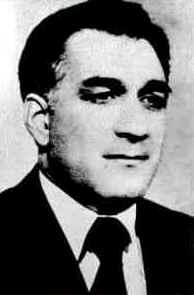
On this date in 1979, the 104-day term of Afghan president Hafizullah Amin met a violent end as a Soviet-engineered coup raised the curtain on a war destined to bring misery to both Cold War combatants.
The Soviet Union’s ongoing intervention in Afghan politics had through the 1970’s steadily mired it deeper into an unstable political situation.
Now, it was running out of patience with the country’s president, Hafizullah Amin.
He’d got the best of rival Nur Mohammad Taraki in a power struggle that September, but to the political chaos and the blossoming Islamic insurgency roiling his country, Amin added a level of brutality that was all his own, and a streak of diplomatic independence that was distinctly unwelcome in Moscow.
Amin was a Communist himself, and both he and the predecessor he’d murdered had wanted ever-increasing Soviet aid to keep the country stable.
Though Kabul radio would announce that Amin had been tried and summarily executed for “crimes against the state,” the short-lived dictator’s fate had been decided two weeks before when the Soviet Politburo passed a secret resolution for his ouster — having lost whatever confidence it had once held in him as a dependable satellite governor.
has seemed deeply troubled by the inability of either the Taraki or Amin governments to put down the rebellions in Afghanistan, which have been largely tribal but also militantly anti-Communist.
Amin survived a KGB poisoning, so the Red Army dispensed with subtlety by raiding the palace, plucking their preferred satrap out of exile in eastern Europe to take Amin’s place.
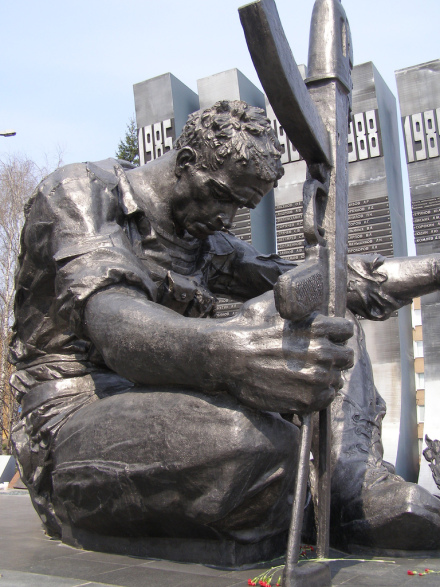
It would not see the last of Afghanistan until 10 years, 15,000 Soviet dead, and hundreds of thousands of Afghan casualties later.
A memorial in Ekaterinburg, Russia, to the Soviet dead in the Afghan war. Image courtesy of beatdrifter (Andy Holmes).
On this date in 1862, a 19-year-old Confederate infantryman became the tragic victim at Murfreesboro, Tenn., of his army’s need to shore up military discipline.
Kentuckian Asa Lewis was shot for desertion, for having returned home after his enlistment expired in order to help his family plant the season’s crops.
“French leave”,* it’s sometimes called — an illicit but temporary and often unpunished absence from the unit.
[The South’s] white population combined with its preferred form of agriculture to create a potential pool of men who could hardly be called disposable … To find the Southern soldier one must go down the food chain into that vast sea of men referred to as yeomen and poor whites. These men and their sons would form the backbone of the Southern army, an army of farmers, men whose lives were as governed by the seasons as the lives of their fathers and grandfathers before them. These men could not be spared in the same way as their Northern counterparts without affecting the quality of their families’ lives — and often those families’ very survival.
Under less urgent circumstances, Lewis would be the poster child for the guy who would sort of deserve to slide for the odd spell of French leave.
He’d fought with distinction, earning decorations and promotions, and his mother and sisters were reportedly starving without his help. He was only being kept in the army after his term of engagement by the 19th-century equivalent of a stop-loss policy.
But Lewis had the bad fortune to go AWOL — it seems he did intend to return — right when the urgency of the army-wide desertion situation was becoming apparent to Confederate brass … and while serving under the general who Weitz says took it most seriously.
Gen. Braxton Bragg had issued an amnesty earlier that fall to clear the decks, and then declared pitiless treatment of desertion going forward.
Bragg understood something that his superiors, peers, and colleagues did not: the Confederacy had an army of farmers … Bragg knew that these men were fighting at home, that they would [sic] were being drawn back there, and that he had to take immediate steps to close off the avenues of departure.
Bragg tightened the screws on soldiers who straggled on the march (a common strategy to slink away), on grunts seeking medical furloughs (already establishing themselves as a halfway house towards a discharge), and on Confederate prisoners obtained by exchange for Union POWs (who were no longer paroled back home, but kept with the army).
Asa Lewis was hardly the only man shot under the policy. But construing mere French leave as capitally punishable “desertion” gave the general a chance to put the fear of a Confederate firing squad into other potential stragglers and malingerers — and the Kentuckian campaign to obtain clemency for the poor kid probably only helped Bragg’s purpose.
[A]midst a drenching rain-storm, Asa Lewis, member of Captain Page’s company, Sixth Kentucky regiment, was shot by a file of men. He was executed upon a charge of desertion, which was fully proven against him. The scene was one of great impressiveness and solemnity. The several regiments of Hanson’s brigade were drawn up in a hollow square, while Generals Breckinridge and Hanson, with their staffs, were present to witness the execution. The prisoner was conveyed from jail to the brigade drill-ground on an open wagon, under the escort of a file of ten men, commanded by Major Morse and Lieut. George B. Brumley. Lewis’s hands were tied behind him, a few words were said to him by Generals Brekinridge and Hanson, and word fire was given, and all was over. The unfortunate man conducted himself with great coolness and composure. He was said to have been a brave soldier, and distinguished himself at the battle of Shiloh.
Official journos may have been approving — Weitz says a contemporary newspaper report approvingly claimed that “when Bragg saw his army melting away from desertion he began shooting every man convicted by a court-martial, and that as a result his army had become ‘well disciplined'” — but less charitable interpretations of Bragg would hew more to the line that the man was simply being a petty, vindictive tyrant.
The aforementioned execution witness Breckinridge, for instance, was a Kentuckian himself and hated Bragg’s guts. (A week later, Bragg would waste 10,000 Confederate lives at the Battle of Stones River, and the rift became irreparable.)
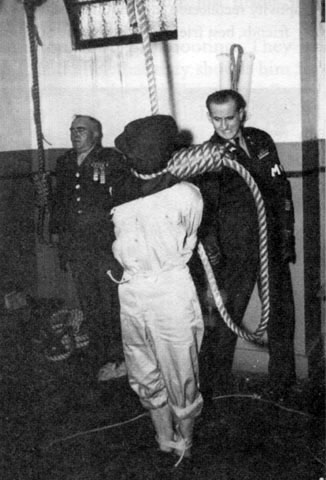
Two years ago today, Japan resumed executions after a break of more than a year with four hangings.
Septuagenarians Yoshio Fujinami (wheelchair-bound) and Yoshimitsu Akiyama (partially blind) both needed the guards’ assistance to reach the trap at Tokyo Detention Center, a mere hour after they were informed of their imminent demise.
Two other prisoners, 64-year-old Michio Fukuoka and 44-year-old Hiroaki Hidaka, were simultaneously hanged in Osaka and Hiroshima, respectively.
Hidaka, a serial killer, had dropped his appeals and thus died a mere 12 years after his crimes. Fukouka died maintaining his innocence of three murders from 1978-81 he said police torture had forced him to confess. The oldest men were on the hook for killings dating to 1975 and 1981. (Much more from The Japan Times.)
Talk about justice delayed.
In Japan’s strange death penalty system, the condemned might await death for decades only to be hanged, as these were, with next to no warning. Their families and supporters did not hear about it until after the deed was done.
These hangings, though protested, were not altogether unexpected, for a break in the Japanese Diet around the end of the year often heralds an appearance on the public stage by the gallows. (Look for them in 2008 as the Diet goes out of session starting today.) And a turnover at the top of the Justice Ministry had replaced a pol disinclined to authorize any hangings, the source of the long break between executions during a decade when Japan’s use of the death penalty has generally been intensifying.
Although at least one particularly pressing motivation for this date’s hanging will not be present this year. After the long hiatus, an anonymous official told a newspaper,
We absolutely wanted to avoid ending the year with zero executions.
Because we executioners are not bereft of sentiment, it is with glad season’s tidings that we remember the veritable rebirth on Christmas Eve of housebreaker John Smith, who was cut down from the Tyburn tree this day in 1705 and revived.
“Though the crimes committed by this man were not marked with particular atrocity, nor his life sufficiently remarkable for a place in these volumes, yet the circumstances attending his fate at the place of execution are perhaps more singular than any we may have to record,” begins the Newgate Calendar, and one can all but see our Marlow setting light to his tobacco as he makes ready to unspool a particularly satisfying yarn.
After John Smith dangled 15 minutes this day at Tyburn, the crowd at his hanging began calling for a reprieve. One gets the impression our narrator may be eliding in a sentence quite an unruly affair; that “the malefactor was cut down” we may well guess, but after a mere 15 minutes? Did the crowd overpower the sentries, or were the officers of the law simply in a Christmas spirit?
There is, too, allusion to his friends’ working to obtain clemency and failing. Family and supporters of the accused intervened at Tyburn in all sorts of meddlesome ways, when they could — pulling the condemned prisoner’s legs to shorten his suffering, or holding his legs up to give him a chance at survival; fighting with anatomists for possession of the corpse, and obviously agitating for mercy at the slightest opportunity. Was it these friends who instigated the crowd’s appeal?
Whether or not Smith’s luck was as dumb as William Duell‘s, they did cut him down, and did revive him “in consequence of bleeding and other proper applications.”
So, what’s it like to be hanged?
When he had perfectly recovered his senses he was asked what were his feelings at the time of execution; to which he repeatedly replied, in substance, as follows. When he was turned off, he for some time was sensible of very great pain, occasioned by the weight of his body, and felt his spirits in a strange commotion, violently pressing upwards. That having forced their way to his head, he as it were saw a great blaze, or glaring light, which seemed to go out at his eyes with a flash, and then he lost all sense of pain. That after he was cut down, and began to come to himself, the blood and spirits, forcing themselves into their former channels, put him, by a sort of pricking or shooting, to such intolerable pain that he could have wished those hanged who had cut him down.
All this violent commotion of the spirit was enough to score a pardon, but not quite equal to the task of reforming the man now known as “Half-Hanged Smith”.
Our narrator relates that he went twice more to the Old Bailey in some danger of his neck, escaping once on a technicality and then again upon the uncommonly timely death of the prosecutor.
Nothing more is henceforth heard of the man, and it is unknown whether he decided to stop tempting fate, or whether officers of the law were in no further mood to tempt the hand of a Providence evidently determined to protect him, or whether some still more mysterious purpose thereafter summoned him away from the worldly cares of the justices.
And laying his finger aside of his nose,
And giving a nod, up the chimney he rose;
He sprang to his sleigh, to his team gave a whistle,
And away they all flew like the down of a thistle.
But I heard him exclaim, ere he drove out of sight,
“Happy Christmas to all, and to all a good-night.”
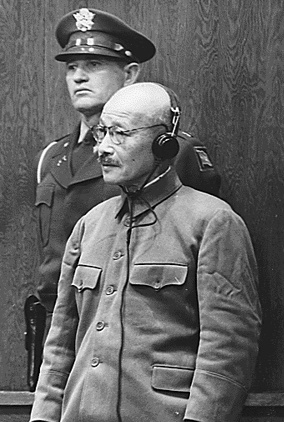
On this date in 1948, seven “Class A” war criminals, including Japan’s wartime Prime Minister Hideki Tojo, were hanged at Sugamo Prison by the American occupation authorities.
Like other Axis heads of state, Tojo was in for a bad end: he shot himself in the chest before American troops could arrest him, but missed his heart even though a doctor had helpfully marked the spot on his chest for him.
Fail.
However inevitable Tojo’s postwar fate, however, he was not exactly of a kind with the likes of Hitler and Mussolini. Indeed, he’d been cashiered from his Prime Ministerial gig in 1944 by the real power behind the throne — the Japanese military.
Unlike the “Fuhrer” and “Il Duce,” Tojo was a reflector, not a creator, of national thought. His word was not law. It was not his command or dictate. He was one among many and not even the first among equals. He was a militarist — misguided, naive, and narrow in outlook; he regarded war as a legitimate instrument of national policy; he apparently believed what he told the court, and failed to recognize the patent contradictions between his contentions and the facts. This had been his undoing.
That’s Robert Butow in Tojo and the Coming of War. Butow argues that the titular authority in Japan (he became Prime Minister shortly before the bombing of Pearl Harbor), a dedicated, patriotic officer of adequate talents but limited vision, came much too late and controlled much too little to be seen as the equal of the European theater’s villains.
The Japan of which General Hideki Tojo became premier was operated by remote control. It was a country in which puppet politics had reached a high state of development, to the detriment of the national welfare. The ranking members of the military services were the robots of their subordinates — the so-called chuken shoko, the nucleus group, which was active “at the center” and which was composed largely of field-grade officers. They, in turn, were influenced by younger elements within the services at large and by ultranationalists outside military ranks. The civilian members of the cabinet were the robots of the military — especially of the nucleus group, working through the service ministers and the chiefs of the army and navy general staffs. The Emperor himself, through no fault of his own, was the robot of the government — of the cabinet and the supreme command, a prisoner of the circumstances into which he was born … Finally, the nation — the one hundred million dedicated souls, the sum and substance of Japan, from whom the blood and toil and tears and sweat of Churchill’s phrase were wrung — the nation was the robot of the throne.
He was the man for his time and place. He fit right in.
The former premier embraced responsibility, diligently shielding the Emperor from any intimation of guilt (some argue this was the procedure’s entire raison d’etre, from the perspective of both the prosecution and the defense), and walked a dignified and honorable last mile in the courtrooms of the victor’s justice, presenting his perspective as he knew it in the context of a wish for peace between the late antagonists.
1. I deny that Japan “declared war on civilization.”
2. To advocate a New Order was to seek freedom and respect for peoples without prejudice, and to seek a stable basis for the existence all peoples, equally, and free of threats. Thus, it was to seek true civilization and true justice for all the peoples of the world, and to view this as the destruction of personal freedom and respect is to be assailed by the hatred and emotion of war, and to make hasty judgments.
3. I would like to point out their [my accusers’] inhumane and uncivilized actions in East Asia ever since the Middle Ages.
4. In the shadow of the prosperity of Europe and America, the colored peoples of East Asia and Africa have been sacrificed and forced into a state of semi-colonization. I would point out that the cultural advance of these people has been suppressed in the past and continues to be suppressed in the present by policies designed to keep them in ignorance.
5. I would point out that Japan’s proposal at the Versailles Peace Conference on the principle of racial equality was rejected by delegates such as those from Britain and the United States.
6. Of two through five above, which is civilization? Which is international justice? Justice has nothing to do with victor nations and vanquished nations, but must be a moral standard that all the world’s peoples can agree to. To seek this and to achieve it — that is true civilization.
7. In order to understand this, all nations must hate war, forsake emotion, reflect upon their pasts, and think calmly.
The “Class A” convicts not executed along with Tojo were freed afterwards.
Tojo has enjoyed a bit of a latter-day resurgence in the public regard, product of the nationalist right’s resurgence in Japan. The hanged man’s granddaughter Yuko Tojo has waged a tireless campaign to clear him.
Further to that end, his ashes — and those of the other Class A convicts — were covertly added to the controversial Yasukuni Shrine, and remain there to this day. That public tribute to principals of Japan’s bloody foreign occupations has become a hot political football between Japan and other nations, especially China.
Japan … faced considerable military threats as well.
Japan attempted to circumvent these dangerous circumstances by diplomatic negotiation, and though Japan heaped concession upon concession, in the hope of finding a solution through mutual compromise, there was no progress because the United States would not retreat from its original position. …
Since events had progressed as they had, it became clear that to continue in this manner was to lead the nation to disaster. With options thus foreclosed, in order to protect and defend the nation and clear the obstacles that stood in its path, a decisive appeal to arms was made.
* According to John Dower’s Embracing Defeat, the suicide scenario angered some nationalists because Tojo only “belatedly summoned the will to die,” and “chose the foreigner’s way of the bullet rather than the samurai’s way of the sword, and then botched even this.”
On this date in 2003, Liu Yong’s situation took a very abrupt turn for the worse.
The wealthy Communist Party member and Shenyang city legislator had been sentenced to death 20 months before in a corruption case for ordering the murder of a tobacco vendor as part of a mafioso racket of graft, extortion, black marketeering, and kindred mayhem.
When that sentence was reduced on retrial on a showing that Liu’s confession was extracted by torture, public outcry at the appearance of a well-connected insider getting off scot-free led the Supreme Court to take the unprecedented step of yet again re-trying a criminal case itself.
“According to China’s legal system, a criminal case can usually be tried only twice,” as China Daily lightly put it.
Amnesty International is less measured, and alleges that the irregular Supreme Court hearing was ordered by political insiders to buttress the credibility of the country’s anti-corruption drive — and to avoid setting any precedent that evidence of torture should mitigate criminal sentencing. (China certainly found defenders for the trial (the link is to an ugly layout of raw HTML).)
The high court handed down its sentence this very day, after which Liu was immediately hailed to one of China’s mobile execution vans, given a lethal injection, and cremated.
On this date in 1878, John “Black Jack” Kehoe was hanged in Pottsville — as Pennsylvania’s anthracite trusts took a victory lap around the corpses of the Molly Maguires.
Even to say what the Mollies were is to take a side in their life-and-death struggle. Irish immigrants fleeing the potato famine had poured into Pennsylvania’s coal mining country in the mid-19th century, where life in the mines was nasty, brutish and short, and the pay wasn’t anything to write home about either.
In a time when capital ruthlessly hunted any intimation of labor organizing and the Irish were a distinctly second-class people, the (apparent, or at least alleged) response of the Mollies was natural: form a secret society, and wring by threat of bodily harm the concessions it could not pursue by collective bargaining. For the recent Irish transplants, the tableau of a Catholic underclass working for a Protestant landlord who owned (and gouged on) everything in sight had a certain familiar feel.
Terrorists? They certainly used violence to achieve political objectives, at least if the testimony of their foes is credited. But they weren’t the only ones.
Mine owners turned public and private violence on Irish radicals pushing for things like the eight-hour day. The notorious strike-breaking Pinkerton Detective Agency was detailed to infiltrate the Mollies.
The main blow against the Mollies was struck over a period of (extrajudicial) vigilante justice in the mid-1870’s, culminating in “Pennsylvania’s Day of the Rope” in 1877, when ten supposed members were (judicially) hanged around the Keystone State.
Kehoe, a power broker in mining country with some sway at the capital who was reputed to call the shots among the Maguires, faced the hangman singly a year later for an 1862 cold-case murder so doubtfully ascribed to Kehoe that the governor hesitated to sign the death warrant.
He signed it just the same, marking a sort of ceremonial “end to Molly-ism.” The New York Timesexulted two days hence “that the widely-extended and long-continued tyranny and terror of this association is at an end,” and all because the resolute executive had gone and sent a hempen message to “the savage and benighted population of the coal region.”
The lesson taught by the punishment of the Molly Maguires would have been shorn of much of its terror and impressiveness if the energetic and persistent efforts made in behalf of KEHOE, the reputed king of that organization, had resulted in rescuing him from the gallows. If they had even so far succeeded as to have caused his punishment to be commuted to imprisonment for life, the admonitory influence of his fate upon the murderous clain of whom he was the last surviving chief would have been greatly lessened, and the snake of Molly Maguire-ism, of which he was the forked tongue and fangs, might haply have been only scotched, not killed. … The law has shown that it has subtlety enough to hunt [the Molly Maguires] through every possible labyrinth of refuge and strip from them every artifice of disguise, and power enough to wring them out of the desperate grasp of sympathizing constituencies and crush them.
Florid.
Like we said, violence wasn’t the exclusive resort of one side. But the monopoly of violence … that was held, as always, by the same hands that held the monopolies. Sean Connery as Kehoe reflects on the uneven contest while awaiting his fate in a (fictional) exchange with the Pinkerton mole who condemned him from the 1970 film The Molly Maguires.*
Pennsylvania Gov. John Hartranft left office a few weeks later, and reflected in his outgoing address on the lessons “the manufacturers and operators” ought to draw from the late unpleasantness.
The Mollie Maguire murders, like the agrarian murders in Ireland, and the trades-union outrages, arsons, and machine-breakings in England, were not the work of the so-called criminal classes. They were essentially class murders … If some of the leading spirits of the class had been members of a board of arbitration as representatives of labor, with some of the employers or their agents as representatives of capital, it is not unreasonable to suppose that most of the disagreements that have kept the coal regions in a state of turmoil might have been amicably adjusted, and many of those who were assassinated and of those who have been hanged living to-day.
101 years later, Kehoe received what was thought to be the first and only posthumous pardon in the state’s history. The Mollies’ true extent, purpose and actual actions — even their very existence as anything but a stalking-horse for the more thorough conquest of surplus labor — remain hotly debated to this day, since the public record of this tight-lipped society consists of little beyond the courtroom testimony of a handful of parties thoroughly prejudiced to hostility by class interest or payoffs.
* Written by Walter Bernstein, who had only recently emerged from the Hollywood blacklist for his Communist proclivities.
On an uncertain date thought to be around the end of 1182, the mother of the Byzantine emperor was strangled to death in Constantinople on her adolescent son’s authority.
In signing his mother’s death warrant, 13-year-old Alexios II signed his own … and that of his dynasty.
The progeny of a nearby Crusader principality, Maria of Antioch was dynastically married to Alexios’ dad, Manuel I.
Two realms separated by a common religion, Orthodox Byzantium’s relationship with western Crusaders was fraught at best, and it was about to get a lot testier. Maria’s Latin heritage went over like a lead balloon in the Greek empire.
When her husband died in 1180, the widow was left in a tenuous position as the unpopular regent of a child-emperor in a political snakepit.
In short order, Andronikos I Komnenos, after a lifetime of scheming, got his mitts on the throne two years after he’d been obliged to grovel in chains before Maria’s husband to be allowed a peacable retirement.
Some retirement.
Byzantine historian Niketas Choniates narrates Andronikos’s ruthless divide-and-conquer path to the purple.
Having thus slaughtered those whom he had been most eager to seize, Andronikos bided his time to assail others; some he delivered over to prison, some he condemned to banishment, and some he utterly destroyed in various ways. Those few who remained were anxious to go along with the majority and to reverse their former course. They changed their minds like the unstable planets and offered their necks to Andronikos to be tread underfoot, revolving around him as their axis, and so Andronikos hastened to bring about the ruin of the empress. After leveling several accusations against her, he finally charged her with treason and convened a court sympathetic to his cause with judges certain to condemn, not try, the wretched woman. The empress, who had attempted to enlist the help of her sister’s husband, Bela [III], the king of Hungary, writing him letters and tempting him with grand promises to ravage the lands around Branicevo and Belgrade, was led away to a cramped dungeon near the Monastery of Saint Diomedes. There she was grossly reviled by the guards as the butt of their jokes, and, pining with hunger and thirst, she was haunted by a vision of the executioner standing on her right where his edge would cut most surely. Andronikos’s ferocity did not abate even a whit. In the words of David, he perceived trouble and wrath and hastened to deliver her over to death, annoyed by the fact that she was still numbered among the living. Ere long he again assembled the justices who mete out injustice and whose right hand is the right hand of iniquity. He inquired as to what punishment the laws decree for traitors of cities and provinces, receiving in hand a written judgment sentencing such criminals to death, his assault against the empress went unchecked. When these lawless men raised their voices and shouted aloud as they cast their votes that this ill-starred woman must depart this life, a decree condemning her to death was immediately signed by her son, the emperor, written as though with a drop of his mother’s blood.
Elected to carry out this loathsome and unholy deed were Andronikos’s firstborn son Manuel and the sebastos George, the brother of Andronikos’s wife. Both men recoiled from their selection in disgust and contemned the emperor’s decree, declaring that they had not concurred earlier in the empress’s execution and that their hands would remain guiltless of such defilement; now, even more so, they could not endure to see her innocent body broken. This unexpected reply struck Andronikos like a thunderbolt. He continually twisted the hairs of his beard around his fingers, his eyes were filled with fire, and, shaking his head up and down, he repeatedly pitied himself and was greatly troubled that he did not have friends who delighted in blood and were eager to commit murder at the nod of his head. Holding his rage in check, like a hot-blooded horse champing at the bit or like smoke wrapping itself around a flame, he quenched his unremitting anger and postponed the execution. A few days later he condemned the ill-starred empress to a wretched death by strangulation. The sentence was carried out under the supervision of Constantine Tripsychos, who held the office of hetairarch, and the eunuch Pterygeonites … And she, who was the sweet light and a vision of beauty unto men, was buried in obscurity in the sand of the nearby shore (O Sun, who didst look down upon this defilement, and Thou, O Word of God, who art without beginning, how inscrutable is thy forbearance!). The bloodthirsty soul of Andronikos exulted at this, for with the extermination of Manuel’s family, with the imperial garden laid waste, he would reign as sole monarch over the Roman empire and hold sway with impunity.
The next year, Andronikos dispensed with the charade and had the young Alexios strangled, too.
A much worse fate awaited Andronikos himself not long after, with still less able successors to follow him … sending the Byzantine Empire into a calamitous tailspin that would see Constantinople sacked by those antagonistic western Crusaders within a generation.
Update: Maria’s German Wikipedia page pegs her execution date at August 27, 1182, citing Detlev Schwennike, Europäische Stammtafeln Band II, Tafel 177, Verlag Stargardt, Marburg, 1984.
On this date in 1943, pacifist novelist Erich Maria Remarque lost his youngest sister to the Nazi regime — beheaded because her “brother is beyond our reach.”
Actually, Elfriede Scholz was convicted (upon the denunciation of her landlady a few weeks before) by the kangaroo People’s Court for undermining the war effort. (“Wehrkraftzersetzung” — German has a word for everything.)
Like her brother, Elfriede was a staunch opponent of the Nazi government, and in 1943 that could certainly have sufficed to get her a one-way trip to Plotzensee Prison.
But Roland Freisler‘s verdict explicitly referenced (German link) her more famous brother — upon whom the Nazis would have poured out an interwar era’s worth of fury had they been able to get to him in America.
Ihr Bruder ist uns entwischt, aber Sie werden uns nicht entwischen! (Your brother is beyond our reach, but you will not escape us!
Remarque’s immortal anti-war novel All Quiet on the Western Front was banned and burned by war-glorifying Nazis (they also said Remarque was of Jewish descent, apparently without any factual basis).
Erna, Elfriede and Erich Remark — the author later restored an ancestral spelling of his name that had been Germanized in the 19th century — in happier times.
Remarque left Germany, an intellectual celebrity and man-about-town who rubbed shoulders with the likes of Marlene Dietrich (with whom he had a passionate affair) and Ernest Hemingway (with whom he did not).
The Nazis stripped his citizenship, and fumed that they couldn’t get their jackboots on him. (At one point, Goebbels invited Remarque to return. Sly.)
But Elfriede, they could get. She had stayed in her native Germany with her husband and family.
Not content with taking her head off, Berlin added a particularly vicious twist by billing the expatriate author 90 marks for the executioner’s trouble.
The author never said or wrote much about Elfriede, even his diaries. But years later, Erich Remarque dedicated his novel about life in a concentration camp, Spark of Life, to his late sister. Today, there’s a street named for Elfriede in the Remarques’ native Osnabruck.

 Now, it was running out of patience with the country’s president,


 However inevitable Tojo’s postwar fate, however, he was not exactly of a kind with the likes of Hitler and Mussolini. Indeed, he’d been cashiered from his Prime Ministerial gig in 1944 by the real power behind the throne — the Japanese military.
 The wealthy Communist Party member and Shenyang city legislator had been sentenced to death 20 months before in a corruption case for ordering the murder of a tobacco vendor as part of a mafioso racket of graft, extortion, black marketeering, and kindred mayhem.
 The main blow against the Mollies was struck over a period of (extrajudicial) vigilante justice in the mid-1870’s, culminating in “Pennsylvania’s Day of the Rope” in 1877, when ten supposed members were (judicially) hanged around the Keystone State.
 In signing his mother’s death warrant, 13-year-old
 Actually, Elfriede Scholz was convicted (upon the denunciation of her landlady a few weeks before) by the kangaroo People’s Court for undermining the war effort. (“Wehrkraftzersetzung” — German has a word for everything.)

