889: Qin Zongquan, late Tang warlord

Tang Dynasty warlord Qin Zongquan was beheaded on this date in 889.

A military governor under Emperor Xizong, Qin made common cause with the rebel/usurper Huang Chao, who briefly established himself in the capital during the early 880s where he asserted himself as the Emperor of Qi. Huang was defeated and killed in 880, but his rebellion proved a mortal blow to the Tang, which succumbed by 907 to a transitional era of unstable dynasties and fractured, rivalrous kingdoms.

Qin Zongquan helped to assure that was so, by carrying on the insurrection after Huang’s death that kept China embroiled in civil war for the remainder of the decade, until a subaltern turned Judas and overthrew him for the benefit of the Tang. (Who by now had a new emperor themselves.) He’s said to have left onlookers in stitches with his last words shouted to the official orchestrating his beheading: “Minister, I, Qin Zongquan, was not committing treason. It was just that my faithfulness was not expressed well.”

On this day..

1536: Michael Seifensieder, Hieronymus Kals and Hans Oberecker, incriminating abstention

From The Mennonite encyclopedia: a comprehensive reference work on the Anabaptist-Mennonite movement, Volume 1:

The earliest Anabaptist confession, The Seven Articles of Schleitheim (1527), forbade in Article 4 the patronage of drinking places. Capito, the reformer of Strasbourg, states in a contemporary letter that the Anabaptists had undertaken to refrain, among other things, from drinking (“zu meiden das üppige Spielen, Saufen, Fressen, Ehebrechen, Kriegen, Totschlagen”). Bullinger, Zwingli‘s successor in Zürich, in his 1560 work against the Anabaptists (Von der Wiedertaufferen Ursprung) states that they drank only unfermented sweet cider (Süssmost) and water. Anabaptists were often identified as such because they refused in the inns to drink alcoholic liquors to the health of other guests, whereupon they were arrested and executed. An illustration of this is Michael Seifensieder, a preacher of the Hutterites, who with two associates [Hieronymus Kals and Hans Oberecker -ed.] was arrested on Jan. 8, 1536, in an inn in Vienna for the above reason,* having been discovered by his refusal to drink, and was finally burned at the stake on March 31, 1536.

* The episode as described in the Martyrs Mirror runs thus:

While they were eating supper, the people tried to ascertain their character by drinking to their health; but when they perceived that they would not respond, the host had some paper brought, and wrote a letter in Latin, which, among other things, read as follows, “Here are three persons who appear to me to be Anabaptists.” But he did not know that Brother Jerome [Hieronymus Kals] understood Latin. Then said Jerome to the other brethren, they would watch together, let things go as the dear Lord should please. Two hours afterwards the constables came and brought them bound before the judge, and when they had been examined they were put in prison.

On this day..

2007: Six Bangladesh bombers

Bangladesh on this date in 2007 hanged six Islamic militants* for a terrorist bombing wave two years prior.

Several were agents of the terrorist organization Jamaat-ul-Mujahideen Bangladesh, notable for a headline-grabbing coordinated bombing on August 17, 2005 that saw hundreds of explosions throughout Bangladesh. That organization’s chief Shaykh Abdur Rahman was among those executed on March 30, 2007, as was “Bangla Bhai” (Siddique ul-Islam), the leader of the Al Qaeda-aligned Jagrata Muslim Janata Bangladesh (JMJB).

* Four different prisons were used for the executions.

On this day..

1623: Reinier van Oldenbarnevelt, family tradition

Reinier van Oldenbarnevelt was a chip off the old headsman’s block on this date in 1623, beheaded in The Hague for plotting to avenge the beheading of his father.

The old man, Johan van Oldenbarnevelt by name, had lost a power struggle to Maurice of Orange and gone to the scaffold in 1619.

Full of murderous filial piety, our man Reinier (English Wikipedia entry | Dutch) conspired with his brother Willem and others of their faction to return the favor on Maurice by having a gang of toughs ambush him in early February.

Word leaked early; the plot fizzled and Reinier was captured to face the vengeance Maurice had once once designed for his father. (Willem escaped to Belgium, but two of their accomplices were dismembered with Reinier.)


Dutch illustrator Claes Janszoon Visscher depicted the son’s execution, as he had once depicted the father’s. For an analysis of the scene, see John Decker’s Death, Torture and the Broken Body in European Art, 1300-1650.

On this day..

1940: The Sass Brothers, Weimar burglars

On this date in 1940, the Sass Brothers — notorious scofflaw thieves from the Weimar Germany era — were extrajudicially executed by the Nazis at the Sachsenhausen concentration camp.

Pioneers of the then-novel art of blowtorching their way into bank safes, die Brüder Sass — Erich and Franz — became public celebrities after their arrest in 1929, especially when the state failed to stick the case against them and the lads remained as free men, publicly flaunting their stolen wealth.

The position of being well-known unpunished crooks became a good deal less comfortable after the 1933 rise of the Nazis, so the Sasses (wisely) moved to Denmark and (less wisely) did some crimes there, too. They copped a short Danish sentence, and after its expiration in 1938 the Danes transferred Erich and Franz Sass back the Third Reich. But even the severity of 13- and 11-year sentences for bank robbery back home, according to Nikolaus Wachsmann,

did not satisfy Heinrich Himmler, who ordered the brothers’ execution. On 27 March 1940, Erich and Franz Sass were taken from penal institutions to the Sachsenhausen concentration camp. Here, they were murdered by SS men under the command of Rudolf Hoess, who recalled the execution after the war: ‘They [the brothers] refused resolutely to stand against the post, and I had to let them be tied up. They resisted with all their strength. I was extremely relieved when I was able to give the order to shoot.’ Their murder was promptly reported in the Nazi press. This case demonstrates clearly the difference between punishment in the Weimar and the Nazi period. In the Weimar Republic, the two brothers had walked free because there was not sufficient evidence to convict them. In Nazi Germany, they were murdered, irrespective of legal regulations.

On this day..

1907: Joseph Jones, no workhouse

Another great hang-day post today from the Facebook page of our friends at Capital Punishment UK, in which we discover one Joseph Jones, teetering on the edge of destitution,

hanged at Stafford on the morning of Tuesday the 26th of March 1907. Henry Pierrepoint and William Willis carried out the execution. Jones is reported to have told Pierrepoint “This is a damned sight better than the workhouse.”

On this day..

1752: James Lowry, despotical nautical

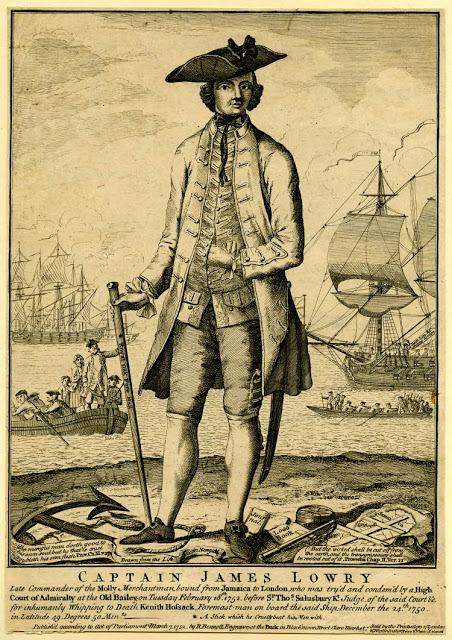
On this date in 1752 the tyrannous Scottish sea captain James Lowrey or Lowry was hanged at London’s execution dock for beating a crew member to death.

Lowr(e)y came to public notice in 1751 after the return to English shores of his merchantman, the Molly, from a run to Jamaica: ten of his ex-crew subscribed a public advertisement accusing him of murdering their mate on board, to which Lowry replied with advertisements accusing those accusers of mutiny.

Right away the British public knew it had a page-turner on its hands.

The captain had become unreasonably enraged with Kennith Hossack for lagging in his duties as he recovered from an illness, and upon a purported accusation of theft he had the mariner tied up and personally battered him about the head using a doubled-over rope as his cudgel, on Christmas Eve no less. Hossack at last dropped dead, at which point the heartless captain slapped his man and denounced him for “shamming Abraham” (i.e., feigning injury to skip work). Lowry evidently really had it in for Hossack, for the first mate explained that “I don’t know that he ever came upon deck twice in a week without beating him: my heart has bled for him many and many a time.” In the mate’s opinion, these beatings were always for no adequate reason.*

That’s a remark from the Admiralty Trial of Captain Lowry, where his former seamen developed the picture of an intolerably Queeg-like commander liable to take bitter umbrage if his men managed an illicit extra ration of sugar or rum, a guy who carried around a beating-cane with its own name (“the Royal Oak Foremast”) just in case he felt like doling out a disciplinary bludgeon. Three days after Hossack’s death, he came to blows with the second mate; two days after that, a fed-up crew “took the command from him” and ran the ship themselves, although they did not forcibly confine him.

Once the ship put in at Lisbon for repairs on the return journey, Lowry lodged a piracy complaint against his crew, but despite the incredibly serious charges and countercharges, everybody sailed on together for home thereafter, each party perhaps silently calculating the odds that the other would dare to press the case further as against getting on about their lives. Lowry does not appear to have made himself scarce until his former comrades went public with their claims, although once they did so he incriminatingly avoided the thief-takers and the small private reward set upon his capture for a few weeks.

On March 25, 1752, the brute was carried from Newgate Prison to the Execution Dock on the Thames, in a cart surmounted by a silver oar emblematic of the Admiralty. There he was hanged, and his body afterwards put in irons and displayed in infamy down the river at Blackwall.


Lowry pictured as part of a “Scotch Triumvirate” of Caledonian evildoers, along with the Scottish officer William Cranstoun, blamed for seducing Mary Blandy to the gallows, and the more mysterious “Major James MacDonald” whose papers suggest involvement in the South Sea Bubble 32 years prior (?). I’m in good company with my confusion on this MacDonald fellow, as the British Museum can’t identify him either. Check out britishtars.com for a fascinating exposition on the iconographic detail of the Lowry images in this post; we have also featured in this narrative several additional links to that same site’s various posts about the events on the Molly.

We have revisited a few times in these pages the intense commercial bustle among publishers of crime ephemera — in England as well as Ireland. Naturally this headline-grabbing execution excited plenty of competitive hawking.

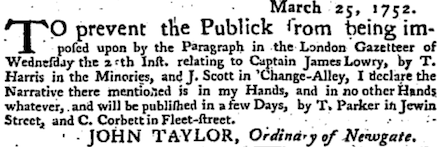
Two examples appear below; the first of them is by a pair of publishers named Harris and Scott; the second, by Parker and Corbett, who at this time had the deal to publish the Ordinary of Newgate’s accounts. Harris and Scott were first to the market here, in an environment where rapidity counted for a lot; the Ordinary wanted to be sure the public knew that his “official” (according to him) version would be soon forthcoming, so he burdened the pages of London newspapers and even his own Ordinary’s Account of ‘regular’ Tyburn criminals with adverts to that effect.


This image from the London General Advertiser of March 26, 1752, one of several papers to carry the notice. For more on the relationship between publishers and crime in this era, see Print Culture, Crime and Justice in 18th-Century London by Richard Ward

Read on below to enjoy both.

* In fact, one nugget from this case is that an adequate reason for corporal punishment at sea might sit at a much higher threshold than we commonly assume today. Although the Royal Navy was (in)famous for the discipline of the lash, multiple experienced sailors testified at this trial that they never knew floggings or beatings to occur on merchant vessels.

On this day..

Feast Day of Saint Pigmenius

March 24 is the feast date of Saint Pigmenius, the patron saint of pigmen.

In the hagiography, Pigmenius was a Christian scholar who numbered among the instructors of the young royal relative destined to switch back to paganism and become reviled of Christians as the Emperor Julian the Apostate.

Fleeing the new order, Pigmenius headed to Persia and as the Roman martyrology recounts it, there

he lived four years and went blind. After four years he was addressed in a dream vision by the Lord Jesus Christ, saying: “Pigmenius, return to Rome, and there you will regain your sight.” Getting up the following morning, he had no fear, but immediately got into a ship and came to Rome. After four months, he entered the city; he began to ascend the hill on the Via Salaria with a boy, feeling his way with a cane. And behold, Julian the emperor, travelling in his golden robes, saw Pigmenius from afar; recognizing him, he ordered him to be summoned. When he had been brought, Julian said to Pigmenius: “Glory be to my gods and goddesses that I see you.” Pigmenius replied: “Glory to my Lord, Jesus Christ, the crucified Nazarene, that I do not see you.” In a rage, Julian ordered him to be thrown off a bridge into the Tiber.

So he got to dunk on the emperor, before he got dunked by the emperor.*

However, this book (French) makes the interesting argument that the fourth century Pigmenius was a reinvention of a 1st century Roman saint of similar name, to whom subsequent legends attributed a fictitious eastern sojourn.** “It is this ‘orientalization’ of Pigmenius that connected it to the time of Julian,” runs the argument. For, once Julian’s death in battle in those precincts made the East an overwhelming shadow in Roman minds, “Julian’s story melded somehow with the legends which ran over the distant lands where it had unfolded and the oriental traditions, were ‘Julianized'” — Pigmenius’s among them.

* As the editor of this martyrology remarks in a footnote, this snappy retort was actually borrowed by the hagiographer from stories of Maris, Bishop of Chalcedon, to whom is attributed a similar exchange:

Julian: Thy Galilean God will not heal thy sight.

Maris: I thank God for depriving me of the power of beholding thy face.

** Comparable, the author claims, to the Persian excursions of Saint Cyriacus.

On this day..

1897: The Nineteen Martyrs of Aklan

In the wee early hours on this date in 1897, the Spanish occupation shot 19 Philippines revolutionaries — the Martyrs of Aklan.

Aklan is a province in the Western Visayas, and our 19 there were surrendered to a purported Spanish amnesty following the assassination of the local independence leader General Francisco del Castillo.

The amnesty was not honored. Known or suspected as active Katipunan subversives, these 19 were shot and (when necessary) bayoneted in a cell in a Kalibo dungeon situated on what’s now known as Nineteen Martyrs Road.

Aklan observes a holiday every March 23 in honor of these men.

On this day..

1540: Hans Kohlhase, horse wild

On this date in 1540, the legendary outlaw Hans Kohlhase — a crime victim turned revengeful crime lord — executed* in Berlin. It’s a classic case of stubborn cusses escalating a minor property dispute.

En route to the Leipzig fair in 1532, Kohlhase (English Wikipedia entry | German) was stopped by a Saxon nobleman who confiscated some of his horses. In dueling publications years later, Kohlhase would charge that Guenther von Zaschwitz accused him of stealing the horses; von Zaschwitz countered that Kohlhase looked suspicious and got uppity with his retainers when questioned.

Proceeding to Leipzig in a huff, Kohlhase obtained the commendations necessary to confirm his identity and then demanded his property back from von Zaschwitz. The lord agreed … if Kohlhase would pay for the horses’ days of upkeep in his stables. Just a little crap sandwich from the neighborhood bully. Kohlhase didn’t feel like having a bite of it.

Fast forward a couple of years. Suits in the courts bogging down, Kohlhase at his wit’s end resorted to an older form of redress, one consecrated by centuries of tradition but now forbidden by a landmark 1495 legal reform: he declared a feud. Kohlhase really vented his spleen in this one, not bothering as a plausibly wronged party to play for hearts and minds but rather pronouncing his vendetta against the whole Electorate of Saxony.

Thus “justified,” he turned out-and-out bandit, gathering a crew of desperados to his banner and robbing with opportunistic promiscuity while staying a step ahead of a bounty issued against him by Elector Johann Frederick I. To repeat: this is all over a question of who foots the bill for a feedbag. Even Martin Luther tried to talk this vengeful fury off his grudge.

What is just, you will do justly, says Moses; wrong is not justified by other injustice … What you rightly do, you do well; if you can not obtain justice, there is no other advice than that you suffer injustice … Therefore, if you desire my council (as you write), I advise, accept peace.

Kohlhase accepted only the peace of the grave.

The German romanticist Heinrich von Kleist immortalized (and renamed) this uncompromising litigant in the novella Michael Kohlhaas; the same story has been re-adapted for cinema several times more.

* No surviving document specifies whether the execution was by breaking wheel or beheading.

On this day..