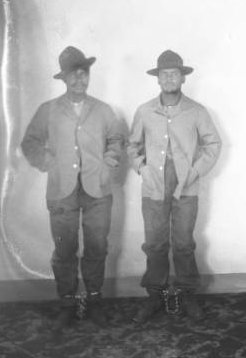
1938: Margarita Arsenieva, the explorer’s widow

On this date* in 1938, the widow of the Russian explorer and ethnographer Vladimir Arseniev was convicted in a drumhead trial of espionage and sabotage, and summarily shot at Vladivostok.

Vladimir Arseniev explored the distant Far East on foot with the help of local guides during the last years of the tsar.

Arseniev formed a lifelong friendship with one such guide, and gave the man’s name to the title of a widely-read book about his explorations — Dersu Uzala.

Japanese director Akira Kurosawa adapted Dersu Uzala to the silver screen in a 1975 joint Japanese-Soviet production that pocketed an Oscar as Best Foreign Language Film. (The entire film is available online through Veoh.)

Arseniev died in 1930 — not by the executioner’s offices — and was survived by his wife and scientific assistant Margarita.

As the subsequent, terrible decade unfolded, Margarita and other members of the Far Eastern Academy of Sciences came under official political scrutiny that would eventually lead to a purging.

Arrested once in 1934, and again in 1937, on the usual right-Trotskyist-conspirator stuff (Vladimir Arseniev — a suspect fellow in his later years for a potentially un-Soviet attitude to “the national question” — was the ringleader, dontcha know?), Arsenieva and a number of colleagues waited a year to get their 10-minute trial this date before assizes of the Military Collegium of the Supreme Court. Six in all, including Margarita Arsenieva, were held “subject to immediate execution.”

The Arseniev’s orphaned teenage daughter Natalia was subsequently consigned to the gulag.

Most of the sources about Margarita Arsenieva available online are in Russian, including:

* This German text gives Aug. 23 as the date of the trial and execution, and a couple of other online sources use that date instead.

On this day..

1951: Antonio Riva and Ruichi Yamaguchi

On this date in 1951, the first two foreigners — Italian merchant Antonio Riva and Japanese bookseller Ruichi Yamaguchi — were convicted and immediately executed in Beijing for a supposed plot to assassinate Mao Zedong.

According to Time magazine’s coverage of the affair, Radio Peking said that

“the streets they passed through [en route to execution] were thronged with people who expressed their feelings .. . with shouts of ‘Down with imperialism! Suppress counterrevolutionaries! Long live Chairman Mao!'”


No relation.

Riva (English Wikipedia entry | Italian) was a World War I fighter ace who had relocated to Beijing/Peking in the 1920s to peddle aircraft and training the Chinese Koumintang.

(In 1936, Riva married Catherine Lum, the daughter of American wood block artist Bertha Lum and sister of Eleanor Peter Lum, who took after mom.)

When the guys those planes were being used against won the Chinese Civil War, Riva mulled an expedient departure, but reportedly declared (Spanish link) that he could do business under any regime type.

The Communist government decided he had a different sort of business in mind. Citing Chinese state media, the London Times (Aug. 18, 1951) described the plot thus:

the conspirators planned to fire mortar shells at a reviewing stand outside the Tien An gate of the forbidden city in Peking during a procession to celebrate China’s national day on October 1 last year.

Several others, both Chinese and foreigners, drew long prison sentences as part of the “conspiracy” uncovered in a one-hour trial. The most illustrious of those was the Italian bishop Tarcisio Martina.*

Though Riva and Yamaguchi were the first foreigners officially executed by the new Chinese government, they were far from the last. All the more remarkable, then, that in a country that carries out thousands of executions per annum, Antonio Riva is thought to have been the last European citizen put to death there until Akmal Shaikh in 2009.

The Shaikh case helped rekindle interest in Riva’s execution — a timely confluence, since a recent book, L’ uomo che doveva uccidere Mao, critiqued the case against the Italian aviator.

* American diplomat Col. David Barrett, safely beyond the reach of the Maoists at Formosa, was a supposed ringleader.

On this day..

1916: Private Billy Nelson

On this date in 1916, 19-year-old Durham Private William Nelson was shot for desertion by the British military.

The Pity of It
by Thomas Hardy

I walked in loamy Wessex lanes, afar
From rail-track and from highway, and I heard
In field and farmstead many an ancient word
Of local lineage like “Thu bist,” “Er war,”

“Ich woll,” “Er sholl,” and by-talk similar,
Nigh as they speak who in this month’s moon gird
At England’s very loins, thereunto spurred
By gangs whose glory threats and slaughters are.

Then seemed a Heart crying: “Whosoever they be
At root and bottom of this, who flung this flame
Between folk kin tongued even as are we,

“Sinister, ugly, lurid, be their fame;
May their familiars grow to shun their name,
And their brood perish everlastingly.”

According to the archive capture of the lamentably defunct Shot at Dawn site — which campaigned (successfully) for clearing the names of World War I soldiers who had been executed for military failings like desertion or cowardice — Nelson gave a pitiable account of his situation. It was less the horror of trench warfare and mustard gas than desperation on his own home front that undid Nelson’s “nerves”.

“I have had a lot of trouble at home, and my nerves are badly upset. My father is a prisoner in Germany and is losing his eyesight there through bad treatment. My mother died while I was still in England, leaving my sister aged 13 and my brother aged 10. I am the only one left. I had to leave them in charge of a neighbour. I had no intention of deserting. I did not realise what I was doing when I left the camp. When I did so I went and gave myself up. When I went to the store my object was to get a night’s sleep and then go and surrender in the morning. I thought it was too late to do so that night. I did not know when the battalion was coming out of the trenches.”

Hap
by Thomas Hardy

If but some vengeful god would call to me
From up the sky, and laugh: “Thou suffering thing,
Know that thy sorrow is my ecstasy,
That thy love’s loss is my hate’s profiting!”

Then would I bear it, clench myself, and die,
Steeled by the sense of ire unmerited;
Half-eased in that a Powerfuller than I
Had willed and meted me the tears I shed.

But not so. How arrives it joy lies slain,
And why unblooms the best hope ever sown?
–Crass Casualty obstructs the sun and rain,
And dicing Time for gladness casts a moan. . . .
These purblind Doomsters had as readily strown
Blisses about my pilgrimage as pain.

That 13-year-old sister whom Nelson worried over long suffered her brother’s senseless death. In 2004, that woman’s daughter (Billy Nelson’s niece), Nora High, told the Guardian:

Every Armistice Day, my mother shed buckets of tears. We’ve got Billy’s Bible, I got that when mother died. She used to lay that out on a piece of blue satin cloth, and she would cry. She always said: ‘I won’t cry any more because that only upsets Billy. He doesn’t want me to cry. Everything’s fine for him now.’

In Time of “The Breaking of Nations”*
by Thomas Hardy

Only a man harrowing clods
In a slow silent walk
With an old horse that stumbles and nods
Half asleep as they stalk.

Only thin smoke without flame
From the heaps of couch-grass;
Yet this will go onward the same
Though Dynasties pass.

Yonder a maid and her wight
Come whispering by:
War’s annals will cloud into night
Ere their story die.

* The title is a Biblical allusion to Jeremiah 51:20.

As a slight stretch, part of the Themed Set: Thomas Hardy.

On this day..

1914: Rudolf Duala Manga Bell, in German Kamerun

On this date in 1914, the Germans hanged D(o)uala king Rudolf Duala Manga Bell for treason in German Kamerun.

European-educated and on retainer by the colonial German government, Bell was hardly the subversive type: rather, as the head of the largest clan of the important Duala tribe, he was the guy that Berlin looked to to uphold its authority.

This mutually satisfactory relationship began unraveling in 1910, with the Reich’s plan to abnegate the 1884 treaty under whose auspices it intruded into Kamerun (Cameroon) in the first place.

Seeking to confine the Duala to a few coastal villages — and subsequently, to push those Duala to less desirable inland territory — Berlin managed the rare feat of uniting the tribe’s various families, and pushing Rudolf Manga Bell himself into (surprising, to Germany) resistance.

When petitions to the Reichstag were ignored, the Duala began (Bell’s own degree of involvement in this seems to be a disputed point) making noises about holding Berlin in breach of the colonial treaty and finding itself a new European patron, like France or England.

Azanwi Nchami’s Footprints of Destiny (“the historical Cameroonian novel par excellence”) tells the story of Rudolf Manga Bell, Martin Paul Samba, and emergent Kamerunian nationalism.

And one notes the year in this post’s title, which would become momentous to Germany for other reasons. “The coming war,” notes Victor T. LeVine, “made it appear that Manga Bell had been plotting with Germany’s enemies.”

Bell was arrested for treason in the first half of 1914, as the Germans seized prime Bell land along the Wouri River.

In the conflict that became remembered as World War I, the first declarations of war were made in the very first days of August; Axis and Ententethe Central Powers and Triple Entente lined up against one another in the colonial territories, too, and German administrators in Kamerun realized that they were about to face an invasion from neighboring British and French colonies.

So it was in an atmosphere of panic and a view towards desperate internal repression that Bell was tried for treason on August 7, 1914, along with his friend and fellow-traveler Martin Paul Samba — and put to death the very next day.

Postscript

The Allied invasion had taken Duala and the other principal cities of Kamerun from the Germans by the end of September; over an 18-month campaign, the Germans were totally defeated in the territory, which France and England claimed as victors’ spoils after the war. (Also inheriting the tense relationship with the Duala; France was still trying to sort out the 1914 German expropriations that started the whole mess decades later.)

As a result, Rudolf Duala Manga Bell’s son, Alexander Ndoumbe Duala Manga Bell, not only inherited his father’s royal position among the Duala — he became Cameroon’s first elected representative to the French National Assembly.* There’s more about that guy here.

It is here that the Germans part ways with Cameroon’s national story, but there was almost a “peace in our time” diplomatic reconquista.

Although Hitler originally held the colonial movement in great disdain, in the late 1930s his regime ‘adopted’ and coordinated this movement. After 1936 the renewed campaign for the recuperation of German colonies had its desired results among the Allied powers. In discussions between the French Foreign Minister, Yvon Delbos, and the American Ambassador, William Bullitt, proposals were considered for the appeasement of Germany including tariff reductions, the involvement of the Third Reich in the development of Africa, and finally the granting of a colony to Germany, probably the Cameroons. In November 1937, during talks between Premier Chautemps, Prime Minister Chamberlain, Eden and Delbos, the suggestion was allegedly made by Chamberlain that France should ‘hand the Cameroons to Germany at once without any quid pro quo’.**

* Ralph A. Austen, “The Metamorphoses of Middlemen: The Duala, Europeans, and the Cameroon Hinterland, ca. 1800 – ca. 1960”, The International Journal of African Historical Studies, Vol. 16, No. 1 (1983).

** Richard A. Joseph, “The German Question in French Cameroun,” Comparative Studies in Society and History, Vol. 17, No. 1 (1975)

On this day..

1936: The Sacred Heart, by Spanish leftists

On this date in 1936, anticlerical leftists in the Spanish Civil War allegedly subjected a monumental statue of Christ to a ritual “execution”.


“This picture, taken by a Paramount News-reel representative and received by air from Madrid yesterday, illustrates an outrage which has no parallel in the photographs published by “The Daily Mail” of the Spanish Reds’ war on religion. It shows a Communist firing squad aiming at the colossal Monument of the Sacred Heart on the Cerro de los Angeles, a hill a few miles south of Madrid which is regarded as the exact centre of Spain.” (Source)

This outstandingly incendiary image made for great recruiting for the Francoist enemies of the “firing squad” and gave credence to a “crusade” lexicology that insured the devout would break overwhelmingly against the Republic. (Nearly 7,000 men and women in religious orders whose deaths during the war are charged to the Republican account also helped.)

Maybe that was inevitable, anyway.

George Orwell, the English leftist who volunteered for the Spanish Republicans, noted in his Homage to Catalonia that

the people in this part of Spain must be genuinely without religious feeling — religious feeling, I mean, in the orthodox sense. It is curious that all the time I was in Spain I never once saw a person cross himself; yet you would think such a movement would become instinctive, revolution or no revolution. Obviously the Spanish Church will come back (as the saying goes, night and the Jesuits always return), but there is no doubt that at the outbreak of the revolution it collapsed and was smashed up to an extent that would be unthinkable even for the moribund C. of E. in like circumstances. To the Spanish people, at any rate in Catalonia and Aragon, the Church was a racket pure and simple. And possibly Christian belief was replaced to some extent by Anarchism, whose influence is widely spread and which undoubtedly has a religious tinge.

Be that as it may, Republican types suspected photographic fakery.

Just like its inspiration is reported to have done, this statue survived its “execution” in fine shapewas resurrected by public subscription, and can still be seen at Cerro de los Angeles outside Madrid.


The “executed” statue today. (cc) image from bigchus.

On this day..

1903: Hilario Hidalgo and Francisco Renteria

Border-related violence and crime due to illegal immigration are critically important issues to the people of our state, to my Administration and to me, as your Governor and as a citizen.

–Statement (pdf) by Arizona Gov. Jan Brewer on signing the anti-immigration law, which went into effect July 29, 2010

Some stories are just plain classics.

In February 1903, two Mexicans shot up Goddard Station stagecoach stop, for motivations that were never plain. (There was no robbery, but it might have been revenge.)

The shooters got away, but law enforcement soon enough decided that a couple of railroad workers on the Mexican side of the border matched their description, and contrived to lure them into Arizona where they could be arrested.

Hilario Hidalgo and Francisco Renteria, were put on trial for their lives in Prescott, Ariz., in June 1903, where they were doomed to hang on the strength of eyewitness testimony and thirty minutes of the jurymen’s time. Appeals forbidden, the sentence was executed on this date — not six months after the crime.

With feelings of profound regret and sorrow, I hereby invite you to attend and witness the private and decent and humane execution of two human beings, namely: Richard Roe and John Doe. Crime — Murder.

Said men will be executed on July 31, 1903 at 12 noon. You are expected to deport yourself in a respectful manner and any flippant or unseemly language or conduct on your part will not be allowed. Conduct on anyone’s part bordering on ribaldry and tending to mar the solemnity of the occasion will not be tolerated.

-Sheriff’s invitation to the hanging, quoted in Frontier Justice in the Wild West: Bungled, Bizarre, and Fascinating Executions

The men cracked wise at the reading of their death warrant — “I have heard that repeated so often that if it was a song I would sing it to you,” reported the Los Angeles Times (Aug. 1, 1903) — and with “perfect nerve” checked out, calling only “Adios! Adios!” from the scaffold.

It was the last hanging in Prescott, Ariz.

On this day..

1936: Aboune Petros, Ethiopian bishop

On this date in 1936, the Italian forces occupying Ethiopia executed anti-occupation cleric Aboune Petros.

War on Ethiopia had been Benito Mussolini‘s monument to muscular Italian nationalism.

By May of 1936, it had forced Haile Selassie into exile and established control of the country. Mission accomplished!

At last Italy has her empire.

-Mussolini

As is often the case, the war of conquest instead transmogrified into a war against continuing resistance to foreign military occupation, and the colony of Italian East Africa was a short-lived and bloody affair.

The Duce will have Ethiopia, with or without the Ethiopians.

-Italian Gen. Rodolfo Graziani

(Though the progressive counterpart to Italy’s iron-fisted approach to troublemakers was monumental construction, and 1930s-era fascist architecture is still to be seen in Addis Ababa today.)

Ethiopian Orthodox patriarch Aboune — it’s a title that can also be rendered Abuna or Abune — Petros cut a public profile a little too sympathetic to the native subversives. When the Italians demanded that he tone it down, he replied (according to a hagiography that appears several places online),

The cry of my countrymen who died due to your nerve-gas and terror machinery will never allow my conscious to accept your ultimatum. How can I see my God if I give a blind eye to such a crime?

On July 28, Italians repelled a large* Abyssinian insurgent attack by the sons of Ras Kassa between Addis Ababa and Petros’s stomping-grounds of Dessie; the next day, Petros was escorted to an abrupt martyrdom to the mirroring causes of national self-determination and anti-insurgency realpolitik.

His sacrifice is commemorated in statuary as well as a couple of notable theatrical pieces, Yedam Dems (The Voice of Blood) by Makonnen Endalkachew** and Petros Yachin Saat (Petros At That Hour) by Tsegaye Gebre-Medhin.

* On the scale of thousands. It “showed a certain tenacity,” according to the London Times‘ droll Rome correspondent in a July 30 story.

** Not the same guy as the post-colonial Prime Minister who was executed in a 1974 purge.

On this day..

1986: Vice-President Paulo Correia and five others

On this date in 1986, six people were executed by firing squad for attempting a coup in the West African state of Guinea-Bissau.

Correia, an ethnic Balanta war hero, was an African Party for the Independence of Guinea and Cape Verde (PAIGC) activist from the days of Portuguese colonial control — which only ended in 1974.

He was among the revolutionary council that governed the country after Joao Bernardo (Nino) Vieira‘s 1980 coup d’etat.*

This latter strongman was finally assassinated in 2009, but in the interim he was one of the world’s most plotted-against heads of state — in no small part because he came from a tiny ethnic group, and had a fraught relationship with military brass from the plurality (but not majority) Balanta. Vieira needed Balanta officers like Correia to keep the army on his team. Balanta officers like Correia had to wonder whether they needed Vieira.

Correia had perhaps been involved in a 1982 coup attempt that got a tank commander executed, but such was the danger to Vieira of alienating the Balanta (and Correia’s personal following in the military) that rather than face prosecution, he was simply shifted from Minister of the Armed Forces to the less martial post of Minister of Rural Development in the aftermath. Two years later, still trying to keep his treacherous officer inside the tent pissing out, Vieira took him on as Vice-President.

Despite these relative concessions, however, neither Correia nor his fellow military men were thwarted in their drive to augment their power, and in November I985 they planned to overthrow the regime and to install Correia as President and [Balanta lawyer] Viriato Pan as Vice-President. Correia and about one dozen Balanta were immediately arrested before their coup could be implemented; a total of 53 accused conspirators were later convicted, including Correia and Pan, who were both executed along with four others in July 1986.**

“This event,” reports Human Rights Library, “is vividly remembered in Bissau, where rumor has it that Correia’s eyes were gouged out before he was shot. True or not, this belief is clear evidence of the gruesome reputation of the security forces.”

* Just a captain at the time of the 1980 coup, Correia was a colonel at the time of his execution.

** Joshua B. Forrest, “Guinea-Bissau since Independence: A Decade of Domestic Power Struggles,” The Journal of Modern African Studies, March 1987.

On this day..

1998: David Wilson

Just after dawn this date in 1998, David Wilson was hanged for murdering a security guard in St. Kitts and Nevis.

Wilson was only the second person executed by the tiny Caribbean nation since it achieved independence in 1983, and he would be the last hanged there until 2008.

The execution of this run-of-the-mill criminal attracted particular attention as a hempen protest against death penalty skeptics on the bench of the British Privy Council. Especially in the 1990s (and since) the exercise by this high court of the commonwealth of an excessively persnickety supervision of Caribbean death sentences attracted regional backlash against colonial meddling for hampering local response to violent crime. (See also the contemporaneous Trinidad and Tobago case of Dole Chadee.)

Wilson was controversially hanged before he submitted his appeal to the Privy Council.

In a bid to shore up national sovereignty, Caribbean countries were even then hammering out a Caribbean Court of Justice to replace these distant and unaccountable magistrates. However, official adoption of the CCJ has been halting.

On this day..

1943: Eight from the Krasnodar Trials

On July 18, 1943, eight Soviet citizens who were among 11 tried for collaboration with the recently expelled German occupiers were hanged before tens of thousands in the main square Krasnodar.

The proceedings from July 14-17 were the first major, open war crimes tribunals of World War II … which, of course, was still ongoing at this point.

But the previous winter, the Soviet Union had turned the tide by winning the Battle of Stalingrad, which victory presaged the liberation of the nearby north Caucasus city where we lay our scene.

The Russians proceeded to put the murderous Nazi occupation on trial, but did so not by trying Germans or their allies — but by trying eleven Soviet citizens for collaboration. Indeed, until the end of the war, thousands of Russians were prosecuted for crimes of collaboration, but only a relative handful of Germans for actually authoring those crimes.

These eleven were mostly* men who had served the Sonderkommando 10a (part of Einsatzgruppe D) in “guarding Gestapo buildings that held arrested Soviet citizens, executing arrests, going on military searches and expeditions against the partisans and peaceful Soviet citizens, [and] exterminating Soviet citizens by hanging, mass shootings, and use of poison gases.”

That “Soviet citizen” stuff, technically accurate, soft-pedaled the Einsatzgruppe‘s predictable primary target: local Jewry.

Sonderkommando 10a arrived in the town of Krasnodar when it fell to the Germans on August 12, 1942. On August 21 and 22, all the Jews were ordered to report for transfer to a certain neighborhood in the city. They were taken to the Pervomaisk woods, where they were shot. Many of the city’s Jews did not obey the order, but they, too, were eventually caught and shot. According to a Soviet committee of inquiry report, the number of civilians — women, old people, and children — murdered in Krasnodar was in excess of 13,000. Almost all were Jews. (Source)

This in a city that was occupied for only six months.

Under any description of the victims, these depredations were plenty to condemn collaborators with even the vaguest of associations. Only a few of the men had specific acts charged against them; evidence establishing frightful Nazi atrocities in the region (not hard to find) plus confessions to having worked for the Nazis (not hard to wring out) forged a sufficient evidentiary chain without getting lost in the weeds of such minutiae as: was the collaboration really voluntary? did these collaborators themselves actually carry out war crimes? was that confession actually reliable? (good luck with that one.)

In this military tribunal, the public prosecutor had a free hand for grandstanding, the defense had almost no scope of action, and (the USSR being an old hand at the show trial game) the accused knew their own part to play with craven self-denunciations and pleas for the “mercy” of being sent to the most dangerous part of the front. This made great headlines in Pravda and Izvestia (and update memos straight to the Kremlin) about Nazi bestiality,** and great copy with inquisitorial slam dunks like,

Today Soviet law will mete out justice to the traitors, fascist hirelings, and boot-lickers now in the prisoners’ dock. Tomorrow the court of history, the court of freedom-loving nations of the world, will pronounce its inexorable verdict on the bloodthirsty rulers of Hitlerite Germany and all its associates — on the enemies of mankind who have plunged the world into the welter of the present war. Not one of them will escape stern retribution! Blood for blood, death for death!

All were convicted; three drew long prison sentences and eight hanging, and since the tribunal permitted no appeal, those sentences were executed the day after the court finished its business.

The period quotes, and much of the information about this otherwise somewhat inaccessible trial, comes from Ilya Bourtman’s 2008 article for Holocaust and Genocide Studies, “‘Blood for Blood, Death for Death’: The Soviet Military Tribunal in Krasnodar, 1943.”


It may have been a first, but one need hardly add that it was hardly the last such prosecution.

Several others war crimes show trials took place in other Soviet cities over the next few months, and these would obviously continue after the war.

Long, long after the war.

* The one exception was a 60-year-old former kulak who had illicitly escaped the deportation prescribed for this class in the 1930s. His “collaboration” consisted of having been a doorman whom a German soldier asked a question of.

** e.g., “Death to Hitler’s Butchers and Their Vile Accomplices”

On this day..