1953: John Christie, a little late in the day

On this date in 1953, English serial killer John Christie was hanged by Albert Pierrepoint for the murders of six women.

The sex-killer is most infamous, though, for a different death: that of Timothy Evans, a neighbor and fellow client of Pierrepoint whom Christie had stitched up three years before for strangling Evans’s wife and child.

Back then, the respectable Christie was the star witness against Evans. Evans tried in vain to blame Christie (“this perfectly innocent man,” Evans’s prosecutors scoffed) for the murders.

Nobody knew then that Christie had strangled an Austrian prostitute during sex back in 1943, nor that he had done a gassing-strangulation-rape job the following year.

Both their bodies were both buried in the garden at 10 Rillington Place: the first inhabitants of what would be the British Isles’ most notorious corpse hotel.

Strangulation sex killings would become the definitive Christie m.o. after Evans hanged. He got himself a no-fault divorce by throttling his wife in bed late in 1952, then raped and strangled at least three other women whom he had invited back to his pad. The remains of each were secreted in the apartment’s nooks and crannies.

This is Richard Attenborough as Christie doing his thing to Evans’s wife (he’d later confess to that crime) in the 1971 flick 10 Rillington Place.

Christie seemingly could’ve gotten away with it all, if it weren’t for his penny-wise and pound-foolish decision to move out of the charnel house early in 1953 and let someone else stumble upon the remains. (Christie had quit his job the previous December, and hocked his strangled wife’s stuff to make ends meet for a while. He was homeless when the subsequent manhunt tracked him down.) There was even a human femur being used to prop a fence.

Having quite a lot of damning evidence, and Christie’s confession besides, his lawyer went for a hail-Mary insanity defense, but Christie didn’t even bother with an appeal when that didn’t take.

But there was the small matter of that other gentleman hanged back in the day for a strangulation murder, all the while unsuccessfully accusing his then-respectable neighbor Christie.

An inquiry launched by the government very conveniently concluded that (Christie’s confession notwithstanding) Evans was indeed guilty of killing his wife. Two stranglers in the same place at the same time, and the one had just happened to try to blame the other one when he was accused.

For obvious reasons, this whitewash was greeted skeptically and — though the two-killers theory does still have its defenders — officially reversed when Evans was posthumously exonerated in 1966.

On this day..

1926: Ziya Hursit and others for a plot against Ataturk

On this date in 1926, 15 people who had been sentenced to death only the day before for attempting to assassinate Turkish statesman Atatürk were hanged in Constantinople.

Ziya Hursit (English Wikipedia entry | Turkish), a former National Assembly delegate who didn’t see eye to eye with Atatürk, generally goes down as the ringleader in this affair.

Their object? To gun down the President during a visit to Izmir a few weeks previous. When interrogated, Hursit “admitted at the outset his intention to kill the President of the Republic.” (London Times, June 29, 1926)

Frictions with said President had been growing over the preceding months, as Atatürk broke the eggs to make the Turkish Republic’s omelet.

In early 1926, Mustafa Kemal also sought to bring the manner in which Turkish society was regulated into line with European countries. On 17 February 1926, the Turkish parliament approved a new civil code which was translated almost verbatim from the civil code in the Swiss canton of Neuchatel. The changes it introduced included: granting Turkish citizens the right to choose their own religion, thus abolishing the previous prohibition on apostasy from Islam; officially recognizing only civil marriage ceremonies conducted by representatives of the civil authorities … outlawing polygamy; making divorce dependent on a decision of the courts; lifting the ban on Muslim women marrying non-Muslims; and granting men and women equal inheritance rights.

The new Civil Code was followed by a battery of further legal reforms to try to bring Turkey into line with contemporary Europe. On 1 March 1926, parliament approved a new Penal Code, which was translated from the Italian Penal Code of 1889. A Code of Obligations was introduced on 22 April 1926, again based on the one in Swiss canton of Neuchatel. On 9 May 1926, parliament approved a new Commercial Code, which was largely based on German law.

(Source)

This first of the Turkish Republic’s political assassination attempts and arguably its last serious bid to reverse secularism licensed an efficient purge and further consolidation of power by Atatürk, who over the weeks ahead shattered the remnants of the Unionists and Progressive Republicans and settled in for essentially secure autocratic governance for the balance of his life.

The alleged conspirators in the hit — not all of them as eager as Hursit to avow responsibility over the two-plus weeks’ trial — were hanged at a couple different locations in the former capital this date, bearing placards damning them for “attempting to assassinate our President, Mustapha Kemal Pasha, who is the saviour of Turkey’s honour.” One of them had a botched execution with a broken rope and a do-over.

(The quote is from the London Times dispatch about the executions, printed July 15, 1926. This story gives the figure of 15 hanged; it appears to me that the correct number that date was either 13 or 14, with two additional death sentences handed down in absentia. It was, in any event, more death sentences than the public prosecutor himself had demanded (11) in the case.)

* The city wasn’t renamed Istanbul until 1930.

On this day..

1989: Arnaldo Ochoa and Tony de la Guardia

In the predawn hours this date in 1989, Cuban Gen. Arnaldo Ochoa was shot in a pasture at a West Havana military base along with Col. Antonio “Tony” de la Guardia and Captains Antonio Padrón and Jorge Martinez — all convicted of treason against the Cuban Revolution because of drug trafficking.

Before his abrupt fall just weeks before this date, Arnaldo Ochoa was one of the shining stars of Castro’s Cuba.

One of the Sierra Maestre guerrillas, Ochoa had fought with Che Guevara in the Battle of Santa Clara that toppled the Batista regime.

In the decades that followed, he rose to become one of the most powerful officers in Cuba, serving in Venezuela, Angola, Ethiopia.

But in early June 1989, and shortly after a Mikhail Gorbachev state visit to Cuba delivered the bad news that the crumbling Soviet Union would be withdrawing its subsidies to Havana, Ochoa and State Security officer Tony de la Guardia* were suddenly busted for running a drug-smuggling operation — essentially conspiring with the Colombian Medellion cartel to exploit Cuba’s position on the most direct routes to Florida, and corruptly skimming the proceeds in the process.

There seems to be little doubt among those in the know that they were doing exactly that, but endless speculation about what else they were up to — what the executions were really about.

There is the year, to begin with, which is why we’ve mentioned Gorbachev; Castro was hostile to the Soviet leader’s glasnost reforms, and could read well enough the dangerous direction of change in eastern Europe. He wanted Gorbachev to put the brakes on.

Ochoa was seen as a charismatic figure of a more liberal outlook and close to Russian officers to boot, and one school of thought has it that he therefore looked like the sort of man who might be able to mount a coup or serve as the KGB’s catspaw if it came to regime change.

Whether or not Ochoa was targeted on that basis, Castro surely did not regret during those dangerous transitional years as Russian patronage slipped away the salutary effect this day’s doings would have had on any other potential aspirants for his job.

That consideration, whether it was primary or tertiary, probably helps explain the purge’s old-school show trial vibe. On television, Ochoa confessed to it all, and assured the court,

If I receive this sentence, which might be execution … my last thought will be of Fidel, for the great revolution he has given our people.

(Although what that thought would have been is a different matter. After falling out with Ochoa over military operations in Angola, the Cuban dictator had bugged his general’s environs and thereby eavesdropped on numerous of caustic remarks about himself.)

The drug charges, too, point the way towards plausible hidden agendas.

Fidel and Raul generally took a cautious approach to the drug business — hardly virginal, but reputedly avoiding particularly egregious entanglements lest they gift-wrap the hostile Yankees a pretext for invading. (Given what happened to Panama later in this eventful year, that would have been a reasonable concern.)

At the same time, it’s all but inconceivable that they were taken completely unawares by “revelations” that their aides were up to something shady.

So the hypotheses in this area run the gamut from: Ochoa and de la Guardia taking an authorized but circumscribed covert operation and avariciously expanding it beyond any possible license; to, everyone at the top being up to his eyeballs and Ochoa and de la Guardia eliminated when it became expedient to bury their firsthand knowledge of Fidel’s firsthand knowledge. Timing, again, is suggestive; with the coming withdrawal of Soviet protection, this might have been seen in Havana a prudent moment to trim sails on narcotics transshipment.

Whatever Arnaldo Ochoa and Tony de la Guardia may have known or sensed about the wheels-within-wheels of Havana politics, they took it to their grave 21 years ago today. Perennial declarations of the Castros’ imminent fall have made the rounds ever since, but until that old stopped clock manages to tell the right time, it’s likely that the rest of us will have to content ourselves with guesswork.

* De la Guardia was a friend of the writer Gabriel Garcia Marquez. In this very year, Marquez dedicated The General in his Labyrinth to the soon-to-be-disgraced colonel.

Speaking of de la Guardia literary connections: Tony’s daughter, Ileana, has also published a book.

On this day..

1916: Cesare Battisti and Fabio Filzi

On this date in 1916, the Austro-Hungarian empire executed Cesare Battisti and Fabio Filzi for treasonous Italian nationalism.

It was the multiethnic Habsburg state that was itself dying of its constituents’ national aspirations; in little more than two years, the state entity that carried out this day’s sentences would no longer exist at all.

Pre-World War I, Battisti (English Wikipedia entry | Italian) was actually a Socialist representative in the Austrian parliament.

When the unpleasantness broke out, though, he made a break for the peninsula where he agitated* (successfully) for Italian entry into the fray against Austria-Hungary. Irredentists had long coveted Habsburg properties with a heavy Italian population, like the Adriatic port of Trieste and Battisti’s own native Trento; the war offered an opportunity to swipe those territories, notwithstanding Italy’s putative prewar alliance with the Austrians.

Although already 40 years of age when Italy entered the war, the intrepid Battisti enlisted to fight. He was captured along with an otherwise obscure subaltern, Fabio Filzi, on the Alpine slope of Monte Corno (now known as Monte Corno Battisti) repelling the Austrian Strafexpedition.**

Austria did not stand on ceremony with these men; their capture took place on July 10, their trial on July 12, and their executions at the Castello del Buon Consiglio — an ironic Calvary, for a parliamentarian — later that same day. (To complete the scene, the strangulation-hanging was botched when Battisti’s first rope broke.)

The Austrian writer Karl Kraus would observe that “they thought they were hanging Italy, but it was really Austria on the gallows.”

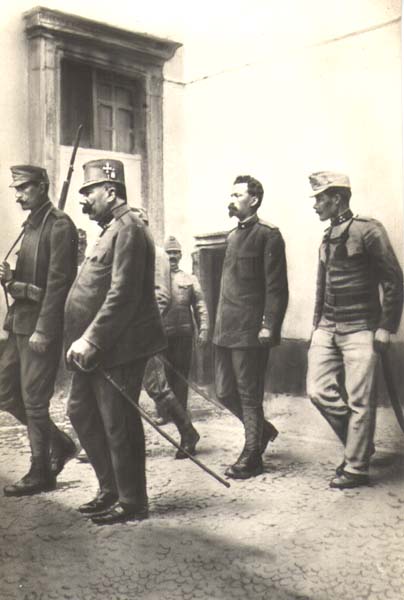
Whichever one it was, they took a lot of pictures.


Battisti and Filzi as prisoners.


Battisti leaving the courtroom en route to his execution.


Battisti approaches the scaffold.


Battisti waiting at the scaffold as the sentence is read.


The Austrian army offers a prayer and salute to the shrouded body of Cesare Battisti.

* As a socialist who broke against the internationalist position and in favor of violent nationalism, Battisti was an ally of Benito Mussolini. It was Battisti, actually, who pioneered the socialist-nationalist-newspaperman act upon which Mussolini would later raise is own star, to such an extent that Battisti’s paper, Il Popolo — the apparent inspiration behind Mussolini’s own subsequent paper, Il Popolo d’Italia — gave the still-obscure future Duce some of his earliest gigs.

A martyr’s death during World War I fortuitously spares Battisti’s legacy the unpleasant association with his friend’s postwar turn towards fascism, so there are many streets and plazas named for Battisti, as well as a memorial in Trento. He’s also honored by name in the 1918 patriotic tune La Leggenda del Piave (lyrics).

** “Punitive expedition”.

On this day..

1976: Costas Georgiou and three other mercenaries in Angola

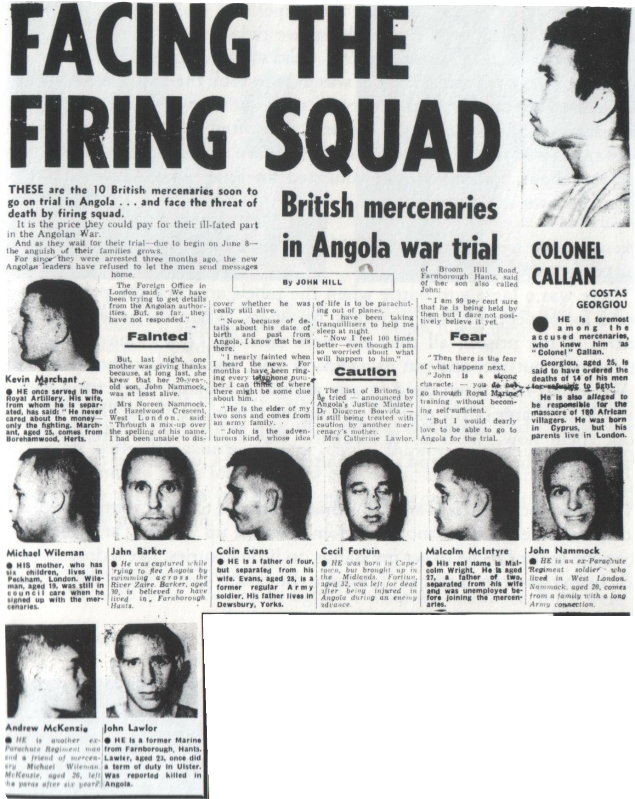
On this date in 1976, three Britons and one American were shot in Angola by a military police squad for murders committed as mercenaries earlier during the year.

Costas Georgiou.

They were among 13 foreigners sentenced at the Luanda Trial, which occurred on the pivot of Angola’s transition from generation-long anti-colonial insurrection on towards generation(s)-long civil war. Between them, more than half a million Angolans died, but this date belonged to a couple of unrepresentative Anglos.

Long story short, the immediate aftermath of Angolan independence in late 1975 was a scramble for control among the several factions who had been fighting the Portuguese … along with a scramble among interested outside states to line up their allies in this resource-rich Cold War prize.

Small wonder that foreign soldiers of fortune soon found their way into the chaotic scene.

Over the course of the first few months of independence, the Popular Movement for the Liberation of Angola (MPLA) more or less consolidated state power, and it proceeded to prosecute supporters of a rival guerrilla movement for their part in the conflict immediately after independence.

Thirteen foreign mercenaries who were captured by MPLA-supporting Cuban troops — the other nine drew long prison sentences — were charged in a show trial with war crimes for their conduct in the field in a case that made the western gun-for-hire an emblem of colonial depravity.

The most notorious of the bunch was Costas Georgiou. A Greek Cypriot emigre to Britain, he had gone to Angola as “Colonel Callan” and was wanted by Scotland Yard for there ordering a mass execution of other British mercenaries — an act he admitted at trial. Even the inevitable London Times editorial against the trial (June 29, 1976) agreed “the proceedings against Callan, if not the rigours of the sentence may be conceded.”

The others looked much less culpable, almost arbitrarily selected for death from among the ranks of unprepossessing, sometimes barely-there mercs. American Daniel Gearhart, a Vietnam veteran drowning in debt, had apparently been in the field for a mere three days and never so much as fired a shot; that he had advertised in Soldier of Fortune magazine was held to aggravate the charges against him, and in vain did the father of four insist that being tried for his life was enough to scare him straight out of the business.

Angolan defense attorneys, while also appealing against the legality of the trial on grounds of both international and domestic law, spoke that revolutionary language of decolonization in defending their charges. Georgiou, according to Maria Teresinha Lopes, was

“a colonized man … [treated in England as] a sub-human, just a Greek, just a ‘boy’.”

Another Angolan defense attorney argued against the death penalty because

“To condemn them to death while ignoring their social origin in terms of revolutionary justice would deny the theory which guided our revolution. My clients are an integral part of the exploited class.” (Both comments from London Times, June 19, 1976)

The era of decolonization was a time for idealism, but not the sort that would shrink from bloodshed.

In denying the doomed men clemency, Angola’s first independent president Agostinho Neto denounced

Mercenarism, instrument of the aggressive designs of imperialism … a scourge of the African continent and a grave threat to the peace, freedom and independence of the peoples …

It is imperative that the practice of mercenarism be banished once and for all from our planet. It is urgent that all states and peace-loving forces fight it most energetically.

We are applying justice in Angola not only in the name of our martyred people but also for the good of the brother peoples of Namibia, Zimbabwe and all the peoples of the world against whom imperialism is already getting ready to prepare new mercenary aggressions.

(Text dated July 9, and reprinted in the July 10 London Times)

You could just about substitute the word “terrorism” for “mercenarism” and read it on today’s campaign trail.

Juridically, Angola pursued these warriors as peoples who had fought unlawfully and could therefore be placed outside the protections conferred on soldiers by the Geneva Conventions — and subjected to the liberating power of revolutionary violence.

That this ad hoc concept of “mercenarism” could be exploited to license an outrage upon humanity was a notion relentlessly denounced by British and American officials,* who had not yet fully explored the utility of the “unlawful combatant” construct in extending the reach of their own security states.

As for all that peace-loving, brother-peoples stuff in the execution order?

What actually happened after the mercenaries were shot was that the two biggest former anti-colonial guerrilla movements in Angola morphed into Cold War proxies — the MPLA of the Warsaw Pact, supported by its control of the country’s oil; UNITA of NATO, supported by its control of the country’s diamonds — and bled the country dry in a horrific civil war.

* Henry Kissinger, then President Gerald Ford’s Secretary of State, complained that Angola’s decision

to ignore both the law and the facts … cannot help but affect adversely the development of relations between the United States and Angola.

On this day..

1917: Gasim, by Lawrence of Arabia

“With Major Lawrence, mercy is a passion. With me, it is merely good manners. You may judge which motive is the more reliable.”

-Alec Guinness as Prince Faisal in Lawrence of Arabia

This date in 1917 was the eve of the Battle of Aqaba, wherein a force of Arabs with famous British officer T.E. Lawrence emerged from the desert to surprise and capture the Ottoman Red Sea port today located in Jordan.*

And that makes this, in the cinematic masterpiece Lawrence of Arabia, the date on which the titular character kept the peace within his fragile coalition by personally executing a malefactor to prevent a tribal blood feud.

The victim, Gasim, is a real figure described in the real T.E. Lawrence’s memoirs —

a gap-toothed, grumbling fellow, skrimshank in all our marches, bad-tempered, suspicious, brutal, a man whose engagement I regretted, and of whom I had promised to rid myself as soon as we reached a discharging-place.

Gasim is most famous as the beneficiary of the movie scene in which Lawrence boldly turns back into the desert to rescue this worthless retainer when Gasim’s camel is found riderless in the caravan. This, too, is based on an actual incident in Lawrence’s memoir, albeit heavily dramatized on celluloid.

In the film, Lawrence’s godlike power to give Gasim life is soon mirrored by the godlike power to deprive it.

Effectively exploiting dramatic license, Lawrence of Arabia portrays the Englishman surveying the scene of the coming triumph when a disturbance breaks out in his camp. Hastening thither, he discovers clan lining up against clan over the destructive right of blood vengeance because of a murder in the camp — a murder committed by the man he has saved.

To forestall a “tribal bloodbath” on the very eve of victory, Lawrence himself volunteers to execute the culprit. Having once risked everything to save Gasim, Lawrence sacrifices him ruthlessly when the occasion demands.** This act underscores the chameleon-like other-ness of the character, one of the film’s principal leitmotifs: “I have no tribe, and no one is offended!”

Though the real Lawrence did no such thing to the real Gasim, this astonishing scene is also related in the memoirs — just at an earlier point, and with a different, less dramatically integral character.

My followers had been quarrelling all day; and while I was lying near the rocks a shot was fired. I paid no attention; for there were hares and birds in the valley; but a little later Suleiman roused me and made me follow him across the valley to an opposite bay in the rocks, where one of the Ageyl, a Boreida man, was lying stone dead with a bullet through his temples. The shot must have been fired from close by; because the skin was burnt about one wound. The remaining Ageyl were running frantically about; and when I asked what it was Ali, their head man, said that Hamed the Moor had done the murder. I suspected Suleiman, because of the feud between the Atban and Ageyl which had burned up in Yenbo and Wejh; but Ali assured me that Suleiman had been with him three hundred yards further up the valley gathering sticks when the shot was fired. I sent all out to search for Hamed, and crawled back to the baggage, feeling that it need not have happened this day of all days when I was in pain.

As I lay there I heard a rustle, and opened my eyes slowly upon Hamed’s back as he stooped over his saddle-bags, which lay just beyond my rock. I covered him with a pistol and then spoke. He had put down his rifle to lift the gear; and was at my mercy till the others came. We held a court at once; and after a while Hamed confessed that, he and Salem having had words, he had seen red and shot him suddenly. Our inquiry ended. The Ageyl, as relatives of the dead man, demanded blood for blood. The others supported them; and I tried vainly to talk the gentle Ali round. My head was aching with fever and I could not think; but hardly even in health, with all eloquence, could I have begged Hamed off; for Salem had been a friendly fellow and his sudden murder a wanton crime.

Then rose up the horror which would make civilized man shun justice like a plague if he had not the needy to serve him as hangmen for wages. There were other Moroccans in our army; and to let the Ageyl kill one in feud meant reprisals by which our unity would have been endangered. It must be a formal execution, and at last, desperately, I told Hamed that he must die for punishment, and laid the burden of his killing on myself. Perhaps they would count me not qualified for feud. At least no revenge could lie against my followers; for I was a stranger and kinless.

I made him enter a narrow gully of the spur, a dank twilight place overgrown with weeds. Its sandy bed had been pitted by trickles of water down the cliffs in the late rain. At the end it shrank to a crack a few inches wide. The walls were vertical. I stood in the entrance and gave him a few moments’ delay which he spent crying on the ground. Then I made him rise and shot him through the chest. He fell down on the weeds shrieking, with the blood coming out in spurts over his clothes, and jerked about till he rolled nearly to where I was. I fired again, but was shaking so that I only broke his wrist. He went on calling out, less loudly, now lying on his back with his feet towards me, and I leant forward and shot him for the last time in the thick of his neck under the jaw. His body shivered a little, and I called the Ageyl, who buried him in the gully where he was. Afterwards the wakeful night dragged over me, till, hours before dawn, I had the men up and made them load, in my longing to be set free of Wadi Kitan. They had to lift me into the saddle.

Peter O’Toole’s Lawrence almost palpably manifests the conflicting aspects of his character as he shoots Gasim to death — and he confirms the transformative effect of his first homicide in subsequent dialogue with Gen. Edmund Allenby.

Lawrence: I killed two people. One was … yesterday? He was just a boy and I led him into quicksand. The other was … well, before Aqaba. I had to execute him with my pistol, and there was something about it that I didn’t like.
Allenby: That’s to be expected.
Lawrence: No, something else.
Allenby: Well, then let it be a lesson.
Lawrence: No … something else.
Allenby: What then?
Lawrence: I enjoyed it.

* Actually, Aqaba is Jordan’s only port. This battle was not so epic as the film depicts.

** In a bit of complex foreshadowing, the cinematic Gasim has told Lawrence at the outset of the expedition that “Allah favors the compassionate.”

On this day..

1972: Three Somali officers for an attempted coup

On this date in 1972, Somali Generals Muhammad Ainanshe Gulaid and Salad Gaveir, along with Col. Abdulkadir bin Abdulla,* were publicly shot in Mogadishu by a 90-man** (!) firing detail for attempting a coup the previous year.

Forged from the decolonized territories formerly known as British Somaliland and Italian Somaliland, Somalia had weathered a rocky 1960s before Siad Barre seized control in a 1969 military coup.

Muhammad Ainanshe Guleid had been Barre’s second vice-president (the first was also arrested for another supposed plot, though not executed), so the alleged conspiracy would have been treason at the very highest level. It’s obscure at this point to what extent the arrests might be attributed to an actual intended coup as against internecine politics within the ruling Supreme Revolutionary Council, or even whether those categories were wholly distinct.

“They were charged,” according to An Encyclopedic Dictionary of Conflict and Conflict Resolution, 1945-1966 (it makes great bathroom reading) “with treason in a plot to assassinate the president … and other high officials and to return the socialist country to capitalism.”

The Soviet-backed Barre had plenty of problems over the next two decades, but actually managed to hold the tumultuous country until 1991. Then rebels finally deposed the dictatorship. Neither those rebels nor anyone else, however, was able to establish an effective central government — leaving Somalia to become the anarchy/libertarian paradise it’s famous as today.

(Juxtapose: the Barre regime’s attempts (pdf) at establishing a more conventional tourist profile.)

* Each of these names have several possible transliterations. Actually, later this same year, Barre would announce an official choice of Latin script for the heretofore unwritten Somali language; schoolchildren at this time had to learn English, Italian, Arabic, and Somali.

** The source for the 90-man firing squad figure is I.M. Lewis, “The Politics of the 1969 Somali Coup” in The Journal of Modern African Studies, Vol. 10, No. 3 (Oct., 1972). As the title indicates, our day’s principals are not the author’s chief concern, but he adds apropos of Barre’s doomed efforts to shift loyalties away from tribes and towards the state that the massive fusillade party “was anti-tribal in composition, and that the Government would see to the funeral arrangements — traditionally a lineage responsibility.”

On this day..

1983: Phillipa Mdluli, enterprising businesswoman

It was this date in 1983 that the last hanging (so far) in Swaziland took place — that of 48-year-old Phillipa Mdluli, for ritually killing the daughter of one of her restaurant’s employees.

The True Crime Library’s archive of worldwide hangings reports that

after the girl, Thuli Mabaso, was slaughtered, her body parts were removed and served up in Mdluli’s restaurant, where the bodies of small girls were considered by the customers to be a great delicacy.

It may be no coincidence that this last hanging occurred during the run-up to parliamentary elections later that year, and while executive power in this absolute monarchy had devolved to a fractious regency following the death of the previous king.

When the heir to Swazi throne came of age as Mswati III in 1986, he became known both for clemency and for centralizing power in his own person. Between those two phenomena, there’s not much room for politicians to productively demagogue the issue. And with a population barely north of one million, there are only so many cannibal restauranteurs.

Despite the death penalty’s long abeyance in the small kingdom, Swaziland has been obstinate about not repealing the statute; in 2008, it voted against a UN death penalty moratorium resolution despite the fact that it functionally had a quarter-century moratorium of its own at that point.

But Swaziland does still have prisoners on death row. In an apparent show of empty juridical saber-rattling, Swaziland made a very public international search in the late 1990s for a new “hangperson” (“Women are welcome … I therefore advise them to try their luck”).

On this day..

1591: Euphane MacCalzean, witch

If there’s one thing King James VI of Scotland (eventually to also become James I of England) worried a lot about, it was witches.

The Al Qaeda of the 16th century imagination, those shadowy yet omnipresent necromancers were especially feared around this time for their powers of supernatural mayhem, and you can take your pick on the phenomenon’s psychosocial explanation. (It was hardly limited to Scotland.)

Whatever it was, King James had it in spades.

The son of one executed monarch and father of another, James kept head tightly fixed to shoulders all his own days, and he used it to write the (well, a) book on witch-hunting.

THE fearefull aboundinge at this time in this countrie, of these detestable slaues of the Deuill, the Witches or enchaunters, hath moved me (beloued reader) to dispatch in post, this following treatise of mine, not in any wise (as I protest) to serue for a shew of my learning & ingine, but onely (mooued of conscience) to preasse / thereby, so farre as I can, to resolue the doubting harts of many; both that such assaultes of Sathan are most certainly practized, & that the instrumentes thereof, merits most severly to be punished: against the damnable opinions … not ashamed in publike print to deny, that ther can be such a thing as Witch-craft.

–Daemonologie

You couldn’t fault the guy for a lot of daylight between his principles and his practices.


With a deft political touch, Shakespeare wrote Macbeth after James ascended the English throne as James I.

In 1589, Jamie sailed to Denmark to wed a Danish princess. When ferocious storms nearly wrecked the royal convoy on its return trip, there was only one possible explanation: witchcraft. And security theater for 16th century Scotland wasn’t taking your shoes off when ferrying across the nearby loch — it was publicly burning human beings to death for consorting with the devil.

So once the king made it back home, he initiated the North Berwick Witch Trials, the first notable witch-hunt of his reign.

It was what you’d expect. Seventy people accused, the doomed tortured into confessions like Jack Bauer would do, and a respectable harvest of souls, most famously (because interrogated by the king himself) Agnes Sampson. “Most of the winter of 1591,” writes one chronicler, “was spent in the discovery and examination of witches and sorcerers.”

Our day’s principal, whose name has various different renderings (such as Eufame Mackalzeane), was the last to suffer for some months.

Euphan McCalzeane was a lady possessed of a considerable estate in her own right. She was the daughter of Thomas McCalzeane, lord Cliftenhall, one of the senators of the college of justice, whose death in the year 1581 spared him the disgrace and misery of seeing his daughter fall by the hands of the executioner. She was married to a gentleman of her own name, by whom she had three children. She was accused of treasonably conspiring of the king; of raising storms to hinder his return from Denmark; and of various other articles of witchcraft. She was heard by counsel in her defense; was found guilty by the jury, which consisted of landed gentlemen of note; and her punishment was still severer than that commonly inflicted on the weyward sisters; she was burned alive, and her estate confiscated. Her children, however, after being thus barbarously robbed of their mother, were restored by act of parliament against the forfeiture. The act does not say that the sentence was unjust, but that the king was touched in honour and conscience to restore the children. But to move the wheels of his majesty’s conscience, the children had to grease them, by a payment of five thousand merks to the donator of escheat, and by relinquishing the estate of Cliftonhall, which the king gave to sir James Sandilands, of Slamanno.

As a striking picture of the state of justice, humanity, and science, in those times, it may be remarked, that this sir James Sandilands, a favourite of the king’s, ex interiore principis familiaritate, who got this estate, which the daughter of one lord of session forfeited, on account of being a witch, did that very year murder another lord of session in the suburbs of Edinburgh, in the public street, without undergoing either trial or punishment. (Source

Like any number of other executed “witches,” this one professed innocence at the scaffold.

Before she was strangled and burnt, the poor woman “tooke it on her conscience that she was innocent of all the crymes layed to her charge.”

On this day..

1908: Two Persian constitutionalists

TEHERAN, June 24.

Two of the Nationalist leaders, Malik-Mutikalamin and Mannchir Khan, were hanged in the Royal camp to-day. Anxiety is felt regarding the fate of the others, including the President, notwithstanding the verbal promise of the Shah to spare their lives.

The house of Zahir-ed-Dowleh, now Governor of Resht, has been bombarded and looted. A state of terrorism exists.

Troops are guarding the approaches to the British Legation, with orders to shoot fugitives seeking sanctuary there.

–London Times, June 25, 1908

On this date, two Persian constitionalist liberals were summarily hanged by the Shah as two factions fought for the future of Iran.

A Constitutional Revolution was shaking that country’s ruling dynasty when the throne passed and the new Shah, Mohammad Ali Shah Qajar, mounted a coup dissolving the newborn parliament and reversing the country’s 1906 constitution. (According to the Shah, constitutionalism was un-Islamic.)

On June 23, the Shah’s Cossacks — he had Russian support, arranged with the connivance of other European powers — bombarded Iran’s parliament, capturing in the process a number of constitutional delegates.

Two in particular, both of them prominent Azali Bab’i exponents of the constitution, would interest the Shah.

Mirza Jahangir Khan (left), and Malek al-Motakallemin.

Journalist, revolutionary, and intellectual Mirza Jahangir Khan Shirazi was a well-known spokesperson of the reformist cause through his paper Sur-e Esrafil. Malek al-Motakallemin was a dissident essayist and preacher with an interest in Persia’s Zoroastrian ancient history.

Their hanging this day calmed the capital for the moment, but hardly settled matters in Iran. (Indeed, one could say matters have never been settled in Iran.) By the next year, Mohammad Ali Shah Qajar was out on his ear (he’d die in exile) — succeeded by the last monarch of the Qajar dynasty.

On this day..