1940: Wilhelm Kusserow, Jehovah’s Witness

(Thanks to Meaghan Good of the Charley Project for the guest post. -ed.)

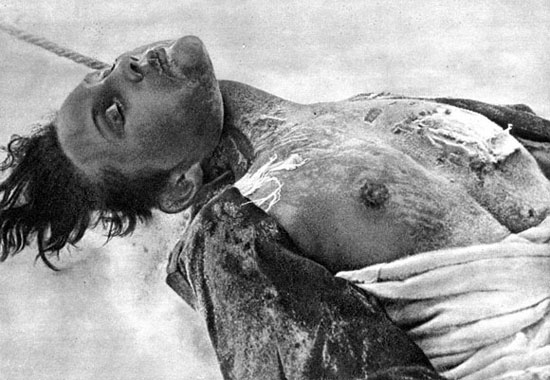
On this date in 1940, 25-year-old Wilhelm Kusserow was executed by firing squad at Münster Prison in Germany.

A Jehovah’s Witness, he interpreted God’s command “thou shalt not kill” literally and refused to serve in the German army — a big no-no in Hitler’s Third Reich.

Kusserow had actually been born Lutheran, but his parents became Jehovah’s Witnesses after World War I and raised their eleven children in the faith. Jehovah’s Witnesses, in addition to not serving in the army, also refused to Heil Hitler, since the tenets of their religion required them to make obeisance only to Jehovah.

They were persecuted by the Nazis from the beginning of Hitler’s regime, and by 1935 the religion was banned altogether. The Kusserows, and many others, continued to practice their faith in secret.

During the Nazi era, some 10,000 Jehovah’s Witnesses did time in prisons and concentration camps (where they were required to wear a purple triangle), Wilhelm’s parents and siblings among them. 2,500 to 5,000 died.

The children in Jehovah’s Witness families were taken from their parents and sent to orphanages, foster families or reform schools.

(French Witness Simone Arnold Liebster would write a memoir about the years she spent in institutions as a child because she and her parents refused to renounce their beliefs.)

At Wilhelm Kusserow’s trial, the judge and the prosecutor were apparently reluctant to condemn this young man. They pleaded with him to back down, promising to spare his life if he did so, but Wilhelm refused. Some things were more important to him than life itself.

In his final letter to his family he wrote,

Dear parents, brothers, and sisters:

All of you know how much you mean to me, and I am repeatedly reminded of this every time I look at our family photo. How harmonious things always were at home. Nevertheless, above all we must love God, as our Leader Jesus Christ commanded. If we stand up for him, he will reward us.

Hitler later decided the firing squad was too honorable a death for Jehovah’s Witnesses and ordered that they be decapitated instead. Wilhelm’s younger brother Wolfgang, who had also refused to serve in the army, was executed in this manner in 1942.

On this day..

1926: Shao Piaoping, journalist

On this date in 1928, Chinese journalist and social activist Shao Piaoping was shot at Beijing’s Tianqiao execution grounds — fulfillment of his lifelong motto, “To die as a journalist.”

The intrepid Shao blazed a trail for print media in his native country, bucking a prejudice that mere journalism was a bit on the declasse side.

He co-founded and edited Hanmin Daily in 1911, just in time to get his support for the Xinhai Revolution into newsprint.

But Shao was no propagandist, and, post-revolution, was repeatedly arrested for his scathing critiques of Yuan Shikai and the various other illiberal strongmen taking roost. He had to duck out to Japan twice during the 1910s; there, he kept cranking copy, now as a foreign correspondent for Shanghai’s top newspapers. As the decade unfolded, he also became a theoretician of journalism without abating his prodigious ongoing output.

“I saw my role as that of helpful critic and believed it wrong to praise petty people simply to avoid trouble,” this pdf biography quotes Shao saying of himself. “I was determined not to dispense with my responsibility.”

By the late 1910s, he was publishing his own capital-city newspaper, Jingbao (literally “The Capital”) and developing his academic thought as a teacher at Peking University. He was perhaps China’s premier journalist; even so, he still had to slip into exile in Japan in 1919 after openly supporting the May Fourth student movement.

Shao left an impressive mark on his students, perhaps none more so than a penniless young leftist working in the university library, Mao Zedong.

As a guerrilla, Mao — still at that time an obscurity to most of the outside world — remembered Shao fondly to journalist Edgar Snow. In contrast to many other Peking University scholars who gave the provincial twentysomething short shrift, Shao “helped me very much. He was a lecturer in the Journalism Society, a liberal, and a man of fervent idealism and fine character.” Word is that Shao even loaned Mao money.

Shao’s acid pen and unabashed sympathy for agitators led to his arrest in 1926 by the warlord Zhang Zuolin — whose wrath Shao incited by denouncing bitterly a horrific March 18 massacre of students.

But the martyr journalist’s heroic career — not to mention his accidental link with the future Great Helmsman — insured his elevation into the pantheon, even though Shao’s underground membership in the Communist party was not known for decades after his death. Mao personally declared him a hero of the revolution, and intervened to see that his widow and children were cared for. China has any number of public monuments in Shao’s honor.

On this day..

1998: 22 for the Rwanda genocide

On this date in 1998, 22 people were tied to wooden stakes in five different cities around Rwanda, then shot dead for their participation in the horrific 1994 Rwanda genocide.

Rwanda had, only shortly before, reversed a ban on public executions — clearly with this date’s spectacle in mind.

A Washington Post reporter described the scene in the capital city of Kigali, where 7,000 to 10,000 witnesses saw the three men and a woman put to death on Nyamirambo Stadium‘s red clay football pitch.

dressed in pale pink uniforms, under a sun that had just driven away a covering of gray clouds.

Four masked police officers leaped from a truck and sprinted to within feet of the black-square targets on the criminals’ chests.

As bullets from AK-47s shredded the prisoners, a sudden sharp silence descended on the crowd. Then a fifth marksman shot each prisoner in the head at point-blank range. Twice.

One man sprinted and danced when the shooting stopped. Women ululated.

A man named Andrew, 45, clapped lustily. “God is great!” he cried.

(Here’s another first-person account of the same execution.)

Among those dying before their eyes that day was the politician Froduald Karamira, once the vice president of the Rwandan Republican Democratic Movement and a prime mover in the 1994 genocide.

Although Karamira was actually born a Tutsi, he “converted” into a Hutu* and how. He established himself as a leading exponent of “Hutu Power” — the chilling banner under which upwards of a million Rwandans were slaughtered — and had control of two of the radio stations inciting Hutu death squads to their bloody work.

According to Hands Off Cain, these are the last executions ever carried out in Rwanda before it abolished the death penalty in 2007.

“Our experience in Rwanda has demonstrated that abolishing the death penalty gave new lease on life and this has contributed to the healing of our society,” said long-serving Rwanda President Paul Kagame, a Tutsi. “Rwandans have achieved a degree of unity and reconciliation, unimagina­ble just a decade and a half ago because a culture of forgiveness — not vengeance — has taken root.”

* Rwanda’s ethnic categories are notoriously artificial.

On this day..

1913: Bonnot Gang members, anarchist illegalists

A century ago today, Raymond Caillemin, Elie Monnier and André Soudy were guillotined in Paris for their exploits with Third Republic France’s most celebrated band of anarchist bank-robbers, the Bonnot Gang.

It was actually not Bonnot but Octave Garnier who was the original moving spirit for the gang, which took shape in 1911 around a core of anarchist adherents to the philosophy of illegalism — criminality as resistance. The outlaws were revolutionaries, vegetarians, working-class. Though respectable anarchist communists fled from them, the philosophy bit wasn’t a pose.

“It’s because I didn’t want to live this life of present-day society, because I didn’t want to wait and maybe die before I’d lived, that I defended myself against the oppressors with all the means at my disposal,” Garnier wrote in a memoir discovered after he was killed in a police shootout.

To Garnier the gang owed its signature innovation of using automobiles: they were the first ever to use this novel machine to flee the scene of a crime after knocking over a Paris bank in December 1911. Between their internal combustion engine and their repeating rifles, they had a decided technological advantage on the police who pursued them.

For obvious reasons they were initially dubbed the “Auto Bandits.” But Jules Bonnot stole the marquee by marching into the office of La Petit Parisien in January 1912 to indignantly correct some of its reporting. The newspaper gave him an interview, and started branding the outlaws the “Bonnot Gang” (La bande a Bonnot), a name which has stuck for posterity and titles a 1968 film about them.

And the “Bonnot Gang” moved plenty of papers.

For the next three months, they would repeatedly crash the headlines on either side of the French-Belgian border by stealing cars to perpetrate new robberies, often shooting policemen and bank tellers into the bargain.

Meanwhile, they magnetized admirers and enemies alike with their Gallic intrepidity and self-confessedly impossible struggle. Garnier mailed his fingerprints to the police chief. Ground-down proletarians fell into their orbit, cracking bitter fatalistic jokes. Under the pen name La Retif, a young writer extolled the masculine, doomed outlaws: he was the Russian expatriate Victor Serge, at the start of a long revolutionary career.*

To shoot, in full daylight, a miserable bank clerk proved that some men have at least understood the virtues of audacity.

I am not afraid to own up to it: I am with the bandits. I find their role a fine one; I see the Men in them. Besides them I see only fools and nonentities.

Whatever may result, I like those who struggle. Perhaps it will make you die younger, or force you to experience the man-hunt and the penal colony; perhaps you will end up beneath the foul kiss of the guillotine. That may be! I like those who accept the risk of a great struggle. It is manly.

Besides, one’s destiny, whether as victor or vanquished, isn’t it preferable to sullen resignation and the slow interminable agony of the proletarian who will die in retirement, a fool who has gained nothing out of life?

The bandit, he gambles. He has therefore a few chances of winning. And that is enough.

The bandits show strength.

The bandits show audacity.

The bandits show their firm desire to live.

By April and May the authorities were finally overcoming the audacious bandits, though desires to live showed firm to the last: both Bonnot and Garnier were overcome and killed only after holding off protracted sieges against overwhelming numbers.

Although the headline attractions were gone, the ensuing massive trial soon fitted four for death:

  • Raymond Callemin, Serge’s own friend and reading-companion since childhood
  • Elie Monier (or Monnier), the onetime refugee draft-dodger whose will grandiloquently bequeathed to the Paris library his copy of Darwin, and to the Paris museum the pistol he was arrested with, provided it be engraved with the phrase “Thou Shalt Not Kill”
  • The sickly Andre Soudy, reckless in his outlaw adventure since tuberculosis that he was too poor to fend off already had him coughing his way to an earl grave
  • The joiner Eugene Dieudonne, a friend and compatriot of the gang members but not an actual bank-robber himself. Dieudonne was reprieved on April 20th and dispatched instead to the French penal colony at Devil’s Island

Other prison sentences from a few years up to a lifetime at hard labor were meted out to various other Bonnot gang members and fellow-travelers, several of whom showed themselves dedicated enough to their heroic fatalism to take their own lives. One who attempted an escape only to find himself stymied when he attained the roof of the prison worked fellow-inmates into a frenzied chant of Viva l’anarchie as he hurled slate shingles at the guards who treed him, then wrapped up the performance by hurling himself off the roof, too.

“I would have liked to eat black bread with black hands,” that man’s last testament read. “But I was forced to eat white bread with red hands.”

* Serge got himself in some hot water as an anti-Stalinist in the Soviet Union. Serge’s mature (1945) appraisal of his youthful infatuation with the Bonnot gang, as well as his first-person recollections of the Bonnot gang trial (which got Serge himself a five-year sentence) can be read here

On this day..

1945: The children of Bullenhuser Damm

On this date in 1945, as Adolf Hitler celebrated his 56th birthday within a Red Army cordon, one of the Second World War’s more tear-jerking little crimes against humanity happened in Hamburg.

Bullenhuser Damm — still to be found today — was a former Hamburg school which fell out of use as World War II progressed, owing to the devastation Allied bombings wrought on the surrounding area.

The school itself sustained little damage, however, which eventually facilitated its appropriation as a satellite building for the nearby Neuengamme concentration camp.

Over at Neuengamme, the SS doctor Kurt Heissmeyer had been conducting a litany of horror medical experiments on 20 Jewish children — mostly from Poland — culled from the concentration camps, seeking medical evidence for Nazi racial theories further to a cushy professorship. But as April 1945 was obviously endgame for the Third Reich, thoughts naturally turned to disposing of evidence of indictable offenses.


Photos of the eventual Bullenhuser Damm victims showing their surgical scars after Heissmeyer injected them with tuberculosis.

Bullenhuser Damm was just the place for disposal.

On April 20, the 20 kids were loaded up on trucks with their four adult caretakers — two French, two Dutch — plus six Soviet prisoners of war.

At Bullenhuser Damm, the kids were parked in a room and hung out, blissfully ignorant of their danger. “They had all their things with them — some food, some toys they had made themselves, etc,” physician Alfred Trzebinski later recalled at his own trial. “They sat on the benches and were happy that they had gotten out. They didn’t suspect a thing.”

In the next room, the 10 adults were being hanged.

According to Admitting the Holocaust, Trzebinski was impressed with his own compassionate use of this bit of down time: he generously gave the children morphine shots to sedate them before their own executions. Or rather, their murders … since the doctor could not but agree that “you cannot execute children, you can only murder them.”

I must say that in general the children’s condition was very good, except for one twelve-year-old boy who was in bad shape; he therefore fell asleep very quickly. Six or eight of the children were still awake — the others were already sleeping … Frahm [an orderly] lifted the twelve-year-old boy and said to the others that he was taking him to bed. He took him to a room that was maybe six or eight yards away, and there I saw a rope already attached to a hook. Frahm put the sleeping boy into the noose and with all his weight pulled down on the body of the boy so that the noose would tighten. (Trzebinski, again)

The other 19 children were disposed of in like manner, and then all 30 corpses cremated overnight … just in time for what must have been a much-needed 5 a.m. coffee.

After the war, the facility went back to use as an actual (creepy!) school, but it was eventually renamed Janusz Korczak School, for a Polish-Jewish educator gassed with his young charges at Treblinka. There’s a permanent exhibition (German) at the site, as well as a memorial rose garden with a variety of plaques commemorating the victims of Bullenhuser Damm.

Trzebinski’s take on his conduct this horrible night might have been good enough for his conscience, but it didn’t pass muster with his judges: he was hanged on a war crimes rap prominently including Bullenhuser Damm on October 8, 1946. Kurt Heissmeyer, however, avoided detection until 1959 and only received a long prison sentence in 1966, shortly before his death.

On this day..

1928: Charles Birger, bootlegger

On this date in 1928, colorful gangster Charles Birger was hanged in Benton, Illinois.

A sort of social bandit for the Prohibition era, Birger was born Shachna Itzik Birger to a Russian Jewish family that immigrated to the U.S.

Birger was a young saloon-keeper on the make when the U.S. decided to make a go of its first foolish drug war, Prohibition. And in the immortal tradition of drug wars, it made the enterprising purveyor a whole lot richer, and a whole lot violent-er.

While Al Capone‘s Tommy Guns were tearing up Chicago, Birger set up shop in southern Illinois. A literal shop: from his famous speakeasy Shady Rest, he did three-way battle with the (pro-Prohibition) Ku Klux Klan and the rival Shelton Brothers Gang.

This cinematic affair of armored car shootouts, aerial bombings, and gangland assassinations comes off with verve in A Knight of Another Sort: Prohibition Days and Charlie Birger. The bon vivant Birger, bursting with charisma, entertains at his gin joint, aids the misfortunate, corrupts the police, and merrily mobs up Williamson County.

That story reached its conclusion when Birger was arrested for ordering the murder of Joe Adams, mayor of a nearby town who had taken the Shelton Gang’s armored “tank” car in for repairs.

Birger said he hadn’t actually done that, but he went to the gallows grinning, and humorously chatted up reporters before the big show — cementing his myth with that legend-quality indifference to death.

“I’ve played the game and lost, but I’ll lose like a man,” Birger philosophized. “I’m convicted of a crime I didn’t commit, but I’ve committed a lot of crimes. So I guess things are even. We got too strong against the law, and the law broke it all up.” (From the Chicago Tribune, April 20, 1928.)


Birger shakes hands with so-called “humanitarian hangman”
Phil Hanna.


Birger insisted on hanging in a black, not a white, hood — owing to his hatred of the Ku Klux Klan.

Birger is still a legend in southern Illinois, and a live one at that: he’s been in the news lately due to a weird custody fight over the rope used to hang him.

This macabre historical memento also happens to be the last rope ever used for any public execution in Illinois.

On this day..

1942: Vasily Klubkov, Zoya Kosmodemyanskaya’s betrayer

We’ve touched in these pages — one of our earliest posts, in fact — on Soviet war heroine Zoya Kosmodemyanskaya, a teenager executed by the advancing German army in November 1941 for conducting partisan attacks behind enemy lines.

Zoya’s story became known after the Red Army recaptured village of Petrishchevo, where she was hanged. A January 27, 1942 Pravda article recounted the gallows defiance of the young guerrilla, whom villagers knew only by her nom de guerre, “Tanya”. She had withstood German torture, refused to give them any information, and at her hanging incited her countrymen and -women to resist the invaders. She’s still to this day a beloved national martyr in Russia, which is why she’s also an Ace in our execution playing cards.

The young woman on the gallows, and in the ghastly post-mortem pictures with her left breast mutilated swiftly became propaganda grist for Moscow.

Zoya’s instant Joan of Arc-like legend invited investigation of the precise circumstances of her capture and death … and this in turn meant extremely dangerous scrutiny for any Soviet citizen in her environs whose behavior in those last days could be held to be in any way sub-heroic.

This brings us to today’s unfortunate entry, Vasily Klubkov, a humble mail-sorter before the war whose picture belongs in the dictionary next to “poor luckless sod.” Just him, Zoya, and everyone else on the terrible Eastern Front.

It was on this date* in 1942 that Klubkov paid the penalty for Zoya’s sacrifice.

Vasily Klubkov and Boris Krainov were other partisans who had been detailed along with Zoya Kosmodemyanskaya to torch some enemy assets on the same mission around Petrishchevo. Practically children all, they each acted independently from the others; long story short, Zoya and Vasily Klubkov were both captured.

Zoya fiercely endured every torture the Germans could throw at her, but Klubkov was made of softer stuff. When an officer pointed a gun at his head and demanded some answers, Klubkov started talking.

“I was a coward,” he later admitted. “I was scared I would be shot.”

Now, this admission very much against his own safety was made to the NKVD in March 1942, and since we already know that Vasily Klubkov was the sort to fold under torture, we can well imagine that the NKVD also got whatever it wanted out of the misfortunate young man. Considering the politicized quality of the trial and the circumstances of the “confession,” it has to be treated with caveats.

Under NKVD pressure, Klubkov signed off on a version of events that just so happened to mesh beautifully with the iconography already forming around the hanged “Tanya”: namely, that he was brought face-to-face with his fellow-prisoner and confirmed her identity, whereas she refused to breathe a word to her captors; that he saw her stripped naked and bashed with truncheons for hours and still summon the fortitude to refuse her interrogators the least satisfaction. Pavel Klubkov gave posterity firsthand evidence of Zoya Kosmodemyanskaya’s heroism in captivity.

“Klubkov may have been telling the truth, since it’s easy to imagine a terrified teenager on his first mission agreeing to his German captors’ demands,” notes Andrew Nagorski in The Greatest Battle: Stalin, Hitler, and the Desperate Struggle for Moscow That Changed the Course of World War II. “But there’s no way of knowing for sure how he really behaved, since he surely was just as terrified when he was interrogated by the NKVD. Or how much of what he said about Zoya was accurate, since the NKVD may already have been preparing the transcript with the idea of her elevation to mythic status.”

Heck, the reason the NKVD even had Klubkov to interrogate was that he escaped German custody, another big character red flag as far as the Soviets were concerned. That he escaped from the same custody that martyred Zoya Kosmodemyanskaya probably sealed his fate before he received his first pistol-whipping. NKVD records paint a kid who has already given up.

Well he might have. The verdict of the court was surely ordained from the start, but it was formally delivered on April 3: “Execution by shooting, without confiscation of property due to its absence.”

* Though there are some cites for April 3 out there, it appears that April 3 was the date of his conviction by a military tribunal and April 16 his execution date. This is a bit of a protracted delay by wartime Soviet tribunal standards, but then, Klubkov would have been a person of relevance to the state itself. The highest-ranking official who thought he could approve Klubkov’s execution without asking anyone else might have been a little further up the food chain than for your run-of-the-mill deserter.

On this day..

1921: Mailo Segura, a Montenegrin in Alaska

(Thanks to Meaghan Good of the Charley Project for the guest post. -ed.)

At noon on this day in 1921, Mailo Segura was hanged in Fairbanks, Alaska.

In 1918 he had murdered a miner, J.E. “George” Riley, near the gold rush town of Flat, in a dispute over money. His was the second execution in Fairbanks history.

George Riley was in charge of the mining operations along Orter Creek near Flat. Segura was a lumberjack and, together with some other men, had sold $300 worth of cordwood to Riley on credit.

In early 1918, Segura confronted Riley with the bill and demanded to be paid. By then, the bill had been outstanding for two years. Riley, however, refused to pay. He said he wasn’t going to hand over any money until Segura either brought his wood-chopping partners along with him to collect the sum in person, or brought a statement from his partners authorizing Segura to take the full amount.

As witnesses at his trial later testified, Segura was furious with Riley and said he would kill him if Riley didn’t give him the $300. On March 2, he withdrew his life savings of $1,800 from his bank account and later that day went looking for the deadbeat.

Segura found his quarry at the mining claim and waited patiently, assisting with the mining work so he wouldn’t look suspicious.

When all the other miners had gone inside the boiler house, Segura shot Riley in the back without warning. The miners heard the shots — there were three, any one of which would have been fatal — and ran outside to find their employer lying stone dead on the ground and Segura running away.

It didn’t take much effort to catch him. Once he was surrounded, Segura raised his hands in surrender and shouted, “Me no kill no more.”

Seeing as how Mailo Segura had repeatedly threatened Riley’s life and then shot the unarmed man from behind, his claim of self-defense didn’t go very far at his trial. He was convicted of first-degree murder on July 18 and was supposed to be hanged on October 8, but Segura put his $1,800 life savings to use filing appeals, and thereby prolonged his life by three years.

When his time came, he was terrified and unable to walk to his death. The authorities had to strap him to a board to keep him upright while they fastened the noose around his neck.

A matter of minor interest: Mailo Segura hailed from halfway around the world in the tiny Balkan kingdom of Montenegro; he might be the only Montenegrin ever executed in North America. (Montenegrins were then and still are today a sizable minority in Alaska.) In spite of his European descent, in trial documents he was referred to as “black,” and possible racial prejudice on the part of the jury was an issue in his appeals.

On this day..

1950: Eugene LaMoore, the last hanged in Alaska

Thanks to Melissa S. Green for giving Executed Today permission to reprint this summary of Alaska’s last execution. It appeared as a section of Green’s longer history of the death penalty in the state, first published here.

For the first (proper, juridical) execution in Alaska, see here. -ed.


Austin Nelson and Eugene LaMoore, both black, were separately convicted and executed for the same crime, the December 1946 murder of a 52-year-old (white) Juneau storekeeper named Jim Ellen. Ellen’s store had also been robbed. Ellen had immigrated to the U.S. from Greece as a boy in 1909. He was a World War I veteran who held memberships in the American Legion and the Juneau Elks Lodge.

Austin Nelson, a 24-year-old who did odd jobs around Juneau, was arrested for the murder after a check written by him to Jim Ellen was found on the store counter following the robbery/murder. He was represented at trial by Henry Roden and Joseph A. McLean. Nelson was convicted on circumstantial evidence, including that of a witness who reported seeing him in the victim’s store on the night of the murder. No one witnessed the actual murder, nor was a murder weapon found, not even the straight-edged razor witnesses testified that Nelson had once owned. Nelson lacked money to pay for an appeal and there was no provision for a public attorney in post-conviction proceedings, His execution was set for July 1, 1947.

Eugene LaMoore, a 42-year-old fisherman with a Tlingit wife and two children, was originally an alibi witness at Nelson’s trial. He testified that he had spent much of the evening with Nelson on the night of the murder, including along the avenue where the victim’s store was located. LaMoore’s credibility with the jury was apparently eroded when he initially denied a felony robbery conviction of twenty years before. Although LaMoore returned to the stand the following day to correct his testimony, he was arrested by U.S. Marshal William Mahoney on a charge of perjury and held on a bond of $10,000 — a high bond in 1947 — which LaMoore could not pay. He was held in a cell in the federal jail, shackled in leg irons and, later, in a ball and chain. He was repeatedly questioned by the local FBI agent and other local law enforcement authorities about the murder of Jim Ellen. Shortly before Nelson’s scheduled execution, Nelson was brought to visit LaMoore in his cell. According to later testimony by LaMoore, Nelson pled with LaMoore to help save his life.

On July 1, 1947, the date of Nelson’s scheduled execution, LaMoore signed a typed confession stating that he had participated in a robbery of Jim Ellen’s store with Austin Nelson and that Nelson had killed Ellen during the robbery.

LaMoore was charged with first degree murder. Nelson’s execution was delayed because he was now considered a material witness against LaMoore.

LaMoore was represented at trial by Henry Roden and Joseph A. McLean, the same court-appointed attorneys who had represented Nelson. The only significant evidence offered at trial to suggest LaMoore’s involvement in the murder was the typed confession he had signed while in jail. At trial, LaMoore retracted the confession, stating it had been made on the advice of a prominent Juneau attorney, Herbert W. Faulkner, who had been persuaded by Deputy Marshal Walter Hellan to come and talk with him (LaMoore had had no lawyer at the time).

LaMoore testified that Faulkner agreed to advise him, though Faulkner denied having done anything except typing up what LaMoore wanted to say in the confession. LaMoore also stated that the confession had been prompted by a desire — especially after Nelson’s visit to his cell — to delay Nelson’s execution. Despite his retraction and the lack of other significant evidence, LaMoore was convicted by the jury and sentenced to death.

Nelson, who had been kept alive during LaMoore’s trial but was never called to testify, was executed on March 1, 1948, a month after LaMoore’s trial ended. LaMoore was executed on April 14, 1950 after an unsuccessful appeal. He reportedly took 13 minutes to die.

His was the last execution to be held in Alaska.

Sources:

Lerman, Averil. (1994). “Death’s double standard: Territorial Alaska’s experience with capital punishment showed race and money mattered.” We Alaskans [Sunday magazine of the Anchorage Daily News], May 1, 1994.

Lerman, Averill. (1998). “Capital Punishment in Territorial Alaska: The Last Three Executions.” Frame of Reference [Alaska Humanities Forum] 9(1): 6-9, 16-19, April 1998.

On this day..

1942: Four Jews from Bedzin and Sosnowiec

(Thanks to Meaghan Good of the Charley Project for the guest post. -ed.)

On this date in 1942, two Jewish men were hanged in the city of Sosnowiec (pronounced sos-no-vitz) in Nazi-occupied Poland, and two more were hanged in the nearby city of Bedzin (pronounced ben-jin).

These executions were witnessed by thousands of people and carefully choreographed, as historian Mary Fulbrook records in her book A Small Town Near Auschwitz:*

The hangings in Bedzin and Sosnowiec had been orchestrated in advance, in meticulous detail, by the Police President in Sosnowiec. The execution in Bedzin was to take place one hour later than the one in Sosnowiec. As much thought was given by the police authorities to questions of security and seating arrangements as might be appropriate for a modern open-air musical concert: this was not to be a simple punishment for an individual offense, as had happened innumerable times, but rather a mass spectacle, intended to have a major impact on the audience…

The identities of the executed Jews in Bedzin have been lost to history. (Correction: Per Yad Vashem, they were Jehuda Warman and “Feffer” (no first name).) They were hanged at the old Jewish cemetery on the corner of Zawale Street, before a crowd of about 5,000, at 5:00 p.m. Jewish workers in the Bedzin Ghetto had their work identity cards confiscated that day and were let out of work early, at 4:00 p.m., and ordered to watch the hangings. Only after they witnessed the executions did they get their work cards back. The bodies remained hanging on the scaffold until 7:30 p.m.

The condemned men in Sosnowiec were 30-year-old Mayer Kohn and his father, Nachun or Nahum.

Nachun (left, with wife) and Mayer.

They’d been caught trading on the black market, probably trying to feed their families, as no one could live long on the official rations. But as Fulbrook points out, the actual offense didn’t matter much to the Nazis:

These coordinated public spectacles of mass hangings do not seem … to have been in direct response to a particular crime; it seems there was a policy of ‘any Jew will do’, although infringements of German rules (including not only black market dealings but also very trivial ‘offenses’) were adduced as the ostensible ‘reason’ for these executions.

Thousands of people, both Jews and Germans, watched Mayer and Nachun Kohn die, then quietly went home.

Although virtually the entire Kohn family perished at the hands of the Nazis, Mayer and Nachun Kohn can claim a bit of immortality by virtue of being mentioned in Maus, Art Spiegelman’s famous graphic novel about the Holocaust: the author’s father, Vladek, hailed from Sosnowiec.

* The author of A Small Town Near Auschwitz is interviewed in this New Books In History podcast.

On this day..