1525: Cuauhtémoc, the last Aztec emperor

Although the primary accounts — those by conquistadors Hernán Cortés and Bernal Díaz del Castillo, and historian Francisco Lopez de Gomara* — did not explicitly record the date, February 28 is the traditionally recognized anniversary of the execution of the last Aztec emperor, Cuauhtémoc.

A monument to Cuauhtemoc in Mexico City. (Author’s photo; public domain)

Cuauhtemoc (English Wikipedia entry | Spanish) was enthroned early in 1521, in a Tenochtitlan already in the train of devastation brought by the Spanish, which had over the preceding months laid low the Emperor Moctezuma II (by violence) and his brother Cuitlahuac (by smallpox, a disease that halved the city’s population within a year).

He was about 23 or 24 years old, a nobleman who must have distinguished himself in war — “a handsome man, both as regards his countenance and his figure,” in Bernal Diaz’s estimation; “a valiant man and a good warrior” by Gomara’s account.

And it would fall to him to bear his proud kingdom’s ruin.

Having previously been welcomed to Tenochtitlan as guests, Cortes and the Spanish had fought their way out and now returned as besiegers, joined by most of the Aztecs’ resentful former subject kingdoms. They soon had Tenochtitlan in a stranglehold, undaunted by the frightening sacrifice of captured prisoners.

all in a moment the large drum of Huitzilopochtli again resounded from the summit of the temple, accompanied by all the hellish music of shell trumpets, horns, and other instruments. The sound was truly dismal and terrifying, but still more agonizing was all this to us when we looked up and beheld how the Mexicans were mercilessly sacrificing to their idols our unfortunate companions, who had been captured in Cortes’ flight across the opening.

We could plainly see the platform, with the chapel in which those cursed idols stood; how the Mexicans had adorned the heads of the Spaniards with feathers, and compelled their victims to dance round the god Huitzilopochtli; we saw how they stretched them out at full length on a large stone, ripped open their breasts with flint knives, tore out the palpitating heart, and offered it to their idols. Alas! we were forced to be spectators of all this, and how they then seized hold of the dead bodies by the legs and threw them headlong down the steps of the temple, at the bottom of which other executioners stood ready to receive them, who severed the arms, legs, and heads from the bodies, drew the skin off the faces, which were tanned with the beards still adhering to them, and produced as spectacles of mockery and derision at their feasts ; the legs, arms, and other parts of the body being cut up and devoured!

In this way the Mexicans served all the Spaniards they took prisoners; and the entrails alone were thrown to the tigers, lions, otters, and serpents, which were kept in cages. These abominable barbarities we were forced to witness with our own eyes from our very camp; and the reader may easily imagine our feelings, how excessively agonizing! the more so as we were so near our unfortunate companions without being able to assist them. Every one of us thanked God from the bottom of his soul for His great mercy in having rescued us from such a horrible death!

Bernal Diaz

Wracked by famine after Cortes successfully cut off its food and water, Tenochtitlan succumbed that August. (The conquistadors found they could barely endure the stench of countless rotting bodies as they took control of the famished city.) When captured, Cuauhtemoc implored Cortes through tears (again according to Bernal Diaz),

I have done what I was bound to do in the defence of my metropolis, and of my subjects. My resources have now become entirely exhausted. I have succumbed to superior power, and stand a prisoner before you. Now draw the dagger which hangs at your belt, and plunge it into my bosom.

There would be no bosom-daggering. Cortes had a much worse fate in mind.

He saluted Cuauhtemoc for his intrepidity in defense, vowing to maintain the latter as the ruler of Mexico … Cortes’s ruler, to ratify the dictates of the conquerors, beginning with commanding his remaining loyalists to surrender. Cuauhtemoc obeyed, with what posterity can only guess must have been fathomless shame and sorrow.

Upon humiliation, Cortes heaped physical torture when the invaders’ ransack of their captured city turned up far less lesser quantities of material loot than they had anticipated — torture which Cuauhtemoc and a cousin-king of a loyal Aztec ally both endured heroically without augmenting the Spanish bottom line. Bernal Diaz once again:

The next thing which Cortes did was to collect all the gold, silver, and jewels that had been found in Mexico, of which, however, there was very little; for Quauhtemoctzin, it was said, had ordered all the treasures to be thrown into the lake four days previous to his capture. A great quantity had likewise been purloined by the Tlascallans, Tezcucans, Huexotzincans, Cholullans, and other auxiliary troops which had assisted us in the siege, besides what had fallen into the hands of the troops on board the brigantines.

The crown officials were positive that Quauhtemoctzin had concealed the greater part, and asserted that Cortes was very pleased that the monarch refused to say a word where it was hidden; for he would then be able to get the whole treasure into his own possession.

The officers then proposed that Quauhtemoctzin and the king of Tlacupa, his most intimate friend and cousin, should be put to the torture, in order to extort from them a confession as to what had become of the treasures: but Cortes could not make up his mind to insult so great a monarch as Quauhtemoctzin, whose territory more than trebled that of Spain, and that for mere lust after gold. Moreover, the monarch’s household assured us they had given up all the gold they possessed to the officers of the crown, which, it was well known, amounted to 380,000 pesos, the whole of which had been melted into bars; and one thing is certain, that the emperor’s and Cortes’ fifths were deducted from that sum; but the conquistadores were not at all satisfied, and considered this sum much below the real amount, and several expressed their suspicion to Alderete, the royal treasurer, that Cortes’ only reason for not wishing to put the monarch to the torture was, that he might secretly take possession of all his riches. Cortes, not willing that such a suspicion should any longer he upon him, or that he should afterwards be called to an account on this score, at last consented that both should be put to the torture.
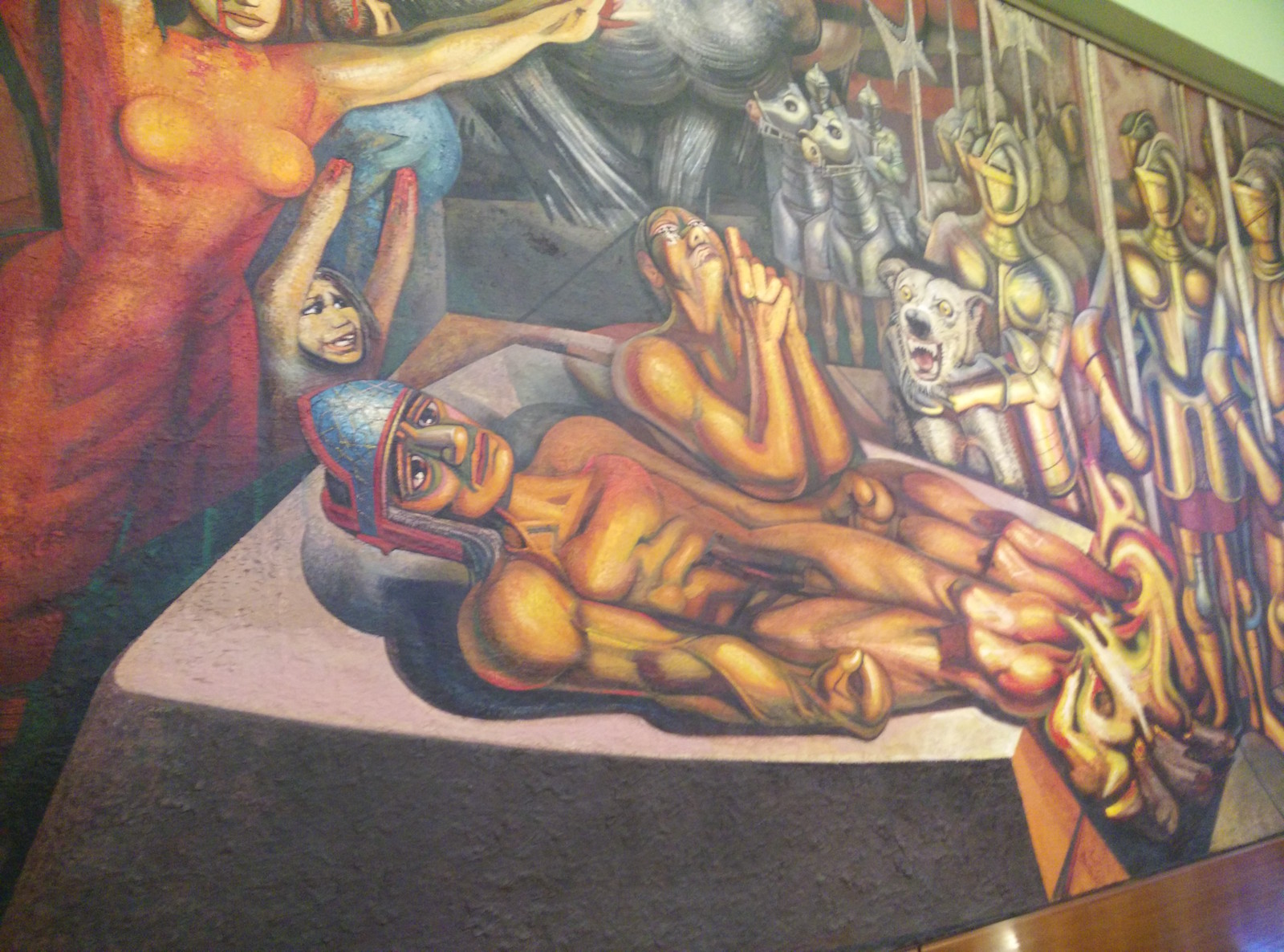

Detail view (click for the full image) of David Alfaro Siquieros‘s monumental 1950-51 mural, The Torment of Cuauhtemoc.

Boiling hot oil was then applied to their feet; upon which they confessed that, four days prior to Quauhtemoctzin’s capture, all the gold, with the cannon, crossbows, and muskets, which we had lost in the night of sorrows, when we retreated from Mexico, besides those which had been taken in Cortes’ last defeat on the causeway, had been thrown into the lake. A number of good swimmers were then sent to dive for the treasure in the spot they pointed out, but nothing was found. Yet there was some truth in the statement; for I was myself present when Quauhtemoctzin led us to a large and deep reservoir of water, built of stone, which lay near his palace. From this reservoir we fished up a sun of gold similar to the one sent us by Motecusuma, besides many jewels and other trinkets, though all of little value. The king of Tlacupa also informed us that he had hidden all manner of valuable things in some large houses, about twelve miles from Tlacupa, and he would accompany us there to point out the spot where he had buried them.

Alvarado was then despatched thither with six soldiers, among which number I also was; but when we arrived at the spot, this king assured us he had merely invented all this in the hopes that we would have killed him in a moment of anger at our disappointment.

(Diaz later added that “the suspicion was become pretty general that he [Cortes] had concealed the greater part of Quauhtemoctzin’s treasure,” and indeed some disgruntled companions — unsatisfied with the share they had been allotted for so magnificent a conquest — would come to lodge this charge against Cortes formally with Emperor Charles V.)

Cortes eventually brought both these hostages/puppet kings/torture victims along with him on a 1524-1525 expedition to Honduras, perhaps to deprive them of any opportunity to rebel in his absence.

On the evening of February 27, Cortes received a report or a rumor that the Indian kings had rebellion on their mind just the same. The timetable from this report to execution is uncertain from the records, but if it was not within 24 hours it cannot have been much longer. Diaz, a hostile-to-Cortes witness here whose narrative indicates his dismay at proceedings, describes it thus:

I have now to relate a circumstance of a very different nature, which occasioned much grief to us all. Quauhtemoctzin and other Mexican chiefs who accompanied our army had, it would appear, spoken among themselves, or secretly determined to put the whole of us to death, then march back to Mexico, and assemble the whole armed power of the country against the few remaining Spaniards, and raise an insurrection throughout the whole of New Spain. This circumstance was discovered to Cortes by two distinguished Mexican chiefs, one of whom was named Tapia, and the other Juan Velasquez. This latter personage had been Quauhtemoctzin’s captain-general during our war with Mexico, and his testimony was borne out by the investigation which Cortes made into the matter, and by the confession of several of the caziques themselves who were implicated in the conspiracy. These men fearlessly declared, that seeing how carelessly and dispiritedly we roamed about; that numbers of the men were ill from want of food; that four of our musicians, with the buffoon and five soldiers, had died of hunger; and that three other men had turned back, more willing to run the risk of reaching Mexico again than of moving forward, the thought struck them that they could not do better than fall suddenly upon us while we were crossing some river or marsh, particularly as they were upwards of 3000 in number, all armed with lances, and several of them with swords. Quauhtemoctzin did not hesitate to acknowledge that these men had spoken the truth, but added that the conspiracy did not emanate with him, and that he himself had never for a moment contemplated carrying it into effect, but had merely spoken about it with the other caziques. All the cazique of Tlacupa confessed was, his having declared to Quauhtemoctzin that it was better to die at once than daily to have death before their eyes on these fatiguing marches, and see their countrymen and relations perish with hunger.

These were sufficient proofs for Cortes, and without any further ceremony he sentenced Quauhtemoctzin and his cousin the king of Tlacupa to the gallows. Before, however, this sentence was executed, the Franciscan monks, with the assistance of Dona Marina, strove to comfort these unfortunate men, and commended their souls to God. When they were being led to the place of execution, Quauhtemoctzin turned to Cortes, and said: “Oh Malinche! I have for a long time perceived, from your false words, that you had destined me for such a death, because I did not lay violent hands on myself when you entered my city of Mexico! Why are you thus going to put me unjustly to death? God will one time ask this of you!”

The king of Tlacupa said, he could only rejoice in a death which he would be permitted to suffer with his monarch Quauhtemoctzin.

Previous to their being hung, both these unhappy caziques confessed to father Juan, who understood the Mexican language, and they begged of him to commend their souls to God. For Indians they were good Christians, and they died in the true faith, and fully believed in our holy religion.

The death of these two monarchs grieved me excessively, for I had known them in all their glory, and on our march they honoured me with their friendship, and showed me many little attentions; for instance, they would often order their servants to go in quest of fodder for my horse; besides which, they were innocent of the guilt imputed to them, and it was the opinion of all who accompanied this expedition that they were put to death unjustly.

But I will leave this miserable subject, and return to our march, on which we henceforth observed the utmost vigilance, for we greatly feared the Mexicans might rise up in arms against us, after they had thus beheld their monarch ignominiously hung by the neck from a tree. But hunger, fatigue, and sickness weighed heavier upon their minds than the misfortune of Quauhtemoctzin.


Detail view (click for the full image) of the “rebel” kings hanged from a tree.

Gomara and, of course, Cortes characterize the accusations against the Indian kings as true and the proceedings against them lawful. From the footnotes in this same Bernal Diaz volume, we have this from the later Jesuit historian and ethnographer Juan de Torquemada, who was fluent in Nahuatl:

I find it differently represented in a history written in the Mexican language, and which I believe to be perfectly correct. While Cortes (the Mexican author says) was quartered in a certain township, the Mexican chiefs one evening began to discourse among themselves about the recent hardships they had suffered, and Cohuanacotzin said to Quauhtemoctzin, to Tetlepanquetzaltzin, and to other distinguished Mexicans, ‘Thus you see, gentlemen, from kings we are become slaves, and we suffer ourselves to be led about by Cortes and this handful of Christians. If we were other people than we are, and would break through the promise we have made these Spaniards, we could play them a pretty trick here, and revenge ourselves upon them for all they have done to us, and the ill-treatment my cousin Quauhtemoctzin has suffered at their hands.’ To this the Mexican monarch replied, ‘I beg of you Cohuanacotzin to drop this subject, lest some one should overhear us, and imagine we were in earnest.’ It appears (continues Torquemada) that they were indeed overheard, for the whole of this discourse was reported to Cortes by a low-minded Mexican of the lower classes.

By law, Mexican flags fly at half-staff in his honor on February 28.

* These texts are cited throughout the post, but for ease of reference … Bernal Diaz: Memoirs of the Conquistador Bernal Diaz del Castillo, vol. 1, vol. 2 | Gomara: The Pleasant Historie of the Conquest of the West India; now called New Spaine | Cortes: History of New Spain, which is a Spanish text as I could not locate an English translation. However, even the Anglophone is liable to appreciate (from p. 225) the illustrations of Indian material culture observed by the Spaniards.

On this day..

1794: The Comte de Feuillide, Jane Austen in-law

To Madame la Comtesse de Feuillide this novel is inscribed by her obliged humble servant The Author.

-Jane Austen’s author’s dedication in Love and Freindship

On this date in 1794, the guillotine brought tragedy to Jane Austen’s family.

The blade’s more immediate victim was Jean Gabriel Capotte, the Comte de Feuillide and the husband of Eliza de Feuillide (nee Hancock), Jane Austen’s “outlandish cousin.”

Fourteen years the novelist’s senior, Eliza was born in India to Jane’s Aunt Philadelphia who went abroad seeking a mercenary marriage and landed an unhappy one to a surgeon twice her age, Tysoe Saul Hancock. Eliza Hancock might possibly have been the illegitimate daughter of colonial administrator Warren Hastings, who stoked rumors by establishing a trust for the young woman. (Eliza also later named her only son “Hastings”.)

Either way, she didn’t grow up in the colonies but in England and France, where her vivacity conquered the heart of a prosperous French officer on the make, a barrister’s son who self-aggrandized his rank of Comte de Feuillide. As a gadabout exile “French countess” during the French Revolution, the charming Eliza de Feuillide was a hit both with London society and with her debutante cousin Jane, “whose kind partiality to me” Eliza would write in a letter “indeed requires a return of the same nature.”

Eliza exerted a magnetic influence on her kinswoman, and she’s popularly suspected to be the model for the Mansfield Park character Mary Crawford.* There’s even a book theorizing that this peripatetic polyglot was the true author of Jane Austen’s canon.


Lucy Cohu as Eliza de Feuillide makes some guillotine banter in Becoming Jane.

Back in France, where he served in the army, the hubby with an emigre wife and an aristocratic pretension made a decidedly poorer impression upon the Jacobins, as Maggie Lane observes in Jane Austen’s Family:

On 22 February 1794 the Comte de Feuillide fell victim to the guillotine. He had foolishly, if gallantly, tried to bribe one of the Secretaries of the Committee of Safety to secure the liberty of the widow of an army colleague, Jacques Marboeuf, Marquis and Marechal-de-camp. The fifty-five-year-old Marquise stood accused of laying down certain arable lands on her estate to fodder crops, with the idea of producing a famine in an effort to undermine the Republic.

De Feuillide was double-crossed by the Secretary and arrested at his lodging in the rue Grenelle et St Honore, where incriminating documents and sums of money parcelled up for the bribery were seized. The Marquise, the Comte and the Marquise’s man of business who had acted as a go-between in the attempt, all were sentenced to death.

After a few years as a merry widow, Eliza wed her cousin Henry Austen — Jane’s brother and Eliza’s “perpetual sunshine”. Eliza Austen died in 1813, with Jane Austen at her bedside.

* In Jane Austen and the French Revolution, Warren Roberts argues that the Comte de Feuillide has his own literary doppelganger in the unfinished Austen novel Catherine, in the form of Edward Stanley.

On this day..

1974: Khosrow Golsorkhi and Keramat Daneshian, Iranian revolutionaries

Death is our most modest gift to the people. Each death is a small window closing on nihilism. And each death is a panel of mystery closing on lies, corruption, poverty, and hunger. Thus, a window will open that lets in the light of life. Let us sacrifice our life for this light — this light.

[Signed,]
People’s Fadaee, Keramat Daneshian
February 8, 1974

Khosrow Gol(e)sorkhi* and Keramat Daneshian, poets and revolutionaries, were shot on this date in 1974 by the Shah of Iran.

Stock of a provincial family with ties to the Communist Tudeh party, Golsorkhi — much the more famous of the two — became a noted writer of radical prose and poetry in the 1960s and 1970s.

Their defiance — Golsorkhi’s especially — of a military court trying them on a trumped-up charge of attempting to kidnap Shah Mohammad Reza Pahlavi‘s son made them Che Guevara-like figures for young Iranian leftists of the time.**

Badly misreading the direction of the wind, the Shah televised their prosecution as a show trial — and the poets used the platform to completely upstage not only their judges but the rotting monarchy they were there to uphold. Farsi speakers can enjoy Golsorkhi on video —

— while this version has English subtitles:

“Equality”
by Khosrow Golsorkhi
(translated by Sherry Laici)

The teacher was shouting at the board.
He flushed angrily
and his hands were covered with chalk dust.
The students in the last row of seats were eating fruits and making noises;
on the other side of the class a student was flipping through a magazine.
None of the students were paying attention
because the teacher was shouting and pointing to the algebraic equations.

The teacher wrote on the blackboard, which reminded us of darkness and cruelty,
1=1
one is equal to one.

One of the students rose
(always one must rise)
and said softly,
“The equation is a blunder.”

The teacher was shocked
and the student asked,
“If one human being was one unit
Does one equal one, still?”
It was a difficult question and the students were silent.
The teacher shouted,
“Yes, it is equal!”

The student laughed,
“If one human being was one unit,
the one who had power and money would be greater than the poor one
who had nothing but a kind heart.
If one human being was one unit,
the one who was white would be greater than the one who was black.
If one human being was one unit,
equality would be ruined.
If one were equal to one
how would it be possible for the rich to get richer?
Or who would build China’s wall?
If one were equal to one,
who would die of poverty?
or who would die of lashing?
If one were equal to one,
who would imprison the liberals?”

The teacher cried:
“Please write in your notebooks
one is not equal to one.”

Abdy Javadzadeh notes in Iranian Irony: Marxists Becoming Muslim that Golsorkhi’s lyrical self-vindication — one could hardly call it a “defense” addressed to the parameters of a court that he openly scorned — “spoke volumes on how Marxism developed within the Iranian opposition,” marrying the language of revolution with that of Islam.

“Life is nothing but a struggle for your belief.”

I will begin my talk with a quotation from Hussein, the great martyr of the people of the Middle East. I, a Marxist-Leninist, have found, for the first time, social justice in the school of Islam and then reached socialism. In this court, I am not bargaining for my life or even my life span. I am but a drop in the great struggle of the Iranian people … I am not bargaining for my life, because I am the child of a fighting people.

The real Islam in Iran has always played its part in liberation movements … When Marx says, in a class society, wealth is accumulated on one side and poverty, hunger, and misery on the other, whilst the producer of wealth is the poor, and Ali says, a castle will not be built unless thousands become poor, we cannot deny that there are great similarities. This is the juncture of history in which we can claim Ali to be the world’s first socialist … and we too approve of such Islam, the Islam of Hussein.

Golsorkhi also scored points by dunking on the military brass sitting in judgment — shooting back at the chief judge when admonished to stay on topic, “Don’t you give me any orders. Go and order your corporals and squadron leaders.”

The more you attack me the more I pride myself, for the further I am from you the closer I am to the people. The more your hatred for my beliefs, the stronger the kindness and support of the people. Even if you bury me — and you certainly will — people will make flags and songs from my corpse.

For his part, Daneshian kept to a more straightforward secular-revolutionary tone.

Millions of people in the armed forces, without having an active role in society or production, are busy in a useless game … such force has no other purpose than the suppression of people’s voice of liberation. The shootings of farmers, peasants, and people’s fighters are their principle duty … Liberated people, social movements on their way to liberation, reverberates the news of shedding poverty, corruption and injustice in the world.

Three others condemned with them were not so eager as our principals to embrace revolutionary martyrdom, and bent the knee to the Shah in exchange for their lives.

* The name “Golsorkhi” means “rose bush”. According to Iranian cleric Mohammad-Ali Abtahi — popularly known as the “blogging mullah” — the censors at the time proceeded to suppress a forthcoming children’s book with the entirely coincidental title We Wake the Rose Bush as potentially Golsorkhi-sympathetic. “In a country where a colonel is running the cultural section, how can you answer such reasoning?”

** The Che analogy was drawn by Hooman Majd in The Ayatollah Begs To Differ: The Paradox of Modern Iran, noting that “his bravery … only served to make him a hero and a symbol of the Shah’s merciless dictatorship.”

On this day..

1806: Cesar Herbaux, Vidocq’s path not taken

French criminal turned seminal criminologist Eugene Francois Vidocq on this date in 1806 witnessed the fate he might have shared when his former underworld collaborator went under the guillotine at Paris for murder.

The son of an Arras baker, the young Vidocq (English Wikipedia entry | French) presented as an incipient Villonesque picaro. He had the first of his many theft-and-arrest events at the tender age of 13 courtesy of his father who summoned the gendarmes when he stole the family silver. Nothing daunted, Vidocq robbed the house again a few months later and ran away to join troupes of itinerant entertainers, soon transitioning into the French Revolution’s new citizen-army where the rogue by turns impressed with his competence and deserted ahead of some scandal, equally prolific in affairs of honor (he was an expert fencer) and those of the heart (same).

While in prison for his latest misadventures in 1795-1796 he fell in with another inmate — our day’s principal, César Herbaux or Herbault — and forged a pardon order for one of their fellows. Vidocq, as we shall see, would always blame the others for inducing him (their story was the reverse). In either event, for their trouble they caught a sentence that was cruel even though “galleys” by this time just meant prison hulks.

The tribunal … sentences Francois Vidocq and Cesar Herbaux to the punishment of the galleys for eight years …

[And] the said Francois Vidocq and Cesar Herbaux shall be exposed for six hours on a scaffold, which whall be for that purpose erected on the public square of this commune.

The sentence Vidocq himself published in his ghost-written memoirs, where the later, respectable man would situate it in the midst of his life’s chrysalis.

Vidocq did not serve his sentence; he escaped custody and lived the first decade of the 19th century on his society’s periphery, under a succession of aliases and with a succession of lovers, the episodes punctuated by re-arrests and re-escapes. In one close escape, Vidocq was lodging in Melun as “a travelling seller of fashionable commodities” when ill rumors induced him to flee for the capital. Resuming his memoir …

I learnt … from the landlord of the inn at which I had put up, that the commissary of police had testified some regret at not having examined my papers; but what was deferred was not ended, and that at my next visit, he meant to pay me a visit. The information surprised me, for I must consequently have been in some way an object of suspicion. To go on might lead to danger, and I therefore returned to Paris, resolving not to make any other journeys, unless I could render less unfavourable the chances which combined against me.

Having started very early, I reached the faubourg Saint Marceau in good time; and at my entrance, I heard the hawkers bawling out, “that two well-known persons are to be executed to-day at the Place de Greve.” I listened, and fancied I distinguished the name of Herbaux. Herbaux, the author of the forgery which caused all my misfortunes? I listened with more attention, but with an involuntary shudder; and this time the crier, to whom I had approached, repeated the sentence with these additions:

Here is the sentence of the criminal tribunal of the department of the Seine, which condemns to death the said Armand Saint Leger, an old sailor, born at Bayonne, and Cesar Herbaux, a freed galley-slave, born at Lille, accused and convicted of murder.

I could doubt no longer; the wretch who had heaped so much misery on my head was about to suffer on the scaffold. Shall I confess that I felt a sentiment of joy, and yet I trembled? … It will not excite wonder, when I say that I ran with haste to the palace of justice to assure myself of the truth; it was not mid-day, and I had great trouble in reaching the grating, near which I fixed myself, waiting for the fatal moment.

At last four o’clock struck, and the wicket opened. A man appeared first on the stage. It was Herbaux. His face was covered with a deadly paleness, whilst he affected a firmness which the convulsive workings of his featured belied. He pretended to talk to his companion, who was already incapacitated from hearing him. At the signal of departure, Herbaux, with a countenance into which he infused all the audacity he could force, gazed round on the crow, and his eye met mine. He started, and the blood rushed to his face. The procession passed on, and I remained as motionless as the bronze railings on which I was leaning; and I should probably have remained longer, if an inspector of the palace had not desired me to come away. Twenty minutes afterwards, a car, laden with a red basket, and escorted by the gendarme, was hurried over the Pont-au-Change, going towards the burial ground allotted for felons. Then, with an oppressed feeling at my heart, I went away, and regained my lodgings, full of sorrowful reflections.

I have since learnt, that during his detention at the Bicetre, Herbaux had expressed his regret at having been instrumental in getting me condemned, when innocent. The crime which had brought this wretch to the scaffold was a murder committed, in company with Saint Leger, on a lady of the Place Dauphine. These two villains had obtained access to their victim under pretence of giving her tidings of her son, whom they said they had seen in the army.

Although, in fact Herbaux’s execution could not have any direct influence over my situation, yet it alarmed me, and I was horror-struck at feeling that I had ever been in contact with such brigands, destined to the executioner’s arm: my remembrance revealed me to myself, and I blushed, as it were, in my own face. I sought to lose the recollection, and to lay down an impassable line of demarcation between the past and the present; for I saw but too plainly, that the future was dependent on the past; and I was the more wretched, as a police, who have not always due powers of discernment, would not permit me to forget myself. I saw myself again on the point of being snared like a deer.

Forever abroad on a false passport, watching over his shoulder for the next inquisitive policeman, the next chance encounter with a bygone criminal acquaintance, Vidocq was in his early thirties now and aching to go straight lest he follow Herbaux’s path to the guillotine. At last in 1809 he was able to find the perfect port of entry for a man of his underworld expertise: policing.

Beginning first as a snitch and informer, Vidocq uncovered a genius for the still-nascent field of professional law enforcement and made himself the field’s towering presence. His last arrest was in 1809; by 1812, he had created La Surete, France’s civil investigative organ. This still-extant entity became the model for Great Britain’s Scotland Yard (1829), with Vidocq consulting for his Anglo imitators.

His subalterns were heavily lawbreakers like himself, men and also women recruited from the streets and prisons for whom the cant of outlaws was native tongue and who took readily to Vidocq’s training in disguise and subterfuge: Vidocq trafficked in information, seeking crime in its native habitat where the easy-to-spot predecessors to the beat cop could not penetrate. The payoffs in robbers ambushed red-handed and turncoats delightedly unmasking themselves made the man a sensation.

Yet alongside his swashbuckling flair, Vidocq’s prescient interest in then-novel police techniques ranging from forensic science to controlling crime scenes to logging permanent records about criminals have established him as either a or the father of criminology.

A few books about Vidocq

All along, the master himself continued to adventure in the field too, and began compounding a sizable income from deploying his investigative talents for a private clientele. His mother who had once been accustomed to shelter him as a fugitive had a requiem mass at Notre Dame on her death in 1824.

In 1833, retired from Surete, Vidocq founded perhaps the first private detective agency. But as had been the case while he was in public service he had a zest for skirting the edges of the legally or ethically permissible, which was eventually the ruin of his business and his fortune. For all his legendary charisma, his heirs at the Surete in the late 19th century all but wrote out of their institutional history the thief who literally wrote the book on their field.

Posterity was bound to reclaim him if for no other reason than that the dashing detective had always been catnip for the literary set. Victor Hugo is thought to have drawn on Vidocq for both the chief antagonists in Les Miserables, the reformed criminal Jean Valjean and his relentless pursuer Inspector Javert; Balzac liberally cribbed from the biography of his good friend Vidocq to create his Human Comedy character Vautrin, a onetime forger become chief of the Surete. American writers invoked Vidocq by name in, e.g., Moby Dick and The Murders in the Rue Morgue, and Edgar Allan Poe‘s interest in turn gestures at the man’s place in the foundational cosmology of the detective story genre. And for all that the real man’s life, however one discounts for literary flourish, was somehow more colorfully impossible than all the Sherlock Holmeses that have followed him — why, by every probability the scoundrel ought to have wound up sharing the stage with a Cesar Herbaux. Accordingly, depictions of this deeply dramatic figure in theater and cinema stretch from the man’s own time all the way to ours, as with this 2011 Gerard Depardieu offering:

On this day..

1853: Nathaniel Mobbs

On this date in 1853, Nathaniel Mobbs hanged for killing his wife.

Mobbs’s loutish drunken abuse was of Catherine Mobbs was audible to many neighbors at his Whitechapel tenement. On the night before he finally murdered her, he was so far gone that Catherine slept at a neighbor’s to stay clear of him. Nathaniel found her the next morning, and physically dragged her back home; that afternoon, an unusually violent row and the prisoner’s screams of “murder!” brought at least two guests scrambling up the stairs to their door, which Mobbs blockaded with a chest — until the “murder!” cries eerily stopped.

Then, the scuffing sound of furniture being moved.

And Catherine staggered out the door and down the steps, her dress and hair gorging on the horrid effluence of her slashed throat. She didn’t say a word before she dropped dead.

This nasty affair is covered by PlanetSlade.com’s murder ballads series, including a broadsheet (pdf) with testimony by the Mobbs’ neighbors, and the usual hanging ballad.

A U.S. band called South County YouTubed a haunting version of the ballad, although I believe they’ve taken some liberty with the lyrics.

This wasn’t Mr. Mobbs’s only brush with the literary. Charles Dickens, who could not but delight in the juxtaposition of pickpockets risking their own necks plying their craft on gallows-gawkers, fastened on just such an incident at the Mobbs execution. (Even if pickpocketing was no longer a capital crime by 1853.)

At Guildhall, on the 22nd, Charles Clark was charged before Alderman Humphery with Stealing a Watch the previous morning in the Old Bailey. Robert Pollard, the prosecutor, said: I was present yesterday morning at the Execution of the man Mobbs. I was in front of the scaffold, when I felt something at my pocket, and then missed my watch.

Alderman Humphery — I suppose you were there to see the man hung? Were there many persons there?

Witness: Yes, sir, a great man.

Alderman Humphery: Did you miss your watch before the execution or afterwards?

Witness: The condemned man was just coming on the scaffold, and before he was hung I saw the prisoner moving from my side. I followed him; but perceiving me behind him, he ran up St. Clement’s Inn-yards, in Old Bailey, and threw himself on some matting. The watch produced by the officer is mine. It is engraved with my own name.

Prisoner: I did not throw myself down, I fell down.

Alderman Humphery: There is one thing very clear. The awful sight of a man being hung has no fear for you. William Gardiner saw the prisoner, on reaching the top of Clement’s Inn yard, throw himself on some sacks and drop something down the iron grating. The witness went below and found the watch produced.

Prisoner: I never took the watch.

Alderman Humphery: You came out to witness the execution of a fellow creature, but it does not appear to have done you any good, for your intention in being there was to pick pockets evidently. It is quite clear that you committed a highway robbery, and that too under the gallows, an offence that was punished at one time with dath. It is too serious a case for me to deal with summarily, and I shall therefore commit you for trial.

On this day..

1915: Mrs. Chippy, safe return doubtful

On this date in 1915, polar explorer Ernest Shackleton, his ship fatally trapped in Antarctic pack ice, had the ship’s beloved cat shot.

The 1915 voyage of Shackleton’s aptly named barquentine Endurance* wrote for the expiring “Heroic Age of Antarctic Exploration” one of its most stouthearted chapters.

Struggling through a gale towards Vahsel Bay, the Endurance became icebound within sight of her destination to the peril of Shackleton and 27 other intrepid souls.

That is, 27 human souls.

“We are twenty-eight men with forty-nine dogs, including Sue’s and Sallie’s five grown-up pups,” Shackleton recorded in his diary for October 29, 1915. By then, the Endurance had been pinned in the ice for the best part of a year, vainly awaiting a favorable wind that would scatter the floes — an exercise in the monotonous perseverance that polar expeditions demanded. Two days before that entry, however, the situation worsened from dire to catastrophic when the weight of the ice began cracking the captive ship’s hull, pouring the frigid Weddell Sea into her hold.

“The pressure caused by the congestion in this area of the pack is producing a scene of absolute chaos,” Shackleton wrote. “The ice moves majestically, irresistibly. Human effort is not futile, but man fights against the giant forces of Nature in a spirit of humility. One has a sense of dependence on the higher Power.” With the ship now impaled upon the floes, human effort and higher Power alike would need to bend every sinew toward mere survival.

By the terms of its objective — to cross Antarctica overland to the Ross Sea — Shackleton’s expedition was a failure. As a feat of human spirit, it was his greatest triumph, its fame nowise hindered by expedition photographer Frank Hurley who captured the drama in photographs and film.


When a stretch of open sea came within a few hundred yards of the Endurance, Shackleton had his crew try to carve a channel to it with pickaxes.


Dogs and men under the hulk of the Endurance in the eerie polar night.


Crushed by the ice, the Endurance crumples into the sea.

After drifting some weeks more on the floes, Shackleton kept his desperate party together to reach open seas where they navigated the ship’s launches to Elephant Island, a frostbitten desolation where they wintered in a makeshift shelter and hunted seals and penguins.

Meanwhile, Shackleton took a few crew members in a small boat hundreds of miles onward to inhabited stations South Georgia Island where they were finally able to muster a rescue mission. Twenty-five men of the 28 survived the harrowing two-year expedition.


Map of the Shackleton expedition’s progress. The light blue line represents the party’s intended course across the continent; instead, the sea voyage (in red) became trapped in the ice and drifted (in yellow) across the Weddell Sea before taking to the launches to escape (in green) to Elephant Island. (cc) image by Finetooth, Like tears in rain.

Those who were not men did not fare as well.

In addition to the Endurance‘s many sled dogs, 40-year-old Scots carpenter Harry “Chippy” McNish (variously spelled MacNish or McNeish) had taken on board a charismatic little tabby for the ship’s cat. “Mrs. Chippy” — the name stuck even after the crew realized that “she” was really a male — quickly became beloved of the crew, and especially of Chippy McNish.

But Mrs. Chippy was not an asset for the survival epic that the Endurance crew was destined to author.

Under the duress of the ice floes, Shackleton on October 29, 1915 did what had to be done and ordered the least utile animals put to death to preserve resources for the others.

This afternoon Sallie’s three youngest pups, Sue’s Sirius, and Mrs. Chippy, the carpenter’s cat, have to be shot. We could not undertake the maintenance of weaklings under the new conditions. Macklin, Crean, and the carpenter [McNish] seemed to feel the loss of their friends rather badly.

McNish’s hard feelings against the skipper for the death of his puss speaks better of his heart than his head; the irascible carpenter would later be threatened by Shackleton with wilderness execution himself for a brief ice floe mutiny, from which McNish correctly retreated. Surely posterity can overlook the slip of discipline under this state of incredible privation and fear … but Shackleton didn’t. After the pains of the ice and sea were past and the expedition safe home, the chief withheld from his able but disgruntled carpenter an endorsement for the Polar Medal that decorated most of his mates. (Other crew, united in their regard for Shackleton, felt that McNish’s Polar Medal slight was on the mean side.)

The poor doomed cat that succumbed on this date in 1915 to the might of the Antarctic and the hard pragmatism of Ernest Shackleton has been tugging heartstrings ever since. McNish’s grave in New Zealand was decorated in 2004 with a bronze statue of Mrs. Chippy; the cat has also made appearances on postage stamps, in opera, headlining books, and in art.

A few books about the Shackleton expedition

n.b. the legendary help-wanted ad referenced by the title of this post — “Men wanted for hazardous journey. Low wages, bitter cold, long hours of complete darkness. Safe return doubtful. Honour and recognition in event of success.” — is most likely an actual legend. Numberless Shackleton enthusiasts have plumbed many a musty archive in pursuit of the original copy, without success.

* The ship was christened after Shackleton’s Game Of Thrones-like house motto, “By Endurance we Conquer.”

On this day..

1654: Hieronymus Duquesnoy the Younger, sculptor

On this date in 1654, Flemish sculptor Hieronymus Duquesnoy the Younger was strangled and burned in Ghent for sodomy (sodomy in a church, no less).

As an artist, the man’s legacy is forever overshadowed by his father’s Brussels tourist essential Manneken Pis; Hieronymus (or Jerome) the Younger learned his craft from dad as a studio apprentice. (We here dismiss Hieronymus the Elder from our narrative; Hieronymus the Younger is meant by all subsequent references in this post.)

This was not to be the end of the story when it came to Hieronymus and naked young boys, but in 1621 he upped stakes for Italy and proceeded to spend the next two decades honing his craft in Mediterranean climes. Or at least, this is the necessary assumption, as very little direct evidence traces his movements in that period.

Returning to the Low Counties in the early 1640s, Duquesnoy earned a number of baroque commissions as “architecte, statuaire et sculpteur de la Cour.” (For a taste of his work: The Infant Hercules | Ganymede.)

The last of his projects was this tomb for Bishop Antonius Triest in Ghent; “he set himself up with his assistants in one of the cathedral‘s chapels, to lay out and prepare the sections of this tomb, which could have been for the master the finest jewel in a new sculptural crown, had he not come to a sad end,” according to Edmond de Busscher.


This monumental tomb would also prove the death of its sculptor. (cc) image by www.pmrmaeyaert.com — Self-photographed, CC BY-SA 3.0.

He was arrested when 8- and 11-year-old boys accused him of molestation in the church during his work on the bishop’s shrine. Duquesnoy vigorously denied the charges and tried to call in favors from his patrons to squelch the case, but Ghent’s council decided otherwise and had him executed in the city’s Koornmarkt (Grain Market).

On this day..

1795: Sayat-Nova

The Armenian poet Sayat-Nova (“King of Songs”) was martyred on this date in 1795 by the invading Qajar army.

Poet, singer, and legendary wielder of the kamancheh in the court of the Georgian king,* Sayat-Nova was also an ordained priest in the Armenian Church.

This last point would figure crucially upon the invasion of the Qajar Shah seized the Caucasus in a 1795 bloodbath:** trapped in a monastery, Sayat-Nova faced the ritual Islamic offer of conversion or death. He chose immortality.

His legendary name and likeness adorn many public places in Armenia (not to mention an Armenian cognac), as well as places touched by the Armenian diaspora like a Boston dance company.

YouTube searches on the man’s name yield a rich trove of songs and movies about the man, but the best commemoration for these pages is surely his own music.

* Until he got ejected for scandalously falling in love with the king’s sister and became a wandering bard. Poets!

** The Shah was assassinated two years later, and the Qajars lost their grip on the Caucasus as a result.

On this day..

1594: Thomas Merry and Rachel Merry, lamentable tragedie

On this date in 1594, Thomas Merry (Merrey, Merrye) and his sister Rachel were executed at Smithfield — Thomas for the robbery-motivated bludgeon murder of their neighbor Master Beech, and (too-)loyal* Rachel as an accessory to it.

No original record of this case survives, but we have its date from a registry record of one of the numerous now-lost ballads about the case, The pitifull lamentation of Rachell Merrye, whoe suffred in Smithfield with her brother Thoms Merrye the vj of September 1594.

The one remaining artifact available for specifics, be they ever so embroidered, is a play from 1601; the date alone underscores the hold of the by-then-seven-year-old crime on public imagination.** And small wonder it was the talk of London, considering the cracking action seen in Robert Yarington’s Two lamentable tragedies:† The one, of the murther of Maister Beech a chaundler in Thames-streete, and his boye, done by Thomas Merry. The other of a young childe murthered in a wood by two ruffins, with the consent of his unckle — like this scene where brother and sister figure out how to carve up the victim. (Slightly tidied for readability.)

Enter Merry and Rachel with a bag.

Merry
What hast thou sped? have you bought the bag?

Rachel
I brother, here it is, what is’t to do?

Merry
To beate hence Beeches body in the night.

Rachel
You cannot beare so great a waight your selfe,
And ’tis no trusting of another man.

Merry
Yes well enough, as I will order it,
Ile cut him peece-meale, first his head and legs
Will be one burthen, then the mangled rest,
Will be another, which I will transport,
Beyond the water in a Ferry boate,
And throw it into Paris-garden ditch.
Fetch me the chopping-knife, and in the meane
Ile move the Fagots that do cover him.

Rachel
Oh can you finde in hart to cut and carve,
His stone colde flesh, and rob the greedy grave,
Of his disseuered blood besprinckled lims?

Merry
I mary can I fetch the chopping knife.

Rachel
This deed is worse, then when you tooke his life.

Merry
But worse, or better, now it must be so,
Better do thus, then feele a greater woe.

Rachel
Here is the knife, I cannot stay to see,
This barbarous deed of inhumanitie.

Exit Rachel

Merry begins to cut the body, and bindes the armes behinde his backe with Beeches garters, leaves out the body, covers the head and legs againe.

If we credit the play — and it’s the only source in town — poor Master Beech ended up hacked into many pieces that were secreted in various places around London as a ploy to avoid detection.

Amazingly, this gruesome and obscure drama has been staged in the 21st century, using not only the Sheakespeare-era script but the rehearsal and performance methods common at the time. There’s a site all about it, including a Tedx Talk by director Emma Whipday and her collaborator Freyja Cox Jensen. (Readers interested in the play production challenges might enjoy this pdf paper by Whipday and Jensen.)

We would be remiss on a site such as this not to spare a peep for the actual execution scene. We pick it up with Thomas Merry already standing upon the ladder with the hemp about his throat, exhorting his sister to firmness.

Merry
God strengthen me with patience to endure,
This chastisement, which I confesse too small
A punishment for this my hainous sinne:
Oh be couragious sister, fight it well,
We shall be crown’d with immortallitie.

Rachel
I will not faint, but combat manfully,
Christ is of power to helpe and strengthen me.

Officer.
I pray make hast, the hower is almost past.

Merry
I am prepar’d, oh God receive my soule,
Forgive my sinnes, for they are numberlesse,
Receive me God, for now I come to thee.

Turne of the Lather: Rachel shrinketh.

Officer
Nay shrinke not woman, have a cheerefull hart.

Rachel
I, so I do, and yet this sinfull flesh,
Will be rebellious gainst my willing spirit.
Come let me clime these steps that lead to heaven,
Although they seeme the staires of infamie!
Let me be merror to ensuing times,
And teach all sisters how they do conceale,
The wicked deeds, of brethren, or of friends,
I not repent me of my love to him,
But that thereby I have provoked God,
To heavie wrath and indignation,
Which turne away great God, for Christes sake.
Ah Harry Williams, thou wert chiefest cause,
That I do drinke of this most bitter cup,
For hadst thou opened Beeches death at first,
The boy had liv’d, and thou hadst sav’d my life:
But thou art bronded with a marke of shame,
And I forgive thee from my very soule,
Let him and me, learne all that heare of this,
To utter brothers or their maisters misse,
Conceale no murther, least it do beget,
More bloody deeds of like deformitie.
Thus God forgive my sinnes, receive my soule,
And though my dinner be of bitter death,
I hope my soule shall sup with Iesus Christ,
And see his presence everlastingly.

Dyeth.

Officer
The Lord of heaven have mercy on her soule,
And teach all other by this spectacle,
To shunne such dangers as she ran into,
By her misguided taciturnitie:
Cut downe their bodies, give hers funerall,
But let his body be conveyed hence,
To Mile-end greene, and there be hang’d in chaines.

Exeunt omnes.

* At one point in the play described in this text, Rachel Merry muses on the enormity of the crime and the likelihood of its detection — “such cruell deedes can never long be hid / Although we practice nere so cunningly.” Neveretheless, she stands by her kin: “Lo he is my brother, I will cover it, / And rather dye than have it spoken rife, / Lo where she goes, betrai’d her brothers life.

** There’s yet another known play about the case from 1599, also lost.

† This play strangely cuts back and forth between the action in the titular two tragedies, which are the Merry crime and a fictitious murder set in Padua — the whole thing scaffolded by a chorus of narrator-allegories comprising Homicide, Avarice, and Truth. The Italian story also ends in a pair of executions.

On this day..

1917: James Smith, Early One Morning

One hundred years ago today, a Bolton private (formerly lance corporal) named James Smith fell to his countrymen’s guns on Belgian soil during World War I.

A career soldier since 1909, Smith had served honorably in India and Egypt before the war. He had the hardiness and luck to survive Gallipoli and the Somme — but their horrors broke him mentally.

According to this biography, “Jimmy almost lost his life on the Somme on 11 October 1916 when a German artillery shell exploded, burying him alive and causing a shrapnel wound ‘the size of a fist’ on his right shoulder.” When he returned from two months’ convalescence leave his mates could see that shellshock had destroyed the old Jimmy Smith.

Erratic behavior that cost him his good conduct badges culminated in a break on July 30, 1917, the eve of the frightful Battle of Passchendaele, when Smith deserted his post and disappeared from the front — to be found later, wandering in a nearby town. In World War I, such an offense invited the brass to make an example of you.

Smith’s own comrades from the 17th Battalion King’s Liverpool Regiment were drafted into the firing squad. Pitying their victim, the executioners pulled their shots and missed the target, only succeeding in wounding the brutalized private. When the firing squad commander faltered at his duty to deliver the coup de grace, the task monstrously fell on a close friend of Smith’s, Private Richard Blundell, to press the revolver to Smith’s temple and blow out his brains. For its service to the war effort, the firing detail got 10 days’ R&R … and a lifetime of shame.

In the weeks before his own death, in February 1989, Blundell was often heard by his son, William, to murmur deliriously: ‘What a way to get leave, what a way to get leave.’

According to historian Graham Maddocks, in his book Liverpool Pals, William Blundell asked his father in a more lucid moment what he meant.

Still desperately upset seven decades after the incident, the dying Richard told his son what had happened. It was clear, that as he faced his own death, Richard had never forgiven himself.

Jimmy Smith was the subject of a 1998 play, Early One Morning.

On this day..