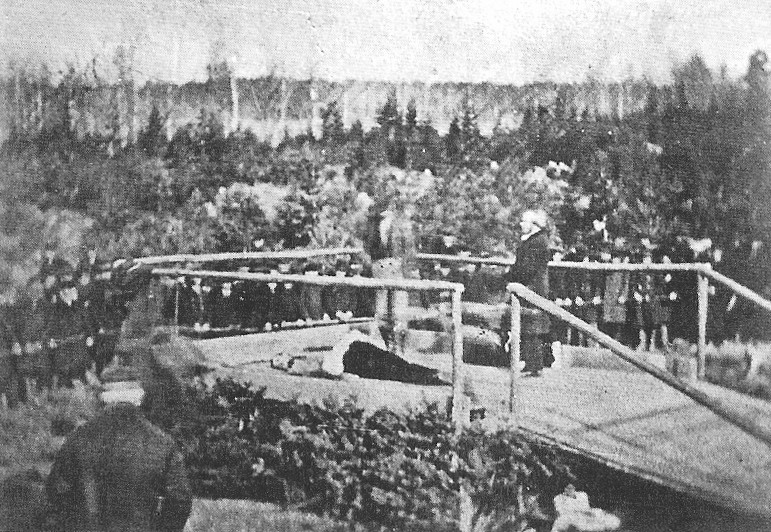
Augusta, you are now so big that the world’s temptations begin to surround you. Pay close attention to your own heart, for in the human heart lies a seed of evil and when it has the opportunity to take root it grows very fast …
Hjert and Tector committed their capital crime together — it was a badly botched* armed robbery of a carriage that resulted in two people shot dead and no booty heisted — but they were separately separated from their heads: Hjert in Lilla Malma, and Tector in Stenkumla, both on the same Thursday morning.
* Botched as in, they were waiting to ambush the mail coach but in their eagerness they waylaid the wrong vehicle.
East Germany beheaded Sylvester Murau by fallbeil on this date in 1956.
A blue-collar laborer who served a jail sentence for poaching under the Third Reich, he’d joined GDR’s feared security service, the Stasi — until he was dismissed when some fascist dalliances during the war years came to light.
He then transitioned from Stasi agent Sylvester Murau to defector Sylvester Murau, fleeing to West Berlin and settled down in West Germany for life as a communist apostate.
That was in 1954. Later that same year, his daughter Brigitte “Gitta” Cullmann, popped in for a visit — transit between East and West Germany was not yet impeded by any wall back then — and fell to drinking with him in Heubach with some pals.
Well, it turns out that Brigitte was a Tier 1 Operative of a Stasi agent herself, albeit a real bum as a child: her presence induced dad to let his guard down with her acquaintances, and once ol’ Sly was sufficiently sauced, the visitors tossed him into a car and bundled him back over the border. It’s among hundreds of cases where Communist bloc defectors were forcibly repatriated eastward by Stasi kidnappers, there to meet all manner of mistreatment — but Murau’s situation was surely exceptional in depending on such obligingly disloyal kin for its very implementation.
Ruthless Gitta later married the Stasi colonel who planned the body-snatch.
I shall rehearse you the dolorous end of those babes, not after every way that I have heard, but after that way thay I have so hard by such men & by such meanes, as me thinketh it wer hard but it should be true. King Richarde after his coronacion, takyng his way to Gloucester to visit in his newe honor, the towne of which he bare the name of his old, devised as he roode, to fulfil that thing which he before had intended. And forasmuch as his minde gave him, that his nephewes living, men woulde not recken that hee could have right to the realm, he thought therfore without delay to rid them, as though the killing of his kinsmen, could amend his cause, and make him a kindly king. Whereuppon he sent one John Grene whom he specially trusted, unto sir Robert Brakenbury constable of the Tower, with a letter and credence also, that the same sir Robert shoulde in any wise put the two children to death. This John Grene did his errande unto Brakenbery kneling before our Lady in the Tower, who plainely answered that he would never putte them to death to dye therfore, with which answer Jhon Grene returning recounted the same to Kynge Richarde at Warwick yet in his way. Wherwith he toke such displeasure and thought, that the same night, he said unto a secret page of his: Ah whome shall a man trust? those that I have brought up my selfe, those that I had went would most surely serve me, even those fayle me, and at my commaundemente wyll do nothyng for me. Sir quod his page there lyeth one on your paylet without, that I dare well say to do your grace pleasure, the thyng were right harde that he wold refuse, meaning this by sir James Tyrell, which was a man of right goodlye parsonage, and for natures gyftes, woorthy to have served a muche better prince, if he had well served god, and by grace obtayned asmuche trouthe & good will as he had strength and witte. The man had an high heart, and sore longed upwarde, not rising yet so fast as he had hoped, being hindered and kept under by the meanes of sir Richard Ratcliffe and sir William Catesby, which longing for no moo parteners of the princes favour, and namely not for hym, whose pride thei wist would beare no pere, kept him by secrete driftes out of all secrete trust. Whiche thyng this page wel had marked and knowen. Wherefore thys occasion offered, of very speciall frendship he toke his time to put him forward, & by such wise doe him good, that al the enemies he had except the devil, could never have done him so muche hurte. For upon this pages wordes king Richard arose. (For this communicacion had he sitting at the draught, a convenient carpet for such a counsaile) and came out in to the pailet chamber, on which he found in bed sir James and sir Thomas Tyrels, of parson like and brethren of blood, but nothing of kin in condicions. Then said the king merely to them: What sirs be ye in bed so soone, and calling up syr James, brake to him secretely his mind in this mischievous matter. In whiche he founde him nothing strange. Wherfore on the morrow he sente him to Brakenbury with a letter, by which he was commaunded to deliver sir James all the kayes of the Tower for one nyght, to the ende he might there accomplish the kinges pleasure, in such thing as he had geuen him commaundement. After which letter delivered and the kayes received, sir James appointed the night nexte ensuing to destroy them, devysing before and preparing the meanes. The prince as soone as the protector left that name and toke himself as king, had it shewed unto him, that he should not reigne, but his uncle should have the crowne. At which worde the prince sore abashed, began to sigh and said: Alas I woulde my uncle woulde lette me have my lyfe yet, though I lese my kingdome. Then he that tolde him the tale, used him with good wordes, and put him in the best comfort he could. But forthwith was the prince and his brother bothe shet up, and all other removed from them, onely one called black wil or William slaughter except, set to serve them and see them sure. After whiche time the prince never tyed his pointes, nor ought rought of himselfe, but with that young babe hys brother, lingered in thought and heavines til this tratorous death, delivered them of that wretchednes. For Sir James Tirel devised that thei shold be murthered in their beddes. To the execucion wherof, he appointed Miles Forest one of the foure that kept them, a felowe fleshed in murther before time. To him he joyned one John Dighton his own horsekeper, a big brode square strong knave. Then al the other beeing removed from them, thys Miles Forest and John Dighton, about midnight (the sely children lying in their beddes) came into the chamber, and sodainly lapped them up among the clothes so be wrapped them and entangled them keping down by force the fetherbed and pillowes hard unto their mouthes, that within a while smored and stifled, theyr breath failing, thei gave up to god their innocent soules into the joyes of heaven, leaving to the tormentors their bodyes dead in the bed.
Whiche after that the wretches parceived, first by the strugling with the paines of death, and after long lying styll, to be throughly dead: they laide their bodies naked out uppon the bed, and fetched sir James to see them. Which upon the sight of them, caused those murtherers to burye them at the stayre foote, metely depe in the grounde under a great heape of stones. Than rode sir James in geat haste to king Richarde, and shewed him al the maner of the murther, who gave hym gret thanks, and as som say there made him knight. But he allowed not as I have heard, the burying in so vile a corner, saying that he woulde have them buried in a better place, because thei wer a kinges sonnes. Wherupon thei say that a prieste of syr Robert Brakenbury toke up the bodyes again, and secretely entered them in such place, as by the occasion of his deathe, whiche onely knew it could never synce come to light. Very trouthe is it & well knowen, that at such time as syr James Tirell was in the Tower, for Treason committed agaynste the moste famous prince king Henry the seventh, bothe Dighton an he were examined, & confessed the murther in maner above writen, but whither the bodies were removed thei could nothing tel. And thus as I have learned of them that much knew and litle cause had to lye, wer these two noble princes, these innocent tender children, borne of moste royall bloode, brought up in great wealth, likely long to live to reigne and rule in the realme, by traitorous tiranny taken, depryved of their estate, shortly shitte up in prison, and privily slaine and murthered, theyr bodies cast god wote where by the cruel ambicion of their unnaturall uncle and his dispiteous tormentors. Which thinges on every part wel pondered: god never gave this world a more notable example, neither in what unsuretie standeth this worldy wel, or what mischief worketh the prowde enterprise of an hyghe heart, or finally what wretched end ensueth such dispiteous crueltie. For first to beginne with the ministers, Miles Forest at sainct Martens pecemele rotted away. Dighton in ded walketh on a live in good possibilitie to bee hanged ere he dye. But sir James Tirel dyed at Tower hill, beheaded for treason.
Although the veracity of More’s account cannot be proven — the purported original confessions do not survive and are not attested elsewhere — Tyrrell’s reputation as the agent of this notorious outrage earned him a bit part in Shakespeare’s Richard III.
On this date in 1560, the son of Renaissance polymath Gerolamo Cardano was beheaded for murdering his — the son’s — wife.
While Cardano pere was one of the great intellectuals of his era, and has been covered in these grim annals via his interest in a genius composer executed for sodomy, the fils earns notice merely for his famous relations.
The latter, Giambatista Cardano by name, committed nothing but a shabby domestic murder, dosing his wife Brandonia di Seroni — “a worthless, shameless woman” in Gerolamo’s estimation — with arsenic when he had tired of her infidelities.
Still, it is the burden of a father to love his firstborn no matter how undistinguished and homicidal. Cardano poured his sorrow into a long funerary verse, not neglecting therein to defend the prerogatives of a jealous husband’s “avenging right hand”; we obtain it from the old man’s autobiography.
A Lament on the Death of My Son
Who has snatched thee away from me —
O, my son, my sweetest son?
Who had the power to bring to my age
Sorrows more than I can count?
Wrath in whose soul or what stern fate
Willed to reap thy youth’s fair flower?
Not Calliope, not Apollo,
Served thee in thine hour of need!
Cithara, now, and all song be still;
Measures of threnodies shall renew
Mourning and sighs for my dear son.
— Strains of his singing haunt me still —
Laurels, alas, in the healing art,
Knowledge of things, and a facile gift
Of Latin tongue—what profit these
Labors long if they swiftly die?
Service rendered Spanish prince,
Duty done to the noblest of men
Help thee naught if with these for thy judge
Death with his scythe doth seek thy blood.
What, ah me, shall I do? My soul
Swoons to remember thee, gentle son;
Silent, I brood on thy destiny grim;
Tears that I dare not give to words,
Shall I not shed for my stricken son?
Lasting encomium had I reserved,
Fitting reward to thine ashes paid;
Silence — O shame — must my tongue now guard,
Death unjust nor its cause announce.
Grave are the ills thou hast borne, mild son.
Prince and Senate and ancient law
Ordered thy doom whilst thou in rash haste,
Brought an adultress the wage of her crime.
Safely adultery now in our homes
Mocks and insults when punishment swift
Stays the avenging right hand of the youth.
Son — the reflection true of the good
Strong in my father — worthy to live
Long through the years — Alas, my beloved!
Fates have forbidden and swept all that good
Far past the stars, and removed from gray earth
Every bright and illustrious thing.
Hail thee, child, for thy spirit high!
Clear is thy blood from ignoble stain;
Honor of forefather’s hast thou sought.
Far stands the king, and hope of safety,
Phoebus denies the lands his beams,
Light from Diana passes and dies,
Stars in the calm sky glance no more
Lest they look down on a palace foul,
Stained with the reeking blood of the slain.
Where lies my way? What land now claims
Body and limbs disfigured by death?
Son, is there naught but this to return?
Thee have I followed on sea and on land!
Fix me — if mercy is anywhere found —
Pierce me with weapons, O ye mad Gods!
Take with thy first blow my dreary life.
Pity me thou, oh great father of Gods,
Thrust with thy spear my hated head
Deep into Tartara; else am I bound
Hardly to burst this life’s bitter chains.
This, O my son, was not pledged to thy sire,
Love so unholy to trust with thine all —
Love that has ruined thee, son of my heart!
Wife of a memory blessed and true,
Happy thy death, nor spared for this grief!
I, through this crime, have myself brought disgrace,
O son to our name, for by envy compelled,
Homeland and Lares paternal I left.
Death had I sought for my innocent soul,
But surviving and living I vanquished my fate.
Ages to come will know, son, thy name,
Orient lands will hear of thy fame;
Dead to us thou art indeed —
Life hast thou won through all the earth!
It would be fair to say that this last vow of the grieving father was not kept. Indeed, the misery of losing his son to the executioner cast an enervating pall over the elder Cardano’s remaining years. “My supreme, my crowning misfortune,” he bewailed. “Because of this, it was neither becoming for me to be retained in my office [a professor of medicine at Pavia], nor could I justly be dismissed. I could neither continue to live in my native city with any peace, nor in security move elsewhere. I walked abroad an object of scorn; I conversed with my fellows abjectly, as one despised, and, as one of unwelcome presence, avoided my friends.”
A couple of years on and the unwelcomeness had become overwhelming; he relocated to a professorship in Bologna — nowise happy but at least clear of the omnipresent, suffocating shame associated with his name. The man’s woes were in no way alleviated by his surviving son Aldo, a thief and all-around lowlife whom Cardano ended up disinheriting. (Lone daughter Chiara was A-OK by pops apart from being unable to bear him grandchildren: “from my daughter alone have I suffered no vexations beyond the getting together of her dowry.”)
Louis Anastay was guillotined on this date in 1892.
The young army lieutenant, catching word of a windfall coming to a wealthy benefactress of his named baroness Dellard, assailed and left for dead both the lady and her servant in December 1891. (The servant survived; Dellard did not.) As the accused described it to a courtroom all aghast:
Yes, I entered; — I chatted with her; — and then I struck, –. Ah! you do not know what it is to have struck your fellow creature with a knife. I have always Madame Dellard before my eyes. I have committed a crime; — not only as an officer have I committed faults, but I have committed a crime against society; — I demand to expiate it; — I accept the responsibility; — I wish to mount the scaffold.
Sensational enough in its time that “the scum of Parisians” were jostling for sightlines to the guillotine for full two days before the blade fell, Anastay rates a passing reference in the anarchist Ravachol‘s secret courtroom address among several criminals notorious for their cupidity. (“We will no longer see men like Pranzini, Prado, Berland, Anastay and others who kill in order to have [gold].”)
According to medical historian Lindsey Fitzharris, Anastay invited his brother to attend his beheading and attempt to interact with his severed head as part of the age-old quest to prove that life subsists a few moments after decapitation. There’s no indication that any such experiment actually took place, however.
As a strange coda of compounded tragedy, that very brother, Leon Anastay by name, was himself murdered in a lovers’ quarrel in 1907.
Six Somali migrant workers were publicly beheaded in Jeddah on this date in 2005 for robbing taxi drivers. The muggings, though violent, were not fatal to the drivers, so the punishment was quite harsh even by the harsh standards of KSA.
According to an Amnesty International researcher, the doomed men had not been “informed in advance that their five-year prison sentences, which they had served — and also been lashed — by May 2004, had apparently been changed later to death sentences by a secret procedure.” They were unaware until the morning of their execution that they had even been condemned to death.
Their names were Ali Sheikh Yusuf, Abdel-Fatar Ali Hassan, Abdullah Adam Abdullah, Hussein Haroon Mohamed, Abdul-Nur Mohamed Wali and Abdullah Hassan Abdu.
Well-connected in the court of Prince George of Denmark, Milan in 1684 was tapped to govern the struggling nascent sugar colony of the Danish West Indies — the islands of Saint Thomas, Saint John, and Saint Croix that have comprised the U.S. Virgin Islands since Denmark sold the money pits off in 1917.
There he proved to be a pettifogging despot who was noxious to the island’s planters and conspicuous about exploiting his office to fatten his own coffers. His incompetent predecessor, who was only supposed to be sent back to the mother country, Milan instead clapped in a dungeon. Even his brutal treatment of slaves — using impalement for an execution! — shocked peers accustomed to a different spectrum of cruelty.
“I wish for my part that your Excellency could have been here a single day and heard what thundering there has been in the commission, with howling, shouting, and screaming, one against the other,” the official reporter noted. “God be thanked it is over.”
A gangster named Henri “Le Tigre” Olivier was guillotined in Lille on this date in 1925.
According to eyebrow-raising (but widely circulated) reports, once the Tiger was reduced to a Cadaver, he joined the august line of medicalized corpses for, as noted in the papers of the executioner Anatole Deibler, “In the cemetery, a professor from the Faculty of Lille removed the thyroid gland from him, for transplant to a young girl suffering from paralysis, the operation succeeded perfectly, the child was saved.”
Bavarian bandit Mathias Kneissl was beheaded by the fallbeil guillotine in an Augsburg prison on the morning of February 21, 1903.
Kneißl/Kneissl got a juvenile start on his delinquency — the family trade, one might say; his parents were part-time thieves and fences and an uncle was a famous robber of the Munich-Augsburg roads named Johann Pascolini. He caught his first serious jail time at the tender age of 18 in an affair when his brother Alois shot dead a police officer who had come to investigate them for poaching.
Alois died of tuberculosis in prison but Kneissl emerged from his cell in 1899 — 24 years old and penniless. He soon returned to his vomit, mounting a bicycle-borne crime spree around Bavaria’s Dachau district.
Quaint though it might read in retrospect, a mobile gunslinging cyclist could be a hell of a menace in a world without cars or telephones. Kneissl proved it over the span of about a year and a half before his March 1901 arrest, raiding farms and passersby trying to accumulate a stake sufficient to vanish with his sweetheart to America.
Instead that sweetheart betrayed his hideout to authorities, who require an hourslong siege to capture the wanted outlaw. Two Altomünster gendarmes whom he had killed in a shootout supplied the requisite capital charge, notwithstanding the popular “social bandit” glow he had gained from his many months on the lam. (Folk songs celebrating him are still in circulation to this day; there have also been 1970 and 2008 cinematic treatments of this criminal legend.)
On this date in 1803, robber Mathias Weber was guillotined.
“Fetzer” made a scintillating career in brigandage in 1790s Rhineland — whose west bank Prussia had been forced to cede to revolutionary France. (The legendary bandit Schinderhannes plied his trade in the same unsettled environs; the two men shared a ride to Mainz as prisoners.)
Fetzer’s gang robbed liberally and violently on the roads; their pinnacle capers were twice raiding the river town of Neuss.
Tried (and eventually executed) in Cologne, he was persuaded to confess — albeit not regret — his considerable career in villainy by a prosecutor named Anton Keil, who made use of his access to this notorious figure to print a little biography of his famous prey. Fetzer, for his part, amused himself by sketching guillotines on his cell wall and building a tally of the distinct robberies he could recollect, eventually cataloguing 178 of them. He wowed the standing-room crowd at his trial with his nerve in the courtroom, joking and sparring and readily revealing all without any expectation of trading admissions for leniency.