1803: George Foster, and thence to the reanimator

It’s not too often that a typical convicted murderer becomes a source for not just law, but also literature and science. George Foster (sometimes spelled George Forster despite few, if any, contemporaneous spellings as such) managed just that on this date in 1803, and his legacy lives on to this day.

Foster’s case was, in the annals of capital punishment, unremarkable.

He was accused in the drowning of his wife and youngest child in the Paddington Canal, one of the many canals being improved at the time to connect various parts of England by water. Foster was found guilty based on circumstantial evidence and sentenced to hang at Newgate Prison on 18 Jan 1803.

Shortly after 8 a.m., Foster was executed; minutes later, he was a science experiment.

Professor Giovanni Aldini was the nephew of biological electricity guru Luigi Galvani, and he wanted to electrify a body. Galvani had shown that frog legs responded to electricity, twitching when current was passed through the muscle, and he was in academic competition with his associate and sometime dissident Alessandro Volta over why this occurred. Galvani claimed that an electrical fluid flowed through the corpse, activating the muscles; Volta said that the cells passed electrical signals between one another. It was this latter assertion that led to the development of Volt’s first battery, a voltaic pile.* Aldini was convinced that his uncle was right about electrical fluid, but he was keen on Volta’s ideas for creating portable electricity.

His stated reason for delving into what was known as galvanic reanimation was to aid the recently drowned, who, he said, might be resuscitated. Galvani leaned on some earlier experience with beheaded victims in Bologna, as well as animal experiments, to convince British government agents of the viability of the plan. As one witness to those events stated:

A very ample series of experiments were made by Professor Aldini which show the eminent and superior power of galvanism beyond any other stimulant in nature. In the months of January and February last, he had the courage to apply it at Bologna to the bodies of various criminals who had suffered death at that place, and by means of the pile he excited the remaining vital forces in a most astonishing manner. This stimulus produced the most horrible contortions and grimaces by the motions of the muscles of the head and face; and an hour and a quarter after death, the arm of one of the bodies was elevated eight inches from the table on which it was supported, and this even when a considerable weight was placed in the hand.

Which is not to say it was really difficult to get permission.

Aldini’s experiments were a very public roadshow demonstration of Galvani’s ideas. London’s Royal College of Surgeons was, at that time, fascinated with the boundaries of life and death, and Aldini was more than happy to offer his services. As well, the 1751 (or 1752) Murder Act would not allow hanged criminals to be buried, and their corpses were often used for scientific discovery. Foster’s body, which had hung for an hour in slightly sub-zero temperatures, was the first complete corpse Aldini acted upon, but he wasn’t the first to get a chance.**

The Newgate Calendar summarizes the events:

On the first application of the process to the face, the jaws of the deceased criminal began to quiver, and the adjoining muscles were horribly contorted, and one eye was actually opened. In the subsequent part of the process the right hand was raised and clenched, and the legs and thighs were set in motion. Mr Pass, the beadle of the Surgeons’ Company, who was officially present during this experiment, was so alarmed that he died of fright soon after his return home.


An illustration of Aldini’s experiments with executed corpses. His notes of George Foster record that “the jaw began to quiver, the adjoining muscles were horribly contorted, and the left eye actually opened … The action even of those muscles furthest distant from the points of contact with the arc was so much increased as almost to give an appearance of re-animation … vitality might, perhaps, have been restored, if many circumstances had not rendered it impossible.” (cited in Mary Shelley: Her Life, Her Fiction, Her Monsters)

Aldini’s act was yet another public showcase of strange new technologies, this time sparking the imaginations of the Brits. Within a generation, Scottish experimenters were performing similar feats, and the College of Surgeons had, after further attempts similar to Aldini’s, revived the heart of another convicted murderer, John Bellingham. It was the first recorded heart shock revival in modern medical history.† (Even today’s scientists turn to electricity to instantiate life’s precursors in trying to solve the riddle of abiogenesis.)

But even more than that was the effect these results had on popular culture, where Mary Shelley, well aware of Aldini’s work (as well as that of Erasmus Darwin, a proponent of evolution well before the concept of “natural selection” was framed by his more famous grandson), used the idea of reanimation — such as was attempted on her husband’s first wife after she drowned — to inspire her signature characters, Victor Frankenstein and his “monster.”

As a cultural icon, Frankenstein did exceedingly well. Considered a true Gothic novel, the story was remade for stage as early as 1887, turned into a variety of films which were subsequently parodied (c.f. The Rocky Horror Picture Show, “Treehouse of Horror II”, The Re-Animator, etc.), retold on radio, brought up in song, and re-written in novels.

Galvanization was never mentioned directly in that book, but the studies at the College of Surgeons were clearly an inspiration. And galvanization transcended that book, striking a chord in the public imagination. It continued to pop up in publication for decades after the Aldini/Foster event, for instance in the 1836 illustration “A Galvanized Corpse”, in which the editor of the Washington Globe, Francis Preston Blair, is shown being “galvanized” by two demons, who represent the interests of Andrew Jackson.

* The Voltaic pile was originally used to disprove Galvani’s fluids theory. However, the two were largely non-adversarial, so Volta actively advanced Galvani’s name through the word “galvanism” and, by the time of Foster’s death, “galvanize.” The term “galvanized” metal refers to a conductive element coated with something non-conductive and dates from the late 1830s. Volta, of course, is the recognizable source of the the electrical potential unit of the “Volt.”

** Indeed, the College of Surgeons was receiving all hanging victims from London since 1752, and most were put through rigorous postmortems. Such scientific experimentation is also often blamed for the revival of Patrick Redmond in 1767, who received a windpipe incision following his hanging in Cork, Ireland; Redmond, however, was documented as hanging for just nine minutes, only slightly longer than the average person takes to die if deprived of oxygen.

† Those interested in the history of cardiology in general should take a look at Louis J. Acierno’s The History of Cardiology; those interested in the use of human remains in medical science should seek out Human Remains: Dissection and Its Histories by Helen MacDonald.

On this day..

1961: Patrice Lumumba

No brutality, no torture has ever made me plead for mercy, because I prefer to die with my head up, with unshakable faith and deep confidence in the destiny of my country, rather than live in submission and spurning of scared principles.

-Patrice Lumumba’s last letter to his wife

One person’s “murdered under controversial circumstances” is another person’s “executed.” By most unbiased accounts, Patrice Lumumba was both.

A strident anti-colonialist caught in the most inflammatory of Cold War power struggles, Lumumba remains a controversial figure.

In 1956, Patrice Lumumba was a mail clerk in Belgian Congo recently out of prison for embezzlement of post office funds. Though previously involved with the Liberal Party of Belgium, a colonialist political party, after prison, he helped found the Mouvement National Congolais, a pro-independence national party (an important distinction at the time, as most pro-independence parties were at least partially tribal in nature).

Convicted in 1959 of inciting an anti-colonial riot and sentenced to 6 months in prison, Lumumba was released early as Congo won its independence and the MNC became an important political force. Just how important became apparent the following June, when the 35-year-old Lumumba was ratified as the newly independent Congo’s first prime minister.

From criminal to high statesman in just over a year, Lumumba took his new power in stride, and watched in disgust as the deposed King Baudouin of Belgium attended the new nation’s first Independence Day celebration, and before a fawning international media condescendingly congratulated Belgium’s colonial beneficence to its former slave plantation.

Struck from the day’s official celebrations in favor of the the lukewarm exhortations of the new President Kasa-Vubu, Lumumba found time on the day’s unofficial program. Strident, emotional, and unabashed in its anticolonialist, nationalist, and pan-Africanist bent, Lumumba’s famous speech was roundly criticized by the domestic and foreign press, but well-received by the crowd and ultimately delivered directly to history.

Lumumba’s tenure as prime minister was short-lived, however.

Mere weeks after independence, a mutiny on army bases broke out in reaction to Lumumba’s ill-fated decision to leave the military out of a government pay raise. The resulting anarchy quickly spread throughout the country, and the province of Katanga, with the support of King Baudouin and powerful mining companies, declared independence. As United Nations troops failed to quell the situation, Lumumba appealed to the Soviets, whose intervention succeeded only in causing Lumumba’s political support to crumble.

Kasa-Vuba dismissed Lumumba in September; in response, Lumumba declared Kasa-Vuba deposed — quite illegally, as it happens — and appealed to the Senate, from whom he managed to win a vote of confidence.

At this point, in the heat of the Cold War, things got interesting.

Deposed again, this time in a CIA-endorsed coup, Lumumba found himself under house arrest and under the protection of UN troops. Not certain whether to trust the rule of the various laws surrounding him, Lumumba slipped out under the cover of night and escaped to nearby Stanleyville (now Kisangani), where he believed he had enough supporters to set up his own government — and army, whom one supposes he had by then resolved to pay rather better.

Pursued by forces loyal to the new government, Lumumba was captured and arrested in early December 1960 and charged with “inciting the army to rebellion.” Devoid of his former UN protection, the man who would be the leader of a newly free nation watched as he became a pawn in a much larger struggle. UN Secretary General Dag Hammarskjöld appealed to the process of law –- whatever that was –- while the USSR jumped a step ahead, demanding that Lumumba be immediately released and reinstated as prime minister and all UN forces withdrawn.

So much for that. The UN Security Council convened, and, a week later, the USSR’s resolution was defeated. Another, Western-backed resolution that would have given the UN power to act as impartial arbitrator was vetoed by the USSR.

At this point, caught between hostility of Cold War politics and the ever-hazy idea of “international law,” Lumumba languished in the military barracks of an even more hostile government. Hearing of plans for his transfer to barracks at the now-subdued Katanga province, Lumumba was wild on the plane trip and was forcibly restrained after appealing to other passengers to intervene on his behalf. Late at night after his arrival at his new prison, Lumumba was driven to an isolated spot and executed by firing squad. News of his death was not released until three weeks later, when it sparked protests in several European cities over the role of the Belgian government, which denied any involvement.

The extent of US and Belgian involvement in Lumumba’s death remains the subject of ongoing speculation. So does the question of what might have been.

On this day..

1980: Four Iraqi Turkmen

On this date in 1980, a professor, a soldier, a bureaucrat and a businessman were hanged by Saddam Hussein in his campaign to cow Iraq’s Turkic ethnic minority.

The ethnic and religious quiltwork of Iraq is much more nuanced than Sunni vs. Shia — and this blog has noticed its deadly potential before.

This day’s hangings belong to an earlier era, of the Ba’athist secular pan-Arab aspiration that had Hussein quashing minority national aspirations. (Though the anti-minority stance was hardly unique to him.)

Nejdet Kochak, Abdullah Abdurrahman, Riza Demirji and Adil Sherif were ethnic Turkmen (or Turkomen), ethnically and linguistically distinct Moslem descendants of those far-flung peoples of the Eurasian steppes.

More to the point, they were relatively prominent voices for Turkoman civil rights in the face of harsh state suppression.

This being Saddam Hussein’s Iraq, the problem had an easy solution. The four were made examples of, convicted of spying for their brother Turks in Turkey, and hanged — but not forgotten.

On this day..

1895: Charles Stokes, in the heart of darkness

On January 15, 1895, a Belgian colonial official in the Congo Free State hanged Charles Stokes for trading illicitly.

A British subject who’d abandoned his humdrum Liverpool desk job to become an missionary in Africa, Stokes eventually became a merchant in the mysterious continent noted for his favorable relationships with the locals. (He had two African wives.)

In 1895, operating out of German East Africa,* his caravan was detained trading into the Congo Free State — King Leopold’s hellish personal reserve — with “Arab” slavers who colonial authorities considered rebels. That “rebel Arab slavers” bit formed the charge against him, but trading outside the royal monopoly was probably at least as egregious in Belgian eyes.

An 1895 Review of Public Events at Home and Abroad sums up the scenario.

It was alleged that [Stokes] had large quantities of arms, ammunition, and ivory, and that he had bought the ivory at a low price from Kibonge, the assassin of Emin Pasha. Captain Lothaire, an official, an official of the Congo State, with a strong force, was then advancing from Stanley Falls to attack this Arab chief Kibonge, in revolt against the Congo State.** On Lothaire’s arrival at Kilunga, Kibonge was already a prisoner in the hands of his own native subordinates, who refused to join him in fighting the State. Stokes applied to Lothaire for protection of his ivory and goods, which he desired to carry towards the East Coast. Lothaire claimed that letters were found among Kibonge’s effects which went to prove that Stokes had sold large quantities of arms and ammunition to this chief, to be used in war against the Congo State. Mr. Stokes was arrested by Captain Lothaire’s orders, brought before a court-martial composed of two non-commissioned officers and Lothaire, and sentenced to be hanged. The execution took place the following morning.

Though not surprising that the summary hanging of a European would provoke an international incident, one would hardly call it equitable given the unnumbered, unmourned multitudes of Africans whose lives were wrung dry and discarded for Belgium’s treasury. Still, the “Stokes Affair” made the headlines in both England and Germany, and for activist types struggling to gain any kind of traction for their tales of colonial horrors, it was something to work with.

Leopold paid off both countries. The trial of Lohaire for naughtily conducting the execution ended in an acquittal. Belgium set up a blue-ribbon commission of missionaries solemnly vowing to investigate abuses, which was never heard from again.

(Look for Charles Stokes’ appearance in this tale of the Belgian Congo’s woe, beginning at about 1:01:25.)

If the Stokes incident didn’t catch fire itself, it became a stick in the accumulating dry tinder that Sir Roger Casement set a spark to in the early 20th century.

And maybe a bit more than that, too.

The horror! The horror!

Stokes’s singular story is often thought to inform (pdf) Joseph Conrad’s great literary critique of colonialism, Heart of Darkness.

The Stokes hanging would be only one data point among many for those who had ears to listen to the horrors emerging from the Congo, to be sure. Still, Molly Mahood and Ian Watt have included Stokes — the gone-native ivory trader — as one of several possible inspirations for the novel and especially the Kurtz character. Lothaire himself probably offered fodder for the petty, tyrannous impunity of colonial officers who the narrator encounters on his way to meet Kurtz.

I gathered in snatches that this was some man supposed to be in Kurtz’s district, and of whom the manager did not approve. ‘We will not be free from unfair competition till one of these fellows is hanged for an example,’ he said. ‘Certainly,’ grunted the other; ‘get him hanged! Why not? Anything — anything can be done in this country.’

* Present-day Rwanda, Burundi and Tanzania.

** Lothaire had spent the early part of the decade wresting Belgian commercial dominance in the eastern Congo from the incumbent Arabo-Swahili elites. (The link is French.) “Arabs” in the context of the Belgian Free State meant these Moslem bantus, not (by and large) ethnic Arabs as we would think of them today.

Neither were “Arab slavers” a distinct enemy class for the Free State; those prepared to play ball with white authorities raided native settlements to obtain slaves for rubber plantations and other Belgian-authorized ventures.

On this day..

1879: James McDonnell and Charles Sharpe

On this date in 1879, two Molly Maguires hanged in Mauch Chunk, Pa., while their reprieve waited for them just outside the door.

John Kehoe may have been the symbolic last chapter in the Mollies‘ suppression, but Pennsylvania didn’t intend to forego its mopping-up operation.

James McDonnell and Charles Sharpe (or Charles Sharp) had been convicted of murdering George Smith in 1863; like other Molly Maguire crimes, this one either (take your pick) languished for 13 years until the criminal enterprise that authored it was toppled, or was plucked from obscurity as a pretext on which to condemn the men on rather doubtful evidence.

It was on the strength of “snitch” testimony from admitted murderers that McDonnell and Sharpe were sentenced to die — McDonnell, a hirsute Irishman straight from barbarian central casting, even tried turning informer himself to save his own life, just as his accusers had done. (He continued to deny responsibility for the Smith murder, including on the gallows in his last statement.)

But as Maguire cases go, these were small fry … and it’s the sad circumstances of their end and the evocative description of the scene under the gallows that attracts our attention today.

An execution which it was thought would be one of the quietest hangings that ever took place in Mauch Chunk has proved the most exciting. A reprieve from Gov. Hartranft arrived here one-half minute after the drop fell — just 30 seconds too late to save the lives of the condemned men.

…

A scene of great excitement took place in the jail; but, although the condemned men had been hanging only a few minutes, there was no movement made toward cutting them down. The telegraph messenger reached the jail door before the drop fell; but no attention was paid to his knocking and ringing, the wife of one of the men having previously been extremely violent outside. When the drop fell the knocking and ringing continued, and the Sheriff sent out a man to arrest the persons whom he imagined to be creating a disturbance. It was then found to be the telegraph messenger with a reprieve. A brother of McDonnell, who had been kneeling by the scaffold, arose and excitedly charged the Sheriff and the bystanders with the murder of his brother. The excitement spread, and the Sheriff appealed to one of the priests, who exonerated him from blame. Amid this excitement and the reproaches of the maddened brother of McDonnell and the wailings of the bereaved families outside, the hanged men were forgotten, and their bodies remained suspended for 30 minutes after the drop fell. There is no reasonable doubt, however, that both were dead when the reprieve came.

It should be noted that the reprieve was not an outright commutation, only a stay of the sentence for a few more days. Nevertheless, the melodramatic affair led the Times to wax lyrical.

“The evil of this whole case,” it began, clearly not speaking from the point of view of McDonnell and Sharpe, “is that the gallows in Pennsylvania is invested with great uncertainty.”

[F]rom this time out the condemned man at the foot of the gallows may not only hope that a reprieve may arrive for him at any moment, but he may take off his thoughts from the certain doom before him and be agonized with the reflection that the boon which he waits for may come when his life has gone past recall. If a stay of proceedings is to be granted at all, it should be granted while the condemned man’s life may be said to keep the case open. It is a refinement of cruelty to keep hope alive and quivering at the foot of the gallows.

On this day..

1759: The Tavora family

Two and a half centuries ago today, Portugal’s noble Tavora family was extirpated in Belem.

[A] scaffold eighteen feet in height was erected in the market-place of Lisbon, during the night of the 13th, round which was drawn up a cordon of military. Precisely at 7 o’clock in the morning, the old Marchioness of Tavora, as the most guilty, was brought upon the scene, her hands bound, and a rope round her neck. She was placed on a chair, and her eyes being bound, the executioner struck her head off without the previous utterance by her of any complaint. After her came the twenty-one-year-old son, Joseph Maria de Tavora. They bound him on a cross raised aloft, broke his arms and legs with iron clubs, and then strangled him with a rope. The same fate befell [Tavora son-in-law] Jeronimo de Ataide, Count of Atouguia, the young Marquis Luiz Bernard de Tavora, colonel of cavalry, his servant Blasius Joseph Romeiro, Corporal Emanuel Alvarez Fereira, valet of the Duke of Aveira, and the body-page, John Michael. Their corpses were all flattened upon wheels, which were placed on poles, and this proceeding took up so much time that fully half an hour elapsed before another execution could be proceeded with.


Other outstandingly gory images of this day’s business are here.

After the page Miguel or Michael, the executioner took the old Francis d’Assis de Tavora, bound him on a St. Andrew’s cross, gave him three blows on the chest with an iron rod that resounded to a distance, shattered his arms and legs, and then gave him his coup de grace through the heart. The executioner’s men then, amidst wild shrieks, shattered the arms, legs, and thighs of the ninth victim, the old Duke of Aveiro, while still alive, then killed him by a blow on the chest, and threw him into the blazing fire. Finally, the tenth delinquent, the valet Anton Alvarez Fereira, brother of the above-mentioned Emanuel, was conducted before the corpses of the nine who had been previously executed, each one being shown to him; he was then bound to a stake, round which was placed a heap of wood, and this being set fire to, was raked together until he was completely consumed* … When the execution was over, the scaffold, together with all the dead bodies, was set on fire and burnt to ashes, which were thrown into the Tagus.

Oh, and one last thing:

[T]he palaces of the high nobility who had been executed were pulled to pieces and levelled to the ground, and salt strewed on the places where they had stood, as a sign that they should never be built up again.

Yikes.


This stone marker was placed on the site of the razed palace of Jose Mascarenhas, the Duke of Aveiro. “On this infamous land,” it announces, “nothing may be built for all time.” Copyrighted image courtesy of Ludgero Paninho.

Seems someone got the idea that the Tavoras tried to kill (and more problematically, failed to kill) Portuguese king Joseph I.

Circumstantial, torture-adduced evidence put the scheming Marchioness Eleonora de Tavora and clan behind an apparent assassination attempt, wherein a couple of assailants had shot at the king’s unmarked carriage as it returned on a little-used road from a rendezvous with his mistress. (One of the circumstances was that the mistress was a Tavora, which put the accused in a position to know the king’s secret travel plans. Others argue the gunmen might have just been common highwaymen who had no idea they were setting upon the royal person.)

Whatever the facts of the matter, obscure behind a quarter-millennium, its attribution to the Tavoras and the spectacular revenge thereupon visited was effected by the king’s competent and ruthless minister, Sebastião José de Carvalho e Melo, the future Marquis de Pombal.


A monumental plinth surmounted by Pombal dominates the present-day Lisbon plaza named for him.

His able handling of the recent Lisbon earthquake had cemented his position as the throne’s right-hand man in a trend of centralizing absolutism not much appreciated by the old aristocracy (nor by the hidebound clerical orders, which explains why the aforesaid gory account of the execution ground comes from a German anti-Jesuit polemic).

And he would not miss the opportunity an attack on the king’s person gave him to sweep away his opponents.

The peers of the realm were summoned to witness their fellow blue-bloods so nauseatingly dispatched, and the Jesuits — “reported to have inflamed the Tavora family to their [the Jesuits’] desired pitch … in revenge for what had justly been done to them in South America”** — were forthwith suppressed.

(Functionally a progressive secular dictator — or an enlightened despot, to use a more 18th-century description — Pombal would eventually push political conflict with Rome so near the brink of outright schism that the Catholic Encyclopedia’s entry on Melo characterizes it as “a sort of disguised Anglicanism,” adding that “many of the evils from which the Church now suffers are a legacy from him.” His ascendancy is the “Pombaline Terror” in Catholic annals.)

Melo/Pombal exercised the power of the state for the rest of Joseph’s life, but the king’s daughter and successor Maria I dismissed him — though she did not take punitive action against Pombal for his persecutions, as his enemies demanded.

* Also doomed to burning alive was one Joseph Policarpo, who was able to escape the mass arrest a few weeks before and fled the kingdom. He was executed by effigy.

** This comment is from the letters of Christopher Hervey, an Englishman abroad in Portugal at the time of the execution whose 100+ pages’ worth of correspondence include live-at-the-scene reporting and English translations of the public pronouncements against the supposed culprits. As to the South American roots of Pombal’s conflict with the Jesuits, the order had resisted Pombal’s early schemes to reorganize and rationalize Portugal’s New World holdings in order to make the country a more competitive colonial power. Jesuit resistance to giving up the order’s control of education, and its humanitarian efforts to protect Indians, had been seen as contributing to an Indian rebellion that broke out in Jesuit-controlled territory — even to the point that Jesuits themselves were suspected of arming Indians in an effort to carve out church-controlled states. Hervey’s version has the Jesuits behind the plot in order to eliminate Pombal’s threat to their power. Others share this opinion … and Pombal, obviously, was keen to have his rivals inculpated for lese majeste in the public mind.

On this day..

1928: Ruth Snyder and Judd Gray

On this date in 1928, a suburban femme fatale and the corset salesman who had murdered her husband were electrocuted at Sing Sing prison.

“A cheap crime involving cheap people,” one writer called it.

“Ruthless Ruth,” as the press inevitably called her, was on the wrong side of 30 and married to a wet blanket on the wrong side of 40 from whom she couldn’t even get away during the day because they worked for the same boating magazine.

The banal hell of the bourgeoisie.

Ruth had a banal solution: commence affair with handsome, limp-willed corset salesman (also married) from New Jersey.

Given a large enough metropolis with a large enough pool of adulterous data points, it must be statistically inexorable that a certain proportion will resolve the love triangle by throttling the cuckold with a wire.

But only that remorseless calculator in the sky can compute why these two, of all those thousands, were the ones not to run off together, or let the affair fizzle, or just continue to rendezvous indefinitely into the future. They certainly weren’t constitutionally cut out for crime; they set up the room in a poor simulacrum of a robbery, and told of a couple of unknown Italians* who’d broke in and done poor Albert Snyder to death.

For their poor judgment and for the speedy collapse of their crummy alibi, journalism owes them a debt of gratitude.

The execution of a woman was quite sensational; Ruth Snyder was to be the first electrocuted since 1899.

For the occasion, The New York Daily News hired a Chicago Tribune journalist to witness the execution … and at the moment the current struck, Tom Howard hoisted his pant leg and secretly snapped with a one-use camera one of the most indelible images the death chamber offered the 20th century, to be splashed in a few hours’ time on the Daily News‘ cover under the headline

DEAD!

The Snyder-Gray adulterous melodrama and its violent conclusion inspired novelist James Cain‘s Double Indemnity, and the noir film of the same title with Barbara Stanwyck as the black widow at the center of the web.

It also inspired the state of New York to begin searching official witnesses to its electrocutions.

* Blame-the-Italians here is a Roaring Twenties Queens version of fingering the black man. The murder was committed in May 1927, just as the Sacco and Vanzetti case was approaching its climax.

On this day..

2003: Nobody in Illinois

Six years ago today, a scandal-plagued governor of Illinois cleared out the state’s death row.

Republican George Ryan, in a speech two days before the end of his term, announced a mass commutation for anyone under sentence of death in Illinois — 157 people plus 10 others with pending legal challenges to vacated sentences, and four condemned men pardoned outright.

[flv:https://www.executedtoday.com/video/George_Ryan_clemency_announcement.flv 300 225]

Once a pro-death penalty legislator, Ryan grew increasingly discomfited with the state’s administration of the error-prone ultimate sanction.

That “demon of error” was dramatically unveiled for Ryan by Anthony Porter, a mentally retarded death row inmate who fortuitously avoided execution by two days on a legal technicality, and was subsequently exonerated by Northwestern University journalism students.

Seen as part of a pattern of wrongful convictions — like that of Rolando Cruz, who was cleared in the early 90’s despite the dogged efforts of then-Attorney General (and present-day quasi-Senator) Roland Burris to execute him in the face of exculpatory DNA evidence.

The governor imposed a moratorium on conducting executions for most of his term, culminating with this day’s controversial (though it did score him a Nobel Peace Prize nomination) announcement. Maybe there’s just something in the water at the Springfield governor’s mansion that attracts its residents to impolitic death penalty interventions.

Successor Rod Blagojevich called Ryan’s blanket clemency “a big mistake”, and his formal continuation of the Ryan moratorium on actual executions has been a dead letter since inheriting a vacant death row meant that no capital case reached the end of its appeals on his watch.

For the favor of sparing Blagojevich the burden of handling a death warrant — although one doesn’t get the sense that Blago is the type for a troubled conscience — George Ryan has been unkindly repaid.

Now residing in federal prison on corruption charges, the ex-governor’s own clemency petition has been complicated by sensational allegations of Blagojevich’s graft.

That petition is addressed to an outgoing executive oppositely inclined on the death row commutation question. Ryan authorized one actual execution early in his term, and spared this day’s host; George W. Bush, his virtual mirror image, has issued one commutation and carried out 155 executions during his time as chief executive of Texas and of the United States.

George Ryan is reportedly skeptical of his prospects for receiving a pardon.

On this day..

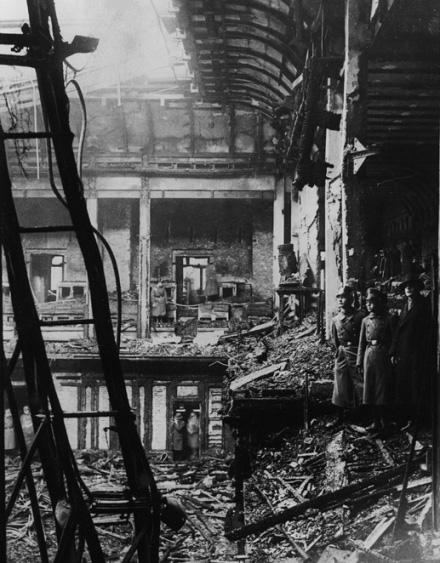
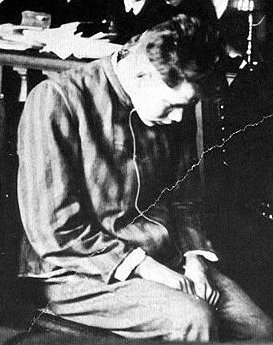
1934: Marinus van der Lubbe, for the Reichstag fire

On this date in 1934, Dutch bricklayer Marinus van der Lubbe was beheaded by guillotine in Leipzig for setting the Reichstag Fire.

A watershed event* in the formation of the Nazi dictatorship, the Reichstag fire days before a parliamentary election enabled Hitler to stampede voters, suspend civil liberties, suppress left-wing parties on grounds of a suspected Communist plot, and seize “emergency” powers he would never relinquish.

Heil Hitler.

This clip from an American miniseries on Hitler with the characters chattering in unaccented English portrays the fascists’ opportunistic use of the attack on a national symbol … something not exactly unknown to later generations.

Van der Lubbe, who was arrested on the scene, suffered the predictable fate. Four other Communists charged as accomplices were acquitted, in a trial with the gratifying spectacle of Hermann Goering personally testifying, and being undressed on cross-examination by one of the reds. One is reminded here that Hitler did not yet have everything in the state apparatus at his beck and call … although he did have a great deal already, inasmuch as the arson law under which van der Lubbe died was passed after the Reichstag fire and made retroactive.

If the big-picture outcome of the Reichstag fire is pretty clear-cut, its real origin and the corresponding rightness of the judicial verdicts have remained murky ever since. The fact that the scene of the crime became Nazi ground zero for the next decade sort of obscures the evidence.

Van der Lubbe confessed, so his participation is generally taken as a given.

Whether he was really able to start the blaze acting alone, as he insisted, and the Nazis “only” exploited this fortuitous calamity; whether he was part of a larger leftist plot, as his prosecutors claimed; or whether, as Shirer and many others since have viewed him, he was a patsy in a false flag operation set up by the Nazis with an eye towards creating a politically advantageous national emergency — these possibilities remain very much up for debate.

For what it’s worth, postwar West German courts reversed and un-reversed the sentence before officially rehabilitating van der Lubbe last year on the non-specifically indisputable grounds that the legal machinery brought to bear on the Reichstag fire “enabled breaches of basic conceptions of justice.”

* From Defying Hitler: A Memoir by a writer who would soon emigrate:

I do not see that one can blame the majority of Germans who, in 1933, believed that the Reichstag fire was the work of the Communists. What one can blame them for, and what shows their terrible collective weakness of character … is that this settled the matter. With sheepish submissiveness, the German people accepted that, as a result of the fire, each one of them lost what little personal freedom and dignity was guaranteed by the constitution, as though it followed as a necessary consequence. If the Communists had burned down the Reichstag, it was perfectly in order that the government took “decisive measures”!

Next morning I discussed these matters with a few other Referendars. All of them were very interested in the question of who had committed the crime, and more than one of them hinted that they had doubts about the official version; but none of them saw anything out of the ordinary in the fact that, from now on, one’s telephone would be tapped, one’s letters opened, and one’s desk might be broken into. “I consider it a personal insult,” I said, “that I should be prevented from reading whichever newspaper I wish, because allegedly a Communist set light to the Reichstag. Don’t you?” One of them cheerfully and harmlessly said, “No. Why should I? Did you read Forwards and The Red Flag up to now?”

On this day..

1980: Islamic extremists for the Grand Mosque seizure

At dawn this date in 1980, the kingdom of Saudi Arabia publicly beheaded over 60 Islamic extremists who had seized Mecca’s holy Al-Masjid al-Haram the preceding November — one of the formative and strangely forgotten events in the birth of radical Islam.

Saudi Arabia’s uneven but unmistakable modernization generated friction extending to the royal family itself.

On November 20, 1979, with 100,000-plus pilgrims bustling in Islam’s holiest shrine on the hajj, a few hundred multinational messianic militants took it over with a cache of smuggled firearms.

For two embarrassing weeks, the Saudi government struggled to respond, bumbling a couple of military operations and delicately negotiating the ecclesiastical permission it would require to commit violence within the Grand Mosque. (Strict Moslim prohibitions against same had left the kingdom’s unarmed guards essentially defenseless against the initial takeover.)

In exchange for that fatwa, the House of Saud struck a Faustian bargain: agreeing to roll back secularization and impose strict Islamic law.

The balance of military materiel, of course, would prove to be no contest at all; Riyadh had troops, heavy armament, and now, permission to use them (and to damage the mosque … which they did). Most of the Mahdists were slain in the decisive assault; the survivors* (except for a few who were underage) were publicly beheaded in various cities around Saudi Arabia on this date, including the operation’s leader, Juhayman al-Otaibi.

But their deed — second-tier news at the time in a United States distracted by the Iranian Revolution — would have dramatic long-term repurcussions. Though intimations of deeper bin Laden family involvement** seem sketchy, it certainly appears to have inspired the 22-year-old Osama bin Laden; he soon made his way to fight the Soviets in Afghanistan, a war that began in earnest just days after the end of the siege and to whose prosecution Saudi Arabia and the west would gratefully direct Islamist energies.

Meanwhile, the Saudi government’s pact with the clergy that gained it permission to assail the Grand Mosque saw it subsequently bankroll Wahhabi religious instruction in Saudi Arabia and beyond … arguably the hand that rocked the cradle of present-day Islamic radical movements like al-Qaeda.

Much of what is latterly recalled about this affair by Anglophones comes courtesy of journalist Yaroslav Trofimov’s recent book The Siege of Mecca: The 1979 Uprising at Islam’s Holiest Shrine. (Review | Another | Book home page).

In this clip, the author discusses the legacy of the siege with Fareed Zakaria.

* The Saudi government put out the figure of 63 executions. Some sources now report 67.

On this day..