1586: Saint Margaret Clitherow, pressed Catholic

(Thanks to historian Courtney Thomas for the guest post. -ed.)

On March 25, 1586 Margaret Clitherow, the wife of a York-based butcher, was subjected to one of the more obscure forms of capital punishment in early modern England: she was pressed to death, the mandated form of punishment for those who refused to enter a plea to a legal charge.*

Margaret was a victim of increasingly stringent attitudes toward recusants in the second half of Elizabeth I’s reign (1558-1603): Margaret was pressed to death just a year before the execution of Mary Queen of Scots for her role in a Catholic plot to overthrow the Elizabethan regime and two years before the 1588 Spanish Armada.

The two officials who were tasked with carrying out the sentence allegedly employed several beggars to perform the job instead and Margaret was taken to the toll-both on the bridge that straddles the river Ouse where she was stripped and had a handkerchief tied over her eyes as a blindfold. She was then placed upon a rock roughly the size of a baseball or an adult’s fist and a large panel of wood (roughly the size of a door) was put on top of her and slowly loaded with 700-800 pounds of rocks and stones.

In theory the smaller rock beneath her would break her back when the heavy rocks were piled on.

Witnesses report that she expired within about fifteen minutes. Other victims of this punishment were not typically so lucky. For example, Giles Corey, executed in Salem in 1692, had weights slowly piled on him for a period of several days (being asked daily before more weight was added if he wished to enter a plea to the charge that he was a warlock) before he expired.

Margaret was born Margaret Middleton in 1552/3, the daughter of a wax-chandler named Thomas and his wife Jane, the daughter of Richard Turner, an innkeeper. One of four children, she was born during the reign of Mary I (who has gone down in history with the unfortunate (but not entirely undeserved) appellation “Bloody” attached to her).

A bit of background on the process of the various reformations in England is necessary to understand why Margaret’s Catholic beliefs were treated so harshly.

Having broken with the Roman Catholic Church and founded the Anglican Church in the 1530s through a legislative reformation designed to assist him in securing the dissolution of his marriage to Catherine of Aragon so that he could wed Anne Boleyn, Henry VIII saw many of his religious policies undone by his heirs.

He was succeeded on the throne in 1547 by his son (with his third wife, Jane Seymour), Edward VI, who made England into a more recognizably Protestant state than Henry appears to have intended (while Henry was interested in reforming stances, he appears to have identified most strongly with Catholic principles and geared his reformation toward abolishing the authority of the Pope in English ecclesiastical affairs, rather than changing beliefs and practices).

Edward was, however, a short-lived king, having died in 1553 after but six years on the throne. He was succeeded by his half-sister Mary (daughter of Henry’s first wife Catherine of Aragon) who was a devout Catholic and spent much of her reign steering England back into the port of Catholicism — a task which involved martyring approximately three hundred of her subjects for their Protestant sympathies.

Mary, in turn, was succeeded by Elizabeth, the daughter of Henry’s second wife, Anne Boleyn. Elizabeth was of a Protestant mindset and reinstituted the Anglican Church. Though initially reluctant to persecute people for their beliefs (she expressed herself as having no desire to “make windows into men’s souls”), political circumstances involving a plethora of plots on the part of Catholics (both real and perceived) against the Queen resulted in a hardening of attitudes.

While fines and penalties were in place for non-attendance at Church of England services, the regime also began to enforce strict penalties against those found guilty of sheltering priests and Jesuits. And it was to these laws that Margaret fell victim.


On July 1, 1571, when she was about eighteen years old, Margaret wed John Clitherow, a local York butcher and a widower with two sons. The number of children borne by Margaret to her husband is unknown; in addition to her stepsons William (1563-1636) and Thomas (d. 1604), she bore Henry (b. 1572) and Anne (1574-1622) and there is mention of other pregnancies but the details do not survive.

In 1574, when she was twenty one, Margaret experienced a spiritual awakening and converted to Catholicism.

While her husband did not join her in converting, members of his family also held Catholic sympathies and he was not unsupportive of her conversion, with the exception of one recorded incident when he railed against Catholics while drunk at a banquet.

Margaret soon became highly involved in northern England’s underground Catholic community. She regularly held masses in her home in the Shambles (where she assisted her husband with his business) and her son, Henry, traveled to Rheims (a Jesuit centre) to train for the priesthood. Inside her home, Margaret created a series of architectural features to facilitate the concealing of priests, including a priest hole and a hole which was cut between the attics of her house and the adjoining house which could be used by a priest to escape in the event that the house was searched.

Inevitably Margaret’s involvement with the local Catholic community drew official censure, and from 1576 onwards, John Clitherow incurred regular fines for her refusal to attend Church of England services with him. She was also imprisoned several times for her refusal to conform, serving three separate terms in York Castle as a recusant (August 1577 – February 1578; October 1580 – April 1581; March 1583 – winter 1584).

Once released, despite her efforts at concealment, on March 10, 1586 Margaret was arrested for harbouring priests (which, in 1585 had been made a capital offense). In a search of her house, a frightened child had revealed the location of a secret room containing Catholic paraphernalia and designed to shelter a priest.

After her arrest, Margaret was jailed and on March 14 she appeared at the assizes. Although she was repeatedly asked to plead, she refused a trial by jury and thereby incurred the penalty of peine forte et dure: being crushed or pressed to death. Margaret maintained that her refusal to plead was a measure to prevent her children and servants having to testify against her and also served to protect the souls of the jury which would find her guilty. It is very likely that she also wanted to protect other local recusants who had assisted her and desired to prevent the revealing of their identity, which a trial would have uncovered. However, many contemporaries simply thought her mad and wondered at her seeming indifference to her husband and children — and Margaret’s willingness to abandon them for martyrdom.

Yet, despite her imminent death, Margaret allegedly did not forget her family in her final days and reportedly sent her hat to her husband and her hose and shoes to her daughter, Anne. Some people, including her father-in-law, engaged in scurrilous mongering and postulated that Margaret’s willingness to die stemmed from guilt over an illicit encounter with her confessor, whose child she now carried. Such views, however, did not attain much popularity.

After her sentencing, she was visited by several local Protestant preachers and kin, who endeavoured in vain to persuade her to plead guilty and throw herself on the mercy of the assize justices. She also appears to have been pregnant at the time as many people urged her to publicly admit her condition and thereby obtain a stay of execution.

Margaret steadfastly refused to consider any of these things; she had embraced martyrdom. After her death, local family and friends (one of whom, John Mush, later authored a biography that remains the primary source for her life) found her corpse (buried anonymously as a criminal) and reinterred her in an unknown location in accordance with Catholic rites.

After his wife’s death, John Clitherow married for a third time and remained a convinced Protestant until his own death. The couple’s children, however, embraced their mother’s Catholic faith. Anne Clitherow was briefly imprisoned in 1593 for her refusal to attend Church of England services and eventually became a nun at the convent of St. Ursula’s in Louvain in 1598. Henry (the son who had traveled to Rheims) studied first to be a Capuchin (he joined that order in 1592) and then to become a Dominican. He died, possibly insane, without having firmly settled on an order. Margaret’s stepson, William, became a priest in 1608, and her other stepson, Thomas, a draper, was imprisoned for his recusancy. He died in Hull prison in 1604.

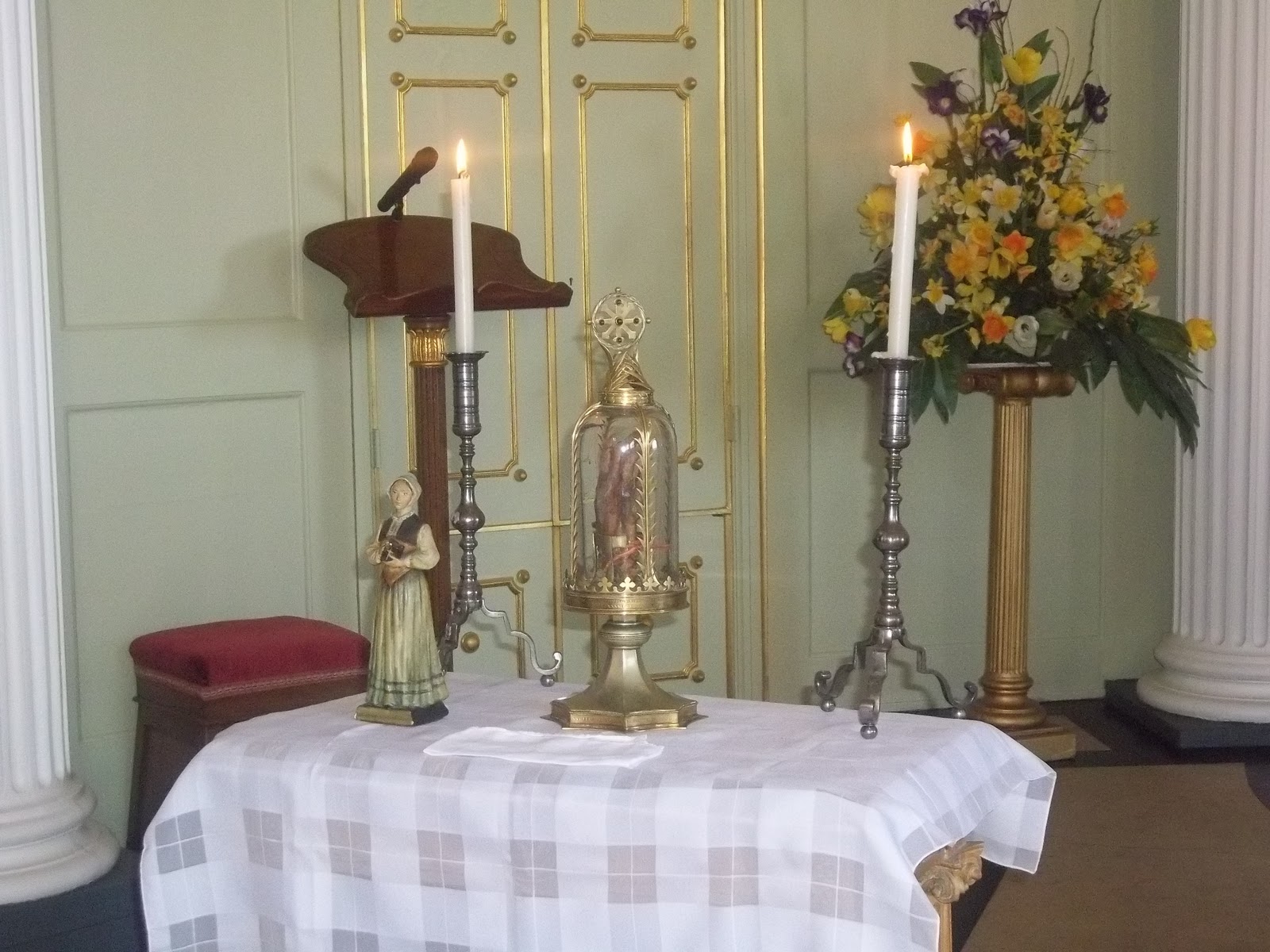
Margaret’s work for the English Catholic community and her martyrdom resulted in her canonization in the twentieth century. She was beatified in 1929 and canonized in October of 1970 — one of the Forty Martyrs of England and Wales. After her execution, somebody apparently chopped off her hand to preserve as a relic at the Bar Convent in York. Margaret’s feast day in the current Roman Catholic calendar, together with that of the other thirty-nine English martyrs, is May 4 — although in England it is celebrated on August 30.

A few books about Margaret Clitherow

* Editor’s note: the trial could not begin without a guilty/not-guilty plea, so pressing was a means of forcing a mum defendant to the bar. Brute force often succeeded in extracting the necessary plea; however, because death by pressing preceded trial or conviction, a defendant hardy enough to undergo that fate could use it as a means to skip to the “execution” without suffering the other pains of criminal conviction. In Margaret’s case, she avoided the potential implication of other furtive Catholics at trial; in Giles Corey’s case, he avoided forfeiting his property upon the inevitable witchcraft conviction, and passed his estate to his heirs instead.

On this day..

1936: George W. Barrett, the first to hang for killing an FBI man

(Thanks to Meaghan Good of the Charley Project for the guest post. -ed.)

On this date in 1936, Kentucky native George W. Barrett was hanged in Lockport, Indiana.

A rather nasty but ordinary enough career criminal specializing in car theft, Barrett also dabbled in murder. According to Keven McQueen’s book Offbeat Kentuckians: Legends to Lunatics, in 1930 he shot to death his elderly mother and his sister (who lingered for an extended time before dying of pneumonia, the consequence of her wounds), but pleaded “self-defense.”

Two juries were unable to reach a verdict.

Minor detail: Barrett’s cousin, Frank Baker, was the prosecutor in that case, and observers noted he appeared rather less than zealous about convicting his relative; the judge even remarked that Baker sounded more like Barrett’s defense attorney.

After his 1931 murder trial, a decidedly ungrateful Barrett allegedly murdered Frank Baker.

At his 1933 trial in that case he got a hung jury again, in spite of the fact that the only relative of his involved in the trial was the victim.

FBI agent Nelson Klein: shot dead in Ohio, but his killer hanged in Indiana.

Third time’s the charm: Barrett finally got his just deserts on December 7, 1935, when he was convicted of murdering FBI Agent Nelson B. Klein. The jurors stayed out for two days, but supposedly they decided on his guilt long before then and only wanted a few more free meals.

Barrett had killed Agent Klein in a shootout on August 14, 1935; before dying, Klein shot back, hitting Barrett in the legs and crippling him. The other agent involved in the gunfight, Donald McGovern, was unscathed and arrested Barrett.

There was an interesting dispute as to which state had jurisdiction over the crime; the agents had been standing in College Corner, Ohio, but the killer fired his shots from a position 22 feet over the Indiana state line. In the end, Indiana got the honors.

A recent federal law had mandated the death sentence for anyone convicted of killing an FBI agent. Barrett was the first to die under the new law; another man who’d murdered two agents in 1934 got a life sentence in Alcatraz.

The leg wounds Barrett suffered in his last shootout never healed. He attended his trial in a wheelchair and ultimately had to be carried to the gallows.

On this day..

1860: William Fee, the only person hanged in Wayne County

On this date in 1860, William Fee became the only person ever executed in Wayne County, New York.

Fee’s alleged victim is not distinguished by a name, at least not one known to Fee’s prosecutors. The anonymous woman turned up dead September 26, 1859 on Wayne County’s old Montezuma Turnpike. She had been strangled, the coroner said — and ravished.

Though she was a stranger, the victim had been seen in the area inquiring about employment. Fee and another man named Muldoon had been observed following her the day previous, and that “following” was cast in a sinister light by their now-unknown whereabouts. Both men were laborers working on an enlargement of the Erie Canal around Lyons, N.Y.

Fee was eventually arrested in New York City; Muldoon, in Scranton, Pa. We’ll return to Muldoon later.

Fee and his ill-favored “Hibernian countenance” stood trial from January 30 to February 3, 1860. “Seats were at a premium in the court room and in the gallery behind the curtains there was a crowd of ladies, listening breathlessly to the testimony,” ran a retrospective from 1913. “During the noon hour, seats were bargained for and sold at 10 cents to 50 cents apiece.”

And though he maintained a superficial calm when the jury returned a guilty verdict against him — “Damn tough, but I’m not going to lie awake thinking about it” — William Fee broke down sobbing when the judge finally sentenced him.

The kid came from a working-class family and had a scrappy reputation. It wasn’t clear as he approached execution that he was handling it with the gravity expected for the occasion by right-thinking gentlemen. Then there was the worry for his eternal salvation: born of mixed Protestant/Catholic parents, he was essentially irreligious and indifferent to a parade of ministers who called upon his cell. (Fee accepted the ministrations of a couple of Catholic priests in his very last hours.)

While clerics kneaded the hard clay of Fee’s soul, municipal officials took a chisel to logistics. Since this was the first (and last) hanging in these parts, the equipment had to be obtained on loan: they borrowed the upward-jerking gallows recently used to execute Ira Stout in upstate New York.*

The gallows was erected in one of the small halls of the jail … four upright posts twelve feet high and five feet apart. Across the top was an oak timber projecting two feet or more beyond the frame. At the front end, above where the prisoner was to stand was a grooved wheel or pully; and another was inserted in the timber over the centre of the frame. The main rope ran over these rollers, one end falling in front, to which the halter was attached, the other dropping to the centre of the gallows frame, where heavy weights were attached. These weights, in all 254 pounds, were suspended by a small cord passing through the main timber above and over it to a pin. The weights had a fall of perhaps eight feet. When the cord was severed by a blow of the axe, the weights fell and jerked the main rope running over the grooved wheels. In order that there should be no failure, Sheriff Snedaker had the gallows put up in the court house and fully tested before removing it to the jail. (New York Herald, April 3, 1860)

Fee came to this device still asserting his innocence, but also asserting that Muldoon wasn’t involved. Don’t worry if those seem a bit at odds; the execution party was confused enough to require clarification, too. Cut him some slack: those 254 pounds of weights weren’t going to cut him any.

The hanging went off without difficulty and, whether influenced by Fee’s parting attempt at exoneration or otherwise, Muldoon was never ultimately brought to trial. The evidence against him being unsatisfactory, he was released some months later.

William Fee’s afterlife — apart from this blog post — is allegedly spent haunting his old Lyons Jail (today, the Wayne County Museum).

* From reports, Wayne County didn’t return the gallows: it was eventually scrapped (someone made a chair out of part of it), and the Lyons Republican nicked the hanging-weight to use as a doorstop.

On this day..

1881: George Parrott, future footwear

(Thanks to Meaghan Good of the Charley Project for the guest post. -ed.)

On this date in 1881, George Parrott, a cattle rustler popularly known as Big Nose George, was lynched in Rawlins, Wyoming.

His story doesn’t end with his death, however: as his Wikipedia entry notes, Parrott was notable for “Banditry, Murder, being made into a pair of shoes.” Oh, and being pickled.

The series of events that lead to Parrott’s death began on August 19, 1878, when he and his gang tried to wreck a train near Medicine Bow, Wyoming so they could rob it. They loosened a rail and waited patiently, but an alert section foreman spotted the loose rail and notified railroad authorities, who came and fixed it before the train arrived.
Realizing the law would be after them, Parrott’s gang fled toward Elk Mountain and hid in Rattlesnake Canyon, waiting to ambush the posse they knew would be coming.

As soon as the lawmen were within their rifle sights, the bandits opened fire. Parrott killed Tip Vincent, a Union Pacific Railroad agent; one of the other fugitives, “Dutch” Charley Bates, killed Deputy Sheriff Robert Widdowfield. The gang then fled and hid out in Montana for a span, eventually reaching Canada — and all the while continuing their criminal ways.

Parrott couldn’t keep his mouth shut about his outlaw exploits and bragged everywhere he went. Inevitably, someone who’d heard one of his stories went to Rawlins and happened to mention the hook-nosed man who’d tried to derail a train, then killed two people when their plan failed.

“Dutch” Charley Bates was arrested in Green River, Wyoming in December 1878 and put on a train bound for Rawlins to face trial. Ironically, it was the same train he’d tried to derail earlier that year.

But Bates never made it to Rawlins: when the train made a stop at Carbon City, a group of masked vigilantes overpowered Bates’s guards, hauled him off the train, forced him to confess to his crimes and then hoisted him up on a rope to slowly strangle to death.

Parrott remained at large and the reward for his capture grew to $2,000 before his big mouth got him into trouble again. He and his gang had held up several stagecoaches and pulled off a particularly lucrative job in July 1880. He bragged about it to a lady friend, who told other people, and eventually word reached the ears of the Rawlins sheriff. Within hours he was under arrest.

In a repeat of the Bates lynching, a posse forced Parrott from his Rawlins-bound train in Carbon City. R. Michael Wilson, in his book Frontier Justice in the Wild West, writes what happened next:

They escorted him onto the station platform, put a noose around his neck, yanked him up, then lowered him and asked for a full confession. When he hesitated the men pulled him up several times and then promised that if he confessed, he would be given a fair trial — but if he did not confess, he would be hung. Parrott talked, and once he began, he gave every detail of his various criminal ventures, some of which were quite a surprise to the vigilantes. The mob, true to their word, then returned the prisoner to the custody of Sheriff Rankin.

That’s touching behavior for a vigilante mob, but it sure feels like Carbon City could stand to tighten up its railroad security.

At any rate, Parrott was tried for Tip Vincent’s murder in the fall of 1880, convicted, and sentenced to death.

However, on March 20, 1881, thirteen days before he was scheduled to hang, he made a desperate escape attempt. Though Parrott managed to knock Sheriff Rankin unconscious, Mrs. Rankin foiled the breakout by locking up the cells before Parrott could get out. Extra guards were assigned to watch him after that.

As Wilson records,

Sheriff Rankin asked the townsmen to wait the short time remaining before the prisoner was to be legally hanged, but the general opinion was that the sheriff had taken enough abuse from the prisoner and that Parrott might yet escape if left to await his fate on April 2. On March 22 at 10:55 p.m., a party of thirty masked men went to the jail and removed Parrott. They marched him to the telegraph pole … A rope was placed over the crossbeam of a telegraph pole, the noose was secured around the prisoner’s neck, and Parrott was forced to stand upon a barrel. Parrott begged piteously to be shot and cried out that it was cruel to hang him, but his pleas were ignored.

They kicked the barrel out from under him, but it was too short: the rope and Parrott’s neck stretched enough so that his toes touched the ground.

The mob cut him down and went and got a ladder. Parrott climbed it and said he would jump off and break his neck, but as far as the vigilantes were concerned, that was too good for him: they pulled the ladder away instead, and he slowly strangled to death, tearing off one of his ears in the process.

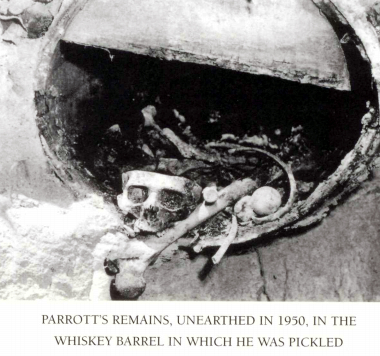
Drs. Thomas Maghee and John Eugene Osborne conducted the autopsy, examined Parrott’s brain, and could find no apparent abnormalities. Osborne then removed a large piece of skin from the dead man’s chest, kept the skullcap, and put the rest of the body in a whiskey barrel full of saline solution, effectively pickling it. The barrel was buried without ceremony, and Dr. Osborne had the skin tanned. He sent the leather to a shoemaker, who made him a pair of shoes with it.

Dr. Osborne was disappointed that Parrott’s nipples weren’t on the tips of the toes like he’d requested (!!!), but you can’t have everything you want in life.

He wore the human leather shoes on special occasions, including at his inaugural ball when he was elected governor of Wyoming in 1890. The skullcap he gave to his fifteen-year-old female assistant, Lillian Heath, who used it variously as a doorstop and an ashtray. (She would grow up to become the first female doctor in Wyoming.)

Parrott’s pickled remains were dug up at a construction site in 1950, and identified after some confusion. His skull, as well as the shoes, are now on display at the Carbon County Museum.

On this day..

1857: Gaspard Matraccia, parrot-lover

From the London Times, March 26, 1857.

AN EXECUTION AT MARSEILLES. — Matraccia, the Italian who, as reported in the Messenger, was some short time back condemned to death by the Court of Assizes of Aix for a series of extraordinary murders at Marseilles, was executed in the latter city on Saturday morning.

At 4 o’clock he was awakened by the chaplain and director of the prison, and told that the petition for a commutation of punishment which he had sent to the Emperor was rejected, and that he was about to be executed. He received the announcement with the greatest calmness, and getting up, seated himself on the side of the bed, and took some coffee and smoked several cigars.

At 6 o’clock he attended mass, and during the service he appeared very devout. The mass was followed by a sermon, which seemed to make a great impression on him. The service was attended by all the prisoners.

When it was concluded, Matraccia was taken back to his cell, and supplied with breakfast. Shortly before 7 o’clock the clerk of the Court of Assizes read to him the text of his condemnation, the chaplain translating it into Italian. He listened to the reading and translation with great resignation, and when they were concluded embraced the clerk and all the persons present, most of whom were so affected that they shed tears.

Shortly after the executioners of Aix and Nismes, accompanied by an assistant, arrived, and proceeded to pinion the condemned. He was then freed from the irons on his legs and he asked if he could not be allowed to walk to the scaffold, but was told that he must be conveyed in a cellular van.

He then begged, as a special favour, that he might be accompanied by one of his friends, a countryman, who had been with him all the morning, and that his parrot, which was in a cage in his cell, might be taken with him to the scaffold. Both these requests were granted, and he was placed in a van, the chaplain being in attendance on him.

Arrived at the scaffold, which was erected in the Place St. Michel, and which was surrounded by an immense crowd, consisting of at least 30,000 persons, the vehicle stopped, and the cage containing the parrot was, to the surprise of the spectators, first placed on the scaffold; the criminal, his friend, and the chaplain then alighted from the van, Matraccia cast a glance at the guillotine, and embraced several persons who were present.

Then, supported by his friend and the chaplain, he ascended the steps of the scaffold, and in doing so it was observed that he slightly trembled.

When he reached the platform he kissed with great fervour the crucifix which the chaplain presented; then he embraced the chaplain and his friend, and then, turning to the parrot, he said in Italian, “Your master is about to die, and he embraces you for the last time.”

Afterwards he advanced towards the front of the scaffold, and cried to the people, “I demand pardon of the inhabitants of Marseilles for the scandal I have occasioned. Pray for me, for in a few minutes I shall pray for you.”

He was then seized by the executioners, and in a few seconds all was over.

On this day..

2007: Taha Yasin Ramadan, Iraqi Vice-President

On this date in 2007, Saddam Hussein‘s former Vice President Taha Yassin Ramadan was hanged for helping conduct the 1982 Dujail Massacre of Shia Iraqis in revenge for an assassination plot against Saddam.

Pushing 70, the Kurd was a longtime pillar of the Iraqi Ba’ath party and had served in a variety of posts since it took power in 1968. For instance, he brought his management expertise to the Ministry of Industry: “I don’t know anything about industry. All I know is that anyone who doesn’t work hard will be executed.”

He was noted for his role in orchestrating Saddam Hussein’s terrifying 1979 internal purge.

While the first operations of America’s 2003 invasion took place on March 19, it was March 20, 2003 local time that the land invasion proper commenced. That made Ramadan’s execution a fourth-anniversary gift to the occupier’s preposterous foreign policy blunder.

Which was all too bad, since Ramadan had also floated a 2002 plan to avert conflict: have Saddam Hussein fight a duel with George W. Bush. Of course, the offer was declined. “An irresponsible statement,” replied the spokesman of a government that was at that moment engaged in a mendacious campaign to justify its coming aggressive war with creative fables about Iraq’s nuclear capacity.

On this day..

1866: John Dunn, teenage bushranger

On this date in 1866, 19-year-old Australian bushranger John Dunn was hanged at Darlinghurst Gaol.

Young master Dunn, deft hand with a horse and a firearm, in 1864 joined a notorious outlaw gang then under the leadership of Ben Hall and John Gilbert.

This gang very quickly came to grief as both Hall and Gilbert were shot dead by police in May 1865. They’d been outlawed under new anti-bushranger legislation (pdf) enacted in 1865 by a parliament impatient with “the constant outrages on person and property of which the interior has for years been the scene.”

This new Felons Apprehension Act — despite its name — empowered people to kill alleged bushrangers without attempting to detain them. It did this by setting up a fast-track process to legally outlaw (pdf) individuals by name.

Dunn done did his own part to stir up this legal hornet’s nest by killing a constable named Samuel Nelson (father of eight children!) during a hotel stickup at the New South Wales hamlet of Collector.


(cc) image from AYArktos.

But the kid had better elusiveness than his bosses.

Dunn managed to escape the shootout that killed Gilbert and disappear for the best part of a year. Only in December of 1865 was he finally recognized and captured. (Then he escaped from detention, and had to be re-captured.)

Once they could keep him long enough to try him, Dunn was done for. It took a jury ten minutes to order him to hang.

Dunn’s godmother buried him at Sydney’s Devonshire Street Cemetery under a headstone reading, “He has gone to his grave but we must not deplore him though sorrow and darkness encompass his tomb — the Saviour has passed through its portals before him and the light of his love was the lamp through his doom.”

On this day..

1825: Peggy Facto, Plattsburgh infanticide

On this date in 1825, a woman named Peggy Facto was hung on Plattsburgh, N.Y.‘s Broad Street Arsenal Lot.

Facto — or “Facteau,” which variant recalls the French influence here on the shores of Lake Champlain — started her way to the gallows the previous autumn when some neighborhood dogs unearthed the remains of a human infant. It had been partially burned in a fireplace, and when found it still had fast about its throat the cord used to choke it to death. (Plus, of course, the dogs had done their own damage.)

This hideous discovery led back to our day’s principal character, the local mother of two [living] children whose husband had abandoned her due to her affair with a guy named Francis LaBare. Both Peggy and Francis were indicted for “being moved and seduced by the instigation of the devil” to murder their inconvenient bastard immediately after birth.

They faced separate trials for the crime, just hours apart on January 19, 1825, on very similar evidence. Witnesses established the discovery of the body, and an acquaintance named Mary Chandreau testified that she had seen Peggy Facto in an obvious late stage of pregnancy that August. This woman also visited Peggy Facto in jail before trial, and testified that Peggy admitted to having taken a string from one of her gowns to furnish the strangulation-cord.

While this evidence was sufficient to condemn Peggy Facto upon mere minutes of juror deliberation, the same case against Francis LaBare resulted in an acquittal. The mother, who did not testify at her own trial, did take the stand at LaBare’s trial, claiming (according to the notes of the judge), that immediately after she delivered the child, Facto

asked [LaBare] to go find her mother & he refused. She then asked him to go find Mrs. Chandreau & he refused, and next asked him if he meant to let her die there & he said the damned old bitch, I can do better than she can. She then requested him to help her & he did & then the child was born & he took it out and went off & was gone an hour, and when he returned … he came towards her with a knife & threatened her life if she said anything about it.

This quote, and much of what is known about Peggy Facto generally, comes via the research of Plattsburgh judge Penelope Clute. See here and here for HTML versions of the article, or here for a pdf.

It’s difficult to account, on the face of it, for the wildly differential outcomes of these trials; the all-male juries might have something to do with it.

At any rate, while LaBare walked, judge Reuben Walworth* pronounced Facto’s fate with enough fury for two … and a distinct disbelief in Facto’s attempt to blame LaBare:

there are very strong reasons for the belief that your own wicked hands have perpetrated the horrid deed. And if there was any other guilty participator in the murder, that your own wickedness and depravity instigated and persuaded him to participate in your crime. To the crime of murder, you have added the crime of perjury, and that in the face of Heaven, and even on the very threshhold of eternity. I am also constrained to say, it is much to be feared, that you will meet more than one murdered child, as an accusing spirit at the bar of Heaven.

Wretched and deluded woman! In vain was the foul and unnatural murder committed under the protecting shade of night, in your lone and sequestered dwelling, where no human eye was near to witness your guilt.

Facto’s only “appeal” after her half-day trial was the clemency consideration of Gov. DeWitt Clinton, a petition that ended up garnering a great deal of popular support, on three stated grounds:

  1. doubts with many as to the guilt of the convict
  2. as to this being a case that requires a public example
  3. As to the policy of executing any person for the crime of murder when the public opinion is much divided on this subject

Even Judge Walworth ultimately supported this appeal, despite his confidence “that the woman was perfectly abandoned and depraved and that she had destroyed this child and probably the one the year previous, not for the purpose of hiding her shame which was open and apparent to everybody that saw her but for the purpose of ridding herself of the trouble of taking care of them and providing for their support.”

The governor disagreed, arguing that the sort of enlightened people who signed on to death penalty appeals were out of touch with the rank terror necessary to keep the criminal orders cowed.**

So on March 18, 1825, an enormous crowd (fretfully many of them women) summoned from all the nearby towns slogged through spring-muddied roads to be duly cowed by the execution of the infanticide. The condemned, visibly terrified, barely made it through her death-ritual without fainting away, but she managed to re-assert her innocence from the gallows. (Some of the firsthand newspapering is here.)

After execution, Peggy Facto’s remains were turned over to the Medical Society for dissection. “A great many went to see her body, although it had been agreed that it should not be seen,” one woman later recollected in her memoirs. “Many young men went. So much talk was made of this that they said that no other body should ever be given to the doctors.”

* Walworth was a man of illustrious descent; one ancestor, William Walworth, was the Lord Mayor of London who killed Wat Tyler.

Judge Walworth would later become, for two decades, New York’s highest-ranking judicial officer; Walworth, N.Y. and Walworth County, Wisc. are named for him. But the American Walworths were bound for a tragic end … including a scandalous murder.

** “Their excellent character elevates them above those feelings which govern the conduct of the depraved … if terror loses its influence with them then indeed the life of no man will be secure.” For more on the evolution of the idea of “exemplary deterrence” as the death penalty’s raison d’etre, see Paul Friedland.

On this day..

1662: Rose Cullender and Amy Denny, Bury St. Edmunds witches

On this date in 1662, two elderly women were hung at Bury St. Edmunds for bewitching various neighborhood children.

This trial, the second notable witch trial at Bury St. Edmunds in the mid-17th century, got going when a well-off merchant, Samuel Pacy repeatedly declined to buy herring from Amy Denny (also spelled Deny or Duny in various accounts). Denny was heard muttering something indistinct as she left the house, and soon Pacy’s daughter Deborah was seized by the “most violent fits, feeling most extream pain in her Stomach, like the pricking of Pins, and Shreeking out in a most dreadful manner like unto a Whelp, and not like unto a sensible Creature.”

Actually, Deborah had already been hit with “”was suddenly taken with a Lameness in her Leggs, so that she could not stand” even before Amy Denny’s visit. Nonetheless, she apparently called out Amy Denny’s name during her throes of this most recent affliction. When an area doctor couldn’t diagnose the situation, Pacy finally filed a witchcraft complaint.

That was Oct. 28, 1661, when Amy Denny was clapped in irons. Two days later, the heretofore unperturbed eldest daughter (age: 11) came down with the same stuff. Anyone with a bit of experience in multiple-child is probably conjuring up an alternative hypothesis right this moment.

Both girls now commenced a litany of woes, coughing up pins, and reporting visions of evil little witches’ familiars like mice and flies, and having dreams “that Amy Duny and Rose Cullender would appear before them holding their Fists at them, threatning, That if they related either what they saw or heard, that they would Torment them Ten times more than eve they did before.”

Rose Cullender was another local widow of advanced age. Like Denny, Cullender had a pre-existing reputation as a witch.

By the time these two crones went on trial on March 10 — a week before their hangings — three other teenage girls were rocking the same symptoms. They even showed up to court, where they “fell into strange and violent fits, screeking out in a most sad manner, so that they could not in any wise give any Instructions in the Court who were the Cause of their Distemper.” Yet another woman deposed that Amy Denny had, several years before, bewitched both of her children, killing one of them: she said she caught a toad lurking around her ailing child, threw it in the fire, and the next day Denny was covered with burns. She didn’t say why she hadn’t mentioned any of this before.

The scientist Thomas Browne turned up to provide expert testimony that witchcraft did exist and that “the Devil” could exacerbate otherwise natural illnesses arising from an imbalance of the four humours.

stir up and excite such humors, super-abounding in [human] Bodies to a great excess, whereby he did in an extraordinary manner afflict them with such distempers as their bodies were most subject to, as particularly appeared in these children; for he conceived, that these swooning fits were natural, and nothing else but that they call the Mother, but only heightened to a great excess by the subtlety of the devil, cooperating with the malice of these which we term witches, at whose instance he doth these villanies.

Despite the court’s confidence as to the existence of witchcraft (The judge — more on him in a bit — instructed the jury that there could be no question on this point, only as to whether the children at hand were indeed bewitched at the defendants’ hands), it did its best impression of skepticism, trying to verify the sorcery by means of whatever tests it could. Unfortunately, the era’s forensics left something to be desired.

Samuel Pacy’s daughters’ reactions to Amy Denny were tested in a few different ways. For instance, as they sat near-comatose with fists clenched, nobody in the court could pry open their stubborn hands … but they popped right open when Amy Denny touched them. Elizabeth once broke out of her torpor to scratch and claw wildly at Amy Denny.

This little girl failed a more plausible test, however. When she was blindfolded and touched by two different women, she had the same reaction to both Amy Denny and the control contact. This embarrassing result was waved off by the widespread conviction in the courtroom that nobody “should counterfeit such Distempers, being accompanied with such various Circumstances, much less Children; and for so long time.” By the time of the trial, it was fully five months since Amy Denny had tried to get the Pacys to buy her darn herring.

In the end, none of the six still-living children supposedly affected by the witches testified directly. Their creepy presence in court did the talking for them. Within the hour after jurors handed down convictions for both women, all the children were freed of their symptoms. Both women, however, refused the many imprecations to confess and set their souls right before execution on March 17.

Noted jurist Matthew Hale heard the case (he was fresh off an assignment trying Charles I‘s regicides). Hale later became Chief Justice of the King’s Bench.

And his authority in this case survived his death in 1676. In the 1680s there was a (slightly misdated) pamphlet published, “A Tryal of Witches at the Assizes Held at Bury St. Edmonds for the County of Suffolk; on the Tenth day of March, 1664”.

Hale’s reputation gave the weight of juridical precedent to his witchcraft superstition.

Across the pond in New England, the Salem witch trials judges would refer to this very case when determining to admit so-called “spectral evidence” from the shitty little fabulistspossessed children who accused various townsfolk of enspelling them.

Witch trials apologist Cotton Mather dedicated a whole chapter (under the title “A Modern Instance of Witches, Discovered and Condemned in a Tryal, before that Celebrated Judg, Sir Matthew Hale”) to the authority established by the Cullender-Denny trial.

It may cast some Light upon the Dark things now in America, if we just give a glance upon the like things lately happening in Europe. We may see the Witchcrafts here most exactly resemble the Witchcrafts there; and we may learn what sort of Devils do trouble the World.

The Venerable Baxter very truly says, [“]Judge Hale was a Person, than whom no man was more Backward to condemn a Witch, without full Evidence.[“]

Now, one of his latest Printed Accounts about a Tryal of Witches, is of what was before him … it was a Tryal, much considered by the Judges of New-England.

… [Mather spends several pages outlining the investigation and trial] …

The next Morning, the Children with their Parents, came to the Lodgings of the Lord Chief Justice [i.e., Hale, although he was not Chief Justice in 1662], and were in as good health as ever in their Lives; being restored within half an Hour after the Witches were Convicted.

The Witches were Executed, and Confessed nothing; which indeed will not be wondered by them, who Consider and Entertain the Judgment of a Judicious Writer, That the Unpardonable Sin, is most usually Committed by Professors of the Christian Religion, falling into Witchcraft.

We will now proceed unto several of the like Trials among our selves.

On this day..

1649: Saint Jean de Brébeuf, missionary to the Huron

It was on this date that the Jesuit missionary Saint Jean de Brébeuf was martyred by indigenous Iroquois near present-day Midland, Ontario.

(cc) image from Patrick Shanks

Brebeuf was of Norman stock, kin to poet Georges de Brebeuf.

Ordained in 1622, Brebeuf soon decamped to the New World to Christianize the natives.

There he teamed up with another Jesuit missionary named Gabriel Lalemant and established the Sainte-Marie among the Hurons mission.

As the name advertises, this outpost aimed to minister to the Hurons (Wyandot); to that end, Brebeuf — who learned the local tongue well enough to write a catechism and a dictionary — composed the still-beloved Christmas song “Huron Carol”.

Brebeuf’s own missives recording Huron established him an energetic chronicler who has been styled Canada’s first serious ethnographer. For instance, Brebeuf on the POW treatment he saw the Huron dish out:

when they seize some of their enemies, they treat them with all the cruelty they can devise. Five or six days will sometimes pass in assuaging their wrath, and in burning them at a slow fire; and they are not satisfied with seeing their skins entirely roasted, — they open the legs, the thighs, the arms, and the most fleshy parts, and thrust therein glowing brands, or red-hot hatchets … After having at last brained a victim, if he was a brave man, they tear out his heart, roast it on the coals, and distribute it in pieces to the young men; they think that this renders them courageous … we hope, with the assistance of Heaven, that the knowledge of the true God will entirely banish from this Country such barbarity. (From the Jesuit Relations, volume 10)

Well … not just yet.

Brebeuf regrettably foreshadowed his own ghastly fate, for during his ministry, the Huron and Iroquois went to war. No fewer than eight men posted to Brebeuf’s mission were martyred during 1640s Huron-Iroquois wars.

On March 16, 1649, Iroquois captured Brebeuf and Lalemant, and subjected them to a horrific death just like the sort of thing Brebeuf had seen inflicted by the Huron. Other Jesuit missionaries recorded the tortures from eyewitness accounts given in the subsequent weeks:

As soon as they were taken captive, they were stripped naked, and some of their nails were torn out; and the welcome which they received upon entering the village of St. Ignace was a hailstorm of blows with sticks upon their shoulders, their loins, their legs, their breasts, their bellies, and their faces, — there being no part of their bodies which did not then endure its torment.

Father Jean de Brebeuf, overwhelmed under the burden of these blows, did not on that account lose care for his flock; seeing himself surrounded with Christians whom he had instructed, and who were in captivity with him, he said to them: “My children, let us lift our eyes to Heaven at the height of our afflictions; let us remember that God is the witness of our sufferings, and will soon be our exceeding great reward. Let us die in this faith; and let us hope from his goodness the fulfillment of his promises. I have more pity for you than for myself; but sustain with courage the few remaining torments. They will end with our lives; the glory which follows them will never have an end.” “Echon,” they said to him (this is the name which the Hurons gave the Father), “our spirits will be in Heaven when our bodies shall be suffering on earth. Pray to God for us, that he may show us mercy; we will invoke him even until death.”

Some Huron Infidels — former captives of the Iroquois, naturalized among them, and former enemies of the Faith — were irritated by these words, and because our Fathers in their captivity had not their tongues captive. They cut off the hands of one, and pierce the other with sharp awls and iron points; they apply under their armpits and upon their loins hatchets heated red in the fire, and put a necklace of these about their necks in such a way that all the motions of their bodies gave them a new torture. For, if they attempted to lean forward, the red-hot hatchets which hung behind them burned the shoulders everywhere; and if they thought to avoid that pain, bending back a little, their stomachs and breasts experienced a similar torment; if they stood upright, without leaning to one side or the other, these glowing hatchets, touching them alike on all sides, were a double torture to them. They put about them belts of bark, filled with pitch and resin, to which they set fire, which scorched the whole of their bodies.

At the height of these torments, Father Gabriel Lallement lifted his eyes to Heaven, clasping his hands from time to time, and uttering sighs to God, whom he invoked to his aid. Father Jean de Brebeuf suffered like a rock, insensible to the fires and the flames, without uttering any cry, and keeping a profound silence, which astonished his executioners themselves: no doubt, his heart was then reposing in his God. Then, returning to himself, he preached to those Infidels, and still more to many good Christian captives, who had compassion on him.

Those butchers, indignant at his zeal, in order to hinder him from further speaking of God, girdled his mouth, cut off his nose, and tore off his lips; but his blood spoke much more loudly than his lips had done; and, his heart not being yet torn out, his tongue did not fail to render him service until the last sigh, for blessing God for these torments, and for animating the Christians more vigorously than he had ever done.

In derision of holy Baptism, — which these good Fathers had so charitably administered even at the breach, and in the hottest of the fight,—those wretches, enemies of the Faith, bethought themselves to baptize them with boiling water. Their bodies were entirely bathed with it, two or three times, and more, with biting gibes, which accompanied these torments. “We baptize thee,” said these wretches, “to the end that thou mayst be blessed in Heaven; for without proper Baptism one cannot be saved.” Others added, mocking, “we treat thee as a friend, since we shall be the cause of thy greatest happiness up in Heaven; thank us for so many good offices, — for, the more thou sufferest, the more thy God will reward thee.”

These were Infidel Hurons, former captives of the Iroquois, and, of old, enemies of the Faith, — who, having previously had sufficient instruction for their salvation, impiously abused it, — in reality, for the glory of the Fathers; but it is much to be feared that it was also for their own misfortune.

The more these torments were augmented, the more the Fathers entreated God that their sins should not be the cause of the reprobation of these poor blind ones, whom they pardoned with all their heart. It is surely now that they say in repose, Transivimus per ignem et aquam, et eduxisti nos in refrigerium.

When they were fastened to the post where they suffered these torments, and where they were to die, they knelt down, they embraced it with joy, and kissed it piously as the object of their desires and their love, and as a sure and final pledge of their salvation. They were there some time in prayers, and longer than those butchers were willing to permit them. They put out Father Gabriel Lallement’s eyes and applied burning coals in the hollows of the same.

Their tortures were not of the same duration. Father Jean de Brebeuf was at the height of his torments at about three o’clock on the same day of the capture, the 16th day of March, and rendered up his soul about four o ‘ clock in the evening. Father Gabriel Lallement endured longer, from six o’clock in the evening until about nine o’clock the next morning, the seventeenth of March.

Before their death, both their hearts were torn out, by means of an opening above the breast; and those Barbarians inhumanly feasted thereon, drinking their blood quite warm, which they drew from its source with sacrilegious hands. While still quite full of life, pieces of flesh were removed from their thighs, from the calves of the legs, and from their arms, — which those executioners placed on coals to roast, and ate in their sight.

They had slashed their bodies in various parts; and, in order to increase the feeling of pain, they had thrust into these wounds red-hot hatchets.

Father Jean de Brebeuf had had the skin which covered his skull torn away; they had cut off his feet and torn the flesh from his thighs, even to the bone, and had split, with the blow of a hatchet, one of his jaws in two.

Father Gabriel Lallement had received a hatchet- blow on the left ear, which they had driven into his brain, which appeared exposed; we saw no part of his body, from the feet even to the head, which had not been broiled, and in which he had not been burned alive,—even the eyes, into which those impious ones had thrust burning coals.

They had broiled their tongues, repeatedly putting into their mouths flaming brands, and burning pieces of bark, — not willing that they should invoke, in dying, him for whom they were suffering, and who could never die in their hearts. I have learned all this from persons worthy of credence, who have seen it, and reported it to me personally, and who were then captives with them, — but who having been reserved to be put to death at another time, found means to escape.

But let us leave these objects of horror, and these monsters of cruelty; since one day all those parts will be endowed with an immortal glory, the greatness of their torments will be the measure of their happiness, and, from now on, they live in the repose of the Saints, and will dwell in it forever.

Brebeuf’s intercultural legacy allegedly lives on in sport form. Though it’s unverifiable folklore, it is said that Brebeuf saw Iroquois tribesmen playing the game of baggataway and, reckoning the sticks used to manipulate the ball resembled bishops’ croziers, conferred upon the game the name lacrosse.

Europeanized versions of this game (“with a few genteel refinements”) remain wildly popular in Canada, and are growing throughout North America. Lax bros can be found especially in the environs of well-heeled private high schools … like Brebeuf Jesuit Prep School (Indianapolis, Indiana).

On this day..