1979: Eleven by a Firing Squad in Iran

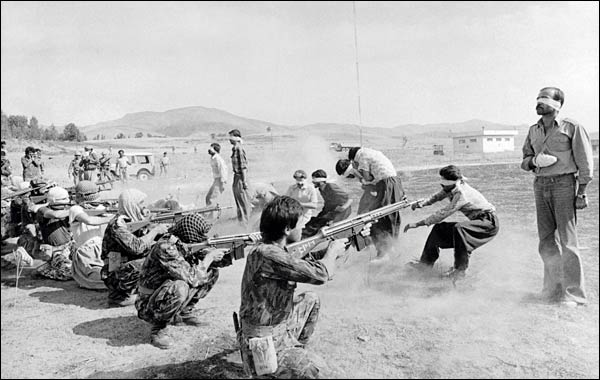
On this date in 1979, the only anonymous photograph to win a Pulitzer Prize captured nine Kurdish rebels and two of the Shah’s policemen executed by firing squad in revolutionary Iran.

This shot, one of a series taken of the event with the permission of the judge who condemned the men to immediate death in a half-hour trial at the Sanandaj airfield, ran the next day in the Iranian paper Ettela’at, whose editor prudently kept the photographer’s identity secret. Within two days, the stunning photo had rocketed around the world.

It won the Pulitzer Prize for Spot News Photography the following spring, still credited anonymously.

Two years ago, the Wall Street Journal revealed — with the photographer’s permission — the identity of the man who shot this indelible image: Jahangir Razmi, who had gone on to a career as one of Iran’s top photographic journalists. He came to New York to collect the prize 27 years late.

The article breaking the story is still available on the Journal‘s website, and on the personal site of reporter Joshua Prager. An NPR story discussing the search for Razmi’s identity is here.

On this day..

1305: William Wallace, Braveheart

On this date in 1305, Scottish knight Mel Gibson — er, William Wallace — was hanged, drawn and quartered at Smithfield for treason to a British crown he refused to recognize.

Just like so:

Well, close enough. Some wags have alleged one or two historical liberties in Braveheart.

Among the lesser (but more pertinent here): that they weren’t — you knew this already — offering the former Guardian of Scotland the opportunity to reduce his suffering with a public submission, or use the stage for theatrical defiance. Hanging, drawing and quartering was a brand new execution Edward I was experimenting with for emasculating, disemboweling, and (so the idea went) utterly cowing the rebellious hinterlands of the British Isles. Wallace may have been just the second person to suffer it.

But only a pointy-headed blogger could possibly care when the main point is that back before Christendom succumbed to nancy decadences like Vatican II, men wore woad, defenestrated queers, and tapped top-shelf babes.


Among the few things known for certain about William Wallace is that he did not score with Isabella of France. Or with Sophie Marceau.

Facts? This is show business!

Mel’s bloodbath only riffs the already-fantastic 15th century epic of “the Wallace” by Scottish minstrel Blind Harry, which in turn got a lyrical call-out in Robert Burns’ 18th century Scottish patriotic tune Scots Wha Hae.

National martyrs — and, sure, it helps to die at the right time, as Wallace did just before Robert the Bruce secured Scottish independence — feed a train of hungry authors and ready audiences in every time, place and medium.

However genuinely flesh-and-blood the limbs that wrought his feats and were torn apart on this day, Wallace returns to his generations of interlocutors half-shrouded in mythology. Seven centuries on, his contested (and sometimes absurd) use as precedent or metaphor stakes a claim to his Truth at least as compelling as battlefield tactics at Stirling Bridge. What does he “really” have to tell us? No matter how grisly his end, William Wallace doesn’t get to decide: it’s between you, me, Mel, and a few billion other folks.

Only a character really worth remembering is worth that kind of fictionalizing.

On this day..

1937: Ikki Kita

On this date in 1937, intellectual Kita Ikki (Kita is the family name) was executed by the Japanese military government for inspiring a failed coup d’etat the previous year.

A onetime socialist turned radical nationalist, Kita — born Kita Terujiro — preached a doctrine of authoritarian national restoration around some socialist-sounding communitarian purpose, coupled with an unapologetic imperialism.

His Outline Plan for the Reorganization of Japan (the translation is from a reader, Sources of Japanese Tradition, partially excerpted here) argues that in the wake of Europe’s self-immolation in World War I, initiative lay with the Land of the Rising Sun — and that the country must adopt a muscular unity of purpose to grasp it.

The entire Japanese people, thinking calmly from this perspective which is the result of Heaven’s rewards and punishments, should, in planning how the great Japanese empire should be reorganized, petition for a manifestation of the imperial prerogative establishing “a national opinion in which no dissenting voice is heard, by the organization of a great union of the Japanese people.” Thus, by homage to the emperor, a basis for national reorganization can be set up.

Truly, our 700 million brothers in China and India have no path to independence other than that offered by our guidance and protection. And for our Japan, whose population has doubled in the past fifty years, great areas adequate to support a population of at least 240 million or 250 million will be absolutely necessary a hundred years from now. For a nation, one hundred years are like a hundred days for an individual. How can those who are anxious about the inevitable developments or who grieve over the desperate conditions of neighboring countries find their solace in the effeminate pacifism of doctrinal socialism? … At a time when the authorities in the European and American revolutionary creeds have found it completely impossible to arrive at an understanding of the “gospel of the sword” because of their superficial philosophy, the noble Greece of Asian culture [meaning Japan, of course] must complete its national reorganization on the basis of its own national polity. At the same time, let it lift the virtuous banner of an Asian league and take the leadership in the world federation that must come. In so doing let it proclaim to the world the Way of Heaven in which all are children of Buddha, and let it set an example that the world must follow.

One could quibble about particulars, but it’s essentially fascism — paralleling Mussolini in doctrine as well as ideological evolution. (According to W.G. Beasley Kita also co-founded a Gen. Jack Ripper-esque Society for the Preservation of the National Essence.)

A military coup was supposed to get the ball rolling, which made him a guru to an aggressive cadre of young officers who tried to seize the government in the February 26 Incident, named for the date in 1936 it took place.

Kita wasn’t himself involved in the coup, but his intellectual sponsorship was enough of a connection for the Kempeitai.* Modern Japanese Thought tartly observes that Kita’s vision for an imperial dictatorship didn’t turn on any misty-eyed allegiance to the emperor’s person.

When he was executed for his role in the mutiny of 1936, he was ordered to recant by saying “long live the emperor” as a final act of reverence and submission. He is reported to have refused by replying that he had vowed long ago never to joke about his own death.

In Fighting Elegy (or Elegy to Violence or Elegy to Fighting), Seijun Suzuki’s 1960’s skewering of militarist 1930’s Japan (review), Kita makes cameos to inspire the main male character to greater feats of violent sublimation of his repressed sexuality. (The following clip is merely the trailer.)

There’s also a 1973 biopic — the last film of Yoshishige Yoshida.

* I don’t have definite documentation on the method of execution; I’m supposing it was hanging, the standard method in Japan since the Meiji period.

On this day..

1963: Henry John Burnett, Scotland’s last hanging

On this date in 1963, the executioner paid his last call to Scotland with the hanging of Henry John Burnett for the murder of a rival-in-love seaman.

The type whom parents hope their daughter never dates, Burnett liked to keep his squeeze Margaret May Guyan under lock and key to keep her stepping out on him.

It’s an old, old tale. Boy meets girl, boy makes girl his prisoner, girl gets creeped out and returns to estranged hubby Thomas Guyan at 14 Jackson Terrace in Aberdeen, boy blasts Guyan in the face with a shotgun. How many times have we heard it told?

Even though the noose was on its way out — this is not only the last execution in Scotland, but the only hanging in Aberdeen in the past century and a half — there wasn’t much pussyfooting around when they’d made up their mind to use it: Burnett outlived his victim by only eleven weeks — notwithstanding an insanity plea and clemency petitions from both his own and the victim’s families — before hanging at Craiginches Prison, a facility that surely ought to be somebody’s porn name.

It’s got pride of place in a book about Aberdeen crime history, Blood and Granite. Because you can find anything on YouTube, there’s also this fine teaser for a forthcoming animation project of some kind:

Part of the Themed Set: At the End of the Rope.

On this day..

1936: Rainey Bethea, America’s last public hanging

On this date in 1936, thousands thronged Owensboro, Kentucky, for a glimpse of what would prove to be the last public hanging in the United States.

The U.S. followed the trend of its onetime mother country, England, in moving the formerly iconic public hanging increasingly behind closed doors, but its federalist structure made that change uneven. In Kentucky itself at this time, the law displayed sedimentary layers of death penalty history.

Caught up for killing a 70-year-old woman — done in the midst of a drunken burglary, he had left a telltale ring at the scene; fingerprint analysis also helped establish his guilt — Rainey Bethea was on the hook for murder, robbery and rape. The former two indictments would have subjected him to (private) electrocution at the state penitentiary. The latter charge still carried the punishment of public hanging in the local county seat.

Bethea was charged only with rape.

While the explicit sentencing disparity between the crimes bears the clear marks of racism and patriarchy that made purported black-on-white sexual crimes such live fodder for lynch law, and the four-and-a-half-minute jury deliberation doesn’t have the look of solemnity, Bethea’s actual guilt seems fairly well-established.

But the case attracted a nationwide media swarm not for any exceptional quality of the crime or the anachronistic nature of the punishment, but for the involvement of a female sheriff. The “matronly” (virtually all descriptions of her gravitate to this adjective) Florence Thompson had inherited the top law enforcement post upon the death of her husband … and that meant she had inherited the responsibility of hanging Rainey Bethea, which would make her the first American woman to supervise an execution.

Would she or wouldn’t she? The press descended on Owensboro to cover the edifying spectacle of a plump mother stringing up a rapist, or else maneuvering her way out of the job. Thompson played cagey until the very last moment, when the ringers she had secretly hired appeared on the scaffold while she watched from a nearby vehicle.
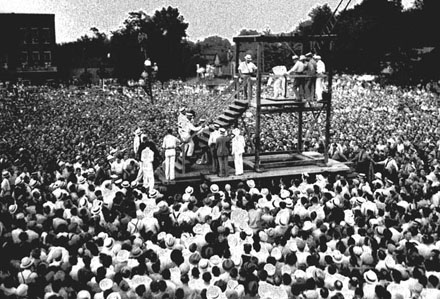
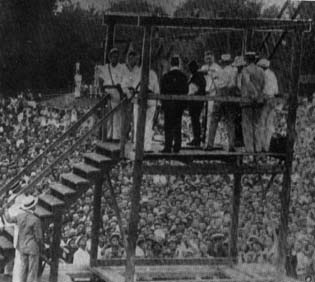
In this photo, Bethea — almost totally obscured between his escorts — has just begun ascending the gallows.

The man who threw the trap showed up drunk and performed appallingly, but press reports subsequently focused on the beastly behavior of the “jeering” crowd rushing the gallows to tear souvenirs from the corpse. (For instance, Time and the New York Times.)

But according to Perry T. Ryan’s 1992 review of the case — including interviews with surviving witnesses — little to nothing of the kind occurred. Ryan claims Bethea faced about the most dignified hanging mob imaginable.

Maybe hyped-up atrocities in the hinterlands were part of what distant editors demanded after H.L. Mencken at the Scopes trial. Certainly, the local Messenger-Inquirer painted a sharply different picture from more prominent outlets in this August 16 editorial (titled “Panderers Galore”) whose themes could have stepped fresh from a modern cable TV gabfest:

Ambitious and irresponsible reporters and photographers who swarmed into Owensboro for the Bethea hanging dipped their ready hands into the cloaca of evil designs and plastered over the name of this fair city the dirty results of their pandering.

Those who saw the dawn kindling in the east and ushering in the last sunrise of the despicable creature about to die, did not expect all of the watchers to be in reverent mood, but a calm, quiet demeanor characterized their behavior, as a group, throughout their long wait, surprisingly moderate for an occasion on which the law was exacting the supreme penalty.

Considering the size of the throng that witnessed the hanging Friday morning and that it was composed largely of people, who journeyed to Owensboro from distant places, the wonder is that there was no demonstration, no emotional outburst. There was not the semblance of ‘mob impulse’ or ‘eagerness for the kill.’ For the sensation seeking star scribes of quacks of American journalism, it was entirely too tame an affair. This is the reason that some of them reported it as they wanted it to be — not as it was.

They heard a very few people on the outskirts of the crowd call out at different times: ‘Hurry up,’ ‘Get it over’ or ‘hang him.’ To give screaming bulletins to the yellow press and to ruthless radio commentators, they magnified and colored it into a scene of ‘great disorder’ though there was never a general outcry of any kind.

When a priest held up his hand from the scaffold for silence, as Bethea was about to go to his death, there was no ‘blood thirst’ mob ‘shouting and yelling.’ Present were several thousand, who came from near and far to see a man legally hanged for the most heinous crime ever committed in Daviess county, and several thousand more, who turned out to see how the rest would act. When that hand went up in a gesture for silence, the buzz of the multitude’s conversations died down till the fall of the proverbial pin could have been heard.

The smart scribes and sob sisters looked on. All they saw was a black man standing on a scaffold with a rope around his neck and a mass of people peering up at him. That was too tame, they would call it a ‘jeering’ throng. All they heard was the click of the trap door. That would not do. There would have to be ‘cheering.’ So they said there was. Then they heard cameramen from cities where nothing is cared about the horrible crime Bethea committed. They were bawling at officials to ‘move out of the way,’ to ‘give us a break.’ They had to have their souvenirs to show the half civilized readers of their yellow sheets. The boys and girls who had to tell the story needed more color to regale them with atrocious accounts of how the people behaved. They found a few individuals who had gone in the bizarre which inspired thundering headlines about ‘gayety’ and ‘carnival’ spirit.

In administering the last sacrament, the Rev. H. J. Lammers, of Louisville, made an opening in the hood. When the doctors pronounced Bethea dead, one of the attendants at the scaffold took a tag off the hood. Another then took a fragment and others, who were at arms length from the dead man, followed suit. The blunder of tearing off that tag gave the high powered thrill-writers their big opening. They pictured the crowd as tearing Bethea’s clothes from his body. The crowd was never in disorder and Bethea’s clothes were never torn.

The ‘souvenir hunting mob’ did not even pick up the sox [sic] and shoes the doomed man left at the foot of the gallows. It did not so much as touch the basket in which Agnew and Wheatley, colored undertakers, placed the body, clothes and all, or molest it or them in the slightest as they bore it away.

The scavenger writers who came to depict a ‘jolly holiday’ and ‘gala occasion’ had both, but they never saw a more orderly throng at a baseball game.

The public hanging of Bethea was not a disgrace to Kentucky. But, a disgrace to Illinois, Missouri, Tennessee, and some other states, was the spectacle made of it in their scandal monger press. Owensboro should not be surprised at the scurrilous attack upon it by lurid writers and glib tongued talkers in northern and eastern states for they delight to distort any news from Kentucky into weird barbaric tales. We have learned how best to protect our women from rapists-murderers, white or colored. The only way, it seems, that we will ever be able to protect them from the cruelties of a sordid section of the press, will be by softening the state’s anti-rape law, which makes public hanging mandatory. So many as favor that will please tell the legislature.

Vendors of news occupy an important place in the nation, and their purpose should always be to maintain unquestioned exactness of facts. Where the subject matter is susceptible to coloring there should be no sacrifice of truth. To pervert the high honor of the profession for the paltry reward of more readers is a dangerous venture and one that should be curbed.

Owensboro’s citizenry, than which no finer representatives of high-bred Americans can be found anywhere, regrets that it was necessary to invoke the Mosaic law, but a sobered regret and a more solemn memory is that the hanging was eagerly seized upon and transformed into a picturization of the exhibition of low passions loosed.

We are proud of our city, and justly so, for no people are of finer fiber. The putrid pens of those who wore the garb of the news profession painted in lurid colors purported happenings, and it is sad but true that such distorted reports are accepted while the plain statement of facts is discarded as an attempted apology.

Thousands of those who witnessed the Bethea hanging came from outside the county. They belonged to good families in their communities, temporarily bereft of their better judgment and bent on viewing a scene which ordinarily would be extremely repugnant to them. And the out-of-town reporters found in the visitors elements to embody in their sordid stories.

A thoughtless word here and there, expressed without cognizance of its probability of misuse, and the staid citizen away from home becomes to the wild-eyed correspondent a Kentuckian gunning for human game. There should be available means of calling to account the writer who for a few filthy shekels diverts his sense of justice into the recording of things that never were.

As the editorial intimates, regardless of what actually happened in Owensboro, the circus atmosphere quickly brought the matter of public hangings into question. In 1938, the Kentucky legislature moved all executions behind prison walls … and Bethea secured an indefinite claim to the status of last person publicly executed in the United States.

Part of the Themed Set: At the End of the Rope.

On this day..

1964: Gwynne Owen Evans and Peter Anthony Allen, England’s last hangings

At 8 o’clock in the morning this date in 1964, two gallows traps 50 kilometers apart opened simultaneously — dropping the last two men England ever hanged.

Gwynne Owen Evans and Peter Anthony Allen couldn’t have been much smaller fare for a milestone as momentous as the last entry in England’s copious annals of execution.


Evans (left) and Allen.

The two twentysomethings had dropped by Evans’s former coworker’s place in the aptly-named port Workington to borrow money. Since the call was at 3 a.m. and the petitioners were armed, it might appear that they had in mind an offer that John Alan West couldn’t refuse. The reader is invited to fill in the rest: a quarrel, a murder, a stolen watch, a medallion dropped at the crime scene with one of the perps’ own names on it …

Three months later, they were on trial for their lives; a month after that, hanged by the neck until dead. If there is tragedy in these hapless thugs, it may be that either could possibly have saved the other by claiming sole responsibility for the murder; since each blamed the other, the jury ended up finding them equally culpable.

While the last hangings in Canada featured two unconnected men hanged together, the last in England had partners in crime hanged separately. Allen died at Liverpool’s Walton Prison; Evans was dropped at Manchester’s Strangeways Prison.*

And unlike the Canadian case, Evans and Allen didn’t die knowing they were likely the last.

Although hangings had slowed to a crawl in Britain — there were just two in 1963, and none in 1964 before this day — death sentences continued to be handed down. But the trend was toward abolition: the British Parliament suspended the death penalty for ordinary crimes late in 1965, and made the suspension permanent in 1969. The handful of exceptional crimes for which the gallows remained nominally available — treason, piracy, espionage — were never enforced as such before those statutes too were removed from the hangman’s jurisdiction by 1998.

* Evans’ executioner, Harry Allen — no relation to Peter Anthony Allen — also conducted the last hanging in Scotland.

Part of the Themed Set: At the End of the Rope.

On this day..
1833: Captain Henry Nicholas Nicholls, sodomite

On this date in 1833, Captain Henry Nicholas Nicholls was hanged in London for sodomy.

Sodomy — “buggery,” in the more evocative British phrase, often bowdlerized in court records as b-gg–y or the like — was a capital offense in England until 1861, when the penalty was reduced to “merely” life imprisonment.

The London Courier reported the event:

Captain Henry Nicholas Nicholls, who was one of the unnatural gang to which the late Captain Beauclerk belonged, (and which latter gentleman put an end to his existence), was convicted on the clearest evidence at Croydon, on Saturday last, of the capital offence of Sodomy; the prisoner was perfectly calm and unmoved throughout the trial, and even when sentence of death was passed upon him. In performing the duty of passing sentence of death upon the prisoner, Mr. Justice Park told him that it would be inconsistent with that duty if he held out the slightest hope that the law would not be allowed to take its severest course. At 9 o’clock in the morning the sentence was carried into effect. The culprit, who was fifty years of age, was a fine looking man, and had served in the Peninsular war. He was connected with a highly respectable family; but, since his apprehension not a single member of it visited him.

The popular broadside on the case was scarcely more sympathetic. [Here’s another version of the gallow lit]

Even though once or twice a year someone would hang for it and the scandal would send family fleeing his name, Old Blighty still had a vigorous underground gay scene in the 19th century. While Lord Byron was enjoying the easier same-sex access of the Ottoman lands, a friend wrote to him, “that what you get for £5 we must risque our necks for; and are content to risque them.” (Cited here)

Quite accidentally, the senseless destruction this day of a respectable veteran helped set the put-upon gay underground upon its long march towards mainstream acceptance.

A first-person narrative written* in 1833 under the name of Lord Byron (who was in fact nine years dead, but whose queer identity clearly informs the work), Don Leon was a signal piece of literature: the first overt literary defense of homosexuality in English.**

It opens with a scene said to be inspired by Captain Nicholls:

Thou ermined judge, pull off that sable cap!
What! Cans’t thou lie, and take thy morning nap?
Peep thro’ the casement; see the gallows there:
Thy work hangs on it; could not mercy spare?
What had he done? Ask crippled Talleyrand,
Ask Beckford, Courtenay, all the motley band
Of priest and laymen, who have shared his guilt
(If guilt it be) then slumber if thou wilt;
What bonds had he of social safety broke?
Found’st thou the dagger hid beneath his cloak?
He stopped no lonely traveller on the road;
He burst no lock, he plundered no abode;
He never wrong’d the orphan of his own;
He stifled not the ravish’d maiden’s groan.
His secret haunts were hid from every soul,
Till thou did’st send thy myrmidons to prowl,
And watch the prickings of his morbid lust,
To wring his neck and call thy doings just.

The author — whose identity is still debated† — continues writing more or less autobiographically of Byron’s life, and using his illicit desires and lifestyle (with digressions into historical precedent) to defend homosexuality as ultimately natural and harmless.

The tree we plant will, when its boughs are grown,
Produce no other blossoms than its own;
And thus in man some inborn passions reign
Which, spite of careful pruning, sprout again.
Then, say, was I or nature in the wrong,
If, yet a boy, one inclination, strong
In wayward fancies, domineered my soul,
And bade complete defiance to control?

Though law cries “hold!” yet passion onward draws;
But nature gave us passions, man gave laws,
Whence spring these inclinations, rank and strong?
And harming no one, wherefore call them wrong?
What’s virtue’s touchstone? Unto others do,
As you would wish that others did to you.
Then tell me not of sex, if to one key
The chords, when struck, vibrate in harmony.
No virgin I deflower, nor, lurking, creep,
With steps adult’rous, on a husband’s sleep.
I plough no field in other men’s domain;
And where I delve no seed shall spring again.

Look, how infected with rank disease
Were those, who held St. Peter’s holy keys,
And pious men to whom the people bowed,
And kings, who churches to the saints endowed;
All these were Christians of the highest stamp-
How many scholars, wasting over their lamp,
How many jurists, versed in legal rules,
How many poets, honoured in the schools,
How many captains, famed for deeds of arms,
Have found their solace in a minion’s arms!
Nay, e’en our bard, Dame Nature’s darling child,
Felt the strange impulse, and his hours beguiled
In penning sonnets to a stripling’s praise,
Such as would damn a poet now-a-days.
To this conclusion we must come at last:
Wise men have lived in generations past,
Whose deeds and sayings history records,
To whom the palm of virtue she awards,
Who, tempted, ate of that forbidden tree,
Which prejudice denies to you and me.
Then be consistent; and, at once confess,
If man’s pursuit through life is happiness,
The great, the wise, the pious, and the good,
Have what they sought not rightly understood;
Or deem not else that aberration crime,
Which reigns in every caste and every clime.

To this conclusion we must come at last:
Wise men have lived in generations past,
Whose deeds and sayings history records,
To whom the palm of virtue she awards,
Who, tempted, ate of that forbidden tree,
Which prejudice denies to you and me.
Then be consistent, and, at once confess;
If man’s pursuit through life is happiness,
The great, the wise, the pious, and the good,
Have what they sought not rightly understood;
Or deem not else that aberration crime,
Which reigns in every caste and every clime.

Statesmen, in your exalted station know
Sins of omission for commission go;
Since ships as often founder on the main
From leaks unstopped as from the hurricane.
Shore up your house; it totters to the base;
A mouldering rot corrodes it; and the trace
Of every crime you punish I descry:
The least of all perhaps is sodomy.

I stand a monument, whereby to learn
That reason’s light can never strongly burn
Where blear-eyed prejudice erects her throne,
And has no scale for virtue but her own.

* Don Leon circulated initially in manuscript form, and was not published in England until years later — a known printing in 1866, and possibly another lost edition from before 1853.

** Here lagging well behind France, which had burned only a bare handful of homosexuals under monarchist anti-sodomy laws in the 18th century, and decriminalized homosexuality full stop in 1791. In Philosophy in the Boudoir the Marquis de Sade preened casually triumphant over the bad old days while Lord Byron was still a boy.

We wonder that savagery could ever reach the point where you condemn to death an unhappy person all of whose crime amounts to not sharing your tastes … Nature, who places such slight importance upon the essence that flows in our loins, can scarcely be vexed by our choice when we are pleased to vent it into this or that avenue.

† Candidates include parliamentarian William Bankes, who was arrested for sodomy in 1833 but acquitted later in the year; fellow MP John Cam Hobhouse; and playwright and Byron-idolizer George Coleman.

On this day..

1944: Eight July 20 plotters

On this date in 1944, Nazi Germany’s juridical vengeance against Hitler’s near-assassins commenced.

Barely two weeks after Col. Stauffenberg‘s bomb had barely missed slaying the Fuhrer, eight of his principal co-conspirators stood show trials at the Volksgerichtshof (People’s Court) before hectoring prig Roland Freisler.

The outcome, of course, was foreordained.

Apparently orders had come down from on high to make the deaths as degrading as possible; this batch, convicted August 7-8, was hanged naked this day at Berlin’s Plotzensee Prison on thin cord (piano wire, say some sources, although it’s not clear to me whether this is literally true) suspended from meathooks while cameras rolled. Video and stills from the ghastly scene were shipped back to Hitler’s bomb-damaged Polish outpost for the edification of the powers that be.

The eight fitted for those nooses were:

Many hundreds more would follow, both at Plotzensee and throughout the Reich where persons distantly connected to the plotters and various miscellaneous resistance figures were swept up in the purge.

On this day..

1777: A British spy, by Israel Putnam

On this date in 1777, a general of the American Revolution laconically asserted his prerogatives with the hanging of a British spy.

A former ranger in the British service, Israel Putnam — he may or may not be the “don’t fire until you see the whites of their eyes” guy — was camped at Peekskill, New York, when he caught one Edmund Palmer stalking the camp.

It was early in the American Revolution, and American spies were being hanged by the British … but the commanders of Albion evidently entertained some notion that the shoe would not go on the other foot. When Palmer was condemned to death for spying, the British General Sir Henry Clinton hurried a missive to his opposite number under flag of truce claiming Palmer as a British lieutenant.

Old Put firmly believed “the speedy execution of spies is agreeable to the laws of nature and nations and absolutely necessary to the preservation of the army.” (According to the unimpeachable sourcing that is the “about” page of an intel e-learning university named for him.)

And Putnam’s reply to Clinton, a terse little masterpiece answering Cicero‘s dictum that “Brevity is a great praise of eloquence,” was one for the ages.

Headquarters, 7th August, 1777.

Sir — Edmund Palmer, an officer in the enemy’s service, was taken as a spy lurking within our lines; he has been tried as a spy, condemned as a spy, and shall be executed as a spy, and the flag is ordered to depart immediately.

Yours, &c.,

Israel Putnam

P.S. He has accordingly been executed.

(Some versions give the slightly zippier postscript as “afternoon — he is hanged.”)

Read all about this spry American Cincinnatus in Old Put, a now-public-domain book published for America’s centennial celebration; or at this enthusiastic fan page. Also of some now-current relevance: tangential background on the jurisdictional wrangling around military commissions at this period, here.

On this day..

2006: Mohamed Amin Mohamed Razali, mystical Malaysian militant

Two years ago today, the strange leader of a mystical Islamic fight club was hanged at Malaysia’s Sungai Buloh prison for waging war on the king.

Caption Contest?: The Headsman could be mistaken, but based on an altogether amateur comparison to the Razali shot on this BBC story, I believe that’s him in the white. Photo from the sect website.

The heretofore obscure Al Ma’unah — just a couple dozen guys — had descended on an army camp in July 2000 and made off with a handsome cache of weapons and a few hostages, apparently the opening gambit in a bid to launch an Islamic fundamentalist revolution in Malaysia.

What actually happened was the army hunted them down and engulfed them a couple of days later.

You’d never know the ambitious designs of this clique from its web site (still online as of this writing), whose English “about us” page rings harmlessly loopy (all grammatical manglings [sic]):

Al-Ma’unah … is a Non-Govermental Organisation (NGO) … involved in the teaching of martial arts particularly the development of one’s inner power and the practice of Islamic traditional medicine.

Literary, the term “Ma’unah” is an Arabic word which means, something extraordinary that happens to an ordinary Muslim individual, for example extra sensory perception or the ability to see “things” in another dimension (paranormal).

“Al-Ma’unah Inner Power” can be defined as “something extraordinary bestowed to a righteous Muslim (in the form of assistance from Allah) in accordance with specific adherence to tradition and proper sequence emphasising on the Islamic principles and Allah’s commandments as stipulated in the holy Quran”.

In teaching the martial art and traditional medicine, the brotherhood placed more emphasis on spiritual development and enlightenment of its members or “ikhwan” as it is known in Al-Maunah, in order to achieve the highest level of proficiency in the art and to attain great healing powers.

… although a section entitled “The Usage of the Inner Power” suggests the training achieves the sorts of useful martial superpowers more commonly found on a Dungeons & Dragons treasure table:

Among the benefit of Al-Ma’unah Inner Power can be listed as follows:

o For health and vitality, both physically and spiritually.
o Making an enemy/attacker to freeze on the spot and to be hurled sprawling backwards without being touch.
o Invincible from sharp objects, weapons, boiling water, fire etc.
o To transfer temporarily the inner energy to another object.
o Able to attain healing powers.
o Able to tie enemies without using rope.
o Able to hypnotise a violent aggressor to sleep or forget his intention.
o Able to pull back a fleeing snatch thief or robber from great distance (without physical body contact).
o Able to make attackers to drop to their knees or fall down with the blink of an eye.
o For marital bliss.
o Able to increase influence over others.

Too bad it didn’t protect against hemp.

Most of the 19 who survived the manhunt and went on trial eagerly cut deals, groveled (“Please don’t send us to the gallows!” one said during the hearing), and pointed the finger at the former army private. Razali didn’t say boo at trial and died stoically at about 6 a.m. this morning.

Although there were 359 executions in Malaysia from 1970 to 2001, the practice has dropped into disuse in this decade; Razali appears to be the last person executed in Malaysia as of this post’s publication. Amnesty International has suggested that Malaysia’s zero figure might conceal some secret (presumably extrajudicial) executions. While the government angrily denied that suggestion, the death penalty has come under growing scrutiny in Malaysia.

On this day..