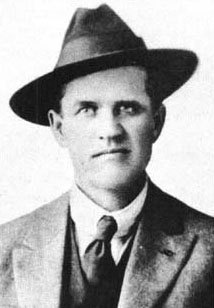
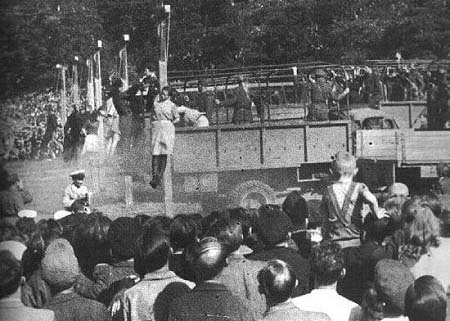
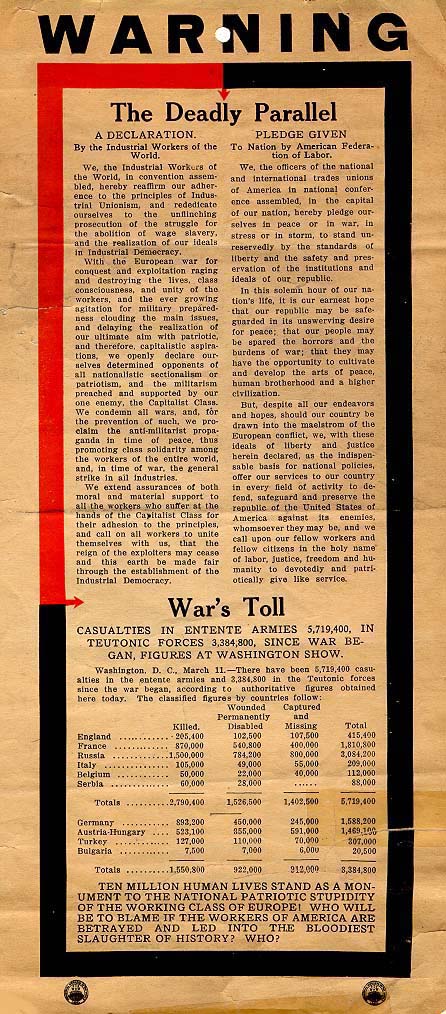
1916: Sir Roger Casement

On this date in 1916, Roger Casement was hanged for treason by the British crown that had knighted him only a few years before.

Casement died for his part in the Easter Rising, but this Irish nationalist hero’s layered story has long made him a very different sort of cultural marker than, say, James Connolly.
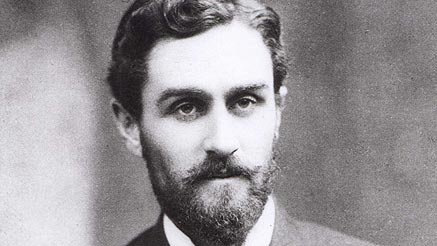
Casement came to public prominence for his damning report on Belgium’s atrocious treatment of natives in its Congo colony, e.g.:

[T]he great decrease in population, the dirty and ill-kept towns, and the complete absence of goats, sheep, or fowls — once very plentiful in this country — were to be attributed above all else to the continued effort made during many years to compel the natives to work india-rubber. Large bodies of native troops had formerly been quartered in the district, and the punitive measures undertaken to his end had endured for a considerable period. During the course of these operations there had been much loss of life, accompanied, I fear, by a somewhat general mutilation of the dead, as proof that the soldiers had done their duty.

. . . Two cases (of mutilation) came to my actual notice while I was in the lake district. One, a young man, both of whose hands had been beaten off with the butt ends of rifles against a tree; the other a young lad of 11 or 12 years of age, whose right hand was cut off at the wrist. . . . I both these cases the Government soldiers had been accompanied by white officers whose names were given to me. Of six natives (one a girl, three little boys, one youth, and one old woman) who had been mutilated in this way during the rubber regime, all except one were dead at the date of my visit.

[A sentry in the employ of one of the concessionary private companies] said he had caught and was detaining as prisoners (eleven women) to compel their husbands to bring in the right amount of rubber required of them on the next market day. . . . When I asked what would become of these women if their husbands failed to bring in the right quantity of rubber . . , he said at once that then they would be kept there until their husbands had redeemed them.

Casement’s is an honorable name in the campaign for the Congo, an early human rights and anti-colonial struggle; in this 92-minute BBC documentary on the notorious depredations in the Congo, the Casement report’s creation and impact are treated from about 1:15:15 through the end:

A similar investigation undertaken in Peru — where the lens focused on British employers, rather than strictly the malfeasance of foreign states — earned him knighthood in 1911, but Casement’s personal evolution from loyal Protestant* imperial operative with a sympathy for the Irish cause to revolutionary nationalist was already underway. “This journey into the depths of the Congo has been useful in helping me discover my own country and understand her situation, her destiny, her reality,” he wrote his sister. “I’ve also found my true self: the incorrigible Irishman.”

He resigned from the consular service and began recruiting for the Irish Volunteers.

As World War I opened, Casement identified British aggression as its cause, an extension of the violent imperial hegemony he chronicled in The Crime Against Europe:

The British Empire was not founded in peace; how, then can it be kept by peace, or ensured by peace-treaties? It was born of pillage and blood-shed, and has been maintained by both; and it cannot now be secured by a common language any more than a common Bible. The lands called the British Empire belong to many races, and it is only by the sword and not by the Book of Peace or any pact of peace that those races can be kept from the ownership of their own countries.

While any Irish Republican would have agreed with that sentiment, the resulting moral and tactical calculus for the Irish cause to ally with the German was not universally embraced — and was certainly anathema to the British.

“In the Streets of Catania”
by Roger Casement

All that was beautiful and just,
All that was pure and sad
Went in one little, moving plot of dust
The world called bad.

Came like a highwayman, and went,
One who was bold and gay,
Left when his lightly loving mood was spent
Thy heart to pay.

By-word of little street and men,
Narrower theirs the shame,
Tread thou the lava loving leaves, and then
Turn whence it came.

Ætna, all wonderful, whose heart
Glows as thine throbbing glows,
Almond and citron bloom quivering at start,
Ends in pure snows.

Casement spent the first two years of the Great War in Germany itself, and arranged a shipment of guns that would have supported the Easter Rising, but thought the aid too little and too late. He had a German U-boat drop him at Ireland, trying to get word to the Republican leadership to postpone the revolt.** Instead, he was picked up three days before the doomed rising and hanged after a sensational trial.†

His “treason” — and of course, the very crime of which he was convicted imports a British legitimacy in Ireland that Casement explicitly rejected — shocked many old associates, but he still had friends in high places. To dampen the international clemency campaign, England circulated the notorious “Black Diaries,” photographs of supposed Casement diary pages detailing the author’s homosexuality.

This dirty (and successful) trick brings a personal-is-political quality to Casement’s legacy as well as an enduring debate over the diaries’ authenticity. Since Irish nationalism gained mainstream acceptance well before homosexuality, right-thinking folk long held the Black Diaries a forgery, and time was you solicited a black eye by saying otherwise in the wrong company.

The gay rights movement has seen a posthumous redefinition of Casement; although homosexuality was not on the indictment against him, one could argue that it was the reason he hanged. Given recent handwriting forensics that support the diaries’ authenticity, the general‡ consensus about the Black Diaries has inverted with the effect of only heightening sympathy for their alleged author, albeit at the expense of some tension over how to situate that characteristic within the whole of Casement’s life and thought.

And that is only one aspect of the shifting place of Casement in the firmament of Republican martyrs since his death. His hagiography waxed in the interwar years, with Yeats among those calling for the return of Casement’s remains in The Ghost of Roger Casement”.

But the humanitarian’s German ties were an inconvenience as World War II raged, and not until afterward was that cause renewed. When his body was finally returned in 1965, an Irish state funeral elided the matter of the diaries.

Even Casement himself, who would be the last to die for the Easter Rising, had a hand in the myth-making. His last mission’s purpose to avert the Easter Rising fit neither the government’s interest in maximizing his perfidy nor Casement’s own in identifying with the Irish cause; he himself therefore owned the Rising fully in his defense which made him fine fodder for Republican hymns like “Lonely Banna Strand”:

RTE radio’s What If? series recently explored Casement’s complex legacy:

[audio:http://www.rte.ie/podcasts/2008/pc/pod-v-240208-27m06-whatif.mp3]

As Casement put it in his voluminous personal writing, “It is a cruel thing to die with all men misunderstanding — misapprehending — and to be silent forever.”

* Casement’s father was Protestant and his mother was Catholic; he lived with a somewhat split identity between the two faiths, but formally converted to Catholicism while awaiting execution (which surely did not hurt his memory to the Irish cause) and his last meal was simply the Host.

** The guns themselves were interdicted by the British navy and ended up scuttled to the ocean floor.

† Since Casement’s incitements to rebellion had occurred on foreign soil, there was some fine legal parsing over whether he could be tried for “treason.” The dispute resolved to the placement of a comma in a medieval law — leading to the epigram/-taph that Casement was “hanged by a comma.” In the midst of war and before an English jury, however, punctuation was an even weaker defense than it sounds.

‡ But still not universal.

On this day..

1917: Frank Little of the IWW lynched

On this date in 1917, Wobbly labor organizer Frank Little was abducted from his hotel and hanged from a railroad trestle in Butte, Montana.

An executive board member of the radical Industrial Workers of the World, the half-Cherokee Little had only rolled into Montana’s copper mining hub two weeks before. A roving agitator who had organized workers all around the west, he would be a signal martyr to America’s nascent Red Scare.

It was a fraught moment nationwide, and worldwide. After winning re-election on the slogan “He kept us out of war,” Woodrow Wilson upon his inauguration immediately (try to act surprised) got the United States into World War I. Just as it had in Europe, the question of war put American labor to the test: would it transfer opposition to war into resistance, or would it line up patriotically with its state?

This outstanding IWW poster (via the University of Arizona’s web exhibit on the labor deportations that had expelled Frank Little from Arizona just days before he arrived in Butte) pits the militant Wobbly position against the nationalist American Federation of Labor.*

And Little was one of the most stridently anti-war in his movement.

Either we’re for their capitalist slaughter fest or against it. I’m ready to face a firing squad** rather than compromise. (Source)

Anaconda Copper could nowise welcome this character’s arrival, where he would organize already-striking miners and mix in militant anti-war rhetoric with incendiary potential in the cocktail of immigrant workers being asked (in many cases) to wage war on their homelands.

The local labor conflict, an exceptionally brutal instance of a pattern across the country and especially in western mining country, was probably savage enough on its own to make Little a marked man. Whether his anti-war activity or his union activity motivated his death is not sure, but the dilemma was probably a false one for his killers just as it was for Little himself: they were two heads of the coin. As American troops poured into Europe, and particularly as the Bolshevik Revolution later in 1917 spurred a worldwide Communist scare (and a separate American military expedition), both public and private power violently pursued left-wing elements.

Caption: Copper Trust to the Press: “It’s all right, pal; just tell them he was a traitor.” (Source.)

The film An Injury To One (review) deftly weaves those themes and others together into the tale of a crime which is also the tale of a time and place:

This note was found pinned to Little’s body. “3-7-77”, a Montana vigilante calling card, indicates the dimensions of a grave.

Officially (again, act surprised), it’s an unsolved crime. Even though the New York Times report the day after the hanging quoted a labor official claiming “certain” knowledge of five of the six men in the posse, and a prosecutor vowing, “it is a cold-blooded murder and every effort will be used to apprehend the men who did it,” nobody ever went on trial for lynching Little.

Company goons, likely aided by the infamous union-busting Pinkerton detective agency, are the presumed culprits. And it is the nature of lynchings to make extrajudicial the rough justice sought by a certain constituency, as expressed by Montana’s Helena Independent:

Good work! Let them continue to hang every I.W.W. in the state. The time has come. It is beyond the comprehension of the average citizen why the war department has not ordered certain leaders arrested and shot. The people will not stand for much more.

A massive funeral turnout brought federal troops to quash labor unrest in Butte … and in the years to come, the IWW would be hunted from pillar to post.

Pro-Wobbly sites give adoring biographical treatment and fairly extensive resource lists on Little here and here.

Little is buried in Butte. His grave marker reads:

Slain By Capitalist Interests For Organizing And Inspiring His Fellow Men.

* The AFL, now the AFL-CIO, remains the dominant institution in American labor today.

** Little undoubtedly had in mind the precedent of his fellow-martyr Joe Hill, executed judicially two years before in Utah.

On this day..

1963: 21 Iraqi Communists

On this date in 1963, Iraq’s infant Ba’ath government executed at least 21 soldiers — all Shi’a — who had participated in a Communist coup attempt on July 3.

The Ba’ath were newly in the saddle after overthrowing Qasim earlier that year, and would be ousted again a few months hence before their definitive seizure of power several years later.

For the moment, they were a fledgling government trying to tilt away from the Soviet bloc and towards the west while navigating a minefield of domestic politics. If the coup really occurred as described, it was the fruit of an Iraqi Communist Party with daggers drawn for the regime after the Ba’athists had massacred their membership with CIA help in the course of offing Qasim. (The name is also transliterated Qassim or Kassem.) If it was bogus, it was probably an official cover story to keep massacring Shi’a Communists.

The affair, in either guise, amounted to a minor hazard in the jagged path of the Ba’ath — but of course, we come by that judgment with benefit of hindsight. Far more interesting to follow, courtesy of this site‘s library of historic cables, the perceived unfolding of the situation through the anxious American diplomatic pouch:

On this day..

1824: Alexander Pearce, cannibal convict

On this date in 1824, Irish convict Alexander Pearce received the Catholic last rites and was hanged in Australia’s Hobart town jail for murdering and cannibalizing a fellow con during an escape attempt.

When Pearce, a petty thief who had been sentenced in England to penal transportation, was caught at King River after fleeing a Tasmanian prison colony. He had human flesh in his pocket … pretty much as alleged in this court scene from the docudrama “Exile in Hell”:

… or, at least, there is no record of Pearce, who was defended by no lawyer, contesting the charges. He is said to have had other food available at this time; it seems he killed his young companion when he realized the boy would hold him up … then ate him, because he liked the taste.

You’re wondering how he knew he liked human flesh, right?

Incredibly, the crime for which he was hanged was not Pearce’s first incident of cannibalism — not even his first incident of confessed cannibalism.

During a previous escape attempt in 1822 with six other men, the party had plunged ill-equipped into forbidding terrain, and fallen to … well, you know. Here’s a newspaper account by the author of a book about Pearce:

As the journey continued, one by one, the weakest man was killed with an axe and butchered to provide food for the others. After five weeks of endless walking, only three men were left: [Robert] Greenhill, Pearce and [Matthew] Travers.

Driven by extreme hunger, Greenhill finally faced the prospect of having to kill his injured friend Travers, who had been bitten on the foot by a venomous tiger snake. With Travers’ foot now gangrenous, Greenhill and Pearce half-dragged and carried their injured companion for five days until Travers begged them to kill him. The only weapon left was the axe. They killed him in his sleep, and ate his flesh.

Pearce and Greenhill struggled on for eight days, playing cat and mouse with each other, desperate to stay awake, fearing that the other would attack him if he closed his eyes and nodded off. It was Pearce who kept awake long enough to grab the axe and kill the sleeping Greenhill with a blow to the head.

Months later, when the law finally caught up with Pearce, he admitted to killing and eating his companions. He wasn’t believed: authorities figured his collaborators were still on the run and Pearce was covering for them, so they sent him back to the prison colony.

Whoops.

This unpleasant story is the subject of a forthcoming film, The Last Confession of Alexander Pearce.

On this day..

2007: Not Sina Paymard, saved by a flute

On this date one year ago, a teenager who saved himself with a flute cheated Iran’s hangman by the narrowest of margins.

Sina Paymard had had the hemp about his throat the previous fall for murdering — at the tender age of 16 — a drug dealer in a pot buy gone bad.

The bipolar young musician’s last request was to play the ney (a Persian flute), and in a feat fit for legend, he played so movingly that the family of the victim reprieved him.

This power under Islamic sharia law comes with a price: the reprieve bought time for the families to negotiate alternative financial compensation known as diyeh. Come July, the lad’s family was still $90,000 short, and he was shifted to Tehran’s Evin prison to do the whole thing over again.

Sina’s new execution date received worldwide attention:

… helping them scrape together enough from donors (“notably a substantial donation from a university lecturer”) to make good his escape.

Such are the vicissitudes of the Iranian judiciary that Paymard went from all but dancing on air twice to outright liberty: he’s a free man today, or was as of a few months ago.

Though things worked out for Sina Paymard, other juvenile offenders continue to face the ultimate sanction in Iran — virtually the last outpost of the practice on the globe. Earlier this month, StopChildExecutions.com detailed 138 Iranian prisoners condemned for crimes committed as children; Iran has executed at least two such prisoners this year.

On this day..

1882: Thomas Egan: 3 tries, 2 ropes, 1 innocent man

On this date in 1882, Thomas Egan was hanged in Sioux Falls in the Dakota Territories (present-day South Dakota) for strangling his wife, Mary.

It took three tries to get the hanging right … and it still turned out they got it wrong: years later, Egan’s stepdaughter copped to the crime on her deathbed.

Egan was the first man hanged (.doc) by state officers in the Dakota Territory; earlier, Jack McCall had been executed there by the feds.

Let’s start with the twice-botched hanging, whose can’t-look-away horror can hardly be improved from its original coverage by The Chicago Tribune (picked up elsewhere as well — such as The Alexandria Post of Douglas County, Minnesota):

A HORRIBLE AFFAIR.

The Execution of Thomas Egan, the Wife Murderer, at Sioux Falls, Dak — The Drop Fails Three Times Before the Culprit is Deprived of Life, Owing to Rotten Ropes.

On Thursday, July 13, occurred at Sioux Falls the first judicial hanging ever done in the territory of Dakota. Nearly two years ago Thomas Egan, who suffered the death penalty, most foully and cruelly murdered his wife, with whom he had lived for nearly a quarter of a century. From evidence produced at the trial it would appear that they had frequent quarrels which at length culminated on this fatal morning in her death. He deliberately sent the children away, and while she was washing dishes at the table came behind her, and after throwing a rope around her neck and strangling her, pounded the life out of her with a club. The body was then thrown through a trap door into the cellar, where it was found three days after, horribly mutilated. The skull was fractured and the head was covered with frightful gashes made by the club. It appeared also as if she were not dead when thrown down, as she was discovered partly reclining against the call [sic] of the cellar, which added to the horribleness of the crime. Eagen [sic] was arrested and tried, and although there was every effort made by his attorneys to save him; he was convicted and sentenced to be hanged at Sioux Falls by Judge Kidder of the Fourth judicial district of the territory.

On Thursday, 13th, after eating a hearty breakfast, hearing the sentence read, and some religious exercises by a Catholic priest, Eagan [sic] was taken to the gallows. All eyes were intently fixed on the prisoner. His face was somewhat pale, but his lips were firm and he seemed to exhibit no sign of fear. He was a straight, heavy-set man, weighing 180 lbs., with a retreating forehead, heavy projecting eyebrows and an ugly looking eye. His general appearance was far from prepossessing. He was dressed in a plain black suit, with clean white shirt, collar and tie, and low shoes. He walked straight up to the platform to the scaffold, taking his place on the fatal trap, turned around and faced the crowd below. The sheriff now asked him if he had any thing to day [sic], but his lips still were kept sealed to his secret, and he shook his head and answered in a low voice, “No.” His legs were now tied, he himself assisting the officer by placing his feet close together. The black cap was put on his head, but not a limb quivered. The noose was adjusted and the fatal moment had come. While the priests were chanting their solemn service, and while the attending officers and crowd were holding their breath in silence, the sheriff touched the trigger which alone kept Thomas Egan from his death. There was a crash as the door flew back against the boards and body, deprived of its footing, shot through the door, and now, horror or horrors!

The rope snaps like a piece of thread, the body drops to the earth with a dull thud, partly on its back, and rebounding rolls over on its face. The crowd are paralyzed with astonishment and fear. An unearthly gurgling sound now breaks forth from the prisoner. His neck is not broken, but the cord is wound tightly about it and he is strangling. A half a dozen men now rush forward, one seizes him by the arm, another by the leg, another by the waist, another by the head. It is seventy-five feet from the ground, where he has fallen, back to the jail-door, and around to the platform of the scaffold he is hurriedly conveyed through the crowd, the broken rope in the meanwhile dangling from his neck, while his horrible groaning strikes terror to the bystanders. Once more on the scaffold, another rope is adjusted and the sickening details once more gone through with, the trap falls again and the half dead man drops once more; but worse. The rope was not fully adjusted before the excited sheriff again touched the trigger and down the body goes a second time but not with sufficient force to accomplish the desired result.

His neck is still unbroken, and the slow process of suffocation is all this time going on. The attendants seize him by the arms and again pull him on the scaffold while the death struggle continues. The first rope is flopping from his neck and he still has life enough, so one says who was on the scaffold, to brace his feet for the third and last fall. If at this juncture some one had mercifully stepped up and put a bullet through his head, it would have been an act which would have certainly been appreciated by the crowd. The rope is finally fixed, the door drops once again, the man shoots down, and there is a snap which is heard all around the yard and outside. There is a shrugging of the shoulders, a twitching of the legs a convulsive shudder and all is still. The body swings slowly around. There is no motion of leg or arm or muscle, and in eight and one half minutes the doctors pronounced him dead, and shortly after the body was taken down. Yes, he is dead at last, and the sightseers heave a genuine sigh of relief. The corpse is now cut down and the pinioned arms and legs released. The dirt was brushed from the clothing and body laid in a coffin, where it was afterwards viewed by the crowd, both outside and inside the jail. The effects of the strangulation were fearfully evidence about the neck. The first cord had embedded itself, but the action of the heart had forced the blood under it and the flesh was swollen, purpled and discolored. There was a sightless stare to the eyes and blood was flowing out of the corners of his mouth. After all those desiring had seen the corpse it was boxed up, and early in the afternoon it was taken to the Catholic burying-ground where it was buried, and with it the club and cord with which he killed his wife.

Nobody in a position to help Egan knew he hadn’t “most foully and cruelly murdered his wife” or that “the horribleness of the crime” stained some other’s soul, of course … but one wonders how the writer thinks he did know it. The obscure considerations of jurymen might well be the most virtuous structural safeguard of the Republic, but as a dependable compass of fact, one might as well scry the entrails of a sacred ox.

It has always seemed misfortunate to the Headsman that journalists prone to the most tedious wheedling over the use of the qualifier “allegedly” to uphold the principle of innocent before proven guilty consider the epistemological certitude of a juridical conviction sufficient to abandon full stop the (admittedly inelegant) qualifier and speak of Revealed Truth. The New York Times would hardly think to make apology for flatly calling Egan — who did keep his peace about the verdict — “the wife murderer”:


… any more than the San Antonio Express-News would regret the assertive headline “Father who killed 3 is executed” mounted atop an article reporting the executed man’s continued insistence upon his innocence. Any good scribe frets more readily about column-inches and legal ass-covering than bickering and arguing over who killed who. But shame if not stylistics merits less awe before the particular sausage-making of the judiciary when such modern cases too turn out to have been cock-ups from start to finish.

In 1993, South Dakota Governor Walter Miller apologized (.pdf) for Egan’s execution. A descendant of Egan’s has written a book about the case, Drop Him Till He Dies: The Twisted Tragedy of Immigrant Homesteader Thomas Egan.

Part of the Themed Set: Embarrassed Executioners.

On this day..

1726: William Fly, unrepentant pirate

On this date in 1726, an obscure boatswain who had mutinied for the liberty of piracy succumbed but did not submit on the gallows in Boston.

Fly overthrew (figuratively and literally — they both ended up in the drink) a tyrannous captain and first mate on a British slave ship in May, reconstituting it Fame’s Revenge, and in a northward journey from North Carolina to New England captured a few less-than-lucrative ships in a month and change.

A minor character in the annals of seaborne pillage. So why should historian Marcus Rediker devote the opening chapter to his Villains of All Nations: Atlantic Pirates in the Golden Age (review) to this man?

[T]he early-eighteenth-century pirate ship was a world turned upside down, made so by the articles of agreement that established the rules and customs of the pirates’ alternative social order. Pirates “distributed justice,” elected their officers, divided their loot equally, and established a different discipline. They limited the authority of the captain, resisted many of the practices of capitalist merchant shipping industry, and maintained a multicultural, multiracial, and multinational social order. They demonstrated quite clearly — and subversively — that ships did not have to be run in the brutal and oppressive ways of the merchant service and the Royal Navy.

Rediker’s sympathetic but unromantic work treats the radical, doomed sphere of resistance pirates offered to the enormous cruelty of the developing Atlantic economy: grinding exploitation of white sailors in the service of the black slave trade under the iron hand of the empire (British, in this case, but hardly exclusive to Old Blighty.)

It bears the trace of Hakim Bey‘s treatment of Temporary Autonomous Zones:

Fleeing from hideous “benefits” of Imperialism such as slavery, serfdom, racism and intolerance, from the tortures of impressment and the living death of the plantations, the Buccaneers adopted Indian ways, intermarried with Caribs, accepted blacks and Spaniards as equals, rejected all nationality, elected their captains democratically, and reverted to the “state of Nature.” Having declared themselves “at war with all the world,” they sailed forth to plunder under mutual contracts called “Articles” which were so egalitarian that every member received a full share and the Captain usually only 1 1/4 or 1 1/2 shares. Flogging and punishments were forbidden — quarrels were settled by vote or by the code duello.

Certainly many men (and women) turned to piracy for many different reasons. Rediker’s work on the systematic brutality in the guts of the imperial economy and the pressures of resistance and coercion they spawned finds an outstanding individual exponent in this day’s victim.

Fly walked indifferently to the gallows; to the astonishment of the spectators, he upbraided the hangman’s poor knot and remade with his own hands the instrument for his own neck — one last use of his seaman’s proficiency with ropes.

On Fly’s turn upon that fatal stage, he would not read from the classics — not cower before his executioners, not salute the majesty of the crown that hung him, not enjoin the mob to straighten up and sail right, and certainly not be cowed on the cusp of the eternal by officious colonial holy roller Cotton Mather’s vain personal bid to convert the corsair:

When the time came for last words on that awful occasion, Mather wanted Fly and his fellow pirates to act as preachers — that is, he wanted them to provide examples and warnings to those who were assembled to watch the execution. They all complied. Samuel Cole, Henry Greenville, and George Condick [three of Fly’s crew], perhaps hoping for a last-minute pardon, stood penitently before the crowd and warned all to obey their parents and superiors and not to curse, drink, whore, or profane the Lord’s day. These three pirates acknowledged the justice of the proceedings against them, and they thanked the ministers for their assistance. Fly, however, did not ask for forgiveness, did not praise the authorities, and did not affirm the values of Christianity, as he was supposed to do, but he did issue a warning. Addressing the port-city crowd thick with ship captains and sailors, he proclaimed his final, fondest wish: that “all Masters of Vessels might take Warning by the Fate of the Captain (meaning Captain Green) that he had murder’d, and to pay Sailors their Wages when due, and to treat them better; saying, that their Barbarity to them made so many turn Pyrates.” Fly thus used his last breath to protest the conditions of work at sea, what he called “Bad Usage.” He would be launched into eternity with the brash threat of mutiny on his lips.

“Bad Usage.” Rediker later defines it as “the violent disciplinary regime of the eighteenth-century deep-sea sailing ship, the ordinary and pervasive violence of labor discipline as practiced by the ship captain as he moved the commodities that were the lifeblood of the capitalist world economy.”

The resistance to a pattern of savage floggings, cheated wages, and the whole spectrum of rough and arbitrary authority on a shipboard dictatorship might be spontaneous and individual in the instant … but it was thick with the stuff of solidarity, and the fraternity of outlawry could make people equal across the boundaries of national rivalry and institutional racism — “Villains of all Nations,” as the title goes.

And the obdurate, like Fly, could every now and then move the pastors who were sent to thunder hellfire at them rather than the other way around.

As it happened, the “stupid” and “impenitent” pirate [Mather uses these words to describe Fly elsewhere] was able to convince the self-righteous minister of at least one primary cause of piracy. During his execution sermon, Mather made it a point to address the ship captains in the crowd, telling them in no uncertain terms that they must hereafter avoid being “too like the Devil in their Barbarous Usage of the Men that are under them and lay them under Tempations to do Desperate Things.”

After the hanging, William Fly’s body was gibbeted as a warning on Nixes Mate, a barely-there speck of an island at the mouth of Boston Harbor. For Rediker, this date marks the end of the Golden Age of Piracy.

Although the full book is worth the buy, a paper Rediker wrote on the subject prior the book’s publication is available free online.

Part of the Themed Set: Embarrassed Executioners.

On this day..

1865: Four for Abraham Lincoln’s assassination

On a sweltering July 7, 1865, a mere 12 weeks after Abraham Lincoln was shot at Ford’s Theater, four of his assassin’s accomplices were hanged in the courtyard of the District of Columbia’s Washington Arsenal — present-day Fort McNair, and specifically its tennis courts.

Booth, on the far left, playing Marc Antony in Julius Caesar opposite his brothers. He had Brutus’ example in mind, as he wrote in his diary while on the run: “with every man’s hand against me, I am here in despair. And why? For doing what Brutus was honored for.”

The exact nature of the conspiracy against the man who had seen the North to victory in the Civil War has been debated ever since actor John Wilkes Booth lodged a ball from his one-shot Derringer behind Honest Abe’s ear. But it was a conspiracy — an astoundingly bold one.

Simultaneous with Booth’s successful attack upon Lincoln, there was an unsuccessful attempt to kill Secretary of State William Seward; it would emerge in the investigation that another man had been detailed to murder Vice President Andrew Johnson, but got drunk and chickened out. The apparent upshot: with the President and Vice President dead, new national elections would be required to replace the Senator who would become acting president — and with the Secretary of State dead too, there’d be nobody to implement them. Booth was trying to paralyze the North with its own constitutional machinery in some desperate hope of reviving the defeated South.

Ten Against D.C.

Hundreds were detained in the stunning assassination’s immediate aftermath, but ten would ultimately be the federals’ targets. A massive manhunt pursued Booth through southern Maryland and into Virginia, where he was killed in a shootout. John Surratt, who had conspired with Booth in an earlier plot to kidnap the president — that failed plot had been reconfigured into the assassination — escaped from the country.

The other eight were rounded up and stashed at the Arsenal to face a military tribunal. It was a highly controversial arrangement: the war had entered a gray area — Robert E. Lee’s surrender just days before the murder had effectively ended the war, but when the trial opened in May Confederate President Jefferson Davis was still at large, and the last Southern general wouldn’t lay down his arms until late June. The District of Columbia was still technically under martial law … so would it do to use a military court?

Military Tribunal

So the government asked itself: government, would you rather have looser evidentiary rules and a lower bar of conviction than you would have in civil court? The government duly produced for the government an opinion that the military characteristic of the assassination — that is, to help whatever southern war effort still obtained — licensed the government to use the military courts.

That didn’t sit well with everyone. One former Attorney General griped:

If the offenders are done to death by that tribunal, however truly guilty, they will pass for martyrs with half the world.

Indeed, a year later, the Supreme Court’s landmark ex parte Milligan ruling would forbid the use of military courts where civilian courts are open — which they were in Washington, D.C.

That, of course, was too late to help Booth’s comrades. It would be a military trial, with a majority vote needed for conviction and no right of appeal but to the president for the most infamous crime of the Republic. Everyone had a pretty good idea what the results would be.

A cartoon depicting the defendants as Gallow's (sic) Birds.

Rogues’ Gallery

Two of the four today were doomed from the outset under any juridical arrangement imaginable: Lewis Powell (also known as Lewis Paine or Lewis Payne) had made the attempt on Secretary of State Seward; David Herold had guided him there with the getaway horse, and later escaped along with Booth. They were in way past their eyeballs. George Atzerodt, the schmo who couldn’t rise to the occasion of popping Andrew Johnson, looks a bit more peripheral from the distance of a century and a half, but in the weeks following the assassination he was much too close to the action to have any hope. All received death sentences.

Two others — Michael O’Laughlen and Samuel Arnold — had been involved in Booth’s earlier scheme to kidnap the president, but didn’t seem to have much to do with the murder. Still another two — Ned Spangler and Dr. Samuel Mudd* — were lesser participants. They all received long prison sentences for their pains, and the three of them still surviving were pardoned by Andrew Johnson as he left the presidency in 1869.

That left Mary Surratt, mother of the fugitive John and the only woman in the dock, the focus of attention and controversy. The 42-year-old widow owned a downtown boardinghouse, plus a tavern of sufficient importance at a Prince George’s County, Maryland, crossroads, that its community was called Surrattsville.**

The conspirators met frequently in her lodgings; Surratt maintained her innocence beyond that, but evidence and witness testimony began to pile up heavily against her … especially when Seward assailant Lewis Powell wandered into her place looking for refuge right while the police were questioning her. Booth and Herold turned out to have made a pit stop at her Surrattsville tavern to pick up a package of guns that Mary had prepared for them.

Though Surratt’s avowal of ignorance was not widely believed, a gesture of presidential mercy was anticipated — many thought (and think) she went on trial as a virtual hostage for her absconded son, who declined to take the bait. Strangely, five members of the nine-judge panel who condemned Mary Surratt turned around and asked President Johnson for clemency. Johnson claimed never to have seen the memo, but his mind seemed pretty made up — when Surratt won a habeas corpus stay on the morning of her scheduled hanging, he promptly “specially-suspended” the writ specifically to hang her:

I, Andrew Johnson, President of the United States do hereby declare that the writ of habeas corpus had been heretofore suspended in such cases as this; and I do hereby specially-suspend this writ, and direct that you proceed to execute the order heretofore given upon the judgment of the Military Commission.

Harsh treatment, and possibly well-deserved, for the first woman executed by the U.S. government. Even so, it does seem a curious thing when all is said and done that the mother of “the nest that hatched the egg” was worth a special suspension of the Great Writ, and even the stagehand who just held Booth’s horse for him caught six years, but old Jeff Davis — who apart from having figureheaded a treasonous four-year insurrection was implicated for giving Booth’s kidnapping plot official Confederate sanction — got to retire to write his memoirs.

Fine pages on the Lincoln assassination are here, here and here. There are also contemporary newspaper accounts posted online as filed for The Boston Post and The New York Herald.

The Surratt houses, by the way, are still standing. The Maryland tavern is kept as the Surratt House Museum by the Surratt Society. The downtown boarding house is a Chinese restaurant … marked with a plaque remembering more momentous doings than bubble tea.

The Chinatown restaurant where Mary Surratt had her boarding house ...

... as marked by plaque ...

... and how it looked back then.

* The panel voted 5-4 to hang Mudd, a Maryland doctor who not only set the leg Booth broke when he leaped onto the stage after shooting Lincoln, but then misdirected Booth’s pursuers. However, the rules for the trial said a two-thirds majority was required for execution.

** They changed the name after the unpleasantness. Today, it’s Clinton, Maryland.

On this day..

1946: Eleven from the Stutthof concentration camp

On this date in 1946, officials of Soviet-occupied Poland publicly hanged eleven convicted war criminals of the Stutthof concentration camp.

Set up immediately upon Germany’s September 1, 1939 invasion of Poland and not liberated until after official German capitulation in 1945, Stutthoff handled over 100,000 prisoners during its long service.

This day’s condemned — camp commandant Johann Pauls, five male kapos, and five female guards — were the product of the first of four Stutthof trials held in 1946-1947. At a hill in Gdansk known as Biskupia Gorka (Bishop Hill), upon a specially-erected row of four T-shaped double gallows centered around a pi-shaped triple gallows, and before a crowd of thousands, the doomed eleven were noosed on the back of military trucks which then drove away to leave them strangling to death with a “short drop” hanging.

The following gut-twisting images are among a number to be found here.

Above: on one end of the gallows row, the truck has just pulled away from Jenny Wanda Barkmann — a modish Hamburg lass in her mid-20’s known to Stutthof prisoners as “the Beautiful Specter” for her cruelty. Down the row, one can see that some of the prisoners are already swinging, while others have not yet been dropped.

Upon hearing her sentence, Jenny Barkmann retorted, “Life is indeed a pleasure, and pleasures are usually short.” (More about Barkmann, including trial photos, here.) In this closer view of her, just as in the first photo, she is still alive and struggling. Next to her, Ewa Paradies, another guard, is prepared for the same fate.

The central triple gallows. Commandant Johann Pauls hangs in the middle with Gerda Steinhoff — one of the senior female guards — in the foreground. The line of five male kapos recedes behind them into the enormous crowd of onlookers.

There’s more about Stutthof’s history at the Holocaust Research Project, and at the current memorial facility’s home page.

On this day..

1570: Aonio Paleario, Italian religious reformer

On this date, Antonio della Pagliara was hanged across the Tiber from the Castel Sant’Angelo in Rome for heresy.

The present-day view from the square where Paleario is thought to have been put to death, over the Ponte Sant’Angelo’s span across the Tiber to the Vatican’s imposing citadel.

Better known as Aonio Paleario (English Wikipedia entry | the considerably deeper Italian), the humanist scholar grew into his intellectual career just as Martin Luther’s doctrine was shaking Christendom.

Paleario’s positions were dangerously — and at length, fatally — close to Protestantism. He counted himself a humanist, a great admirer of Erasmus, who from the Low Countries managed to hold his critical positions without running afoul of the Catholic Church.

This would prove an increasingly difficult trick as the century unfolded … especially in the pope’s back yard.

Paleario’s most particular offenses were to take what amounts to the Lutheran side on the primacy of scriptural text over ecclesiastical tradition, and of salvation through Christ alone without the Church’s intermediation. (He also denied Purgatory.)

Since the Italian academic also cottoned to the Protestant-humanist critique of clerical corruption, he pitched Martin Luther and John Calvin on the notion of convening a Christendom-wide ecclesiastical council to reconcile competing sects. He seems to have wanted to reconcile the reformist current of humanism still within the Catholic tradition, and that of those critics who had broken, perhaps not yet irrevocably, with Rome.

The effort ultimately foundered. Instead, the curia-approved Council of Trent formulated a Roman Catholic doctrine that insured the permanent schism with Protestantism.

The Counter-Reformation was on. Still, with contending theologies — and contending polities — afoot in the Italian quiltwork plus his own towering reputation as the greatest orator in Italy, Paleario was able to find protectors and carry on. He taught in Siena, Lucca and Milan for more than three decades, surviving two bouts with the Inquisition before a Rome in crackdown mode finally pinned a heresy rap on him.

By that time, the septuagenarian didn’t much bother to fight it.

If your Eminences have so many credible witnesses against me, there is no need to give yourselves or me any further trouble … Judge, therefore, and condemn Aonio; satisfy my adversaries, and fulfil your office.

The office was fulfilled consuming the old man in flames, but they did extend the favor of hanging him (and apparently exposing the corpse for several days) first.

A book uncertainly attributed to Paleario, Beneficio di Criso (The Benefit of Christ’s Death) is available free at Google Books.

On this day..