1578: Blessed John Nelson, martyr

On this date in 1578, John Nelson was martyred at Tyburn.

A Catholic who had popped across to Flanders to train as a priest, Nelson was captured after about a year’s ministry in December 1577.

Matters with this minor martyr proceeded according to the usual script from that point. Interrogators put it to him whether Queen Elizabeth was the proper head of the Church of England — that old chestnut. The wrong answer would be treason.

[Nelson] was brought forth to be examined before the high commissioners. Here they tendered him the oath of the queen’s supremacy, which he refused to take; and being asked, why he would not swear, he answered, because he had never heard, or read, that any lay prince could have that pre-eminence. And being farther demanded, who then was the head of the church, he answered, sincerely and boldly, that the pope’s holiness was, to whom that supreme authority in earth was due, as being Christ’s vicar, and the lawful successor of St. Peter.

Secondly, [t]hey asked him his opinion of the religion now practised in England; to which he answered, without any hesitation, that it was both schismatical and heretical. Whereupon they bid him define what schism was; he told them, it was a voluntary departure from the unity of the catholic Roman faith. Then (seeking to ensnare him) they farther urged, what is the queen then, a schismatic or no? … he answered, conditionally, if she be the setter forth [of Anglicanism], said he, and defender of this religion, now practised in England, then she is a schismatic and a heretic.

After he was cut down alive from his hanging so that he could be disemboweled and quartered, Nelson’s last words were reportedly “I forgive the queen and all the authors of my death.”

On this day..

1400: Sir Thomas Blount, “bowels burning before him”

On this date in 1400, Sir Thomas Blount was drawn and quartered at Oxford.

He was a loyalist of the latterly deposed (and soon to be murdered) Richard II. Blount took part in the Epiphany Rising plot against the usurper Henry IV.

The chronicles supply an unusually graphic and detailed description (pdf) of this horrible manner of death. (Paragraph breaks have been added for readability.)

The King [Henry IV] commanded his chamberlain, Sir Thomas Erpingham, to have justice executed upon the lords who were taken prisoners, and to put them all to death, except a young knight whom he had dubbed the Saturday before his coronation, whom the King pardoned for rising in arms against him, on account of his youth and noble lineage.

Sir Thomas Blount and Sir Benet [Shelley] were drawn from Oxford unto the place of execution, a long league or more, and there they were hung; they then cut them down and made them speak, and placed them before a long fire. Then came the executioner with a razor in his hand, and kneeling down before Sir Thomas Blount, who had his hands tied, begged his foregiveness [sic] for putting him to death, for he was obliged to perform his office.

‘Are you he,’ said Sir Thomas, ‘who will deliver me from this world?’

The executioner replied, ‘Yes, my lord; I beg you to pardon me.’

The lord then kissed him and forgave him.

The executioner had with him a small basin and a razor, and kneeling between the fire and the lords, unbuttoned Sir Thomas Blount, and ripped open his stomach and tied the bowels with a piece of whipcord that the breath of the heart might not escape, and cast the bowels into the fire.

As Sir Thomas was thus seated before the fire, his bowels burning before him, Sir Thomas Erpingham said, ‘Now go and seek a master who will cure you.’

Sir Thomas Blount placed his hands together, saying, ‘Te Deum laudamus! Blessed be the hour when I was born, and blessed be this day, for I die this day in the service of my sovereign lord King Richard.’

After he had thus spoken, Sir Thomas Erpingham asked him, ‘Who are the lords, knights, and esquires who are of your accord, and treason?’

To which the good knight replied, suffering as he was, ‘Art thou the traitor Erpingham? Thou art more false than I am or ever was; and thou liest, false knight as thou art; for, by the death which I must suffer, I never spake ill of any knight, lord, or esquire, nor of anybody in the world; but thou utteredst thy false spleen like a false and disloyal traitor; for by thee, and by the false traitor the Earl of Rutland [who ratted out the conspiracy], the noble knighthood of England is destroyed.

‘Cursed be the hour when thou and he were born! I pray to God to pardon my sins: and thou traitor Rutland, and thou false Erpingham, I call you both to answer before the face of Jesus Christ for the great treason that you two have committed against our sovereign lord noble King Richard, and against his noble knighthood.’

The executioner then asked him if he would drink.

‘No,’ he replied, ‘you have taken away wherein to put it, thank God’! and then he begged the executioner to deliver him from this world, for it did him harm to see the traitors.

The executioner kneeled down, and, Sir Thomas having kissed him, the executioner cut off his head and quartered him; and he did the same to the other lords, and parboiled the quarters. And in Oxford castle many other knights and esquires were beheaded.

Thomas Erpingham doesn’t exactly exude charm in this account, going out of his way to bust on a guy having his entrails ripped out. But good guys and bad guys are a matter of perspective: Erpingham’s loyal service to the new dynasty got him a complimentary bit part in Shakespeare’s Henry V (Erpingham fought at Agincourt). Shakespeare’s young King Harry calls him his “Good old Knight”.

On this day..

1678: William Staley, “the prologue to the bloody tragedy”

David’s mildness managed it so well,
The bad found no occasion to rebel.
But when to sin our biassed nature leans,
The careful devil is still at hand with means, [80]
And providently pimps for ill desires;
The good old cause, revived, a plot requires.
Plots, true or false, are necessary things,
To raise up commonwealths, and ruin kings.

-John Dryden’s Absalom and Achitophel, a Biblical allegory of the English political/religious scene in which the Popish Plot (“plots, true or false”) took place

On this date in 1678, a Catholic goldsmith was hanged and quartered for treason … a preposterous case that would preview the tragic main acts of the “Popish Plot”.

This 17th century anti-Catholic witch hunt traced to weird and unprincipled Anglican divine Titus Oates.

With his friend Israel Tonge, Oates in 1678 ginned up a fantastical Jesuit plot against the life of Charles II — which supposed conspiracy played insidiously to the realm’s age-old religious divisions, in a moment when a Catholic royal sibling stood next in line to the throne.

Indeed, Oates’s “revelations” would trigger the Exclusion Crisis, an unsuccessful parliamentary bid to balk the heir presumptive James (eventually James II) of his throne. Parliament, argued Henry Capell, “must quiet the minds of the people, as to their fears of Popery and the Succession.”

In Queen Elizabeth’s time there were conspiracies against her, when Mary Queen of Scots was taken off. In King James’s time, the Gunpowder-Treason. In the last King’s time, a horrid Rebellion, that ended in his murder; but here the Crown is under such a character as is more dangerous than all those; and from Popery came the notion of a standing Army and arbitrary power.

Oh, and London had just burned down within everyone’s living memory, an event popularly ascribed to a French Catholic conspiracy even into the 19th century.

There was an awful lot of latent (and not-so-latent) anti-Popery around for Oates to stir up, and he proved to have a gift for this demagoguery. (pdf) In late 1678, a magistrate investigating Oates’s claims, Edmund Berry Godfrey, was mysteriously murdered, and all hell broke loose: a political assassination could now be hung on the alleged Catholic conspiracy. In short order, alleged Catholic conspirators would themselves hang for it.

It was a full 9/12 mentality: people going about armed, loyalty oaths, rumors of French invasion or Guy Fawkes tunneling.

Oates, when feeling his, would have the juice to put peers of the realm on the scaffold … so what chance did poor William Staley have?

This patsy, no great ornament of the “plot”, was more an incidental (and expedient) casualty of the swelling paranoia. Overheard at a tavern chatting about the Protestant freak-out, in French (quelle horreur!), a couple of unscrupulous eavesdroppers shopped for treason when they couldn’t blackmail him.

The sovereign was supposed to have been characterized in this chat as “a great Persecutor or Tormentor of the people of God … And ([Staley] stretching forth his Arm, and then clapping his Hand on his Breast), speaking of His Sacred Majesty, said, I my self will kill him.” (Source) Whether a frustrated Catholic into his cups incautiously popping off, an innocent naif set up by reprobates, or a case of lost in translation, it seems safe to say that William Staley was no danger to the monarchy.

Staley, at any rate, denied having said anything of the sort all the few hours that remained to draw breath, which wasn’t many. It was a mere 12 days from the “treasonable” conversation on Nov. 14 to Staley’s execution.


Image from William Faithorne‘s 1681 (misdated) engraving depicting William Staley being drawn to execution.

With this hanging, and another (that of Edward Coleman) a week later, the Popish Plot persecutions were into full swing … three years of Stuart England McCarthyism that would claim at least 15 lives and end with Titus Oates imprisoned, whipped, and pilloried.

After the Orange Revolution chased the Catholic monarch out of England, Oates was released and pensioned: the incident long remained an ideological litmus test between proto-Whigs (pro-Oates, as he was a club wielded against the absolutist aspirations of Charles II and James II) and Tories (anti-Oates, for the same reason). Centuries later, one commenter could still remark, “There are three events in our history that may be regarded as the touchstone of party men: an English whig who asserts the reality of the Popish plot, an Irish Catholic who denies the massacre of 1641, a Scotch Jacobite who maintains the innocence of Queen Mary, must be considered as men beyond the reach of argument or reason.”

On this day..

1600: The corpses of John and Alexander Ruthven, for the Gowrie conspiracy

Remember, remember, the fifth of … August?

If you didn’t get August 5 off, your jurisdiction is ignoring the Scottish parliament’s 1600 decree: “in all times and ages to come the fifth of August should be solemnly kept with prayers, preachings, and thanksgiving for the benefit, discharging all work, labour, and other occupations upon the said day.”*

They didn’t mean to keep it out of excess reverence for St. Emygdius: rather, August 5 was the date of the Gowrie conspiracy, a sketchy supposed assassination attempt on King James VI of Scotland (soon also to become King James I of England). John Ruthven, Earl of Gowrie and his brother Alexander Ruthven were both slain on the spot during that event … but not until 15 weeks later did Parliament rule that “the said bodies of the said Traitors shall be carried, upon Monday next [i.e., November 17], to the publick cross of Edinburgh: and there to be hangd, quarter’d, and drawn, in presence of the hail People: and thereafter, the heads, quarters, and carcasses, to be affix’d upon the most patent parts and places of the Burroughs of Edinburgh, Perth, Dundee and Stirling.”

Did they deserve it?

Scottish writer John Prebble considered the Gowrie conspiracy one of his realm’s best mysteries. It’s a maddeningly perplexing sequence of ambiguous (or altogether dubious) events related by interested, partisan sources.

I am murtherit!

The summary official version — and we’re skipping over such writerly red herrings as a mystery man in the turret, a still-stabled horse, and a wild fable about a pot of foreign gold — is that while staying at the Ruthven estates, James’s courtiers saw him shouting out the window, “I am murtherit! Treassoun! My Lord of Mar, help! help!”

While Lord Mar and others spent half an hour (!) trying to batter down a locked entrance to the regicidal turret, a page named John Ramsay found another staircase in, where he came upon the king and Alexander Ruthven grappling. Ramsay stabbed Ruthven about the head and neck, and Ruthven fled down Ramsay’s same staircase: there he careened headlong into more arriving royal retainers who killed him flat. Ruthven died exclaiming “Allace! I had na wyte [blame] of it!”

Meanwhile, the Lord Gowrie — quite possibly knowing nothing but that there was a commotion involving the king in his home — had rallied outside the courtyard with his own household and marched in swords drawn, passing the fresh-slain body of his little brother on the way. He must have been in an evil temper when he burst into the chamber, there to discover Ramsay and friends, and only them: the king had been locked in another room for his protection. Ramsay demanded Gowrie’s submission and the two crossed swords, with Ramsay running the elder Ruthven through, too.

(Small wonder Ramsay went on to become a royal favorite.**)

“… if it be true”

“A very wonderful story, your Majesty, if it be true,” one lord is supposed to have replied to James upon hearing this amazing tale.

Suspicion was immediately rife that this “treason” stuff was a cover for the king to take out a rival noble. The Ruthvens had often been at odds with King Jamie’s own family; John and Alexander’s own father was beheaded in 1584 for trying to kidnap the then-teenaged king, and their grandfather had helped a gang of nobles destabilize James’s mother Mary by murdering her favorite courtier David Rizzio right before her eyes. And of course, the crown would be able to seize all the “traitors'” estates, nicely flipping around a significant cash debt owed to the Ruthven clan.

Edinburgh Presbyterian ministers openly disputed the Ruthvens’ guilt, refusing to thank God for James’s “deliverance”.† James found it necessary to forcibly quash this talk, and he would insist upon the Ruthvens’ guilt all his days. But those outside the reach of Scottish royal power had looser tongues.

French nobles who had met Gowrie on the latter’s recent return from his continental studies, and Queen Elizabeth, who had received Gowrie warmly at court, openly doubted the official account: it was thought wildly at odds with the young man’s character. The nature of the interaction between the king and Alexander Ruthven prior to the intervention of John Ramsay depends upon the account of the king himself — that account, and no other. The other witnesses were dead. And the object of the plot seems unclear: sure, maybe Alexander Ruthven could have killed the king mano a mano, but then what? There was no indication at all of confederates (even Alexander’s brother reacted in confusion), nor coherent design for some next step like massacring James’s courtiers or toppling the government or even escaping. These were scheming aristocrats, not deranged lone assassins. And both James and Gowrie had behaved for all the world before this incident as if the unpleasantness with the father was water under the bridge.

“The assassination of the Gowries was the most indefensible act that has ever appeared on the pages of Scottish history,” avers mildy a 1912 volume of the Ruthven family papers. It was “a cunning conspiracy that has disgraced the historical record for more than three hundred years.”

The jury’s still out

Still, the hypothetical account of a royal anti-Gowrie conspiracy seems if anything even less satisfying than the official story. Most of the happenings besides what passed between Alexander and James were witnessed by others, so … the king falsely yelled “treason” counting on the handful of his guys staying in the Ruthvens’ own place to kill the Ruthvens instead of the other way around? Events played out so chaotically that this convenient outcome seems mere [mis]chance. What was the plan if John Ramsay hadn’t found the unlocked second entrance?

And yet some 350 witnesses were examined without turning up any concrete design, and three Ruthven retainers hanged on August 23 insisting upon their innocence of any treasonable intent.

One can go a lot of ways from here, and it’s hard to spin any one story that satisfyingly accounts for all the evidence. A scheme to kidnap (and extract policy change from) the king, rather than murder him? Alexander an unwilling pawn, forced into it by his brother? Or, as one English envoy supposed, a destructive spiral of events proceeding from a silly misunderstanding wherein a chance reference to the Ruthvens’ executed father led Alexander to defend the family a little too hotly and the king to start shouting in panic when he realized he was unarmed in the company of an excited, and much larger, man?‡

We’ll never really know. Light a candle for epistemological uncertainty next August 5.

Much help drawn from a two-parter review of the contradictory evidence in The Scottish Historical Review, nos. 121 and 122 (April and October 1957) by W.F. Arbuckle.

* August 5 was indeed “solemnly kept” during the reign of James, according to F.C. Eeles in “The English Thanksgiving Service for King James’ Delivery from the Gowrie Conspiracy” from the July 1911 Scottish Historical Review. As the title of that piece suggests, there was even a service promulgated (though never incorporated into the Book of Common Prayer), beseeching God that James “may bee kept as the apple of thine eye, and thy kindnesse and mercy may follow him all the dayes of his life, with abundance of all thy blessings both heavenly and earthly upon his Majesty, our gracious Queene, the Prince …”

The Prince in question was the future King Charles I, which might cause one to doubt the prayer’s efficacy.

** Ramsay would be supplanted in the royal sun come the 1620s, by George Villiers.

† Religion affords another potential motivation here, although perhaps only retrospectively. James was working a long-term project to reintroduce episcopacy — crown-appointed bishops — to control the loose canons of Scotch Presbyterianism. “No bishop, no king,” in the aphorism attributed him.

With the Gowrie plot as backdrop, James was able to force radical ministers and their tin-foil hats out of Edinburgh and obtain the consent of the rest to James’s own hand-picked bishops — the camel’s nose under the tent, if you like. (See Maurice Lee, Jr., “James VI and the Revival of Episcopacy in Scotland: 1596-1600,” Church History, 43 (1974).) The Ruthven family papers volume also sets great stock by the idea that a Catholic party was out to get Lord Gowrie.

‡ “by occasion of a picture (as is sayde) or otherwise, speech happening of Earle Gourie his father executed, the k. angrelie sayde he was a traitour. Whereat the youth showing a greived and expostulatorie countenance and happilie Scot-like woords, the k. seeing hymself alone and wythout weapon cryed, ‘Treason, Treason’. The Mr [i.e., Alexander Ruthven], abashed much to see the k. to apprehend yt so … putt his hand with earnest deprecations to staie the k. showing his countenance to them with out in that moode, immediatlie falling on his knees to entreat the k.” Ramsay did say that when he entered the room he saw Alexander’s head under James’s arm, which might be consistent with this supplicatory pose … especially given that accounts of the men’s respective physiques suggest Alexander should have had the clear advantage in an actual scrap.

On this day..

1486: Humphrey Stafford of Grafton, no sanctuary

On this date in 1486,* the knight Humphrey Stafford was executed at Tyburn.

Stafford had backed the wrong horse at the Battle of Bosworth Field that settled the Wars of the Roses, and fled thence to the Quasimodo-like sanctuary of a parish.

He had a couple of years to cool his heels and work his rosary while the new king, Henry VII, set about securing a reign of dubious legitimacy. One cunning strategem: Henry had his late rival’s supporters (like our friend Stafford) attainted of treason without actually taking action on those attainders, maintaining continuity with the ancien regime while dangling a Damoclean sword over the head of any lord who might step out of line again in the future.

Nevertheless, in the spring of 1486, the already-attainted Stafford emerged from his holy confines to throw the dice on a minor rebellion that never got off the ground. As the whole thing descended into fiasco, Stafford fled back to sanctuary at Culham.


A cozy but ill-fortified sanctuary: St. Paul’s at Culham. Image (c) Rex Harris and used with permission. (Mr. Harris says the church as pictured is a Victorian-era rebuild.)

Henry broke the asserted sanctuary to haul his man off consecrated grounds.

This was a bit of a sticky wicket, juridically, and Henry’s own judges proceeded very cautiously with it — ultimately holding that sanctuaries proceeded from the common-law grant of the king, and specifically that sanctuary may not be pleaded for instances of treason. There’s more about all this in this Google books freebie, which adds the interesting detail that the Pope himself did not fight this interpretation — assenting in a papal bull later that year to a much-circumscribed view of ecclesiastical refuge:

  1. Where a sanctuary man got out of sanctuary and committed mischief and trespass, he lost the benefit of sanctuary although he returned to it.
  2. The goods of no sanctuary men were to be protected from their Creditors.
  3. If any man took sanctuary for case of treason, the King might appoint keepers to look after him in sanctuary.

“The Rebellion of Humphrey Stafford in 1486” by C. H. Williams in The English Historical Review, April 1928 — a JSTOR article that seems like it must be in the public domain even if it’s not yet covered by that institution’s free content bloc — is virtually the only semi-detailed source on this affair that’s readily available. Williams’s pithy conclusion: “Henry’s policy towards Stafford and his party was definite enough. Like all problems of statecraft of that period the rebellion ‘was so handled that neither prerogative nor profit went to diminution.'”

* The date is asserted here and here, among other places, although upon what primary authority I have not been able to determine.

On this day..

1388: Three evil counselors of Richard II

On this date in 1388, James Berners, John Beauchamp, and John Salisbury were convicted by the “Merciless Parliament” of treason, and put to immediate death.

You could say that relations between the branches of government were a bit on the frayed side, since crown and parliament had civil war for political primacy. Parliament won.

It just wasn’t quite one of those all-out, kill-you-when-we’re-done wars to depose the king outright. (That would come later.) “We do not rebel or arm ourselves against the King except in order to instruct him,” one of the rebelling Lord Appellant told His Majesty.

“Instructing” Richard II meant politically isolating him and then mercilessly — hence the resulting parliament’s name — attainting his aides and allies for treason.

So all that spring, young Richard II helplessly “presided” over a parliament where his supporters were condemned on trumped-up charges.

This date was the turn for Sir John Beauchamp of Holt and Sir James Berners (or Barnes), two guys noble enough to suffer “merely” beheading, plus Sir John Salisbury, who was far enough down England’s class hierarchy that he got to endure the full drawing and quartering treatment.


Berners may have been the father of a 15th century prioress and author, Juliana Berners.

This woman wasn’t the type to keep to her cloister and meditate: Berners wrote books on her vigorous pastimes of heraldry, hunting, and hawking. Her Treatise of Fishing with an Angle remains one of the seminal books for the sport of angling.

On this day..

1662: John Barkstead, Miles Corbet, and John Okey, renditioned regicides

Happy 350th death day to three English regicides renditioned from Holland.

John Barkstead, Miles Corbet and John Okey were all among the 59 judges who signed the death-warrant of King Charles I.

Like everyone else on that parchment, they were in a world of hurt when Oliver Cromwell died and Charles II returned to the throne. And like a great many of those who figured to reap the whirlwind, they sensibly fled the realm.

Had they stayed hunkered down in Germany, they might have died in their beds.

Instead, they trusted a friend … and died half-hanged, emasculated, disemboweled, and chopped to pieces on a scaffold.

It was an ugly sight from start to finish. The capture of these fugitives was a dirty business mixing treachery, diplomatic subterfuge, and dubious legality, all in the service of violent statecraft. Sort of like it was ripped from the Downing Street memo.

The author of it all was the original Downing: Sir George Downing, the namesake of London’s Downing Street, where the British Prime Minister resides.

This guy was coming into the prime of his continent- and polity-spanning career: from Puritan New England, to the West Indies, to a gig in Cromwell’s army during the English Civil War. (It was John Okey himself who hooked Downing up: Downing matriculated with Harvard University’s first graduating class thanks to Okey’s sponsorship, and it was in Okey’s regiment that Downing was retained as chaplain.)

An able diplomat for the Protectorate, Downing was able to communicate his discreet abjuration to the exiled Charles II once the handwriting was on the wall, and he therefore effected a convenient volte-face and went right to work for the new boss … even when it meant hunting down his own friends and patrons. You might say it was the zeal of the converted, but maybe it was better-expressed by Downing’s own pledge to secure the refugees with vigor “as much as if my life lay at stake in the busines.”

Sound policy, considering his history. And he couldn’t have pulled it off with an ounce less.

Officially, the Low Countries had agreed not to give refuge to regicides: in reality, regicides could rest pretty easy there. Pro-immigrant, pro-Protestant,* and jealous of their sovereignty, the Dutch had little desire to enforce such clauses at any level of government; and, thanks to a federal structure, multiple state organs each held effective veto over enforcement. Moreover, a silly legalistic fetish required that fugitivies have warrants sworn out against them — warrants that would cause regicides’ many friends and sympathizers to raise the alarm before the target could be taken, which is exactly what happened when Downing tried to get Edward Dendy arrested in Rotterdam.

Downing cogitated all manner of extra-legal options to black-bag a few of the Protectorate personnel for his Majesty’s pleasure. What he ended up with was cunning, vicious, and just barely legitimate.

Turning one of the regicides’ contacts with threats and bribery, he secured advance warning of Barkstead, Corbet, and Okey’s planned visit to Delft in early March 1662. He then waited until the very day he planned to spring his trap to procure a general arrest warrant (concealing the names of his prey) from the Estates General’s capable leader Johan de Witt, and pounced within hours — using a force of his own men and a little more payola to circumvent the inevitable reluctance of the local bailiffs.

Now that the regicides were in irons, Downing had to double down on duplicitous diplomacy by maneuvering to get them delivered to the English — and that against a growing popular resistance as their capture became known. The Delft aldermen dilated; sympathetic local worthies visited the prisoners in their cells; petitions on the Englishmen’s behalf circulated nationwide. The notion of actually marching these guys out into English hands seemed to promise a riot.

Downing spread more palm grease around, maneuvered to frustrate legal aid for the prisoners, posted his own men to watch the prisoners 24-7, and after several tense days finally made arrangements

in the dead of the night to get a boate into a litle channell which came neare behinde the prison, and at the very first dawning of the day without so much as giving any notice to the seamen I had provided … forthwith to slip them downe the backstaires … and so accordingly we did, and there was not the least notice in the Towne thereof, and before 5 in the morning the boate was without the Porto of Delft, where I delivered them to Mr. Armerer … giving him direction not to put them a shoare in any place, but to go the whole way by water to the Blackamore Frigat at Helverdsluice.

Downing was exultant.

“This is a thing the like thereof hath not been done in this country and which nobody believed was possible to be done,” he gloated in his correspondence. “And there is not a thing that hath happened these many yeares that hath occasioned so much discourse here, saying that they are now no longer a free Countrey, and that no man is now sure here.” De Witt and the Dutch Estates General, having never had any intention to actually deliver a regicide to condign punishment in England, had been embarrassingly played. Ordinary Hollanders were infuriated and ashamed at having been a party to the whole business.

Nobody could dispute the excellence of Downing’s operation. But anybody on either side of the channel who wasn’t a dyed-in-the-wool Royalist was somewhere between discomfited and revolted by it, especially as it was achieved against his own personal benefactor by a guy who had once urged Cromwell to make himself king.

Diarist Samuel Pepys (who witnessed the executions, reporting the victims “very cheerful” on that occasion) recorded the mood of the English burgher upon the news

that Sir G. Downing (like a perfidious rogue, though the action is good and of service to the King, yet he cannot with a good conscience do it) hath taken Okey, Corbet, and Barkestead … all the world takes notice of him for a most ungrateful villaine for his pains. (Pepys’s March 12 and March 17 entries for this year)


See: Ralph C.H. Catterall, “Sir George Downing and the Regicides,” The American Historical Review, Vol. 17, No. 2 (Jan., 1912)

* Dutch affinity for religious dissent and for foreigners was all of a piece with its prosperous mercantile empire. One liberal Englishman (quoted by James Walker in “The English Exiles in Holland during the Reigns of Charles II and James II,” Transactions of the Royal Historical Society, Fourth Series, Vol. 30 (1948)) proposed that “Liberty of Conscience would be a more serious blow to Holland than all the victories yet gained.”

On this day..

1579: Thomas Sherwood, Catholic martyr

On this date in 1579, young Catholic layman Thomas Sherwood was hanged at Tyburn, cut down while still alive, disemboweled, and quartered.

This casualty of the Elizabethan era’s dangerous struggle for the soul of Britain had popped across to the continent to begin his studies under the church’s auspices.

He had not yet completed them when, on a return trip, a Protestant recognized him and got him locked up in the Tower, where Sherwood was tortured for information about the whereabouts of the underground Catholic Mass — but “he was brave beyond his years, no racking, no cross-examination could make him name any one.”

Sherwood had the distinction during his confinement of being one of the last earthly creatures to receive the (attempted) aid of octogenarian fellow-Catholic William Roper, Sir Thomas More‘s son-in-law and first biographer. (Roper’s attempts to send money to the imprisoned Sherwood were intercepted, however.)

Sherwood’s brother recalled of the martyr,

He was of small learning, scarcely understanding the Latin tongue, but had much read books of controversies and devotion, and had used much to converse among Catholic priests, and by reason thereof, having a good wit and judgment, and withal being very devout and religious, he was able to give good counsel, as he did to many of the more ignorant sort, being much esteemed for his virtuous life and humble and modest behaviour: besides God did give a special grace in his [conversation] , whereby together with his good example of life, he much moved and edified others. He was a man of little stature of body, yet of a healthful and good constitution, and very temperate in his diet.

After his first racking in the Tower (which was said to be rigorous), being visited by a Catholic gentlewoman, he showed himself of that joyful and comfortable spirit as she was astonished thereat. As also his keeper with compassion giving him warning that he was to be racked again, he was so little moved therewith, as merrily and with a cheerful countenance he said these words: ‘ I am very little, and you are very tall; you may hide me in your great hose and so they shall not find me; ‘ which the keeper did afterwards report to divers, much marvelling at his great fortitude and courage. He was about the age of twenty-seven years when he was martyred.

On this day..

1537: “Silken Thomas” FitzGerald, Earl of Kildare

On this date in 1537, an Irish lord and his five uncles were hanged and beheaded at Tyburn for revolting against Henry VIII: the last act in an entire cycle of executions.

The Rumored Execution

Thomas FitzGerald‘s father, the king’s Lord-Deputy of Ireland, had been summoned to London to answer the complaints of his rivals and there committed to the Tower.

Said rivals then cunningly circulated reports that dad had been beheaded, inducing the hot-headed (and finely-appareled) heir Thomas to renounce his allegiance and rebel with a dramatic retinue of 140 silk-bedizened gentlemen.

The Summary Execution

The Earl of Kildare hadn’t really been executed at all: he just died of shock and grief upon reading the reports of what his son had got up to in his absence.

Stuff like, besieging Dublin Castle where he hunted down the fleeing Archbishop (a longtime enemy of the Kildares) and had him instantly put to death.

(This might have been more pardonable had he at least managed to take Dublin Castle.)

The Maynooth Pardon
(Euphemism for Execution)

Instead, Silken Tom holed up in Maynooth Castle where he soon found himself on the receiving end of a siege.


Maynooth Castle in its present, romantically ruined state. (cc) image from Bart Busschots.

Thomas and his silk went off to find some allies to relieve it, hoping to play a Catholic-resentment card against Henry VIII’s rift with Rome.

But the local response was desultory and while the new Earl of Kildare was busy beating the bushes, the English took the castle — issuing to its garrison the “Maynooth Pardon”, the ironical sobriquet for executing most of the lot.

Silken Thomas’s Execution

His rebellion having been all downhill since the big silken resignation, Thomas was eventually induced by promises of safekeeping to surrender himself to the royal mercy.

But said mercy was not forthcoming, and he endured a year-plus locked up in something less than his trademark finery — “I have had neither hosen, doublet, nor shoes, nor shirt but one; nor any other garment but a single frieze gown … so I have gone wolward, and barefoot and barelegged,” he complained in a letter — until, attainted by the Irish Parliament, he was executed with his kinsmen.

Although the Kildare title disappeared for a time, Thomas FitzGerald’s young but hunted half-brother escaped to the continent, bounced all over Europe for a decade, picked up an education, fought the Turks, and returned to receive his family’s peerage re-granted so he could practice alchemy in his castle as “the Wizard Earl”.

When next in Kildare Town, stand a drink or two for these hearty bygone Geraldines at the Silken Thomas pub.

On this day..

1782: David Tyrie, the last hanged, drawn, and quartered

On this date in 1782, a crowd contemporaries pegged at 100,000 mobbed the gruesome public execution of David Tyrie — the last man hanged, drawn, and quartered in British history.

Tyrie was a Scotsman clerking at a Portsmouth naval office, who was caught in a treacherous correspondence with the French. He lacked political pull of his own and either the means or inclination to shop confederates, and therefore faced the full weight of the treason statute.

Said venerable statute, a theatrically bloody relic of the Middle Ages popularized by Edward I for terrorizing malcontent subjects, had persisted for half a millennium or so and in its grisly Tudor efflorescence crowned the careers of saints, terrorists, lovers, fighters, and Shakespeare characters.

Tyrie might have been small time by those standards, but he wore it well this date — “played the man,” in the old parlance — before the throng on Southsea Common.

From the time he was put on the sledge, till be came to the gibbet, he continued in an unconcerned conversation with the gaoler, in which he expressed that he thought there were not three better, sounder, or honester hearts in the kingdom, than his own, which was just going to be burnt. That there was only one thing which gave him concern, which was, that his father was living, and he feared this misfortune would bring his grey hairs with sorrow to the grave. He declined saying a word to the populace, observing, that he knew not why he was to feed or gratify the idle curiosity of the multitude. He never hung his head the whole time. — When arrived at the place of execution, no halter was provided, upon which he smiled, and expressed astonishment as the inattention and neglect of his executioners; and indeed the business would have been retarded for some time, had not a rope and pulley been procured out of a lugger that lay under shore, during which time he read several passages in a bible he carried in his hand. – Before he was drawn up, he delivered a paper, setting forth, that he had authorised no person to publish any account of his life, nor was there any one who knew sufficiently of him to give any genuine particulars of his transactions in the world.

After hanging exactly twenty-two minutes, he was lowered upon the sledge, and the sentence literally put in execution. His head was severed from his body, his heart taken out and burnt, his privities cut off, and his body quartered. He was then put into a coffin, and buried among the pebbles by the sea-side; but no sooner had the officers retired, but the sailors dug up the coffin, took out the body, and cut it in a thousand pieces, every one carrying away a piece of his body to shew their messmates on board. — A more dreadful, affecting execution was perhaps never seen.


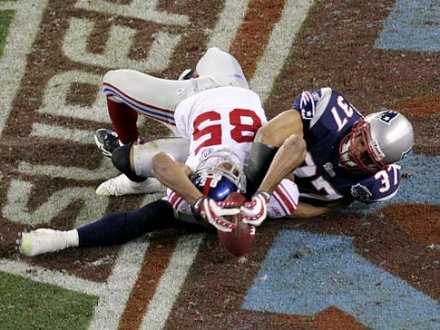
Before disemboweling, he was probably stretched out somewhat like David Tyree.

In fact, it was so dreadful (including many injuries in the distasteful rush for souvenirs) that they stopped doing it. Only gradually: Edward Marcus Despard, for instance, was sentenced to drawing and quartering, but they only hanged him to death and cut off his head posthumously. In 1814, that sentence — hanging plus posthumous beheading — formally replaced the old disemboweling-and-quartering bit as the penalty for treason.

(The invaluable CapitalPunishmentUK.org says that one James O’Coigley suffered hanging, drawing, and quartering in 1798 for that year’s Irish Rebellion; however, the Newgate Calendar’s record says that O’Coigley was “merely” hanged and beheaded, like Despard.)

On this day..