1820: The pirates of the William

On this date in 1820, six pirates of the brig William hanged at the Maltese capital Valletta.

This vessel had the previous July departed her Liverpool berth hauling a cargo of lucrative sugar to Malta under the command of Charles Christopher Delano. The latter evidently labored under some legal judgment he considered unjust and convinced a none-too-reluctant crew that it would be “neither a sin nor a shame” to augment their wages by turning buccaneer.

To this end, the William waylaid an Italy-bound English brigantine, the Helen, off the Spanish coast just inside the Straits of Gibraltar on August 2. All that night and throughout the next day the pirates were engaged in transferring the Helen‘s cargo to their own ship, finally boring open the hull and abandoning her to sink with all hands aboard. The contingent of the Helen was able with difficult to force their way out of confinement and take a longboat (likewise disabled by the raiders and therefore in need of constant bailing) towards the coast until they encountered the aid of friendlier mariners. All survived their brush with the William although their prosecutor would rightly observe that “the confidence on which the prisoners relied for their security (and which has led to their present arraignment) must have arisen from the belief that all evidence of their crime was extinct, and that the intention of a deliberate and comprehensive murder must be added to their already too prominent offence.”

The William, meanwhile, had proceeded to Sardinia where her crew was able to unload some of the ill-gotten gains, and thence to Malta, where they discharged the remainder, along with the legitimate sugar cargo they’d carried out of Liverpool.* However, the Maltese transactions attracted enough suspicion that after the William left harbor, British insurance men there hired a ship named Frederick to apprehend the William — which was soon accomplished.

The case itself was open and shut, and from an appendix to its record we discover the usual climax that is this site‘s stock in trade:

On Friday morning, the 4th of February, at eight o’clock, the awful sentence of the law was carried into execution, on board the brig William, upon Charles Christopher Delano, Thomas Thompson, Benjamin Wilcock, John Smith, John Lewis, and John Webb, in the mode prescribed by the following order issued upon that occasion: —

That the William, brig, being the vessel in which the unfortunate convicts committed the flagrant and most atrocious act of piracy, be painted black, hauled out and anchored in the middle of the great port of Malta, viz. that of Valetta [sic]; and that the aforesaid most unhappy convicts be carried on board of the said vessel, at such time and in such manner as may hereafter be directed; and that on Friday morning, being the fourth day of the month, between the hours of eight and twelve, the aforesaid convicts, viz. Charles Christopher Delano, the late master of the said brig; Thomas Thompson, late mate of ditto; Benjamin Wilcock, late mariner and second mate of ditto; John Webb, late mariner of ditto; John Lewis, late mariner and cook of ditto; John Smith, late mariner of ditto; John Curtis, late carpenter of ditto;** and Reuben Marshall, late mariner of ditto, be hanged as may be directed between the hours of eight and twelve on Friday morning next, being the fourth day of the month of February, in the year of Our Lord one thousand eight hundred and twenty; and after hanging till they be dead, that they be cut down, put in open shells, and protected by a proper guard from his Majesty’s ships; that they be carried to the appointed place, viz. Fort Ricasoli, where the body of the late Charles Christopher Delano, late Captain of the William, is to be hung in irons on the right hand gibbet, next to the Port of Valletta, erected for this purpose in the north-west angle of the said fort; the body of John Lewis, late cook and mariner on board the same vessel, on the left hand gibbet in the same angle; the body of Thomas Thompson, late mate, on the right hand gibbet, erected for the purpose on the north-east angle of the same part of the said fort; and the body of John Smith on the left hand gibbet in the same fort; and that the four remaining bodies be interred at the feet of the before-mentioned gibbets — the body of Benjamin Wilcock under the gibbet on which the late Charles Christopher Delano hangs; the body of John Webb under the gibbet on which the late John Lewis hangs; the body of John Curtis under that on which Thomas Thompson hangs; and the body of Reuben Marshall under the gibbet on which John Smith hangs.

It is satisfactory to state, that the unfortunate man, who commanded the piratical vessel, confessed, in the last hours of his life, in order to reconcile himself with that Supreme Being on whom alone all his hopes then depended, that he was the prime mover and instigator of this most heinous crime.

His Majesty’s most gracious clemency was extended to the persons of the other two prisoners, Reuben Marshall and John Curtis, whose fatal sentence was respited on the spot, after the execution of their associates, by a warrant to that effect from his Excellency Sir Thomas Maitland,† issued at ten o’clock on the preceding night.

The following extract from the Malta Government Gazette will explain the laudable motives which induced His Excellency to this most humane and gracious act of clemency: —

We understand that His Excellency was induced to grant this mark of favour from the conviction, after a laborious investigation into the subject, that cases had occurred, although very rarely, of such clemency having been extended, in previous instances, to some of the parties convicted of aggravated piracy.

Such a precedent was, no doubt, most grateful to his Excellency’s feelings, and in the choice of the two persons to be spared, we understand his Excellency was guided by the uncommonly good character which Marshall had possessed previous to this atrocious act in which he was concerned; and in the case of Curtis, independently of his youth, by some very peculiar circumstances which had been disclosed in his favour by the captain and the rest of his ill-fated associates.

* One of the crew members reported receiving a total of 345 dollars from his share of the booty. Even allowing that “legitimate” fourfold share he claimed for himself as the captain, Delano apparently shortchanged his associates.

** So many Johns!

† Catch a Maitland cameo in this post from the Haitian Revolution.

On this day..

1860: James Stephens

James Stephens hanged in New York on this date in 1860, for poisoning his wife.

We’ve referenced passingly a number of 19th century hangings on then-trendy “upward-jerking” gallows — whose action is not to drop the offender down through a trap, but to drop a heavy weight which levers the offender up.

Thanks to the Feb. 4, 1860 edition of the New York Herald, we have a very detailed description of this macabre device.

Perhaps the reporter’s skepticism as to this machine’s humane efficacy is informed here by a bit of hindsight, for when it engaged to end the life of our Mr. Stephens,

Up went the culprit high into the air, not with a sudden violent jerk as usual, but slowly, as if by the strength of a man’s arms, instead of a powerful weight of some 300 pounds. It became evident immediately that something was wrong, and soon a rumor went round that the rope had been unwound instead of cut by the hangman. It appeared that the executioner, who was inexperienced, got frightened, and thus the barbarous manner of hanging the culprit was explained.

It was extraordinary that under these circumstances the unfortunate wretch, suspended between heaven and earth, did not exhibit indications of violent suffering. The moment the rope tightened around his neck, and he was elevated about half way up, a slight twitching of the fingers and kicking of the legs were perceptible. Then a few moments intervened without the slightest indication of suffering, except the hard breathing, which was fearful to listen to. After hanging two minutes in this way, another convulsive throe took place; the vessels in the neck seemed to be swelled almost to bursting, the fingers and wrists assumed a bluish hue, and the feet twitched once or twice spasmodically. Three minutes came, and with it a very feeble tremor showed itself in the whole body; but it lasted only a few seconds, when all further motion ceased, and life seemed to be completely extinct. The surgeons, Drs. Woodward, Simmons and Covell, viewed the body after a suspension of five minutes, and gave it as their opinion that animation was certainly gone; but the body was not lowered until fourteen minutes had expired. The surgeons then again examined the body, found no pulse, and the flesh icy cold. Considering the circumstances, the culprit died a remarkably easy death, which was owing, doubtless, to the feeble condition of his constitution. Had he been in good strength at the time of his execution there is no question but that he would have struggled in the most frightful agony for half an hour.

On this day..

1927: Ada Bonner LeBoeuf and Dr. Thomas E. Dreher

A call back to the sadly demobilized crime blog CLEWS for the double execution on this date in 1927 of Louisiana adulterous lovers Ada Bonner LeBoeuf and Dr. Thomas E. Dreher, for the murder (via hireling) of Mrs. LeBoeuf’ husband …

The first-degree murder trial that followed a month after the murder of Mr. LeBoeuf was billed in the press as one of the Southland’s most sensational legal battles, since, it was reported, the South hadn’t convicted and hanged a white woman for murder since Reconstruction days, and Louisiana had never hanged a white woman for murder, not even in the days of French and Spanish rule.

The trial was a cross-country sensation. The state produced nearly a dozen witnesses who testified to the details of the scandal. Per these many witnesses, the light-o’-loves carried on their small-town affair in the “negro shacks” on the outskirts of the village. The evidence included love letters that were read aloud.

Read the whole jam here.

On this day..

1733: Henry Neal, for shoes and breeches

That life is often cheap is Executed Today‘s stock in trade and few hanged cheaper than Henry Neal on this date in 19733.

Two bare entries at the Old Bailey Online constitute, we suspect, something close to the entirety of the documentary trail civilization holds for this soul.

Working backwards in time, we begin with the customary account of the Ordinary of Newgate, James Guthrie, of the twelvefold Tyburn hanging on January 29, 1733:

Henry Neal, Twenty Years of Age, his Father a Porter at Billingsgate died, and left him young, and his Mother being a poor Old Woman, could give him no Education at School, after he was Four Years Old; since which time he was forced to Work for his Bread at One Shilling per Week, and as he advanc’d in Years they gave him more. He commonly serv’d the Carters and Scavingers, till about Seven or Eight Months ago a Cart run over his Leg, which disabled him for Work. He own’d the robbing of Mr. Graves’s House, as was Sworn against him, but with a variation of Circumstances; for he said, that he only took the Hat, Breeches, and some small Things; but as to the Rings, the Guinea and a Half, he never saw them, as he said. He said, that he kept the Church, and was not very wicked, neither did he know the vile ways usually practis’d by such wicked People; and that what he did was merely for poverty and want, he having been disabled for Work, having fasted for three Days, and every body refusing him Charity. This is the Account he gave of himself, but as to the truth thereof, we leave it to others to judge thereupon. He was a poor ignorant Fellow, and knew but little of Religion. He declared himself Penitent for his Sins, that he believ’d in Christ his only Saviour, and that he died in Peace with all the World.


Here’s the preceding trial record that got him the noose, with testimony by those he robbed (the last of them seemingly written progressively to capture his distinctive accent):

Henry Neal, of St. Giles’s Cripplegate, was indicted for breaking and entring the House of William Graves, and stealing a Pair of Breeches, a Hat, a Pair of Shoes, 2 Gold Rings, a Guinea and a Half, and 2s. 6d. the Goods and Money of Richard Sims, and a Pair of Leather Breeches, the Goods of Tho Cecil, November 16, about ten at Night.

Richard Sims. I look after the Dog-house Bar. About six at Night the Prisoner came into the House, and desired me to let him warm himself by the Fire, for he said he had been with a Cart to Edmonton, and was very cold. He beg’d an old Pair of Shoes, upon which, I took Notice that those he had on were very bad; but I did not give him any. He staid till eight o’Clock, and then went away, and I shut up the Door as usual, and went to Supper at the Green Man on Windmill-Hill, and after Supper I returned to the House at the Bar, and went to Bed: Next Morning the Taylor came to mend my Breeches, which I had left in my Room overnight before I went to Supper, and there was two gold Rings, a Guinea and a half, and 2s. and 6d. in a brass Box in the Side-Pocket. I look’d for my Breeches but could not find ’em, and at the same Time I mist my Hat and my Shoes. Searching farther I found the Prisoner’s old Shoes, which were tied with Packthread, at the Door, and the Cellar Door was split in two. The Shoes made me suspect the Prisoner. Next week I met with him. He confess’d that he broke the Cellar-Door with a great Stone, and then thrust the wooden Bolt back, and got and took the Goods; that he had pawn’d the Hat in Golden-lane for 6d. and the Breeches in Turnbull-Street for a 1s. He went with me to those Places, and found them there. He had my Shoes upon his Feet.

– Thompson. I took the Prisoner in Coleman-street. I knew him before, and had heard there was a Warrant out against him. He had pilfer’d some Things while he had work’d with me there. I tax’d him with robbing Mr. Sims. He at first denied it, but afterwards own’d that he broke the Cellar-door open with a Stone, and had pawn’d the Hat and Breeches, but said he was drunk when he did it.

Tho. Cecil. I do keep the Dog-house-Bar for Mr. Graves, my Lord-Mayor’s Huntsman. My Breeches did hang up where I did lye, but being Zick, I was vorced to go home and leave’m there, and he have got ‘en on now.

Court. Go and look on ’em.

Cecil. Yes, these be they, I can zafely zwear to ‘n.

The Prisoner made no Defence, and the Jury found him Guilty. Death.

On this day..

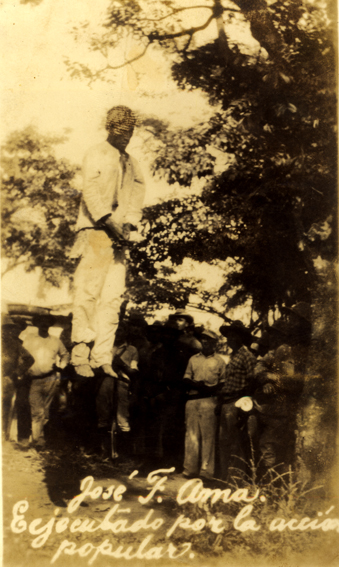
1932: Jose Feliciano Ama, Izalco indigenous peasant

El Salvador campesino Jose Feliciano Ama was hanged in the town square of Izalco on this date in 1932 during a ferocious repression of the peasantry.

In an environment of desperate economic immiseration for nearly all Salvadorans below the landed oligarchy, the heavily indigenous western peasantry rebelled on January 22, 1932 — aided or led by the Communist Party.*
This fate of this rebellion might be inferred by its historiographical sobriquet, the Salvadoran peasant massacre — or simply la Matanza, the slaughter.

In numerical terms, it ran to well into the tens of thousands, maybe up to 40,000 — indiscriminately visited on peasants of originario complexion in the zone of rebellion, batches of them summarily shot into mass graves they’d been forced to dig for themselves.

In the Pipil town of Izalco, where coffee latifundias dominated the best agricultural land,* up to a quarter of the population was butchered. None of those put to la Matanza were more recognizable nor more vividly recalled than the local rebel leader Feliciano Ama English Wikipedia entry | Spanish), extrajudicially noosed in front of the Izalco church. Today a small plaque in this square honors him as a popular martyr.

* See States and Social Evolution: Coffee and the Rise of National Governments in Central America. An heiress of coffee magnate and former president Tomas Regalado allegedly forced our Feliciano Ama off his lands by dint of brute force.

On this day..

1872: George “Charcoal” Botts

It’s the old, old story: conniving war profiteer helps client get divorce, conniving war profiteer installs divorced client as mistress, rival lover also awaiting divorced client’s divorce shoots conniving war profiteer, rival lover winds up on Executed Today.

It’s the story of George Botts (hanged January 27, 1872) and D.C. Civil War gadabout Oliver “Pet” Halsted. Friends of the site Murder By Gaslight has the details.

On this day..

1866: The Nashville murderers of William Hefferman

Blood accumulates upon us. Verily, it does seem that the reins of justice have been loosely thrown to the devil, and that we are all driving at breakneck speed in the same direction.

-Nashville Banner (via)

On this date in 1866, four youths employed as teamsters in the Army corrals of Union-occupied Nashville were hanged for a brutal highway robbery/murder.

The victim was William Hefferman, a wealthy railway contractor. His assailants were George Crabb/Craft, James Lysaught, Thomas Perry/Ferry, and James Knight; Knight at 20 was the only one out of his teens. On the night of November 22, 1865, they held up Hefferman’s carriage. The situation turned deadly when Hefferman’s son-in-law, attempting to protect the old man from the blows of the assailants when he refused to give them any money, fired a shot that wounded Crabb — which led to a return shot that mortally wounded Hefferman. He succumbed to the wound a few days later.

This was the immediate, unsettled aftermath of the U.S. Civil War, occasion for a robust crime wave that held Middle Tennessee in terror. “Nashville is infested by bands of robbers and murderers,” complained the Ohio newspaper The Spirit of Democracy (Dec. 6, 1865). Hefferman’s murder would be one of the signal crimes of that interim and draw nationwide outrage — all of which helped the killers’ associates to shop them very speedily. The army’s drumhead court-martial was gaveled in within a week and the hoodlums were lucky to get that far. “Great excitement exists in the city,” a dispatch to the Daily Ohio Statesman (Nov. 28, 1865) reported. “The streets are thronged with men vowing vengeance and threatening lynch law. Tonight meetings are being held in each ward to form a citizen patrol. A spark may incite the crowd to mob law.”

As it was a military trial, the appeal went up the chain of command to U.S. President Andrew Johnson,* who denied it. However, such a proceeding would not have been licit under the imminent (April 1866) U.S. Supreme Court holding in Ex Parte Milligan — which held that military courts cannot try civilians wherever civilian courts are open.

It is their youth, their boyishness, that leaps off the page in the accounts of their last hours — such as this from the Cleveland Daily Leader of January 29:

The four Heffernan [sic] murderers were hung to-day, at thirteen minutes past twelve o’clock. Their real names are James Knight, Thomas Perry, George Crab and James Lysaught. Two had been in the rebel army.

Yesterday several orthodox ministers called, conversed and prayed with the prisoners, who exhibited some emotion. Afterward, Father Begrath, of the Catholic Church, was with them. They all professed the Roman Catholic faith. Knight and Perry were baptised. The other two had been baptised in infancy. The prisoners had previously shown great hardihood, singing such pieces as “Bold Jack Dunaho” and “Bingen on the Rhine.” The past two days had tamed them down, but they were still stolid, frivolous and careless, joking about their doom.

This morning, Perry’s brother brought him clothing. The parting scene between them was heart-rending, Perry giving way to tears and sobs. Colonel Innis provided the others with clothing. Lysaught said, at first, that he didn’t want any pants, as those he had on were good as gold to hang in. Crab was asked to tell who shot Hefferman. He replied, “That is not a fair question; I’ll never tell that in this world.”

Father Begrath came about ten o’clock to attend them in their last moments. Lysaught said he felt as gay as a lay. He said he had been badly treated, else he would be with his parents now. Father Begrath read a touching letter from Lysaught’s parents to the Bishop, asking him to have James’ grave marked that some day they might take the body away. He was earnestly exhorted to repentance, but he remained almost stolid. Some one in the room having a looking-glass, he jumped up, exclaiming, “By golly, I must look at my face once more.” Then turning to Crab, he remarked, “Look at yours — it is your last chance.”

Crab replied, “It aint any use.” Lysaught asked, laughingly, “afraid you’ll break the glass?” when all four seemed much tickled. Crab having eased Lysaught’s handkerchief, the latter playfully snatched it away, saying, “let me smell it everlasting.” Then, turning to Crab, said, “you’re enough to make a monkey grin.”

Perry was asked if he feared to die. He replied “I don’t dread it a bit. It’s best to take it easy, it’s got to come.”

Crab indicted the following letter to Byron Heston, Oswego, New York:

George Crab, the boy who used to run on the packet with you, in 1861, is about to be hung. He requests to be remembered, kindly, to yourself and family.

Perry took his brother aside at parting, and advised him never to indulge in sinful, lazy ways, never to swear, and to let alone whisky, cards and bad houses, “for the like of this has brought me to the gallows. I want you to take my body home and let mother see me. I am sorry she did not see me before I was hung. Tell her to meet me in a better world, as I am prepared to die. God bless you! Good-bye!”

When the priest left them for a few moments they began to chat and joke about the ropes that would hang them, the feeling of contrition being evanescent.

An immense crowd, numbering fifteen thousand persons, were on the ground. At twenty minutes past eleven, the prisoners were brought to the gallows, which they mounted with a firm step, and stood gazing around for nineteen minutes, while the charges and specifications and sentence were read. Perry composedly leaned against one of the uprights, and surveyed the crowd. Crabb took hold of the noose before him, and viewed it with a comic look, testing its strength with his thumb, and rubbing his head against the rope.

Knight buttoned his coat, chewing his cud of tobacco violently and showing nervousness. As his arms were bound he quivered a moment. During the prayer he knelt, bowing his head and holding his handkerchief to his nose, which was bleeding. His last words were: “I have no hard feelings against any one. I am going to a better world.” Lysaught took a farewell chew of tobacco, saying “Pretty rough, ain’t it?” He asked forgiveness of all whom he had injured, adding, “I am glad we had time for repentance; I am glad we were removed from the jail to the Penitentiary. If I had stayed at the jail I would have starved to death.” Crab also asked forgiveness for his misdeeds, and thanked Mr. Johnson, keeper of the Penitentiary, for his kindness. Just before the drop fell, he shrugged his shoulders and exclaimed, “It’s kind o’ cold.” A chum called on him on the platform, and was affectionately kissed by Knight and Crab; as he went down the steps, the former called out, “Take warning by this.”

Just before the drop fell, Perry held out his hat and said, “Jim Johnson give my brother that.”

At thirteen minutes after 12 o’clock the rope was cut, and the four bodies fell with a heavy thump. Lysaught’s neck was broken. The knot slipped with Knight and Crab, who died with many struggles and convulsive writhings. Perry died by strangulation, but did not move much.

After hanging twenty minutes the bodies were cut down and placed in common pauper coffins.

An early attempt was made to erect whisky, candy and apple stands among the crowd of spectators, but the military promptly interfered.

The bearing of the condemned showed that they had agreed to brave it out. Their highest estimation of conduct on such occasions seems to have been to die game. They certainly met death with as little show of fear as it possible to imagine in youths not out of their teens.

* By coincidence, Johnson had been the military governor of Tennessee during the war.

On this day..

1774: John Malcom, tarred and feathered

On this date in 1774,* in the British official John Malco(l)m was tarred and feathered and mock-executed by enraged Bostonians during the tense run-up to the American Revolution.

Malcom’s militant Loyalism put him sharply at odds with his city’s’s rising Patriot ultras — the sorts of people who, just a month before, had provocatively dumped British East India Company tea into Boston Harbor.

Malcom himself hadn’t been proximate to that event but as a customs official he’d made himself obnoxious on the docks before. In October of 1773, he seized a ship in Falmouth,** threatening “to sheath his sword in the bowels of any one who dared dispute his authority.” The sailors responded by sheathing John Malcom in a coat of tar and feathers and marching him through the streets.

This vigilante justice was meant to come up short of serious physical injury, and it did. But it was a crippling public disgrace, far beyond the streets of Falmouth — an ironic situation since Malcom’s own late brother Daniel was a celebrated Patriot bootlegger.† Back in Boston, Malcom found himself heckled in the streets about the incident to such an extent that he complained to the governor. (The governor told him to suck it up.) And it bubbled right to the surface in the incident that brings today’s post, too.

On January 25 of 1774, one of the Patriot participants in the aforementioned Boston Tea Party named George Robert Twelves Hewes‡ happened across the hated crown agent — “standing over a small boy who was pushing a little sled before him, cursing, damning, threatening and shaking a very large cane with a very heavy ferril on it.” (That’s according to the next week’s (Jan. 31, 1774) Boston Gazette, as are the subsequent quotes in this post.) Apparently the kid had crashed his conveyance into Malcom while out frolicking in the deep winter’s snow.

Hewes interceded for the child, and Malcom rounded on him: “you are an impertinent rascal, it is none of your business!” Flexing his class rank, Malcom further scolded the “vagabond” that he ought not address a gentleman in public. Hewes dissented and after an exchange of barbs cut Malcom to the quick with the retort, “be that as it will, I never was tarred or feathered.” This own brought Malcom’s heavy cane crashing into Hewes’s head, crumpling the Good Samaritan to the cobblestones.

Angry bystanders to the incident trailed Malcom home, and heaven only knows what hard words were traded on the way. He should have been worried and maybe he was, but his blood was up from Hewes’s insult: Malcom stood on the threshold and verbally sparred with his angry neighbors — “you say I was tarred and feathered, and that it was not done in a proper manner, damn you let me see the man that dare do it better! I want to see it done in the new-fashioned manner.” The man’s Falmouth tarring, you see, had been leniently poured over his clothes, which might have been hell on his dry cleaning bills but also minimized the injury that hot tar could do to naked skin. Now he was daring a rougher treatment at the hands of Bostonians who had certainly proven up to that challenge in the past.

Calmer heads knew this situation could spiral out of control and judiciously steered the irate official into his house. But Malcom was not to be stilled; when his wife opened a sash to implore the crowd to disperse, her husband exploited the opening to thrust a sword into the breast of a bystander. Luckily for both parties the blade struck bone, causing only a glancing flesh wound.

Somehow the irascible coot restrained himself in the house long enough for this disturbance to subside, while Hewes shook off his concussion well enough to swear out a warrant.

But by evening, word of this politically charged provocation had circulated in Boston, along with all Malcom’s bluster — “among other things, that he would split down the yankees by dozens, and receive 20l. sterling a head for every one he destroyed.” A crowd started assembling again at Mr. Malcom’s door, now dangerously intent on its purpose.

they got ladders and beating in an upper window, entered the house and took him without loss of blood, and dragging him out put him on a sled, and amidst the huzzas of thousand[s], brought him into King street. Several Gentlemen endeavoured to divert the populace from their intention, alledging that he was open to the laws of the land which would undoubtedly award a reasonable satisfaction to the parties he had abused; they answered he had been an old, impudent and mischievous offender — he had joined in the murders at North Carolina — he had seized vessels on account of sailors having a bottle or two of gin on board — he had in office, and otherwise, behaved in the most capricious, insulting and daringly abusive manner — and on every occasion discovered the most rooted enmity to this country, and the defenders of its rights — that in case they let him go they might expect a like satisfaction as they had received in the cafes of Richardson and the soldiers, and the other friends of government. With these and such-like arguments, together with a gentle crouding of persons not of their way of thinking out of the ring, they proceeded to elevate Mr. Malcom from his sled into the cart, and stripping him to buff and breeches, gave him a modern jacket, and hurried him away to liberty-tree, where they proposed to him to renounce his present commission, and swear that he would never hold another inconsistent with the liberties of his country; but this he obstinately refusing, they then carted him to the gallows, passed a rope round his neck, and threw the other end over the beam as if they intended to hang him: But this manoeuvre he set at defiance. They then basted him for some time with rope’s end, and threatened to cut his ears off, and on this he complied, and they the brought him home.

See, reader, the effects of a government in which the people have no confidence!


“Bostonians Paying the Excise-Man, or Tarring and Feathering” (color version of same). This print and the next one make reference to a dubious report in London papers that Malcom was made to guzzle tea to the point of bursting for “your whole Fraternity at the Custom house would drench us with this Poison, and we are to have our Throats cut if it will not stay upon our Stomachs.”


“A new method of macarony making, as practiced in Boston”. (A different print with a nearly identical title shows an expanded view of a gallows here.) The number 45 seen on the hat above was code for Liberty at this period, due to the daring anti-monarchist sentiment in issue no. 45 of radical agitator John Wilkes‘s The North Briton.


A French engraving of the event, from 1784.

* There are a few other dates besides Tuesday, January 25 to be found out there, but newspaper reports from the time clearly place it on that day. Malcom himself later circulated a strange bulletin to Boston churches confirming the date with the words “John Malcom returns thanks to Almighty God, that again he is able to wait on him again in the public worship, after the cruel and barbarous usage of a cruel and barbarous savage mob in Boston, on the 25th evening of January last past confined him to house, bed and room.”

** The town of Falmouth is now Portland, Maine. Its most famous revolutionary war incident was put it to the torch by the British in 1775.

Daniel Malco(l)m’s grave is pocked by musket balls fired at the marker for good luck by redcoats.

‡ Hewes lived to the ripe old age of 98. Enjoy a public domain 1830s biography drawn from personal conversation with the old veteran here … including Hewes’s recollection of the tarring and feathering, which in his telling was clearly extremely traumatic to his antagonist.

The people, however, soon broke open the door, and took Malcom into their custody. They then took him to the place where the massacre was committed, and their flogged him with thirty-nine stripes. After which, they besmeared him thoroughly with tar and feathers; they then whipped him through the town, till they arrived at the gallows, on the neck, where they gave him thirty-nine stripes more, and then, after putting one end of a rope about his neck, and throwing the other end over the gallows, told him to remember that he had come within one of being hanged. They then took him back to the house from whence they had taken him, and discharged him from their custody.

The severity of the flogging they had given him, together with the cold coat of tar with which they had invested him, had such a benumbing effect upon his health, that it required considerable effort to restore his usual circulation. During the process of his chastisement, the deleterious effect of the frost, it being a cold season, generated a morbid affection upon the prominent parts of his face, especially upon his chin, which caused a separation and peeling off of some fragments of loose skin and flesh, which, with a portion of the tar and feathers, which adhered to him, he preserved in a box, and soon after carried with him to England, as the testimonials of his sufferings in the cause of his country. On his arrival in England soon after this catastrophe Malcom obtained an annual pension of fifty pounds, but lived only two years after to enjoy it.

On relating this adventure, the very excitement which the affront must have wrought upon him, evidently began to rekindle, and he remarked with emphasis, I shall carry to my grave the scar which the wound Malcom gave me left on my head; and passing my finger over the spot to which he directed it, there was obviously such a scar, as must have been occasioned by the wound he had described.

On this day..

1779: Claudius Smith, Cowboy of the Ramapos

Claudius Smith, a feared Tory guerrilla during the American, was hanged in Goshen, N.Y., on this date in 1779.

“The Cowboy of the Ramapos” for his penchant for livestock-rustling in the Ramapo Mountains, Smith headlined a gang of pro-British criminals/partisans operating out of Monroe, N.Y., near the New Jersey border — a zone of dirty irregular warfare.

Quite a lot of legends apparently proliferated about this guy, including in his own time: one wanted poster described him as seven feet tall.

If you were a British loyalist in his neighborhood you might have figured him along the lines of an Anglo hajduk — the Balkan freebooters who straddled the line between social bandit and hero insurgent. To a Patriot, he was little better than a brigand, and not satisfied with riding off cattle and horses ventured also to invade farm houses for plunder. After one of his band’s deadly raids, Orange County Whigs complained to New York Gov. George Clinton, “we have not thought ourselves secure for a long time. We live so scattered that they can come in the dead of night to any one family & do what they please.”

So unsettled were the wartime frontiers that Gov. Clinton was notably unable to satisfy their petition for quite some time, and Smith’s raids, sometimes working in concert with the pro-British Mohawk commander Joseph Brant, continued to frighten those scattered revolutionists.

A Continental Army major named Jesse Brush finally captured Smith on Long Island late in 1778, and delivered him back to authorities at Orange County who gave him a proper trial and condemned him to hang for several robberies. (Murder wasn’t on the rap sheet.)

One month later, Smith’s son Richard with a band of cowboys revenged the execution by slaying a Goshen man named Richard Clark — and pinning to his corpse a warning to their persecutors.

A Warning to the Rebels

You are hereby warned from hanging any more friends to the government as you did Claudius Smith. You are warned likewise to use James Smith, James Flewelling, and William Cole well and ease them from their irons, for we are determined to hang six for one, for the blood of the innocent cries aloud for vengeance. Your noted friend, Capt. Williams and his crew of robbers and murders we have got in our power, and the blood of Claudius Smith shall be repaid. There are particular companies of us who belong to Col. Butler’s army, Indians as well as white men, and particularly numbers from New York that are resolved to be revenged on you for your cruelty and murders. We are to remind you that you are the beginners and aggressors, for by your cruel oppressions and bloody actions drive us to it. This is the first and we are determined to pursue it on your heads and leaders to the last till the whole of you is massacred.

Dated New York February 1779.

It was tall talk that the raiders couldn’t back up: rewards and informants soon broke up the band, leaving the cowboys and Claudius Smith to pass into history.

Ramblers might enjoy a visit to Claudius Smith’s Den, a cave that formerly served as a refuge for Smith’s gang. Beware of ghosts!

On this day..

1957: József Dudás, Hungarian Revolution wild card

Hungarian politician József Dudás was hanged on this date in 1957, for participation in the previous year’s abortive Hungarian Revolution.

Although he’d been a Communist in his prewar youth, Dudás won election to the postwar government on the Independent Smallholders line. This agrarian opposition party was gradually pushed out of power and eventually suppressed over the course of the late 1940s; Dudás himself ended up getting arrested and detailed for a long visit to the feared Romanian Securitate.

He’d long since been repatriated as a non-political engineer when the Hungarian Revolution briefly cracked open the horizon of possibilities in the autumn of 1956.

Dudás immediately proved himself not so non-political — and a distinct thorn in the side of the Imre Nagy government. He advocated not only for Hungarian Independence (which was also the title of his newspaper) but also for a multiparty reformulation of the Hungarian state, which was a bit much for Nagy to process during the revolution’s two-week lease on life. Dudás’s penchant for off-script revolutionary improvisations, such as putting out feelers to Soviet commanders and also having his militia lynch agents of the temporarily disempowered secret police, made him an unwelcome wild card and Nagy had him arrested shortly before Soviet tanks re-established control.

The Soviets, of course, also had no use themselves for the peasants’ party deputy who’d been trying to subvert Nagy from the right.

On this day..