1752: James Lowry, despotical nautical

On this date in 1752 the tyrannous Scottish sea captain James Lowrey or Lowry was hanged at London’s execution dock for beating a crew member to death.
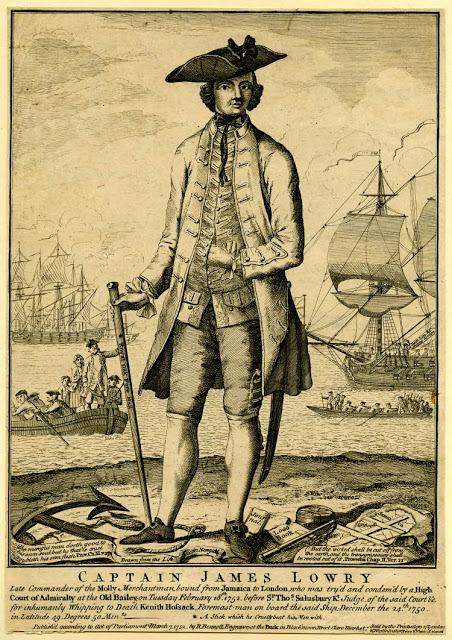
Lowr(e)y came to public notice in 1751 after the return to English shores of his merchantman, the Molly, from a run to Jamaica: ten of his ex-crew subscribed a public advertisement accusing him of murdering their mate on board, to which Lowry replied with advertisements accusing those accusers of mutiny.

Right away the British public knew it had a page-turner on its hands.

The captain had become unreasonably enraged with Kennith Hossack for lagging in his duties as he recovered from an illness, and upon a purported accusation of theft he had the mariner tied up and personally battered him about the head using a doubled-over rope as his cudgel, on Christmas Eve no less. Hossack at last dropped dead, at which point the heartless captain slapped his man and denounced him for “shamming Abraham” (i.e., feigning injury to skip work). Lowry evidently really had it in for Hossack, for the first mate explained that “I don’t know that he ever came upon deck twice in a week without beating him: my heart has bled for him many and many a time.” In the mate’s opinion, these beatings were always for no adequate reason.*

That’s a remark from the Admiralty Trial of Captain Lowry, where his former seamen developed the picture of an intolerably Queeg-like commander liable to take bitter umbrage if his men managed an illicit extra ration of sugar or rum, a guy who carried around a beating-cane with its own name (“the Royal Oak Foremast”) just in case he felt like doling out a disciplinary bludgeon. Three days after Hossack’s death, he came to blows with the second mate; two days after that, a fed-up crew “took the command from him” and ran the ship themselves, although they did not forcibly confine him.

Once the ship put in at Lisbon for repairs on the return journey, Lowry lodged a piracy complaint against his crew, but despite the incredibly serious charges and countercharges, everybody sailed on together for home thereafter, each party perhaps silently calculating the odds that the other would dare to press the case further as against getting on about their lives. Lowry does not appear to have made himself scarce until his former comrades went public with their claims, although once they did so he incriminatingly avoided the thief-takers and the small private reward set upon his capture for a few weeks.

On March 25, 1752, the brute was carried from Newgate Prison to the Execution Dock on the Thames, in a cart surmounted by a silver oar emblematic of the Admiralty. There he was hanged, and his body afterwards put in irons and displayed in infamy down the river at Blackwall.


Lowry pictured as part of a “Scotch Triumvirate” of Caledonian evildoers, along with the Scottish officer William Cranstoun, blamed for seducing Mary Blandy to the gallows, and the more mysterious “Major James MacDonald” whose papers suggest involvement in the South Sea Bubble 32 years prior (?). I’m in good company with my confusion on this MacDonald fellow, as the British Museum can’t identify him either. Check out britishtars.com for a fascinating exposition on the iconographic detail of the Lowry images in this post; we have also featured in this narrative several additional links to that same site’s various posts about the events on the Molly.

We have revisited a few times in these pages the intense commercial bustle among publishers of crime ephemera — in England as well as Ireland. Naturally this headline-grabbing execution excited plenty of competitive hawking.

Two examples appear below; the first of them is by a pair of publishers named Harris and Scott; the second, by Parker and Corbett, who at this time had the deal to publish the Ordinary of Newgate’s accounts. Harris and Scott were first to the market here, in an environment where rapidity counted for a lot; the Ordinary wanted to be sure the public knew that his “official” (according to him) version would be soon forthcoming, so he burdened the pages of London newspapers and even his own Ordinary’s Account of ‘regular’ Tyburn criminals with adverts to that effect.
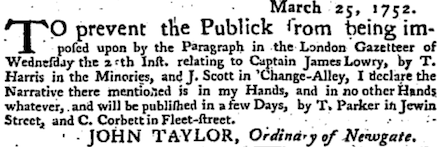

This image from the London General Advertiser of March 26, 1752, one of several papers to carry the notice. For more on the relationship between publishers and crime in this era, see Print Culture, Crime and Justice in 18th-Century London by Richard Ward

Read on below to enjoy both.

* In fact, one nugget from this case is that an adequate reason for corporal punishment at sea might sit at a much higher threshold than we commonly assume today. Although the Royal Navy was (in)famous for the discipline of the lash, multiple experienced sailors testified at this trial that they never knew floggings or beatings to occur on merchant vessels.

On this day..

Feast Day of Saint Pigmenius

March 24 is the feast date of Saint Pigmenius, the patron saint of pigmen.

In the hagiography, Pigmenius was a Christian scholar who numbered among the instructors of the young royal relative destined to switch back to paganism and become reviled of Christians as the Emperor Julian the Apostate.

Fleeing the new order, Pigmenius headed to Persia and as the Roman martyrology recounts it, there

he lived four years and went blind. After four years he was addressed in a dream vision by the Lord Jesus Christ, saying: “Pigmenius, return to Rome, and there you will regain your sight.” Getting up the following morning, he had no fear, but immediately got into a ship and came to Rome. After four months, he entered the city; he began to ascend the hill on the Via Salaria with a boy, feeling his way with a cane. And behold, Julian the emperor, travelling in his golden robes, saw Pigmenius from afar; recognizing him, he ordered him to be summoned. When he had been brought, Julian said to Pigmenius: “Glory be to my gods and goddesses that I see you.” Pigmenius replied: “Glory to my Lord, Jesus Christ, the crucified Nazarene, that I do not see you.” In a rage, Julian ordered him to be thrown off a bridge into the Tiber.

So he got to dunk on the emperor, before he got dunked by the emperor.*

However, this book (French) makes the interesting argument that the fourth century Pigmenius was a reinvention of a 1st century Roman saint of similar name, to whom subsequent legends attributed a fictitious eastern sojourn.** “It is this ‘orientalization’ of Pigmenius that connected it to the time of Julian,” runs the argument. For, once Julian’s death in battle in those precincts made the East an overwhelming shadow in Roman minds, “Julian’s story melded somehow with the legends which ran over the distant lands where it had unfolded and the oriental traditions, were ‘Julianized'” — Pigmenius’s among them.

* As the editor of this martyrology remarks in a footnote, this snappy retort was actually borrowed by the hagiographer from stories of Maris, Bishop of Chalcedon, to whom is attributed a similar exchange:

Julian: Thy Galilean God will not heal thy sight.

Maris: I thank God for depriving me of the power of beholding thy face.

** Comparable, the author claims, to the Persian excursions of Saint Cyriacus.

On this day..

1897: The Nineteen Martyrs of Aklan

In the wee early hours on this date in 1897, the Spanish occupation shot 19 Philippines revolutionaries — the Martyrs of Aklan.

Aklan is a province in the Western Visayas, and our 19 there were surrendered to a purported Spanish amnesty following the assassination of the local independence leader General Francisco del Castillo.

The amnesty was not honored. Known or suspected as active Katipunan subversives, these 19 were shot and (when necessary) bayoneted in a cell in a Kalibo dungeon situated on what’s now known as Nineteen Martyrs Road.

Aklan observes a holiday every March 23 in honor of these men.

On this day..

1540: Hans Kohlhase, horse wild

On this date in 1540, the legendary outlaw Hans Kohlhase — a crime victim turned revengeful crime lord — executed* in Berlin. It’s a classic case of stubborn cusses escalating a minor property dispute.

En route to the Leipzig fair in 1532, Kohlhase (English Wikipedia entry | German) was stopped by a Saxon nobleman who confiscated some of his horses. In dueling publications years later, Kohlhase would charge that Guenther von Zaschwitz accused him of stealing the horses; von Zaschwitz countered that Kohlhase looked suspicious and got uppity with his retainers when questioned.

Proceeding to Leipzig in a huff, Kohlhase obtained the commendations necessary to confirm his identity and then demanded his property back from von Zaschwitz. The lord agreed … if Kohlhase would pay for the horses’ days of upkeep in his stables. Just a little crap sandwich from the neighborhood bully. Kohlhase didn’t feel like having a bite of it.

Fast forward a couple of years. Suits in the courts bogging down, Kohlhase at his wit’s end resorted to an older form of redress, one consecrated by centuries of tradition but now forbidden by a landmark 1495 legal reform: he declared a feud. Kohlhase really vented his spleen in this one, not bothering as a plausibly wronged party to play for hearts and minds but rather pronouncing his vendetta against the whole Electorate of Saxony.

Thus “justified,” he turned out-and-out bandit, gathering a crew of desperados to his banner and robbing with opportunistic promiscuity while staying a step ahead of a bounty issued against him by Elector Johann Frederick I. To repeat: this is all over a question of who foots the bill for a feedbag. Even Martin Luther tried to talk this vengeful fury off his grudge.

What is just, you will do justly, says Moses; wrong is not justified by other injustice … What you rightly do, you do well; if you can not obtain justice, there is no other advice than that you suffer injustice … Therefore, if you desire my council (as you write), I advise, accept peace.

Kohlhase accepted only the peace of the grave.

The German romanticist Heinrich von Kleist immortalized (and renamed) this uncompromising litigant in the novella Michael Kohlhaas; the same story has been re-adapted for cinema several times more.

* No surviving document specifies whether the execution was by breaking wheel or beheading.

On this day..

1952: The last executions in the Netherlands

The last executions in the Netherlands took place on this date in 1952: Dutch SS volunteer Andries Jan Pieters and German SS man Artur Albrecht, both condemned for war crimes committed during the Nazi occupation. Each was implicated in numerous incidents of torturing and executing prisoners.

Both men were shot at Waalsdorpervlakte, outside The Hague. They were the tail end of a 1940s era that brought numerous capital prosecutions for World War II offenses.

Pieters (left) and Albrecht (right).

Capital punishment had been abolished in the Netherlands for ordinary crimes since 1870. Although execution remained theoretically available for military crimes until 1993, nobody after Pieters and Albrecht came close to facing an executioner. Today, the death penalty is completely forbidden in Dutch law.

On this day..

1738: Nicolas Doxat de Demoret

Swiss officer and military engineer Nicolas Doxat de Demoret — also referred to as Doxat de Moretz or Doxat von Morez — was beheaded on this date in 1738 for surrendering to a Turkish siege.

Native — as his name suggests — of Demoret, Doxat was a career soldier who had served the Austrian empire since 1712. The generation of Doxat’s service saw Austria’s greatest expansion into the Balkans, with Turkey forced to cede to the empire most of present-day Serbia. Doxat emerged with some war wounds and a general’s epaulets.

Unfortunately 18th century Vienna did not have access to the Internet articles informing it that this would represent its greatest expansion in the Balkans — for, in 1737, Austria jumped into a Russo-Turkish War with an eye to gobbling even more, and instead started suffering the defeats that would return its conquests to the Sublime Porte.

General Doxat owned one of these defeats, the October 1737 surrender of the Serbian city of Niš to an Ottoman siege — yielded too readily, in the judgment of Austrian authorities. He had weeks of supplies remaining but with little water and no prospect of relief he judged the situation hopeless and accepted an arrangement that permitted the honorable withdrawal of his garrison.

Despite the appeals of comrades in arms for clemency, the emperor confirmed the sentence of a war council, and Doxat was beheaded* in Belgrade on March 20, 1738. Barely a year later, that city too was in Turkish hands.

* The beheading, conducted in the botch-prone seated position, was botched — the first blow gouging the general’s shoulder and knocking him prone, where he was inelegantly finished off.

On this day..

1819: John Van Alstine

John Van Alstine was (incompetently) hanged two hundred years ago today for murdering Schoharie County, N.Y., deputy sheriff William Huddleston — whom he bludgeoned to death in a rage when Huddleston turned up to execute a civil judgment forcing the sale of Van Alstine’s property to service a debt. The man acknowledged having a ferocious temper.

“It is not a year since I stated in Judge Beekman’s presence, (and, I stated it as the firm conviction of my mind), that there were two things I should never come to — the state’s prison and the gallows,” the confessed murderer mused in his public reflections, below. “How often have these words occurred to me since the regretted 9th, and taught me the vanity of human boasting, and the weakness of human resolution, when opposed to long indulged passions.”


This document has also been transcribed here.

On this day..

1696: Charnock, King, and Keyes, frustrated of regicide

On this date in 1696, a trio of Jacobite conspirators were hanged for their failed assassination plot against King William.

An exiled loyalist to the deposed King James II, the onetime Oxford don Robert Charnock conceived what the propagandists would call “the late Hellish and Barbarous Plott” along with fellow Stuart loyalist George Barclay. Their mission in murdering William III was to catalyze a general Jacobite rising that would reverse the Glorious Revolution and restore James to the throne: it was a recurring campaign against the Dutch usurper throughout the 1690s.

Ambush was the gambit proposed by the worthies in this case, for William.

was in the habit of going every Saturday from Kensington to hunt in Richmond Park. There was then no bridge over the Thames between London and Kingston. The King therefore went, in a coach escorted by some of his body guards, through Turnham Green to the river. There he took boat, crossed the water, and found another coach and another set of guards ready to receive him on the Surrey side. The first coach and the first set of guards awaited his return on the northern bank. The conspirators ascertained with great precision the whole order of these journeys, and carefully examined the ground on both sides of the Thames. They thought that they should attack the King with more advantage on the Middlesex than on the Surrey bank, and when he was returning than when he was going … The place was to be a narrow and winding lane leading from the landing place on the north of the river to Turnham Green … a quagmire, through which the royal coach was with difficulty tugged at a foot’s pace. The time was to be the afternoon of Saturday the fifteenth of February. (Macaulay)

Some 40 assassins had been marshaled for the purpose of surprising the royal party on that occasion but as they nursed their cups in the vicinity’s public houses they received the disquieting intelligence that the king had skipped the hunt that day.

Although the inclement weather was the reason given out, the truth of the matter was that they were betrayed. In a week’s time, most of the conspirators would be in custody* and the country on a virtual war footing against prospective invasion by France. On March 11, the first three prospective assassins stood at the bar: Charnock, Edward King, and Thomas Keyes. They were plainly guilty and condemned accordingly.

King died firmly; Keyes, in “an agony of terror … [that] moved the pity of some of the spectators”; and Charnock, being repelled in his bid to turn songbird in exchange for his life, went out with a missive bitterly defending his project, for “if an army of twenty thousand men had suddenly landed in England and surprised the usurper, this would have been called legitimate war. Did the difference between war and assassination depend merely on the number of persons engaged?” (both quotes from Macaulay) Several additional conspirators would follow them to the scaffold in the weeks to come.


“The Triumphs of Providence over Hell, France & Rome”: Broadside celebrating and satirizing the deliverance of the realm from the Jacobite plot, via the British Museum.

* George Barclay, however, successfully escaped to the continent.

On this day..

1780: Elizabeth Butchill, Trinity College Cambridge bedding-girl

A Cambridge University servant was hanged on this date in 1780 for infanticide.

Elizabeth Butchill made her way turning down the beds for the boys attending Trinity College, work she had secured via her aunt who held the same position. She somehow got pregnant, an event which does not appear to have inordinately exercised her eventual judges perhaps by virtue of its very obviousness; as Frank McLynn wryly observes, “It does not need the imagination of a novelist to reconstruct the events that led her to the gallows.”

She was surely desperate to avoid social opprobrium and unemployment, so we find from the Newgate Calendar that “she confessed that she was delivered of a female child on Thursday morning [January 6, 1780], about half past six o’clock, by herself; that the child cried some little time after its birth; and that, in about twenty minutes after, she herself threw the said infant down one of the holes of the necessary into the river, and buried the placenta, &c. in the dunghill near the house.”

“Modest, patient, and penitent” during her confinement awaiting the noose, Butchill died

firm, resigned, and exemplary. She joined with the minister in prayer, and sung the lamentation of a sinner with marks of a sincere penitent, declaring she had made her peace with God, and was reconciled to her fate. Desiring her example might be a warning to all thoughtless young women, and calling on Jesus Christ for mercy, she was launched into eternity amidst thousands of commiserating spectators, who, though they abhorred the crime, shed tears of pity for the unhappy criminal.

Whether the nameless infant’s nameless father shared those tears is a matter for the novelist’s imagination.

On this day..

1984: James Hutchins

James W. Hutchins was gassedexecuted by lethal injection in North Carolina on this date in 1984.

Hutchins was “credited” with the largest one-day slaughter of North Carolina law enforcement officers in 1979. An altercation with his teenage daughter* led to a domestic disturbance call, which led eventually to three dead cops all killed in separate shootings.

Hutchins shot Captain Roy Huskey by ambush when he responded alone to the 911 call. Several minutes later, a deputy named Owen Messersmith rolled up to check on the situation since Huskey hadn’t checked in. Messersmith quickly realized the reason, but was shot through the window of his patrol car as he slammed into reverse and “the vehicle drifted backwards across the street and came to rest in a ditch with Messersmith’s body slumped over the steering wheel, causing the horn to blow without stop.” (Wikipedia) The third victim, state highway patrolman Robert L. Peterson, pulled Hutchins over for speeding as the latter fled in his car.

Only by this point did the garbled and chaotic communications flying through dispatch radios that day finally coalesce sufficiently to give cops on the scene a full picture of what was going on: Peterson, for instance, is thought to have been entirely innocent of the knowledge that a suspect in a double shooting was at large in the area.

At any rate, the ensuing manhunt brought Hutchins into custody and a postscript as a part of political lore: in a sort of Ricky Ray Rector play, Democratic Governor Jim Hunt theatrically staged Hutchins’s execution date and denial of clemency in the run-up to his 1984 Senate campaign. But Rector’s sacrifice at least had the excuse of success: not so Hutchins’s. No matter Hunt’s tough-on-crime credentials, he was still trounced at the polls by goggle-eyed racist Jesse Helms.

There’s an independent film about the events in this notorious murder spree, titled Damon’s Law.

* Hutchins was pissed that she spiked the punch for her high school graduation party with vodka.

On this day..