1716: 100 Sikhs per day for a week

On this date in 1716, the Mughal Empire began disposing of 700-plus Sikh prisoners taken in its grueling campaign against Banda Singh Bahadur by beheading them 100 at a time in Delhi.

The peacable-at-first Sikhs had been a thorn in the Muslim Mughal rulers’ side for a century, militarizing in response to heavy official persecution. (The kirpan, the ceremonial dagger Sikhs still wear as a religious tenet, dates to this period.)

The Mughals finally succeeded in overcoming Banda Bahadur, who sacked a Mughal provincial capital and maintained a rival kingdom in the Punjab,

His 700 doomed adherents were borne into Delhi in a procession along with the heads of slain companions mounted on pikes, and Banda Bahadur himself carried in a cage. British envoys John Surman and Edward Stephenson described in a dispatch to the mother country (available in Early Records of British India) the fate of these unfortunates.

The great rebel Guru (Bandu, the Sikh) who has been for these twenty years so troublesome in the province of Lahore, is at length taken with all his family and attendance by the Subahdar, or Viceroy, of that province. Some days ago they entered the city laden with fetters, his whole attendants which were left alive being about 780,* all severally mounted on camels, which were sent out of the city for that purpose, besides about 2,000 heads stuck upon poles, being those who died by the sword inb attle. He was carried into the presence of the King, and from thence to a close prison. He at present has his life prolonged with most of his officers, in hopes to get an account of his treasure in several parts of his kingdom, and of those that assisted him, when afterwards he will be executed for the rest. There are one hundred each day beheaded. It is not a little remarkable with what patience they undergo their fate, and to the last it has not been found that one has apostatised from the new formed religion.

According to the obviously partisan source sikhism.com, one of the prisoners was a teenage boy whose “mother appealed to the Emperor that her son should be set free because he was not a Sikh, but the boy replied that his mother was lying, that he was indeed a Sikh, and that he must be executed in the same way as the rest.”

* Surman and Stephenson may have been mistaken about the exact count of prisoners.

On this day..

1839: An opium merchant

On this date in 1839, the Chinese government provocatively beheaded an opium merchant before the European consulates in Canton.

Opium exports from India into China were a lucrative trade for the British Empire* — for those watching the macroeconomic books, it balanced Britain’s costly importation of Chinese tea — but the consequences for China were wealth hemorrhaging overseas and a growing population of addicts.

Qing decrees against the opium trade dated to decades earlier, but the English had simply smuggled the stuff in. Finally, in the late 1830’s, China began to move to enforce its prohibition.

The trading port of Canton — the English name for Guangzhou — under the administration of upright Confucian governor Lin Zexu (alternately transliterated Lin Tse-hsu) would become the tinder box for open war, by which Britain ultimately compelled China by force of arms to accept its unwanted product.

This day’s execution was one small escalation in that conflict.


Lin Zexu supervises the destruction of opium.

Late in 1838, Chinese police initiated drug busts and expelled at least one opium-trading British merchant. The beheading this date was of a Chinese dealer, but unmistakably directed at westerners given its placement before the foreign missions. The consular officials pulled down their flags in protest of the affront.**

But greater provocations were to follow anon, and by year’s end open hostilities were afoot.

The humiliating British victory that ensued forced China to accept Her Majesty’s drug-running … and helped seed domestic agitation that would ultimately undermine China’s decrepit Imperial rule.

* The United States also trafficked opium — primarily lower-quality opium imported from Smyrna, Turkey — into China during this time, on a much smaller scale than Britain. (Source)

** This period would also mark Canton/Guangzhou’s eclipse as a trading port. Britain seized Hong Kong during the Opium Wars and relocated its foreign offices. Most European powers followed suit, making that city the far eastern entrepôt of choice.

On this day..

1944: Twenty-two or more Poles

The demonstrative public hanging this day in 1944 of Poles in the remains of the Warsaw Ghetto* was little more than an everyday atrocity in Nazi-occupied Poland — although, ten days after the gauleiter responsible for previous mass executions had himself been assassinated by the Polish Home Army, it presumably had an extra bit of meaning for the city’s denizens.

According to Gregor Dallas’s 1945: The War That Never Ended,

Nazi terror reached new heights for the non-Jewish population of Warsaw in the winter of 1943-4. People were seized at random in the streets and executed on the spot; between October and February some 270 to 300 men and women were publicly hanged or shot each week — the kind of atrocities the French commemorate in Tulle and Oradour were, in Warsaw, a part of daily life. ‘On my way to Leszno Church today,’ Julian Kulski, a young soldier of the Home Army, recorded on 11 February 1944, ‘I saw a crowd of people standing in front of the Wall. They were gazing at something above the Wall, on the Ghetto side of it. As I got closer, I could see for myself — hanged from the upper-storey balconies of what had been an apartment house were the bodies of twenty-two of our Freedom Fighters.’ Kulski, at any rate, took them for Freedom Fighters.


This blurry photo dated to the same day and location was taken from a moving tram.

This mass execution may also be one alluded to by Jewish resistance fighter Yizhak “Antek” Zuckerman,** who survived the war in Warsaw with false papers identifying him as a Pole. His A Surplus of Memory: Chronicle of the Warsaw Ghetto Uprising remembers such an execution occurring while they lived on Leszno Street after the ghetto’s destruction — and that it greatly upset his wife, Zivia Lubetkin, because Zuckerman was so late arriving home that day.

One day the Germans hanged fifty Poles on street lamps, something they often did. This time it was on Leszno Street, in retaliation for harassing Germans. In such a case, they would take fifty Poles from their “stock” in Pawiak, publish their names, add the crime for which they were being murdered, and hang them in the city on electric poles. In this case, they also strung people up on the outside walls of the ghetto, where there was still a wall, even though there was no longer a ghetto.

* Warsaw’s Jewish ghetto had been liquidated the previous spring; at this point, it was rubble behind the still-standing wall.

** Zuckerman also appeared as a witness in the Israeli trial of Adolf Eichmann.

On this day..

2006: A female spy by al Qaeda

On this date three years ago — or at least, so says the date in the camera’s viewfinder — a female spy was “tried” and “executed” in Iraq by al Qaeda affiliated terrorists for spying.

Warning: This is (by design) a graphic and chilling video. I have little information beyond the assertion of the video posters as to its veracity. Whether or not it may be relied upon factually or dated reliably, it’s a gut-twisting video of a woman being shot in the head.

[flv:http://www.nothingtoxic.com/mediar.php?552d90ab9f59a971705f6bf3300da297.flv 440 330]

A longer version is on a very not-safe-for-work site here.

On this day..

1781: Mutinous ringleaders of the New Jersey line

On this date in 1781, George Washington quelled a dangerous mutiny in his starving Continental Army with a couple of salutary summary executions.

Weeks before, the Pennsylvania Line had mutinied for better pay — successfully. (When approached by British agents offering hard currency should they turn coat, the mutinous troops patriotically arrested the agents.)

General Washington had cause to fear widespread discontent in his chronically undersupplied army, however. He circulated to Congress and to several state governors an urgent appeal (.pdf) for more aid to hold up morale.

The aggravated calamities and distresses that have resulted from the total want of pay for nearly twelve months, the want of clothing at a severe season, and not unfrequently the want of provisions, are beyond description … it is vain to think an army can be kept together much longer under such a variety of sufferings as ours has experienced … unless some immediate and spirited measures are adopted to furnish at least three months’ pay to the troops in money, which will be of some value to them, and at the same time ways and means are devised to clothe and feed them better … the worst that can befall us may be expected.

Washington vowed in the meantime to “continue to exert every means I am possessed of to prevent an extension of the mischief.”

The mischief, however, extended.

The New Jersey line at Pompton imitated — and the imitation was reportedly explicit — the Pennsylvania line. They had legitimate grievances, like nearly everyone in the Continental Army, and that was precisely the problem: if mutiny became the means to resolve grievances, Washington wouldn’t have a Continental Army much longer.

Washington detailed Gen. Robert Howe to make an example.

Sir: You are to take the command of the detachment, which has been ordered to march from this post against the mutineers of the Jersey line. You will rendezvous the whole of your command at Ringwood or Pompton as you find best from circumstances. The object of your detachment is to compel the mutineers to unconditional submission, and I am to desire you will grant no terms while they are with arms in their hands in a state of resistance. The manner of executing this I leave to your discretion according to circumstances. If you succeed in compelling the revolted troops to a surrender you will instantly execute a few of the most active and most incendiary leaders.

And as Washington reported this afternoon to New Jersey Governor William Livingstonsuccess.

Dr. Sir: I have the pleasure to inform your Excellency, that the measures concerted for quelling the mutiny in the Jersey line were this morning carried into full execution. The mutineers were unexpectedly surrounded and awed into an unconditional surrender with little hesitation and no resistance. Two of the principal actors were executed on the spot, the rest pardonned. The spirit of mutiny seems now to have completely subsided and to have given place to a genuine repentance. This was very far from being the case previous to this step, notwithstanding the apparent submission which the assurances of redress had produced; they still continued insolent and refractory and disobedient to the commands of their officers.

A general pardon was promised by Colonel Dayton, on condition of an immediate and full return to duty. This condition was not performed on the part of the mutineers and of course they were not entitled to the benefit of the promise; besides which the existence of the Army called for an example. I have the honor etc.

That second paragraph of the letter hints at a bit of ass-covering from Washington. The officer on the scene, Elias Dayton, had, according to Charles Patrick Neimeyer, already smoothed the disturbance by promising that a state commission would adjudicate discharge claims.

The placated “mutineers” were therefore surprised to be roused from their beds at Ringwood, N.J., by Howe’s forces and forced to form a firing squad to execute their own sergeants. (Neimeyer also claims that the first six-man squad intentionally missed.)

This in-the-field execution to enforce military discipline was a precedent later cited by Alexander Mackenzie to justify hanging Philip Spencer, Samuel Cromwell and Elisha Small at sea for mutiny.

On this day..

1795: Unspecified Robespierrists

On this date in 1795, a Balzac story La Comedie humaine reaches its climax as the tumbrils of the Thermidorian Reaction wind their way to the scaffold.

In “An Episode Under the Terror”, a mysterious man appears to a priest in hiding and prevails upon him to say a secret mass for the recently executed Louis XVI.

It transpires in an exchange between the two that the stranger’s own conscience is somehow troubled.

“Remember, my son, [said the abbe] that it is not enough to have taken no active part in the great crime; that fact does not absolve you. The men who might have defended the King and left their swords in their scabbards, will have a very heavy account to render to the King of Heaven — Ah! yes,” he added, with an eloquent shake of the head, “heavy indeed! — for by doing nothing they became accomplices in the awful wickedness—-”

“But do you think that an indirect participation will be punished?” the stranger asked with a bewildered look. “There is the private soldier commanded to fall into line — is he actually responsible?”

We have no more answer in the text than we have in life.

Spoiler (That You Saw Coming) Alert

The stranger returns on the anniversary of the king’s martyrdom, but he remains enigmatic, until the abbe is caught up in a crowd watching the procession to the guillotine.

“What is the matter?” [the abbe] asked Madame Ragon.

“Nothing,” she said; “it is only the tumbril cart and the executioner going to the Place Louis XV. Ah! we used to see it often enough last year; but to-day, four days after the anniversary of the twenty-first of January, one does not feel sorry to see the ghastly procession.”

“Why not?” asked the abbe. “That is not said like a Christian.”

“Eh! but it is the execution of Robespierre‘s accomplices. They defended themselves as long as they could, but now it is their turn to go where they sent so many innocent people.”

The crowd poured by like a flood. The abbe, yielding to an impulse of curiosity, looked up above the heads, and there in the tumbril stood the man who had heard mass in the garret three days ago.

“Who is it?” he asked; “who is the man with—-”

“That is the headsman,” answered M. Ragon.

Meaning (though unnamed as such by Balzac), the phenomenally prolific Sanson.

On this day..

1980: Islamic extremists for the Grand Mosque seizure

At dawn this date in 1980, the kingdom of Saudi Arabia publicly beheaded over 60 Islamic extremists who had seized Mecca’s holy Al-Masjid al-Haram the preceding November — one of the formative and strangely forgotten events in the birth of radical Islam.

Saudi Arabia’s uneven but unmistakable modernization generated friction extending to the royal family itself.

On November 20, 1979, with 100,000-plus pilgrims bustling in Islam’s holiest shrine on the hajj, a few hundred multinational messianic militants took it over with a cache of smuggled firearms.

For two embarrassing weeks, the Saudi government struggled to respond, bumbling a couple of military operations and delicately negotiating the ecclesiastical permission it would require to commit violence within the Grand Mosque. (Strict Moslim prohibitions against same had left the kingdom’s unarmed guards essentially defenseless against the initial takeover.)

In exchange for that fatwa, the House of Saud struck a Faustian bargain: agreeing to roll back secularization and impose strict Islamic law.

The balance of military materiel, of course, would prove to be no contest at all; Riyadh had troops, heavy armament, and now, permission to use them (and to damage the mosque … which they did). Most of the Mahdists were slain in the decisive assault; the survivors* (except for a few who were underage) were publicly beheaded in various cities around Saudi Arabia on this date, including the operation’s leader, Juhayman al-Otaibi.

But their deed — second-tier news at the time in a United States distracted by the Iranian Revolution — would have dramatic long-term repurcussions. Though intimations of deeper bin Laden family involvement** seem sketchy, it certainly appears to have inspired the 22-year-old Osama bin Laden; he soon made his way to fight the Soviets in Afghanistan, a war that began in earnest just days after the end of the siege and to whose prosecution Saudi Arabia and the west would gratefully direct Islamist energies.

Meanwhile, the Saudi government’s pact with the clergy that gained it permission to assail the Grand Mosque saw it subsequently bankroll Wahhabi religious instruction in Saudi Arabia and beyond … arguably the hand that rocked the cradle of present-day Islamic radical movements like al-Qaeda.

Much of what is latterly recalled about this affair by Anglophones comes courtesy of journalist Yaroslav Trofimov’s recent book The Siege of Mecca: The 1979 Uprising at Islam’s Holiest Shrine. (Review | Another | Book home page).

In this clip, the author discusses the legacy of the siege with Fareed Zakaria.

* The Saudi government put out the figure of 63 executions. Some sources now report 67.

On this day..

1914: Regiment Mixte de Tirailleurs decimated

On this date in 1914, the French army decimated a regiment of its Tunisian soldiers for retreating.

Seriously, decimation? In the 20th century?

Even the most jaded navigator of World War I’s extensive stock of horror may be gobsmacked to find that military executions in this conflict extended to the Roman-pioneered practice of imposing collective punishment on a unit by killing a random tenth of it. Little more is evidently available about this situation online, but the idea of the French military selecting randomly for salutary executions is used in Stanley Kubrick’s Paths of Glory where one officer, charged with providing an enlisted man for trial, simply has them all draw lots.

And according to Gilbert Meynier’s L’Algérie Révélée: La guerre de. 1914–1918 et le premier quart du XX sie`cle (French review), African soldiers’ experience in the Great War with incidents like this tended to underscore France’s colonial domination … and helped contribute to the national identity-forming that would break the French grip on North Africa as the century unfolded.

On this day..

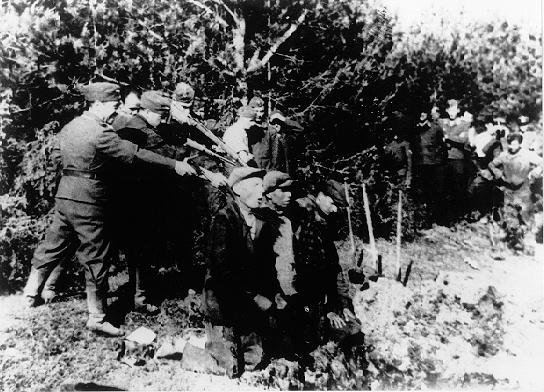
1942: Partisans by the Sonderbataillon Dirlewanger

On an uncertain date in November 1942, this photograph of an SS unit executing anti-Nazi partisans in Belarus was taken.

Behind this striking but all too typical image of brutal field executions on the eastern front lies the sordid story of one of the strangest military formations in the Nazi service.

The Dirlewanger brigade was formed under a man whose fortuitous early enrollment in the NSDAP had enabled him to pull strings to get himself out of Dachau, where he had been sent after his second molestation conviction, and where unfolding events could have easily seen him on the other end of the firing squad.

Instead, Oskar Dirlewanger formed a unit of criminals and reprobates: poachers at first, and eventually, as it grew into the SS-Sonderbatallion Dirlewanger, men culled from the camps or soldiers condemned by the army, some literally trading the likelihood of execution themselves for service under one of the most disreputable commanders in the field.

Oh, and, just incidentally — it stuck them into a lawless environment where they could probably practice and refine their pathologies unchecked. Some “rehabilitation.”

As of this relatively early date, the convict floodgates weren’t yet entirely open, and the existing German volunteers were supplemented by a goodly portion of Soviet citizens recruited in the occupied territories. From 1942 to 1944, they hung around Belarus hunting guerrillas and doing to them — well, you know. (The original notion of using poachers was to exploit their ranger-like woodsman talents for anti-partisan warfare.)

Oh, and civilians. Tens of thousands of civilians. That almost goes without saying.

Sadly for Dr. Dirlewanger, events further south were undoing all his bloody work, for it was also in the November 1942 that the Red Army decisively turned the tide of the war with its counterattack at Stalingrad — in fact, it was this very date in 1942 that it completed its encirclement, stranding a quarter-million freezing Wehrmacht regulars on the banks of the Volga, only a handful ever to see Germany again.

The Dirlewanger brigade would have its own turn being minced by the Soviet war machine, though not before it had a notorious hand in drowning the Warsaw Uprising in blood.

Dirlewanger himself was tortured to death by Polish guards a few weeks after the war ended.

Part of the Themed Set: The “Ex” Stands For “Extrajudicial”.

On this day..

1864: Klatsassin and four fellow Tsilhqot’ins

On this date in 1864, five Tsilhqot’in warriors were hanged as common criminals in Quesnel, British Columbia, for resisting white incursion during the Chilcotin War.

The only possibly authentic image of Klatsassin extant. (From this image archive.)

An indigenous nation in northern B.C., the Tsilhqot’in or Chilcotin* had been relatively insulated — though not completely isolated; they had well-established fur-trading contacts from the early 19th century — from the colonization that had swept the continent over the preceding centuries.

In 1862, two cataclysms turned that world upside down.

First, a smallpox epidemic sweeping out of mining camps decimated the Tsilhqot’in population.

Second, gold was discovered in the adjacent inland Cariboo region — and the ensuing gold rush to the inaccessible vein saw whites laying multiple roads through Tsilhqot’in territory. At least one of the entrepreneurs racing to complete the first road might have exploited tribal labor and forced women into prostitution.

The specific internal mechanisms and deliberations that triggered the response are lost to us, but the community must have felt itself under siege — and certainly the building projects, unchecked, would serve to project crown authority into the tribal land. The roads, too, are a specific trigger in the European encounter with North American natives. If it had not been gold, it would have been something else, and soon.

The Chilcotin War or Chilcotin Uprising erupted in April 1864 when a Tsilhqot’in party slew a civilian road-building crew. Bloodthirsty rumors (sometimes unreliable) of Indian atrocities quickly set abroad in the colonial capitals.

Despite almost limitless land to disappear into, the leader, Klatsassin (or Klattasine, or Klatsassan), was captured that August with seven of his followers by the expedient of luring him under assurance that they would be treated as prisoners of war.

Instead, they were tried as common murderers. Five were condemned — including both Klatsassin and his son. (Two others were arrested the following year, and one of them hanged as well.)

In 1993, the government of British Columbia apologized for the executions.

There’s an out-of-print (but available used) book, The Chilcotin War by a descendant of one of the whites killed in it. Several links in this piece go to the excellent canadianmysteries.ca site on this incident, which contains a trove of text from primary documents of the time.

And “Canadian Mysteries” is the apt title. “Klatsassin,” in the native tongue, simply means, “we do not know his name.”


The peak in the center of this photograph is “Mount Klattasine,” and the glacier stretching towards the upper right is also named for the hanged war chief.

* Many other transliterations are possible: e.g., Tsilqut’in, T?inlhqot’in, Chilkhodin, Tsilkótin, Tsilkotin.

On this day..